A DTC apparel brand in Austin came to our team after paying $4,200 a month for 18 months of Shopify SEO services that produced a 6% organic revenue gain against a 42% projection. The retainer built backlinks, wrote blog posts, and filed monthly reports every cycle. Nobody had touched the theme.liquid file. Nobody had audited the 14 apps quietly rewriting canonical tags across the storefront. That is the exact profile of Shopify SEO services scoped from a WordPress playbook. Content and links on the outside, a Liquid layer nobody ever opened on the inside.
This guide walks through Shopify SEO services the way our team runs them for DTC brands past $500k annual revenue. Liquid template edits that fix schema and canonicals platform-wide. Collection page rendering paths that decide whether Google sees your PLP or a spinner. App conflicts that quietly break hreflang and title tags across regions. And the line between what Shopify gives you out of the box versus what a Shopify SEO expert has to custom-build inside the theme repository. Founders debating platforms should also read the Shopify versus WooCommerce SEO comparison before locking a migration.
Liquid template tweaks inside Shopify SEO services
Liquid is Shopify’s templating language and the single layer where the highest-return SEO fixes on the platform live. Every schema block, every canonical tag, and every meta title on a Shopify storefront flows through Liquid before rendering to the browser. A Shopify SEO expert who cannot edit Liquid is a content writer with a different job title on the invoice. The theme repository is the operating room. The Shopify admin panel is the waiting room.
Where Liquid controls the SEO layer
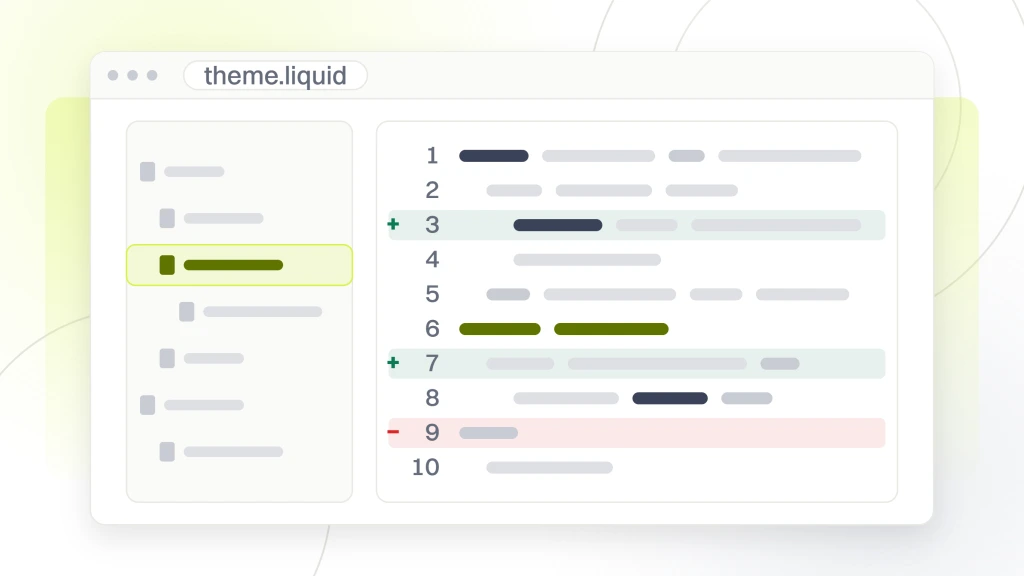
Layout.liquid holds the site-wide head block where canonical, robots, hreflang, and Organization schema get rendered. Product.liquid holds the product page template where Product schema, Offer nodes, and Review markup render into the DOM. Collection.liquid holds the PLP where BreadcrumbList schema and product tile output happen. Theme.liquid on older 1.0 themes replicates head-block logic across template files, which is why 2.0 migrations often surface stale schema left behind by hand. Every Shopify SEO audit our team runs starts with a Liquid file walk before any content work gets scoped into the retainer. The template layer sets the ceiling on everything above it.
The five Liquid edits that pay back first on most stores
- Add variant-level Offer nodes to Product schema in product.liquid so Google reads price, availability, and SKU per variant, not just the parent product.
- Inject BreadcrumbList schema in collection.liquid pointing at the site’s real navigation hierarchy, not a flat parent-child assumption.
- Add self-canonical logic that strips sort, filter, and pagination parameters from canonical URLs across product and collection templates.
- Fix meta title fallback logic in theme layouts so pages without a hand-written title inherit a template pattern, not the product name plus store name duplicated across 800 SKUs.
- Add hreflang cluster output for stores past a single region, either inline in layout.liquid or via sitemap-embedded hreflang using Shopify Markets natively.
Those five edits together typically move organic revenue 12% to 28% on catalogs past 500 SKUs inside 90 days. Google’s documentation on Product structured data is the primary reference every developer touching product.liquid should keep open during the sprint. Skipping any of the five and paying for content and links on top of the gap is why most Shopify retainers under-deliver against their projections at month four.
Collection page rendering inside Shopify SEO services
Collection pages are the ranking workhorses of a Shopify catalog. They target category-level head terms, feed product pages ranking equity through internal links, and convert commercial intent traffic at higher rates than the homepage or the blog. Getting collection page rendering right is the second-highest-return workstream inside a real Shopify retainer, right behind Liquid schema fixes on product templates.
Server-side rendering versus client-side injection
Standard Shopify 2.0 themes render collection pages server-side through Liquid. Google sees the full product tile list on first request, indexes titles, images, and prices in one pass, and passes ranking equity down to each product page. Stores using headless-lite frameworks, Hydrogen storefronts, or client-side filter apps often push product tile rendering into JavaScript. That means Googlebot sees a nearly empty collection page until its second-pass rendering picks up the JS output. The second pass runs slower, less reliably, and drops rankings on collections carrying more than 40 tiles. A Shopify SEO expert who cannot tell you whether your collection pages render server-side or client-side is missing the single most important input to your PLP ranking model.
How to test collection page rendering in ten minutes
Open Search Console, paste a collection URL into URL Inspection, click Test Live URL, and read the rendered HTML tab. If the product tile grid appears in the rendered HTML with product titles and image alt text baked in, the page renders server-side and passes ranking equity. If the rendered HTML shows a loading spinner or an empty grid container, the page depends on client-side JavaScript that Google may or may not execute on a given crawl cycle. Run this test on the top 20 revenue-driving collections. Any collection failing the test needs a Liquid tweak that pushes tile rendering server-side before any content or link work gets billed against that page.
App conflicts every Shopify SEO agency team eventually hits
App conflicts are the hidden SEO tax on Shopify. Every third-party app that rewrites the head block, injects schema, or manipulates canonical tags stacks a silent failure mode on top of a clean Liquid base. 12 of the last 15 underperforming Shopify SEO agency audits our team ran in 2025 traced back to at least one app fighting the theme for control of the head tag. Nobody set out to break anything on install day. The apps just do not talk to each other after month three.
The three app categories that break SEO most often
Currency and geolocation apps are the worst offenders on any mid-market catalog. They rewrite URLs, inject regional canonicals, and conflict with Shopify Markets hreflang in ways that produce silent duplicate content across two or three regions. Review and social proof apps often inject conflicting Product schema on product.liquid, which Google reads as competing structured data and quietly ignores across the catalog. Popup and email capture apps sometimes inject scripts that block server-side rendering of product tiles on collection pages. Every audit our team runs sweeps the installed app list, tests each app on a staging clone with one disabled at a time, and documents which apps carry SEO-affecting side effects. That work is unglamorous. It also finds the 8% to 15% revenue gain sitting inside your existing traffic every month. Pair that sweep with a complete ecommerce SEO checklist so no step gets skipped between sprints.
The comparison table Shopify founders should reference
| App category | Common SEO side effect | Diagnostic method | Fix path | Revenue at risk |
|---|---|---|---|---|
| Currency switcher | Rewrites canonical or hreflang | View source per region | Switch to Markets native | 18% to 34% |
| Product reviews | Injects duplicate Product schema | Rich Results Test | Move to Liquid only | 6% to 12% |
| Popup or email capture | Blocks server render on collection | URL Inspection tool | Defer script load | 4% to 9% |
| Filter and sort apps | Creates uncanonicalized filter URLs | Screaming Frog crawl | Add noindex or canonical rule | 8% to 20% |
| Wishlist and quick-view | Injects invalid schema types | Schema validator | Remove or replace | 2% to 6% |
Read the table against your installed app list, not against the aspirational stack you wish you had. Most DTC brands past 500 SKUs carry at least two of these five conflicts on any given month. Fixing them is not a one-time audit. That’s a monthly hygiene sweep inside a real Shopify SEO agency retainer, since every app update introduces a new potential failure mode across your top revenue pages the same week.
How Shopify SEO services price a real retainer for DTC brands
Shopify retainer pricing runs against catalog size, technical baseline, and target growth rate, not a flat monthly figure a sales deck can quote. Real retainers start at $999 per month for stores under 200 SKUs on a clean 2.0 theme. Mid-market DTC catalogs past 1,500 SKUs with 20 or more apps installed carry $1,499 to $2,499 per month for core scope, and start at $4,500 per month at Enterprise tier against the same technical baseline.
What the $999 baseline covers on a small Shopify catalog
The baseline retainer covers a Liquid audit inside month one, product and collection title rewrites across the top 40 revenue pages inside month two, one blog post per month inside a cluster architecture, and monthly technical hygiene sweeps. It does not cover custom Hydrogen work, headless integration, or multi-region rollouts across Shopify Markets. Small DTC brands under $300k annual revenue can usually run against this scope for 12 months before catalog size or growth targets force a step up. Our writeup on the ecommerce seo services scope lays out the sibling retainer tiers across DTC platforms.
Where mid-market Shopify SEO services scope up
Past 1,500 SKUs the scope expands to weekly Liquid edits, product title rewrites across the top 200 SKUs per quarter, 4 to 8 blog posts per month, an app conflict monitoring dashboard, hreflang cluster maintenance for multi-region rollouts, and quarterly Search Console health reviews. Retainers in the $1,499 to $2,499 range assume a technical baseline that took the first 60 days of the engagement to build through the Liquid audit sprint. Enterprise-tier work starts at $4,500 per month and layers in headless integration, Hydrogen storefront advisory, and cross-region reporting. Teams that need Liquid work paired with feature builds often bring in a Shopify web development agency at the same tier. Founders comparing agency proposals should ask what the first 60 days deliver on the Liquid layer, not what the third-month blog cadence looks like on a content calendar. The template work sets the ceiling for the rest of the year.
Hidden Shopify SEO pitfalls a real Shopify SEO expert catches
Every Shopify catalog past 500 SKUs carries hidden SEO pitfalls that never surface in a standard content-only audit. These are the failure modes that eat retainer budget quietly and get blamed on the algorithm at the quarterly business review. A Shopify SEO expert who has opened more than 40 theme repositories can name the top ten pitfalls from memory and point to where inside the Liquid tree each one hides on a typical 2.0 build.
Duplicate product URLs from collection routing
Shopify routes a single product URL through two distinct paths by default. /products/example and /collections/parent-collection/products/example resolve to the same product page with different URLs. Without a canonical tag pointing at the /products/ version, Google indexes both, splits ranking equity across duplicates, and drops the product 3 to 6 positions across every commercial query. Every Shopify audit our team runs finds at least one product family bleeding ranking to this exact pattern in the first week. The fix is a Liquid tweak in product.liquid that hard-codes the /products/ canonical regardless of the request path.
Paginated collections without rel canonical hygiene
Collections past 40 products paginate by default into /collections/parent-collection?page=2, /page=3, and beyond across a Shopify build. Shopify self-canonicals each page to itself, which Google reads as separate documents competing for the same category head term. On stores past 800 SKUs this quietly caps collection ranking at position 8 or 9 for every mid-tail category term across the catalog. The fix is a Liquid rule in collection.liquid that either self-canonicals only page 1 and adds rel prev and next tags, or noindexes pages past 1 and preserves crawlability. Either fix restores the collection rankings inside 45 to 90 days.
Image alt text auto-generated from filename
Shopify auto-generates image alt text from the product title unless you override it manually inside the admin. Most stores never override it during their first two years of catalog growth. That means every product image carries alt text matching the product title verbatim, which Google reads as thin optimization and mostly ignores. Rewriting alt text across the top 200 revenue SKUs to describe the image content plus the query intent typically adds 4% to 9% to image search traffic and 2% to 5% to product page ranking over 60 to 90 days. Our writeup on seo for ecommerce product pages covers alt text hygiene in more depth alongside title and description patterns that pair with it.
Choosing a Shopify SEO agency that will touch Liquid
Most agencies pitching Shopify retainers will not open the theme repository during the engagement. Their scope stops at content, links, and admin-panel meta edits pulled from the sidebar. That gap between what they will do and what a real Shopify SEO agency does is where retainer budget quietly disappears for 6 to 12 months at a time. Interviewing agencies against a Liquid-first criteria list is the fastest way to cut through the sales deck on day one.
Ten questions that separate content agencies from Shopify SEO agencies
- Which Liquid files will you edit in the first 30 days? A real answer names theme.liquid, layout.liquid, product.liquid, and collection.liquid.
- How do you audit app conflicts in the head block? A real answer names a staging clone process with one app disabled at a time.
- Do you inject variant-level Offer nodes in Product schema? A real answer says yes and shows sample Liquid code.
- How do you handle canonical logic on paginated collections? A real answer describes a Liquid rule, not a plugin setting.
- What is your collection page rendering audit process? A real answer names Search Console URL Inspection and a rendered HTML tab walkthrough.
- Do you edit theme code directly or ask us to hire a Shopify developer? A real answer says direct, or partners with a named dev shop.
- How do you handle Shopify Markets hreflang rollout? A real answer describes native Markets versus manual sitemap embedded hreflang and which fits which store.
- What is your monthly Liquid maintenance sweep? A real answer names monthly schema validation and app-conflict re-testing after every app update.
- How do you measure Liquid-layer gains separately from content gains? A real answer describes cohort tracking on pages the Liquid work touched versus a control group.
- Which theme version do you specialize in and which do you refuse to work on? A real answer names 2.0 with confidence and describes the 1.0 migration path.
Agencies that flinch at more than three of these questions are pitching content services with a Shopify label glued onto the deck. Agencies that answer all ten cleanly are the small pool of Shopify SEO agency teams worth the retainer spend. Our ecommerce seo services hub covers our own answer to each of these ten questions and the sample Liquid we deliver in the first 30 days of an engagement.
Measuring a Shopify SEO retainer against real revenue
Measurement closes the loop on the retainer. Retainers measured against ranking movements alone routinely miss the revenue picture, since Shopify rankings and Shopify revenue diverge more often than DTC founders expect at the quarterly review. A category page climbing from position 12 to position 6 might triple organic sessions and add zero revenue if the product mix has drifted since the collection page was last curated. Measurement against real revenue keeps the retainer honest across every quarter.
The four KPIs that hold every Shopify retainer accountable
- Organic revenue per collection page. Shopify Analytics filtered to organic source, split by landing collection page in a monthly dashboard tile.
- Ranking movement on the top 30 head terms. AccuRanker or Nightwatch tracking with weekly cadence, monthly reporting against the retainer scope.
- Organic conversion rate on product pages. Shopify Analytics split by product page category, filtered to organic session source only.
- App conflict audit pass rate. Monthly Liquid QA sweep counting schema validation errors per template file against the previous month baseline.
The monthly dashboard that runs quarterly reviews
Building a Looker Studio dashboard that stacks all four KPIs against a 12-month rolling baseline takes 6 to 10 hours of setup and 90 minutes of monthly maintenance from a technical marketer. The dashboard shows organic revenue per collection, ranking movement per head term cohort, conversion rate per product category, and app conflict audit pass rate month over month across the year. Stores that run the dashboard catch retainer under-performance inside 60 days. Stores that skip it usually notice weakness 6 to 9 months in when a CFO asks why last year’s organic revenue chart has plateaued against forecast. Our writeup on technical seo for ecommerce covers the crawl-budget math that pairs with the Shopify measurement stack past 5,000 SKUs.
A real Shopify SEO services engagement in production
Abigail Ahern, a Shopify DTC brand our team runs Shopify SEO services for, is the cleanest production example of the Liquid-first retainer at scale. The catalog had grown organically to a large SKU count across regional storefronts. Product photography was strong. Category storytelling read cleanly. Google Ads was carrying most of the revenue at a cost per acquisition the founders wanted to cut. Organic revenue sat flat for three consecutive quarters against a competent content retainer with steady blog cadence. Nobody had audited the Liquid layer or the app conflict surface across the regions.
Our team ran the Shopify SEO playbook in a phased sequence across the first 90 days. Weeks 1 through 3 covered a full Liquid audit across theme.liquid, layout.liquid, product.liquid, and collection.liquid, plus a staging-clone app-conflict sweep that flagged 4 of 18 installed apps rewriting canonical or schema tags. Weeks 4 through 8 covered variant-level Product schema rollout across the catalog, canonical hygiene on paginated collections, and rewrote the top 40 revenue collection page intros for query intent. Weeks 9 through 12 covered a cluster architecture rollout of blog posts pointing at the top-earning collection pages, an image alt text sweep across the top 200 SKUs, and a Looker Studio dashboard build tracking organic revenue per collection page.
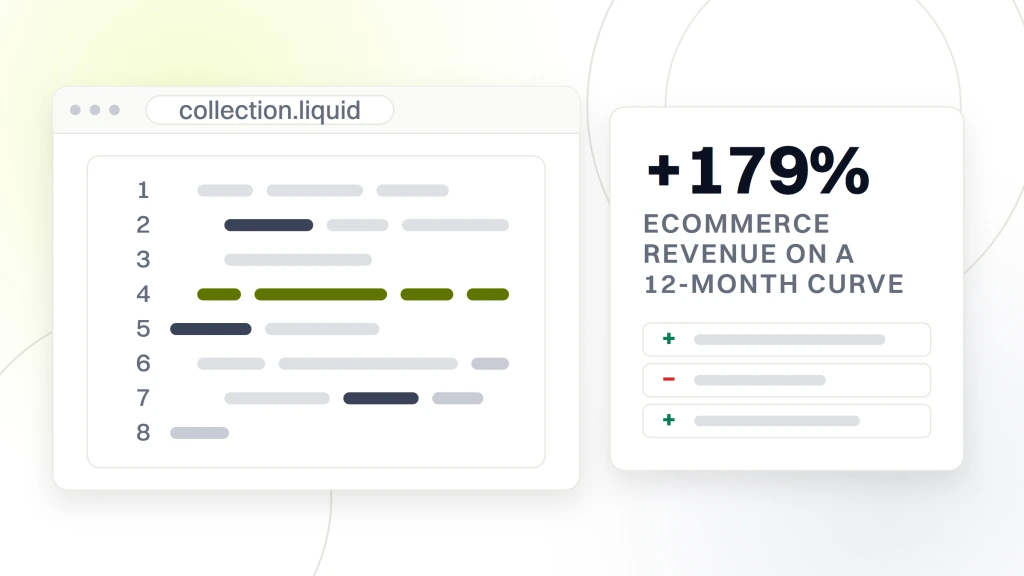
Across the engagement, Abigail Ahern’s ecommerce revenue climbed +179% on a 12-month curve as the Liquid schema fixes stacked with the content architecture and the app conflict sweep. Cost per acquisition on paid channels dropped as branded and mid-tail organic traffic absorbed queries Google Ads had been paying for. Conversion rates on organic sessions climbed against the pre-engagement baseline. The engagement compounded across the following year as monthly app conflict monitoring caught two app updates that would have quietly broken canonical logic on the top revenue collection page.
Where Shopify SEO services fit your growth stack
A Shopify SEO retainer sits under the paid media layer and above the content layer in a DTC growth stack. The Liquid template layer, the app conflict monitoring, and the collection page rendering audit set the ceiling every content and link investment operates under across the year. Stores that budget for tactics without settling the template layer end up with tactical wins and strategic drift across quarters. Stores that settle the template layer first end up with tactical wins that compound across the whole catalog through the first two years of the engagement.
Our ecommerce marketing agency hub covers the retainer scope for DTC founders who want a Shopify SEO retainer run for them across the Liquid layer, content architecture, and monthly technical hygiene sweeps. Retainers start at $999 per month for single-store DTC catalogs under 200 SKUs on a clean 2.0 theme, run $1,499 and $2,499 monthly for mid-market work, and start at $4,500 per month at Enterprise tier for multi-region rollouts past 1,500 SKUs with Shopify Markets active. Six-month contracts are standard, since Shopify SEO gains compound across at least two full crawl and reindex cycles before the revenue picture stabilizes.
Google’s Product structured data documentation is the reference for any developer touching product.liquid against a real DTC catalog on the Liquid layer through the first year of a retainer engagement.