
Small Business PPC Management Services That Book Real Jobs
- Retainers run $500 to $2,500 per month for owner-led shops.
- LSA sits above Search for eligible verticals.
- Call tracking captures 60 to 80 percent of paid leads.
- Gwinnett Area Plumbers booked 141 leads at $34 each.
- Expect 3x to 6x return on ad spend by month six.
- Call tracking is non-negotiable in small business ppc management
- Gwinnett Area Plumbers case study on small business ppc management
- Local business ppc management inside a service radius
- Affordable ppc management scopes for owner-led shops
- Reporting cadence and metrics for small business ppc management
- Red flags in ppc management proposals for small businesses
- In-house versus outsourced small business ppc management
- First 90 days of a small business ppc management engagement
- How to choose a small business ppc management partner
- Wrapping up small business ppc management as a program
Small business ppc management is the weekly job of running Google Ads, Microsoft Ads, and Meta campaigns for owner-led shops so every hundred dollars in ad spend books a real call or a real appointment. The work sits on five moving parts. Campaign structure by service line. Landing pages that load in under two seconds on mobile. Call tracking wired through the customer relationship management. Negative keyword hygiene run weekly. And a written 30-day plan the owner can point at. Skip any one of those and the account slowly bleeds budget on clicks that never convert.
Real numbers help set the shape. A solo plumber in a mid-size metro pays $600 to $1,500 per month in retainer plus $1,500 to $6,000 in ad spend. That budget produces 40 to 120 tracked calls at $15 to $45 each, and 12 to 35 booked jobs at an average ticket of $340. Gwinnett Area Plumbers hit 141 qualified leads in four months on a small business ppc management scope. The math works when the structure is clean and the phone rings for real reasons.
Call tracking is non-negotiable in small business ppc management
Roughly 60 to 80 percent of small business paid leads come through the phone, not the form. Every account runs call tracking through Google Ads call extensions, CallRail, WhatConverts, or a similar platform. Skip this and Smart Bidding optimizes for form fills that barely happen, wasting 30 to 50 percent of spend. Owner-led accounts often underestimate this because the phone ratio never shows on any default Google Ads report until offline imports get wired in.
Dynamic number insertion across sources
Dynamic number insertion swaps the visible phone number based on traffic source. Google Ads clicks see one tracking number. Microsoft Ads clicks see another. Meta clicks see a third. Organic traffic sees the real business line. Every call feeds attribution back to the right channel, and every conversion tunes bidding on the right audience. Without dynamic number insertion, the account attributes 100 percent of calls to whichever source the tech team hard-coded last.
Offline conversion imports on booked jobs
Offline conversion imports send the booked-job signal from the CRM back to Google Ads. A phone call is a lead. A booked appointment is worth 5x to 15x a lead. A completed job is worth 20x to 50x. Wiring the CRM back into Google Ads via offline imports tells Smart Bidding which lead types actually produced revenue. Skip this and Smart Bidding chases cheap tire-kicker calls that clog the phone and never book. Owner accounts that get this right often cut cost per booked job by 30 to 50 percent inside 90 days.
Gwinnett Area Plumbers case study on small business ppc management
Gwinnett Area Plumbers came in as a small residential plumbing shop looking for faster lead flow without hiring an in-house marketer. The prior account ran one blended campaign, no call tracking, and a homepage as the destination for every ad. Cost per lead sat above $180. Quality was thin. Classic small business paid media misfire.
We rebuilt the account into 4 campaigns by service line, wired CallRail, built one service-specific landing page for water heater repair, and layered LSA on top of Search. Inside four months the account produced 141 qualified leads, 968 targeted clicks, and a 14.6 percent conversion rate on the landing page. Cost per lead landed at $34. The owner never hired an in-house marketer. According to the Search Engine Journal PPC coverage archive, disciplined small business accounts routinely outperform industry averages by 40 to 60 percent on cost per lead once the structure and tracking match.
The three changes that carried the account
Change one was the split by service line. Emergency plumbing keywords moved to their own campaign on Maximize Conversions bidding, mobile-first ad copy, and a dedicated emergency landing page. Change two was the landing page. The homepage got replaced with a purpose-built water heater repair page that answered three questions inside three seconds. Change three was LSA. Layering Local Service Ads captured booking-ready calls at a lower blended cost per lead than Search alone delivered.
Local business ppc management inside a service radius
Every small business paid account runs on a service radius. Get the radius wrong and you burn 20 to 40 percent of spend on clicks from customers you cannot serve. Set the radius by drive-time from the physical location, not by simple miles. A 30-minute drive-time radius books more real jobs than a flat 15-mile radius in any metro with traffic patterns worth respecting.
Radius by drive-time, not straight-line miles
Google Ads supports both circular radius targeting and drive-time targeting. Drive-time uses live traffic data. A 30-minute drive-time radius in Cincinnati covers a smaller straight-line area during rush hour than at 2 a.m., which is the right behavior for a plumber or a dentist. Use drive-time on every service business account. Use straight-line only when the business genuinely serves a fixed geographic polygon (a school district, a resort, a specific county).
Bid adjustments by ZIP code performance
After 60 days of data, layer ZIP-level bid adjustments. Boost ZIPs producing above-average booked jobs by 15 to 40 percent. Cut ZIPs producing calls that never book by 30 to 60 percent. Exclude ZIPs producing zero booked jobs after 90 days entirely. That single pass often cuts cost per booked job by another 15 to 25 percent on a small business account. The data comes from the CRM, not from Google Ads. That is why offline conversion imports matter so much.
Smart Bidding needs 30 conversions in 30 days before Maximize Conversions works. Switching earlier resets learning. Check your conversion count today.
Affordable ppc management scopes for owner-led shops
Owner-led shops asking for affordable ppc management want three things at once. A retainer under $1,000. A specialist who picks up the phone. And returns that pay for the retainer inside 90 days. All three are possible. None are automatic. The scope has to match the account size honestly.
What $500 to $800 per month buys
Around $500 to $800 buys 3 to 6 hours of specialist time per month. That covers 1 to 2 Google Search campaigns, weekly search term reviews, monthly ad copy refresh, monthly landing page review, one Loom walk-through, and a monthly one-page report. It does not cover a landing page rebuild, a full CRM integration, or Microsoft Ads. Owner-led shops with under $2,000 in monthly ad spend and one service line fit this tier well.
What $1,200 to $2,000 per month buys
Around $1,200 to $2,000 buys 10 to 16 hours of specialist time per month. That covers 3 to 5 Search campaigns, LSA management where eligible, Meta remarketing, weekly search term reviews, weekly negative keyword pruning, bi-weekly ad copy refresh, monthly landing page A/B tests, a written monthly report, and a monthly strategy call. This is where most owner-led accounts sit between $4,000 and $10,000 in monthly ad spend. Our PPC management services team runs this tier weekly across plumbing, dental, legal, and boutique retail accounts.
Reporting cadence and metrics for small business ppc management
Reporting dashboards can display 200 metrics. A working manager watches 8 to 10. The rest are noise. For an owner-led shop, the 10 split into three groups: spend efficiency, call quality, and revenue outcomes. Founders shopping a retainer should ask which 10 the manager tracks weekly. Fuzzy answers mean the account probably runs on autopilot.
Weekly one-pager format
The weekly one-pager runs half a page. Ad spend, tracked calls, booked jobs, cost per booked job, and three-line commentary on the biggest week-over-week change. That is enough for the owner to sign off without a 45-minute review call. Owners want the number, the trend, and the reason. They do not want a slide deck. Longer reports usually mean the specialist is hiding behind volume of information.
- Ad spend for the week and month-to-date
- Tracked calls with duration and source split
- Booked jobs from the CRM sync
- Cost per booked job on a rolling 30-day window
- Impression share on brand and non-brand terms
- Top 3 winning keywords by conversion
- Top 3 wasteful keywords added to negatives this week
- One-line note on the biggest week-over-week change
Monthly deep-dive call
The monthly deep dive runs 30 to 45 minutes. Screen-share of the account, walk-through of the top 5 wins and top 5 losses, review of landing page conversion trends, and the plan for the next 30 days. Every deep dive ends with a written action list the specialist owns for the coming month. That written list is the contract between the specialist and the owner. Skip it and month two starts with a fuzzy scope, which always slides into wasted hours by month three.
Red flags in ppc management proposals for small businesses
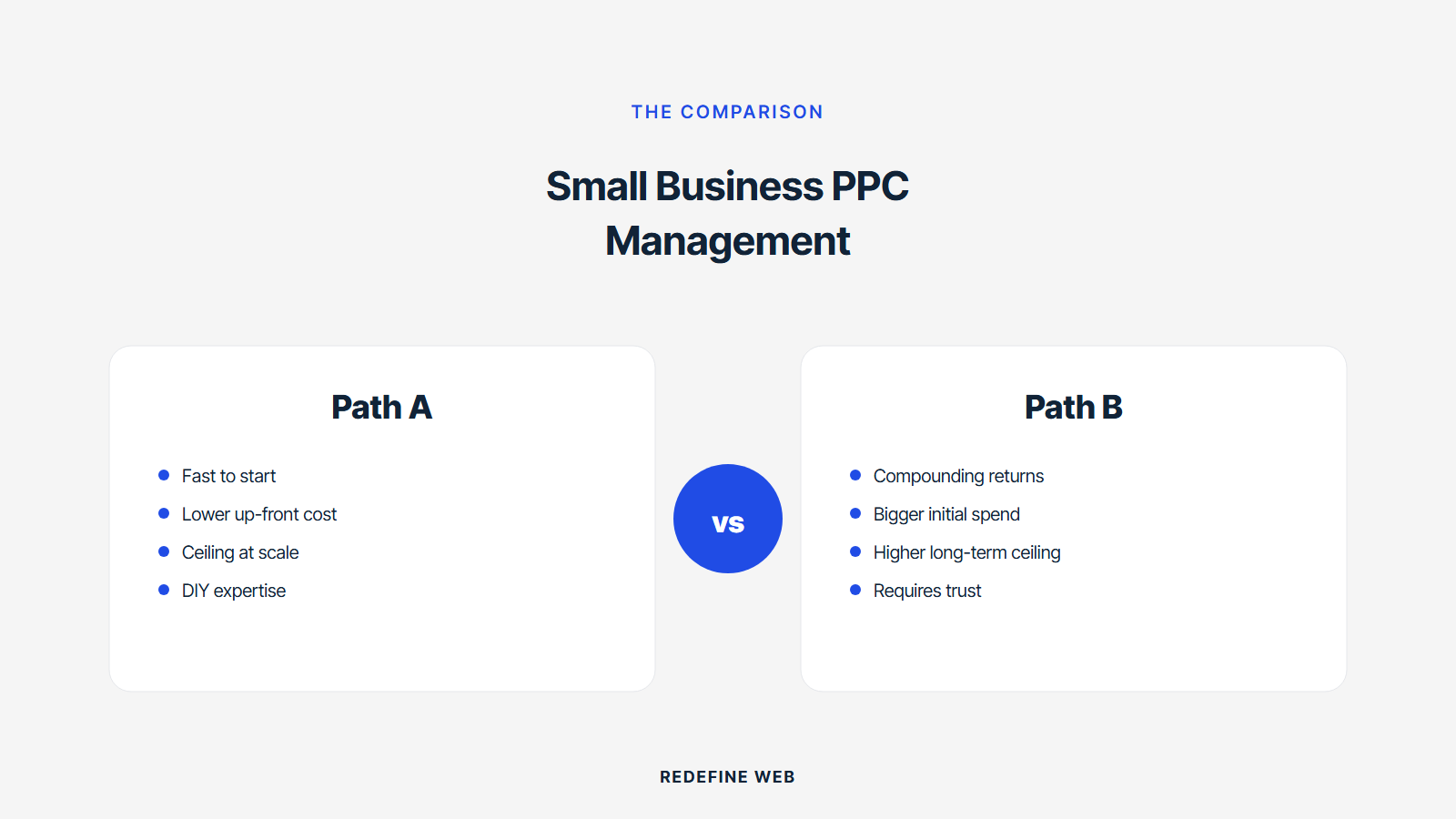
Every small business owner reads a proposal that sounds great until they compare it against a second one. The differences show up in numbers the first proposal quietly leaves out. The red flags below catch most shallow pitches before signing.
- No mention of LSA on an eligible vertical. The agency does not run it, so the account misses the highest-converting channel.
- No call tracking setup in month one. Skipping this trains the account on wrong signals for 60 days.
- Retainer under $500 with a promise of full management plus landing pages. That budget covers 2 to 3 hours per month, which is not full management.
- Account owned by the agency instead of the client through the MCC link. You want portable ownership.
- Percent-of-spend pricing on accounts under $3,000 in monthly ad spend. The math incentivizes the agency to inflate spend for their own fee.
- Case studies with only cost per click or click-through rate. Real case studies show cost per booked job or revenue.
- No named specialist on the account. Anonymous pods rarely respond in under 24 hours.
Every small business owner gets one really tempting pitch. A national-quality Google Ads program with a proprietary bidding algorithm for $199 a month, no setup fee, no contract. The math says the algorithm is Google Smart Bidding with a rebranded logo, and the specialist runs 60 accounts out of a WeWork somewhere near a taco truck. Neither of those things ends well for the account.
Green flags to look for in a real proposal
A written scope naming Google Search, LSA where eligible, and the call tracking platform by name. A week-one tracking QA pass on the schedule. A landing page rebuild inside the setup fee if the current page loads over three seconds on mobile. A weekly one-pager report sample. A client-owned MCC link with 24-hour termination. Case studies with real small business accounts, real spend, real cost per booked job, and at least six months of data. Vendors that show all six earn a pilot.
In-house versus outsourced small business ppc management
Every owner eventually asks whether to run paid media in-house or hire an agency. The honest answer depends on account spend, appetite for weekly account work, and whether the shop has enough volume to keep a part-time specialist useful. Below $2,000 in monthly ad spend, DIY plus a Fiverr freelancer usually wins on math. Between $2,000 and $30,000, a small business ppc management retainer beats every other option. Above $30,000, the conversation shifts to hybrid models with an in-house lead.
Where DIY works
DIY works when the owner has 5 to 8 hours per week free, understands Google Ads Editor at a basic level, and runs a single-service business with a stable target audience. A local piano teacher spending $400 a month on Google Search does not need an agency. She needs a clean one-campaign structure and a single landing page. The math flips as soon as spend passes $2,000 or the shop opens a second service line.
Where outsourced wins for small businesses
Outsourced wins between $2,000 and $30,000 in monthly ad spend on any account with 2 or more service lines. A $1,200 monthly retainer at that size returns $4,000 to $12,000 in freed spend inside 90 days through better structure, LSA layering, and tighter negative keyword hygiene. That is a 3x to 10x return on the retainer itself. Add the value of the owner not doing the account work at 1 a.m. and the math gets much clearer. Retainer plans start at $599 per month across our industry programs at the home services marketing retainer, with equivalents for dental, legal, and boutique retail.
First 90 days of a small business ppc management engagement
The first 90 days set the ceiling for the next 12 months. Get them wrong and the account limps for the whole year. Get them right and the account compounds every month after month three. The pattern below has run across roughly 40 small business accounts we have onboarded this year across home services, dental, legal, and boutique retail verticals.
Days 1 to 30 setup and hygiene
Days 1 to 14 cover access audits, conversion tracking QA, CallRail install, keyword research by service line, and one landing page rewrite. Days 15 to 30 launch new campaigns on Maximize Clicks for the first two weeks. This period reads slow to the owner because the numbers barely move. Setting expectations correctly here is the biggest single lever for keeping the engagement alive at day 45, when owners tend to panic if week 3 does not already look like month 6.
Days 31 to 90 optimization and scale
Days 31 to 60 switch bidding to Maximize Conversions once 30 conversions land in a rolling window. Days 61 to 90 layer ZIP-level bid adjustments and A/B test the second landing page variant. By day 90 the account should show a 30 to 50 percent drop in cost per booked job versus the pre-engagement baseline. Compounding kicks in from month four onward. Renewal conversations at month 6 close themselves when the numbers stay green quarter over quarter.
How to choose a small business ppc management partner
Choosing a small business ppc management partner is a 30-day exercise, not a discovery call. Ask three vendors for line-item scopes, one written 90-day plan each, and access to a live client dashboard. The vendor that shows all three wins the pilot. The vendors that hide behind discovery calls or refuse a written scope do not deserve the account.
Questions to ask on the discovery call
Ask five questions on the first call. Who is the named specialist on my account. What was the cost per booked job on a similar small business account you ran last quarter. How do you wire offline conversion imports from a small business CRM back into Google Ads. What does your weekly one-pager look like. And what does the MCC ownership and termination clause say in the contract. Any vendor that dodges two of those questions gets scratched. Any vendor that answers all five in writing earns a paid pilot at reduced scope.
Pilot scope before annual retainer
Sign a 90-day pilot before any annual retainer. The pilot covers setup plus 60 days of management at a reduced monthly fee. At day 90, the owner reviews the numbers with the specialist and either signs the six-month retainer or walks. That structure protects the owner from long lock-ins and gives the vendor a real chance to show returns before the paperwork gets serious.
Wrapping up small business ppc management as a program
Small business ppc management is the discipline of running Google Search, LSA, and one Meta remarketing layer every week so ad spend books real calls and real jobs. The work covers campaign structure by service line, service-specific landing pages, call tracking through the CRM, and weekly negative keyword hygiene. Owner-led accounts routinely see 3x to 6x return on ad spend by month 6 with all four pieces in scope and a specialist who picks up the phone.
If you spend more than $2,000 per month on ads, professional small business ppc management pays for itself inside 90 days. Ask three vendors for line-item scopes. Look for green flags above. Pick the one that gives full account ownership through the MCC link. Redefine Web offers a fixed-scope PPC management services package, a Google-specific Google Ads management services package, and vertical retainers such as the home services marketing retainer. Related reading on affordable scopes and cost bands: affordable ppc management services, ppc management cost, and how to choose a ppc management company. Book a 20-minute call and we will walk through three small business ppc management accounts we turned around this quarter, line by line, with real spend, real leads, and real cost per booked job.
Frequently asked questions
What does small business ppc management cover for an owner-led shop?
Small business ppc management covers Google Search, Google Local Service Ads where the vertical is eligible, Microsoft Ads for the older desktop audience, and one Meta remarketing layer. The weekly work includes search term reviews, negative keyword pruning, landing page conversion checks, ad copy refreshes, and offline conversion imports from the CRM. The reporting side stays simple: a weekly one-pager with ad spend, tracked calls, booked jobs, and cost per booked job. Owner-led accounts do not need enterprise reporting stacks. They need clear scope, tight structure, and one specialist who picks up the phone.
How much does small business ppc management cost per month?
Small business ppc management retainers run $500 to $2,500 per month for accounts spending under $10,000 on ads. The floor at $500 buys 3 to 5 hours of specialist time per month, which is fine for a stable single-service account. Growth accounts pay $1,200 to $2,000 for 10 to 15 hours plus reporting. Multi-location shops or accounts with 4 or more service lines pay $2,000 to $3,500. Setup fees run $600 to $1,500 and cover tracking QA, CallRail install, keyword research, initial ad copy, and one landing page rewrite for the top service.
Do small businesses need Local Service Ads on top of Google Search?
Yes, if the vertical is eligible. Local Service Ads apply to plumbing, HVAC, electrical, roofing, garage door, pest control, cleaning, tree service, locksmith, and about 60 other categories. LSA runs pay-per-lead, sits above the Google Search results, and carries the Google Guaranteed badge once verification clears. Cost per lead runs $18 to $95 across verticals. Every small business ppc management scope in an LSA-eligible vertical includes LSA on day one. Search alone leaves the highest-converting local channel on the table, and the map pack loses ground to competitors who ran LSA first.
How does call tracking work for a small business paid media account?
Every phone call gets tracked through Google Ads call extensions, CallRail, WhatConverts, or a similar platform. Dynamic number insertion swaps the visible phone number based on traffic source so every call routes attribution to the correct channel. Google Ads clicks see one tracking number. Microsoft Ads clicks see another. Organic traffic sees the real business line. Every scored call feeds back to Google Ads via offline conversion imports so Smart Bidding learns which call types actually book. Skip call scoring and the model treats every 15-second wrong number as a real conversion.
How long does small business ppc management take to show results?
Month one shows setup and tracking work with modest volume changes. Month two shows the first real optimization signal as negative keywords compound and Smart Bidding starts learning off cleaner data. Month three is where most small business accounts hit break-even against the retainer plus ad spend. By month six, cost per booked job typically drops 30 to 50 percent versus the pre-engagement baseline. Small business accounts routinely see 3x to 6x return on ad spend by month six with disciplined weekly management, LSA layered on Search, and clean offline conversion imports from the CRM into Google Ads.
What are the biggest red flags in small business ppc management proposals?
No mention of LSA on an eligible vertical is the biggest red flag because LSA is the highest-converting local channel. No call tracking setup in month one is the second. Retainer under $500 with a promise of full management plus landing pages is the third because that budget covers 2 to 3 hours of real work per month. Account owned by the agency instead of the client through the MCC link is the fourth. Percent-of-spend pricing on accounts under $3,000 in monthly ad spend is the fifth. Case studies showing only cost per click without cost per booked job is the sixth.
Book your free 30-minute strategy call.
No spam, no sales rep. We use your email to schedule your call with a senior strategist. That is it.
More from the blog
View all articles → PPC
PPC Healthcare PPC Advertising Channels Compliance and Targeting
Read article PPC
PPC Dental Facebook Ads Guide for Practices That Book Patients
Read article PPC
PPC