
Custom Web Design and Development for Local Businesses
- Custom builds land $8K to $60K by scope, not by page count.
- Stack decisions before pixel decisions save 30 percent on rework.
- One stack pattern serves web and app builds together.
- Local businesses recover build cost in 6 to 14 months.
- Own the codebase, own the CMS, own the analytics.
- Cost tiers for custom web design and development services
- Custom web design and development for local businesses
- Custom web app design and development scope
- Integrations for a custom web design and development company
- A real custom web design and development case study
- Process inside a real custom web design and development engagement
- Post-launch retainer inside custom web design and development services
- Where to start on custom web design and development
Custom web design and development is what local businesses turn to once the template site starts costing more conversions than it saves. A Squarespace page runs a bakery just fine. A dental group with three locations, a booking widget, a HIPAA-adjacent contact form, and 40 service pages, that dental group has already outgrown the template. Custom web design and development services build a stack around your real revenue flow, not around a page-count license from a vendor who has never met your customers.
This guide walks through the pieces that decide whether a custom web design and development project pays back or drags. Scope tiers and pricing. Stack decisions before pixel decisions. Local-business integrations that actually get used. Custom web app design and development for the businesses that need a dashboard or a booking portal on top of the marketing site. And the payback math that turns a $22,000 build into a $180,000-a-year lead engine.
Cost tiers for custom web design and development services
Custom web design and development services fall into three real tiers. A single-owner service site with 8 to 15 pages, one contact form, brand-system tokens, analytics, and schema runs $8,000 to $18,000. A local business site with 20 to 40 pages, service pages, blog, booking or lead capture, CRM integration, and location schema runs $18,000 to $45,000. A custom web app design and development scope with user accounts, dashboards, custom database logic, and native app flows runs $35,000 to $120,000.
Ranges assume a US or Western European agency. Freelancers land 30 to 50 percent below. Overseas agencies land 40 to 60 percent below on sticker price but often add 20 to 40 percent in project-management overhead and revision cycles. The build number excludes copywriting, photography, video, ongoing hosting, plugin renewals, payment processing fees, and the post-launch retainer. Budget the first-year total, not the build number. Founders who scope the whole first year avoid the six-month surprise bill.
Where the build money actually goes
On a mid-market build, roughly 15 percent goes to discovery and information architecture. 25 percent goes to design (brand system, page templates, prototypes). 30 percent goes to front-end development. 15 percent goes to back-end and CMS work. 10 percent goes to integrations and third-party wiring. 5 percent goes to QA, accessibility, and launch. Integrations always eat more than founders expect. Getting a real CRM sync working, plus call tracking, plus payment gateway takes 30 to 60 engineering hours by itself.
Hidden costs beyond the initial build
Hosting: $25 to $500 per month. Plugin and license renewals: $500 to $3,000 per year. Payment gateway fees: 2.6 to 3.5 percent per transaction. Call tracking: $45 to $300 per month. Email platform: $50 to $300 per month. CRM: $50 to $200 per user per month. Site monitoring and security: $30 to $150 per month. First-year operating cost for a mid-market local business site lands at $3,000 to $9,000 beyond the build itself. Every founder underestimates this by 40 percent on the first project.
Custom web design and development for local businesses
Custom web design and development for local businesses solves a different problem than a national brand site. You compete inside a five-to-fifteen-mile service radius. You win or lose the map pack. Your visitors decide in 90 seconds whether to call or bounce. The homepage above the fold has to answer three questions in one glance: what you do, where you serve, and how to book. Templates almost never nail all three at once. A custom build is where you make sure they do.
Local schema markup on every page. NAP consistency (name, address, phone) between the site, Google Business Profile, and every citation directory. Location-specific service pages when the business has multiple locations. Booking widgets that connect to the calendar the front desk actually checks. Call tracking on every phone number so you know which channel books the appointment. A custom web design and development company that has shipped 30 local business sites already knows this checklist. One that has shipped three is still learning it on your project.
Map-pack signals baked into the site
LocalBusiness schema with correct NAP. Service-area pages when you cover multiple cities. Embedded Google Map on the contact page. Real review pull from Google or Trustpilot. Location-specific H1s and meta tags. Every one of these signals adds a fraction of a rank position. Together they add up to the map-pack visibility your competition is buying with $80 per click on Google Ads. Custom web design and development services bake these in during the build so you inherit the ranking, not the ad bill. See Google Search Central on LocalBusiness structured data for the schema properties every service-area page needs.
Conversion flow above the fold
The homepage above the fold decides 60 percent of your lead flow. Big service statement in Fraunces or a strong sans-serif. Sub-headline that names the outcome (“Book 30 more patients per month”, not “We are the leading provider”). One phone number, one form, one book-now button, all above the fold. Trust bar with reviews or client logos underneath. Every second the visitor spends parsing the page is a second closer to a bounce. Design for the 12-second scan, not the 12-minute case-study read.
Custom web app design and development scope
Custom web app design and development covers user accounts, dashboards, custom database logic, third-party API integrations, and the front-end for a browser or mobile-native experience. Custom web application design and development services build the layer above a marketing site: the patient portal, the client dashboard, the internal admin, the multi-user SaaS UI. Custom web design and app development scopes both the marketing site and the app inside the same engagement, which saves 20 to 30 percent versus building them as separate projects.
Web-app builds run twelve to twenty-four weeks and land at $35,000 to $120,000 depending on scope. The variables that drive the price up: role-based access control, custom reporting, real-time features (WebSockets, live chat), payment or subscription logic, HIPAA or PCI compliance, native mobile publishing, and third-party integrations past three. Founders who scope the app before scoping the marketing site end up with two disconnected products. Founders who scope them together get a shared stack, shared design system, and one launch date.
Custom web development and web design versus app development
Custom web development and web design ships a public site for marketing, SEO, and lead capture. Custom web design and mobile app development pushes the same layer live plus a browser-based or native app for logged-in users. The stack pattern overlaps 60 to 70 percent. Same design system. Same auth layer often. Same analytics. Same CRM sync. The delta is the account infrastructure, the dashboard UI, and the mobile publishing. Scoping web and app together in one engagement is where a good custom website design and web development company earns its keep.
Native mobile vs progressive web app
Native mobile (React Native, Swift, Kotlin) fits apps that need camera, GPS, offline mode, or App Store distribution. Progressive web apps fit apps where a browser experience is enough and App Store friction hurts adoption. Native adds $30,000 to $80,000 to the build cost. PWA adds $8,000 to $20,000. Founders often assume they need native and end up with a $60,000 App Store presence downloaded by 400 people. PWA-first, native-later is the cheaper path for most local-business apps.
If the pitch doesn't name who owns the code, database, and hosting login on day one, you're renting the site. Get it in writing before the deposit.
Integrations for a custom web design and development company
A custom web design and development company that ships one site a month has learned which integrations pay back and which sit unused. Analytics, CRM, email, booking, payment, call tracking, chat. Every business needs some subset. Every integration adds 4 to 20 engineering hours during the build. Founders who scope integrations before design get a site where lead flow tracks end-to-end. Founders who bolt integrations on after launch pay 30 to 50 percent more per hour and get flakier data.
- Analytics: GA4 with server-side tagging, plus a privacy-friendly layer like Fathom or Plausible for owner reporting.
- CRM: HubSpot, Salesforce, Pipedrive, Zoho. Pick before the form fields get designed.
- Email: Klaviyo for commerce, Mailchimp or ActiveCampaign for service businesses, HubSpot when the CRM already handles it.
- Booking: Calendly, Acuity, Amelia, or a native calendar built into the CMS for full control.
- Payment: Stripe for most businesses, Square when a physical POS is already installed.
- Call tracking: CallRail or WhatConverts on every phone number the site displays.
- Chat: Intercom, Drift, or a lightweight tool like Tidio when the sales team responds inside business hours.
GA4 the right way
Server-side tagging through Google Tag Manager. Enhanced conversions on every form. Cross-domain tracking when the CRM lives on a subdomain. Consent Mode v2 for EU visitors. UTM parameter preservation from ad landing pages through to CRM record. GA4 is the truth layer for every marketing decision downstream. Set it up wrong at launch and every ad-spend decision for 12 months runs on bad numbers. Set it up right and you know within 30 days which channel deserves the budget.
CRM integration that actually sticks
Form submission fires a webhook. The webhook writes the lead to CRM with the UTM parameters attached. CRM triggers an email sequence if the lead qualifies. Sales gets a Slack ping when a high-intent form fills out. The status of the lead flows back into the site’s dashboard for real-time reporting. Any custom web design and development services scope that skips this loop leaves 20 to 40 percent of lead value on the table. The CRM is the closing tool, not the storage tool.
A real custom web design and development case study
Passion Built, a Sydney bathroom and home-renovation specialist, came in with two underperforming websites, six ranking keywords, and a conversion rate under one percent. We rebuilt the stack as one SEO-driven site with a custom theme, service-area pages, a booking flow tied to the trades team, and an SEO layer with local schema. Inside 12 months keyword rankings grew from 6 to over 300, monthly visitors climbed past 800, and the site generated more than $60,000 in booked renovation work.
The pattern generalizes. Real custom web design and development for local businesses recovers the build cost inside 8 to 14 months and then keeps compounding. Passion Built’s stack still runs on the same custom theme two years later, and the SEO ground the site holds is worth 20 to 40 times the annual retainer cost. That is the actual payback of a custom web design and development company that scopes for lead flow, not for portfolio screenshots.
Every local business owner who has ever tried to “just quickly redo the site on a template on the weekend” ends up, three months later, on a Wednesday afternoon, googling “how do I add a booking widget to Squarespace without breaking the header” while a real customer sits on hold on the office phone line. The custom web design and development conversation that felt expensive in January reads as the boring correct answer by April. Every owner learns the same lesson. Some just pay more tuition for it.
Payback math on a custom build
Take the current monthly lead volume from the site. Multiply by the close rate. Multiply by the average deal size. That is your monthly site revenue. A custom rebuild that raises conversion rate from 1.2 percent to 2.5 percent doubles that number. A $22,000 build that adds $18,000 per month in signed work pays back in 14 months and keeps compounding for three to five years. Every founder who runs this math before signing signs faster than the founder who does not.
Ownership beats vendor lock-in
The template site rents you page slots. The custom web design and development build gives you the code, the CMS, the analytics account, the domain, and every credential. You can move hosts, change agencies, or bring the work in-house any time. Vendor lock-in is where template platforms make their real revenue, on the customers who never quite get around to leaving. Custom builds keep that control on your side of the table.
Process inside a real custom web design and development engagement
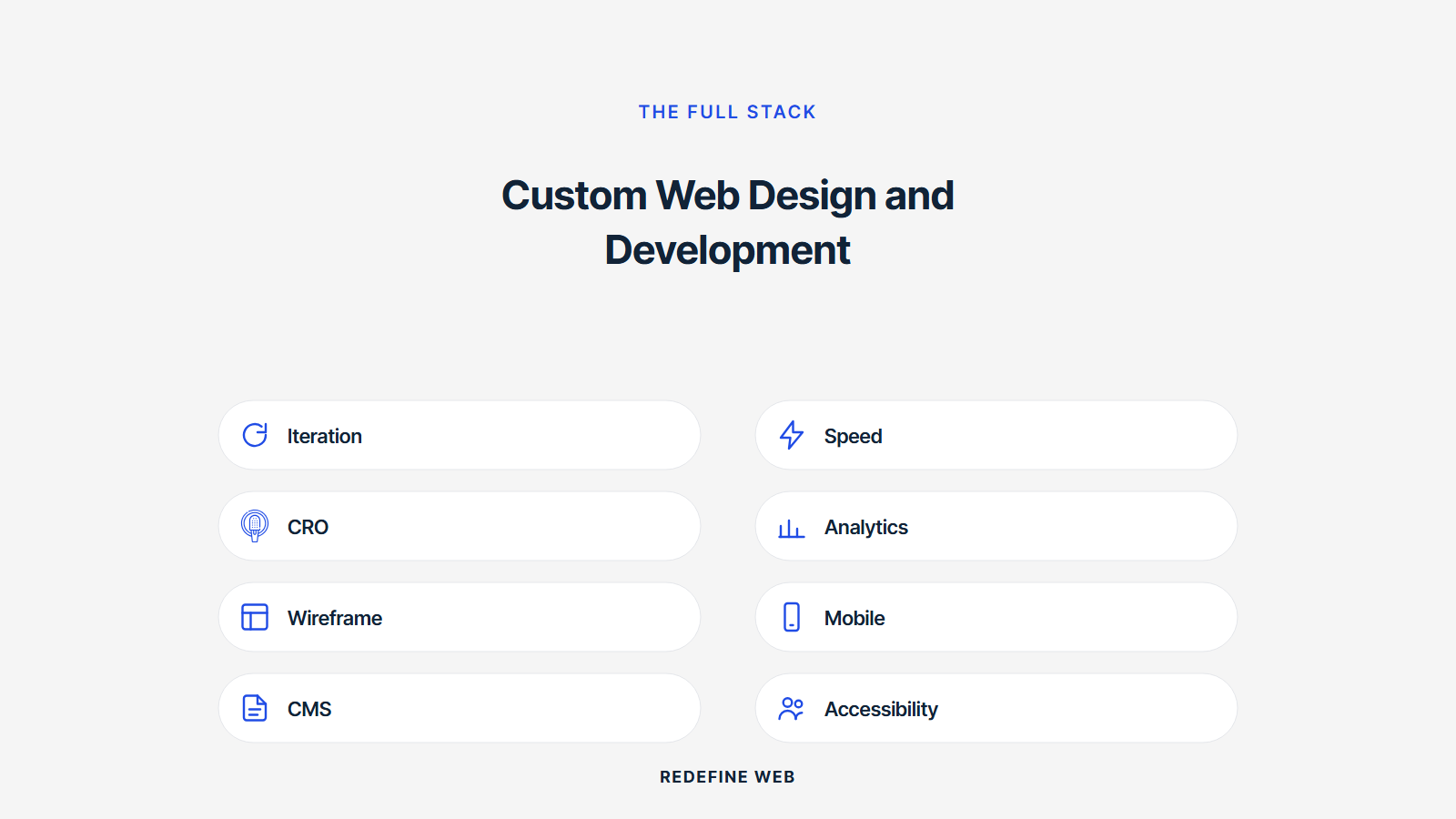
Kickoff meeting on week one. Discovery interviews with the owner, the sales lead, and the front-desk staff. Analytics audit on the current site. Competitor scan. Sitemap and content architecture inside week two. Wireframes for the top ten templates by week three. Visual design and brand system by week five. Front-end build kicks off week five and runs eight to ten weeks parallel to content writing. Integrations wire in weeks seven through nine. QA runs weeks ten and eleven. Launch on week twelve.
Weekly status calls every Tuesday. Loom videos for async updates any day the team ships something the owner should see. A shared Notion or ClickUp workspace with every asset, decision log, and open question. Content copy managed inside a shared Google Doc with clear ownership. Every stalled decision has a name attached. Every open question has a deadline. The best custom web design and development company you have ever worked with is the one that made decisions boring and predictable, not the one that pushed live the flashiest home page.
Weekly cadence that keeps the schedule
Tuesday status call at 30 minutes max. Loom updates any day work shipped. Shared workspace with the current sprint, the backlog, and blocked items. Every meeting ends with named action items and dates. Any decision that stalls past 48 hours gets escalated. Any dependency that misses two calls gets rescoped. Predictable cadence beats flashy meetings every time. The projects that ship on time are the ones that ran boring status calls for twelve straight weeks.
Handoff and training that stops the panic
Handoff week covers admin walkthroughs, editor training for whoever will update content, a documented CMS guide, and a redirect map that maps every old URL to the new one. A 45-minute training session with the marketing lead. A second session with the front-desk person who updates hours or promos. A written FAQ for the top 15 questions clients ask post-launch. A support retainer with response times documented. Skipping any one of these turns a working site into a helpdesk ticket queue inside a month.
Post-launch retainer inside custom web design and development services
Post-launch retainer covers plugin updates through a staging environment, monthly performance monitoring, security scans, quarterly SEO refreshes on marketing pages, monthly conversion-rate testing, and incident response for hosting or payment issues. The retainer runs 15 to 25 percent of the initial build cost annually. Skipping it turns a working site into a stale asset inside 12 months. Payment gateways update APIs. WordPress and framework versions ship breaking changes. Browsers release new bugs. The retainer preserves the entire build investment.
Retainer scope beats project-based rework every time. A $600 to $1,800 per month retainer costs less than a single emergency “the site is down” call once per year. And the retainer team knows the codebase, which saves 40 to 60 percent of the diagnostic time on any incident. Founders who scope the retainer at build time land at a fair price. Founders who shop for a retainer after launch pay a premium because every retainer team has to start with a codebase audit.
Maintenance scope that catches the bugs
Weekly plugin updates on staging with a smoke-test checklist before production push. Monthly security scans with an actionable report. Quarterly Core Web Vitals audits with fixes for anything that dropped below 90. Monthly conversion-rate testing on the top three landing pages. Uptime monitoring with a 5-minute alert threshold. Incident response inside 4 business hours. Real maintenance keeps the site the way it launched. Skipping any layer here is how sites decay past year one. Read our Web Vitals guide from web.dev for the metrics that decide search ranking.
Conversion-rate testing that pays for itself
Monthly A/B tests on the top three landing pages. Headline tests. CTA button copy tests. Form-field count tests. Trust-signal placement tests. Every winning test compounds into every future ad campaign. The average conversion-rate testing program pays for the entire retainer inside three months. The founders who skip conversion testing are the same founders who tell you a year later that their custom build “never really performed the way they hoped”. It performed. Nobody tested it.
Where to start on custom web design and development
Start with the revenue map. Where does the site fit in the acquisition funnel. What percentage of monthly leads come through the site today. What percentage should come through the site 18 months from now. That answer decides the scope tier, the stack, the integrations, and the timeline. Custom web design and development that starts with the revenue map ships to the right budget. Every project that starts with a Pinterest mood board ends up 40 percent over budget.
Ready to scope a real custom web design and development project. See our web design and development services for the full scope and stack options. If the current site is small-business scale, our web design services for small business page covers the fixed-price entry point. Founders who need a custom development track without design overhead can start on our custom web development services. For post-launch scope, see our monthly website maintenance packages. And for the wider vertical hub, our professional services marketing page maps the whole stack, retainer starts at $599 per month.
Frequently asked questions
What do custom web design and development services actually include?
Custom web design and development services cover discovery, sitemap and content architecture, UX wireframes, visual design, front-end build in HTML/CSS/JS or a framework, back-end build on WordPress or a headless stack, CMS configuration, forms and CRM integration, payment or booking layer where the business needs it, analytics, schema markup, accessibility passes, staging, QA, and production launch. A real build also covers post-launch training, a support retainer, and a documented handoff. You own the codebase, the CMS credentials, the analytics account, and every domain asset from day one.
How much do custom web design and development services cost in 2026?
Custom web design and development services land in three tiers. A single-owner service site with 8 to 15 pages, a contact form, and analytics runs $8,000 to $18,000. A local business site with 20 to 40 pages, service pages, blog, booking or lead capture, CRM integration, and location schema runs $18,000 to $45,000. A custom web application with user accounts, gated content, custom database logic, and native app-style flows runs $35,000 to $120,000. Ranges assume a US-based agency and a 6 to 12 week build window.
How long does a custom web design and development project take?
A single-owner service site with pre-written copy finishes in four to six weeks. A local business site with new copy, custom design, integrations, and 20-plus pages runs eight to fourteen weeks. A custom web application with account flows, dashboards, and data logic runs twelve to twenty-four weeks. Timelines slip when copy and imagery arrive late from the client side. Locking content before development kickoff cuts the schedule risk by 60 percent. Every week of copy delay maps to one week of build delay downstream.
Should a local business pick custom web design and development over a template?
Depends on the growth ceiling you want. A Squarespace or Wix template site fits a solo owner testing an idea under $200K in annual revenue. Past that, template limits start costing you conversions, page speed, SEO ground, and integration options. Custom web design and development services pay back once you rely on the site for real lead flow. If the site drives more than 20 percent of your revenue, a custom build recovers its cost inside 8 to 14 months through better conversion rates, faster load times, and integrations the template never supported.
Do custom web design and development services cover mobile apps too?
Yes when the scope calls for it. Custom web app design and development uses the same stack pattern as a web-only build but adds React Native or a progressive web app layer for mobile. Custom web application design and development services cover account systems, dashboards, custom database logic, third-party integrations, and native app publishing to iOS and Android where the business needs it. The web and app stacks share 60 to 70 percent of their code, so scoping them together saves 20 to 30 percent versus building each separately.
What integrations should custom web design and development services build in from day one?
Google Analytics 4 with server-side tagging. A CRM (HubSpot, Salesforce, or a lightweight tool like Pipedrive or Zoho). Email platform (Klaviyo, Mailchimp, ActiveCampaign). A booking or scheduling layer where the business books appointments. A payment gateway (Stripe, Square, or Braintree) where the site handles transactions. Call tracking (CallRail, WhatConverts) for service businesses. Live chat where the sales team responds within business hours. Every integration built at launch costs 30 to 50 percent less than the same integration bolted on six months later.
How does a custom web design and development company handle ongoing maintenance?
Post-launch retainer covers plugin updates through a staging environment, monthly performance monitoring, security scans, quarterly SEO refreshes on marketing pages, monthly conversion-rate testing, and incident response for hosting or payment issues. Skipping the retainer turns a working site into a stale asset inside 12 months. Payment gateways update APIs. WordPress and framework versions ship breaking changes. Browser versions release new bugs. The retainer runs 15 to 25 percent of the initial build cost annually and preserves the entire investment.
Book your free 30-minute strategy call.
No spam, no sales rep. We use your email to schedule your call with a senior strategist. That is it.
More from the blog
View all articles → Web Design
 Core Web Vitals Healthcare Websites Actually Need to Book Patients
Read article Web Design
 Professional Services Website Design Best Practices for 2026
Read article Web Design