
Top Web Development Trends for Small Businesses in 2026
- Three focused trends applied well beat twelve trends applied casually.
- AI features pay back when they replace a repeatable manual task.
- Headless CMS wins above 20,000 monthly visits, not below.
- Core Web Vitals is a real Google mobile ranking signal in 2026.
- Stonehenge Consulting hit five-times return on Google Ads in 90 days.
- Headless CMS as one of the top web development trends for small businesses
- Core Web Vitals as a Google ranking signal in 2026
- Best web development platforms for small businesses in 2025 and 2026
- Accessibility as a top web development trend for small businesses
- Schema markup as a top web development trend for small businesses
- Case study on top web development trends for small businesses applied together
- Trends to skip on a small business build in 2026
- Where to start with top web development trends for small businesses
Top web development trends for small businesses in 2026 are shorter, sharper, and more revenue-focused than any list from the past five years. You already know the drill. Every year brings a fresh cycle of buzzwords, half of which never touch a real project. This guide skips that cycle. You get the seven trends that actually change the math on a small business site in 2026, what each one costs, and how to know when a trend is worth the retainer time versus when to skip it and hold the current stack.
You will read the top web development trends for small businesses in 2026 ranked by revenue impact, not by conference-talk hype. AI features that earn back their build cost. Headless CMS tradeoffs with the honest downside. Core Web Vitals targets Google now reads for ranking. The best web development platforms for small businesses in 2025 and 2026 compared on real numbers. Voice and search integration for local businesses. A case study on a small business tax firm that hit five-times return on Google Ads in 90 days after applying three of these trends.
Headless CMS as one of the top web development trends for small businesses
Headless CMS is one of the top web development trends for small businesses in 2026 but only for a specific kind of small business. Headless separates the content editor (Sanity, Contentful, Storyblok) from the front-end (Next.js, Nuxt, Astro). Pages render server-side and cache aggressively, which drops load times to under one second on mobile. The tradeoff is a bigger dev budget and a smaller talent pool for future edits. Not every small business needs headless. Some genuinely benefit.
Headless CMS pays off when your site publishes 4 or more articles a month, ranks organically for 100+ keywords, and gets 20,000+ monthly visitors. Below those thresholds, a traditional WordPress build with managed hosting and page caching hits the same speed at half the cost. Above those thresholds, the headless architecture starts to earn its keep on load speed, editor experience, and horizontal scaling. Match the build to the traffic pattern, not to the trend cycle. See the web.dev Core Web Vitals reference for the load-speed targets a headless build is chasing.
| Factor | Traditional WordPress | Headless CMS |
|---|---|---|
| Build cost | $8,000 to $20,000 | $18,000 to $45,000 |
| Monthly hosting | $25 to $120 | $60 to $400 |
| Editor experience | Familiar Gutenberg | Cleaner API-driven UI |
| Page load speed | 1.5 to 3s | 0.5 to 1.2s |
| Talent pool for edits | Large | Small |
| Best fit | Under 20k monthly visits | 20k+ visits, 4+ posts/mo |
When headless CMS wins for a small business
Headless wins for a small business publisher, a growing e-commerce brand, or a professional services firm that has invested in content marketing. If you publish weekly, your writer or editor cares about the drafting UI more than the front-end code. Sanity or Contentful gives them a cleaner surface. The Next.js front-end serves cached HTML that loads in under a second. Google notices the page-experience gain and rewards it in mobile rank. That is a real revenue signal for content-driven small businesses.
When headless CMS loses for a small business
Headless loses for a small business that publishes twice a year, runs mostly on referral traffic, or does not have a dedicated content lead. The extra build cost never pays back. The smaller talent pool means your next vendor charges premium rates. WordPress with managed hosting and a page cache plugin hits the same speed targets on a static brochure site. Every top web development trends for small businesses list that puts headless CMS at the top without qualifying it is missing this context. Match the architecture to the workload.
Core Web Vitals as a Google ranking signal in 2026
Core Web Vitals became a real Google ranking signal in 2021 and got sharper every year since. In 2026 the three targets are Largest Contentful Paint under 2.5 seconds, Interaction to Next Paint under 200 milliseconds, and Cumulative Layout Shift under 0.1. Sites that clear all three on 75 percent of real-user visits rank higher on mobile than sites that miss even one. Small businesses that ignored Core Web Vitals in 2022 are the ones losing rank to competitors who quietly fixed their scores in 2024.
Fixing Core Web Vitals on a small business site is a scoped 20 to 40 hour project. Compress and lazy-load images. Preload the hero font. Split JavaScript bundles so only the code the page needs loads immediately. Reserve space for embedded media so nothing shifts on load. Add a page cache. Every one of those is a specific fix a real developer can do inside a two-week retainer sprint. See the web.dev Core Web Vitals guide for the metric definitions and thresholds Google actually reads.
Fixing Largest Contentful Paint
Largest Contentful Paint fails most often because the hero image loads slowly or the hero font blocks rendering. The fixes are boring and effective. Convert the hero image to WebP. Set fetchpriority=”high” and loading=”eager” on the hero image tag. Preload the hero font. Set explicit width and height so the browser reserves space. Those four changes drop LCP by 30 to 60 percent on most small business sites. Your developer applies them once and the Google Search Console page-experience report shows the pass inside 28 days.
Fixing Cumulative Layout Shift
Cumulative Layout Shift fails when embedded ads, videos, or fonts push content down as they load. Fixes: set explicit dimensions on every image and iframe, use font-display: swap with fallback metrics, avoid injecting content above existing DOM nodes, and reserve space for lazy-loaded elements with CSS aspect-ratio boxes. Every one of those fixes is a 20 to 60 minute change a WordPress theme developer can apply in a single sprint.
Best web development platforms for small businesses in 2025 and 2026
The best web development platforms for small businesses in 2025 and 2026 have not changed dramatically at the top. WordPress with a custom theme still runs about 45 percent of new small business builds we run. Webflow runs 20 percent for design-forward brands. Shopify runs 15 percent for e-commerce. Next.js with a headless CMS runs 10 percent for content-heavy publishers. Squarespace and Wix cover the rest at the low end of the market. Each platform has a real fit and real tradeoffs.
Pick the platform after you know your traffic pattern, your content cadence, and your team’s technical comfort. A WordPress custom theme fits a small business publishing monthly with a two-person marketing team. Webflow fits a design agency, a boutique consultancy, or a personal brand where updates are quarterly. Shopify fits any e-commerce shop with more than 20 SKUs. Next.js with a headless CMS fits a small business that ranks for 100+ keywords and gets 20,000+ monthly visits. Match the platform to the workload, not the trend cycle.
WordPress custom theme fit
WordPress with a custom Gutenberg theme fits a small business that publishes 2 to 6 pieces of content a month and needs a rich plugin ecosystem for forms, SEO, backups, and integrations. The editor is familiar to marketers and admins. The talent pool for future edits is deep. Hosting on Kinsta, WP Engine, or a similar managed host runs $30 to $150 per month. See our WordPress Website Development Services for the exact stack we run on most small business builds.
Webflow fit for design-forward brands
Webflow fits a small business that cares more about design polish than about publishing volume. The visual editor gives designers direct CSS control without touching code. Hosting bundles into the platform subscription at $23 to $49 per month. The tradeoffs are a smaller plugin ecosystem, no self-hosting option, and a shallower talent pool if your first vendor disappears. Webflow wins on aesthetics and hosting simplicity. WordPress wins on flexibility and marketplace depth.
The trend that pays back is a fast site with good copy and a working form. Run PageSpeed on your homepage before you spend on AI features nobody asked for.
Accessibility as a top web development trend for small businesses
Accessibility became a top web development trend for small businesses in 2026 for two reasons. First, ADA compliance lawsuits against small business websites hit a record high in 2025. Second, Google’s page-experience signal now reads accessibility as a soft ranking factor. Sites that fail basic accessibility (missing alt text, low contrast, no keyboard navigation) lose ground on mobile search rank. A scoped accessibility audit costs $600 to $2,400 for a small business site and closes the risk on both fronts.
Accessibility fixes for a small business site are boring and effective. Add descriptive alt text to every image. Increase color contrast on body text to at least 4.5:1 against the background. Set focus outlines visible on every interactive element. Add ARIA labels to form fields. Make the site fully navigable by keyboard. Every one of those is a 1 to 8 hour fix a real front-end developer can complete in a two-week retainer sprint. See the WCAG 2.1 quick reference for the target checklist Google and screen readers both read.
WCAG 2.1 AA basics
WCAG 2.1 AA is the target most small business sites should hit. Level A is the floor and covers only the most basic compliance. Level AA covers the mid-tier including color contrast, keyboard navigation, and text resize. Level AAA is enterprise territory and overkill for most small businesses. AA compliance passes the majority of ADA lawsuit filings against small business sites and clears Google’s soft accessibility ranking factor at the same time.
Accessibility audit cost
A scoped accessibility audit on a small business site costs $600 for a 5 to 10 page brochure site, $1,200 for a 10 to 20 page site, and $2,400 for a 20+ page site with e-commerce. Every audit produces a written report with specific fixes ranked by severity. A follow-up implementation sprint runs $1,500 to $4,800 depending on how many issues surfaced. Small business owners who audit annually rarely see a compliance-driven rebuild because the fixes stay caught up.
Schema markup as a top web development trend for small businesses
Schema markup earned a place on the top web development trends for small businesses in 2026 because Google’s rich-result surfaces keep growing. A small business site with Organization, LocalBusiness, Service, and Review schema on every relevant page earns 15 to 30 percent higher click-through rates on search-result snippets. That gain shows up on the CTR column of Google Search Console inside 45 days after the schema goes live.
Schema on a small business site is a one-time build with light annual upkeep. A dental practice adds MedicalBusiness. A home services contractor adds HomeAndConstructionBusiness. A restaurant adds Restaurant with menu items. Each type maps to a specific rich-result surface. Every top web development trends for small businesses list should push schema as a first-quarter deliverable, not a year-two upgrade. See Google’s structured data introduction for the reference every schema build should follow.
Which schema types every small business needs
Every small business site needs Organization schema on the about page, LocalBusiness schema on the contact page, Service schema on every service page, and Review schema on any page with client testimonials. Beyond that, industry-specific types add rich results in their specific SERP surfaces. FAQPage on service pages earns People-Also-Ask surface real estate. Article schema on blog posts earns the article-carousel surface for topical searches.
Validating schema after launch
Google’s Rich Results Test validates schema on any URL in under 30 seconds. Every small business site should run the test on the top 10 pages after launch and after every major content update. Schema breaks quietly when a plugin updates or a theme changes. Weekly validation on the top 10 pages catches breaks before they cost you SERP visibility. A scoped monthly retainer that includes schema validation costs $100 to $250 and prevents the silent CTR drop that comes with broken structured data.
The classic 2026 trends article opens with the phrase artificial intelligence eleven times before it gets to a real recommendation. You are supposed to nod along until the actual insight arrives around word 1,800. This guide skipped that arc. The trends here are the ones we install on real small business sites and measure over 90 days. If a trend cannot show its work on a client’s Google Analytics dashboard, it does not make our list.
Case study on top web development trends for small businesses applied together
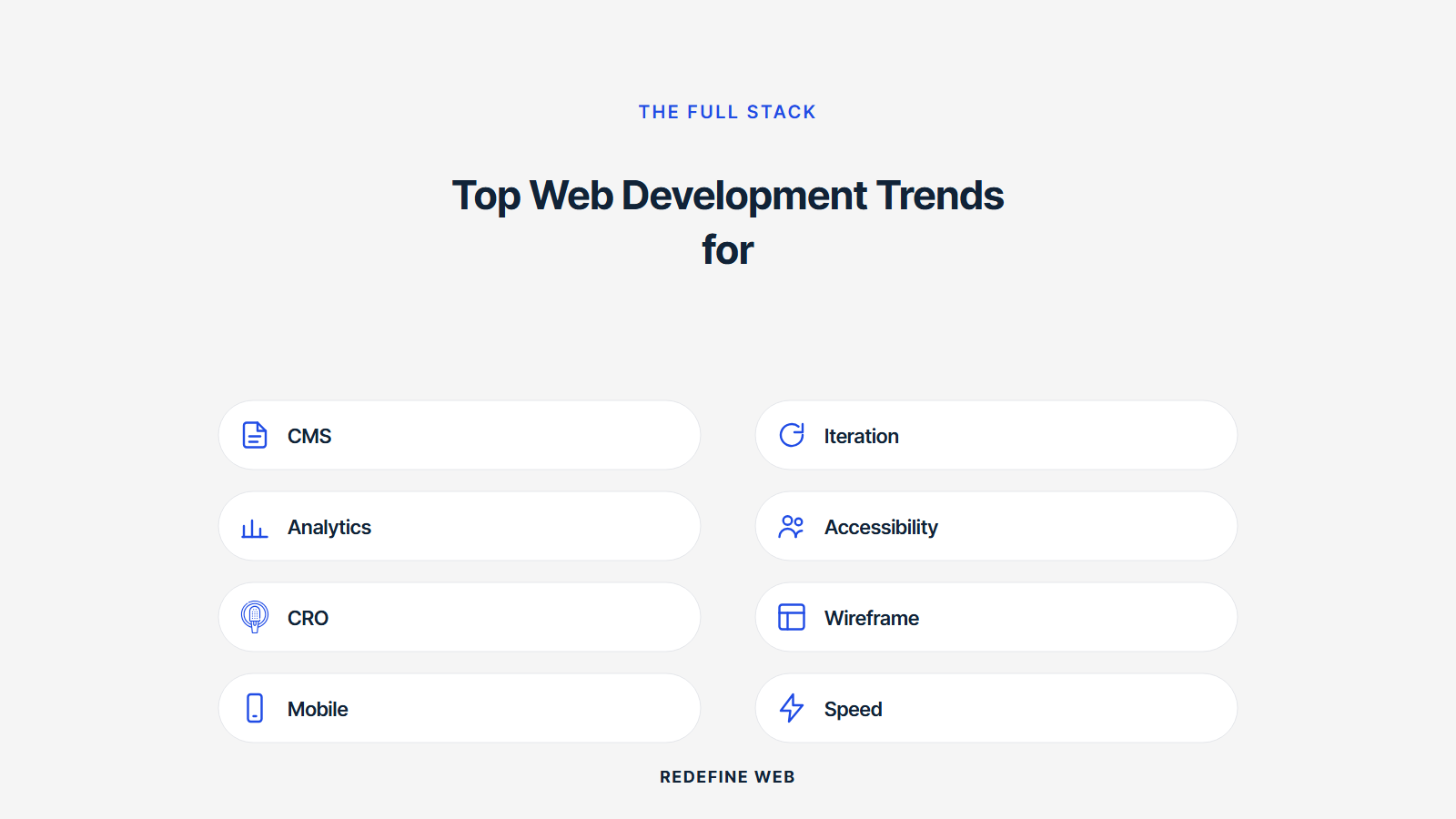
Stonehenge Consulting PLC, a small-business tax advisory firm, came to us with a referral pipeline that could not scale. Their existing site was three years old, missed all three Core Web Vitals targets on mobile, had no schema markup, and ranked for nothing. The team had tried two more freelancers before landing on our first call. They had spent $6,800 on rebuilds that never made it to launch. Referrals were still driving 80 percent of new work and the pipeline was unpredictable month to month.
We applied three of the top web development trends for small businesses on the Stonehenge build. A WordPress custom theme built to hit Core Web Vitals on mobile. Schema markup on every page for Organization, LocalBusiness, and Service. A support chatbot on the contact page trained on their top 20 FAQ answers. Inside 90 days Stonehenge Consulting was pulling five-times return on Google Ads spend, had turned local visibility into weekly booked consultations, and had replaced the unpredictable referral pipeline with a steady monthly lead flow.
The outcome measured 90 days out
Five-times return on Google Ads spend inside the first quarter. Three-times increase in local visibility on Google. Weekly booked consultations replacing a referral-only pipeline. Predictable monthly lead flow the owner could plan against. Those four numbers came from applying three specific top web development trends for small businesses trends to a real build. Every trend earned its keep. Every dollar of the build fee paid back in ad-spend efficiency inside the first 90 days.
Lessons for applying trends to your own site
Two lessons from the Stonehenge Consulting build apply to almost every small business trend adoption. First, three focused trends applied well beat 12 trends applied casually. Focus wins. Second, every trend adoption should have a 90-day measurement plan. Named metric, baseline number, target number, review date. Trends that cannot show their work on your Analytics dashboard in 90 days should get dropped from the retainer plan. Every top web development trends for small businesses list should include the measurement discipline, not just the trend name.
Trends to skip on a small business build in 2026
Not every trend on a 2026 list belongs on a small business site. The ones to skip are the trends built for enterprise budgets, the trends that look futuristic but change nothing on conversion, and the trends that add maintenance overhead without a matching revenue return. Skipping the wrong trend saves you $4,000 to $12,000 in build cost and 3 to 6 months of debugging time. Every small business owner should have a written skip list, not just a written trend list.
Micro-interactions that require 40 hours of custom JavaScript rarely earn back the build cost on a small business site. Fully immersive 3D product configurators outside of a niche e-commerce vertical land in the same skip bucket. Blockchain-based any-anything on a five-person consulting firm belongs on the skip list too. Every top web development trends for small businesses list that pushes these features without qualification is optimizing for the vendor’s portfolio piece, not your bottom line.
Explicit skip list
The explicit skip list for a small business in 2026 includes micro-interactions that cost $4,000+ to build, fully custom 3D product visualization for non-e-commerce sites, blockchain-based loyalty programs on service businesses, voice-activated navigation, and augmented reality product previews outside of large-scale e-commerce. Each of those makes sense for a specific enterprise use case. None makes sense on a $12,000 to $28,000 small business build.
When to revisit a skipped trend
Revisit a skipped trend when your business changes shape. A five-person consulting firm that grows into a 30-person agency crosses new thresholds where headless CMS or a custom design system starts to earn its keep. An e-commerce shop that clears $500,000 in annual revenue crosses new thresholds where personalization and AR previews start to matter. Every 12 months, revisit the skip list against the current business shape. Some trends move from skip to adopt as the business grows.
Where to start with top web development trends for small businesses
Start with a 12-month audit of your current site. Test Core Web Vitals on the top three revenue pages. Check schema markup against Google’s Rich Results Test. Review your top 20 FAQ questions against a support chatbot use case. Rank the results by 90-day revenue impact. The three highest-scoring items become the trends you adopt this quarter. The rest go into the annual plan or the skip list. That process turns a 2026 trends article into a real retainer plan you can measure.
Ready to run the audit with a team that measures the work. Our Custom Web Development Services USA covers the full audit-plan-implement cycle. For the sibling read on picking a vendor, see our how to choose web designer and developer for small business. For the sibling read on the actual build, see our custom web development for small businesses. For authoritative reference on Core Web Vitals thresholds, see the web.dev Core Web Vitals guide.
Frequently asked questions
What are the top web development trends for small businesses in 2026?
The top web development trends for small businesses in 2026 are Core Web Vitals as a real Google ranking signal, AI-assisted features that replace repeatable manual tasks, headless CMS for content-heavy publishers, WCAG 2.1 AA accessibility compliance, schema markup for rich results, and the WordPress custom theme stack that hits page-speed targets without a full rebuild. Each trend maps to a specific revenue outcome inside 90 days. Skip the trends built for enterprise budgets. Focus on the three that map to your current traffic pattern, content cadence, and support workload. That focus turns a trends list into a real retainer plan.
Is AI web development for small business worth the cost in 2026?
AI web development for small business is worth the cost when it replaces a repeatable manual task. A support chatbot on the contact page trained on your top 20 FAQ answers saves 3 to 5 hours a week of email replies. An AI-assisted location page generator drafts city pages in 20 minutes instead of 90. A voice-to-text intake form on booking flow saves 15 minutes per lead. Each of these pays back inside a quarter. Skip AI features that do not touch a revenue task like generative image banners or voice-cloned team greetings. Match the AI feature to a task that costs owner time today.
Should a small business use a headless CMS in 2026?
Headless CMS is worth it for a small business that publishes 4 or more articles a month, ranks organically for 100+ keywords, and gets 20,000+ monthly visitors. Below those thresholds, a traditional WordPress custom theme with managed hosting and page caching hits the same speed targets at half the build cost. Above those thresholds, the headless architecture earns its keep on load speed, editor experience, and horizontal scaling. Match the architecture to the workload. A small business that publishes twice a year and runs on referral traffic should stay on WordPress and skip the headless upgrade cycle.
What are the best web development platforms for small businesses in 2025 and 2026?
The best web development platforms for small businesses in 2025 and 2026 are WordPress with a custom theme for content-heavy sites, Webflow for design-forward brands, Shopify for any e-commerce shop with more than 20 SKUs, and Next.js with a headless CMS for content publishers with 20,000+ monthly visits. WordPress runs 45 percent of new small business builds. Webflow runs 20 percent. Shopify runs 15 percent. Next.js with headless runs 10 percent. Squarespace and Wix cover the rest at the low end. Pick the platform after you know your traffic pattern, content cadence, and team's technical comfort.
How much do the top web development trends for small businesses cost to adopt?
Adoption cost for the top web development trends for small businesses varies by trend. Core Web Vitals fixes run $1,500 to $4,800 for a scoped 20 to 40 hour project. A support chatbot trained on top 20 FAQ answers costs $1,200 to $3,600 to build plus $30 to $120 monthly. WCAG 2.1 AA accessibility audit costs $600 to $2,400 depending on site size. A headless CMS build runs $18,000 to $45,000 for the initial project. Schema markup implementation runs $600 to $2,000 as a standalone sprint. Budget $6,000 to $12,000 a year for continuous trend adoption on a real small business site, not $30,000 in one lump.
Which web development trends should a small business skip in 2026?
Skip the trends built for enterprise budgets. Micro-interactions that require 40 hours of custom JavaScript rarely earn back the cost on a small business site. Fully immersive 3D product configurators outside of niche e-commerce belong on the skip list. Blockchain-based loyalty programs on a five-person consulting firm belong on the skip list. Voice-activated navigation outside of accessibility contexts adds maintenance overhead without matching revenue return. Augmented reality product previews outside of large-scale e-commerce skip too. Revisit the skip list every 12 months against the current business shape. Some trends move from skip to adopt as the business grows.
Book your free 30-minute strategy call.
No spam, no sales rep. We use your email to schedule your call with a senior strategist. That is it.
More from the blog
View all articles → Web Design
 Core Web Vitals Healthcare Websites Actually Need to Book Patients
Read article Web Design
 Professional Services Website Design Best Practices for 2026
Read article Web Design