
Website Design and SEO Packages That Book Real Traffic in 2026
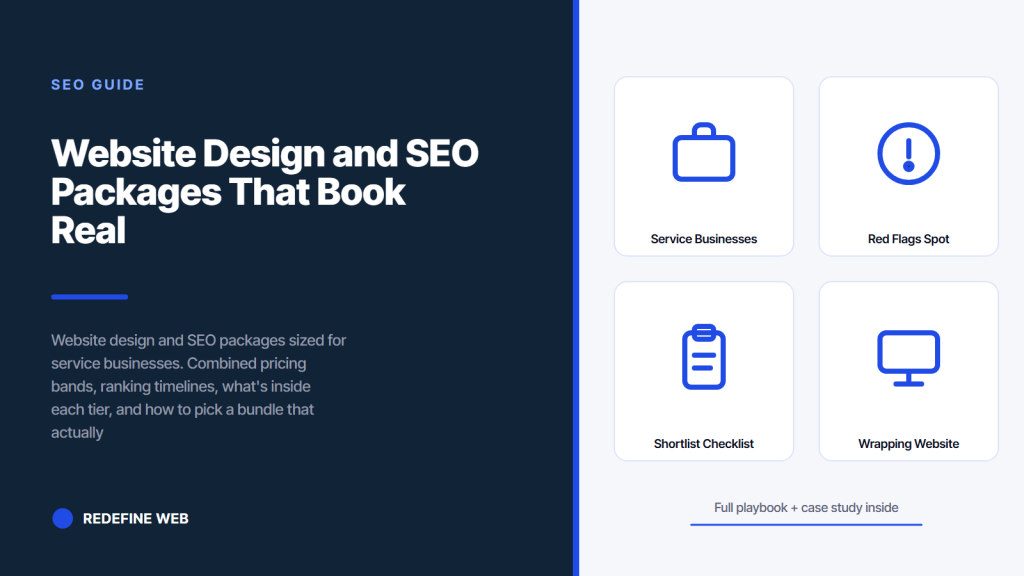
- Combined bundles run $3,500 to $32,000 upfront.
- Retainer runs $600 to $4,200 monthly by tier.
- Rankings show up on a 12-month curve, not 60 days.
- Service-plus-city pages carry the local map pack.
- Ask for month-by-month client rankings before signing.
- Local SEO and website design packages for service businesses
- Real ranking timelines from an SEO-optimized website design package
- A real client case for the website design and SEO packages conversation
- Website design and SEO package red flags to spot on the intro call
- Website design and SEO packages cost breakdown by service business type
- Website design and SEO packages retainer bands past launch
- Website design and SEO packages shortlist checklist
- Wrapping the website design and SEO packages guide
Website design and SEO packages exist because a beautiful site with no traffic is a $12,000 brochure nobody visits. Most service business owners buy a design package first, learn six months later that Google can’t find the site, and then hire a second vendor to fix the foundation the first vendor should have poured. This guide walks you through combined website design and SEO packages, the pricing bands, ranking timelines, and how to pick a bundle that avoids the two-vendor gap. Read straight through in about ten minutes and you’ll know which tier fits a dentist, a plumber, an accounting firm, or an HVAC shop by the end.
You’re likely reading this because you got two quotes: one for a $6,500 site and one for a $1,800 monthly SEO retainer, and neither vendor mentions the other. Below you’ll find combined pricing bands for four bundle tiers, a scope checklist, a working comparison table, and one Redefine Web client whose combined SEO plus design engagement drove a 206 percent organic click gain at peak season. Steal the shortlist, apply it to the next round of quotes, and stop paying two vendors to build the same site from opposite ends.
Local SEO and website design packages for service businesses
Local SEO and website design packages built for a service business bake the map pack into the launch scope. That means service-plus-city pages, LocalBusiness schema on every page, Google Business Profile integration, and review capture QR codes at the point of service. Not one generic services page and a Google Business Profile update at launch.
Service-plus-city pages are the single highest-impact move a bundled engagement makes. A plumber in Cincinnati needs a page for water heater repair Cincinnati, drain cleaning Cincinnati, and sump pump installation Cincinnati. Each page targets one service in one city and pulls buyer-intent traffic the generic services page never captures. The math: 8 services times 4 cities equals 32 landing pages, each pulling 40 to 200 monthly organic visits inside twelve months. That’s 1,280 to 6,400 monthly organic sessions from a build that costs $8,500 to $18,000 depending on tier. External benchmark data on local ranking patterns lives at the Search Engine Journal local SEO guide.
Google Business Profile ties the site to the map pack. Every service-plus-city page links to the profile. Every profile post links back to the matching service page. Reviews requested on the site with a QR code at the point of service push new reviews to the profile weekly. Twelve months in, the small business that ran this bundle from day one has 60 to 140 reviews and a top-3 map pack ranking. The one that split design and SEO across two vendors has 8 reviews and a spot on page two. For the ongoing side of the retainer, our Website Maintenance Packages from $199/mo team runs the retainer past launch.
| Bundle tier | Site pages | Upfront | Monthly retainer | Blog posts / quarter | Link building / month |
|---|---|---|---|---|---|
| Starter | 8 to 14 | $3,500 | $600 | 4 | 0 |
| Growth | 16 to 28 | $8,500 | $1,400 | 8 | 4 to 8 |
| Pro | 28 to 60 | $18,000 | $2,600 | 12 | 12 to 20 |
| Pro Plus | 60 to 120 | $32,000 | $4,200 | 20 | 20 to 40 |
Real ranking timelines from an SEO-optimized website design package
An SEO-optimized website design package delivers rankings on a 12-month curve, not a 60-day sprint. Month one to three: the site launches, technical foundation clears, Google indexes the pages. Month four to six: rankings appear on long-tail commercial terms. Month seven to twelve: top 10 rankings on head commercial terms and map pack placement on service-plus-city queries.
The vendor who promises page-one rankings in 60 days is selling a lie. Google’s ranking systems weight domain authority, backlink profile, and content velocity across a 6 to 12 month window. A new site with 8 pages and 4 blog posts hits real rankings between month four and month seven, not week six. The one exception: branded queries where the business name and city rank in week one because nobody else is competing for that exact phrase. That’s not a ranking win. That’s an index confirmation.
The real gains show up between month nine and month eighteen when compounding kicks in. A site with 30 published blog posts, 40 landing pages, and 60 backlinks starts pulling organic traffic that outperforms paid search on cost per acquisition. Month eighteen is when a well-run SEO bundle stops feeling like a monthly expense and starts feeling like a compounding asset. The vendor who won’t share month-by-month client rankings from a live engagement is hiding a curve that flattens at month four.
A real client case for the website design and SEO packages conversation
Dino Decking Ltd, a family-run UK composite decking specialist, ran a bundled technical SEO plus content strategy that drove 206 percent year-over-year organic clicks at peak season, 74 percent higher conversions, and 101 percent more referring domains. The engagement mirrors what a growth-tier bundle looks like when the vendor stays past launch.
The Dino Decking engagement started with a technical SEO audit that cleared indexing blockers and fixed GA4 tracking that had been quietly broken for months. Commercial URLs on page two got prioritized for optimization so they could break into page one before peak season. Pillar-cluster content built authority around composite decking topics with internal linking that pulled the whole commercial set up in rankings. Digital PR earned coverage on relevant home-improvement publications, growing referring domains 101 percent in twelve months. The build timing landed authority ahead of the spring and summer demand spike.
The takeaway for a service business considering a bundle: the SEO layer inside a website design and SEO package works when it’s tied to a real seasonal calendar and a working technical foundation. Not when it’s a monthly newsletter of “we published four blog posts, please pay us $1,400.” Ask the vendor to walk you through the month-by-month plan for the next six months. If they can’t, they don’t have a plan, they have a retainer. For the paid side that pairs with organic, our PPC Management Services practice runs the account shape while SEO compounds in the background.
Adding SEO after launch means rebuilding. Ask your design vendor whether schema, URL structure, and city pages land in the sitemap. If it's phase 2, cancel the SOW.
Website design and SEO package red flags to spot on the intro call
A website design and SEO package worth the deposit passes a red-flag scan on the first intro call. A vendor who quotes without asking about your top ten commercial keywords, your current site’s organic sessions, and your Google Business Profile status is scoping a portfolio piece, not your business. Walk within twenty minutes.
The specific red flags: no keyword research included in the base scope, a link count with no publication samples, a content calendar with no topics defined, a “guaranteed rankings” line anywhere in the proposal, and a technical SEO audit sold as an add-on to the base bundle. Any two of these on the same intro call is enough to move to the next vendor. Good vendors show you three live client dashboards in the first thirty minutes and can name the top three failure modes of every bundle tier they sell without prompting.
The single most predictable line on a bundled SEO pitch call is “We’ll get you to page one of Google in 60 days.” The site launches. Month two comes and goes. Month three arrives. The vendor’s monthly report includes a screenshot of a keyword ranking at position 47 with a green up-arrow next to it. That’s a ranking win the way finding a nickel in your couch is a retirement plan. If the vendor can’t show you three past client sites at position 1 to 10 on head commercial terms with the timeline it took to get there, they don’t have a page-one playbook either.
Website design and SEO packages cost breakdown by service business type
Website design and SEO packages cost varies by service business type because the keyword pool and competition band shifts across verticals. A solo dentist in a mid-size metro runs the growth bundle at $8,500 plus $1,400 monthly. A multi-location HVAC shop runs pro at $18,000 plus $2,600 monthly. A B2B accounting firm targeting national keywords runs pro plus at $32,000 plus $4,200 monthly.
The keyword pool decides the tier. A solo dentist competes on 30 to 60 commercial keywords across the metro. A multi-location HVAC shop competes on 200 to 400 keywords across four to eight cities. A B2B accounting firm targeting national queries competes against Big Four content teams with $40,000 monthly SEO budgets. Buying the growth bundle for a B2B national play burns cash on scope that can’t move a competitive keyword. Buying the pro plus for a solo dentist burns cash on scope you don’t need for another three years.
The right pattern: match the bundle to the keyword pool, not to the vendor’s biggest tier. Ask the vendor to walk you through 10 target keywords, their current position, and the 12-month plan to move them. A vendor who can do this in the intro call has done it before. A vendor who dodges it is selling a template. External benchmark data on keyword competition patterns lives at the Moz beginner’s guide to SEO.
Website design and SEO packages retainer bands past launch
Every website design and SEO packages engagement needs a retainer band written into the proposal at deposit signing. Starter tier runs $600 monthly for on-page SEO plus 4 blog posts a quarter. Growth runs $1,400 monthly for 8 posts plus 4 to 8 links a month. Pro runs $2,600 monthly for 12 posts plus 12 to 20 links. Pro plus runs $4,200 monthly for 20 posts plus 20 to 40 links.
Anything below $600 monthly on an SEO retainer and you don’t have an SEO program, you have a Google Business Profile update. Real SEO retainers require content velocity, link acquisition, technical monitoring, and a monthly strategy call. Below $600 a month, none of those are inside the scope. Above $4,200 monthly is a real growth partnership with a dedicated strategist, weekly reporting, and digital PR outreach across national publications.
Compare retainers across vendors before signing the bundle. The vendor who quotes a low upfront and a high monthly is banking on lock-in. The vendor who quotes a high upfront and a low monthly is banking on you canceling the retainer in month four. The right pattern is a mid upfront and a mid monthly with the SEO deliverables named line by line. Ask for the last month’s retainer report from three current clients. If the vendor can’t produce it, the retainer isn’t real. For the retainer past launch, our Website Maintenance Packages from $199/mo team publishes a real monthly report every account gets.
Website design and SEO packages shortlist checklist
Website design and SEO packages worth signing pass a nine-point checklist. Keyword research inside base scope. Live client dashboards in the first thirty minutes. Technical SEO baked into wireframes. Link publication samples. Content calendar with topics defined. Month-by-month plan for the next six months. Real monthly report from a current client. No “guaranteed rankings” line. 30-day retainer termination clause.
Run the checklist against every quote you get. The vendor who passes all nine is worth a follow-up call. The vendor who passes six of nine is worth a conversation about the three gaps. The vendor who passes fewer than five is a design shop with an SEO checkbox tacked on, and the bundle they sell will underperform inside twelve months. This is the pattern we see repeatedly across service-business owners coming to us after a bad first vendor engagement.
- Keyword research inside the base scope, not billed as an add-on
- Live client dashboards shown in the first thirty minutes
- Technical SEO baked into the wireframes, not sold as a month-three audit
- Link publication samples shared before deposit signing
- Content calendar with topics defined by keyword and buyer intent
- Month-by-month plan for the next six months of the retainer
- Real monthly report from a current retainer client, shared on request
- No “guaranteed page-one rankings in 60 days” line anywhere in the proposal
- 30-day retainer termination clause with prorated refund on unbilled scope
Wrapping the website design and SEO packages guide
Website design and SEO packages that book traffic, capture buyer intent, and stay working past launch run on a repeatable pattern. Technical SEO inside the wireframes. Keyword research before content is written. Service-plus-city pages baked into the launch scope. Link acquisition tied to real publications. A retainer strategist who reports monthly on ranking movement.
If you take one thing from this website design and SEO packages guide, take the nine-point checklist and run it against every quote in your inbox. If you take two things, ask the vendor for month-by-month client rankings on head commercial terms from a live engagement, and refuse to sign a bundle without seeing them. When you’re ready to talk through a combined build plus SEO retainer, our Web Design Services for Small Business practice walks through the shape in a 30-minute call.
Frequently asked questions
How much do website design and SEO packages cost for a service business?
Website design and SEO packages for a service business run $3,500 to $32,000 upfront plus a monthly retainer of $600 to $4,200. The starter bundle at $3,500 upfront plus $600 monthly covers 8 to 14 pages, on-page SEO, and 4 blog posts a quarter. Growth at $8,500 upfront plus $1,400 monthly adds 40 to 80 keywords, 4 to 8 links a month, and 8 posts a quarter. Pro at $18,000 upfront plus $2,600 monthly adds multi-city landing pages and 12 to 20 links. Pro plus at $32,000 upfront plus $4,200 monthly adds a dedicated strategist, digital PR, and 20 to 40 links a month.
How long before a bundled SEO plus website design package delivers rankings?
A bundled SEO plus website design package delivers rankings on a 12-month curve. Month one to three: the site launches, technical foundation clears, Google indexes the pages. Month four to six: rankings appear on long-tail commercial terms. Month seven to twelve: top 10 rankings on head commercial terms and map pack placement on service-plus-city queries. Real compounding shows up between month nine and month eighteen when a site with 30 published blog posts, 40 landing pages, and 60 backlinks starts pulling organic traffic that outperforms paid search on cost per acquisition. Any vendor promising page-one rankings in 60 days is selling a lie.
Should I bundle design and SEO or hire two vendors?
Bundle design and SEO with one vendor when the service business is small enough that the combined scope fits inside one team's capacity. Split across two vendors when the SEO scope is national-scale, technical enough to require a specialist, or the design vendor lacks in-house SEO strategists with named client wins. For most service businesses under $80,000 monthly revenue, the bundle beats the split because SEO decisions belong in the wireframe. Site architecture, URL structure, schema markup, and internal linking all have to land during the build, not in a retainer that starts three months after launch. The two-vendor gap is where money goes to die.
What's included in a working local SEO and website design package?
A working local SEO and website design package includes technical SEO baked into wireframes, keyword research on 30 to 200 commercial terms, LocalBusiness plus Service schema on every page, Google Business Profile integration, service-plus-city landing pages, review capture QR codes, Google Search Console setup, GA4 configuration, an XML sitemap tied to the CMS, and Core Web Vitals proof at launch. Everything below the starter tier is a hosting bill with a Google Business Profile update thrown in. Ask the vendor to walk you through the technical audit checklist they run on every launch. If they can't produce one, they don't have one.
What are the best website design and SEO packages for a solo dental practice?
The best website design and SEO packages for a solo dental practice sit in the growth tier at $8,500 upfront plus $1,400 monthly. A solo dental practice competes on 30 to 60 commercial keywords across one metro, which fits the growth tier's keyword research scope. The bundle covers 16 to 28 pages including service pages for cleaning, whitening, veneers, invisalign, implants, and root canal, plus service-plus-city variants for the top three cities in the service radius. The retainer covers 8 blog posts a quarter, 4 to 8 links a month, monthly technical monitoring, and quarterly strategy calls tied to seasonal patient recall patterns.
How do I evaluate SEO-optimized website design packages before signing?
Evaluate SEO-optimized website design packages on nine points before signing. Keyword research inside base scope, not billed as an add-on. Live client dashboards shown in the first thirty minutes. Technical SEO baked into wireframes, not sold as a month-three audit. Link publication samples shared before deposit signing. Content calendar with topics defined by keyword and buyer intent. Month-by-month plan for the next six months of the retainer. Real monthly report from a current retainer client, shared on request. No "guaranteed page-one rankings in 60 days" line anywhere in the proposal. 30-day retainer termination clause with prorated refund on unbilled scope.
Book your free 30-minute strategy call.
No spam, no sales rep. We use your email to schedule your call with a senior strategist. That is it.
More from the blog
View all articles → SEO
SEO Organic Search Engine Optimization Services That Grow Real Traffic
Read article SEO
SEO SEO for Pet Groomers That Fills the Appointment Book Weekly
Read article SEO
SEO