
Website Design Packages for Service Businesses That Actually Book Jobs
- Fixed pricing runs $1,500 to $45,000 across six tiers.
- Match the package to monthly revenue, not vendor pitch.
- Retainer band belongs in the proposal at deposit signing.
- Local SEO and schema bake in at build, not year two.
- 30-day termination clause protects three months of runway.
- Website designing packages and the platform decision
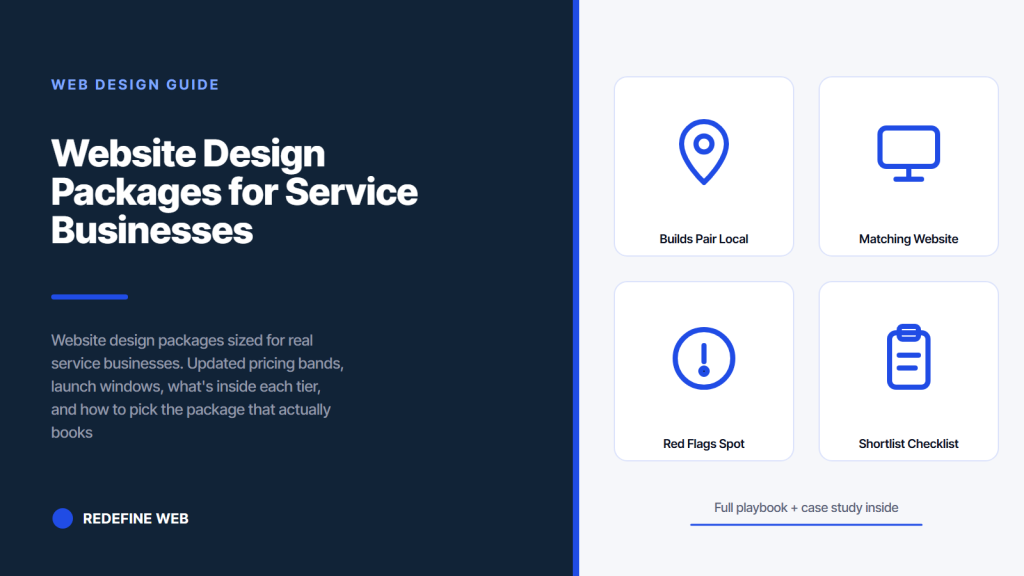
- Website design package builds that pair with local SEO from day one
- Matching a website design package to your revenue stage
- A real client case for the website design package conversation
- Website design package red flags to spot on the intro call
- Website design package retainer bands post-launch
- Firing a bad website design package vendor mid-project
- Website design packages shortlist checklist
- Wrapping the website design packages guide
Website design packages are the difference between a site that books jobs on Monday and a $180 monthly hosting bill you forget you’re paying. Most service business owners buy the wrong tier because vendors bury scope in fine print and leave the retainer number off the proposal until launch week. This guide walks you through what each website design package tier includes, what it costs, and how to know which one fits a plumber, a dentist, an HVAC shop, or an accounting firm. Read straight through in about ten minutes and you’ll cut a shortlist of twelve vendors down to three by the end of the afternoon.
You’re likely reading this because a vendor quoted you $4,500 for a starter build, another quoted $32,000 for the same-sounding site, and you can’t tell which one is real. Below you’ll find fixed pricing bands for six tiers, a scope checklist by tier, a working comparison table, and one Redefine Web client whose growth-tier engagement paid back inside twelve months. Steal the shortlist, apply it to the next three quotes in your inbox, and stop paying vendors to guess at what your business needs.
Website designing packages and the platform decision
Website designing packages live or die on the platform pick. WordPress, Webflow, Shopify, Squarespace, and Wix all serve different budgets and skill levels. Pick wrong and every future edit costs you time you don’t have or money you didn’t budget. Pick right and the site compounds for years without a full rebuild.
WordPress is the default at 43 percent of the web for a reason. Every plugin, every integration, every developer knows it, and the ecosystem is deep enough that you can hire the next vendor in ten minutes when the current one moves on. The tradeoff is that WordPress needs maintenance. Updates roll weekly. Plugins conflict. Security patches release monthly. A managed host like Kinsta or WP Engine at $35 to $115 monthly handles the boring parts and pays back the first time a plugin update would have taken the site down at 9 pm on a Friday. External reference on WordPress maintenance patterns lives at the WordPress documentation library.
Webflow works well when the growth-tier client wants a designer-friendly CMS and doesn’t want to manage a plugin ecosystem. The tradeoff is a $23 to $39 monthly hosting fee locked to Webflow, and you can’t easily migrate off the platform if the price triples in year three. Shopify is the right pick for physical products online, wrong for a service business that only needs a contact form and a booking widget. Squarespace and Wix are DIY at $23 to $49 monthly and only make sense before the business does $8,000 a month in revenue and can afford to hire out the rebuild inside twelve months.
| Package tier | Pages | Upfront | Monthly retainer | Launch window |
|---|---|---|---|---|
| Starter | 6 to 12 | $1,500 to $4,500 | $180 | 4 to 6 weeks |
| Growth | 12 to 24 | $4,500 to $9,500 | $240 | 6 to 8 weeks |
| Growth Plus | 18 to 30 | $6,500 to $14,000 | $320 | 8 to 10 weeks |
| Pro | 24 to 60 | $12,000 to $22,000 | $480 | 10 to 14 weeks |
| Pro Plus | 40 to 80 | $22,000 to $45,000 | $640 | 14 to 18 weeks |
| DIY | 4 to 8 | $0 | $23 to $49 | 2 to 4 weeks |
Website design package builds that pair with local SEO from day one
A website design package that ignores local SEO from day one loses 6 to 12 months of rankings a competitor picks up while you rebuild. The right package bakes local schema, service-plus-city pages, and Google Business Profile integration into the launch scope. Not into a year-two upgrade.
Local schema is a 90-minute add at build time that pays back for the life of the site. LocalBusiness schema on the home page. Service schema on every service page. FAQPage schema on the FAQ section of every service. Review schema pulled from Google Business Profile. Get this in the launch scope or the site ranks two positions lower than it should for the entire first year. Service-plus-city pages are the second lever. A plumber in Cincinnati needs a page for water heater repair Cincinnati, drain cleaning Cincinnati, and sump pump installation Cincinnati. Not one generic services page listing eight items with no location signal.
Google Business Profile ties the site to the map pack. Every service page links to the profile. Every profile post links back to the matching service page. Reviews requested on the site with a QR code at the point of service push new reviews to the profile weekly. Twelve months in, the small business that ran this pattern from day one has 60 to 140 reviews and a top-3 map pack ranking. The one that didn’t has 8 reviews and a spot on page two. External reference on local SEO patterns lives at the Search Engine Journal local SEO library.
Matching a website design package to your revenue stage
Match the package to your monthly revenue, not to the vendor’s biggest tier. A business doing $8,000 monthly picks the starter. A business doing $30,000 monthly picks growth. A business doing $80,000 monthly picks pro. Buying above your stage burns cash on scope you can’t use for another eighteen months.
Under $8,000 monthly, DIY on Squarespace or Wix is fine. A four-page site with a phone number, a services list, a photo gallery, and a contact form gets you through the first six months without spending cash you need for tools, trucks, or hiring. The mistake at this stage is signing a $6,500 build before you have a repeatable lead source, because the site does nothing if nobody visits. Fix the source first. Google Ads at $600 monthly, Google Business Profile at zero cost, and one referral request per completed job. The site scales when traffic scales, not the other way around.
Between $8,000 and $30,000 monthly, the starter build at $1,500 to $4,500 pays back inside six months. You’ve got repeatable traffic from ads and referrals, and the site converts a share of it. Between $30,000 and $80,000, the growth build at $4,500 to $9,500 unlocks the local SEO layer, adds three lead offers, and ties the CRM into the flow. Above $80,000 monthly, the pro build at $12,000 to $22,000 handles multi-service, multi-city expansion and layers marketing automation on top. For the retainer that pairs with each tier, our Website Maintenance Packages from $199/mo practice runs the ongoing side.
If your homepage reads services-grid-and-phone-number, you have a pamphlet online. Rewrite the hero around one primary action. Book, quote, or call. Pick one.
A real client case for the website design package conversation
Tilghman Builders, a family-owned renovation company in Pennsylvania, mirrors what a growth-tier package looks like when the vendor stays past launch. Revenue moved from $1.5 million to $6.8 million across a nine-year window, with website traffic up 784 percent and qualified leads up 637 percent over the same period.
The Tilghman engagement started with a growth-tier site rebuild tied directly to a HubSpot CRM. Every form submission, phone call, and direct-mail QR scan logged into a real pipeline so spend could be measured against booked jobs. The rebrand replaced a portfolio system that hid the work with one that opened at full quality on a mobile phone. Paid ads on Facebook and Google targeted service areas with creative rotated against real buyer personas. The site was the anchor, not the appendix, of the marketing motion.
The takeaway for a service business considering a website design package: the launch is not the win. The launch is the starting line. The vendor who commits to a post-launch retainer at a defined monthly rate is the one whose numbers compound. The vendor who disappears after launch produces the flat traffic curve you see on 70 percent of small-business sites. Pick the vendor for the ten years past launch, not the eight weeks up to it. For the paid search motion that pairs with the build, our PPC Management Services practice runs the same account shape on service businesses at Tilghman scale.
Website design package red flags to spot on the intro call
A website design package worth the deposit passes a red-flag scan on the first intro call. A vendor who quotes without asking about your monthly revenue, your top three services, and your current site’s traffic is scoping a portfolio piece, not your business. Walk within twenty minutes.
The specific red flags: no fixed pricing tied to scope, a monthly retainer that renews annually with no termination clause, a template installation dressed up as a custom design, a portfolio full of non-service-business work, and a proposal that puts photography and copywriting outside the base scope with no called-out line items. Any two of these on the same intro call is a signal to move to the next vendor. Good vendors show you three past service-business builds in the first thirty minutes and can name the top three failure modes of every tier they sell without prompting.
The single most predictable line on a small-business web design pitch call is “We’ll make you stand out from every other plumber in your zip code.” The site launches. Three competitors have the same blue-and-orange header. Two have the same testimonials carousel. One has the same drone-shot hero of a water tower. Nobody stood out. Everybody paid $4,500 to look identical to everybody else in the same zip code. If the vendor can’t show you three past service-business sites side by side and point to the visible differences in sixty seconds, they don’t have a template for standing out either.
Website design package retainer bands post-launch
Every website design package needs a retainer band written into the proposal at deposit signing. The starter tier runs $180 monthly for hosting, security, and one content update. The growth tier runs $240 to $320 monthly for hosting, one A/B test, and a quarterly conversion review. The pro tier runs $480 to $960 monthly for the full working retainer with weekly reporting.
Anything below $180 monthly and you don’t have a maintenance program, you have a hosting bill. The site breaks quarterly. Plugins conflict. Security patches skip a month. Google penalizes a hacked site inside a week and the business loses six weeks of traffic recovering. Pay for the retainer at the right band or don’t sign a build past the DIY tier. Above the $960 monthly line is a real growth partnership: two working sessions a month, one A/B test, a quarterly conversion audit, a monthly SEO report, and a dedicated account lead who knows the business well enough to spot problems before they show up in the numbers.
Compare retainers across vendors before signing the build. The vendor who quotes a low upfront and a high monthly is banking on lock-in. The vendor who quotes a high upfront and a low monthly is banking on change orders. The right pattern for a service business is a mid upfront and a mid monthly with a called-out list of what’s inside each. Ask for the last month’s retainer report from three current clients. If the vendor can’t produce it, the retainer isn’t real. For the ongoing side that keeps sites fast and secure past launch, our Website Maintenance Packages from $199/mo team publishes a real monthly report every account gets.
Firing a bad website design package vendor mid-project
Firing a website design package vendor mid-project is common enough that a working proposal should include the termination clause upfront. The right clause: 30 days notice, no reason required, prorated refund on unbilled scope, and full transfer of design files and hosting credentials within seven days. Anything longer is a lock-in that costs you three months of runway.
The signals you’re about to fire a vendor: missed weekly check-ins with no rescheduling, wireframes delivered two weeks past deadline with no design system underneath, a first-round design pass that ignores half the brief, and change orders billed at $175 hourly for scope you thought was inside the base. Any two of these inside the first four weeks and you’re already behind. Send the termination notice, take the deposit hit, and start the next vendor conversation with the lessons in hand. Losing a $2,000 deposit is cheaper than losing four months on a launch that never happens.
The next vendor conversation goes faster because you now know the questions. What’s the weekly cadence. Who’s the account lead by name. What’s the change order rate. What’s the termination clause. How many builds have you launched in the last twelve months. Which three didn’t launch and why. The vendor who answers the sixth question with a story is honest. The one who dodges it is the one you just fired, wearing a different logo. For a service-business build with a defined scope and a real retainer past launch, our Web Design Services for Small Business practice runs the same intake checklist on every engagement.
Website design packages shortlist checklist
Website design packages worth signing pass a nine-point checklist. Live client site link past two years old. Named account lead. Fixed pricing tied to scope. Retainer band written into the proposal. Photography and copywriting scoped upfront. Mobile-first process. Core Web Vitals proof. 30-day termination clause. Real monthly report from a current client.
Run the checklist against every quote you get. The vendor who passes all nine is worth a follow-up call. The vendor who passes six of nine is worth a conversation about the three gaps. The vendor who passes fewer than five is a portfolio-only shop and the site they build will underperform inside twelve months. This is the pattern we see repeatedly across service-business owners coming to us after a bad first vendor engagement. Save the pattern, apply it to the next round of quotes, and cut the shortlist from twelve vendors to three in an afternoon.
- Live client site link past two years old in a comparable trade
- Named account lead with prior service-business experience
- Fixed pricing tied to scope, not a retainer that never ends
- Retainer band written into the proposal at deposit signing
- Photography and copywriting scoped upfront, not billed as change orders
- Mobile-first process with mockups delivered mobile-first, not desktop-first
- Core Web Vitals proof from at least three past client sites
- 30-day termination clause, no long-tail lock-in
- Real monthly report from a current retainer client, shared on request
Wrapping the website design packages guide
Website design packages that book jobs, capture buyer intent, and stay working past launch run on a repeatable pattern. Fixed pricing tied to scope. Retainer band written into the proposal. Three lead capture offers running in parallel. Real photography paired with real service copy. A retainer partner past launch who watches the numbers monthly.
If you take one thing from this guide, take the nine-point website design packages checklist and run it against every quote in your inbox. If you take two things, wire the CRM auto-response before the site launches so first touch happens same-day, not 48 hours later. When you’re ready to talk through a build tied to a working marketing motion, our Web Design Services for Small Business practice walks through the shape in a 30-minute call.
Frequently asked questions
How much do website design packages cost for a service business?
Website design packages for a service business run $1,500 to $45,000 upfront depending on scope, plus a monthly retainer of $180 to $960. The starter tier at $1,500 to $4,500 covers 6 to 12 pages, one contact form, and a basic booking widget on WordPress plus Astra. The growth tier at $4,500 to $9,500 adds three lead offers, 12 to 24 pages, and CRM integration. The pro tier at $12,000 to $22,000 handles 24 to 60 pages with local landing pages and marketing automation. DIY on Squarespace or Wix at $23 to $49 monthly with no upfront cost fits businesses under $8,000 in monthly revenue.
What's included in a website design package beyond page layout?
A working website design package includes strategy, wireframes, a design system, page templates for home, service, about, and contact pages, mobile-first responsive layout, a contact form tied to email plus a CRM, on-page SEO, LocalBusiness schema, Google Business Profile integration, and an owner training video. What's usually excluded and worth negotiating into the quote upfront: professional photography of your team and trucks, copywriting for service pages, blog templates, paid ad landing pages, and the post-launch retainer for ongoing optimization. Read every quote line by line before signing so change orders don't turn a $4,500 project into a $8,900 invoice at launch.
How is a custom website design package different from a template pick?
A custom website design package differs from a template pick in three ways: full layout freedom on service and city pages, complete control of the lead capture flow tied to your CRM, and ownership of the codebase without renting from the platform vendor. Templates on WordPress themes like Astra or Kadence get you to launch in four weeks at $59 for the theme, which is fine at the starter tier where speed beats uniqueness. Custom design starts making sense past the growth tier because the pages you need, like a service-plus-city page with review schema, embedded reviews, and a two-field mobile booking form, don't exist in template libraries. Budget $12,000 minimum for a real custom build.
Which platform works best for website design packages?
WordPress is the default pick for website design packages because 43 percent of the web runs on it, every developer knows it, and the plugin ecosystem is deep enough to hire the next vendor in ten minutes. Webflow works well for the growth tier when the client wants a designer-friendly CMS and doesn't want plugin maintenance. Shopify is the right pick for a small business selling physical products online, wrong for a service business that only needs a contact form and a booking widget. Squarespace and Wix are DIY at $23 to $49 monthly and only make sense before the business does $8,000 a month in revenue.
How long does a website design package take from kickoff to launch?
Timeline for a website design package runs 2 to 18 weeks depending on tier and platform. A DIY Squarespace or Wix build runs 2 to 4 weeks with the owner doing the work in evenings. A starter WordPress build with 6 to 12 pages runs 4 to 6 weeks. A growth build with 12 to 24 pages plus custom service page layouts runs 6 to 8 weeks. A growth-plus Webflow build runs 8 to 10 weeks. A pro build with 24 to 60 pages runs 10 to 14 weeks. Pro-plus custom Next.js builds for larger service businesses run 14 to 18 weeks depending on CRM and marketing automation complexity.
What red flags should I watch for in website design packages?
Watch for packages whose pricing has no fixed number tied to scope, whose retainer renews annually with no termination clause, whose portfolio is entirely non-service-business work, whose quote excludes photography and copywriting with no called-out line items, whose references are text testimonials rather than live phone calls with current clients, whose mobile approach starts from a desktop mockup and scales down, and whose past client sites you can't load on your phone in under three seconds. Any two of these red flags in the same intro call is a strong signal to move to the next vendor on your shortlist rather than sign a proposal you'll regret in four months.
Book your free 30-minute strategy call.
No spam, no sales rep. We use your email to schedule your call with a senior strategist. That is it.
More from the blog
View all articles → Web Design
 Core Web Vitals Healthcare Websites Actually Need to Book Patients
Read article Web Design
 Professional Services Website Design Best Practices for 2026
Read article Web Design