
What Are Professional SEO Services and What Do You Get for Your Money
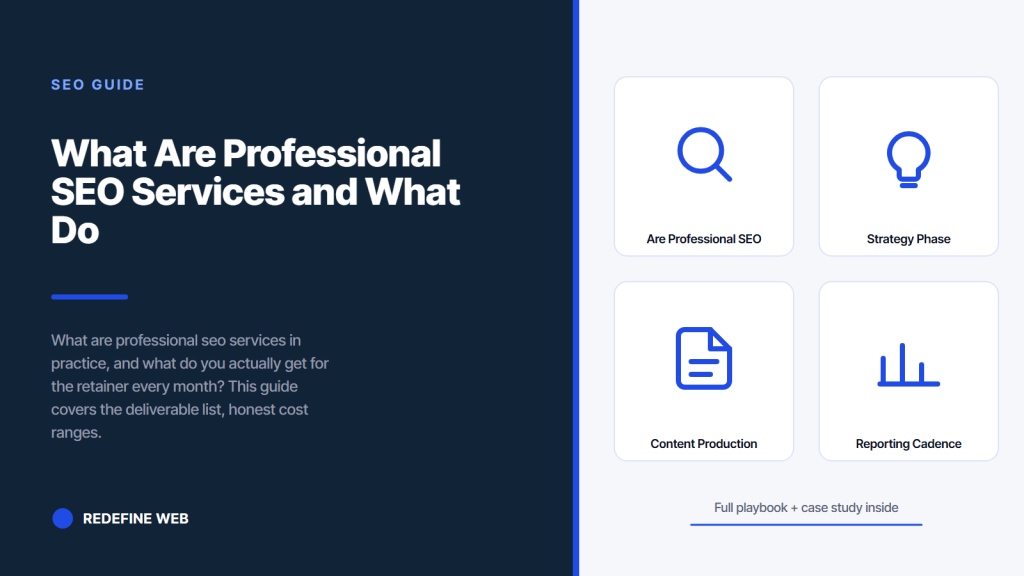
- Professional SEO covers strategy, content, technical, local, and links.
- Real retainers run $800 to $5,000 depending on scope and market.
- Rankings compound over 12 weeks to 12 months of consistent execution.
- Reporting ties booked meetings to organic search, not to impressions.
- Switching agencies inside 6 months is the biggest buyer mistake.
- What are professional seo services made up of
- The monthly deliverable list every seo retainer should include
- How much do professional seo services cost per month
- The strategy phase before any content or links get produced
- How do professional seo services build local rankings
- Content production inside a real seo retainer
- What professional seo services do not include
- In-house SEO versus hiring an outside team
- How do you evaluate a professional seo services agency
- What is the biggest professional seo services mistake to avoid
- The reporting cadence that keeps a retainer honest
- What are professional seo services worth after 12 months
- Next steps when hiring professional seo services
What are professional seo services in the practical sense? A retainer where an outside team runs the on-page, technical, content, link, and reporting work that pulls a website from page four to the top three in Google for the terms that actually book revenue. Done right, professional seo services produce 40 to 60 percent of qualified leads by month 12 and reduce the cost per booked meeting by half against pure paid search.
This is a buyer guide, not a sales page. The first half covers what a real professional seo services scope includes month by month. The second half covers cost ranges, red flags on agency pitches, how in-house SEO differs from an outside partner, and the reporting cadence a founder or partner uses to hold the retainer accountable. Bring the current Search Console dashboard and last quarter's lead numbers. The framework only makes sense with real data next to it.

What are professional seo services made up of
Professional seo services are a monthly retainer covering keyword research, on-page work, technical audits, content production, local map-pack ranking, review generation, backlink outreach, and reporting tied to booked meetings. A fair scope produces two content pieces, three to five citation fixes, one to two new local backlinks, and one measurable report every month.
What are professional seo services broken into deliverables? Five areas that all move together every month, and the mix shifts by client but the coverage stays consistent.
The retainer scope splits into five deliverable areas that all move together. Content: two blog posts and two service-page rewrites per month. Technical: one schema audit, one Core Web Vitals check, one crawl-error sweep per quarter. Local: weekly Google Business Profile posts, monthly citation audits, review generation setup. Off-page: one to three new local backlinks per month via outreach or press. Reporting: one call, three summary numbers, one page of Search Console data.
What are professional seo services if any one of those five pieces is missing? Half a retainer at full price. A retainer that ships content but no backlinks compounds slowly. A retainer that runs technical work but no content creates a well-crawled but shallow site. A retainer that produces reports but no local work misses 40 to 60 percent of the map-pack opportunity for local firms. All five have to move every month.
The five pieces do not need to be equal in effort. A well-optimized new site with strong content already may spend 60 percent of the retainer on links and reporting. A neglected old site may spend 60 percent on technical fixes for the first quarter. The mix shifts by month, but the coverage stays complete. Ask about that coverage before signing any retainer.
The monthly deliverable list every seo retainer should include
Every professional seo services retainer produces a shared client folder containing the month's work. If a buyer cannot open a folder on day 30 and read what happened, the retainer is running on trust rather than proof. The list below is the minimum a fair $1,500 to $3,000 retainer produces for a professional-services firm or a growth-stage brand.
A working month-30 folder shows dates, files, and receipts. Two blog posts with the actual published URLs, drafted-by attribution, and word count. Two service or scenario page updates with the diff of what changed and why. A citation cleanup log with the five directories corrected and the mismatched name-address-phone data before-and-after. Two review request scripts sent to intake with the count of new reviews generated. One report tying booked meetings to source-mix data.
- Two blog posts, 1,500 to 2,000 words each, targeting commercial or informational queries
- Two service or scenario page updates with schema and internal links
- Weekly Google Business Profile posts and photo updates
- Monthly citation audit and correction across the top 20 to 40 directories
- Review generation setup plus monthly review response management
- One to three new local backlinks via press, sponsorship, or industry contribution
- Monthly reporting tied to booked meetings and map-pack position changes
- One 45-minute review meeting with the partner-in-charge or founder
Firms that skip the review meeting six months in usually stop reading the reports too. That is the moment a retainer goes stale on both sides. Keep the meeting on the calendar for the full 12 months. Small consistent decisions compound. Skipped meetings are what "the SEO stopped working" actually means in most cases where the underlying work was still happening.
How much do professional seo services cost per month
Professional seo services run $800 to $5,000 per month depending on the vertical, the metro, and the number of service lines the retainer covers. Boutique firms and single-location businesses in mid-size markets sit at $800 to $1,600. Multi-location and B2B companies in major metros run $2,500 to $5,000 per month.
Anything under $800 usually means no content and no link work. Weekly Google Business Profile posts and a monthly citation review is worth about $200 in real value. Anything over $5,000 for a boutique firm typically includes services the firm is not ready to consume yet. The middle of the range produces the honest yield curve on a 12-month plan.
What are professional seo services worth compared to paid search on the same terms? Google Ads on a high-intent keyword like "employment lawyer Nashville" clears at $22 to $60 per click. An organic click on the same query costs zero after month 12. A $2,000 monthly retainer producing 15 to 20 organic clicks a day works out to $3 to $4 per click blended, dropping to under $1 by month 24 as the compounding curve steepens.
Cost benchmarks by scope look like this:
| Scope | Monthly cost | Content per month | Time to compounding |
|---|---|---|---|
| Boutique local business | $800 to $1,400 | 2 posts, 2 page updates | 10 to 14 weeks |
| Multi-location or B2B | $1,400 to $2,800 | 4 posts, 4 page updates | 10 to 14 weeks |
| Enterprise or national | $2,800 to $5,000 | 6 to 8 posts, 6 page updates | 12 to 20 weeks |

Two ,500 retainers rarely deliver the same volume. Ask each shop for a monthly deliverable count. If one lists 2 posts and the other 1, the price gap disappears.
The strategy phase before any content or links get produced
Every professional seo services engagement opens with a two-week strategy phase. Skip it and the first quarter of work misses the highest-return keywords. The phase covers keyword research tied to real buyer intent, a competitive audit of the top three ranking domains in the vertical, a technical audit of the client site, and a 90-day content and link roadmap the client signs off on before any writing starts.
Keyword research goes deeper than a Semrush export. Every keyword gets a search intent tag (informational, commercial, transactional), a buyer stage tag (top of funnel, mid, bottom), a difficulty score, and a monthly search volume estimate. The output is a spreadsheet of 80 to 200 keywords ranked by return on effort for the specific vertical. A boutique law firm in a mid-size metro usually finds 30 to 40 keywords worth targeting with dedicated pages in year one.
The competitive audit reads what the top three ranking domains are doing right and wrong for the flagship terms. Page title patterns, on-page word count, schema markup coverage, internal link depth, backlink profile mix, review count and recency, Google Business Profile completeness. The output is a gap analysis showing exactly what the client site has to match and beat inside 12 months to rank at position one to three.
The technical audit catches every issue that would block ranking regardless of content quality. Broken canonical tags, missing schema, duplicate title tags, mobile page speed regressions, crawl errors in Search Console, redirect chains, missing hreflang if the site is multi-region. Every issue gets a severity tag and a fix-by date. Fixing technical baseline in weeks one to three lets content and link work compound uninterrupted from month two onward.
How do professional seo services build local rankings
Local rankings come from three signals working together every month. Google Business Profile completeness and post frequency drive the map pack. Consistent name-address-phone data across 20 to 40 citations builds authority. Review velocity of 5 to 12 new Google reviews per month with recent dates holds the position once earned.
The Google Business Profile is the single-most-important asset for local ranking. A complete profile with weekly posts, correct primary category, 40+ recent reviews, accurate hours, and 20+ photos out-ranks a competitor with a 60 percent complete profile 100 percent of the time. Google's local business structured data guide covers the schema markup component that reinforces the profile signals.
Citation cleanup is the boring work that pays back on every audit. Practices average four to six inconsistencies across the top 40 citation directories on any given day. Yelp says the phone number is (615) 555-0100. The Better Business Bureau lists (615) 555-0101. Google Business Profile lists (615) 555-0100 with a different suite number. Every mismatch dilutes the local ranking signal. Correction takes 2 to 4 hours per month across all directories once a tool like BrightLocal is set up.
Review generation runs on automation, not on the receptionist trying to remember. A tool like Podium or Birdeye sends a review request text 24 to 72 hours after the appointment or consult. The response rate on a text sent inside 72 hours is 4 to 6x higher than a text sent 30 days later. Consistent monthly volume of 6 to 12 new reviews with recent dates carries more weight than 400 reviews all posted 3+ years ago. Google reads review velocity as a trust and recency signal.

Content production inside a real seo retainer
Content is where most professional seo services underdeliver because it is the most visible line item. A retainer that produces one 800-word blog post a month is running about $500 of value on a $1,500 retainer. A retainer producing two 1,500 to 2,000 word posts per month plus two service-page rewrites per month is running full value. The gap between those two scopes is what separates real compounding from a flat traffic curve.
Every post starts with the keyword and search intent, not the topic. The writer looks at the top three ranking pages for the target keyword, notes the subtopics they cover, adds one subtopic they miss, then writes the answer-first structure that AI Overviews and featured snippets extract from. WordStream's content team confirmed the pattern in their 2026 local SEO tips guide where they note that structured, question-driven content compounds faster than opinion pieces.
Service-page rewrites carry more direct revenue impact than blog posts because they sit closer to the buying decision. A rewritten service page with three named client scenarios, honest pricing, and a clear next-step CTA converts organic traffic at 3x the rate of a bare-bones service page. Two service-page rewrites per month across 12 months produces 24 rewritten pages, which is enough to cover every service line a boutique firm delivers.
Case study production is the third content type that gets under-invested. Every 4 to 6 weeks the retainer produces a written case study with a named client, real numbers, and a specific service outcome. Gillette Law Firm, a boutique employment practice we work with, went from six new consults per month at engagement start to 27 new consults per month by month 14. That case study alone pulls 40 to 60 organic visits per month once indexed and ranks for the client-name plus vertical query.
What professional seo services do not include
Every buyer guide should name the scope boundary honestly. A professional SEO retainer at $1,500 to $3,000 per month does not include everything a growing business needs. Naming the exclusions on day one prevents the "why did SEO not fix our conversion rate" conversation in month four.
Not included in a standard SEO retainer: paid ad management (that is a separate PPC scope), full website rebuilds (that is web design), email marketing production, social media content, CRO landing page rebuilds, or on-demand copywriting for sales emails. A retainer that quietly absorbs all of those without adjusting scope stops delivering the SEO work that was actually paid for.
If a firm needs SEO plus PPC plus web maintenance under one contract, the honest structure is a bundled marketing retainer covering all three. Our Professional Services Marketing Retainer starts at $599 per month for solo practices and scales with the number of channels the firm wants running.
Also not included in standard SEO: rank guarantees. No agency can honestly guarantee page-one rankings on a specific date. Google's algorithm updates 4,000+ times per year across the top ranking systems. Any agency selling a guarantee is either buying the rank with tactics that get penalized within 90 days or lying about attribution. Google's spam policies documentation is explicit that no ranking is guaranteed. Walk away from any pitch deck that promises specific positions on specific dates for specific keywords.
In-house SEO versus hiring an outside team
The build-or-buy question comes up on every buyer call. In-house SEO with one detail-oriented marketing lead at 15 to 20 hours per week can match agency results at 40 to 50 percent of the cost through month 12. That math holds if the lead sticks with it. Most in-house SEO plans stall at month four when the marketing lead gets pulled onto a launch or a rebrand.
The signal that in-house is working: the weekly checklist gets done every week for three months in a row. Google Business Profile post on Monday. Citation cleanup on Tuesday. Blog post drafted Wednesday, published Thursday. Local backlink outreach email Friday. Repeat 50 weeks. If any two of those five slots slip more than once a month, the plan is not working and the retainer conversation is due.
The math on hiring an outside team pays back at a specific inflection: the firm is booking 15+ new consults or new customers per month from all channels, and the marketing lead can no longer personally draft blog posts and manage citations and run reviews and pitch backlinks in a 40-hour week. That inflection usually lands between month 8 and month 14 of a growing firm.
The bundle economics work out cleaner too. An outside professional seo services team already owns the content tooling, the citation platform, the backlink outreach system, and the reporting stack. Building that in-house from scratch costs $300 to $500 per month in tool subscriptions alone plus 6 to 8 weeks of set-up time. That fixed cost eats the margin on a $1,200 retainer differential for a boutique firm.
How do you evaluate a professional seo services agency
Ask five specific questions on every intro call and the pattern separates competent from cosmetic agencies. The five questions cover case studies with named clients, monthly reporting samples tied to booked meetings, Google Business Profile handling for suspensions, deliverable volume at the discussed price, and the exit clause plus asset transfer terms.
Competent agencies show up with case studies, deliverable schedules, and honest 12-week timelines. Cosmetic agencies show up with vague promises, generic pitch decks, and rank guarantees that violate Google's webmaster guidelines. The audit conversation reveals which one is on the other end of the call inside the first 10 minutes if the right questions get asked.
Ask for three named case studies with the client name and the specific ranking improvements over 12 months. If the agency says "we cannot share due to NDA" on all three, that is a red flag. Every mature agency has at least one client who agreed to be a named reference. Ask for that reference's phone number and call them for 10 minutes.
Ask what the monthly reporting is tied to. If the answer is "impressions, sessions, and bounce rate," keep interviewing. Impressions are diagnostic, not decisions. A working monthly report shows map-pack position for the flagship term, booked meetings attributed to organic via call tracking, and cost per booked meeting from organic. Everything else is context. Ask for a sample report from a real client with names redacted.
What is the biggest professional seo services mistake to avoid
Switching agencies inside the first 6 months is the biggest mistake. SEO compounds on a 12-week to 12-month curve. Firms that switch at month four because "rankings did not move" restart the compounding clock and burn another 90 days on onboarding. Pick the right agency once, stick with it through month 12, and the compounding math works.
The second biggest mistake is buying on price alone. A $500 monthly retainer produces $500 of work. That is a citation audit, a Google Business Profile post, and nothing else. Real professional seo services start at $800 to $1,000 for a solo practice and go up from there. Below that price the math does not support the deliverable list.
The third biggest mistake is not running call tracking. Without a dedicated organic-search phone number that logs calls as organic in the tracking dashboard, the firm has no honest way to know which channel booked the last 30 meetings. Every monthly report becomes a guess. Install call tracking on day one. CallRail runs $45 a month and returns 20x that in attribution clarity.
The marketing partner who reads three SEO articles on a Sunday afternoon and shows up Monday convinced the whole strategy needs to change is the same partner who signed off on the same strategy two months ago. The right response is agreeing that the articles were interesting and continuing the 12-month plan. Firms that swap strategy every quarter earn zero compounding. Firms that pick a plan and stick with it earn 40 to 60 percent of leads from organic by month 12.
The reporting cadence that keeps a retainer honest
The monthly review meeting runs 45 to 60 minutes on the first Tuesday. Partner-in-charge or founder, marketing lead, and SEO contact review three summary numbers and one page from Search Console. Decisions come out of the meeting. Next month's topic. Review-request script tweak. One citation to correct. One new service page to add. Small consistent decisions compound over 12 months.
The three summary numbers stay the same every month. Map-pack position for the flagship city plus service query. Booked meetings attributed to organic search via call tracking. Cost per booked meeting from organic (retainer cost divided by organic booked count that month). Track those three, and the story of whether the retainer is working or not becomes obvious inside four months.
The one Search Console page shows top-ranking queries by clicks and impressions over the last 30 days versus the prior 30 days. A working retainer moves the queries up steadily. A stalling retainer shows the same queries in the same positions month after month. That signal shows up before booked meetings drop, which gives the firm time to correct course before the phone stops ringing.
The quarterly report layers in the technical audit results, the backlink additions over the last 90 days, the review count trend, and the citation health check. That report runs 45 minutes on the second Tuesday of the first month in each quarter. It replaces the monthly meeting for that specific month. Full year at 12 monthly meetings plus four quarterly reviews equals 16 touchpoints, which is the minimum a working professional seo services relationship needs.
What are professional seo services worth after 12 months
A 12-month professional seo services engagement worth the retainer produces four measurable outputs: 30+ ranked pages, 40 to 60 percent of leads from organic search, 3 to 5x lower cost per lead than paid search, and a compounding traffic curve continuing to grow at zero additional monthly spend for years after.
The compounding math is where the retainer pays back over the following 24 months. A blog post that ranks position two for a commercial keyword generates 30 to 60 organic visits per month indefinitely at no ongoing cost. Multiply that across 24 blog posts and 24 rewritten service pages produced over 12 months, and the compounding curve is 1,500 to 3,000 organic visits per month by month 15, all at zero variable cost.
Paid search on the same intent captures the same volume for $30,000 to $60,000 per month in ad spend forever. The retainer costs $30,000 to $50,000 across the 12-month build. The break-even against paid search lands between month 10 and month 16 depending on the vertical. After break-even every organic click is free until the firm stops publishing.
The final answer to what are professional seo services worth: the retainer that pays itself back inside 12 to 16 months and then compounds for years is the retainer that produces steady deliverables against a fixed monthly scope. The retainer that costs $500 and produces $200 of value is worth negative money because it consumes the founder's attention with no offsetting return. Pick the right scope. Ignore the bargain-basement offers.
Next steps when hiring professional seo services
Pick three actions this week. First, run the current site through a free technical SEO audit (Ahrefs, Semrush, or Google Search Console) and print the top 10 issues on one page. Second, count Google reviews from the last 90 days across every location or partner profile. Third, list every keyword the site currently ranks in the top 20 for and cross-reference against the actual services the firm sells.
Those three inputs are the baseline every agency interview should reference. Show up on the interview call with the printouts. Ask the agency to reference them in their proposal. That single step separates agencies who wrote a real proposal from agencies who copy-pasted the same generic pitch deck to 40 firms this quarter.
The search engine optimization services team at Redefine Web runs a 30-minute audit call reviewing the current site, profile, and Search Console dashboard. The output is a specific 90-day plan handed back within 48 hours of the call. The audit and plan cost nothing. The decision to hire or not comes after reading the plan. Firms that book the audit are typically 60 to 90 days closer to organic-search compounding than firms that spend the same 60 days interviewing agencies.
For firms comparing multiple providers, the shortlist below covers the questions that separate real from cosmetic:
- Three named case studies with client name and 12-month ranking data
- Sample monthly report showing map-pack position, booked meetings, cost per meeting
- Deliverable list matching the retainer price with content volume, links, and reporting spelled out
- Exit clause and asset transfer terms named on page one of the contract
- Reference call available with at least one current client the buyer can talk to for 10 minutes
- Ownership of Google Business Profile and Search Console retained by the client, not the agency
- No rank guarantees anywhere in the sales collateral or contract
Firms already running SEO in-house who want a second opinion on the current plan can also start with a 30-minute audit call. What are professional seo services worth to a firm already producing content in-house? Usually the value shifts from content production to link outreach, technical work, and monthly reporting the in-house lead does not have time to run. The Professional Services SEO service adds those pieces on top of the existing in-house work without duplicating the content production. Oxford Capital ran that hybrid model successfully for 14 months and hit 174 percent organic keyword growth in the same window. For the wider bundled retainer see the Professional Services Marketing hub.
Frequently asked questions
What are professional seo services in one sentence?
Professional seo services are a monthly retainer covering keyword research, on-page work, technical audits, content production, local map-pack ranking, review generation, backlink outreach, and reporting tied to booked meetings. Done right, professional SEO services produce 40 to 60 percent of qualified leads from organic search by month 12 and reduce cost per booked meeting by 3 to 5x compared to paid search on the same intent. The retainer covers execution across all five deliverable areas every month.
How much do professional seo services cost per month?
Professional seo services run $800 to $5,000 per month depending on vertical, metro competition, and the number of service lines the retainer covers. Boutique local firms sit at $800 to $1,600. Multi-location or B2B companies in major metros run $2,500 to $5,000. Anything under $800 typically means no real content or link work. Anything over $5,000 for a boutique firm usually bundles services the firm is not ready to consume yet. The middle of the range produces the honest yield curve.
How long before professional seo services show results?
Local rankings move in 8 to 12 weeks for a new domain and 4 to 6 weeks for an established site. First leads from organic search land in month 2 or 3. Meaningful traffic compounds through month 6. Mature yield of 40 to 60 percent of leads from organic lands at month 12 to 18 with consistent execution across content, citations, reviews, and technical SEO. Firms that hold through month 12 see the compounding payoff clearly.
Can I do professional SEO in-house without hiring an agency?
Yes, if one detail-oriented marketing lead dedicates 15 to 20 hours per week to a consistent weekly checklist covering Google Business Profile posts, citation cleanup, blog publishing, review generation, and local backlink outreach. In-house SEO matches agency results at about 40 to 50 percent of the cost through month 12. The transition to hiring an outside professional seo services team usually pays back when the firm hits 15+ new consults per month or opens a second location.
What is the biggest mistake when hiring professional seo services?
Switching agencies inside the first 6 months is the biggest mistake because it restarts the compounding clock and burns 90 days on onboarding. The second biggest is buying on price alone. A $500 monthly retainer produces $500 of work, typically a citation audit and a Google Business Profile post and nothing else. Real professional seo services start at $800 to $1,000 for a solo practice and scale from there. Below that price the math does not support the deliverable list.
What should be in every SEO monthly report?
Every working SEO monthly report shows three summary numbers plus one page of Search Console data. The summary numbers are map-pack position for the flagship city plus service query, booked meetings attributed to organic search via call tracking, and cost per booked meeting from organic (retainer cost divided by organic booked count that month). The Search Console page shows top-ranking queries by clicks and impressions over the last 30 days versus the prior 30 days.
Book your free 30-minute strategy call.
No spam, no sales rep. We use your email to schedule your call with a senior strategist. That is it.
More from the blog
View all articles → SEO
SEO Organic Search Engine Optimization Services That Grow Real Traffic
Read article SEO
SEO SEO for Pet Groomers That Fills the Appointment Book Weekly
Read article SEO
SEO