
What Does DSO Mean in Dental Practice Ownership
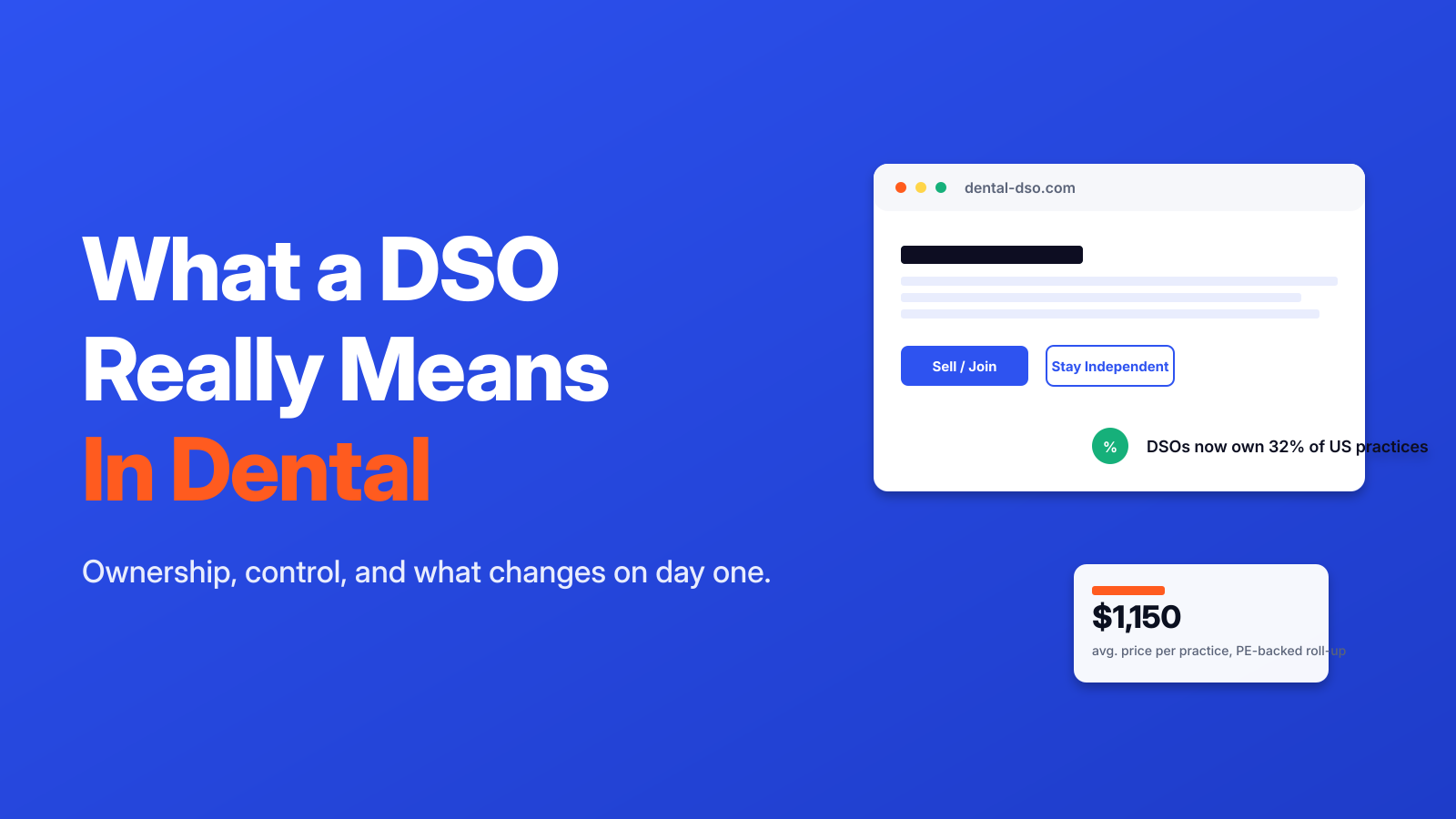
- A DSO, or Dental Service Organization, is a corporate parent that runs shared non-clinical services like marketing, HR, billing, and IT across a group of dental practices.
- Clinical decisions still legally sit with the licensed dentist, which is what separates a DSO from a corporate dental chain in most US states.
- Around 32% of US dental practices are now DSO-affiliated, up from under 9% a decade ago, driven by private-equity roll-up capital.
- Most DSO buyouts pay 5 to 8 times adjusted EBITDA, with 60 to 75% in cash at close and the rest in rollover equity or an earn-out.
- The healthy DSOs to consider have monthly per-clinic P&L reporting, doctor retention past year three, and marketing attribution the local dentist can actually see.
A dental service organization, or DSO, is a company that owns the non-clinical side of dental practices so the dentists can focus on patient care. The DSO handles marketing, HR, billing, IT, procurement, and back-office finance across many clinics at once. Clinical decisions still belong to the licensed dentist under state law, which is why the DSO structure exists in the first place. This piece walks through what a DSO in dental really is, how the ownership split works, why the model is growing, and what changes on day one for a practice that joins one.
What a DSO in dental means in plain English
A dental service organization is the corporate parent that sits above a group of dental practices and delivers shared business services to each one. Think of it as a management company. The DSO does not treat patients, does not diagnose, and does not write treatment plans. It runs the parts of the business that repeat across every clinic, from Google Ads and patient recall texts to payroll and PPO contract negotiation. See the DSO structure and business model breakdown for the full PC and MSO split.
The reason this legal split exists is the corporate practice of dentistry doctrine. Most US states restrict clinic ownership to licensed dentists. A DSO cannot legally own the clinic that treats patients. So the DSO signs a management services agreement with the practice owner, provides the shared services, takes a management fee, and leaves clinical control with the dentist on paper. In everyday operations the DSO often still writes the checks and picks the software, but the license stays with the person holding it.
That growth curve is the reason every dentist under 60 hears the acronym at least once a quarter. What was a fringe model in 2010 is now roughly a third of the market. Understanding the dso dental meaning and what a DSO in dental actually does, and where its authority stops, is table stakes for anyone running or joining a group practice today.
The three-layer structure every dental service organization uses
Almost every DSO you will meet, from Heartland Dental to Pacific Dental Services to Smile Brands, stacks the same three layers. The names change. The shape does not.

Layer one is the DSO parent company. It holds the operating brand, the private-equity capital, the executive team, and the central services teams. Layer two is a professional corporation or PLLC owned by a licensed dentist, one per state in most cases, which formally holds the license and the clinical staff. Layer three is the individual clinic, or a bundle of clinics, tied to that PC through a management services agreement.
Money flows from patient to clinic to PC, then to the DSO as a management fee. Services flow the other way. The DSO markets, hires, negotiates, and reports. The PC keeps the license clean. The clinic sees patients. When a lawyer describes a DSO deal as a friendly-PC or captive-PC model, that is the arrangement being described.
The reason this matters to you as a practice owner is that every operational lever you care about lives in a different layer. Marketing budgets and PPO contracts sit at the DSO. Hiring hygienists and setting the schedule sit at the clinic. Choosing a crown material sits with the dentist. If you join a DSO and later feel squeezed, the fight usually happens on a lever that moved layers without you noticing.
What a DSO does day to day for its practices
The list of services a DSO provides is long, but the pattern is consistent. Anything a solo practice would hire an outside vendor for gets absorbed by the DSO and delivered at scale. Marketing is the biggest visible line item and the one where dental groups either win or waste the most money. Central teams often run Google Ads, local SEO, review management, patient recall texts, and the group website across every clinic at once. That is where our work with Smile Design Dentistry, a Florida DSO with more than 50 locations, sits.
When Smile Design Dentistry came to us, their per-location paid budget was leaking on broad targeting and untracked calls. We restructured PPC accounts, added full-funnel paid social, and built tailored landing pages by clinic. The result was a 20% gain in PPC conversion rate, a 30% drop in cost per call, and clean visibility into which of the 50-plus offices was actually pulling weight. That kind of centralized marketing operations is exactly what a DSO exists to run.
Beyond marketing, most DSOs centralize revenue cycle management, insurance credentialing, group PPO negotiation, IT and cybersecurity, HR and payroll, procurement of consumables and lab work, real estate and lease negotiation, compliance and OSHA training, and a finance function that produces monthly P&Ls per clinic. A well-run DSO turns those functions into a shared service with playbooks. A poorly run DSO turns them into a bottleneck the clinic manager cannot get around.
How a DSO is different from a group practice or a franchise
The three terms get used loosely, but they mean different things. A DSO, a traditional group practice, and a dental franchise each sit on a different point of the ownership-versus-control spectrum. If you are trying to figure out which one you belong to, or which one is knocking on your door, the table below is the fastest way to read it.
| Model | Who owns the clinic | Who controls day-to-day | How marketing runs | Typical exit |
|---|---|---|---|---|
| DSO | Licensed dentist PC on paper. DSO controls economics. | DSO for operations, dentist for clinical. | Centralized. One agency or in-house team across every clinic. | Roll-up sale to a larger DSO or a PE recap in 3-7 years. |
| Group practice | One or a few dentists own every location outright. | Founding dentists. | Usually one internal marketer plus outside help. | Sale to a DSO, or generational transfer. |
| Franchise | Individual dentist owns each clinic and pays a royalty. | Dentist, inside a franchise operating manual. | Franchisor sets the brand. Local marketing is the franchisee’s job. | Sell the franchise unit or the underlying practice. |
| Solo private | The one dentist who works there. | The same dentist. | Whatever the owner has time for. | Sale to a neighbor, an associate, or a DSO. |
The clean tell that a practice is DSO-affiliated, even if it still trades under a local name, is centralized non-clinical control. If the front-desk software, the payroll provider, the group PPO contracts, and the marketing agency are all set at a corporate level the dentist did not choose, that is a DSO relationship. If the dentist can fire the agency next Tuesday without a phone call to a regional VP, it is not.
Why the DSO model exists and who is funding it
DSOs grew for three reasons stacked on top of each other. Dentistry is fragmented, which private equity loves. Fixed costs per clinic keep rising, which pushes solo practices toward shared services. And a wave of dentists in their late 50s and 60s want to sell without walking away from a job market that has few solo buyers left.
Private-equity capital is the accelerant. Most large DSOs today are backed by a PE sponsor that bought a platform practice, layered in central services, and now buys smaller practices as add-ons at multiples of EBITDA. The math is straightforward. A solo practice trades for roughly 3 to 5 times adjusted earnings. A 30-clinic DSO can trade for 10 to 14 times. Every add-on the DSO buys immediately becomes worth more inside the platform than it did on its own. That arbitrage funds the roll-up.
That is why unsolicited offers land in dentists’ inboxes every week. It is not personal interest. It is a spreadsheet that says every clinic added under 5x is worth 12x the next month. If you want the full breakdown of the offers and the mechanics behind them, our piece on DSO dental marketing for multi-location groups lays out how a group actually gets ready to sell or scale.
What changes for a dentist who joins a DSO on day one
A dentist who sells to a DSO usually stays on as an employed provider under a multi-year agreement, most often three to five years, with an earn-out tied to production. The clinical work looks the same on Monday morning. The business decisions do not.
Practice management software often gets migrated to the DSO’s standard, typically Dentrix Enterprise or Denticon. The website is rebuilt on the group template. Google Business Profiles get consolidated under a corporate account so the DSO can manage reviews and posts at scale. Insurance contracts move to the group’s PPO panel, which usually pays better than a solo practice negotiated on its own but limits which plans stay in-network. Staff wages and benefits often normalize to a corporate schedule inside the first year.
The two levers a dentist most misses after joining a DSO are supply choice and hiring speed. Buying gloves and lab work from a preferred vendor is a group decision, not a clinic one. Hiring a new hygienist runs through corporate HR, which can add weeks. Both of those are trade-offs the dentist accepted by signing, but they show up as friction most sellers did not price in during due diligence.
How to spot a healthy DSO vs one to walk away from
Not every dental service organization is worth joining. The gap between the best DSOs and the worst is the difference between a well-run 100-clinic group and a debt-heavy rollup that treats each new practice as a spreadsheet input. Before signing a letter of intent, dentists we work with grade any DSO offer against a short list.
Look at doctor retention past year three. If associate turnover after the initial earn-out is above 25%, something in the operating model is pushing dentists out. Look at clinical decision authority in the offer letter, not the pitch. A healthy DSO puts clinical judgment in writing and does not tie compensation to specific procedures. Look at how the DSO reports to its own clinics. Monthly per-clinic P&Ls with production, collection, adjustment, and new-patient counts are table stakes. If the reporting is quarterly and rolled up, the clinic loses visibility on its own numbers.
Next, check how the DSO handles marketing spend visibility. When a DSO runs paid ads across 30 locations, per-clinic attribution should be clean. Central teams that cannot say which clinic booked which appointment are running the marketing on hope. That is the specific pattern our work fixes for growing groups, from pediatric multi-location groups to emergency dental networks. Marketing without per-clinic reporting is a black box the DSO cannot manage and the dentist cannot trust.
The trade-offs a dentist actually feels after year one
Any honest description of the DSO model has to name the trade-offs. Selling to a DSO frees a dentist from payroll, HR, marketing, and lease renewals. That is real time back. It usually means selling for a mix of cash and rollover equity in the DSO parent, which turns a fully paid asset into a partially liquid one that only pays out on the next sale.
On the plus side, most dentists we talk to see production go up in year one under a DSO, driven by better scheduling, better recall, and marketing that finally has a budget. Wages for hygienists and assistants often stabilize since the group can offer benefits a solo cannot. On the minus side, autonomy on staffing, supply choices, and PPO participation gets narrower. Some dentists trade that autonomy for a cleaner life and never look back. Others rebuy their practice out of a DSO five years later at a premium and swear off the model.
If you are on the fence, the useful test is not whether the DSO model is good or bad in the abstract. It is whether the specific DSO in front of you has a track record of paying earn-outs in full, keeping dentists past year five, and letting individual clinics keep the parts of their identity that drew patients in the first place. Ask the DSO for three references from dentists who joined five or more years ago, and call them. Any DSO that hesitates on that request has already told you the answer.
Where DSOs are headed through 2027
Two shifts are worth watching if you are running a practice today. The first is regulatory. State dental boards in Texas, California, and North Carolina have started scrutinizing management services agreements to make sure clinical control genuinely sits with the dentist. Expect more, not less, of that pressure through the next two legislative cycles. DSOs that lean too hard on operational levers that touch clinical decisions are the ones most exposed.
The second shift is roll-up fatigue. The largest DSOs, from Heartland to Aspen to Pacific Dental Services, are past the easy add-on phase. Multiples for platform practices are still healthy but no longer expanding. The DSOs winning market share now are mid-size regional groups of 20 to 80 clinics that specialize by service line, such as pediatric, orthodontic, or oral surgery groups, and can outmarket a generalist DSO in their vertical. That is where most of the growth for solo dentists selling in 2026 and 2027 is going to come from.
The takeaway for a practice owner reading this is that DSO in dental is not a single answer. It is a menu of ownership models, each with a different cost of freedom. The dentists who navigate it well are the ones who understand the layers, price the trade-offs honestly, and pick the buyer whose model matches the life they actually want to run.
Frequently asked questions about what a DSO is in dental
What does DSO stand for in dental terminology
DSO stands for Dental Service Organization. It is a corporate parent that provides shared non-clinical services, including marketing, HR, IT, and billing, to a group of affiliated dental practices. The DSO does not treat patients. Clinical decisions stay with the licensed dentist under state law.
Some groups use the term DSO interchangeably with dental support organization. The two terms describe the same structure. The distinction lawyers care about is between a DSO, which delivers services under a management agreement, and a directly owned corporate chain, which would violate the corporate practice of dentistry doctrine in most states. Practically, if you see the DSO acronym on a company website, they are describing the management services model.
Is a DSO the same as a dental chain
No. A DSO is a management company that supports a group of legally separate dental practices, each formally owned by a licensed dentist. A dental chain in the traditional retail sense would own the clinics directly, which is illegal in most US states.
The chain feel is real to a patient walking in, since the branding, the software, and the price sheet often match across every clinic. But the underlying ownership is a stack of professional corporations, each holding one or more clinics, tied to the DSO through a services contract. That legal split is what allows a national DSO to operate 500-plus locations without running afoul of state licensure rules.
How much does a DSO pay for a dental practice
Most DSOs pay between 5 and 8 times adjusted EBITDA for a healthy dental practice, with 60 to 75% in cash at close and the rest in DSO equity or an earn-out over three to five years. Smaller solo practices trade closer to 4x. Multi-location groups with strong per-clinic P&Ls trade north of 8x.
The gap between offers is real, and it is driven mostly by the quality of the seller’s books, the specialty mix, and the geography. A practice with clean production reports, low chair turnover, and a specialty line the DSO wants to expand into will pull the top of the range. A practice with mixed personal expenses run through the P&L and heavy PPO dependence will get the bottom. Getting to a top-of-range offer usually takes 6 to 12 months of prep before the LOI stage.
What is the difference between DSO and DPO in dental
A DSO owns the shared non-clinical services and typically takes ownership of the practice economics. A DPO, or Dental Partnership Organization, is a partnership model where the practice owner retains meaningful equity and clinical control alongside shared services. DPOs are usually structured for dentists who want central support without giving up majority ownership.
The trade-off is capital versus autonomy. A DSO writes a bigger check up front and takes control. A DPO writes a smaller check but leaves the seller with more upside on the next sale. For dentists under 50 who still want to build, DPOs and MSOs, or Management Services Organizations, are worth putting on the shortlist alongside DSO offers.
Can I keep my own website and marketing after joining a DSO
Most DSOs migrate every acquired clinic onto a group website and central marketing stack within six months. A few flexible DSOs and DPOs let a strong local brand keep its site, but they still take over the ads, review management, and reporting behind the scenes.
If your local brand is what drives new patients, that migration is worth negotiating up front. Ask for a written commitment to keep the domain, the Google Business Profile owner status, and the local phone number for at least 18 months. Ask how per-clinic marketing performance is reported and how often you get to weigh in on channel mix. A DSO that will not put those answers in writing is a DSO that treats marketing as a corporate lever, not a per-clinic asset.
How do I know if a dental practice is part of a DSO
The clearest signal is a corporate footer or PC ownership disclosure on the practice website. Many DSOs share a common patient portal, a central phone number, or a “dental group” branded parent that shows up on billing statements. If several nearby practices use identical software, layouts, and PPO contracts, they are almost certainly DSO-affiliated.
State dental board licensing records are the definitive check. Every clinic must disclose its owning professional corporation. If the same PC name shows up on 10 clinics across the state, that PC is the captive entity for a DSO. Patients rarely care about the distinction, but dentists evaluating a job offer or a competitor should always run the check.
If your dental group is growing past two locations and starting to feel the operational strain that pushed most owners toward the DSO conversation in the first place, see how we help multi-location dental groups scale marketing without giving up ownership on our DSO dental marketing page.
Book your free 30-minute strategy call.
No spam, no sales rep. We use your email to schedule your call with a senior strategist. That is it.
More from the blog
View all articles → Marketing Strategy
 How Dental DSOs Grow Through Marketing. Tactics That Scale
Read article Marketing Strategy
 Dental DSO Marketing Services. What to Expect From an Agency Partner
Read article Marketing Strategy