
Dental DSO Marketing Services That Grow Patient Volume
- Dental dso marketing services need central attribution first.
- Local brand protection matters at every office in the network.
- PPC and SEO run together for reliable patient volume.
- Reporting cadence should stay monthly, not quarterly.
- Management fee should map cleanly to service delivery.
- Local brand protection in dental dso marketing services
- Reporting cadence for dental dso marketing services
- The dental dso marketing services comparison table
- Case study on dental dso marketing services deployment
- Common dental dso marketing services problems
- Evaluating dental dso marketing services during LOI
- Working with a partner on dental dso marketing services preparation
- Industry sources on dental dso marketing services
- Final read on dental dso marketing services
Dental dso marketing services separate well-run platforms from underperforming platforms as clearly as any single operational category inside the DSO stack. A platform that invests in central attribution, protects the local practice brand at every office, and reports monthly to office leadership delivers real efficiency against solo practice benchmarks. A platform that centralizes brand aggressively, reports quarterly only, and runs paid media with weak attribution capture underperforms against the management fee it charges every practice inside the network. The gap between the two shows up in practice-level P&L data within 12 to 18 months of any affiliation close.
This guide walks the dental dso marketing services stack that a well-run platform actually deploys. Central attribution infrastructure. Paid media (PPC and paid social). SEO across the domain plus every office. Local brand protection at each location. Reporting cadence and dashboard structure. Cost economics against practice collections. And how sellers should evaluate dental dso marketing services capability during LOI diligence before signing. Every number and pattern here traces to platform work our team either watched close or executed directly across 2024 to mid-2026.
Local brand protection in dental dso marketing services
Local brand protection is the single most common area where dental dso marketing services underperform against seller expectations. Sellers spent years building the local practice brand. Central marketing teams often replace that brand with generic platform templates that damage local recognition and review history. Sellers who negotiate written brand protection at LOI hold their local brand equity through the integration cycle. Sellers who trust verbal assurances often watch the local brand fade within 90 days of central rollout while patient reviews drop and local search rankings weaken.
Practice name and signage
Practice name and signage protection means the local practice name stays on the office signage, website URL, and Google Business Profile. Well-run platforms brand each office with the local practice name in primary position and the DSO parent name in secondary position. Poorly-run platforms replace the local practice name with generic DSO branding within 60 days of close. Sellers should negotiate this protection in writing at LOI. The specific written language should require the local practice name at primary position on all patient-facing signage, website, and search listings for at least the length of the seller employment term.
Local Google Business Profile ownership
Local Google Business Profile ownership continues at the office level rather than migrating to central platform management. Central migration typically loses reviews, wipes local history, and resets the profile’s Google authority. This damage compounds because reviews and profile history drive local search rankings which drive new patient acquisition. Sellers should negotiate continued local GBP ownership at LOI. The specific written language should require GBP ownership stays at the office level with practice-name branding preserved through the seller employment term. Central teams can support GBP management remotely without taking primary ownership of the profile.
Website URL and local domain
Website URL and local domain protection covers the practice’s existing domain staying live with the local content preserved rather than redirecting to a central platform domain. Central redirect typically damages the practice’s earned SEO authority because links to the old domain lose their pass-through value if the redirect handling is sloppy. Well-run platforms maintain the local domain with the local branding while adding central platform integration on the back end. Sellers should verify the platform’s plan for the practice domain during LOI diligence and require written commitment to preserve the domain and content through the seller employment term.
Reporting cadence for dental dso marketing services
Reporting cadence for dental dso marketing services should run monthly to office leadership and quarterly to sponsor board. Weekly reporting typically overburdens the office and produces noise without insight. Quarterly-only reporting typically produces weak paid media execution because monthly attention keeps the accounts responsive to changing performance patterns. Monthly is the right rhythm for actionable practice-level reporting that supports office managers in optimizing their team behavior around new patient volume, review capture, and reactivation activity across the calendar.
Monthly reporting content
Monthly reporting should include new patient volume by channel, cost per new patient by office, conversion rate at each funnel stage, review count and rating trends over the month, and marketing spend against budget with variance analysis. Office leadership uses this data to identify weak funnel stages, adjust team behavior on review capture and reactivation, and confirm the marketing team is delivering against expected practice-level volume. Well-run platforms deliver this data in a standardized dashboard format that office managers can read in 15 minutes rather than a 40-page slide deck that nobody reads at the office level.
Quarterly reporting content
Quarterly reporting adds trend analysis over the trailing three months, cohort retention data on new patient lifetime value, cross-office benchmarking against network averages, and capital allocation recommendations for the next quarter. Sponsor board uses this data to confirm platform-level marketing operations are delivering against management fee. Sellers rolling equity should ask to see the quarterly board report format during LOI diligence. Platforms with clean quarterly reporting typically deliver real marketing execution. Platforms with weak or informal quarterly reporting typically hide operational gaps that surface later as underperformance against original acquisition expectations.
Dashboard structure and access
Dashboard structure should surface practice-level metrics first with network-level rollups available on demand. Office managers should have direct dashboard access rather than depending on central team pushed reports. Direct access enables real-time monitoring of marketing performance during the month, which supports faster response to short-term shifts in patient acquisition patterns. Sellers should verify dashboard access permissions during LOI diligence. Platforms that gate dashboard access behind central team gatekeepers typically deliver weaker marketing execution because office managers cannot respond quickly to signals in the data without central intermediation delays that lose value in fast-moving paid media environments.
The dental dso marketing services comparison table
The table below compares well-run dental dso marketing services against underperforming operations across the key categories that matter for practice-level patient volume. Sellers should use these benchmarks during LOI diligence to filter target platforms into the well-run bucket versus the underperformer bucket based on concrete operational data rather than platform pitch decks.
| Category | Well-run platform | Underperforming platform |
|---|---|---|
| Marketing spend | 3-5% of collections | 5-7% of collections |
| Cost per new patient | 150-220 dollars | 280-400 dollars |
| Attribution stack | Full call plus form plus GA4 | Partial or missing |
| Reporting cadence | Monthly to office | Quarterly only |
| Local brand | Preserved with written protection | Replaced within 60 days |
| Local GBP | Office-level ownership | Central migration |
Read the table with fee context in mind. A platform running marketing spend at 3 to 5 percent of collections delivers real efficiency against solo practice benchmarks. A platform at 5 to 7 percent of collections captures the management fee without delivering equivalent value. Sellers modeling post-close economics should target platforms in the well-run column across every category rather than accepting mixed results on the diligence data. Our DSO Dental Marketing for Multi-Location Groups program builds these operational metrics for platforms seeking to move from the underperforming column into the well-run column across 90 to 180 days of central marketing infrastructure work.
Read the local brand and GBP rows carefully. These two rows carry the highest downstream impact on practice reputation. A platform that migrates GBP centrally within 60 days of close typically loses 20 to 40 percent of review history along with the local search authority tied to profile continuity. That damage compounds for 12 to 18 months as new reviews accumulate slowly on the migrated profile. Written protection against central GBP migration is worth negotiating explicitly at LOI even at the cost of small concessions on other terms. The value protection matters more than most sellers appreciate at LOI time.
Read the reporting cadence row with practice manager experience in mind. Practice managers who receive monthly marketing reports optimize their team behavior around new patient volume actively. Managers who receive quarterly-only reports drift from marketing awareness and often miss short-term shifts that hurt patient acquisition. Sellers should verify reporting cadence during LOI diligence by asking to see actual reports from the last 3 months at 3 comparable practices in the target platform. Platforms that produce the reports quickly demonstrate real reporting infrastructure. Platforms that stall on the request typically deliver informal or inconsistent reporting inside the operational infrastructure.
In DSO diligence, ask how the platform preserves the doctor's name on the site. Central rebranding kills patient volume across most affiliations inside 18 months.
Case study on dental dso marketing services deployment
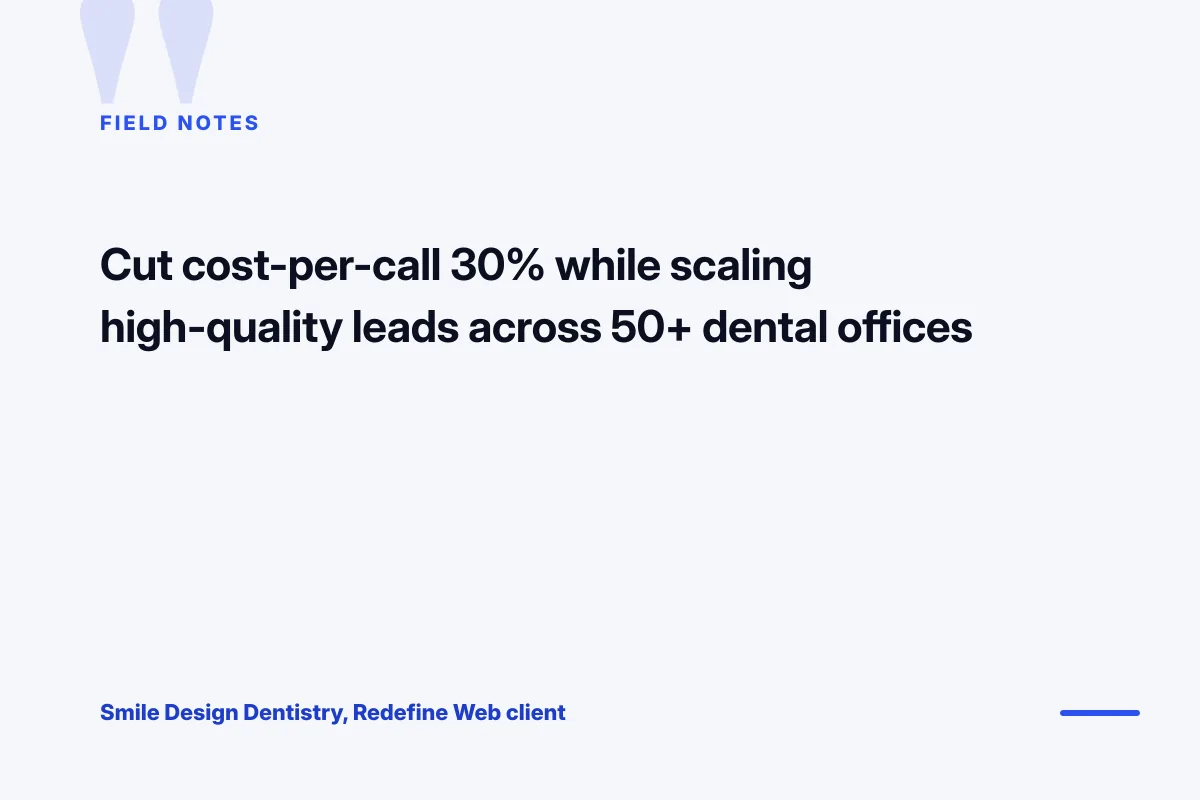
Smile Design Dentistry runs 50-plus locations across Central Florida and Tampa Bay under a mature dental dso structure with a well-run central marketing operation. When our team engaged with the group, the digital marketing operation was fragmented across every office. Each location ran its own PPC accounts and landing pages without central coordination on messaging, budget allocation, or attribution. That fragmentation left roughly 30 percent of the marketing budget captured by duplicate audience targeting and unoptimized landing page flows across the network. This kind of fragmentation is exactly what a good dental dso marketing services team should consolidate.
Our team restructured the PPC accounts by funnel stage and geography inside a central MSO marketing infrastructure. Tailored landing pages went live for each core service line. Full-funnel paid social layered on top of the search program with audience data flowing from a unified attribution stack. Cost per call fell 30 percent across the network within 12 months. PPC conversion rate rose 20 percent year over year. Fifty-plus offices reported on one unified dashboard for the first time with practice-level drill-downs available on demand to office managers running day-to-day office operations across the network.
What this shows about dental dso marketing services
Sellers evaluating dental dso marketing services should ask specifically what central marketing capability produces at the practice level over 12 months. Well-run platforms deliver measurable practice-level results like the 30 percent cost per call reduction and 20 percent conversion rate growth shown above. Underperforming platforms deliver informal or inconsistent results without practice-level attribution data to prove the marketing investment worked. The difference is visible in practice-level P&L data if the sponsor shares it. Our Dental SEO Services team runs comparable central-domain plus per-office SEO work at solo scale for sellers preparing 12 months before market.
Common dental dso marketing services problems
Common dental dso marketing services problems concentrate in a handful of predictable areas that separate well-run platforms from underperforming platforms. Sellers who ask about these areas during LOI diligence surface the operational quality faster than sellers who accept general marketing capability claims. Reading the problems carefully before LOI signing helps sellers filter platforms into the well-run bucket versus the underperformer bucket based on real diligence data rather than platform pitch decks.
Central brand replacement
Central brand replacement happens when the platform swaps the local practice name for generic DSO branding within 60 days of close. Signage changes. Website URL changes. Google Business Profile migrates to central management. Review history often gets lost during profile migration. Sellers should watch for this pattern at LOI diligence and require written protection against central rebrand for at least the length of the seller employment term. Central branding rarely improves patient acquisition for solo practices with strong existing local reputation. It typically damages the local reputation the platform paid for at close through the seller consideration package.
Weak attribution stack
Weak attribution stack means the platform cannot show cost per new patient by office, cannot attribute new patient volume by channel, and cannot demonstrate marketing efficiency versus solo practice benchmarks. Sellers should ask to see the actual attribution dashboard during LOI diligence. Platforms without a mature attribution stack typically capture the management fee without delivering practice-level results because the marketing team lacks the data to optimize spend against actual patient volume. Attribution is the foundation for every other marketing service. Skipping attribution investment leaves the entire marketing operation running on assumptions rather than actual performance data across the network.
Quarterly-only reporting
Quarterly-only reporting produces weak paid media execution because monthly attention keeps the accounts responsive to changing performance patterns. Platforms that report only quarterly typically miss short-term shifts in auction dynamics, seasonal patterns, and competitive pressure that require monthly optimization cadence. Sellers should verify reporting cadence during LOI diligence and require monthly reporting as a written service standard. Reporting cadence is one of the clearest signals of marketing execution quality. Well-run platforms report monthly because the operational data changes monthly. Weak platforms report quarterly because they lack the data infrastructure to support monthly analysis at scale.
Evaluating dental dso marketing services during LOI
Evaluating dental dso marketing services during LOI diligence takes 5 to 7 specific questions that surface operational quality quickly. Sellers who ask these questions filter target platforms into well-run versus underperforming buckets faster than sellers who accept general capability claims from platform pitch decks. The five questions cover attribution stack quality, reference calls with prior sellers, practice-level data transparency, central team tenure, and written brand protection commitments.
Ask to see the attribution dashboard
Ask to see the central attribution dashboard with practice-level drill-downs during LOI diligence. Platforms with mature attribution show the dashboard willingly and walk through 3 practice-level examples in 15 minutes. Platforms without mature attribution typically stall on the request, share screenshots instead of live access, or share data at the platform level only without practice-level drill-downs. Sellers who see live dashboard access with practice-level detail can confirm marketing execution quality directly rather than depending on platform claims about capability that may or may not reflect operational reality across the office network.
Reference calls with prior sellers
Reference calls with three prior sellers about marketing execution post-close surface qualitative context that dashboards cannot show. Prior sellers describe integration experience, central team responsiveness, and practice-level results in ways that filter marketing execution quality clearly. Sellers should ask prior seller references about specific metrics like cost per new patient trends across their first 12 months post-close, review count trends, and local brand protection experience. Consistent stories across 3 references typically reflect real platform behavior. Wildly varying stories typically reflect inconsistent execution that hides average practice-level results behind top-performer or worst-performer anecdotes selectively.
Central team tenure data
Central team tenure data shows platform marketing execution stability. Platforms with senior marketing leadership tenure of 3-plus years typically deliver consistent execution over hold cycles. Platforms with high turnover on marketing leadership typically deliver inconsistent execution because each new leader restructures the operation on their arrival. Sellers should ask for marketing team tenure data during LOI diligence. Platforms that share tenure data willingly demonstrate operational stability. Platforms that dodge the question typically hide high turnover patterns that translate directly into inconsistent practice-level marketing results across the network over the seller employment window.
Working with a partner on dental dso marketing services preparation
Working with a specialist partner on marketing services preparation before market entry builds the attribution artifacts and central infrastructure that buyer QoE teams look for during diligence. Solo practices with 12 months of clean attribution earn top-of-range multiples. Practices without attribution earn bottom-of-range multiples with buyer QoE surprises during diligence. Multi-office groups with central marketing already deployed show buyer QoE teams the exact infrastructure the platform playbook expects, which holds the multiple at the top of the range through diligence review.
Multi-office group preparation
Multi-office groups preparing for DSO conversation should build central attribution across offices 12 to 18 months before market. Central attribution mirrors what a well-run DSO would deploy post-close. Buyer QoE teams pay premium multiples for practices with the infrastructure already in place because they can model the acquisition economics into the platform playbook cleanly. Our Dental PPC Management program installs central PPC infrastructure with per-office attribution and monthly reporting cadence that mirrors DSO operational standards ahead of any serious market process.
Solo practice preparation
Solo practices preparing for their first DSO conversation should build 12 months of clean attribution before opening a buyer conversation. Twelve months is the sweet spot for attribution maturity. Six months is possible but buyer QoE teams discount less mature data. Sellers who did the preparation reported that closing checks came in at the top of the multiple range. Sellers who did not prepare reported closing at the low end with buyer QoE surprises during diligence that further compressed the multiple by another quarter turn during closing.
Post-close integration support
Post-close integration support helps sellers navigate the first 12 months inside the platform’s central marketing operation. Sellers should confirm during LOI that the platform allows the incumbent local marketing partner to remain engaged during a 3 to 6 month transition window. This preserves the local brand protection and gives the seller continuity through the operational transition while the central team observes and understands the local marketing patterns before deploying changes. Well-run platforms welcome this transition period because it reduces integration risk. Underperforming platforms often push aggressive central rollout that damages local marketing performance during the seller employment window.
Industry sources on dental dso marketing services
Industry sources on dental dso marketing services help sellers benchmark platform capability against market standards rather than accepting platform claims about capability at face value. Sellers reading a rotation of two to three primary sources monthly get the clearest picture of what marketing operations should look like at platform scale. Reading the sources over the 12 month preparation window builds the diligence sophistication needed to ask sharp questions during LOI conversations with target platforms.
Group Dentistry Now marketing coverage
Group Dentistry Now at groupdentistrynow.com publishes coverage of platform marketing operations including central team structure, marketing spend as percent of collections, and practice-level results across platforms. Reading their coverage over 12 months of preparation builds the diligence sophistication needed for sharp LOI conversations. Their quarterly marketing benchmarks report gives sellers concrete numbers to hold platforms accountable against during LOI negotiation. This coverage often reveals gaps between what platforms claim during LOI conversations and what their actual practice-level results reflect over hold cycles.
Dentaltown practice management forums
Dentaltown at dentaltown.com hosts practice management forums where practicing dentists share direct experience with specific platforms. Sellers evaluating a platform can search Dentaltown for prior seller commentary on that specific platform’s marketing execution. Practicing dentists share candid views on marketing quality, local brand protection experience, and central team responsiveness that platform business development materials rarely surface. This qualitative context supplements the formal reference call process by adding data points from sellers the platform did not choose as their curated references.
ADA marketing guidance
The ADA at ada.org publishes marketing ethics guidance and clinical advertising standards that apply to dental practice marketing regardless of ownership structure. Sellers should understand these standards because DSO marketing operations must comply with them at every office in the network. Platforms with weak compliance awareness typically produce advertising that runs afoul of state licensing board scrutiny at some point during the hold period. Well-run platforms build compliance review into the creative production process from the beginning across every office in the network.
Final read on dental dso marketing services
Dental dso marketing services separate well-run platforms from underperforming platforms as clearly as any single operational category inside the DSO stack. Central attribution infrastructure. Paid media with weekly optimization. SEO across the domain plus every office. Local brand protection at each location. Monthly reporting to office leadership. Reasonable cost economics against practice collections. Every one of these categories deserves specific LOI diligence questions and written commitments before signing definitive documents.
Sellers who complete this diligence carefully typically land on platforms that deliver on their marketing service commitments over the seller employment window. Sellers who skip the marketing diligence typically discover 12 months after close that the platform captures management fee without delivering equivalent operational value. Marketing operational quality drives EBITDA growth during the sponsor hold, which drives the second-bite math for rolled sellers at the sponsor exit. Solo owners preparing 12 months ahead of market can use our Dental Marketing Retainer at 599 dollars per month to build the attribution artifacts buyer QoE teams will value at LOI negotiation.
Frequently asked questions
What do dental dso marketing services actually cover?
Dental dso marketing services cover the central marketing infrastructure a DSO deploys across every office in the network. That includes central call tracking with a unified attribution stack. Central PPC account structure by geography and service line with weekly optimization cadence. Central SEO strategy across the domain and each office location page. Central creative production for paid social and search assets. Central reporting to one dashboard with practice-level drill-downs. Well-run dental dso marketing services also protect the local practice brand at each office rather than replacing it wholesale. Poorly-run services centralize brand and language in ways that damage the local reputation the platform paid for at close.
How much do dental dso marketing services cost against practice collections?
Dental dso marketing services typically cost 3 to 6 percent of practice collections when delivered through central MSO operations. Solo practice benchmarks run 4 to 8 percent of collections on marketing spend, so the DSO scale delivers meaningful efficiency when the central team runs the marketing well. The cost breakdown covers roughly 40 to 50 percent on paid media budget, 15 to 25 percent on creative and copy production, 10 to 15 percent on attribution stack licensing, 10 to 15 percent on central team salaries, and 5 to 10 percent on tooling and reporting infrastructure. Sellers should model these percentages against their existing marketing spend during LOI diligence to preview the post-close economics.
What attribution stack should dental dso marketing services deploy?
Dental dso marketing services should deploy a call tracking platform (CallRail, CallTrackingMetrics, or Invoca), a form fill tracking layer (HubSpot, Marketo, or a lightweight custom tag), a GA4 property with proper conversion event mapping, and a data warehouse layer that consolidates practice-level data for cross-office reporting. The full stack costs 3,000 to 8,000 dollars per month at 20 to 50 office scale depending on tooling choices and integration complexity. The stack pays back within the first 6 months through better spend allocation across offices and clearer read on which channels produce actual new patient volume versus vanity metrics.
How do dental dso marketing services protect local practice brand?
Well-run dental dso marketing services protect local practice brand through three practices. First, keep the local practice name and identity on the office signage, website, and paid ad creative rather than replacing with generic DSO branding. Second, allow each office to retain distinctive local language and voice on their office landing page rather than forcing central copy templates. Third, preserve the local Google Business Profile with continuous ownership rather than migrating to central management that loses reviews and local history. Sellers should confirm these three protections in writing at LOI. Verbal assurances rarely hold when the integration team arrives with a central branding playbook.
What reporting cadence should dental dso marketing services follow?
Dental dso marketing services should report at monthly cadence to office leadership and at quarterly cadence to sponsor board with practice-level drill-downs available on demand. Monthly reporting includes new patient volume by channel, cost per new patient by office, conversion rate at each funnel stage, review count and rating trends, and marketing spend against budget. Quarterly reporting adds trend analysis, cohort retention data, and cross-office benchmarking. Sellers should ask specifically about reporting cadence during LOI diligence. Platforms that report only quarterly typically deliver weaker service execution because monthly attention keeps the paid media accounts optimized against changing performance.
How do I evaluate dental dso marketing services during LOI diligence?
Evaluate dental dso marketing services during LOI diligence with five specific questions. First, ask to see the central attribution dashboard with practice-level drill-downs so you can review data structure and depth. Second, ask for reference calls with three prior sellers about marketing execution post-close. Third, request practice-level marketing spend and new patient volume data for at least six comparable practices in the platform. Fourth, confirm the central team's tenure and turnover rate because marketing execution suffers with high team turnover. Fifth, get the local brand protection written into the definitive documents. Platforms that resist any of these five should drop off your bidder table.
Book your free 30-minute strategy call.
No spam, no sales rep. We use your email to schedule your call with a senior strategist. That is it.
More from the blog
View all articles → Digital Marketing
 Dental Marketing Tips That Compound Into New Patients
Read article Digital Marketing
 Ecommerce Marketing Strategies That Drive Real DTC Revenue
Read article Digital Marketing