White label SEO services let a growing marketing agency add search engine optimization to its lineup without hiring an in-house SEO team. You white label the delivery, put your brand on the reports, and keep the client relationship intact. A white label SEO agency handles the technical audits, content production, link earning, and monthly reporting behind the scenes. Your account manager stays the face of the work. Done right, this partnership can push margins past 55% and keeps headcount flat.
This guide covers what white label SEO services should include in 2026, real partner pricing bands, the six delivery workstreams that separate a serious partner from a reseller markup, and the shortlist process that keeps you from signing a bad 12-month agreement. It is written for agency owners, growth leads, and account directors weighing an in-house SEO build against a white label partner. Skim to the pricing table for a fast answer or read straight through in about 12 minutes.
What white label SEO services actually deliver for your agency
White label SEO services cover the full delivery stack an in-house SEO team would run, packaged so your agency can resell it under one brand. The partner does the work. Your team owns the client. Deliverables land in your inbox on a fixed cadence, get reviewed inside 48 hours, then forward to the client with your logo and voice.
The standard scope includes a technical audit at kickoff, an ongoing content roadmap, monthly on-page optimization, link earning, local SEO for multi-location clients, and monthly performance reports. Some partners bundle digital PR or conversion-rate work at the upper tiers. The point of a white label SEO agency is fulfillment depth, not add-on fluff. You want a partner that can staff a mid-market retainer 90 days out, not one that recycles a template deck.
Two things matter more than the surface scope. First, staffing model. A real partner puts senior leads on retainer accounts and juniors on the reseller tier. Ask who owns your account and how often that person changes. Second, reporting infrastructure. You need branded PDF exports, a shared dashboard, and monthly numbers that survive a client CFO questions. If the partner cannot produce a sample report in your brand within a week, they are not built for scale.
The gap between a white label SEO agency and a plain reseller is depth. Resellers pass work to freelancers and mark it up. A partner runs a full delivery bench, holds client SLAs, and can defend a technical decision on a call with the client dev team when you loop them in. That difference shows up in retention and margin nine months into the contract.
White label SEO services pricing bands, margins, and volume economics
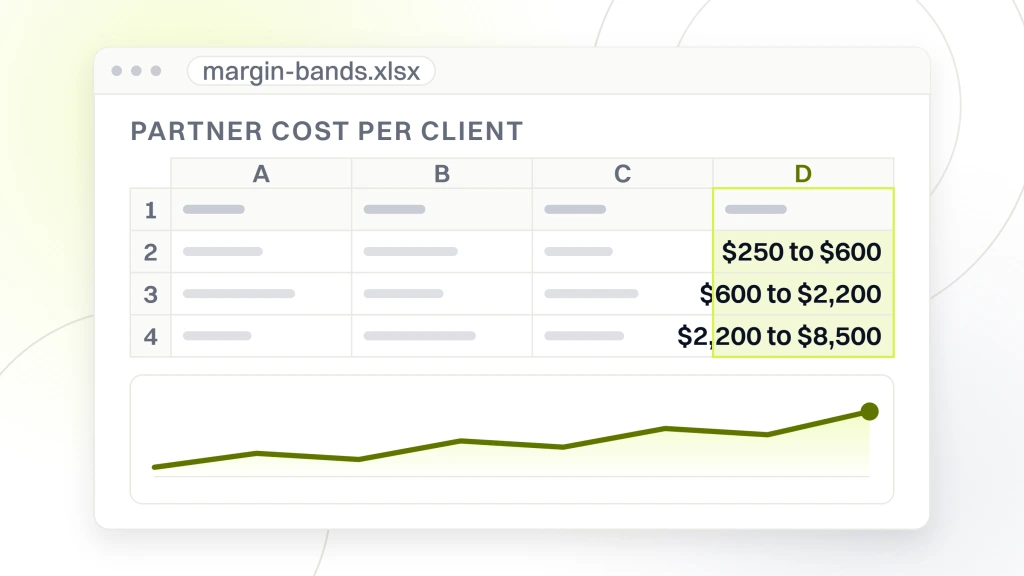
White label SEO services partner pricing lands in three bands in 2026. Entry runs $250 to $600 per client per month for reseller-tier packages. Mid runs $600 to $2,200 per client per month for custom SMB retainers. Upper runs $2,200 to $8,500 per client per month for mid-market and enterprise accounts. Your markup to the end client sits at 40% to 120%, driven by your agency positioning and the vertical you serve.
| Band | Partner cost per client | Your retail to end client | Typical margin |
|---|---|---|---|
| Entry (reseller) | $250 to $600 | $500 to $1,500 | 50 to 60% |
| Mid (custom SMB) | $600 to $2,200 | $1,500 to $4,500 | 55 to 65% |
| Upper (mid-market) | $2,200 to $8,500 | $4,500 to $18,000 | 50 to 55% |
Margin math on white label SEO services works when your agency clears $1,500 to $4,000 per client per month after paying the partner and covering internal account labor. That threshold usually needs 15 to 40 clients running concurrently to justify a dedicated account manager on your side. Below 15 clients, account management labor eats the margin. Above 40 clients, you need a second account manager and process discipline. The volume ladder decides whether white label SEO services pay off or bleed cash quietly.
Upsell lanes and margin expansion
The upsell lanes inside a white label SEO services program are content velocity, link earning add-ons, digital PR, and geographic expansion for multi-location clients. Each upsell adds $500 to $8,000 per month per client at 45 to 60% margin. Agencies that build the upsell motion into onboarding earn 30 to 60% more margin per client than agencies running flat retainers. Set the upsell menu at partnership kickoff and price each lane explicitly, so an account manager can move a client from mid to upper in one conversation instead of a rebuild.
Where margin drains fast
Two patterns drain margin fast. First, scope creep. A client asks for one extra blog post, one more competitor teardown, one small PR pitch, and the partner honors it. Nine months in you are 20% underwater on that account. Second, reporting rework. If your partner default report looks nothing like your brand, your team ends up rebuilding decks every month. That is 4 to 6 billable hours per client, per month, going into slide surgery instead of client strategy. Fix both at kickoff with a signed scope doc and a branded-report template.
The six workstreams every white label SEO agency should own end to end
A credible white label SEO agency owns six workstreams at delivery depth. Skip one and the partnership stops holding client SLAs inside two quarters. Ask for sample deliverables from each workstream before you sign anything.
Technical SEO and site health
The kickoff audit maps crawl issues, indexation gaps, Core Web Vitals problems, schema coverage, and internal link structure. The partner then holds monthly site-health sweeps that catch drift before it hurts rankings. If the audit deck runs 12 pages of screenshots and no fix priorities, that is a bad sign. You want ranked, tagged findings with dev-ready tickets, not a screenshot dump.
Content strategy and production
Keyword mapping, editorial calendar, cluster architecture, and 4 to 12 pieces of long-form content per month depending on tier. The partner writes to your voice guide, which means you need to hand one over on day 1. Content workstreams live or die on brief quality. A partner that publishes without a signed brief is going to embarrass you inside 90 days.
On-page optimization
Title tags, meta descriptions, header structure, internal linking, and schema markup on new and existing pages. This is the highest-impact workstream in the first six months of any account. Look for a partner that can produce 40 to 80 on-page edits per client per month, staged inside your CMS or delivered as a ready-to-paste change log.
Link earning and digital PR
The partner earns 4 to 12 links per client per month through pitched-in-relationship placements, HARO-style responses, and data studies. Ban partners that rely on PBNs or paid guest post networks. One toxic link at scale can undo six months of ranking gains. Anything cheaper than $150 per link is almost certainly recycled.
Local SEO for multi-location clients
Google Business Profile optimization, citation cleanup, review generation flows, and location-page architecture. Local is where multi-location clients see the fastest ROI, so a partner without a local practice is going to leave revenue on the table for you and your clients. Ask how many locations they manage in aggregate. A partner running under 200 total locations across their book is not operational at scale.
Reporting and account management support
Branded monthly reports, live dashboards, and a shared Slack or project channel. The partner should give your account manager the numbers they need to run a client review meeting cold, with no prep. If your team is rewriting the story every month, the partner has the wrong reporting model.
Partnership models, communication cadence, and roles that survive 24 months
The white label SEO services partnership model that works looks the same at every scale. Your agency owns the client relationship. The partner owns delivery. One shared Slack channel and a weekly 30-minute sync coordinate handoffs. Break any of those three and the partnership erodes inside a quarter, usually through missed check-ins first, then through missed deliverables.
Cadence that holds
Weekly 30-minute sync between your account manager and the partner project lead. Monthly 60-minute review covering pipeline metrics across all shared clients. Quarterly 90-minute business review covering partnership health, churn signals, and expansion. When any cadence slips two weeks in a row, escalate to leadership on both sides. Partnerships do not fail from one bad month. They fail from six weeks of silence that no one names.
Roles with clean handoffs
Your account manager runs the client kickoff and the quarterly review. The partner project lead runs the technical audit, content calendar, and monthly deliverables. Deliverables land in your account manager inbox on a fixed cadence, get reviewed inside 48 hours, then forward to the client with your branding. Set an escalation path at kickoff. A content-quality complaint goes to the partner editorial lead inside 24 hours. A technical miss goes to the partner tech lead inside 48. A billing dispute goes to leadership on both sides inside a week.
Contract shape
Master services agreement plus per-client statements of work. 90-day out clauses on the SOWs, not the MSA. That structure lets you switch a struggling client to a different tier or another partner without unwinding the whole relationship. Written performance thresholds tied to reporting metrics, not vague best-efforts language. Read the FTC small business guidance before signing any partnership that touches client billing, so you know where your obligations sit if the partner misrepresents deliverables to your end client.
How to shortlist a white label SEO agency in 6 to 10 weeks
Shortlist 5 to 8 white label SEO agency candidates, request written proposals from all of them, run reference calls with the top 3, and negotiate the final 2. Skipping reference calls is the shortcut most agency owners take, and it is the reason most partnerships fail inside 12 months.
Week 1 to 2 covers longlist research. Pull from public rankings, agency directory listings, and referrals from other agency owners you trust. Compare each candidate against your target tier. A partner built for the entry band is going to struggle at mid-market. A partner built for enterprise is going to price the entry band out of your reach.
Week 3 to 4 covers RFP and written proposals. Ask each candidate for a sample audit, a sample content brief, and a sample monthly report in your brand. Timebox them at two weeks. Any partner that misses that deadline is telling you how they will handle client SLAs.
Week 5 to 6 covers reference calls. Ask each candidate for three current agency clients on the tier you want. Talk to all three. Ask about communication cadence, escalation history, and whether they would re-sign for another 12 months. If a partner will not provide references, walk away. If two of three references hedge on the re-sign question, walk away.
Week 7 to 10 covers pilot design. Sign a 90-day paid pilot with your top 2 candidates on 2 to 3 clients each. Compare the pilots on delivery quality, communication, and client satisfaction. Then commit to the winner with a 12-month MSA. That comparison window is the single best predictor of partnership success at 24 months.
For a deeper dive on how we vet partner shortlists, see our guide to the best search engine optimization services and the shortlist criteria we use when clients ask us to compare vendors.
What real white label SEO services results look like
The numbers on a strong white label SEO services program compound over the first 18 months and stay compounding well past the 24-month mark. Two examples from our own book show what the trajectory looks like when the six workstreams get executed cleanly.
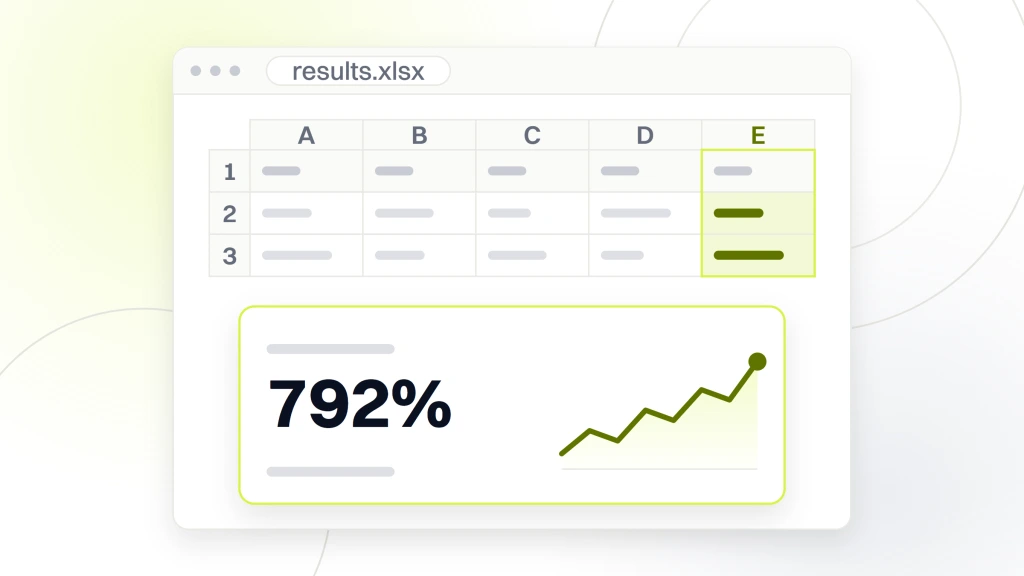
A New Jersey business intelligence consultancy grew website traffic 792% from 2023 to 2024. It had no marketing team, so we redesigned the website, set up Insightly CRM with email automation, and built landing pages, content and sales collateral. The gain was not a single-tactic win. Marketing qualified leads rose 450% over the same stretch as the pieces worked together.
Gillette Law Firm ran a longer arc. Over a 36-month window, organic traffic grew +48,233%. That number reads like a typo, but it is what happens when a partner sticks with a compound-growth playbook for three years. Content depth, topical authority, and technical hygiene stacked over 36 months hit orders of magnitude that no six-month sprint touches.
Both cases share a pattern. The partner ran all six workstreams in parallel, held cadence for the full term, and reported in numbers the client finance team could defend. That is the shape of a white label SEO services program that pays off for both your agency and the end client. For a walk-through of how we scope similar programs, see our search engine optimization audit services guide.
Common failure modes on white label SEO services partnerships
Most white label SEO services partnerships fail in one of four ways. Watch for these signals in the first 90 days and correct fast.
First, staffing swaps. Your first project lead was a senior, the second was a mid, and by month four you are getting deliverables from a junior. Some rotation is normal. Two swaps in six months is a red flag. Ask the partner to name a senior lead and put that name in the SOW.
Second, reporting drift. The first three monthly reports were tight and defensible. By month six they are a template with the numbers dropped in. That drift means the partner has stopped thinking about your account. Push back and demand analyst commentary, not just metric dumps.
Third, scope elasticity. Every client request gets a yes with no scope adjustment. Nine months in, the partner is underwater on your book and quality collapses across every account. Fix this with a written scope-change process that any yes over 30 minutes of work triggers.
Fourth, silence. Weekly syncs get canceled, monthly reviews slip, and quarterly business reviews get rescheduled to the next quarter. Silence is the single strongest predictor of partnership failure. When a partner goes quiet, you have 30 to 60 days to reset the relationship or start a fresh RFP with a different provider.
Build your white label SEO services partnership right the first time
A well-run white label SEO services partnership sits between $250 and $8,500 per client per month at the partner cost line, produces 40 to 120% markup for your agency, and clears the six-workstream bar every month for 24 months without staffing swaps or reporting drift. Get the shortlist right, run a 90-day paid pilot with two finalists, and sign a 12-month MSA with per-client SOWs that give you 90-day out clauses.
If you are weighing partners now, or you want a benchmark against how we deliver full-service search engine optimization services ourselves, we can walk you through the vendor scorecard we use internally when clients bring us into their partner selection. Book a discovery call and we will pressure-test your shortlist against the six-workstream bar, the pricing bands, and the retention math above.
What are white label SEO services and how do they work? White label SEO services are a delivery model where a specialist SEO partner runs technical audits, content, links, local SEO, and reporting behind the scenes, and your agency puts its brand on the deliverables. Your team owns the client relationship. The partner stays invisible. You pay the partner $250 to $8,500 per client per month depending on tier, then bill your end client at a 40 to 120% markup. It is how agencies add SEO to a service lineup without hiring an in-house team.
How much do white label SEO services cost in 2026? White label SEO services cost $250 to $600 per client per month at the entry reseller tier, $600 to $2,200 at the mid custom-retainer tier, and $2,200 to $8,500 at the upper mid-market and enterprise tier. Your retail markup to the end client runs 40 to 120% on top of the partner cost. Margin math works cleanly once you are running 15 to 40 clients concurrently, which is the volume threshold that pays for a dedicated account manager on your side.
How do I shortlist a white label SEO agency without wasting a quarter? Run a 6 to 10 week shortlist. Weeks 1 to 2 for longlist research, weeks 3 to 4 for RFP and sample deliverables, weeks 5 to 6 for reference calls with three current agency clients, and weeks 7 to 10 for a paid 90-day pilot with your top 2 finalists on 2 to 3 clients each. Then sign a 12-month MSA with the winner. Skipping reference calls is the shortcut most agency owners take, and it is the top predictor of partnership failure inside 12 months.
What margin should I expect on white label SEO services? Typical margin on white label SEO services runs 50 to 65% across the three tiers, with the mid custom-retainer band clearing the highest margin at 55 to 65%. Your net after account-management labor sits at $1,500 to $4,000 per client per month once you are at 15 or more concurrent clients. Add upsell lanes for content velocity, link earning, digital PR, or geographic expansion, and margin per client climbs another 30 to 60%.
What is the difference between a white label SEO agency and an SEO reseller? A white label SEO agency runs a full in-house delivery bench with senior leads, technical SEOs, editors, and dedicated project managers. A reseller passes your work to freelancers or a third-party fulfillment shop and marks it up. The gap shows up in retention. Agencies working with a real white label SEO agency retain 85 to 92% of their clients past 12 months. Agencies working with resellers retain 55 to 70%. Fulfillment depth is the difference.
How long until white label SEO services show client results? Client results on a strong white label SEO services program start showing in months 4 to 6 for local and long-tail keywords, months 6 to 9 for competitive commercial terms, and months 12 to 18 for compound organic traffic growth. A New Jersey BI consultancy we worked with grew website traffic 792% from 2023 to 2024. Gillette Law Firm compounded to +48,233% over 36 months. Set client expectations at kickoff around the 6-month and 12-month benchmarks, not a first-month spike.
Can a small agency profitably run white label SEO services? Yes, but the math is tight until you hit 15 concurrent clients. Below that, account-management labor eats 30 to 40% of the retainer margin. Between 15 and 40 clients, you are at the sweet spot for one dedicated account manager and clean margin. Past 40 clients, you need a second account manager and process discipline. Start by adding white label SEO services to 3 to 5 existing clients as a pilot, then scale into the 15 to 40 band over 12 to 18 months.