5.0 · verified April 2026
"They kept the process simple and focused. Understood our goals as a dental practice and stayed focused on improvements that would make the website and ad campaigns more effective."

Ecommerce marketing retainer that runs on-store SEO, Klaviyo flows, Google Shopping, Meta, Amazon, TikTok Shop, and product-page CRO for your DTC brand. DTC marketing retainer and Shopify marketing retainer from $599 per month with quarterly reviews built in, cancel with 30 days notice.
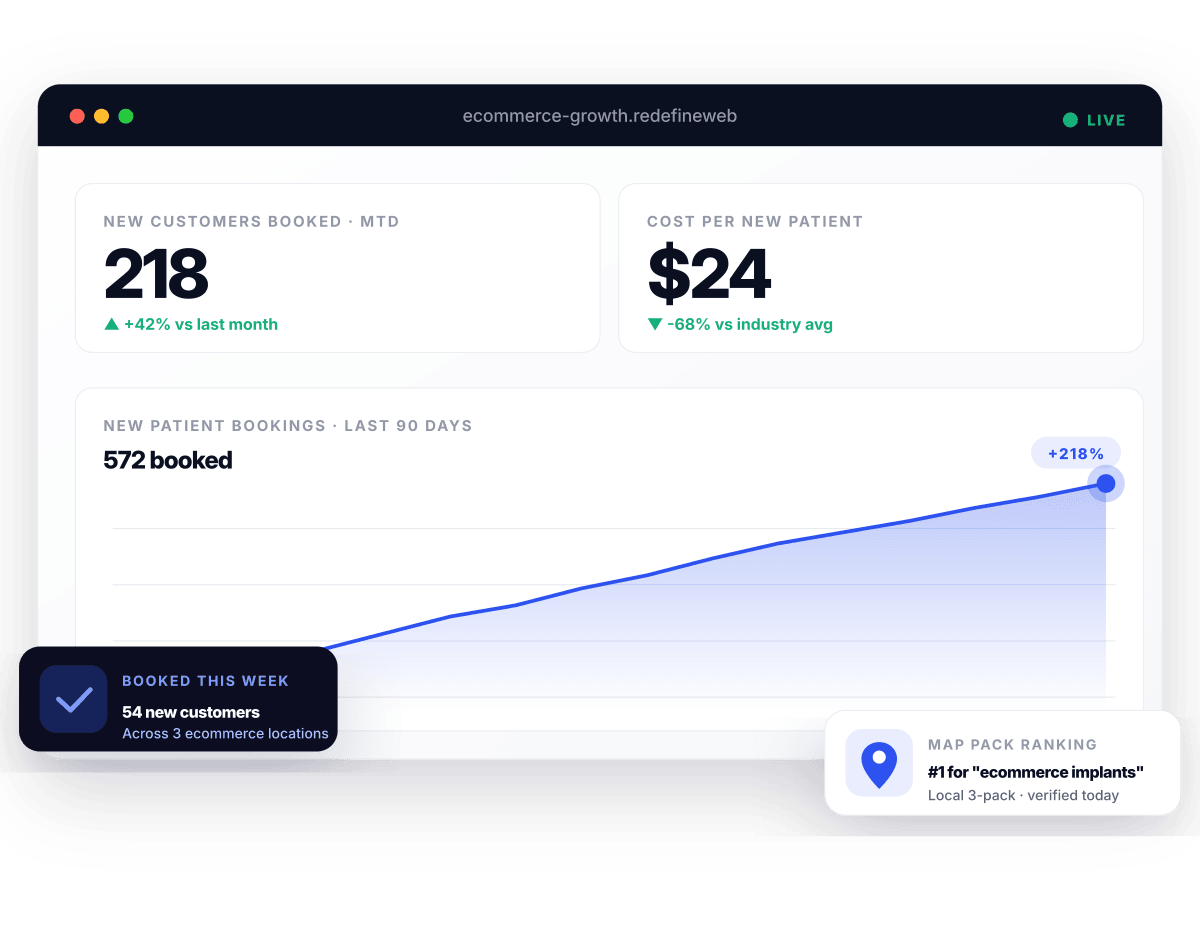


























Nothing here is "reach" or "impressions". Every outcome maps to an order placed, an AOV point gained, or a CAC-to-LTV ratio that holds.
Google Shopping, Meta, TikTok Shop, and Amazon running from the same plan with server-side tracking and CAPI in place. Every order carries a channel, campaign, and margin tag so you know where CAC is holding and where it is losing money.
Welcome, browse abandon, cart abandon, post-purchase, winback, and replenishment set up and A/B tested monthly. Retainer clients typically see email + SMS drive 28 to 42 percent of order volume by month four.
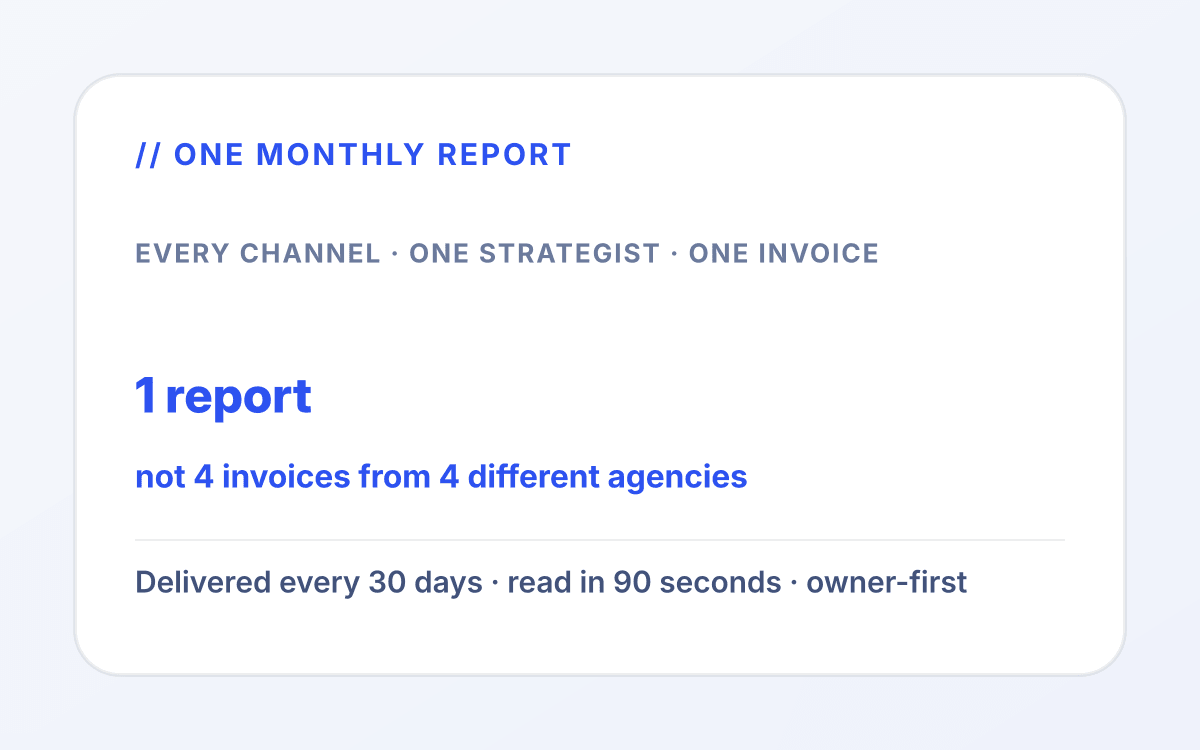
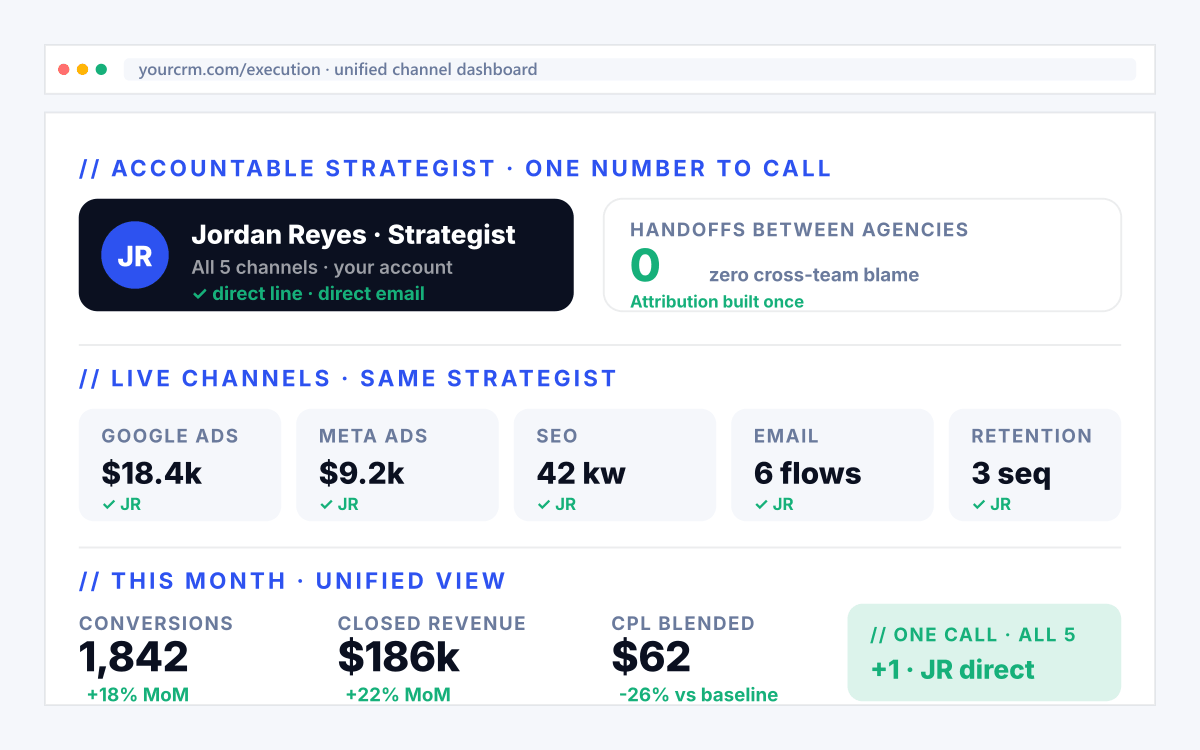
You stop paying five vendors and getting five conflicting spreadsheets. A DTC growth strategist owns the roadmap, pushes the work live, and shows up on the monthly call with what moved on orders, AOV, and CAC to LTV.
Pick the tier that matches your brand stage. Move up or down anytime with 30 days notice. Ad spend billed separately at pass-through. Hover any feature name for a plain-English explanation.
Solo DTC brands that want an accountable growth program running without a five-vendor stack. On-store SEO, Klaviyo core flows, product CRO patches, and reporting, run monthly.
Growing DTC brands ready to add Google Shopping, Meta prospecting, product-page tests, and a monthly winback campaign on top of the Foundation stack.
Multi-channel DTC brands running Amazon, TikTok Shop, or a subscription program alongside DTC. Adds marketplace management, subscription mechanics, and retention sequences.
Multi-region storefronts, brands doing $500K+ monthly revenue, or category-defining DTC that wants marketplace management at scale plus a dedicated DTC growth strategist.
Need scope beyond the Scale tier? We also run full-service ecommerce marketing retainers from $4,000/mo for brands with larger media budgets, multi-region storefronts, or dedicated marketplace programs.
Tap any section to expand or collapse. Hover a feature name for a plain-English explanation.
| Feature | 01 · Foundation | 02 · GrowthPopular | 03 · Scale | 04 · Enterprise |
|---|---|---|---|---|
| Content pieces per month | 2 | 2 | 4 | 6+ |
| Collection / landing pages | 1/mo | 2+/mo | ||
| Programmatic ecommerce SEO | ✓ |
| Feature | 01 · Foundation | 02 · GrowthPopular | 03 · Scale | 04 · Enterprise |
|---|---|---|---|---|
| Klaviyo core flows | ✓ | ✓ | ✓ | ✓ |
| Winback campaigns | Monthly | Bi-weekly | Weekly | |
| Subscription retention mechanics | ✓ | ✓ |
| Feature | 01 · Foundation | 02 · GrowthPopular | 03 · Scale | 04 · Enterprise |
|---|---|---|---|---|
| Google Shopping management | Up to $5k | Up to $10k | Unlimited | |
| Meta Ads management | Up to $3k | Up to $6k | Unlimited | |
| Amazon Ads management | Up to $4k | Unlimited | ||
| PDP + checkout CRO tests | Monthly | Bi-weekly | Weekly |
| Feature | 01 · Foundation | 02 · GrowthPopular | 03 · Scale | 04 · Enterprise |
|---|---|---|---|---|
| Server-side tracking + CAPI | ✓ | ✓ | ✓ | |
| Blended CAC-to-LTV cohorts | ✓ | ✓ |
| Feature | 01 · Foundation | 02 · GrowthPopular | 03 · Scale | 04 · Enterprise |
|---|---|---|---|---|
| Reporting cadence | Monthly | Monthly | Bi-weekly | Weekly |
| Strategy calls | 45 min/mo | 45 min bi-wk | Dedicated | |
| Dedicated strategist | ✓ |
Every quote is verified by Clutch through a direct call with the client. Reviews shown span our verticals; sector-specific references available on the strategy call.
Engagements where the retainer moved the number that matters. All client-verified.
 E-commerce · SEO + PPC + Web
A Swedish brand offering sustainable, affordable furniture for businesses and individuals. Buy, sell, or optimize spaces with quality pre-owned pieces.
 E-commerce · SEO + PPC + Web
Creator of the first reusable writing tablet in 2009. Pioneer of sustainable digital writing with liquid crystal technology.
If your question is not here, book the 30-minute strategy call. A DTC growth strategist answers on the call, not a sales rep.
An ecommerce marketing retainer at Redefine Web starts at $599 a month for the Foundation tier (solo DTC brands), $999 for Growth (adds Google Shopping and Meta prospecting), $1,499 for Scale (multi-channel: Amazon, TikTok Shop, subscription mechanics), and Enterprise is quoted for brands doing $500K+ a month in revenue. Most brands with $30K to $250K in monthly revenue land on Growth or Scale.
Three real drivers move the price on an ecommerce marketing retainer. SKU count sets how much category, PDP, and collection SEO work is inside the plan. Channel count (Shopify only, or Shopify + Amazon + TikTok Shop + wholesale) drives the ops load. Lifecycle depth (a 4-flow Klaviyo starter versus 40+ flows with SMS, cart, browse, VIP, and winback) is the biggest lever after the first 90 days.
Every tier runs flat monthly with a 6-month initial term. Paid media on Meta, Google, TikTok, Amazon Ads, and Pinterest is billed by the platform directly to your brand's account with no percentage-of-spend markup.
LTV:CAC is the number the ecommerce marketing retainer is built to move, not ROAS. Most DTC brands with a healthy business run at 3:1 or better on 12-month LTV against blended CAC. Below 2:1 you are buying revenue at a loss once you back out COGS, shipping, and payment processing. Above 4:1 you are usually under-investing in acquisition and could grow faster.
The retainer works both sides of the ratio. On CAC: creative diversification on Meta and TikTok, Google Shopping feed hygiene, retargeting exclusions on 90-day buyers, and post-iOS 14 measurement (CAPI, first-party pixel, MMM lite). On LTV: Klaviyo flows built for the second and third order, a subscription offer where the product supports one, VIP tiers, and a browse-history-based winback stack.
Reporting shows blended CAC, 30-day payback, and rolling 12-month LTV per acquisition cohort every month. That layout makes the trade-off between "spend more now" and "let LTV catch up" a decision you can actually make on data, not gut.
First-order economics decide whether a DTC brand can scale on paid or whether it has to lean on organic + retention. The ecommerce marketing retainer runs a first-order P&L per acquisition source every month: revenue minus COGS minus shipping minus payment processing minus paid-media cost equals first-order contribution margin. If that number is positive on any meaningful volume, you can scale. If it is negative, you need repeat purchases to make the customer profitable.
Typical DTC math looks like a $75 AOV, $28 COGS, $9 shipping, $2.50 payment processing, $32 blended CAC. First-order contribution: $3.50. That is the point where retention (repeat purchase within 90 days) has to carry the model. If contribution comes out at negative $10, we push AOV up (bundles, free-shipping thresholds, order-value upsells) or knock CAC down (creative testing, product-page rebuild, better hook rate on cold Meta) before adding spend.
The intro call includes a walk-through of your current first-order economics if you have the numbers, or a modeled version if you do not.
Repeat-purchase rate (RPR) is the leverage point most DTC founders under-work. Healthy DTC brands run 30 to 45 percent 12-month RPR in consumables and 15 to 25 percent in durable goods. Every 5-point gain in RPR usually shifts LTV:CAC by 20 to 40 percent because the second and third order carry no acquisition cost.
The ecommerce marketing retainer moves RPR on four levers stacked together. Klaviyo post-purchase flow segmented by product category (a customer who bought serum needs a different next-touch than a customer who bought hair oil). SMS post-purchase check-in on day 14 tied to product usage. A "replenishment reminder" flow timed to the honest usage window per product (60, 90, or 120 days). And a browse-abandonment reactivation flow for lapsed customers who came back to look but did not buy.
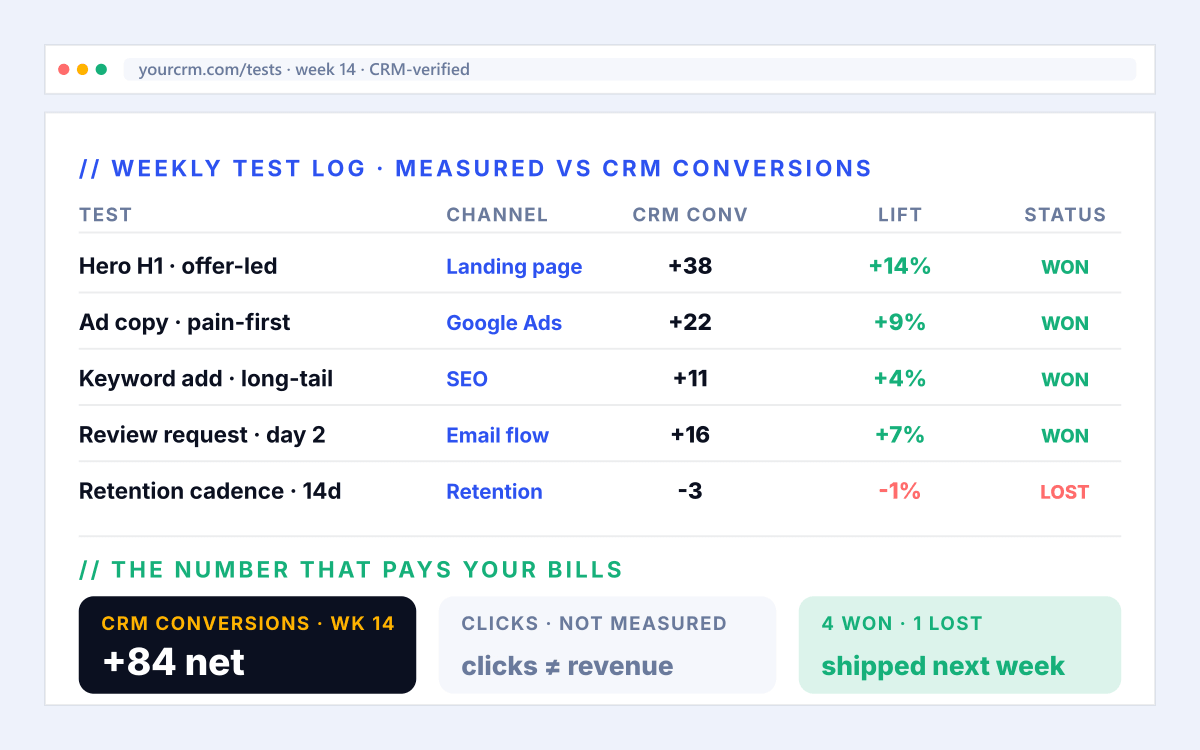
Every flow is measured against control (holdout) so you know the flow itself is producing the gain and not just correlating with organic buying behavior.
All three, with a caveat. Shopify and Shopify Plus are the default. Most of the DTC-native app stack (Klaviyo, Recharge, Yotpo, Postscript, Loop, Rebuy) is built Shopify-first, so Shopify brands ship changes faster and pay less for equivalent functionality. BigCommerce works well for higher-catalog brands (5,000+ SKUs), B2B/B2C hybrids, or brands that need multi-storefront under one admin.
WooCommerce we support but recommend a migration path for brands over $50K monthly revenue. The reasons are honest: WooCommerce needs a technical WordPress operator for stability, checkout speed is slower without significant engineering, and the DTC app ecosystem is thinner. Below $50K, a well-tuned Woo store is fine and cheaper to operate.
Platform choice is a scoping conversation on the intro call, not something we push. If you already run Woo well, we run the ecommerce marketing retainer on Woo. If you are pre-launch, we usually recommend Shopify because time-to-first-sale is faster.
Email and SMS should carry 25 to 40 percent of a mature DTC brand's revenue. Under 15 percent, the lifecycle stack is under-built. Above 45 percent, the brand is usually over-mailing and burning the list. The ecommerce marketing retainer builds Klaviyo (and Postscript, if SMS is in scope) against that target.
Foundation core flows: welcome series, browse abandonment, cart abandonment, post-purchase thank-you, winback at 60 days. Growth adds: browse-to-cart bridge, category-specific browse flows, replenishment, VIP tier onboarding, quarterly campaign calendar (12+ sends a month across newsletter, promo, and story). Scale adds: predictive segmentation off Klaviyo CDP, SMS layered on top of email, sunset flows to protect deliverability, and win-you-back-with-a-sample flows.
Every flow gets AB tested on subject line, hero image, and offer angle. Reporting shows revenue per recipient (RPR) not open rate as the primary KPI, because Apple Mail Privacy Protection made open rate a broken metric in 2021.
Channel mix depends on category, price band, and creative capacity. Most DTC brands with $30K to $250K in monthly revenue land somewhere near a 55/25/20 split (Meta / Google Shopping / TikTok) as a starting point. Beauty, apparel, and lifestyle brands lean heavier on TikTok. Home goods, gifting, and higher-consideration categories lean heavier on Google Shopping.
Meta stays the acquisition workhorse because the algorithm is still the best at finding a cold buyer, especially for creative-driven categories. Google Shopping catches the intent buyer at the bottom of the funnel; if the feed is a mess (Titles too short, GTINs missing, product category miscoded), we rebuild it in week one before scaling budget. TikTok Shop works well if you have UGC volume and a $25 to $65 impulse-buy price band; struggles at $150+ AOV.
Reporting shows blended CAC and incremental CAC per channel (via geo holdouts on Meta and TikTok) so the channel mix decision runs on incremental contribution, not last-click ROAS.
Abandoned cart is not one flow. It is three, and the ecommerce marketing retainer builds them per category. Impulse categories (candles, snacks, low-consideration beauty under $50) get a 1-hour text, 24-hour email with a $5 or 10 percent discount, and a 3-day final touch. Considered purchases ($75 to $250 AOV) get a 4-hour email, 24-hour text with product education (why the product is worth it) instead of a discount, and a 5-day final push. High-ticket ($250+) gets a 24-hour email with a customer story, a 48-hour "any questions?" text from a human-signed sender, and a 7-day close.
Discount inside the abandoned-cart flow is the biggest lever, and also the most misused. Too aggressive and you train customers to abandon on purpose. The retainer runs a monthly holdout test on discount level (no discount, 10 percent, 15 percent, free shipping to test the shipping threshold) to see which converts without cannibalizing full-price orders.
Reporting shows attributed revenue per abandoned-cart sequence, split by device (mobile vs desktop; mobile cart recovery closes faster).
Yes, on the Scale tier and up. Marketplace management runs alongside owned DTC because most brands over $150K in monthly revenue need both channels working. Amazon covers the "search first, brand second" buyer who is going to buy on Amazon whether you sell there or not. TikTok Shop covers the FYP-discovery buyer who converts in-app.
Amazon scope covers Seller Central or Vendor Central account management, PPC (Sponsored Products, Sponsored Brands, Sponsored Display), listing content, A+ content, brand storefront, review generation on the vine program, and Buy Box protection. TikTok Shop covers product catalog, affiliate program, live shopping cadence, and creator seeding.
Retainer reporting rolls up owned DTC, Amazon, and TikTok Shop into one blended CAC and blended contribution margin so channel-shifting decisions run on unit economics, not gut. Marketplace ad spend is billed by Amazon/TikTok directly to the brand.
Yes. Shipping options, the free-shipping threshold, and returns policy sit inside CRO scope, not as a separate line item. Free-shipping threshold testing is one of the highest-leverage AOV moves available. Raising the threshold from $50 to $75 typically pushes AOV up 8 to 15 percent if the product mix supports the anchor. Lowering it from $100 to $75 usually loses AOV; the retainer runs the test rather than guessing.
Returns setup on Loop or ReturnLogic covers the operational side (return portal, exchange-first-refund-second logic, restocking fee decisions) plus the marketing side (a "keep the item, we will refund it" flow for low-cost SKUs where the return shipping costs more than the product). Return rate reporting sits alongside CAC and RPR each month.
International shipping (shipping to Canada, UK, Australia) is scoped separately if you want to open a new region. The retainer handles the market-entry marketing side; a fulfillment partner handles the customs and duties side.
Yes, on Scale and Enterprise. Subscription mechanics live on top of the standard Shopify + Klaviyo stack, and Recharge, Skio, and Ordergroove are the three most common apps. The ecommerce marketing retainer covers subscription page copy, upgrade/downgrade/skip logic in the customer portal, cancellation-flow win-back offers, and the "convert one-time buyers into subscribers" flow at post-purchase.
Subscription math is different. Subscription customers typically produce 4 to 8 times the LTV of a one-time buyer, but only 15 to 35 percent of buyers convert to subscription depending on category. The retainer treats subscription CAC and one-time CAC as two separate P&Ls in reporting, so the trade-off between subsidizing the first-order discount to lock a subscription and taking a smaller margin on a one-time purchase is a real number.
If subscription is not a category fit (durable goods, gifts, one-time-purchase products), we say so on the intro call rather than force it.
Since iOS 14, last-click attribution in GA4 and platform-reported ROAS in Meta both under-count some sources and over-credit others. The ecommerce marketing retainer uses three layers stacked. First-party server-side tagging (Shopify pixel + Meta CAPI + Google Enhanced Conversions) to recover the modeled conversions that platform-side pixels miss. Geo-based holdout tests on Meta and TikTok every 60 days to measure actual incremental contribution, not correlated conversions. And a monthly Media Mix Model lite (backend spend versus new customer revenue plot) that catches the coarse "what is really working" signal quarterly.
None of the three is perfect on its own. Together they give you a defensible incremental CAC by channel that survives a CFO question. Reporting distinguishes attributed revenue (what the platforms claim) from incremental revenue (what the geo tests confirm) so you never scale a channel that ROAS-reports well but isn't really moving units.
Three real differences from most agencies running an ecommerce marketing retainer. Every account gets one DTC growth strategist who has actually run a P&L on a DTC brand, not a rotating generalist who calls a first-order contribution loss "brand-building". Every deliverable ties back to blended CAC, contribution margin, RPR, and rolling 12-month LTV, not last-click ROAS. And the 30-minute intro call ends with three specific fixes we would prioritize on your Shopify (or Woo/BigCommerce) store, your Klaviyo, and your Meta account, yours to keep whether you hire us or not.
Flat-fee monthly, no percentage-of-spend markup. Shopify admin, Klaviyo, Meta Business, Google Ads, and analytics all stay in your name and your logins. Contract is a 6-month initial term with rolling 30-day renewal after that. No procurement gauntlet.
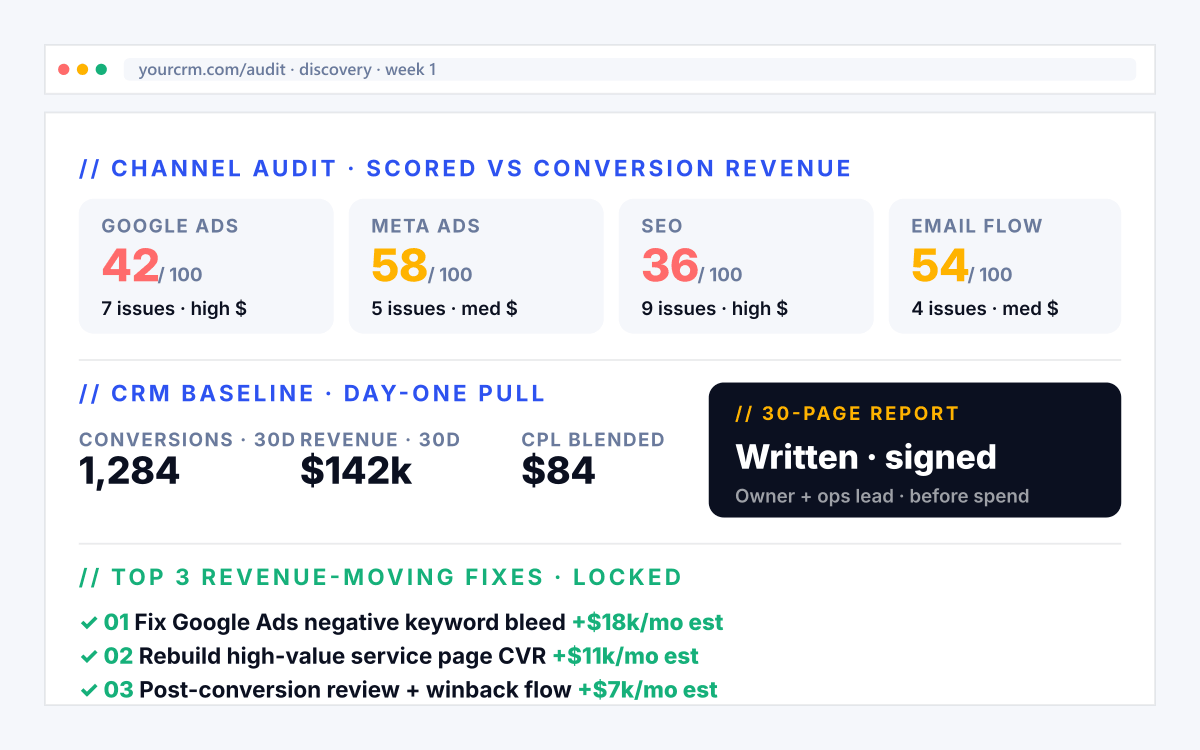
DTC growth strategist on the call. Three specific growth fixes you can apply, with or without us. Written summary in your inbox the next business day.
Drop your email. A DTC growth strategist reviews your store and books the 30-minute audit within one business day.