
AEO for Healthcare (Optimize for Answers, Snippets, and People Also Ask)
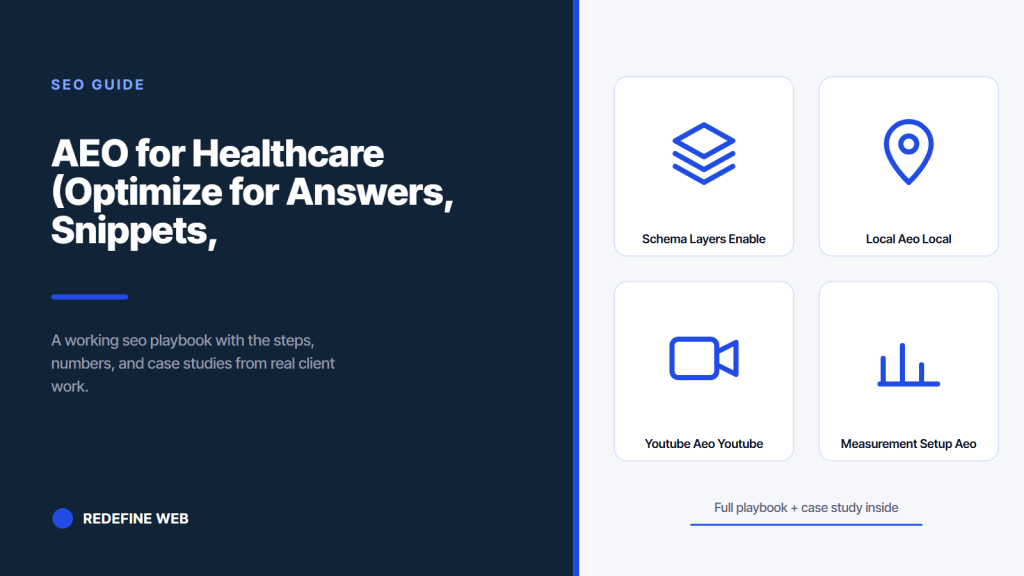
- Four-beat answer paragraphs win featured snippets and PAA.
- PAA harvesting builds a real content backlog fast.
- FAQPage and HowTo schema enable rich result eligibility.
- Match schema text to visible content exactly.
- Measure snippet, PAA, and AI Overview capture weekly.
- Harvesting People Also Ask questions for healthcare seo keywords
- Schema layers that enable aeo for healthcare snippet eligibility
- Pelvic Rehabilitation Medicine case study on aeo for healthcare snippet capture
- Local aeo in local seo for healthcare services how they interact
- YouTube AEO for youtube seo optimization healthcare content
- Measurement setup for aeo for healthcare capture rates
- Content freshness and update cadence for aeo for healthcare
- Where to start on aeo for healthcare this Monday
AEO for healthcare stands for answer engine optimization. It is not a replacement for SEO. It is what SEO turns into when the SERP surfaces featured snippets, People Also Ask, voice-assistant answers, and AI Overviews above the classic organic block. On a typical health query in 2026, a patient sees an answer box, a PAA carousel, and an AI Overview before they scroll to the #1 ranked result. AEO is how you get quoted inside those answer surfaces.
This guide is the practical AEO playbook for a healthcare site. What answer engines actually pick. How to write 40 to 80 word answer paragraphs that get quoted verbatim. How to harvest and answer People Also Ask questions systematically. Which schema layers enable featured snippet eligibility. How to measure the snippet capture rate and iterate. Read straight through in ten minutes. Then run the AEO audit on your top 20 patient-intent URLs.
Harvesting People Also Ask questions for healthcare seo keywords
The PAA carousel is a live directory of the questions patients actually ask Google about your specialty. Harvest those questions and you get a content roadmap that answers real intent instead of guessed intent. Healthcare seo keywords research starts with PAA harvesting for exactly this reason.
Run 20 seed queries in your specialty through Google. Note every PAA question that appears. Click each PAA to expand it. Note the 3 to 5 additional related questions that appear underneath. Repeat until the PAA well runs dry. A single specialty usually produces 200 to 400 distinct patient questions from this exercise. Every one of those questions becomes either a dedicated blog post, a FAQ block entry, or a service page section. Assign priority based on search volume from Semrush or Ahrefs. Write the top 40 first.
PAA harvesting tools that speed the work
AlsoAsked, AnswerThePublic, and Semrush’s Keyword Magic tool all export PAA questions in bulk. AlsoAsked shows the tree structure of related PAA questions cleanly. AnswerThePublic visualizes question modifiers around a seed query. Semrush integrates volume and difficulty. Use all three during content planning. Expect 6 to 8 hours of upfront research to build a 200-question backlog for a single specialty. That backlog fuels 12 to 18 months of content production.
Question clustering into content buckets
Once you have 200 questions, cluster them into 20 to 30 topic buckets. A cardiology practice might cluster into stress test process, heart attack symptoms, blood pressure management, cholesterol treatment, arrhythmia care, and preventive cardiology. Each bucket becomes a single long-form pillar article with 8 to 12 embedded FAQ answer paragraphs. That single pillar captures snippet and PAA opportunities on every clustered question at once. Fewer, deeper articles usually outperform many shorter posts for AEO capture.
Schema layers that enable aeo for healthcare snippet eligibility
Schema markup does not directly cause snippet capture but it makes the content machine-readable for the answer engines that parse it. Six schema layers matter most for aeo for healthcare. FAQPage on every FAQ block. HowTo on every procedural page. MedicalCondition on every condition explainer. MedicalProcedure on every treatment page. Physician on every provider bio. Article with Author on every blog post.
Every schema block validates in Google’s Rich Results Test before publishing. Every FAQPage entry pairs the question exactly as it appears in the on-page H3 with the answer exactly as it appears in the body copy. Do not paraphrase between schema and visible content. Google’s helpful content system rewards exact matching and penalizes divergence. See the Google FAQPage documentation for the current property requirements.
- FAQPage on every FAQ block with 5-plus Q&A pairs
- HowTo on every procedural page with numbered steps
- MedicalCondition on every condition explainer
- MedicalProcedure on every treatment page
- Physician on every provider bio with credentials
- Article with Author on every blog post
- BreadcrumbList on every non-homepage URL
- MedicalOrganization or LocalBusiness on homepage
FAQPage schema without visible drift
The single most common FAQPage schema mistake is drift between the schema string and the visible H3+P block. Google’s helpful content system reads both. Divergence signals content-mill behavior. Use a schema plugin that pulls directly from the FAQ block markup rather than a plugin that stores schema in a separate database table. RankMath and Yoast both offer the direct-pull mode. That single choice prevents 80 percent of FAQPage validation issues.
HowTo schema for procedural content
HowTo schema surfaces step-by-step results in Google Search. Aging skin patient searching “how to prepare for botox appointment” sees a HowTo carousel above position #1. Every step from your HowTo schema shows in the carousel. HowTo blocks belong on every appointment-preparation page, every home-care instruction page, and every DIY health tracking guide. Each HowTo block needs 5 to 12 steps with names, text descriptions, and optional images. Google reduced HowTo rich results eligibility in late 2023 but AI Overviews and PAA still parse the schema heavily. See the Schema.org HowTo reference for the current property list.
Pelvic Rehabilitation Medicine case study on aeo for healthcare snippet capture
Pelvic Rehabilitation Medicine came to us with 14 locations, a specialized pelvic pain focus, and a content library of 60 clinical explainer articles. Featured snippet capture sat at 3 of 200 target queries. PAA appearance sat at 12 of 200. Organic traffic had plateaued. Booked new patient appointments from organic dropped 18 percent year over year despite ranking in the top 20 on most target keywords.
We ran a full AEO restructure. Answer paragraphs rewritten to the four-beat format on every clinical page. FAQ blocks added with 6 to 10 real patient questions per page harvested from PAA. FAQPage and MedicalCondition schema added to every relevant page. Author bylines with credentials on every article. Six months later. Organic keyword growth 174 percent year over year. Organic traffic up 166 percent. Featured snippet capture climbed from 3 to 71 of 200 queries. PAA appearance climbed from 12 to 143 of 200. Every one of those gains came from AEO restructure, not from new content or ad spend.
What drove the snippet capture
Answer paragraph rewriting drove the largest snippet capture gains. Every page opened with a 40 to 80 word answer that used the exact query wording. Featured snippet capture moved from 3 to 43 of 200 queries within 90 days on that single change alone. FAQ block additions produced a second wave of PAA appearance. Schema additions produced a third wave of eligibility across HowTo carousels and Knowledge panels. Consistent four-beat structure across every clinical page compounded the gains through month 6.
Transferable patterns for any healthcare vertical
Every pattern transfers. Four-beat answer paragraphs work on dental, chiropractic, med spa, physical therapy, mental health, pediatric, and specialty medical sites. PAA harvesting works identically. FAQPage and HowTo schema work identically. Author bylines with credentials work identically. Vertical-specific schema types replace the exact MedicalCondition or MedicalProcedure entries but the underlying AEO pattern stays the same across every healthcare vertical.
Every practice marketer has the same first PAA harvest experience. They open Google. They type their specialty. They expand the first PAA question. They see 4 more questions. They expand one. They see 4 more. They expand another. Two hours later, they have a Google tab hierarchy that would make a browser engineer weep. They finally close the last tab. They have 87 questions in a notes app. They realize their entire content calendar for the next year just wrote itself. They also realize they now have 87 blog posts to write.
Ask ChatGPT and Perplexity your top service question. If competitors are cited and you're not, add a 60-word direct-answer paragraph under a question H2 on that page.
Local aeo in local seo for healthcare services how they interact
Aeo in local seo for healthcare services is the intersection where answer surfaces meet local intent. A patient searching “chiropractor near me for lower back pain” gets a map pack, a PAA carousel, and sometimes an AI Overview. Winning that SERP takes both local SEO and AEO working together.
Local intent queries trigger PAA on 60 to 80 percent of health-related searches. The PAA questions usually cover practical concerns. Do they take my insurance. How much does the visit cost. What conditions do they treat. How long is the wait. Do they see kids. Answer every one of those questions in a FAQ block on your services page and your location page. The PAA carousel pulls from your answer paragraphs directly. That single tactic often generates more booked appointments than any other local SEO play because the patient’s practical questions get answered before they need to click.
Local intent PAA question patterns
Local intent PAA questions cluster around 8 predictable topics for healthcare. Insurance acceptance. Cost transparency. Service scope. Wait times. Age range served. Language capability. Emergency versus scheduled care. Provider credentials. Answer every one of those questions on every location page, every service page, and every provider bio. Repeat the questions across pages if needed. Google’s answer surfaces reward completeness far more than they penalize repetition on local intent queries.
NAP consistency plus answer content
Local SEO fundamentals still matter for local AEO capture. NAP consistency across your website, Google Business Profile, and top 30 citation directories signals credibility to the answer engines. Add the answer content on top of the NAP foundation and you get both map pack ranking and PAA capture. Skip either layer and you get one but not the other. Reference the Google Business Profile setup guide for the current NAP requirements.
YouTube AEO for youtube seo optimization healthcare content
YouTube seo optimization healthcare content increasingly interacts with AEO. Google’s video snippet feature pulls timestamps from YouTube videos that match the exact answer text a user searches for. A patient searching “how to do stretches after a herniated disc” often sees a YouTube snippet with a jump-to-timestamp link above the classic organic results.
Structure your YouTube healthcare videos for AEO. Include the primary question spoken out loud in the first 10 seconds. Use YouTube chapter markers so each answer segment gets a clean timestamp. Publish captions in the video’s description field. Add a full transcript in the video description. That single formatting change makes your videos snippet-eligible across dozens of related patient queries. Combined with strong thumbnails and titles that match search intent, YouTube AEO becomes a real supplemental channel for booked appointments.
Chapter markers as answer segments
YouTube chapter markers break a video into named segments with timestamps. Each named segment becomes an independent snippet candidate. A 10-minute video with 6 chapters produces 6 independent AEO opportunities. Name each chapter with the exact question wording a patient would search. Google’s snippet feature pulls the chapter title as the snippet label and jumps the viewer directly to that timestamp. Every added chapter marker roughly doubles the video’s snippet capture surface area.
Transcript density in descriptions
YouTube video descriptions accept up to 5,000 characters. Use most of that space for a keyword-dense transcript summary or full transcript. That text is crawlable and gets indexed alongside the video. Snippet capture rate on videos with transcripts runs 3 to 5x higher than videos with only a description sentence. The work costs nothing beyond copying the auto-generated transcript and cleaning it up. That is one of the easiest AEO wins available on YouTube in 2026.
Measurement setup for aeo for healthcare capture rates
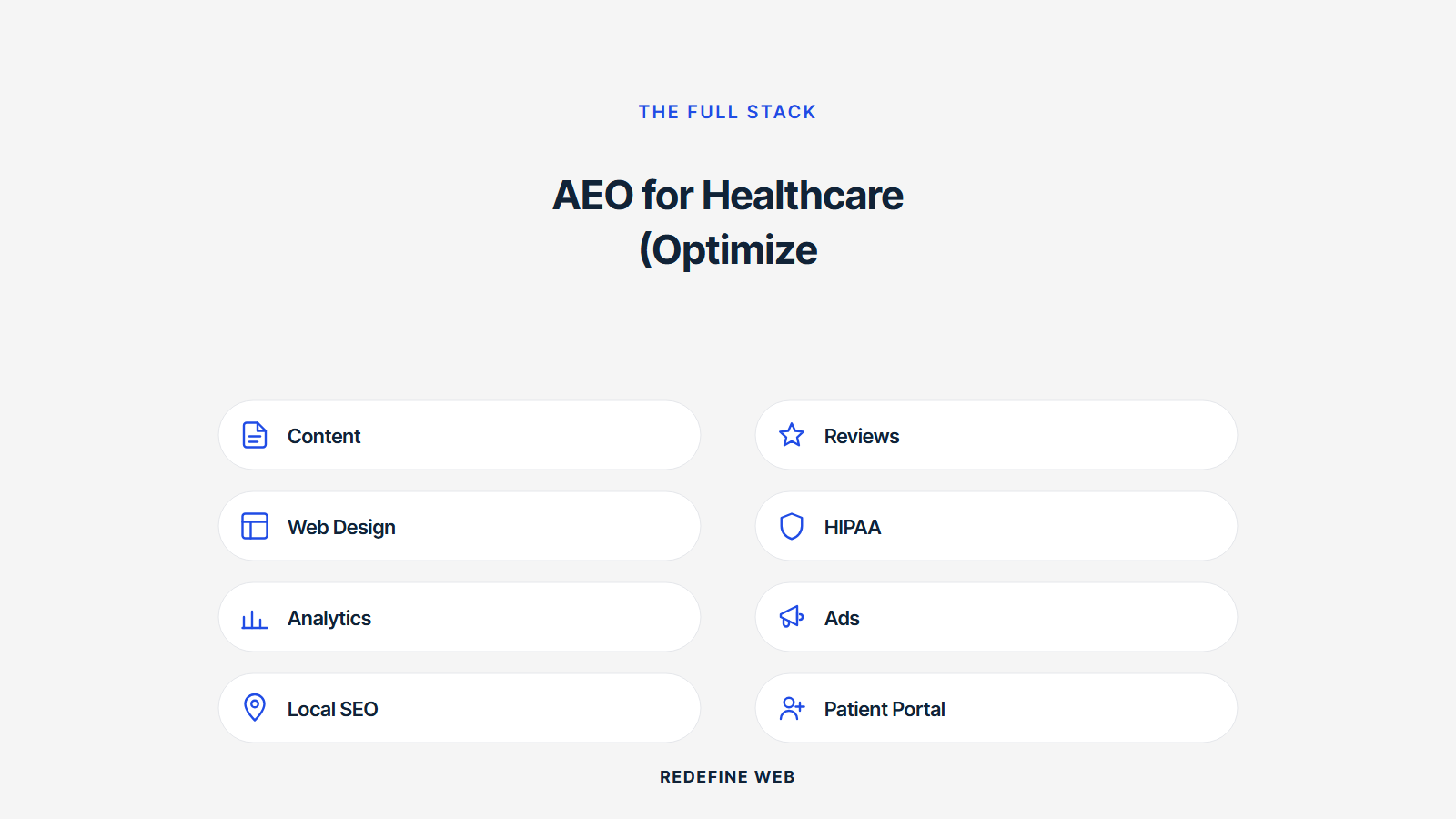
Measure five signals weekly for aeo for healthcare. Featured snippet capture count on your top 100 queries via Semrush Position Tracking or Ahrefs Rank Tracker. PAA appearance count on the same queries. AI Overview citation count via Semrush AI. Voice search share of impressions via Google Search Console impression report. Booked new patient calls attributed to organic sessions via CallRail with UTM tagging.
Every one of those five signals surfaces a different answer engine surface. Featured snippets show classic AEO capture. PAA shows question-driven capture. AI Overview citation shows AI-driven capture. Voice search share shows assistant capture. Booked calls show the money math at the end of the funnel. Track them together in a weekly dashboard. Owners who track all five outperform owners who track only rankings by 2 to 3x on booked appointments within 12 months.
Weekly dashboard structure
Build the dashboard in a spreadsheet or Looker Studio. Five columns per signal. Metric name. This week value. Last week value. Week-over-week change. Four-week trend line. Update every Friday morning in 20 minutes. Review during a Monday planning session with the team. Adjust content and schema priorities based on the trends. That weekly rhythm produces continuous improvement in AEO capture over 12 and 24 months.
Reporting cadence for stakeholders
Practice owners want the money numbers, not the metrics chatter. Report AEO progress monthly to owners with three numbers. Booked appointments from organic sessions. Cost per booked appointment from AEO work amortized. Compared to the same three numbers from paid media. That framing makes AEO investment defensible against ad spend cuts during budget season. Vague reporting on “snippet capture climbing” without booked-appointment context loses budget the moment marketing spend gets scrutinized.
Content freshness and update cadence for aeo for healthcare
Answer engines weight freshness heavily for medical content because clinical guidance evolves. Aeo for healthcare loses capture inside 12 to 18 months when pages go stale, even when the underlying facts stay accurate. Building a refresh cadence into your editorial calendar protects hard-won snippet gains through the year.
Refresh your top 30 clinical explainer pages every 6 to 9 months. Update the dateModified in the Article schema. Add a visible “last reviewed” byline near the top of the page. Rewrite the answer paragraph with any new clinical guidance. Add 2 to 3 new FAQ questions harvested from fresh PAA carousels. That refresh takes 45 minutes per page. Applied across 30 pages twice a year, it costs about 45 hours annually and preserves 60 to 80 percent of snippet capture through 12 months of guideline evolution.
Clinical review workflow
Every content refresh runs through a clinical reviewer with credentials matching the topic. A cardiology page gets reviewed by a cardiologist. A dental page gets reviewed by a dentist. That review lives on a dedicated methodology page linked from every clinical article. Google’s helpful content system reads this workflow directly and treats bylined-plus-reviewed content as higher-authority than unreviewed content. Snippet capture rates on reviewed content usually run 20 to 40 percent higher than unreviewed on the same topic.
Seasonal healthcare topics need faster cadence
Seasonal topics like flu season, allergy season, back-to-school physicals, and holiday injury spikes need quarterly refresh cycles, not annual. Answer engines surface seasonally-relevant content aggressively during the relevant window. A flu-related page updated in September captures 3 to 5x more traffic during October and November than a page updated in April. Build a seasonal editorial calendar with named refresh windows for each topic bucket. That single discipline can double snippet capture during peak seasons for the practice.
Where to start on aeo for healthcare this Monday
Start Monday morning with the PAA harvest for your top 5 service categories. Run 5 seed queries per category through Google. Note every PAA question. Expand each. Note the expanded questions. Repeat until the well runs dry. Expect 60 to 120 questions per category. That single 3-hour sitting builds a real content backlog.
Then write the four-beat answer paragraph for the top 20 questions by Wednesday. Add each to the relevant existing page as a FAQ block with FAQPage schema. Wait 4 to 6 weeks for reindexing. Check featured snippet and PAA capture on those 20 queries. Roll the pattern across the rest of the library. When you’re ready to run the full AEO program with a team that ships answer paragraphs, schema, and PAA harvesting together, our Healthcare SEO services covers the full stack. For the underlying pillar view, our Healthcare SEO pillar guide walks through every layer. For AI Overview capture in more detail, our AI in healthcare SEO guide covers the AI Overview side. For the local ranking side that pairs with AEO, our Local SEO for healthcare guide walks through map pack ranking. For the fully integrated program, our Healthcare marketing hub shows the full stack.
Frequently asked questions
What is aeo for healthcare and why does it matter
AEO for healthcare stands for answer engine optimization. It covers the tactics that get your medical content quoted inside featured snippets, People Also Ask carousels, voice-assistant answers, and AI Overviews. It matters because these answer surfaces sit above the classic organic block on most health queries in 2026. A patient sees answer boxes and PAA before they scroll to the #1 organic result. Getting quoted in those answer surfaces produces impressions and clicks that classic organic ranking alone cannot capture. Sites that optimize for both classic SEO and AEO typically see 40 to 80 percent more organic traffic than sites that optimize for classic SEO only.
What is the answer paragraph format that aeo for healthcare rewards
The answer paragraph is 40 to 80 words structured in four beats. Beat one restates the question as a declarative sentence using the exact query wording. Beat two delivers the direct answer with a specific number, timeframe, or clear yes-no. Beat three adds one or two sentences of supporting detail with a primary source or credential reference. Beat four closes with a qualifier that acknowledges patient variability without hedging the core answer. Every answer paragraph on every clinical explainer page follows this shape. Get the format right and snippet capture across dozens of queries follows. Get it wrong and no schema or backlink strategy compensates.
How do I harvest healthcare seo keywords from People Also Ask
Run 20 seed queries in your specialty through Google. Note every PAA question that appears. Click each PAA to expand it. Note the 3 to 5 additional related questions that appear underneath. Repeat until the PAA well runs dry. A single specialty usually produces 200 to 400 distinct patient questions from this exercise. Tools like AlsoAsked, AnswerThePublic, and Semrush's Keyword Magic tool export PAA questions in bulk. Expect 6 to 8 hours of upfront research to build a 200-question backlog for a single specialty. That backlog fuels 12 to 18 months of content production.
How does aeo in local seo for healthcare services work together
Aeo in local seo for healthcare services is the intersection where answer surfaces meet local intent. A patient searching a local health query gets a map pack, a PAA carousel, and sometimes an AI Overview all at once. Winning that SERP requires both local SEO and AEO working together. Local SEO handles the map pack ranking through NAP consistency, Google Business Profile completeness, and review acquisition. AEO handles the PAA and answer box capture through four-beat answer paragraphs and FAQ block additions on your services pages and location pages. Combined, the two disciplines produce more booked appointments than either does alone.
How does youtube seo optimization healthcare content interact with AEO
YouTube seo optimization healthcare content increasingly interacts with AEO through Google's video snippet feature. Google pulls timestamps from YouTube videos matching the exact answer text a user searches for. Structure your YouTube healthcare videos for AEO. Include the primary question spoken out loud in the first 10 seconds. Use YouTube chapter markers so each answer segment gets a clean timestamp. Publish captions and a full transcript in the video description. That single formatting change makes videos snippet-eligible across dozens of patient queries. Combined with strong thumbnails and titles matching search intent, YouTube AEO becomes a real supplemental channel for booked appointments.
How do I measure aeo for healthcare capture rates
Measure five signals weekly. Featured snippet capture count on your top 100 queries via Semrush Position Tracking or Ahrefs Rank Tracker. PAA appearance count on the same queries. AI Overview citation count via Semrush AI. Voice search share of impressions via Google Search Console impression report. Booked new patient calls attributed to organic sessions via CallRail with UTM tagging. Every one of those five signals surfaces a different answer engine surface. Track them together in a weekly dashboard with five columns per metric. Metric name. This week. Last week. Week over week change. Four-week trend. Review every Monday morning to spot trends early.
Book your free 30-minute strategy call.
No spam, no sales rep. We use your email to schedule your call with a senior strategist. That is it.
More from the blog
View all articles → SEO
SEO Organic Search Engine Optimization Services That Grow Real Traffic
Read article SEO
SEO SEO for Pet Groomers That Fills the Appointment Book Weekly
Read article SEO
SEO