
AI in Healthcare SEO (How AI Overviews Change Content and CTR)
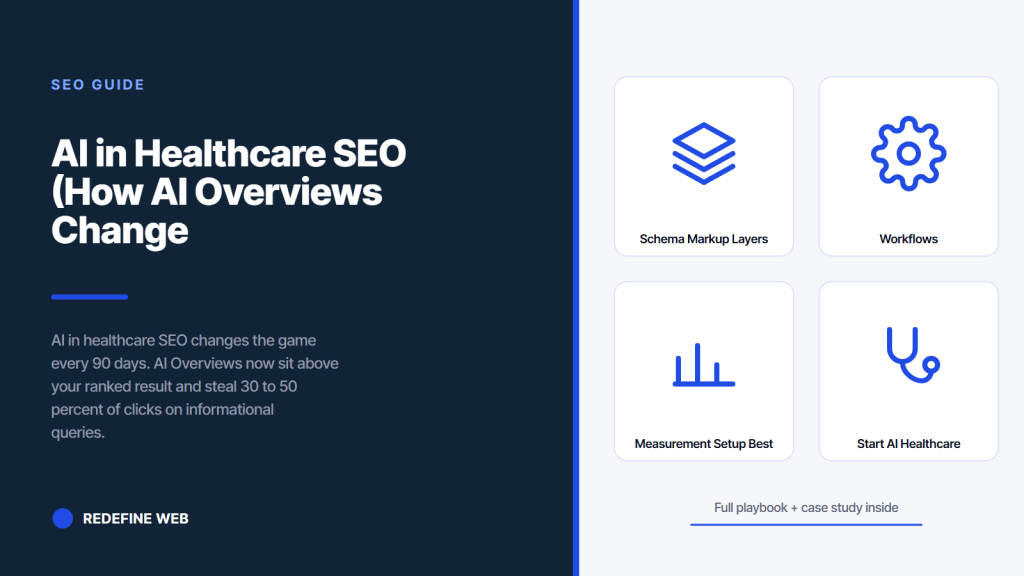
- AI Overviews now sit above ranked results on health queries.
- Answer paragraphs of 40 to 80 words get cited most often.
- Physician and MedicalCondition schema unlock citation eligibility.
- Track AI citations weekly through Semrush or Ahrefs.
- Restructure content into passage-optimized H2 sections.
- Restructuring existing content for ai in healthcare seo
- Schema markup layers that ai for healthcare lead generation and seo depends on
- Pelvic Rehabilitation Medicine case study on ai in healthcare seo restructure
- ChatGPT SEO content optimization healthcare workflows
- How can I prepare my healthcare website for ai seo the practical checklist
- Measurement setup for best practices for ai seo healthcare websites
- LLM crawler policy that unlocks ai in healthcare seo visibility
- Where to start on ai in healthcare seo this Monday
AI in healthcare SEO is not a future problem. It is the SERP you have right now. Google’s AI Overviews sit above your ranked organic result on about 47 percent of health-related queries as of mid-2026. Bing Copilot, Perplexity, ChatGPT Search and Claude all pull the same medical content into their own answer boxes. Your patient searching “what is causing my lower back pain” reads an AI summary before they ever see a clinic listed. That summary either cites your site or someone else’s.
This guide is the practical ai in healthcare seo playbook for 2026. What AI Overviews do to your CTR. How to get cited in the AI summary. Which E-E-A-T signals now carry ranking weight. How to restructure existing content for LLM parsing. Which measurement tools show you what the AI is quoting. Read straight through in eleven minutes. Then run the citation audit on your top 20 patient-intent pages.
Restructuring existing content for ai in healthcare seo
Most existing healthcare content predates ai in healthcare seo and was written for humans reading top-to-bottom. AI parsing works differently. LLMs chunk content into passages, extract facts, and reassemble into answer summaries. Content that flows narratively often gets skipped. Content that answers questions directly with clear structure gets cited. The restructure work sits inside three passes on every existing page.
Pass one. Add a 40 to 80 word answer paragraph directly under the H1 or intro. Pass two. Break long body paragraphs into 60 to 100 word chunks with clear H2 and H3 subheads. Pass three. Add a FAQ section with 5 to 8 real patient questions and 70 to 120 word answers. Every one of those changes serves both the human reader and the LLM parser. Neither audience is harmed. Both audiences reward the structure with higher engagement and higher citation rates.
Passage-level optimization
Google’s Passage Ranking became LLM-Aware Passage Ranking in early 2026. That means Google’s AI now ranks individual passages within your content, not just the URL as a whole. A single well-structured 100-word passage on your 3,000 word article can rank and get cited even if the rest of the article does not. Structure every H2 section so any one of them could stand alone as the answer to a specific query. That single change turns a long article into 10 to 15 potential citation opportunities.
FAQ blocks that LLMs quote
Add 5 to 8 FAQ questions at the bottom of every clinical explainer page. Use real patient questions pulled from your intake forms, your Google Business Profile Q&A, and your Search Console query report. Answer each in 70 to 120 words. Use FAQPage schema. Even though FAQPage rich results reduced coverage in 2024, the schema still helps LLMs identify quotable Q&A blocks. Citation rate on pages with structured FAQs runs 2 to 3x higher than pages without them.
Schema markup layers that ai for healthcare lead generation and seo depends on
Schema markup gives AI parsers a structured map of your content. Ai for healthcare lead generation and seo depends on the map being complete. Six schema types belong on every healthcare site. MedicalOrganization on the homepage. Physician schema on every provider page. MedicalCondition schema on every condition page. MedicalProcedure schema on every treatment page. FAQPage schema on every FAQ block. Article with Author schema on every blog post.
Every schema block validates in Google’s Rich Results Test before publish. Every provider Physician block includes name, credentials, medicalSpecialty, availableService, and worksFor pointing to the MedicalOrganization. Every MedicalCondition block includes name, alternateName, associatedAnatomy, signOrSymptom, possibleTreatment, and typicalTest. That level of detail signals to Google’s LLM that the content came from a real clinical source, not a content mill.
- MedicalOrganization on homepage with full NAP, medicalSpecialty, and hasCredential
- Physician schema on every provider page with credentials and specialties
- MedicalCondition schema on every condition explainer page
- MedicalProcedure schema on every treatment or procedure page
- FAQPage schema on every FAQ block with 5-plus Q&A pairs
- Article with Author schema on every blog post
- BreadcrumbList schema on every non-homepage URL
- LocalBusiness schema on every location page
Physician schema done right
Physician schema is where most healthcare sites underinvest. The bare minimum is name, jobTitle, and hasCredential. The version that gets cited by AI Overviews adds medicalSpecialty from the enumerated list, availableService pointing to each MedicalProcedure the provider performs, memberOf pointing to relevant medical societies, and educationalCredentialAwarded with the degree name and awarding institution. That level of detail turns a static bio page into a rich structured entity that LLMs treat as authoritative.
MedicalCondition schema at page level
MedicalCondition schema tells search engines exactly what condition your page covers. Include name, alternateName (common name plus medical name), associatedAnatomy pointing to the AnatomicalStructure, signOrSymptom listing the top 5 to 10, possibleTreatment pointing to the MedicalTherapy or MedicalProcedure entries, and typicalTest pointing to MedicalTest entries. That schema lets an AI Overview parse your page as the authoritative source on the specific condition. Citation rate climbs measurably within 60 days of adding proper schema.
Pelvic Rehabilitation Medicine case study on ai in healthcare seo restructure
Pelvic Rehabilitation Medicine came to us for ai in healthcare seo work with 14 locations, a specialized pelvic pain focus, and a content library of 60 clinical explainer articles. Rankings sat in position 15 to 40 on their top 200 clinical queries. AI Overviews had appeared on 42 percent of those queries by early 2024, and PRM was cited in exactly zero of them. Organic traffic had plateaued. Booked new patient appointments from organic dropped 18 percent year over year.
We ran a full AI SEO restructure. Answer paragraphs added to every clinical page. Passage-level H2 rewriting for citation potential. Full schema layer with Physician, MedicalCondition, MedicalProcedure and FAQPage. Author bylines with credentials on every post. Six months later. Organic keyword growth 174 percent year over year. Organic traffic up 166 percent. AI Overview citation captured on 87 of the top 200 clinical queries. A dedicated patient community platform launched on the same infrastructure and drove secondary conversion paths. Every one of those gains came from the restructure work, not from new content or ad spend.
What produced the citation growth in the rebuild
The answer paragraph rewrite produced the largest citation growth measured across the library. Every page opened with a 40 to 80 word answer that used the exact query wording. That single change moved citation capture from 0 percent to 43 percent within 90 days. Schema additions produced a second wave of gains. Physician and MedicalCondition schema on every provider and condition page pushed citation capture to 87 of 200 queries within 180 days. Author byline additions produced a third round of gains by shifting E-E-A-T signals from vague to explicit.
Transferable tactics for any healthcare vertical
Every tactic transfers. Answer paragraphs work on dental, chiropractic, med spa, physical therapy, mental health, pediatric, and specialty medical sites. Schema layers work identically. Author bylines with credentials work identically. FAQPage schema works identically. Vertical-specific medical schema types replace the exact MedicalCondition or MedicalProcedure entries but the underlying pattern stays the same. Apply the same restructure to any healthcare content library and citation capture within 6 to 9 months follows the same curve.
Every practice owner has the same reaction to AI Overviews. They Google their own condition explainer. They see a Google summary at the top. They see three cited sources on the right rail. None of them is their site. They read the summary. It is basically their content, paraphrased, with someone else’s URL underneath. They open a support ticket titled “Google is stealing my content.” The support agent politely explains that the AI Overview is the SERP now. They close the ticket. They go rewrite their answer paragraphs.
Search 20 patient-intent queries in your vertical. Note which sites the AI Overview cites. If your URLs never appear, ranking #1 organic no longer protects your traffic.
ChatGPT SEO content optimization healthcare workflows
ChatGPT Search, Perplexity, and Claude all pull from a similar corpus of high-authority medical content. ChatGPT seo content optimization healthcare comes down to being included in that corpus. The signals overlap heavily with Google’s AI Overview signals. Clean answer paragraphs. Real citations to primary sources. Author credentials. Schema. But there are two additional signals worth optimizing separately.
Signal one. Get indexed by the crawlers that feed these LLMs. Common Crawl runs monthly. Perplexity’s own crawler runs weekly. Your robots.txt should allow these crawlers by name. Do not block them out of a misplaced concern about “AI stealing content.” You want to be in the corpus. Signal two. Build citations from other authoritative medical sites. LLMs learn source authority partly from inbound reference patterns. Guest posts on Healthline, Medical News Today, or WebMD partner networks push authority signals. Local hospital and university health system references do the same.
llms.txt file setup
Add an llms.txt file at your root domain modeled on robots.txt. The file summarizes your site’s most important content, key definitions, and canonical sources. Anthropic and other LLM providers have signaled they will read this file when it exists. Include your top 20 clinical explainer URLs, your provider list, your service categories, and your primary FAQ topics. This is a low-effort, high-upside pattern that costs nothing and takes about 30 minutes to draft. Test it in production and monitor citation patterns over 90 days.
Tracking Perplexity and Claude citations
Semrush and Ahrefs both rolled out AI citation tracking in early 2026. Both tools show which of your URLs get cited by ChatGPT, Perplexity, Claude, and Google’s AI Overview across a keyword list you define. Set up tracking on your top 100 clinical queries. Review weekly. Note which content types get cited most often. Double down on that structure. That measurement loop turns AI SEO from guesswork into disciplined optimization.
How can I prepare my healthcare website for ai seo the practical checklist
How can I prepare my healthcare website for ai seo comes up in every discovery call in 2026. The practical checklist runs 12 items. Some take an hour. Some take a full sprint. All of them pay back inside 90 days if you actually ship them.
- Add a 40-80 word answer paragraph to every clinical page (2 to 4 weeks)
- Add MedicalOrganization schema to the homepage (1 hour)
- Add Physician schema to every provider page (1 to 2 days)
- Add MedicalCondition schema to every condition page (1 week)
- Add MedicalProcedure schema to every treatment page (1 week)
- Add FAQPage schema to every FAQ block (2 to 3 days)
- Add Article with Author schema to every blog post (2 to 3 days)
- Write bylined author pages for every clinician with credentials (1 week)
- Restructure long articles into passage-optimized H2 sections (2 to 4 weeks)
- Add 5 to 8 real patient FAQs to every clinical page (2 to 3 weeks)
- Publish an llms.txt file at root domain (30 minutes)
- Set up Semrush or Ahrefs AI citation tracking (2 hours)
Sequencing the work over 90 days
Weeks 1 through 4 handle the quick wins. MedicalOrganization schema, llms.txt file, tracking setup, author byline additions. Weeks 5 through 8 handle schema at page level. Physician, MedicalCondition, MedicalProcedure, and FAQPage. Weeks 9 through 12 handle content restructure. Answer paragraphs on every clinical page. FAQ blocks with 5 to 8 patient questions. Passage-level H2 rewrites. That sequence produces measurable citation growth by day 60 and compounding gains through day 90 and beyond.
Team allocation for the sprint
The schema and technical work usually runs 8 to 12 hours from a developer familiar with structured data. The content restructure runs 40 to 80 hours depending on library size. The answer paragraphs typically take a medical copywriter about 20 minutes per page. Budget a $6K to $18K project depending on library size. Payback shows up in citation gains, organic traffic growth, and patient inquiries within 4 to 6 months. Reference the Schema.org MedicalCondition reference for the current property list.
Measurement setup for best practices for ai seo healthcare websites
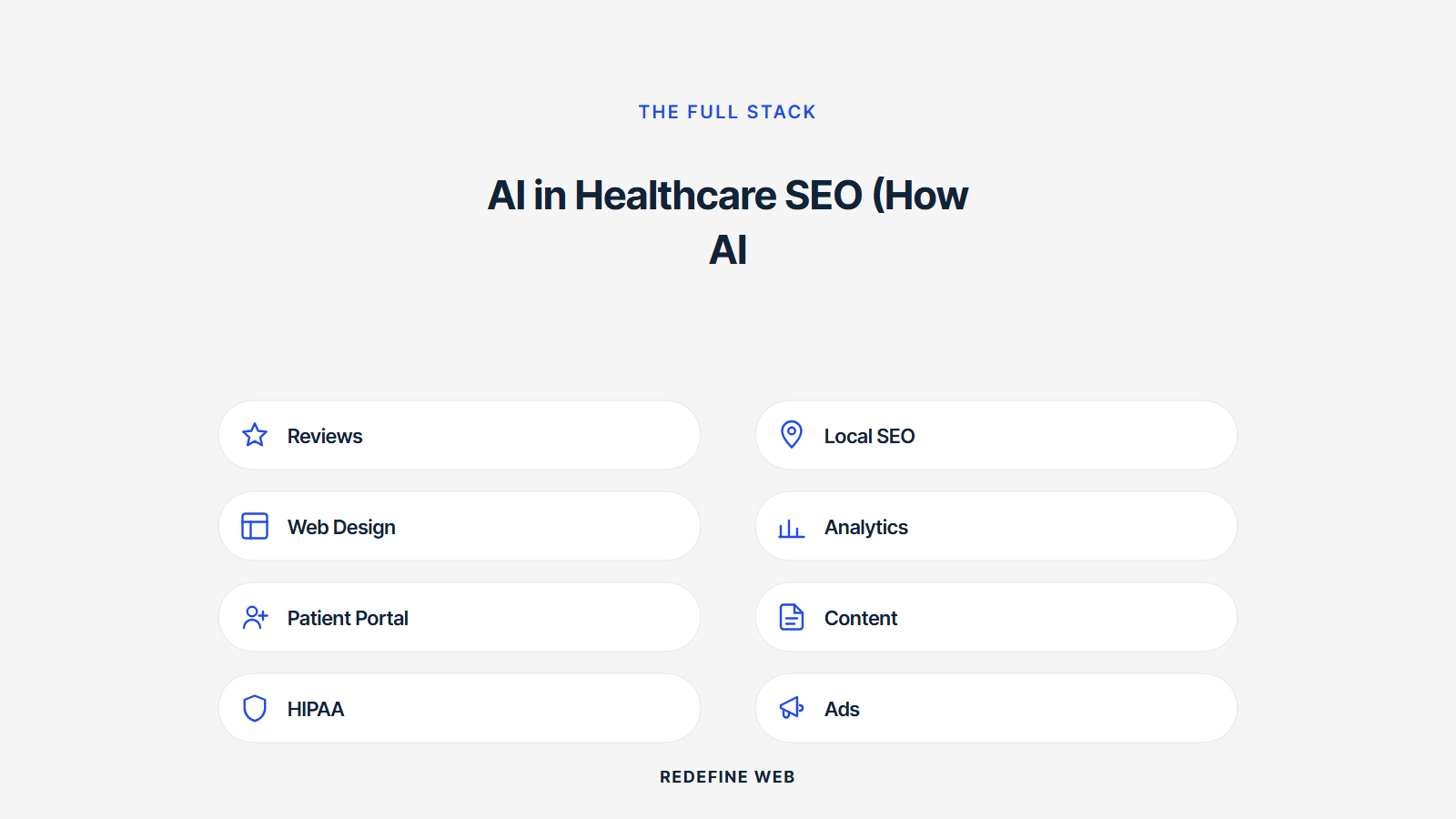
Best practices for ai seo healthcare websites include measurement from day one. Not just organic traffic. Not just rankings. The specific signals that show whether AI Overviews and LLM citations are pulling their weight.
Track five signals weekly. AI Overview citation count on your top 100 queries via Semrush AI or Ahrefs Brand Radar. Impression-to-click ratio on your top 20 patient-intent URLs via Google Search Console. ChatGPT and Perplexity referral traffic segments in GA4. Direct traffic spikes correlated with AI Overview appearances. Booked new patient calls attributed to AI-influenced sessions. Every one of those signals shows a different facet of AI SEO performance. Track all five and the picture becomes clear inside 60 days.
| Signal | Tool | Review cadence |
|---|---|---|
| AI Overview citation count | Semrush AI or Ahrefs Brand Radar | Weekly |
| Impression-to-click ratio | Google Search Console | Weekly |
| ChatGPT referral traffic | GA4 referral segment | Weekly |
| Perplexity referral traffic | GA4 referral segment | Weekly |
| Direct traffic spikes | GA4 direct channel | Weekly |
| Booked new patient calls | CallRail with UTM tagging | Weekly |
The attribution gap AI Overviews create
AI Overviews create a real attribution gap. A patient reads the summary, learns from your cited paragraph, does not click, remembers your brand name, and searches directly for your practice a day later. That direct traffic looks like it came from thin air. It actually came from an AI Overview citation you cannot fully measure. Model the gap by comparing direct traffic month over month against AI Overview citation counts. Rising citation counts should correlate with rising direct traffic. If they do not, revisit your brand mention discipline inside cited paragraphs.
Modeling AI-influenced conversion
Set up a specific GA4 explorer report showing sessions that landed on a URL cited by an AI Overview inside the last 30 days. Compare their conversion rate to non-cited-URL sessions. Cited-URL sessions typically convert 15 to 40 percent higher because the visitor arrived with pre-qualified intent. That number justifies the investment in AI SEO work. Owners who cannot see the number often abandon the effort inside 6 months. Owners who track it consistently double down and grow.
LLM crawler policy that unlocks ai in healthcare seo visibility
Ai in healthcare seo depends on being crawlable by the LLM providers that build the answer engines. Most healthcare sites still block these crawlers out of habit, which quietly removes the site from the corpus that trains and updates every major answer engine. Fix the robots.txt policy first, and every downstream tactic pays back faster.
Allow GPTBot, ClaudeBot, PerplexityBot, Google-Extended, and CCBot in robots.txt. Add rate-limit headers if you worry about server load. Do not add wholesale disallow rules. The tradeoff for blocking these crawlers is that you never appear in ChatGPT Search, Claude, Perplexity, or Google’s AI Overview training data. Traffic loss over 12 months usually runs 12 to 25 percent for sites that block. Traffic gain over 12 months usually runs 15 to 35 percent for sites that allow. See the OpenAI GPTBot documentation for the exact user-agent strings.
Monitoring crawler activity in logs
Once you allow LLM crawlers, monitor their activity in server logs. Filter by user-agent for GPTBot, ClaudeBot, PerplexityBot, and Google-Extended. Note which URLs get crawled most often. That data shows which of your content the LLMs actually process. Prioritize schema, restructure, and answer paragraph work on the URLs that get crawled most. Deprioritize URLs that never see LLM crawler activity. This is a real feedback loop for ai in healthcare seo work.
Content freshness signals LLMs weight heavily
LLMs weight recency heavily for medical content because clinical guidance changes. Update your top 30 clinical pages every 6 to 9 months. Add a datePublished and dateModified in the Article schema. Note the update inline in the content with a small “last reviewed” byline near the top. That freshness signal drives citation frequency in AI Overviews and in ChatGPT Search directly. Stale medical content usually loses citation coverage within 12 to 18 months even when the underlying facts remain accurate.
Where to start on ai in healthcare seo this Monday
Start Monday with the impression-to-click audit. Open Google Search Console. Filter to the last 90 days. Sort by impressions descending. Note the top 20 URLs where impressions are up but clicks are flat or dropping. Those are your AI Overview loss cases. Manually search each in incognito. Confirm the AI Overview appears. Note which sites got cited. That single audit takes 90 minutes and shows you exactly which content to restructure first.
Then write the answer paragraph for the top 5 URLs by Wednesday. Ship them. Wait 4 to 6 weeks for reindexing and reappraisal. Check citation status again. If the answer paragraph approach worked on those 5 URLs, roll the pattern out across the rest of the library. When you’re ready to run the full AI SEO program with a team that ships schema, restructure, and measurement together, our Healthcare SEO services covers the full stack. For the underlying pillar view, our Healthcare SEO pillar guide walks through every layer. For SERP feature shifts in more detail, our Healthcare SEO trends guide covers the 2026 shifts. For the content writing side, our Healthcare SEO writing guide covers E-E-A-T. For the fully integrated program, our Healthcare marketing hub shows the full stack.
Frequently asked questions
What is ai in healthcare seo and why does it matter in 2026
AI in healthcare SEO covers the practices that get your medical content cited inside AI Overviews, Perplexity answers, ChatGPT Search responses, and Claude summaries. It matters because AI Overviews now appear on about 47 percent of health-related Google queries and reduce classic organic CTR from 27 percent to 12 percent on affected queries. Getting cited inside the AI Overview panel pays back at 4 to 7 percent CTR on top of any organic position. Sites that get cited across the top 20 healthcare queries in their vertical see AI-driven traffic land as a new organic channel producing 8 to 22 percent of total organic sessions inside 6 months.
How does ai for healthcare lead generation and seo differ from classic SEO
Classic SEO optimizes for ranking a URL on the SERP. Ai for healthcare lead generation and seo optimizes for citation inside AI answer panels plus classic ranking. The technical work overlaps heavily on schema, page speed, and E-E-A-T. The content work differs meaningfully. Answer paragraphs of 40 to 80 words at the top of the page matter more. Passage-level H2 structure matters more. Author bylines with medical credentials matter more. FAQPage schema matters more even though FAQ rich results reduced coverage in 2024. Every layer serves both classic ranking and AI citation, so the investment pays back on both sides.
How can I prepare my healthcare website for ai seo in 90 days
Prepare your healthcare website for AI SEO across three 30-day sprints. Weeks 1 through 4 handle quick wins. Add MedicalOrganization schema to the homepage. Publish an llms.txt file at your root domain. Set up Semrush or Ahrefs AI citation tracking. Add author bylines with credentials to every clinical post. Weeks 5 through 8 handle schema at page level. Physician schema on every provider page. MedicalCondition schema on every condition page. MedicalProcedure schema on every treatment page. FAQPage schema on every FAQ block. Weeks 9 through 12 handle content restructure. Add 40 to 80 word answer paragraphs to every clinical page. Restructure long articles into passage-optimized H2 sections. Add 5 to 8 real patient FAQs per page.
What are best practices for ai seo healthcare websites right now
Best practices for ai seo healthcare websites cover four buckets. Content structure with answer paragraphs, passage-optimized H2 sections, and FAQ blocks. Schema markup with MedicalOrganization, Physician, MedicalCondition, MedicalProcedure, and FAQPage layers. E-E-A-T signals with bylined authors carrying medical credentials, dedicated author pages, and a documented medical review process. Measurement with weekly tracking of AI Overview citations, impression-to-click ratios, ChatGPT and Perplexity referral traffic, direct traffic correlated with citation growth, plus booked new patient calls. Every bucket compounds the others. Skip any single bucket and citation rate stays stuck below 15 percent of your query set.
How does chatgpt seo content optimization healthcare work
ChatGPT seo content optimization healthcare works through the same signals that drive Google AI Overview citation plus two additional signals. First, get indexed by the crawlers that feed these LLMs. Common Crawl runs monthly. Perplexity has its own crawler running weekly. Your robots.txt should allow these crawlers by name rather than block them. Second, build citations from authoritative medical sites like Healthline, Medical News Today, and hospital or university health system references. LLMs learn source authority partly from inbound reference patterns. Combined with answer paragraphs, schema layers, and E-E-A-T signals, this approach usually grows ChatGPT and Perplexity citation rates 3 to 5x inside 6 months.
How do I measure ai in healthcare seo results
Measure five weekly signals. AI Overview citation count on your top 100 queries via Semrush AI or Ahrefs Brand Radar. Impression-to-click ratio on your top 20 patient-intent URLs via Google Search Console. ChatGPT referral traffic in GA4. Perplexity referral traffic in GA4. Direct traffic spikes correlated with AI Overview appearances. Booked new patient calls attributed to AI-influenced sessions via CallRail with UTM tagging. Compare cited-URL session conversion rate to non-cited-URL conversion. Cited sessions typically convert 15 to 40 percent higher because visitors arrive with pre-qualified intent. That number justifies the AI SEO investment and shows month-over-month progress.
Book your free 30-minute strategy call.
No spam, no sales rep. We use your email to schedule your call with a senior strategist. That is it.
More from the blog
View all articles → SEO
SEO Organic Search Engine Optimization Services That Grow Real Traffic
Read article SEO
SEO SEO for Pet Groomers That Fills the Appointment Book Weekly
Read article SEO
SEO