
Affordable Web Design Services for Small Businesses That Actually Rank
- Real budget floor starts at $1,900 for a five-page WordPress build.
- Mid-range small business builds sit at $6,000 to $12,000.
- Cheap builds skip SEO wiring, schema, and analytics.
- A $99 monthly package is usually a template with backups.
- Watch for shared page counts, stock themes, no revisions.
- Cheap versus affordable versus expensive small business web design
- What cheap builds skip that affordable builds keep
- A real small business case study: Abels Residential
- Red flags to catch a low-ball affordable quote
- How to compare three affordable web design quotes on the same table
- WordPress themes versus page builder templates in affordable web design services for small business
- What happens to an affordable small business site after launch
- What to do next when you’re shopping for an affordable build
Affordable web design services for small business is a phrase that hides three very different quotes in the same email inbox. One is a $499 template with a logo swap and a promise. One is a $3,200 WordPress build from a lean agency that knows the drill. One is a $9,000 boutique quote written in a fancier font. Only one of those three is actually affordable when you count the year-two cost of fixing what the cheap build skipped.
This guide covers the honest floor of affordable web design services for small business in 2026, the pricing bands from starter to mid-range, what a cheap build includes and skips, the red flags on a low-ball quote, and how to spot a template dressed as custom work. You will see real numbers, a pricing comparison table, a case study from a small business we run this exact scope for, and the seven-question filter to run on any agency you talk to. Read it before you send the deposit.
- Discovery. 60-minute kick-off call, brand asset review, competitor scan, keyword map for the top 5 pages. Written brief before wireframes start.
- Wireframes. Low-fidelity layouts for every unique template. One round of revisions. Approved before design starts.
- Design. Full desktop and mobile designs in Figma. One to three revision rounds depending on tier.
- Development. WordPress build on a starter theme or custom theme depending on tier. Staging environment for client review.
- Content and SEO. Copy loaded into the CMS. On-page SEO applied. Schema on Growth and Mid-range tiers.
- Launch and QA. Pre-launch checklist, cross-device testing, redirect map, DNS cutover, 14 days of post-launch monitoring.
Content production is where most quotes hide the true cost. If the scope says “SEO copywriting” without listing a per-page rate, ask what happens when your team cannot deliver the copy on time. Common answers: the launch slips, the agency writes the copy at $150 to $400 per page, or the agency loads placeholder copy and calls it a launch. Get the answer in writing before you sign.
A quick rule for content budgets: a 500-word service page costs $150 to $250 from a competent freelance writer, $250 to $400 from an agency team, and $75 to $150 if you write it yourself with a solid brief. Multiply by the page count in the scope. That is the real content line item most affordable quotes leave off the total. Add it before you compare quotes side by side.
Photography and stock imagery is another hidden cost. Most affordable quotes assume the client provides brand imagery. When the client does not, the agency either uses free stock (which looks like free stock) or bills for original photography at $300 to $1,200 per shoot. Ask what happens when your team has no professional photos. Ask before the deposit.
Cheap versus affordable versus expensive small business web design
Cheap and affordable are not the same word. Cheap agencies cut SEO and skip revisions to hit a low number. Affordable agencies run efficient systems and repeatable scopes to keep the price down without cutting scope. Expensive agencies carry boutique overhead, senior designers on every hour, and a longer discovery phase. All three exist honestly. Only one of them fits most small businesses.
Cheap: $499 to $1,499. Template pack, logo drop-in, homepage-only SEO, no schema, no revisions, no ongoing support. Delivered in five days. Ranks for zero keywords past your brand name. You could keep buying a new $499 site every eighteen months from a different marketplace freelancer and never once ask why your search traffic looks like a Nokia flip phone. Or you could pay for a real build once.
Affordable: $1,900 to $12,000. Real WordPress build, real SEO, real design system, real revision rounds. Delivered in three to nine weeks. Ranks for your core keywords within six to twelve months when the SEO work continues. This is the band 80 percent of small businesses should buy in.
Expensive: $15,000 to $50,000. Custom design system from scratch, bespoke development, a lead designer on every hour, longer discovery phase, in-house content team. Justified for multi-location businesses, ecommerce with 500-plus SKUs, or businesses where the site is the primary revenue channel. Overkill for a five-page brochure site.
The mistake we see repeatedly is a small business owner reading a boutique agency blog and assuming their five-page dental practice site needs the same $30,000 treatment. It does not. The boutique agency serves clients whose site is the primary revenue channel. Your dental practice’s primary revenue channel is the phone. The site’s job is to make the phone ring. That job costs $3,500 to $7,000 done right.
What cheap builds skip that affordable builds keep
The gap between a $499 template and a $3,200 affordable build is not the theme, it is the wiring. Cheap builds skip about a dozen items that seem small individually and add up to a site that does not rank, does not convert, and does not scale.
- On-page SEO on every page, not just the homepage
- Schema markup on services, reviews, and location pages
- Analytics events wired to real conversion actions
- Redirect map from the old site preserving link equity
- XML sitemap submitted to Search Console at launch
- Image optimization for Core Web Vitals
- Mobile-specific layout tuning past the default breakpoint
- A written scope with phase deliverables
- Post-launch monitoring for 14 to 30 days
- Documentation for the client to maintain the site
Each item takes 30 minutes to two hours. Across ten items, that is 15 to 20 hours of work missing from a cheap build. At $75 per hour, that gap explains the $1,500 price difference between a template and a real affordable build. The math is honest. The cheap vendor is not lying about the price, they are lying about the scope.
Google’s own guidance on structured data makes the case for schema markup on any small business site. Schema is a two-hour job at build time and a two-day job at retrofit time. Cheap builds skip it. Affordable builds bake it in.
The same pattern holds for Core Web Vitals tuning. Independent research from web.dev shows sites in the green on Core Web Vitals convert 15 to 30 percent higher than sites in the red. Cheap builds ignore the metric and rely on the host to make the numbers look okay. Affordable builds test each page against real-world lab data before launch and fix the outliers.
A real small business case study: Abels Residential
Abels Residential runs a London-based residential lettings business. When we picked up the account, the previous site was a $600 marketplace template with zero schema, four pages, and a contact form that emailed the founder’s personal Gmail. Monthly organic sessions sat at 240. Rental inquiries came through phone calls tied to no source.
We ran a Growth-tier affordable build. Twelve pages on a semi-custom WordPress theme, on-page SEO across every page, review schema, GA4 events wired to form fills and phone taps, and a monthly retainer to keep the search work moving. The build fee sat at $5,800. Monthly retainer at $899. Total year-one cost including build: $16,588.
Within twelve months the site ranked for over 300 keywords, drove 20-plus qualified rental leads per month, and hit a two-second page load. The full case study is public on our site. The account still runs. The numbers hold because the SEO work continued monthly after launch. A $600 template would have looked identical on the homepage. The rankings and the leads would have looked nothing alike.
This is the payoff on affordable. The build fee is a rounding error against the leads the site drives across three years. A $499 template would have saved $5,300 up front and cost the founder tens of thousands in lost inquiries. Founders who run this math on paper before buying always land in the affordable band. Founders who run it emotionally always land in the cheap band and pay again in year two.
The labor math on a real WordPress build is 25-40 hours at /hr blended. Anyone quoting under ,900 planned the disappearance into the price.
Red flags to catch a low-ball affordable quote
Not every low quote is bad. Not every high quote is good. The tells sit in the scope document, the sales call, and the way the vendor answers questions about their process. Below are the eight red flags we tell clients to watch for when comparing affordable web design services for small business quotes.
- The quote lists a page count but no per-page scope. What is on each page matters more than how many pages exist.
- The vendor cannot name the WordPress theme or page builder they will use. Winging it usually means Elementor with a free template.
- “Unlimited revisions” or “unlimited pages” appears in writing. Unlimited is a marketing word. Real scopes have limits.
- The deposit is 100 percent up front. Real agencies split deposits across milestones.
- The timeline is under two weeks for a five-page site. Real builds take three-plus weeks minimum.
- No SEO deliverables listed in the scope. If SEO is not written down, it will not happen.
- The sample portfolio is generic stock sites that all look identical. Template-driven vendors show template-driven work.
- The vendor refuses to share two live client references. Every real agency has references ready.
Any single red flag is worth a follow-up question. Two red flags in the same quote is a walk-away signal. The vendor will not get better between the deposit and the launch. They are showing you their working style during the sales call. Trust it.
How to compare three affordable web design quotes on the same table
Comparing quotes at different prices without a common scope is impossible. Every quote hides its exclusions in different places. The fix is a shared scope sheet you send to every vendor before they quote. If a vendor refuses to quote on your sheet, they are protecting a hidden markup.
Your shared scope sheet should list pages by title, expected keyword per page, integrations required, timeline, revision rounds, and post-launch support window. Send it to three vendors. Ask each to fill in a price per row plus a total. The quotes come back on the same axes. Comparing $2,400 versus $4,800 versus $8,200 on a shared sheet reveals exactly where the money goes and where corners get cut.
The best-fit vendor is not always the cheapest or the priciest. The best-fit vendor answers your questions on the first call, has a written phase list ready, and can name a small business site they built two years ago that still ranks today. Anyone who cannot answer those three prompts is either new to small business work or hiding something in the scope.
Put a decision deadline on the shortlist. Two weeks from the day you send the brief. Any vendor who cannot return a quote inside a week is either fully booked (fine) or slow at proposals (worrying). A slow proposal cycle predicts a slow project cycle. Small businesses that let quote conversations drag for months typically end the year with no site and a pile of half-read PDFs.
For a full breakdown of the build side of the stack, see our web design services for small business. Retainer scoping stacks on top and prices at the tier that matches your actual site.
WordPress themes versus page builder templates in affordable web design services for small business
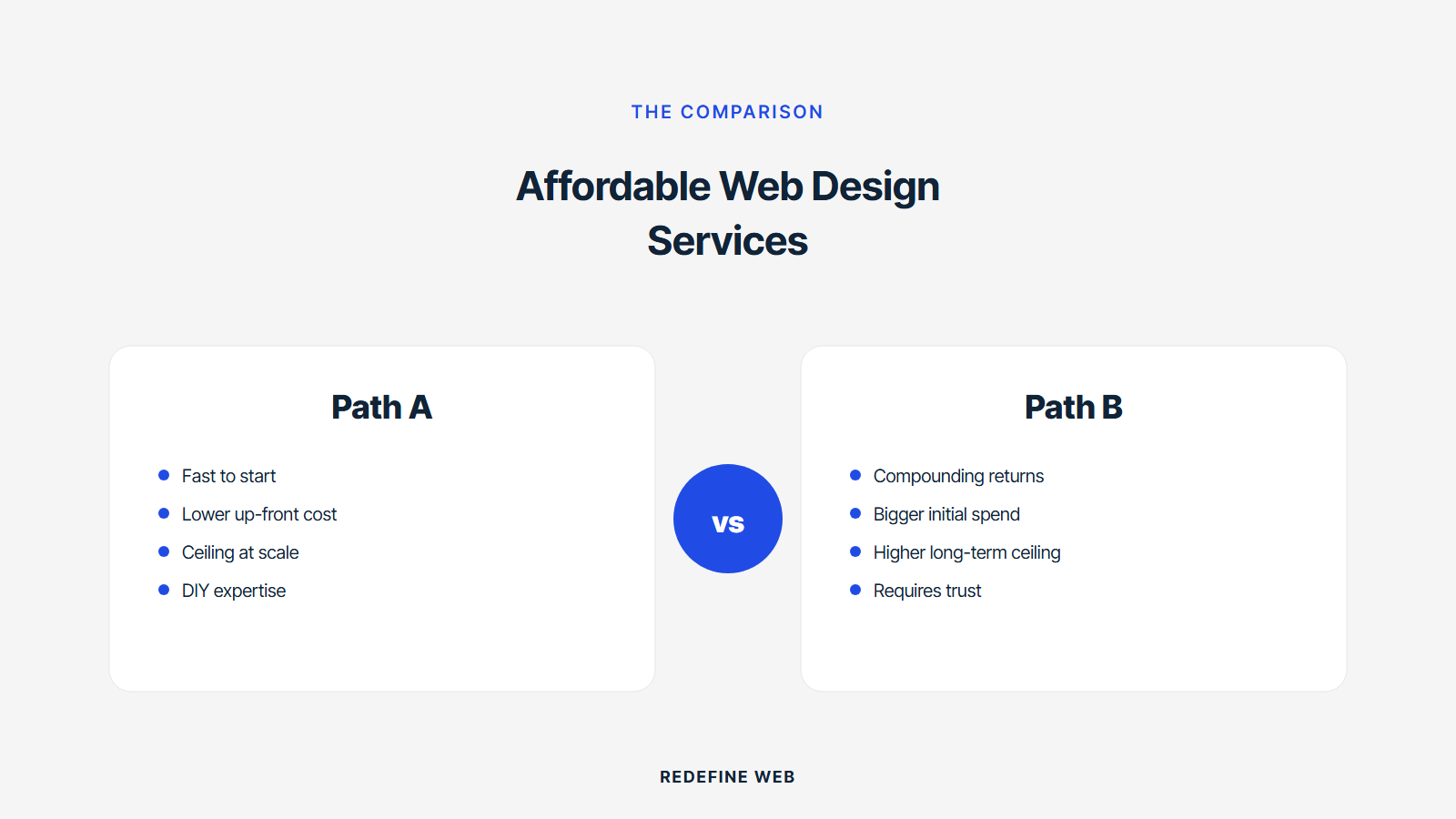
The single biggest fork in affordable web design services for small business is whether the site is built on a real WordPress theme with proper structure or on a page builder plugin like Elementor or Divi on top of a stock theme. Both work. They produce very different sites.
Real WordPress themes produce faster sites with cleaner code, better Core Web Vitals scores, and easier SEO wiring. Page builder plugins produce visually flexible sites that anyone can edit but that carry 30 to 60 percent more page weight. On a five-page brochure site, the page weight cost is invisible to the average visitor. On a site pushing 15 pages and a booking widget, the weight cost shows up in mobile speed and bounce rate.
The WordPress documentation covers both approaches without picking a side. Our recommendation for affordable web design services for small business is a lightweight starter theme (Kadence, GeneratePress, Astra) with custom CSS, not a page builder plugin sitting on top of a stock theme. The build cost is similar. The performance and SEO ceiling is very different.
Owners who insist on drag-and-drop editing after launch should ask the agency to install a block editor pattern library, not a page builder plugin. The block editor comes with WordPress core, produces clean output, and lets non-technical users edit content without touching code. Page builder plugins add a dependency you have to maintain forever.
What happens to an affordable small business site after launch
The most expensive mistake in affordable web design services for small business is treating the launch as the finish line. Launch is the starting line. A site that ranks in month twelve got weekly attention from months two through eleven. A site that ranks nowhere got logged into once in month three.
Post-launch maintenance sits in three buckets. Infrastructure: weekly patches, monthly backups, quarterly speed audits. Content: one new page or post per month. SEO: monthly on-page refresh across the top three pages plus a quarterly technical audit. Bundled with the build at a monthly retainer of $299 to $899 for the Starter and Growth tiers.
Owners who skip the retainer save $3,588 to $10,788 in year one and lose about 30 to 50 percent of their organic sessions by month twelve. The savings are visible on the bank statement. The losses are visible on the traffic dashboard. Most owners never connect the two because the losses show up as “the site just is not working anymore,” not as a line item.
When you’re ready to bundle the retainer with the build, our monthly website maintenance packages covers the recurring scope from $199 per month. Together with the build, the total year-one spend for a small business site lands at $4,000 to $18,000 depending on tier. That is the honest full-cost figure. Anyone quoting well below it is skipping steps you will pay for later.
Sibling reading on the build side: our post on how to choose a web design and development company covers the vetting angle deeper, and WordPress website development cost covers the pricing side from the technical scope angle.
What to do next when you’re shopping for an affordable build
Start with a written brief. One page. What the site needs to do, how many pages, which integrations, what the launch date target is, what the year-one budget is. Send the brief to three vendors and ask for a quote on the same scope within seven business days.
Compare the three quotes on a shared spreadsheet. Score each on price, scope depth, timeline, references, and post-launch support. The winning quote is rarely the cheapest and rarely the priciest. The winning quote is the one where the scope maps cleanly to your brief with no hidden exclusions.
Book a 30-minute call with the top two before you sign. Ask each vendor to walk through their process for a small business build in your industry. Take notes. Vendors who talk about the launch date are selling. Vendors who talk about the year-two ranking are building. Sign with the second one.
The last step is a written contract with milestone payments, phase deliverables, and a change order process. If the vendor pushes back on any of those three items, they are protecting themselves at your expense. A good affordable web design services for small business partner welcomes all three because that is how professional work gets done.
One more filter before you sign: ask what happens when the site is 60 percent built and you realize a page needs to be rebuilt. A good partner names their change order rate (usually $75 to $150 per hour) and how they price scope shifts inside a milestone. A weak partner promises “we will figure it out later.” Later means a bill you did not expect during launch week, which is the worst possible moment to argue about pricing.
Frequently asked questions
What do affordable web design services for small business actually include at the low end?
The honest low end runs $1,900 to $3,500 and covers a five-page WordPress site on a stock theme, one round of design revisions, basic on-page SEO on the homepage only, a contact form wired to your email, GA4 setup, and a mobile-responsive layout. Copywriting sits on the client side. Custom illustrations and photography are extra. Anything below $1,900 is usually a template with logo drop-in, one afternoon of setup, and no room for the small business changes you will actually need in month three. Cheap has a floor. The floor exists because a real WordPress build takes at least 25 hours of skilled labor.
How much do mid-range affordable web design services for small business cost?
Mid-range affordable web design services for small business run $6,000 to $12,000 and cover a 10 to 20-page site on a custom theme built to your brand, three rounds of design revisions, on-page SEO across every core page, schema markup on services and reviews, a CRM integration or booking widget, GA4 events wired to conversion actions, and 30 days of post-launch support. This is the tier where the site earns its keep because the SEO is baked in from day one and the design was drawn for your business rather than shipped from a template pack. Most established small businesses land in this band and stay here for three years before they need a rebuild.
Are affordable web design services for small business worse than expensive ones?
Not always. Affordable web design services for small business are worse when the price is achieved by skipping SEO wiring, using a page builder that produces slow code, or capping design revisions at one. Affordable is a fine choice when the agency operates lean, has repeatable systems for common small business site types, and uses a proven WordPress starter theme they know cold. The tell is not the price tag. The tell is what the scope includes. A $3,200 build with real SEO from an efficient agency outperforms a $9,000 build from a boutique that spent all its time on a designer coffee table shot.
What red flags mean an affordable web design services for small business quote is too cheap?
A $499 flat fee that promises a full custom site is a template with a logo swap. A quote that includes unlimited pages, unlimited revisions, and 24-7 support is a marketing brochure with no math behind it. A vendor who cannot name the WordPress theme or page builder they will use is winging it. A vendor who takes the deposit but refuses to send a written phase list is running the same script on ten clients at once and will disappear by month three. Ask for a written phase plan, a named lead designer, and two live references before you sign anything under $2,000.
Can affordable web design services for small business rank on Google or do you need to spend more?
Affordable web design services for small business rank on Google when the on-page SEO is done at build time. That means keyword-mapped page titles, structured H1s and H2s, schema markup, image alt text, an XML sitemap, and clean URL structure. All of that is standard WordPress work and takes a competent agency about eight hours across the full site. If your quote does not include those items line by line, the site will not rank and you will pay someone else to fix it in year two. The ranking floor is not tied to build cost. It is tied to whether the agency built the site with search in mind or as a brochure.
How long does an affordable web design services for small business build take?
A five to seven-page affordable build on a stock theme takes three to four weeks from kick-off to launch. A 10 to 15-page mid-range build takes six to nine weeks. Most delays come from the client side. Copy delivery slips by two weeks on average. Stakeholder approvals slip by another week when there is more than one decision-maker. The single fix that keeps small business builds on schedule is locking the copy before design starts. Agencies that write copy in parallel with design ship late. Agencies that lock copy first ship on time.
Do affordable web design services for small business include hosting and ongoing maintenance?
Some do, most do not. A build-only quote hands you the finished WordPress site plus a login and expects you to point it at your own host. A build-plus-hosting package bundles managed WordPress hosting at $30 to $70 per month plus weekly updates and backups. A build-plus-management package layers on monthly SEO edits, content publishing, and a monthly report. The right answer depends on your team. Small businesses with no technical staff should bundle the hosting and management. Small businesses with an in-house developer can take the build-only quote and save the retainer.
Book your free 30-minute strategy call.
No spam, no sales rep. We use your email to schedule your call with a senior strategist. That is it.
More from the blog
View all articles → Web Design
 Core Web Vitals Healthcare Websites Actually Need to Book Patients
Read article Web Design
 Professional Services Website Design Best Practices for 2026
Read article Web Design