
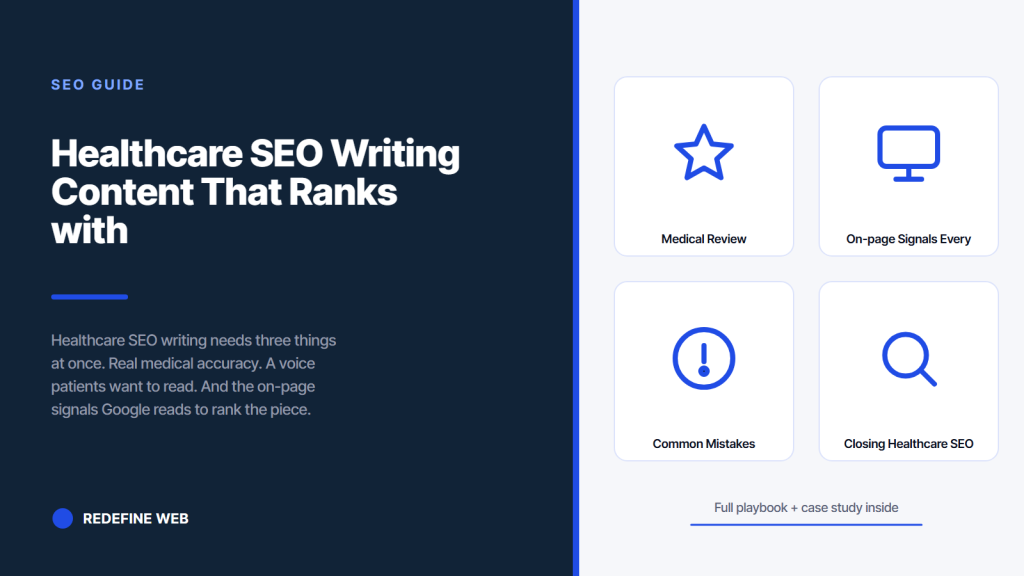
Healthcare SEO Writing Content That Ranks with Real E-E-A-T
- Every healthcare SEO piece needs a named clinician review byline.
- Match word count to the top-3 SERP, not to a house style guide.
- Lock the H2 outline in the brief before writing starts.
- Use 40 to 60 word answer paragraphs under every question H2.
- Weave provider quotes into every piece for E-E-A-T signal.
- SEO Content Length Healthcare What Actually Ranks
- Medical Review Workflow That Supports SEO Content Guidelines Healthcare
- On-Page Signals Every Healthcare SEO Writer Should Hit
- Real Numbers From a Healthcare SEO Writing Program
- Hiring and Managing a Healthcare SEO Writer
- Common Mistakes in Healthcare SEO Writing
- Closing the Healthcare SEO Writing Loop
Healthcare SEO writing has to do three things at the same time. Get the medical facts right, because getting them wrong risks patient safety and Google’s E-E-A-T scoring. Read like something a human patient wants to read, not like a WebMD copy. And carry the on-page signals Google uses to rank the piece: focus keyword placement, heading structure, internal linking, schema. Miss any one of those three and the piece either ranks well without converting, converts without ranking, or gets pulled by legal review before publishing.
You’ll get the whole writing framework in this post, laid out end to end. How to brief a healthcare SEO writer. How to structure a ranking piece from H1 to FAQ. What word-count band matters per intent type. How to handle the medical review step without killing the writing voice. And the on-page signals the piece has to emit to reach the top three for its target keyword.
SEO Content Length Healthcare What Actually Ranks
Word count is not the ranking factor. Ranking pages tend to be long because they cover the topic completely. Correlation, not causation. The length that ranks depends on intent, competition, and topic complexity. Chasing a fixed word count without matching the top-3 SERP length is either overwriting or underwriting the piece.
| Intent type | Target word count | Section count | Media count |
|---|---|---|---|
| Informational (symptom, condition) | 2,500 to 3,500 | 10 to 14 H2s | 3 to 5 images, 1 to 2 tables |
| Commercial (service, procedure) | 1,500 to 2,500 | 7 to 10 H2s | 2 to 4 images, 1 table |
| Transactional (booking, contact) | 800 to 1,500 | 4 to 7 H2s | 2 to 3 images, 1 table |
| Hub or pillar | 3,000 to 5,000 | 12 to 18 H2s | 4 to 8 images, 2 to 3 tables |
Why long pieces beat short pieces for healthcare
Healthcare patients are researching high-stakes decisions. They want depth. Google reads their behavior (time on page, scroll depth, pogo-sticking rate) as a quality signal. A 1,200-word piece on “dental implants cost” competing against a 2,800-word piece with better structure ranks lower and converts worse. The depth is not padding. It’s answering the questions patients actually have without forcing them to bounce back to Google for the next detail.
When shorter beats longer
Some queries genuinely warrant short content. “Office hours,” “parking directions,” “insurance accepted list.” Those pages should be 200 to 500 words and rank based on relevance, not depth. Never over-write a page whose intent is transactional and answerable in one paragraph. The user just wants the answer. Padding it to hit a word count teaches Google the page is bloated and drops the ranking accordingly.
The overwriting risk
Writers chasing a 3,000-word target on a 1,500-word topic pad the piece with filler. Patients notice. Bounces go up. Rankings drop. The word count target is a band, not a target. Land within the band based on real topic complexity. Underwriting risks not covering the topic completely; overwriting risks producing content patients don’t finish.
Medical Review Workflow That Supports SEO Content Guidelines Healthcare
Every healthcare SEO piece needs medical review before publishing. Not “the marketing lead read it and it seemed fine.” A named clinician has to sign off. That review step is where E-E-A-T signals get their strongest reinforcement, and it’s where most content programs slow to a crawl if the workflow isn’t designed for speed.
Who reviews what
Match the reviewer to the topic. Implant content reviewed by an implant provider. Pediatric content reviewed by a pediatric provider. General health content can rotate through the whole clinical team. Each reviewer gets pieces batched into a weekly or monthly slot so the interruption to clinical schedule is minimal. Providers who review 4 pieces at once on Thursday afternoon are less resistant than providers pinged for one piece at a time throughout the week.
What reviewers look for
Give reviewers a two-page checklist. Clinical accuracy on every factual claim. Correct treatment protocol descriptions. Correct medication references. Recovery-timeline realism. Contraindications called out where relevant. No claims that overstate outcomes. No claims that understate risks. That checklist keeps the review focused and produces 30-minute reviews rather than 3-hour rewrites.
How to name the reviewer in the byline
The published piece carries a “Medically reviewed by [Provider Name], [Credentials]” line under the title. That line is a trust signal Google reads, and it’s a trust signal patients read. Never publish healthcare content without it. If no provider will sign off, the piece isn’t ready. Use the review pass as a forcing function for accuracy, not a bureaucratic hoop. See our Healthcare Website Copywriting for the CTAs and voice patterns that pair with the review workflow.
On-Page Signals Every Healthcare SEO Writer Should Hit
On-page signals are the mechanical part of healthcare SEO writing. Focus keyword placement, heading structure, image alt text, internal linking. Every one is a checkbox item, not a judgment call. A writer who hits all the on-page signals produces pieces that rank consistently. A writer who freelances them produces pieces that rank randomly.
Focus keyword placement
Focus keyword in the H1 (verbatim), first 100 characters of the intro, at least 2 H2 headings, the meta description, the featured image alt text, and 6 to 12 times throughout the body at natural density. Never keyword-stuff. Density above 2 percent flags as spam. The goal is verbatim placement in the anchor positions plus natural inclusion elsewhere.
Internal and outbound linking
4-plus internal links: one to the industry hub, one to a service or retainer page, two to sibling cluster posts. 3-plus outbound links to authoritative primary sources (CDC, NIH, medical association guidelines, peer-reviewed research). Every link has descriptive anchor text. Never link to competitor practices. Never link to affiliate content. See our Healthcare SEO Keywords for the cluster map that dictates internal linking.
Schema for the piece
Every healthcare SEO piece emits Article schema plus MedicalWebPage schema plus, if the piece has FAQ content, FAQPage schema. Provider bylines get Person schema referencing the provider’s professional profile. Medically-reviewed pieces emit reviewedBy referencing the reviewing provider’s Person schema. The schema is where trust signals get made machine-readable for Google.
Google's YMYL raters look at the byline. If your blog says Admin or Team, rewrite bylines to the actual provider with credentials. Costs an hour, moves rankings in weeks.
Real Numbers From a Healthcare SEO Writing Program
Peaceful Mind Psychology, a Melbourne psychology clinic, ran a paired paid-search plus SEO writing program to fix flat enquiries and shift toward organic acquisition. The writing program covered 20 pieces across the first six months, each briefed against the framework in this post and reviewed by a named clinician. The result: 8,000 monthly ad impressions, a 17 percent organic traffic gain in the first 3 months, and 55 percent of conversions from organic search inside 6 months.
What the writing framework changed
Before the framework: pieces averaged 900 words with three or four generic H2s and no medical review byline. After: pieces averaged 2,200 words with 8 to 12 H2s, provider quotes woven in, and clinician review credit in the byline. Same writer, same monthly output, different structure. The E-E-A-T signal upgrade produced most of the organic traffic gain in the first 90 days. See the NIH review of digital health information quality signals for the accuracy-versus-readability framing that underpins how clinicians evaluate published patient content.
Where the review workflow paid off
The clinician review workflow surfaced 3 factual errors across the first 10 pieces that would have shipped without review. Two were minor (dose range on a supplement mention, recovery timeline for a specific therapy). One was significant (a claim about a treatment’s applicability that would have exposed the practice to a complaint from the professional board). The 30-minute review pass paid for itself the first time it caught something meaningful.
Operational takeaway
The writer wasn’t better after the framework. The brief was better. The review was tighter. The structure was locked before writing started. That’s the whole change. Healthcare SEO writing quality is 60 percent brief, 20 percent writer, 20 percent review. Practices that under-invest in the brief and over-invest in the writer keep getting inconsistent results. Our Healthcare SEO Audit covers the audit that flags weak briefs before they become weak pieces.
Hiring and Managing a Healthcare SEO Writer
The healthcare SEO writer market is thin. Fewer writers know healthcare than know home services or B2B SaaS. The good ones charge $150 to $400 per piece for well-briefed 2,500-word content, and they book out. Practices hiring without a clear brief format burn 3 to 5 writers before landing on one who can execute.
What to test in a paid trial
Pay for one piece against a real brief. Score it on medical accuracy (needs zero fact-check corrections), voice (patient-voice test), structure (matches brief), and on-page signals (hits every checklist item). Writers who score 8-plus on all four are candidates for a monthly retainer. Writers who score below 6 on any one are not, no matter how good the writing feels on first read. The scoring makes the hire objective.
Rates and expectations
$0.10 to $0.20 per word for freelance healthcare SEO writing. $0.20 to $0.35 per word for writers with medical or clinical backgrounds. Full-time healthcare content leads $75,000 to $115,000 depending on market and specialization. Retainer agencies typically bundle 4 to 8 pieces a month into a $2,500 to $6,000 monthly rate for a single-specialty practice. Our Healthcare SEO Services covers the full agency retainer model.
Feedback loops that produce better pieces
Give the writer feedback with specifics. “Voice was too clinical in section 3” beats “read a bit stiff.” “H2 outline missed the People Also Ask about insurance coverage” beats “could go deeper.” Specific feedback across 5 to 10 pieces trains the writer to your standard. Vague feedback trains them to guess, and guessing produces inconsistent pieces across the retainer.
Common Mistakes in Healthcare SEO Writing
The mistakes we see most often. Publishing without a named medical reviewer. Chasing word counts instead of top-3 SERP alignment. Freelancing the H2 structure. Ignoring the answer-first pattern under question H2s. And skipping provider quotes because the interview logistics feel hard.
No named medical reviewer
The most common mistake. Pieces publish with an “Editorial Team” byline and no reviewer credit. Google’s Search Quality Rater Guidelines call out YMYL content without demonstrable expertise as low-quality. Every piece needs a named clinician review credit visible under the title. Without it, the piece caps at a ranking ceiling well below what the content could otherwise earn.
Word count over SERP alignment
Writers chase a fixed 2,500-word target regardless of the topic. When the top-3 SERP average is 1,500 words, the piece is padded. When it’s 3,500, the piece is thin. Word count targets should come from the SERP, not from a house style guide. Read the top 3, average their word counts, add 10 to 20 percent, and target that band. Match the SERP or the piece doesn’t rank.
Freelanced H2 structure
Writers left to write their own H2 outlines produce pieces that read like essays. Google’s ranking algorithm rewards structural patterns that match search intent. The brief includes the H2 outline for exactly that reason. Skipping it means every piece is a fresh restructuring exercise, which slows output and produces inconsistent ranking outcomes across the same retainer.
Skipping the answer-first pattern
Question-formatted H2s (“How much does an implant cost?”) need a 40 to 60 word answer paragraph directly underneath. Google pulls those into featured snippets and “People Also Ask.” Skip the pattern and the piece loses the featured snippet real estate to a competitor who did include it. That real estate is often worth more than half the organic click-through rate on the SERP.
Closing the Healthcare SEO Writing Loop
Healthcare SEO writing is 60 percent brief, 20 percent writer, 20 percent review. Get the brief right, hire against a scoring rubric, run the review workflow with named clinicians, and the pieces compound over time. Skip any one of those three and the retainer produces inconsistent output at best. The framework is copyable. The discipline to run it every piece is what separates programs that rank from programs that publish.
Where to start on your first piece
Pick one target keyword from your cluster map. Read the top 3 SERP results. Draft the 15-field brief. Book a 30-minute provider interview. Write the piece against the brief. Run the medical review. Publish with the reviewer credit under the title. That single-piece proof of concept becomes the template for every piece that follows on the same retainer.
What to measure on the first 5 pieces
Track three numbers across the first 5 pieces. Time from brief to publish (target: under 3 weeks). Revision rounds per piece (target: 1 light round). Ranking position 60 days after publish (target: page 2 or better for at least 3 of 5). Miss any of the three and adjust the brief format, the writer selection, or the review workflow. Hit all three and the program is ready for a 4-piece-per-month cadence.
When to add a second writer
Add a second writer when the first writer is booked out and the content plan is behind schedule. Never split pieces across writers for pace reasons alone. Voice consistency across the site matters. A single writer producing 4 pieces a month against a locked brief produces more consistent site-level voice than two writers producing 2 pieces each. Bring the second writer in only when the volume demand genuinely exceeds one writer’s capacity.
Frequently asked questions
What is healthcare SEO writing and how is it different from general SEO writing?
Healthcare SEO writing is content writing for healthcare websites that combines medical accuracy, patient-friendly voice, and on-page SEO signals in one piece. It differs from general SEO writing because healthcare content sits in Google's YMYL category, meaning E-E-A-T scoring applies more strictly. Every clinical statement has to be accurate, every piece needs a named medical reviewer credit, and every draft has to demonstrate experience and expertise through concrete signals like provider quotes and links to authoritative primary sources. A great writer for home services content is not automatically a great healthcare SEO writer. The trust layer changes what good looks like at every level from brief through review to publication.
How long should a healthcare SEO piece be?
Word count depends on intent and SERP competition. Informational content on symptoms or conditions typically runs 2,500 to 3,500 words to cover the topic completely. Commercial content on services or procedures runs 1,500 to 2,500 words. Transactional content like booking pages or contact pages runs 800 to 1,500 words. Hub or pillar pages run 3,000 to 5,000 words because they establish topical authority for the whole cluster. Word count itself isn't the ranking factor. The right length depends on what the top 3 SERP results already look like. Read the top 3, average their word counts, add 10 to 20 percent, and target that band.
Why does every healthcare SEO piece need a named medical reviewer?
Because Google's Search Quality Rater Guidelines specifically call out YMYL content without demonstrable expertise as low-quality. Every healthcare piece needs a "Medically reviewed by [Provider Name], [Credentials]" line under the title. That reviewer credit is a machine-readable trust signal Google reads through byline schema, and it's a human trust signal patients read before deciding to trust the content. Without a named clinician reviewer, the piece caps at a ranking ceiling well below what the content could otherwise earn, even if the writing itself is technically strong and factually accurate. Use the review pass as a forcing function for accuracy rather than as a bureaucratic hoop.
How should healthcare SEO writers handle provider quotes?
Interview one provider for 15 to 30 minutes per piece. Ask them the 3 to 5 questions the piece needs to answer. Transcribe the quotes. Weave 2 to 4 direct quotes into the piece with the provider's byline attribution. Provider quotes are what move a piece from generic AI-tell content to demonstrably-human content with real clinical experience behind it. Google reads provider quotes as an E-E-A-T signal through the combination of the visible attribution, the Person schema referencing the provider, and the writing style shift between narrator voice and quoted voice. That single step separates pieces that survive core updates from pieces that get suppressed.
What on-page SEO signals should every healthcare SEO writer hit?
Focus keyword in the H1 verbatim, focus keyword in the first 100 characters of the intro, focus keyword in at least 2 H2 headings, focus keyword in the meta description, focus keyword in the featured image alt text, and 6 to 12 natural-density body occurrences. At least 4 internal links: one to the industry hub, one to a service or retainer page, two to sibling cluster posts. At least 3 outbound links to authoritative primary sources like CDC, NIH, or peer-reviewed research. Every H2 that reads like a question gets a 40 to 60 word answer paragraph directly underneath. Article plus MedicalWebPage plus FAQPage schema on every piece. Provider byline plus reviewedBy schema for medical review credit.
How much does a healthcare SEO writer cost?
Freelance healthcare SEO writers charge $0.10 to $0.20 per word for standard content, and $0.20 to $0.35 per word for writers with a medical or clinical background. That works out to $250 to $875 per piece for a 2,500-word article. Full-time healthcare content leads run $75,000 to $115,000 annually depending on market and specialization. Retainer agencies typically bundle 4 to 8 pieces per month into a $2,500 to $6,000 monthly rate for a single-specialty practice, which includes brief writing, provider interview coordination, medical review workflow, and publication. Practices new to healthcare content often underestimate the review coordination cost and end up burning through the writing budget on rewrites.
How do I brief a healthcare SEO writer so they can execute without follow-up questions?
A working brief has 10 to 15 fields: primary keyword and secondary keywords from the cluster map, target word count band from top-3 SERP analysis, intent classification, target audience persona, H2 outline with brief section descriptions, required internal links from cluster hub to sibling spokes, required outbound authoritative sources, provider quotes required with topic hints, media required including photos and tables, and an FAQ list from People Also Ask plus front-desk sources. That format lets the writer execute without having to make structural decisions mid-draft. A one-line brief (just a title) produces a piece that needs 3 to 5 rounds of revision. A 15-field brief produces a piece that needs 1 round of light editing.
Book your free 30-minute strategy call.
No spam, no sales rep. We use your email to schedule your call with a senior strategist. That is it.
More from the blog
View all articles → SEO
SEO Organic Search Engine Optimization Services That Grow Real Traffic
Read article SEO
SEO SEO for Pet Groomers That Fills the Appointment Book Weekly
Read article SEO
SEO