
AI Marketing for Chiropractors With Real Use Cases and Workflows
- AI marketing works for outlines, review drafts, reminders, and captions.
- Human editors on every workflow are non-negotiable.
- Core tool stack costs under $80 a month.
- HIPAA rules still apply to any patient data in AI tools.
- AI saves 10 to 15 hours a week when applied to the right tasks.
- What ai marketing for chiropractors actually does well
- Use case 1: blog post outline generation
- Use case 2: review response management
- Use case 3: appointment reminder personalization
- Use case 4: social caption variants
- The ai tools for chiropractor marketing stack under $80 a month
- Pelvic Rehabilitation Medicine case study on AI-assisted content scale
- The weekly AI marketing workflow loop for a chiropractor
- Where ai marketing for chiropractors still fails
- Start ai marketing for chiropractors this week
AI marketing for chiropractors is where a solo practice can save 15 hours a week without hiring anyone new. The catch is that the productive use cases are narrower than every sales email promises. AI does not replace your marketing coordinator or your copywriter. It does replace the 15 hours a week you spend on repetitive first-draft work, review response management, appointment reminder personalization, and content research. Applied to the right tasks, AI turns a solo practice’s marketing capacity into that of a two-person team.
This guide covers the real ai marketing for chiropractors playbook we run with practice clients in 2026. You get the use cases that actually save time, the tool stack that costs under $80 a month, the workflows a solo practice can implement in one afternoon, the guardrails that keep AI-generated content from ranking-poison territory, and the boundaries where AI still fails. Read straight through in about nine minutes and you have a plan you can start Monday.
What ai marketing for chiropractors actually does well
AI marketing for chiropractors performs best on four specific tasks: blog outline drafts, review response drafts, appointment reminder personalization, and social caption variants. Those four use cases save a solo practice 10 to 15 hours a week and cost less than $80 a month in tool subscriptions.
What AI does poorly for a chiropractor practice is anything requiring clinical judgment, patient-specific detail, or original insight. AI cannot write a good chiropractor blog post from a prompt alone because the post ends up sounding like every other AI-generated chiropractor blog post on the internet. AI cannot handle sensitive review responses on complaints or health concerns. AI cannot write your practice’s unique voice without extensive training. Use it for drafts. Never for finals.
The time savings math that sold us
Solo chiropractors spend an average of 8 to 12 hours a week on marketing tasks between social captions, review responses, appointment reminders, blog drafts, and email newsletters. AI handles the first draft on all of those in a fraction of the time and still leaves a human editor with 30 to 60 minutes a week for review and finalization. Net savings: 6 to 10 hours a week, which is a full workday of doctor or front desk time freed for patient care.
Quality guardrails that keep AI content honest
Every AI-generated draft needs a human editor pass before publishing. That editor should have a checklist: does the copy sound like our practice, does it use the doctor’s voice, does it avoid tell-tale words a normal chiropractor would never write, does it include specific practice details a stranger would not know. If the answer to any of those is no, rewrite the section by hand. This rule alone separates practices that use AI well from practices that publish AI slop and watch rankings drop.
Use case 1: blog post outline generation
Blog post outline generation is the top AI use case for a chiropractor practice. Feed the AI your target keyword, your top three competitor URLs, and a short brief on the practice’s voice. Get back an outline with 6 to 8 H2s, suggested subtopics, an intro hook, and an FAQ list. That outline takes 10 minutes to generate and would take 60 to 90 minutes to write from scratch.
The human writer then interviews the doctor for 20 minutes, drafts the post using the outline as a scaffold, and edits for voice. Total time to publish drops from 4 to 5 hours per post to 90 minutes. Quality stays high because a human handles the actual writing. AI never touches the final draft. The AI touched only the outline stage where creativity is optional and structure matters more.
| Task | Manual time | AI-assisted time | Time saved |
|---|---|---|---|
| Blog outline | 60 min | 10 min | 50 min |
| Review response draft | 15 min | 3 min | 12 min |
| Social captions x 10 | 90 min | 15 min | 75 min |
| Newsletter first draft | 120 min | 25 min | 95 min |
The prompt template that works for blog outlines
The prompt template for a chiropractor blog outline should include the target keyword, three competitor URLs, the practice’s target audience, the desired word count, and a voice guide covering do’s and don’ts. “Write in second person. Skip agency-tone words that a chiropractor would never say. Include a table and a bulleted list. Structure with 8 H2s and an FAQ.” That prompt structure produces usable outlines on the first try roughly 80 percent of the time.
The editorial line human writers keep
Human writers keep the editorial line on every AI-assisted post. That means the doctor interview provides real practice details, the writer weaves those details into the body copy, and the editor removes any generic paragraph that could have come from any chiropractor blog on the internet. Specificity is the antidote to AI-tell writing. “Our office in Brookhaven treats 30 desk workers a week for lower back pain” beats “Many patients experience lower back pain from prolonged sitting” every time on both trust and ranking signals.
Use case 2: review response management
Review response management is the second AI marketing for chiropractors use case worth setting up. Every five-star review deserves a personalized thank-you within 24 hours. Every one to four-star review deserves a thoughtful response that offers to make things right. That volume, spread across 15 to 30 reviews a month for a busy practice, eats 5 to 10 hours of front desk time. AI drafts every response in 30 seconds. A human review takes 90 seconds. Total time per review: 2 minutes instead of 15.
The workflow: front desk pastes the review into a prompt template that includes the patient’s first name, the star rating, and any specific detail mentioned. AI generates a draft response in the practice’s voice. Front desk reads, edits any awkward phrasing, posts within 5 minutes of receiving the review. That speed alone signals to future patients reading reviews that the practice is responsive, which converts more of them into first-visit bookings than the response content itself.
Five-star response template that stays human
The five-star response template should thank the patient by first name, reference the specific detail they mentioned in their review, and invite them to book their next visit through a soft nudge. Skip generic thank-yous. “Thanks Sarah, we love hearing that Dr. Martinez helped with your sciatica pain. See you at your follow-up next month” beats “Thanks for the great review” by 10x on future review activity. Other patients read your responses when deciding whether to book. Show them the practice cares about detail.
Negative review handling stays 100 percent human
Negative reviews should never get AI-drafted responses. The stakes are too high. A poorly worded AI response on a complaint about billing, wait time, or clinical outcome can turn a two-star review into a public relations problem. The practice owner should personally draft every response to a review under four stars. Take 30 minutes. Get it right. AI has no place in this workflow because tone and empathy on complaints need a human who knows the patient’s context.
Don't publish AI drafts as finals. Rewrite in your voice with a real patient story per post, or Google's helpful-content update kills your traffic.
Use case 3: appointment reminder personalization
Appointment reminder personalization is where ai marketing for chiropractors delivers the fastest ROI. Generic reminders like “Your appointment is tomorrow at 2 PM” produce a 25 to 35 percent no-show rate on first visits. Personalized reminders referencing the treatment type, the doctor’s name, and one specific detail from the intake form cut no-shows to 8 to 15 percent. AI writes 200 personalized reminders in 5 minutes. Front desk sends them through the practice management system.
The workflow requires an integration between your practice management system and an AI tool. Push tomorrow’s appointment list to the AI with patient name, treatment type, doctor name, and one intake note. Get back 200 personalized reminder texts under 160 characters each. Send through the practice management SMS system. Track no-show rate over 30 days to measure the impact. Most practices see a $8,000 to $18,000 monthly revenue gain from cut no-shows alone at a solo practice scale.
TCPA consent still applies to AI-generated messages
AI-generated appointment reminders still need TCPA consent from every patient who receives them. A checkbox on the intake form saying “Yes, text me appointment reminders” is the minimum legal requirement. Without that consent your practice risks $500 to $1,500 per unwanted text message under TCPA rules. AI does not change the legal framework. See FCC guidance on TCPA for the current rules on healthcare messaging.
Personalization limits worth respecting
Never reference sensitive clinical detail in an AI-generated text message. “See you tomorrow for your lower back adjustment” is fine. “See you tomorrow to discuss your MRI results” is not. The line is whether the content would embarrass or upset a patient if seen by a family member reading the phone. AI does not know this line without explicit guardrails in the prompt. Add “Never reference clinical diagnosis, imaging results, or medications” to every reminder generation prompt.
Use case 4: social caption variants
Social caption generation for Instagram and Facebook is the fourth core AI marketing for chiropractors use case. A chiropractor posting 3 Reels a week and 15 story frames needs roughly 90 social captions a month across formats. Writing those from scratch takes 3 to 5 hours a week. AI generates 30 caption variants from a single photo and topic in under 10 minutes. A human picks the best five, edits for voice, and schedules through Meta Business Suite.
The AI caption workflow works because captions are structurally similar across posts of the same type. A doctor Q and A caption always follows a hook plus question plus soft CTA structure. A treatment explainer caption follows an educate plus context plus offer structure. AI handles the structural repetition well. Human editors keep the specific voice and add the practice details that make the caption feel written by an actual chiropractor.
- Feed the AI: photo topic, target keyword, and desired CTA
- Get 5 to 10 caption variants at 3 different lengths
- Pick the best, edit for voice, add the practice detail
- Schedule through Meta Business Suite
- Time per caption drops from 20 minutes to 4 minutes
Voice training that makes AI captions sound like you
Voice training on AI takes about an hour of setup. Paste 10 to 15 of your best-performing existing captions into the prompt as reference. Ask the AI to match the tone, sentence length, and personality of those examples. That single training step transforms output quality from generic-chiropractor to specific-your-practice. Every three months, refresh the reference caption set with new best performers. The AI drifts otherwise and starts producing generic output again.
Caption length that works on each platform
Instagram Reels captions perform best at 3 to 5 sentences with a clear CTA in the last line. Facebook post captions perform best at 2 to 3 sentences. Instagram story frames need 1 to 2 lines at most because they overlay on the image. Ask the AI for length variants and pick the format that matches the platform. Practices that copy the same caption across all platforms see 30 to 50 percent lower engagement compared to platform-tuned variants.
The ai tools for chiropractor marketing stack under $80 a month
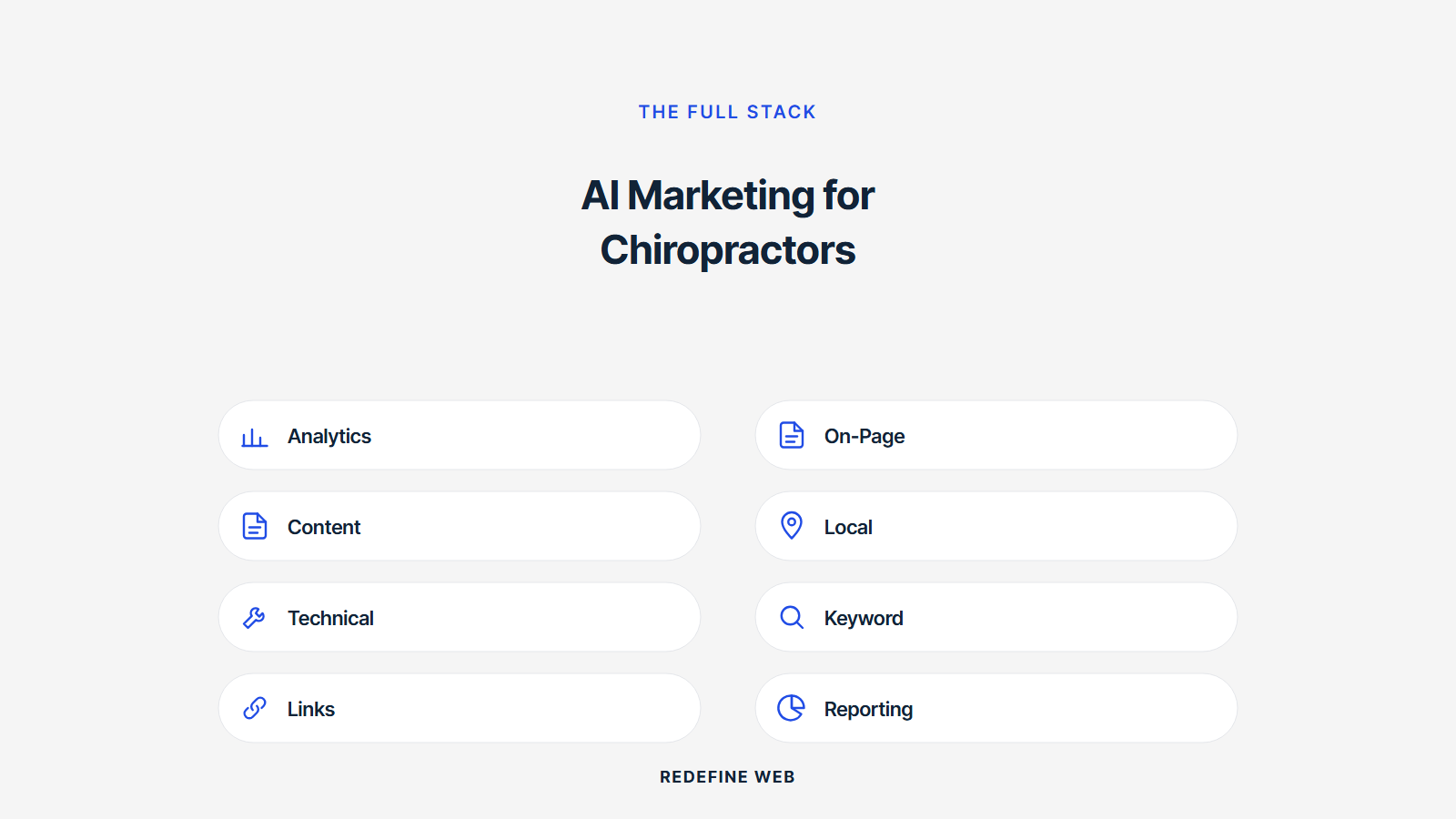
The core ai tools for chiropractor marketing stack for a solo practice runs under $80 a month. ChatGPT Plus at $20 covers writing, review response drafts, and appointment reminder personalization. Claude at $20 covers longer-form blog outline generation and voice training. Descript at $24 covers Reels transcription and quick video edits. Metricool or Later at $15 covers scheduling and platform-specific caption variants. That $79 a month replaces roughly $2,000 a month of freelance production capacity.
Enterprise AI marketing platforms like Jasper or Writesonic pitch chiropractors at $99 to $299 a month. Most solo practices do not need them because the core ChatGPT plus Claude combination handles 90 percent of the same use cases at 20 percent of the cost. Buy the enterprise platform if you scale to a 5-plus location group or if you need multi-user access with brand guides. Otherwise the lightweight stack does the job at a fraction of the spend.
ChatGPT versus Claude for chiropractor work
ChatGPT wins on speed and short-form output like captions, review responses, and reminder personalization. Claude wins on longer-form structured output like blog outlines, FAQ generation, and voice-matched drafts. Most practices should have both because switching between them for the right use case adds an hour of speed to any content workflow. See OpenAI’s enterprise privacy documentation and Anthropic’s commercial terms for the current terms on business use.
Data privacy rules for healthcare AI use
Never paste protected health information into a consumer AI tool. Patient names paired with clinical details count as PHI under HIPAA. Use only first names and non-clinical context in any AI prompt. For workflows that require PHI like appointment reminders, use a HIPAA-compliant vendor that signs a business associate agreement. Most consumer AI tools including ChatGPT do not sign BAAs for the standard $20 plans. HIPAA-eligible ChatGPT plans exist through OpenAI’s business tier at higher price points.
Pelvic Rehabilitation Medicine case study on AI-assisted content scale
Pelvic Rehabilitation Medicine, a 14-location specialty medical group, ran an AI-assisted content workflow that transferred directly to what a chiropractor practice can do at a smaller scale. The team faced the volume problem every multi-location practice hits: producing enough locally relevant content for 14 markets without hiring 14 marketing coordinators.
The workflow used AI for blog outline generation, patient education FAQ drafts, and local content variants. Human writers finalized every post, editors reviewed for voice, and clinicians signed off on medical accuracy. Twelve months in, organic keyword rankings grew 174 percent, organic traffic grew 166 percent, and the group launched a patient community platform on the same content architecture. AI did the volume work. Humans did the trust work. That split is the model every chiropractor practice should copy.
Chiropractor-specific transfers
The AI plus human split works at any scale. A solo practice runs the same workflow at 5 percent of the multi-location budget: doctor interview, AI-generated outline, human writer drafts, editor reviews for voice, clinician approves for accuracy. Time per post drops from 4 to 5 hours to 90 minutes. Quality stays high because the human touch never leaves the workflow. See our marketing tools for chiropractors writeup for the broader tool stack.
What the multi-location group avoided
The group specifically avoided the trap most healthcare practices fall into: publishing raw AI output without a human editing pass. That path produces content that reads generic, ranks poorly, and burns trust with the audience once patients notice the tone. The extra 30 to 60 minutes per post for human editing is what separates practices using AI well from practices using AI in ways that hurt them. For the underlying content strategy that AI accelerates, see our content marketing for chiropractors guide.
Every chiropractor who has tried publishing raw AI blog posts knows the pattern. Post one gets 40 visits. Post two gets 20. Post three gets 8. You check Google Search Console and notice the impressions curve looks like a black-diamond ski slope going the wrong way. You paste one of your posts into an AI-detection tool. It comes back 97 percent AI-generated. You realize the free trial you took last month generated 12 posts and Google noticed all of them. You delete them. You go back to writing the old way with a doctor interview and a human writer. Traffic recovers over the next 90 days. The lesson costs you a quarter of rankings and a mild ego bruise.
The weekly AI marketing workflow loop for a chiropractor
The weekly ai marketing for chiropractors workflow loop runs on Monday afternoon in about 45 minutes. Pull last week’s reviews from Google, Yelp, and Healthgrades. Paste each into the review response prompt. Approve and post responses one by one. Pull tomorrow’s appointment list. Generate personalized reminders. Send through the practice management system. Pull the topic for this week’s blog post. Generate the outline. Hand to the writer for the interview.
That single 45-minute Monday session replaces 8 to 12 hours of scattered work spread across the week for a solo practice. The loop compounds because each week’s outputs get logged and used to refine the next week’s prompts. After 90 days the prompts get tight enough that AI output needs 5-minute edits instead of 15-minute edits. Small compounding gains add up over a quarter to another 2 or 3 hours saved.
Monday block that holds the whole system
Block Monday from 1 PM to 2 PM as the AI marketing block. Nothing else on the calendar. Front desk handles this if the doctor is booked with patients. The block never moves. If Monday is holiday, shift to Tuesday. Practices that skip the block for two weeks in a row find AI marketing quietly slipping out of the practice’s routine. The block is the ritual that keeps the whole system running week after week.
Friday review that catches drift
Every Friday, take 15 minutes to review the week’s AI outputs. Did the reminders match the treatment types. Did the review responses feel human. Did the blog outline lead to a real interview or a scrapped draft. That short review catches drift before it compounds. Log any prompt tweaks in a shared doc so the next Monday block starts with the improvements already in place. Small weekly refinements keep the system honest.
Where ai marketing for chiropractors still fails
AI still fails at four things a chiropractor practice needs. First, AI cannot conduct a doctor interview. The insights that come out of a 20-minute recorded conversation with a clinician are the raw material that separates a great blog post from a generic one. AI cannot ask the follow-up question that unlocks the specific story worth telling.
Second, AI cannot write in your practice’s specific voice without extensive training and constant refresh. Third, AI cannot handle patient-specific clinical detail without HIPAA-compliant infrastructure that costs 10x more than consumer tools. Fourth, AI cannot make judgment calls on sensitive topics like negative reviews, patient complaints, or clinical outcome discussions. Every one of those tasks needs a human owner.
Clinical content boundaries that AI should never cross
Clinical content on a chiropractor site needs clinician review for medical accuracy. AI-generated content on conditions, treatments, or contraindications must never publish without a licensed provider reading and approving the copy. Search engines increasingly penalize sites publishing unreviewed medical content. Google’s E-E-A-T guidelines specifically flag healthcare content lacking author expertise. See Google’s helpful content guidance for the current standards on YMYL content.
Voice drift that shows up in AI content over time
AI-assisted content drifts toward generic voice over 3 to 6 months without active correction. The signals are AI-tell words creeping into copy, sentence structures becoming uniform, and paragraphs sounding interchangeable across posts. Refresh the voice guide every quarter with new examples. Add practice details that AI cannot know. Have the doctor read a random published post every month and flag anything that sounds off. That maintenance loop keeps AI content aligned with the practice voice year over year.
Start ai marketing for chiropractors this week
Start with three moves this week. Set up ChatGPT Plus and Claude subscriptions for $40 total. Pair the tools with the plan covered in our marketing plan for chiropractors so AI accelerates work you already know is worth doing. Build one review response prompt template and one appointment reminder template. Run the workflow on one week of reviews and appointments to prove the time savings before scaling further. Those three moves take about two hours and produce a real ROI signal within seven days.
Then expand slowly. Add blog outline generation in month two. Add social caption variants in month three. Never publish raw AI output. Always keep a human editor on every workflow. Practices that stack AI use cases responsibly save 10 to 15 hours a week within 90 days. Practices that dump AI content into publishing pipelines without editors watch rankings drop over the same period. The tool is the same. The workflow decides the outcome. For the operational structure under an AI-assisted marketing plan, our chiropractor marketing services page covers what a real retainer includes.
Frequently asked questions
What is ai marketing for chiropractors in practical terms
AI marketing for chiropractors is the use of AI tools like ChatGPT and Claude to accelerate repetitive marketing tasks including blog post outline generation, review response drafts, appointment reminder personalization, and social caption variants. The productive use cases save a solo chiropractor practice 10 to 15 hours a week on tasks that would otherwise consume front desk or doctor time. AI does not replace a marketing coordinator or copywriter. It replaces the repetitive first-draft work those roles used to do, letting the human parts of marketing focus on voice, judgment, and clinical accuracy. Every AI-generated draft needs a human editor before publishing.
How much does an ai tools for chiropractor marketing stack cost
A working ai tools for chiropractor marketing stack for a solo practice runs under $80 a month. ChatGPT Plus at $20 handles writing, review response drafts, and appointment reminder personalization. Claude at $20 handles longer-form blog outline generation and voice training. Descript at $24 covers Reels transcription and quick video edits. Metricool or Later at $15 covers scheduling and platform-specific caption variants. That $79 a month replaces roughly $2,000 a month of freelance production capacity. Enterprise AI platforms at $99 to $299 a month are usually overkill for solo practices.
Can AI write chiropractor blog posts that rank on Google
AI cannot write chiropractor blog posts that rank well when publishing raw output. Google's helpful content system now flags AI-generated content that lacks author expertise or original insight, especially in healthcare where E-E-A-T standards apply. What works is using AI for the outline stage only, then having a human writer draft the actual body copy from a doctor interview, followed by an editor pass for voice and a clinician review for medical accuracy. That AI plus human workflow cuts time per post from 4 hours to 90 minutes while keeping the content quality high enough to rank.
Is it safe to put patient information into ChatGPT for ai marketing for chiropractor tasks
No. Consumer AI tools including standard ChatGPT and Claude subscriptions do not sign business associate agreements under HIPAA. Patient names paired with clinical details count as protected health information. Never paste PHI into a consumer AI tool. Use only first names and non-clinical context in prompts. For workflows that require PHI like appointment reminders, use a HIPAA-compliant vendor that signs a BAA. HIPAA-eligible ChatGPT plans exist through OpenAI's business tier at higher price points. Confirm the tier and the BAA in writing before any patient data enters the workflow.
How long before ai marketing for chiropractors shows time savings
AI marketing for chiropractors shows measurable time savings within the first week of implementing the review response workflow and the appointment reminder personalization workflow. Both use cases have immediate ROI. Blog outline and social caption use cases show savings within the first month once the voice training is set up. Total savings ramp from 3 to 5 hours a week in the first month to 10 to 15 hours a week by month three. That freed time can be redirected to patient care, clinical training, or building the practice through referrals and community outreach.
What ai marketing for chiropractor mistakes should we avoid
The biggest ai marketing for chiropractor mistakes to avoid are three specific patterns. First, publishing raw AI output on the blog without a human editor pass, which produces content that reads generic, ranks poorly, and hurts trust with patients who notice the tone. Second, using AI to draft responses to negative reviews or complaint threads where tone and empathy require human judgment. Third, pasting protected health information into consumer AI tools that do not sign HIPAA business associate agreements. Every one of those mistakes has real downside risk. The workflow that keeps humans in the loop on judgment, voice, and clinical accuracy avoids all three.
Book your free 30-minute strategy call.
No spam, no sales rep. We use your email to schedule your call with a senior strategist. That is it.
More from the blog
View all articles → SEO
SEO Organic Search Engine Optimization Services That Grow Real Traffic
Read article SEO
SEO SEO for Pet Groomers That Fills the Appointment Book Weekly
Read article SEO
SEO