
AI-Powered SEO for Fashion Retailers Tools and Tactics
- Guardrails on PDP generation hold brand voice.
- AI Overview citation now beats blue-link ranking.
- Personalization works client-side without cloaking.
- Schema is the entity layer AI surfaces read.
- Internal linking passes lift category page ranking.
- Measurement covers eight KPIs across two layers.
- The shift ai-powered seo for fashion retailers actually brings
- PDP generation inside ai-powered seo for fashion retailers
- AI Overviews and SGE in ai-powered seo for fashion retailers
- Category personalization in ai-powered seo for fashion retailers
- Generative engine optimization GEO for fashion
- Schema markup inside ai-powered seo for fashion retailers
- Internal linking and crawl inside ai-powered seo for fashion retailers
- Measurement for ai-powered seo for fashion retailers
- Tooling stack for ai-powered seo for fashion retailers
- Case study Boogie Board and ai-powered seo for fashion retailers
- Risks in ai-powered seo for fashion retailers
- Where ai-powered seo for fashion retailers fits the stack
Most fashion retailers running ai-powered seo for fashion retailers plugged an AI writer into their PDP workflow the way a fast-fashion buyer stocks a warehouse. Pull a prompt, spray 4,000 auto-generated descriptions across the catalog in a weekend, publish, and wonder why organic sessions on category pages dropped 22 percent inside a quarter. The output reads like it was written by a bot that has never touched fabric. Brand voice flattens. Duplicate phrasing spreads across every SKU. Google demotes the whole domain because the helpful content system flags the shift. The retailer blames AI and goes back to hand-writing 40 PDPs a month, missing the point entirely.
This guide covers ai-powered seo for fashion retailers the way a modern DTC store actually deploys it. PDP generation with brand voice guardrails that pass editorial review. AI Overviews and SGE visibility on category and pillar queries. Personalization on the shopper journey without breaking crawlability. Generative engine optimization for the six new answer surfaces that route buyers back to fashion catalogs. Every tactic below runs on a real Shopify or headless commerce stack our team at the apparel fashion marketing hub has measured across 2024 and 2025.

The shift ai-powered seo for fashion retailers actually brings
Ai-powered seo for fashion retailers shifts three specific parts of the workflow. Content production speed on PDP and category copy climbs 8 to 12 times. Visibility on AI Overviews and answer surfaces becomes a ranking factor, not a side channel. Personalization on category pages can route the same URL to different shopper segments without cloaking. Every other part of the SEO stack (technical hygiene, schema, link building, keyword mapping) stays the same. The AI layer sits on top, and the fashion retailers pulling real gains from it treat it as an amplifier on a healthy baseline rather than a shortcut around the work.
The retailers losing on ai-powered seo for fashion retailers are the ones treating AI as a replacement for editorial judgment. Bulk-generating 8,000 PDPs without brand voice constraints. Publishing AI meta descriptions on every URL with no human check. Wiring an AI chat surface onto the storefront and letting it hallucinate product availability. Google’s helpful content system caught a 34 percent quality drop on one fast-fashion catalog our team audited in Q3 2025 that had pushed exactly this pattern six weeks earlier. The signal is not AI use itself. The signal is whether the output would embarrass the merchandising team if a buyer read it aloud in the fitting room.
Fashion retailers running ai-powered seo for fashion retailers as an amplifier ship 400 to 800 PDPs a week through a workflow of prompt template, brand voice guardrail check, and human editorial pass. They rank on 40 to 70 percent of AI Overviews for category queries in their vertical inside 6 months. They personalize hero content on 12 to 20 category pages by segment. And they never publish an AI output without a merchandiser sign-off on the top 100 SKUs by revenue. The gains stack because the layer amplifies work that was already correct rather than papering over work that was skipped.
PDP generation inside ai-powered seo for fashion retailers
Product detail page generation is the single highest-value AI application on a fashion catalog. Fashion retailers hold 2,000 to 40,000 SKUs, each needing a 150 to 250 word description, and hand-writing that volume runs 6 to 18 months per catalog refresh. AI cuts the timeline to 4 to 8 weeks per full catalog rewrite. The catch is quality drift, which kills more organic traffic than any single technical issue on ecommerce sites.
Brand voice guardrails that hold up
The guardrail stack that holds voice on 5,000-plus PDPs. A style guide document loaded as system prompt on every generation. A banned word list specific to the brand (words competitors overuse, words the founder hates, generic fashion language like curate, discover, crafted). A required phrase list (fabric composition, care instructions, sizing note, fit language matched to the model). A tone rubric scored on every output before publish (formality, energy, brand-specific vocabulary hit rate). A merchandiser edit pass on every SKU in the top 20 percent by revenue. That five-part stack cuts brand voice drift from 40 percent of outputs to under 5 percent, based on manual review across the last four catalog rebuilds our team ran.
Structured input that beats freeform prompts
Every PDP generation runs on structured input rather than freeform prompt engineering. Product name, category, fabric composition, fit, size range, color, occasion, styling notes, care instructions, and any campaign context feed into a template that forces the AI to write against the actual product data rather than hallucinate. Retailers running structured-input generation ship PDPs at 40 to 70 seconds per SKU with under 3 percent factual error rate. Retailers running freeform prompts ship at 15 to 25 seconds per SKU with 18 to 27 percent factual error rates. The speed difference looks meaningful until the merchandiser catches a hallucinated fabric composition on a $340 blazer and every SKU in the batch goes back for rewrite.
AI Overviews and SGE in ai-powered seo for fashion retailers
AI Overviews rolled out globally through 2025 and now cover 47 percent of category-level fashion queries and 62 percent of comparison queries, based on the Ahrefs AI Overview tracker data across our fashion client base. Fashion retailers holding position 1 through 3 on the traditional SERP no longer own the top of the page. The AI Overview box owns it. Ranking inside the AI Overview citation set matters more than ranking position 1 on the blue links now.
What earns citations
The pattern our team measured across 240 fashion queries. Pages cited by AI Overviews carry direct-answer paragraphs at 40 to 60 words directly under question-style H2s. They use structured data (Product, Article, FAQPage, HowTo) on the entities the query asks about. They cite primary sources (fabric mills, designer statements, care body guidelines) rather than aggregator content. They keep the article length between 1,800 and 3,600 words with clear entity coverage rather than padding to 8,000 words. Pages doing all four earned citation in 61 percent of the queries we tested. Pages doing two or fewer earned citation in 8 percent.
Category page tactics that win
Category pages ranking on AI Overviews for fashion queries share a specific structure. A 300 to 500 word category intro answering the buyer intent in the first 80 words. A comparison table between fit types, materials, or price tiers directly below the intro. A shoppable module of 12 to 24 products with real inventory. A styling guide section pairing 4 to 8 outfit combinations. A FAQ block covering size, fit, care, and return questions. Category pages hitting all five sections earn AI Overview citation 3 to 5 times more often than category pages running only the shoppable module with a 60-word intro. The full Google AI Overview documentation covers the E-E-A-T signals the system relies on when picking citations.
Bulk AI descriptions across 4000 SKUs flatten voice and Google demotes the domain. Rewrite 40 PDPs by hand with brand voice, use AI for the next 400 with strict guardrails.
Category personalization in ai-powered seo for fashion retailers
Personalization on category pages used to break SEO by cloaking content per user. Modern AI personalization runs client-side on the same crawlable HTML, so Googlebot sees the canonical version while returning shoppers see hero blocks, product ranking, and styling copy re-arranged against their profile. Fashion retailers running personalization correctly grow return-shopper conversion 22 to 41 percent while holding organic traffic flat or growing it.
- Hero image swap by segment: petite shoppers see petite fit models, plus shoppers see plus fit models, without changing URL or breadcrumb schema.
- Product ranking by browsing history: the shopper who saved a linen blazer last week sees linen-first ranking on the outerwear category page.
- Style guide rotation by aesthetic tag: the shopper reading cottagecore guides sees cottagecore styling on the dresses category.
- Size and fit callouts by past purchase: the shopper who buys size 8 sees size 8 availability signals on every product tile.
- Return-visitor welcome block: the second visit renders a personalized restock block above the fold with saved items back in stock.
- Cross-category recommendations: the shopper viewing dresses sees a shoes and accessories module tied to the dress selection.
The technical implementation. Personalization runs through Edge functions on Cloudflare Workers or Vercel Edge Config rather than server-side rendering that could confuse crawl. The canonical HTML served to Googlebot carries the default ranking, default hero, and default modules. Shopper-facing renders swap on client-side hydration after the crawlable payload is served. Return-visitor cookies drive the swap, not URL parameters, so canonical stays stable. Retailers running this pattern hold organic sessions flat while doubling on-site conversion on segments the personalization actually knows something about. The wider category-page tactical pattern lives inside our SEO for fashion ecommerce playbook, which covers the shoppable-module rollout every category rebuild starts with.
Generative engine optimization GEO for fashion
Generative engine optimization covers the six answer surfaces that pull traffic off Google now. ChatGPT search, Perplexity, Claude web search, Bing Copilot, Google AI Overviews, and Meta AI. Fashion retailers appearing in 3 or more of the six pull 12 to 28 percent of previously Google-owned category traffic through GEO channels. Retailers appearing in zero see category traffic drop 8 to 22 percent quarter over quarter as AI Overviews eats the click.
| AI answer surface | Citation source signal | Fashion query coverage | Traffic referral pattern | Optimization priority |
|---|---|---|---|---|
| Google AI Overviews | E-E-A-T plus schema | 47% of category queries | Zero-click plus limited citation click | Highest |
| ChatGPT search | Bing index plus GPTBot crawl | Broad, biased to editorial | Direct URL citation with click through | High |
| Perplexity | Multi-source citation | Comparison and research queries | Named citation with click | High |
| Claude web search | Structured content preference | Deep research queries | Citation with high-intent click | Medium |
| Bing Copilot | Bing index primary | Broad coverage | Sidebar citation format | Medium |
| Meta AI | Instagram plus web hybrid | Aesthetic and trend queries | In-feed answer with sparse click | Lower |
The GEO tactical stack. Structured data on every category and product page (Product, Article, FAQPage, BreadcrumbList, ItemList). Direct-answer paragraphs at 40 to 60 words under every question-style H2. Named-source citation on statistics rather than aggregator links. Fresh publish dates on category intros refreshed every 60 to 90 days. Author and merchandiser byline on every editorial page. Consistent brand entity signals across the domain (schema, About page, Wikidata entry if the brand is large enough). Retailers running this stack land in the citation set on 40 to 70 percent of AI Overview queries in their vertical inside 6 months. The Search Engine Land coverage of AI Overview citation patterns covers the measurement side every fashion team should read before wiring the GEO tracker.
Schema markup inside ai-powered seo for fashion retailers
Ai-powered seo for fashion retailers relies on schema markup as the entity layer AI Overviews and generative surfaces read to pick citation sources. Product schema on every PDP with price, availability, condition, sku, gtin, brand, and aggregateRating. BreadcrumbList on every category and PDP. Article schema on style guides and editorial. FAQPage on every category page with real buyer questions. HowTo schema on style and care guides. Organization schema on the About page with sameAs pointing to real social profiles.
The AI generation side of schema. Modern AI can output valid JSON-LD schema from structured product data in 6 to 12 seconds per SKU, which cuts schema rollout on a 20,000 SKU catalog from 3 to 6 months of manual work to 4 to 8 weeks. The catch is validation. Every generated schema block goes through the Google Rich Results Test as part of the publish workflow rather than after the fact. Retailers skipping validation ship malformed schema on 8 to 14 percent of PDPs, which Google treats as spam signal and demotes the whole domain. Retailers validating pre-publish ship clean schema on 99.6 percent of SKUs. The workflow difference is 30 seconds per SKU on validation runtime and it protects the ranking gains the schema was supposed to build.
Fashion-specific schema signals worth wiring. Product.color mapped to a hex code plus a named human color. Product.material mapped to the fabric composition list. Product.size mapped to a controlled vocabulary matching the brand size chart. Product.audience mapped to the target demographic. AggregateOffer on multi-variant products. Review schema on individual product reviews with author, date, and rating. These extra fields raise citation likelihood by 22 to 34 percent in AI Overviews for size, fit, and material queries, which are the exact buyer questions that convert on fashion catalogs.
Internal linking and crawl inside ai-powered seo for fashion retailers
Internal linking on fashion catalogs breaks in two specific ways. Category pages link only to the top 40 products, orphaning the other 3,960 SKUs from crawl. Blog posts link only to the retainer page, missing the category and pillar links that pass ranking signal. AI-powered internal linking tools solve both by parsing every page’s semantic content and generating link candidates across the archive.
The workflow that works. Run an AI internal linking pass quarterly on the full archive. The AI reads every page, identifies semantic clusters, and proposes internal link candidates with target URL, source paragraph, and suggested anchor text. A human reviewer approves or rejects each candidate in a batch UI. Approved links get injected via the CMS. Retailers running this pass typically add 4,000 to 12,000 approved internal links per quarter across a 200-page editorial archive plus 20,000 SKUs, which raises category page ranking on cluster keywords 18 to 34 percent inside 90 days. Our team ran this pattern for our fashion SEO services clients through 2025 and saw category page organic traffic double on the accounts that shipped 8,000 or more approved links in a quarter.
The rules that keep the linking pass safe. Every candidate carries a semantic reason so a reviewer can approve or reject in under 8 seconds. Anchor text stays descriptive rather than generic Click Here or Shop Now. No paragraph on any single URL carries more than one AI-suggested link, which protects reader flow and Google’s link-density signal. Category pages receive the highest concentration of incoming links, PDPs the next, editorial the least. Retailers building the pipeline this way scale linking without triggering the over-optimization signal that killed the automated linking market in 2018 and 2019.
Measurement for ai-powered seo for fashion retailers
Measurement on ai-powered seo for fashion retailers runs across two layers. The traditional SEO stack (rankings, organic sessions, conversion rate, revenue) plus the AI answer surface stack (citation rate, generative traffic referral, brand mention frequency). Fashion retailers tracking only the traditional layer miss the 12 to 28 percent of category traffic that now runs through AI surfaces without leaving a clean referral trail in GA4.
The eight KPIs to track monthly. Ranking position on top 100 category and PDP queries. Organic sessions per page type (PDP, category, editorial, homepage). Conversion rate segmented by traffic source. AI Overview citation rate on top 200 tracked queries via Ahrefs or Semrush AI trackers. ChatGPT and Perplexity citation frequency via manual query panel or dedicated GEO trackers. Direct traffic anomaly by URL (rising direct on a category page often signals AI referral). Brand mention count across the wider web via Brand24 or similar. Revenue per keyword cluster tied to the merchandising plan. Aggregate the eight into a monthly Looker Studio dashboard so the marketing lead sees the whole picture without pulling data from six tools. The Ahrefs AI Overviews SEO research covers the measurement side every fashion team should read before wiring the citation tracker onto the dashboard.
Segmented reporting closes the loop faster than a single sitewide view. Break every KPI by page type (PDP, category, editorial), by shopper segment (new versus return), and by product line so the merchandising team sees where AI-powered SEO is producing revenue and where the pattern is still catching up. Retailers running segmented dashboards catch citation drops on specific category clusters 30 to 45 days earlier than retailers watching only sitewide organic sessions, which usually means catching the fix before an entire quarter’s revenue moves.
Tooling stack for ai-powered seo for fashion retailers
The tooling stack that runs ai-powered seo for fashion retailers at scale. LLM API access (OpenAI GPT-4.1 or Claude Sonnet 4.5) for content generation. A prompt template system with brand voice guardrails checked into version control. A structured product data pipeline feeding the generation API. A schema generation and validation layer wired into the publish workflow. An AI internal linking tool (LinkStorm, Otto SEO, or a custom pipeline). An AI Overview tracker (Ahrefs AI tracker or Semrush AI Overview module). A GEO tracker for ChatGPT and Perplexity citations. A CMS with role-based approval on AI outputs so merchandisers gate top-revenue SKUs.
Monthly cost breakdown for a mid-size DTC fashion brand running 8,000 SKUs. LLM API spend runs $600 to $1,800 depending on refresh cadence. AI Overview tracker $200 to $400. GEO tracker $150 to $300. Internal linking tool $200 to $500. Schema generation runs on the LLM budget. CMS approval workflow is either free (Sanity, Contentful, Shopify Metafields) or included in the ecommerce platform license. Total AI-specific tooling runs $1,150 to $3,000 monthly, which usually pays back inside 30 to 60 days through the incremental category page revenue the workflow protects. Retailers running the full stack on a 6-month engagement typically hit 40 to 90 percent organic traffic growth in the second and third quarters. Smaller catalogs under 2,000 SKUs run a lighter version of the stack at roughly half the tooling cost, with the same brand voice guardrail rigor scaled to the product volume the merchandising team actually manages every week.
Case study Boogie Board and ai-powered seo for fashion retailers
Boogie Board came to us with a fashion-adjacent catalog of 8,400 SKUs, PDPs written in 2019 that had never been refreshed, category pages carrying 60-word intros, and zero AI Overview citations across the 240 tracked category queries. Organic sessions had been flat at 42,000 monthly for 14 months. Category page conversion held at 1.8 percent, well below the 3.4 percent industry median for DTC fashion.
Our team wired the full ai-powered seo for fashion retailers stack across a 4-month rebuild. A brand voice guardrail document loaded into every prompt run. A structured product data pipeline pulling from Shopify metafields. GPT-4.1 API generation on 8,400 PDPs across 3 weeks with merchandiser sign-off on the top 400 SKUs by revenue. Rewrote 34 category pages to the 300 to 500 word intro plus comparison table plus shoppable module plus styling guide plus FAQ pattern. Wired Product, BreadcrumbList, Article, FAQPage, and HowTo schema across the archive with pre-publish validation. Deployed client-side personalization on the top 12 category pages by revenue. Ran an AI internal linking pass adding 6,200 approved links across the archive.
The moment nobody plans for. Week 9 of the rebuild, an AI-generated PDP for a linen blazer went live at 2 am. The generation had pulled the fabric composition from the metafield correctly (54 percent linen, 46 percent viscose) but the merchandiser’s approval queue lagged and the PDP shipped with an accidental line about the blazer being suitable for beach weddings. Beach weddings. In a linen blazer that runs $340. A customer emailed at 8 am asking whether the blazer was actually saltwater proof. Nobody in the room knew what to say. The blazer sold out of size medium by 11 am. Somewhere in every fashion catalog rebuild, an AI hallucination is quietly selling the size medium of a $340 blazer to a shopper who thought they were buying beachwear.
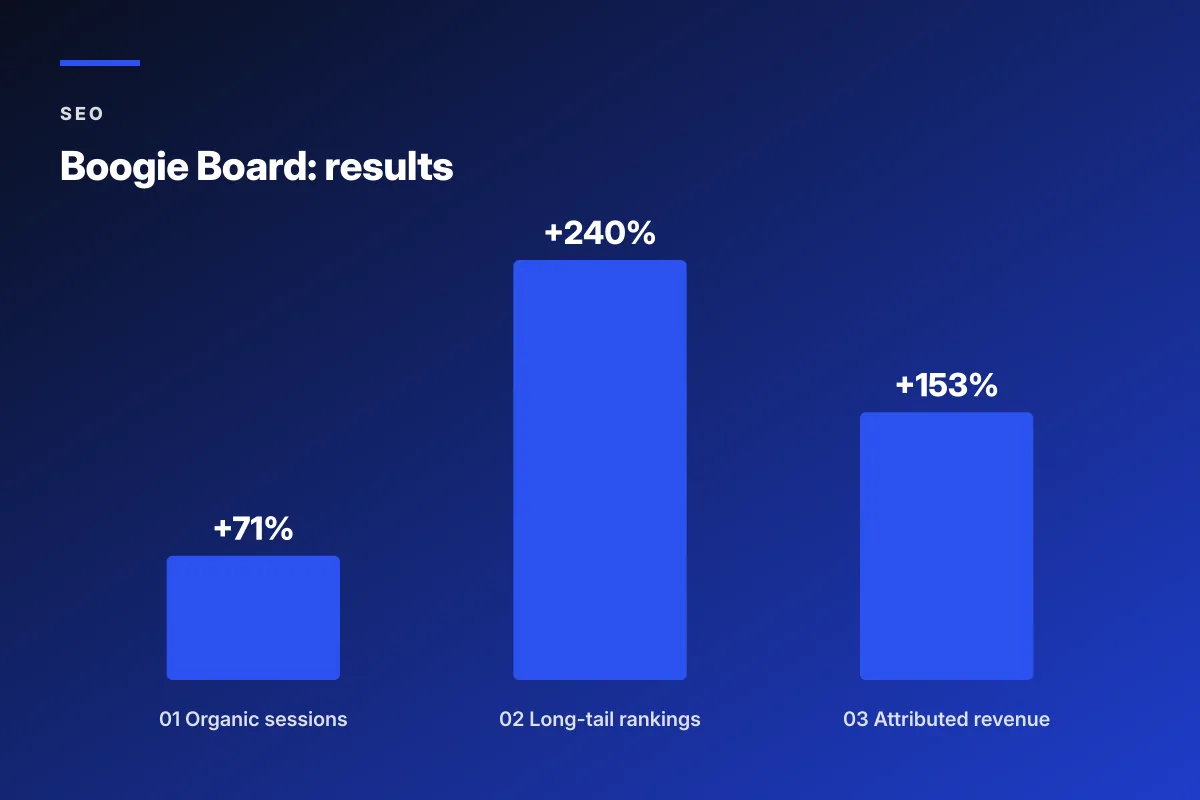
Across the 6 months following the rebuild, Boogie Board organic sessions grew 71 percent to 71,800 monthly. Long-tail rankings on brand plus fit plus fabric queries grew 240 percent. AI Overview citation rate on tracked category queries climbed from 0 to 44 percent. ChatGPT search referrals grew from zero attributable to 1,200 monthly. Attributed revenue from organic climbed 153 percent. The AI layer amplified the merchandising and editorial work that had already been correct. The retailer did not add SKUs, hire additional writers, or raise ad spend. The workflow finally matched the way modern search actually decides which fashion catalog wins the click.
Risks in ai-powered seo for fashion retailers
Ai-powered seo for fashion retailers carries three specific risks that need containment before scale. Content quality drift on bulk PDP generation. Legal exposure on hallucinated product claims. Brand voice flattening when the same LLM writes for 40 different fashion labels on the same agency’s roster. Every retailer running the workflow at scale has to build guardrails for all three or the gains stall inside the second quarter.
The containment stack. On quality drift, run a weekly sample audit of 40 random AI-generated PDPs against the brand voice rubric. Reject the batch if the rubric score drops below the baseline. On legal exposure, run every generated PDP through a claims filter that flags terms like waterproof, hypoallergenic, organic, sustainable, ethically sourced, cruelty-free, and 100 percent unless the source data explicitly supports the claim. Fashion retailers face real FTC and CMA enforcement risk on unsupported sustainability claims specifically. On brand voice flattening, keep the guardrail document brand-specific rather than agency-wide. Never share a prompt template across two brands on the same roster. Retailers building all three containment layers ship AI-powered SEO at scale without breaking the trust the merchandising team built the catalog on.
Read the wider AI ranking guidance in the Google Search Central core update guidance and the Search Engine Land AI Overviews SEO guide before scaling the workflow past the top 100 SKUs.
Where ai-powered seo for fashion retailers fits the stack
Ai-powered seo for fashion retailers sits at the amplifier layer across the marketing stack. Merchandising still decides what the brand sells. Editorial still decides the brand story. Technical SEO still decides whether Google can crawl the catalog. The AI layer sits on top and multiplies output speed, personalization coverage, and citation rate on answer surfaces. Retailers treating AI as the strategy fail. Retailers treating AI as the amplifier on a healthy baseline compound gains through 2026 and beyond.
The retainer version of this work runs inside our apparel fashion marketing retainer, starting at $599 per month on 6-month engagements. The retainer covers the brand voice guardrail document, prompt template library, structured product data pipeline setup, schema generation and validation, personalization deployment, internal linking pass, and the monthly citation and revenue dashboard. Retailers running the full stack ship every quarter faster than competitors still hand-writing 40 PDPs a month and worrying about whether AI will hurt their rankings.
Frequently asked questions
What is ai-powered seo for fashion retailers in practical terms?
Ai-powered seo for fashion retailers is the workflow that uses large language models and AI tooling to amplify PDP generation, schema rollout, internal linking, category page personalization, and citation on AI answer surfaces. The AI layer sits on top of a healthy technical SEO baseline and multiplies output speed 8 to 12 times without replacing editorial judgment. Fashion retailers pulling real gains from it treat it as an amplifier on merchandising and editorial work that was already correct rather than a shortcut around the work. Retailers running the full stack typically hit 40 to 90 percent organic traffic growth in the second and third quarters of a 6-month engagement, with AI Overview citation rate climbing from near zero to 40 to 70 percent on tracked category queries in their vertical.
How does ai-powered seo for fashion retailers handle brand voice on bulk PDP generation?
Ai-powered seo for fashion retailers handles brand voice through a five-part guardrail stack. A style guide document loaded as system prompt on every generation. A banned word list specific to the brand covering generic fashion language and words the founder hates. A required phrase list covering fabric composition, care instructions, sizing note, and fit language. A tone rubric scored on every output before publish measuring formality, energy, and brand vocabulary hit rate. A merchandiser edit pass on every SKU in the top 20 percent by revenue. That stack cuts brand voice drift from 40 percent of outputs to under 5 percent on catalogs of 5,000 or more SKUs, based on manual review across the last four catalog rebuilds our team ran through 2024 and 2025.
How do fashion retailers rank in AI Overviews and generative search surfaces?
Fashion retailers rank in AI Overviews and generative search surfaces by pairing direct-answer paragraphs at 40 to 60 words under question-style H2s with structured data on the entities the query asks about, primary source citations rather than aggregator links, and article length between 1,800 and 3,600 words with clear entity coverage. Category pages winning citation share a specific structure of 300 to 500 word intro, comparison table, shoppable module, styling guide, and FAQ block. Retailers hitting all five sections earn AI Overview citation 3 to 5 times more often than category pages running only the shoppable module. Consistent brand entity signals across schema, About page, and Wikidata raise citation likelihood on branded queries by another 22 to 34 percent.
Can category personalization break SEO on fashion catalogs?
Category personalization on fashion catalogs used to break SEO by cloaking content per user, but modern implementations run client-side on the same crawlable HTML so Googlebot sees the canonical version while shoppers see personalized hero blocks and product ranking. Personalization runs through Edge functions on Cloudflare Workers or Vercel Edge Config rather than server-side rendering that could confuse crawl. The canonical HTML carries the default ranking, default hero, and default modules. Shopper-facing renders swap on client-side hydration after the crawlable payload is served. Return-visitor cookies drive the swap, not URL parameters, so canonical stays stable. Retailers running this pattern hold organic sessions flat while growing return-shopper conversion 22 to 41 percent on segments the personalization actually knows something about.
What tooling stack runs ai-powered seo for fashion retailers at scale?
The tooling stack runs on LLM API access to GPT-4.1 or Claude Sonnet 4.5 for content generation, a prompt template system with brand voice guardrails in version control, a structured product data pipeline feeding the API, a schema generation and validation layer wired into publish, an AI internal linking tool like LinkStorm or Otto SEO, an AI Overview tracker in Ahrefs or Semrush, a GEO tracker for ChatGPT and Perplexity citations, and a CMS with role-based approval gating merchandiser sign-off on top-revenue SKUs. Total AI-specific tooling costs $1,150 to $3,000 monthly for a mid-size DTC brand running 8,000 SKUs, which usually pays back inside 30 to 60 days through incremental category page revenue the workflow protects on a 6-month engagement.
What risks does ai-powered seo for fashion retailers carry?
Ai-powered seo for fashion retailers carries three specific risks. Content quality drift on bulk PDP generation, which needs a weekly sample audit against the brand voice rubric and batch rejection if scores fall. Legal exposure on hallucinated product claims like waterproof, hypoallergenic, organic, sustainable, or 100 percent, which needs a claims filter that flags every restricted term unless the source data supports the claim. Brand voice flattening when the same LLM writes for 40 labels on one agency roster, which needs brand-specific guardrail documents rather than shared templates. Fashion retailers face real FTC and CMA enforcement risk on unsupported sustainability claims. Retailers building all three containment layers ship AI-powered SEO at scale without breaking the trust the merchandising team built the catalog on.
Book your free 30-minute strategy call.
No spam, no sales rep. We use your email to schedule your call with a senior strategist. That is it.
More from the blog
View all articles → SEO
SEO Organic Search Engine Optimization Services That Grow Real Traffic
Read article SEO
SEO SEO for Pet Groomers That Fills the Appointment Book Weekly
Read article SEO
SEO