5.0 · verified April 2026
"They kept the process simple and focused. Understood our goals as a dental practice and stayed focused on improvements that would make the website and ad campaigns more effective."

Fashion marketing retainer that runs on-store SEO, Klaviyo flows, Meta and TikTok, return-rate CRO, sizing tools, VIP tier programs, and Pinterest for your brand. Apparel marketing retainer and fashion marketing packages from $599 per month with quarterly reviews built in, cancel with 30 days notice.
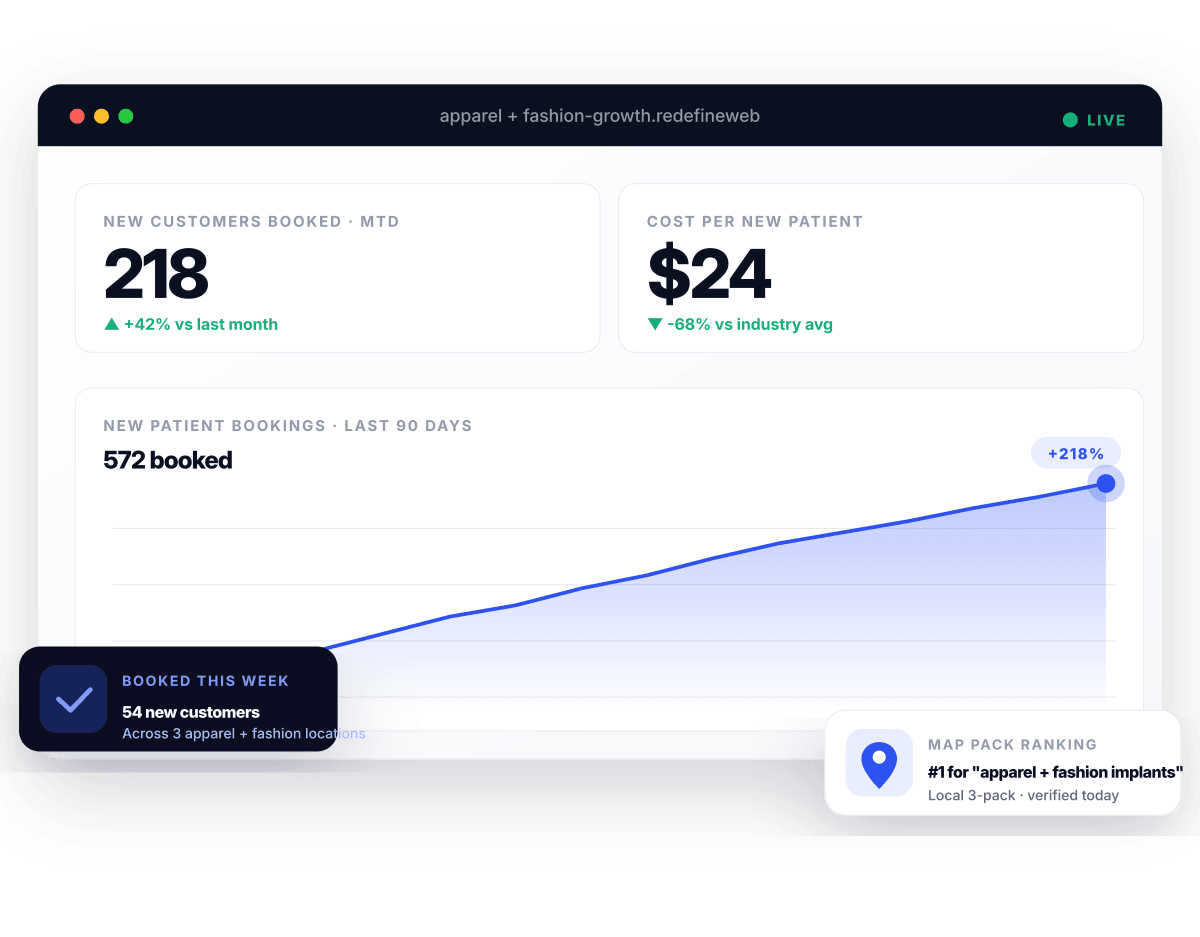


























Nothing here is "reach" or "impressions". Every outcome maps to a new-customer order kept, a return avoided, or a VIP repeat purchase.
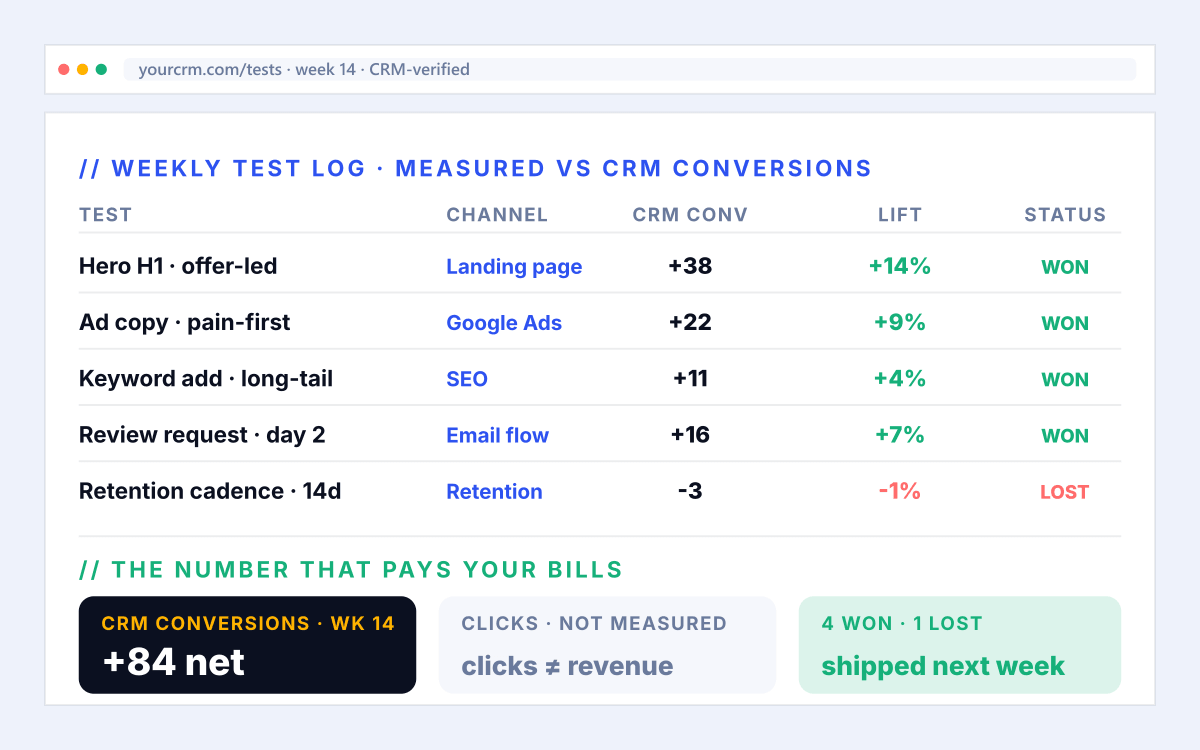
Meta, TikTok, and Google Shopping running from the same plan with server-side tracking and CAPI in place. Every first-time order carries a channel, campaign, and margin tag so you know which creator or drop actually paid for itself.
Model-height tags, sizing tool integration, fit-content pages, and ad creative that sets fit expectations pre-purchase. Retainer clients typically drop return rate 4 to 9 percentage points inside 90 days, worth more than most brands make from a new campaign.
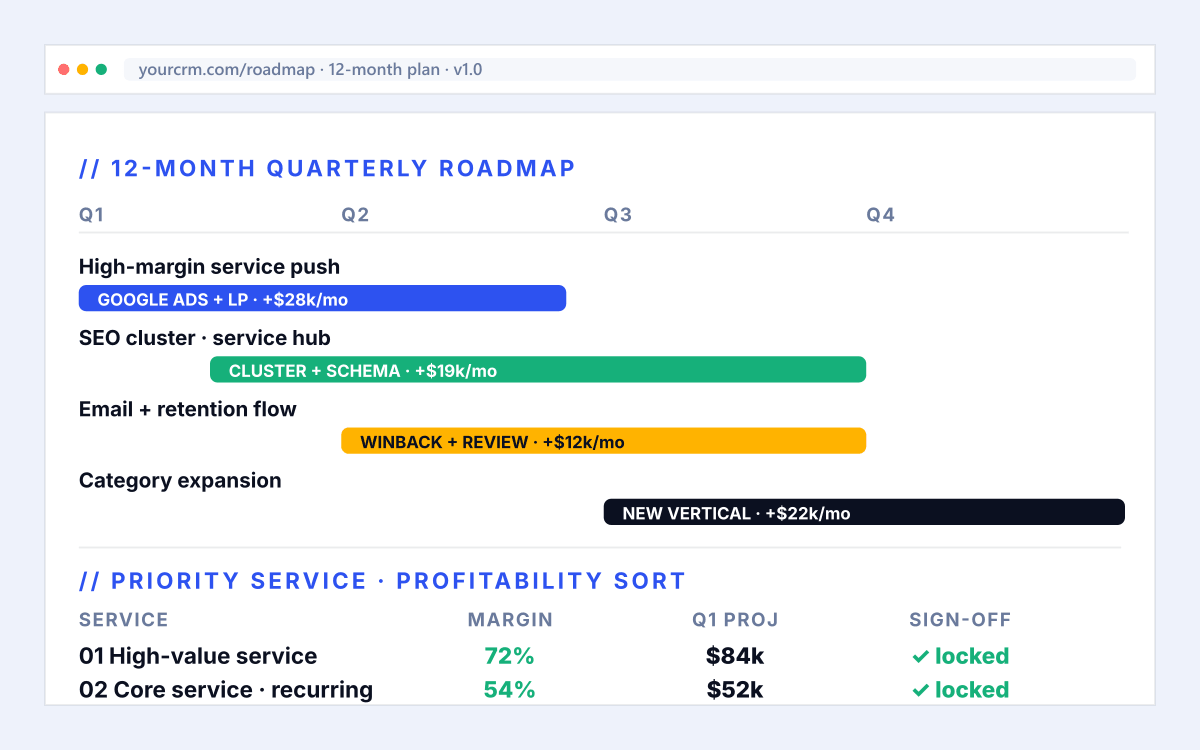
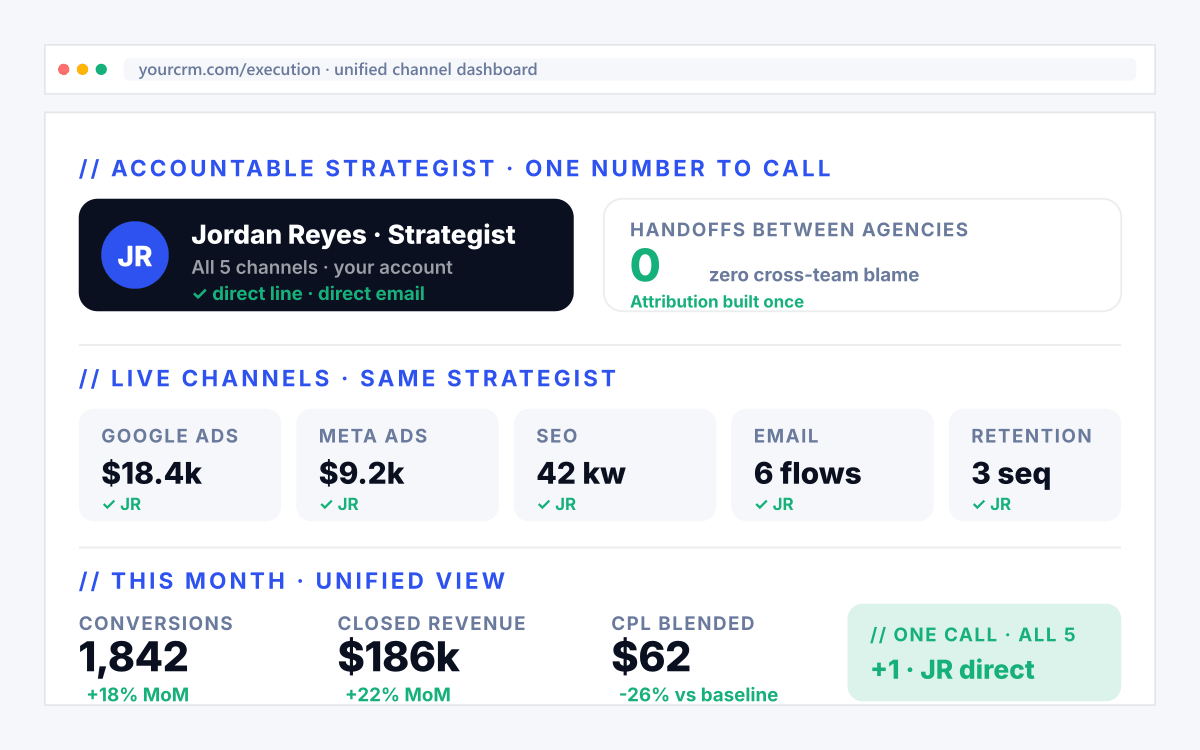
You stop paying five vendors and getting five conflicting spreadsheets. A fashion growth strategist owns the roadmap, pushes the work live, and shows up on the monthly call with what moved on new-customer AOV, return rate, and VIP repeat.
Pick the tier that matches your brand stage. Move up or down anytime with 30 days notice. Ad spend billed separately at pass-through. Hover any feature name for a plain-English explanation.
Solo fashion brands that want an accountable growth program running without a five-vendor stack. On-store SEO, Klaviyo core flows, sizing content patches, and reporting, run monthly.
Growing fashion brands ready to add Meta and TikTok prospecting, return-rate CRO, and a monthly VIP or winback campaign on top of the Foundation stack.
Multi-channel fashion brands running seasonal launches, VIP programs, or wholesale alongside DTC. Adds sizing tool integration, VIP tier programs, launch waterfall support, and resale monitoring.
Multi-region storefronts, brands doing $500K+ monthly revenue, or luxury and streetwear brands that split DTC and wholesale with a dedicated fashion growth strategist.
Need scope beyond the Scale tier? We also run full-service apparel and fashion marketing retainers from $4,000/mo for brands with larger media budgets, seasonal launch waterfalls, or split DTC and wholesale operations.
Tap any section to expand or collapse. Hover a feature name for a plain-English explanation.
| Feature | 01 · Foundation | 02 · GrowthPopular | 03 · Scale | 04 · Enterprise |
|---|---|---|---|---|
| Content pieces per month | 2 | 2 | 4 | 6+ |
| Collection / lookbook pages | 1/mo | 2+/mo | ||
| Programmatic fit SEO | ✓ |
| Feature | 01 · Foundation | 02 · GrowthPopular | 03 · Scale | 04 · Enterprise |
|---|---|---|---|---|
| Sizing content patches on top PDPs | ✓ | ✓ | ✓ | ✓ |
| Return-rate CRO workstream | ✓ | ✓ | ✓ | |
| Sizing tool integration | ✓ | ✓ |
| Feature | 01 · Foundation | 02 · GrowthPopular | 03 · Scale | 04 · Enterprise |
|---|---|---|---|---|
| Meta Ads management | Up to $4k | Up to $8k | Unlimited | |
| TikTok Ads management | Up to $3k | Up to $6k | Unlimited | |
| Meta whitelisting with creators | ✓ | ✓ | ✓ |
| Feature | 01 · Foundation | 02 · GrowthPopular | 03 · Scale | 04 · Enterprise |
|---|---|---|---|---|
| Klaviyo core flows | ✓ | ✓ | ✓ | ✓ |
| VIP tier program build | ✓ | ✓ | ||
| Launch waterfall support | ✓ | ✓ |
| Feature | 01 · Foundation | 02 · GrowthPopular | 03 · Scale | 04 · Enterprise |
|---|---|---|---|---|
| Reporting cadence | Monthly | Monthly | Bi-weekly | Weekly |
| Strategy calls | 45 min/mo | 45 min bi-wk | Dedicated | |
| Dedicated strategist | ✓ |
Every quote is verified by Clutch through a direct call with the client. Reviews shown span our verticals; sector-specific references available on the strategy call.
Recent engagements matched to this vertical. Numbers verified with the client.
A sampling of recent engagements that match this work.
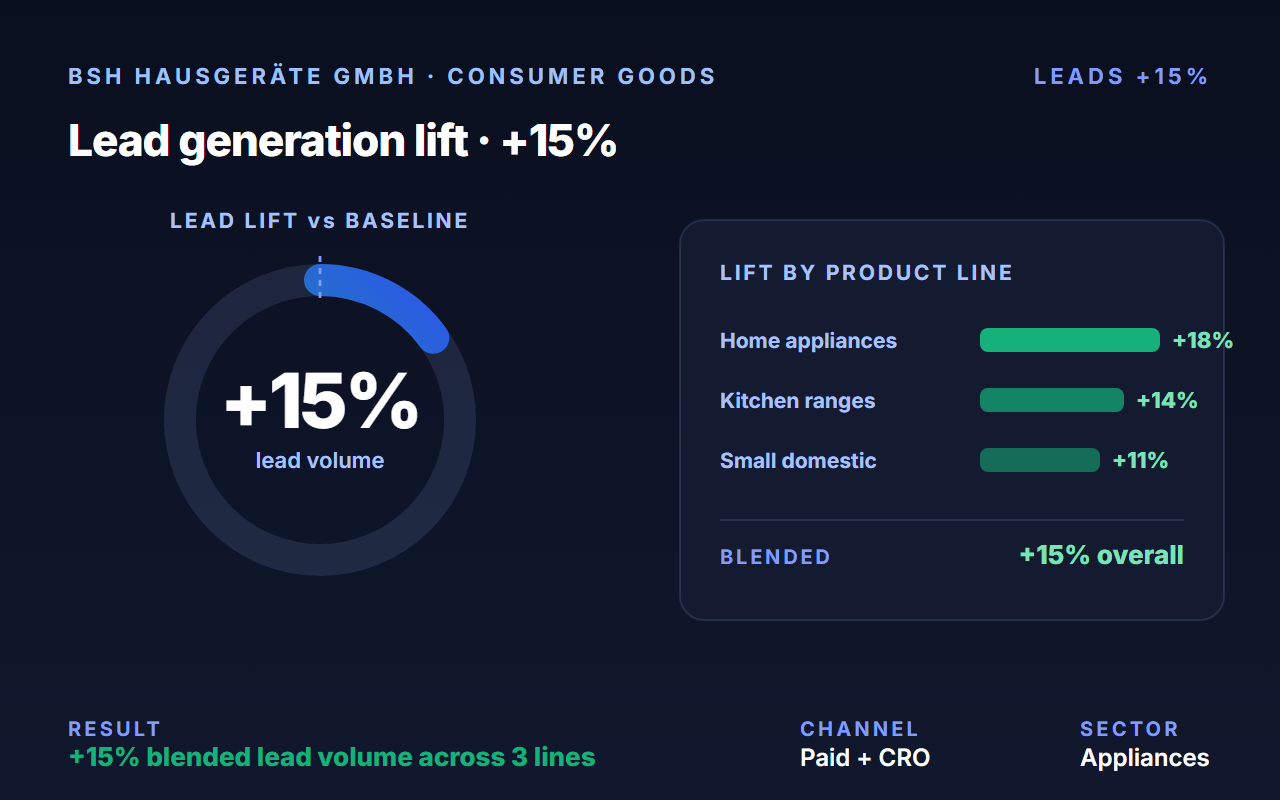 Consumer Goods · Home Appliances · Europe
Europe's largest home appliance maker (Bosch, Siemens, Gaggenau, Neff) optimized BSH Turkey's site for engagement — 15% lead growth, 3% organic lift, 45s longer…
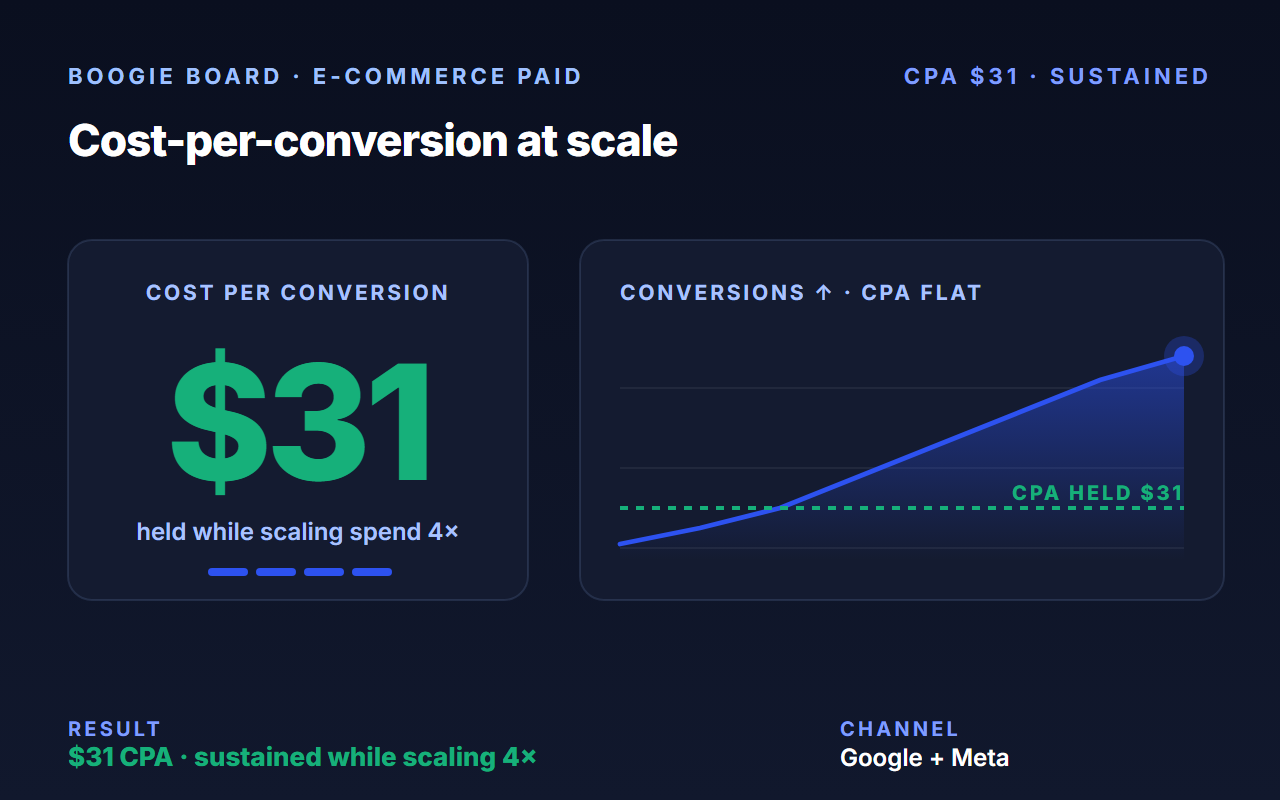 Ecommerce · Reusable Writing Tablets
A pioneering reusable-writing-tablet brand cut acquisition costs to $31 per conversion + boosted conversions 11% — managing $650K in ads with sustainable ROI.
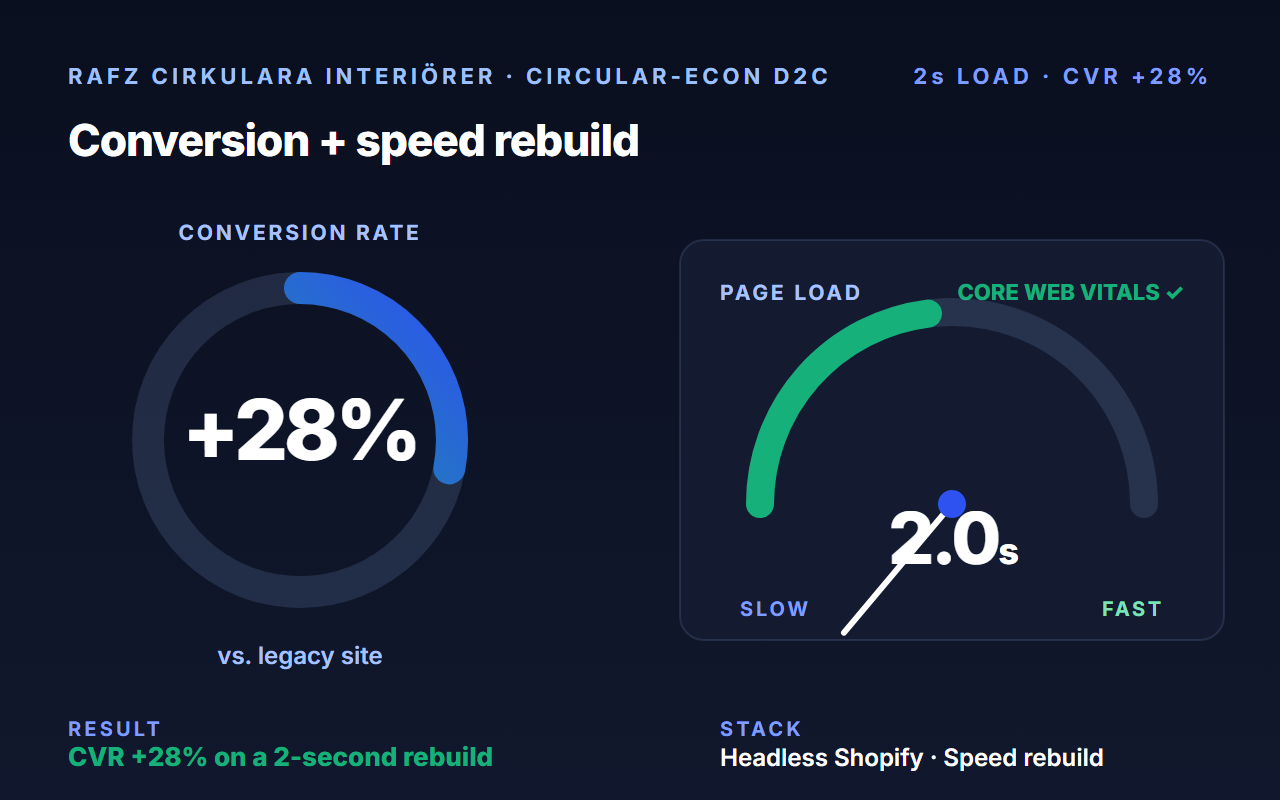 Ecommerce · Sustainable Furniture · Sweden
A Swedish sustainable furniture brand replaced a plugin-bloated 15-second site with a custom lightweight rebuild — 28% conversion lift, 82% fewer server requests, place2place…
If your question is not here, book the 30-minute strategy call. A fashion growth strategist answers on the call, not a sales rep.
Category-honest return-rate benchmarks for DTC apparel in 2026. Basics and loungewear: 8 to 14%. Contemporary womenswear: 22 to 34%. Men's denim: 18 to 26%. Contemporary dresses and occasion wear: 32 to 45%. Swimwear: 28 to 42%. Footwear (non-athletic): 24 to 38%. Every point of return rate you take off scales straight to the bottom line, which is why the fashion marketing retainer treats return rate as a top-3 KPI alongside CAC and repeat-purchase rate.
What the retainer does to lower it on Growth and Scale tiers. Rebuild the size chart per silhouette (not one generic chart for the whole store). Add fit-model measurements on every PDP: model wearing size M is 5'9", 148 lbs, 32-25-36 kind of specificity. Deploy Kiwi Sizer, Fit Analytics, or Bold Sizes for AI recommendations if AOV supports the app cost. Rewrite PDP copy so fabric weight, stretch, and rise are unambiguous. Push post-purchase surveys asking why customers kept or returned each item so the data compounds monthly.
Return-rate work on the fashion marketing retainer routinely takes 3 to 6 points off the rate inside 90 days on a brand starting at 30%+. That is the single fastest margin gain in DTC apparel.
Typical channel mix for a DTC apparel brand at $200K/mo revenue. Meta and Instagram Ads 40 to 50% of paid spend (still the workhorse for conversion, especially for contemporary womenswear). TikTok Ads and Shop 25 to 35% (dominant for streetwear, Gen Z casual, viral micro-trend brands). Pinterest 10 to 20% (highest-converting channel for occasion wear, wedding, home-adjacent lifestyle apparel). Google Shopping and PMax 10 to 15%. Email and SMS drive another 25 to 40% of revenue on their own, wired through Klaviyo across all tiers.
Where the split gets nuanced. A vintage or resale-heavy fashion brand shifts hard to TikTok. A modest fashion or hijab brand shifts hard to Pinterest and Meta. A menswear brand at $100+ AOV shifts more to Meta and Google. Pinterest is undervalued by most fashion founders and is often the first place the fashion marketing retainer flags fresh spend during the first 30-day audit.
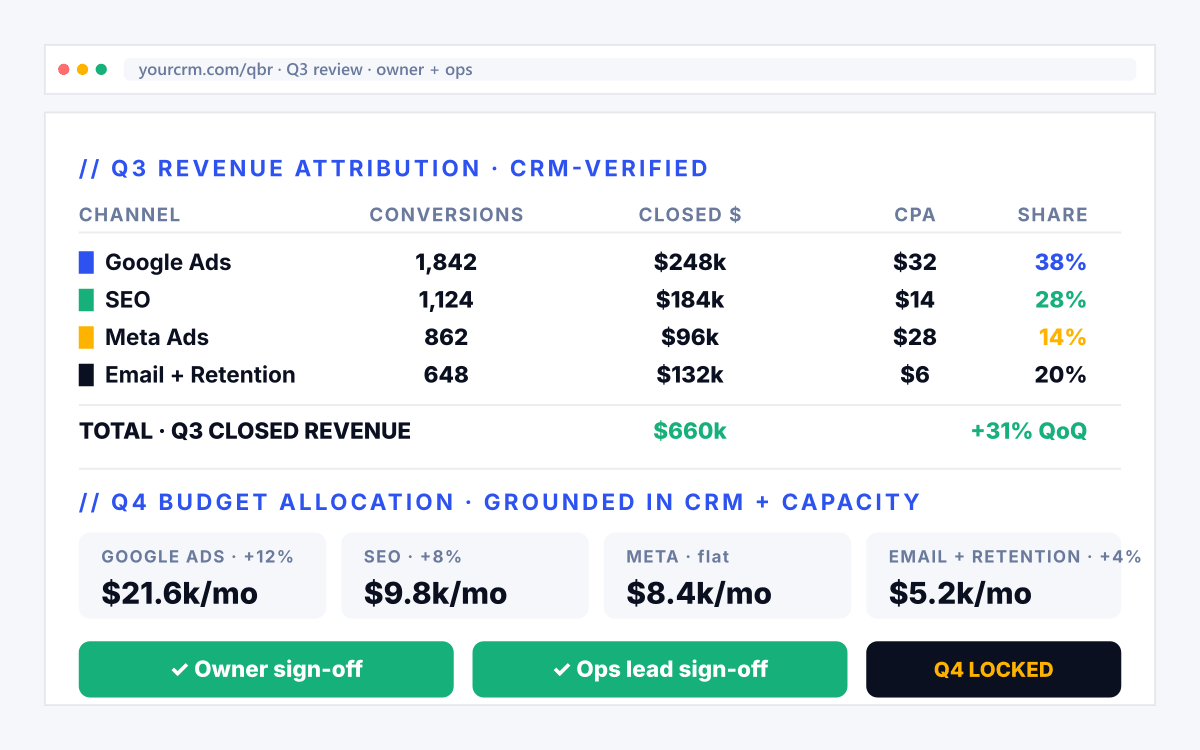
The channel mix is not a taste conversation. It moves monthly based on channel-level CAC-to-LTV data. The fashion monthly marketing plans report every channel's blended CAC and 90-day contribution margin, and shift budget to the winners.
Yes, on Growth tier and above. Fashion runs on drop cadence, not steady evergreen. Scale tier ($1,499/mo) explicitly adds "launch waterfall support" because most fashion brands doing $250K+/mo run 6 to 24 drops a year and the whole marketing operation has to bend around that calendar.
What launch waterfall support means on the retainer. 30 days before drop: teaser campaign on Meta and TikTok, waitlist signup on Klaviyo, PDP staged with placeholder image + email capture. 14 days before: influencer seeding for the drop-specific pieces, PR sends to the 6 to 10 editors covering your category. Drop day: full-scale Meta and TikTok launch, email and SMS blast to the waitlist, PDP live with real inventory. 7 days after: retargeting cart abandoners with size-availability updates, VIP tier gets first restock notice. 30 days after: sold-through analysis feeding the next drop's colorway and sizing forecast.
Six drops a year is the pattern that fits most emerging brands. Anything above 12 drops needs an in-house merchant + calendar-planning tool because the retainer scope stops being marketing and becomes ops.
Held inventory almost always wins for real fashion brands. Drop-ship models on print-on-demand (Printful, Printify) work for one-off T-shirt brands and creator merch, but they hit a ceiling around $30K to $50K/mo because unit economics are painful (low margin, slow shipping, no control over quality, weak return experience). Every serious apparel brand we work with holds inventory through a 3PL.
Where drop-ship fits. Pre-launch, first 100 units to test PMF. Long-tail sizes (XXS, 4XL) that don't justify a full production run. Marketplace-only expansion products where you are testing a category before committing to hold. Beyond that, the math kills you: a $28 T-shirt at 42% margin dropshipped nets $2 per unit after ad spend, which never scales.
The apparel marketing retainer works with either model but flags the economics honestly. If you are dropshipping at $80K+/mo revenue and asking why you cannot scale ad spend past a $3K/mo ceiling without CAC blowing up, the answer is not more ads. It is that drop-ship margin cannot support the CAC that a real apparel brand carries. Move to held inventory or stay at $80K/mo.
Size chart work is inside every fashion marketing retainer starting at Foundation ($599/mo), and it is one of the highest-ROI things we do in the first 60 days. Most apparel brands publish a single generic size chart applied globally. That is what drives 40% of returns and 60% of chargebacks around fit complaints.
What we do on the retainer. Silhouette-specific size charts: separate chart for tops, bottoms, dresses, outerwear, swim. Cross-brand size comparison notes ("runs true to Everlane, one size larger than Reformation") on PDPs where the audience overlaps. Fit-model measurements + garment measurements laid flat: chest, waist, hip, front rise, back rise, inseam. Every PDP tagged with "model wearing size X, height Y, weight Z, chest/waist/hip A/B/C". Klaviyo post-purchase email asking specifically about fit at the 14-day mark so the data compounds.
Scale tier adds sizing tool integration on Shopify (Kiwi Sizer, True Fit, Fit Analytics, Bold Sizes). Enterprise adds regional size norms for international expansion (UK, EU, JP grade rules). Fit is the single biggest lever the apparel brand marketing retainer pulls on margin.
Amazon Fashion, yes, on Scale tier and Enterprise. Sponsored Products, Sponsored Brands, DSP retargeting, and A+ Content build. Amazon Fashion is a viable channel for brands with $30+ AOV, wholesale margins built into pricing, and unique catalog (not commodity T-shirts competing on price).
Nordstrom and Revolve are wholesale channels, not marketplace listings. The retainer supports them from the marketing side: brand-lookbook production for the buyer pitch, DTC velocity data as proof for the category review, Meta and TikTok geotargeted around Nordstrom Rack locations once you are on shelf, coordinated content when Revolve editorializes your drop on the site. The wholesale sales cycle itself (buyer meetings, category reviews, terms negotiation) is on your founder or fashion sales rep.
Shopify + Amazon + Nordstrom running in parallel needs Scale tier at minimum because reporting complexity triples. Multi-channel margin math on the fashion marketing retainer breaks out DTC contribution, Amazon contribution, and wholesale contribution separately so you can see which channel actually pays the bills.
Blended first-order CAC benchmarks by category in 2026. Basics and loungewear at $35 to $60 AOV: $18 to $32 CAC. Contemporary womenswear at $80 to $140 AOV: $34 to $65 CAC. Menswear at $60 to $120 AOV: $28 to $55 CAC. Occasion wear and premium at $180 to $400 AOV: $65 to $140 CAC. Streetwear and drop-driven at $60 to $200 AOV: $22 to $70 CAC (highly variable by drop hype).
Three things move fashion CAC most. Creative refresh cadence: winning UGC lasts 4 to 8 weeks on Meta and TikTok before fatigue hits (faster than beauty or CPG). Landing page match: sending a specific SKU ad to your homepage instead of the PDP costs 25 to 40% on CAC. AOV via bundling: styled outfits ("shop the look" bundling) raises AOV 30 to 50% and effectively drops CAC-to-AOV ratio.
The retainer reports blended CAC weekly. Not Meta-attributed CAC, not last-click. Blended across all channels including returns netted out so you see the real cash-in-the-bank number. Return rate on apparel means the CAC number without returns netted is a lie the ad platforms tell you.
Four tiers on the fashion marketing retainer. Foundation $599/mo for solo indie brands and pre-Growth stage. Growth $999/mo for the $80K to $200K/mo revenue brand adding Meta and TikTok ads and return-rate CRO. Scale $1,499/mo for the $250K+/mo brand running seasonal drops, VIP programs, or wholesale alongside DTC. Enterprise Custom for multi-region storefronts, $500K+/mo brands, luxury and streetwear brands splitting DTC and wholesale.
What decides the tier. Not brand vibe. Revenue stage plus channel complexity. A brand at $60K/mo doing only Shopify + Meta + Klaviyo sits on Foundation. A brand at the same revenue running Meta + TikTok + Pinterest + Amazon needs Growth for the channel management alone. A brand at $400K/mo running 6 drops a year with a small wholesale book absolutely needs Scale for the launch waterfall support.
Ad spend is pass-through, billed by Meta, TikTok, Pinterest, Google, and Amazon directly to the brand card. The retainer fee is flat-monthly agency work. No percentage-of-spend markup, and your ad accounts stay in the brand name throughout the 6-month initial contract.
Yes, on Growth and Scale tiers. Fashion brands with repeat-purchase rates above 25% get outsized LTV from proper VIP structure. The math: a customer buying 3.2x per year at $95 AOV represents $304 annual revenue. A VIP customer buying 5.8x per year at $118 AOV (VIP AOV gain from early access + bundling) represents $684 annual revenue. That is the LTV difference the retainer is aiming at.
Real VIP program structure we build on Klaviyo + Shopify. Silver tier: $0 to $250 lifetime spend, free shipping over $75. Gold: $250 to $750, free shipping always + early access to drops 48 hours before public. Platinum: $750+, gold benefits + surprise-gift-with-purchase 2x a year + personal stylist Klaviyo flow. Enrollment is automatic based on spend, no signup friction.
Scale tier includes VIP tier programs as an explicit deliverable. The fashion monthly marketing plans on Scale are where most fashion brands see the shift from paid-acquisition-dependent to organic-plus-loyalty-driven inside 8 months.
Repeat customer AOV lands 22 to 32% higher than first-time buyer AOV in almost every apparel category, so the VIP tier structure pays back in gross revenue and margin, not just retention numbers.
Klaviyo core flows go into every tier of the apparel marketing retainer. Fashion-specific flow structure matters more than the generic ecommerce template most agencies deploy. Welcome flow with style-quiz first email (women's tops, women's bottoms, dresses, outerwear, or menswear). Abandoned cart with size-specific low-stock messaging ("Only 2 left in size M"). Browse abandon by category. Post-purchase asking for a fit review at day 14 (not day 3). Back-in-stock notification on size + color combo. VIP restock alert. Drop teaser flow 30 days before launch.
SMS on Growth and above. Drop-day launch blast. Waitlist re-engagement. Size-back-in-stock (highest-converting SMS trigger for fashion, 12 to 18% CTR). Restock alerts for hero SKUs. VIP tier-upgrade notifications.
What we do not do. Discount-blast weekly emails. Fashion brands that live on 20% off promotions kill their brand equity and train the customer to wait for the discount. The retainer's Klaviyo strategy is content-plus-social-proof-first, discounts second and only around real drops or clearance.
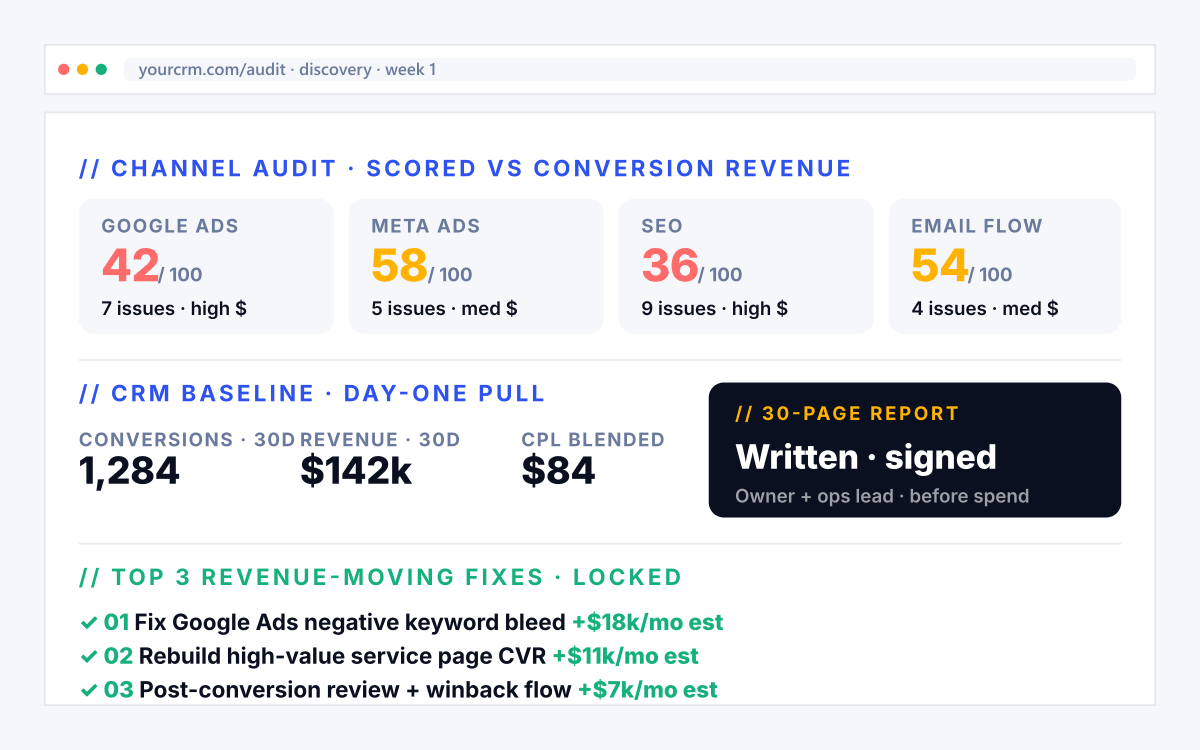
Week 1. Kickoff call, account handover (Shopify, Klaviyo, Meta Ads, TikTok Ads, Pinterest, Google Ads, Amazon Seller Central if in scope), and full audit of your PDPs, size charts, checkout flow, return-rate data, and Klaviyo core flows. Written 30-60-90 plan delivered by end of week 1.
Weeks 2-3. Size chart rebuild per silhouette. Klaviyo core flow refactor with fashion-specific triggers. Meta CAPI and Google Enhanced Conversions validation. PDP copy and imagery audit on top 20 SKUs by revenue. First round of ad creative into rotation. Return-rate baseline captured for the 90-day comparison.
Week 4. First monthly report. What moved, what did not, next month's plan. Content briefs approved for month 2. If launch waterfall support is in scope, the next drop's 30-day calendar is written and shared.
By day 30 the return-rate reduction work is already showing in the Klaviyo fit-review responses, and paid channel revenue is on stable numbers. The apparel brand marketing retainer moves fast in the first month because that is where the biggest quick wins live.
Yes, and the retainer scope changes. When 60%+ of revenue is wholesale, the DTC site becomes a brand-halo and buyer-proof channel, not a primary revenue driver. Nordstrom and Revolve buyers care about your Instagram engagement, your TikTok organic reach, your PR mentions, and your DTC velocity as proof the brand has demand.
What the Scale tier apparel marketing retainer does for wholesale-heavy fashion brands. Push Meta and Pinterest geotargeted around Nordstrom Rack locations to grow in-store velocity. Coordinate PR sends 30 days before Revolve editorializes a drop so the content compounds. Push organic TikTok and Instagram to make sure the brand's community signal keeps buyers happy at the quarterly category review. Track DTC velocity per hero SKU so you walk into every buyer meeting with the numbers.
Enterprise tier adds resale monitoring (StockX, Grailed, The RealReal) for streetwear and premium brands where secondary market velocity is a brand-value signal buyers look at. Scale tier is where most wholesale-heavy fashion brands land. The DTC site still runs, but as a proof layer for the wholesale relationship, not the revenue driver.
Fashion growth strategist on the call. Three specific growth fixes you can apply, with or without us. Written summary in your inbox the next business day.
Drop your email. A fashion growth strategist reviews your brand and books the 30-minute audit within one business day.