
AI Search Engine Optimization Services for Answer Engines
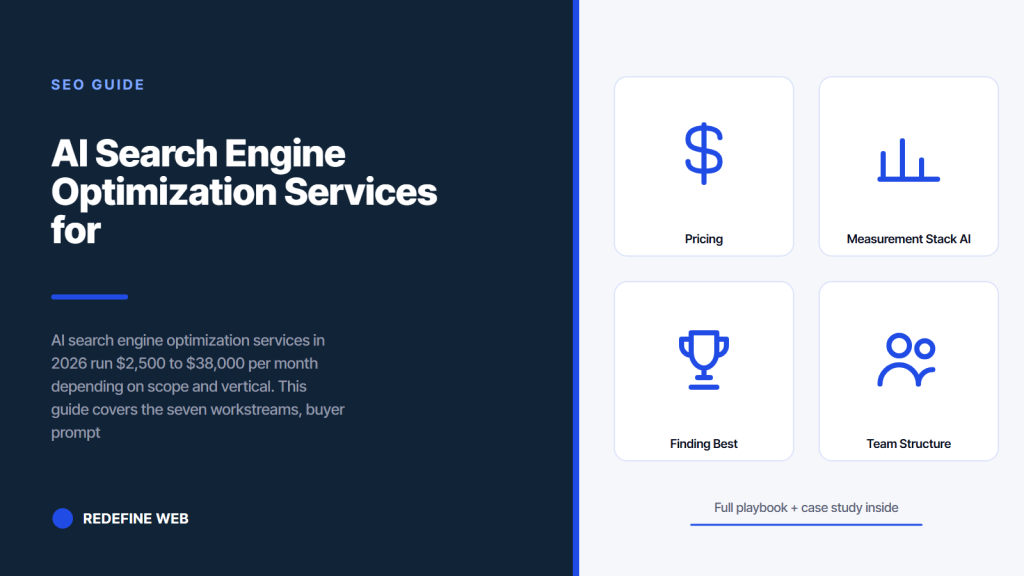
- AI SEO retainers run $2,500 to $38,000 per month by vertical competition.
- Answer-first structure gets extracted at 3 to 5 times prose-only rates.
- LLM visibility tracking tools cost $199 to $1,499 per month.
- AI referral traffic converts 2 to 4 times classic organic.
- Six-month outcome: AI Overview citation up 40 to 120 percent.
- Artificial intelligence search engine optimization services pricing
- AI search engine content optimization services and the editorial shift
- Measurement stack for AI search engine optimization services
- Finding the best ai-powered search engine optimization services partner
- Team structure required to run AI search engine optimization services
- Buyer prompt strategy that earns AI answer engine citations
- Integrating AI search engine optimization services with classic SEO
- Contract structure and expected AI SEO outcomes
- Wrapping up AI SEO services and the road ahead
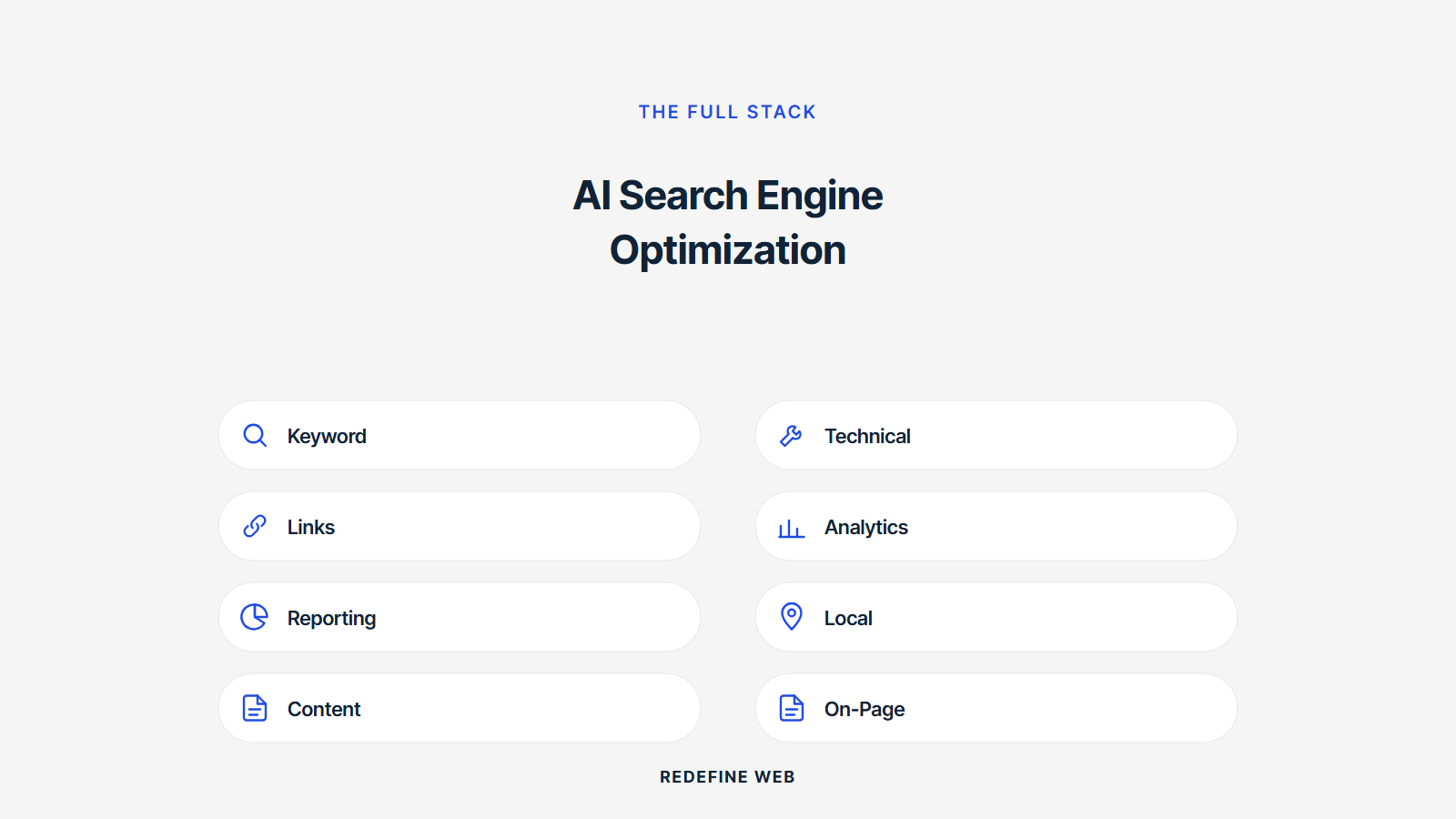
AI search engine optimization services are what growing brands hire when the SEO game changes and traditional keyword optimization stops covering the search experience. You are no longer optimizing for ten blue links. You are optimizing for Google AI Overviews, ChatGPT extraction, Perplexity citations, and the growing group of AI answer engines that summarize content instead of linking to it. This guide covers what AI search engine optimization services should include, what they cost in 2026, and how to tell a real practitioner from a rebranded content shop.
You get the pricing bands from live 2026 deals, the seven workstreams that actually earn AI Overview and ChatGPT citations, the vendor evaluation framework, and the measurement stack needed to prove AI visibility to your CFO. Written for marketing directors, VPs of growth, and founders whose organic traffic is starting to erode as AI answer engines eat the top-funnel search. Read in about ten minutes.
Artificial intelligence search engine optimization services pricing
Artificial intelligence search engine optimization services price in three bands. Entry $2,500 to $5,500 per month for small brands adding AI visibility to existing SEO. Mid $5,500 to $14,000 per month for growing brands with dedicated AI SEO focus. Upper $14,000 to $38,000 per month for competitive verticals where AI Overview citations directly affect pipeline.
| Band | Monthly retainer | Team size | LLM monitoring | Fit |
|---|---|---|---|---|
| Entry | $2,500 to $5,500 | 2 to 3 | Monthly checks on top 30 prompts | Small brands adding AI to existing SEO |
| Mid | $5,500 to $14,000 | 4 to 6 | Weekly checks on top 100 prompts | Growing brands, dedicated AI focus |
| Upper | $14,000 to $38,000 | 6 to 12 | Daily checks on 300+ prompts | Competitive verticals, AI-driven pipeline |
Entry band for small brands
The entry band covers the basics: quarterly technical audit for AI crawler behavior, rewriting 4 to 8 top-performing pages for answer-first structure, adding entity schema on 10 to 20 pages per quarter, and monthly LLM visibility checks on 30 buyer-intent prompts. Team: a strategist splitting time and a content specialist. Programs at this band produce visible AI Overview citation growth inside 4 to 6 months and are the right investment for brands where organic already contributes 20 to 40 percent of pipeline.
Upper band for competitive verticals
The upper band fits brands in competitive verticals where AI Overview and ChatGPT citations directly affect qualified pipeline. SaaS, fintech, healthcare, legal, and B2B services are the top verticals seeing AI Overview citation weight matter more than classic organic clicks. Retainers at this band fund dedicated strategy, technical, content, entity, and analytics roles. Programs produce measurable AI visibility gains inside 3 months and defensible category presence in AI answer engines starting at month 8 to 12.
AI search engine content optimization services and the editorial shift
AI search engine content optimization services rewrite existing content and produce new content specifically for extraction by AI answer engines. The editorial shift is deep. Content that ranked well in classic SEO often extracts poorly for AI Overviews. Long-form prose narrative loses to answer-first structured content when the AI is generating a 200-word answer summary.
The rewrite pattern that works: identify your top 30 to 100 buyer-intent pages, rewrite the intro as a 40 to 60 word answer paragraph, add comparison tables where relevant, restructure H2s as questions, add named entities and specific numbers throughout, and add FAQPage schema at the bottom. That rewrite typically doubles AI Overview citation rate inside 8 to 14 weeks. Traffic gains follow at 3 to 5 months as the compounding citation earns wider awareness across AI answer engines.
Rewrite workflow at scale
The rewrite workflow at scale covers 10 to 25 pages per month at the mid-band retainer. Each page: 4 to 8 hours of editorial work covering answer paragraph, entity insertion, table addition, and schema markup. Content leads work from a rewrite template that codifies the answer-first pattern. Quality control on your side runs 30 to 60 minutes per rewrite. Programs that skip the internal quality control watch partner-side templated rewrites reach the client and produce generic content that ranks worse than the original.
New content planning for AI extraction
New content planning maps buyer prompts, not just keywords. Buyer prompts are the full-sentence questions your target buyer types into ChatGPT or Perplexity. “What is the best MSP for a 100-person law firm in Chicago” is a buyer prompt. “MSP Chicago” is a keyword. The prompt maps to pages structured differently than the keyword page. Programs that publish for keywords without also publishing for prompts miss the AI answer engine referral traffic entirely.
Every AI SEO kickoff includes a moment where a stakeholder asks whether ChatGPT will cite our brand if we just ask nicely in a paragraph. We nod politely, note that ChatGPT does not read blog posts asking for citations any more than Google reads meta tags asking to please rank us, and move on to the actual technical work. The polite-request theory of AI visibility keeps showing up in strategy meetings. It is wrong every time. AI answer engines cite specific, structured, verifiable content. Politeness is not a ranking factor.
Measurement stack for AI search engine optimization services
The measurement stack for AI search engine optimization services runs on three layers: LLM visibility tracking, AI referral traffic analytics, and brand mention monitoring. Each layer answers a different question. Skip any layer and you cannot defend AI SEO budget at the next QBR.
Rocket Software, Inc. worked with our team on a launch program that grew activation rates 300 percent inside the first month, drove 3,000 customers in week one, and produced a steady 400-plus daily subscriber flow post-launch. The mechanic that scaled: a measurement stack that tied user acquisition to specific content pieces and specific campaigns. That same discipline applies to AI SEO measurement. If you cannot tie AI Overview citations to specific content updates and referral traffic to specific brand mentions, you cannot defend the budget line. Build the measurement stack in the first 90 days of the engagement.
LLM visibility tracking tools
LLM visibility tracking tools query ChatGPT, Perplexity, Google AI Overviews, and Claude on a defined prompt list and record whether your brand is cited, mentioned, or absent. Otterly, Peec AI, Profound, and Athena HQ are the current leaders. Tool costs run $199 to $1,499 per month at the SMB and mid-market tier. Programs at the upper band build custom monitoring stacks on top of OpenAI, Anthropic, and Perplexity APIs for tighter integration with internal reporting.
AI referral traffic analytics
AI referral traffic shows up in Google Analytics 4 as chatgpt.com, chat.openai.com, perplexity.ai, and copilot.microsoft.com source. Setting up UTM discipline plus GA4 exploration reports lets you attribute AI referral traffic to specific content pieces. Volume is still small at 1 to 5 percent of organic for most brands in 2026, but it converts at 2 to 4 times the rate of classic organic because the user arrived pre-qualified by the AI engine. Guidance in Google Search Central on AI features covers what Google publishes about its own AI answer engine.
Ask ChatGPT and Perplexity your top three brand queries. If you're cited, the AI SEO work is maintenance. If you're not, that's where the retainer starts.
Finding the best ai-powered search engine optimization services partner
The best ai-powered search engine optimization services partners share four traits: published case studies with named brands and specific AI visibility gains, a technical lead who can explain the differences between AI crawler user-agents without deferring, a measurement stack built on real LLM visibility tools rather than screenshots, and reference clients willing to take a 30-minute call.
Shortlist 5 to 8 vendors. Filter to 3 via written proposals and technical demos. Filter to 2 via reference calls. Negotiate the final contract. The evaluation cycle takes 6 to 10 weeks. Skipping the technical demo is the shortcut that produces the wrong pick more often than any other step. Sit through a 45-minute demo of the vendor’s measurement stack, watch them run a live prompt, and check whether the workflow matches what they described in the proposal.
The seven questions that filter proposals
- Which LLM visibility tools do you use and why
- How do you handle robots.txt policy for GPTBot, ClaudeBot, and PerplexityBot
- What percentage of AI Overview citation growth do you commit to over 6 months
- Walk us through your prompt-mapping methodology
- Show us three case studies with named brands and specific AI visibility metrics
- Who leads day-to-day on our account and what is their AI SEO experience
- What did you get wrong on a client program in the last 12 months and how did you fix it
Technical demo checklist
During the technical demo, watch for four things. First: the vendor runs a live LLM prompt query and shows the visibility dashboard update in real time. Second: the vendor pulls a robots.txt sample from a live client and walks through the AI crawler policy. Third: the vendor shows a GA4 exploration report with AI referral traffic segmented from classic organic. Fourth: the vendor walks through a real content rewrite from before to after, with the specific structural changes and their measurable extraction gain. Demos that skip any one of the four are marketing theater, not real practice.
Team structure required to run AI search engine optimization services
AI SEO programs need four roles on the agency side and three roles on the client side. Missing any seat stalls the program. The most common gap: no client-side engineering liaison who can prioritize AI-crawler technical fixes in Jira. Without that role, technical recommendations sit in the backlog for a quarter.
Agency-side seats: AI strategy lead, technical SEO lead with AI crawler expertise, content lead who understands answer-first structure, and LLM visibility analyst. Client-side seats: marketing owner with 15 to 25 percent of their time, engineering liaison with 15 to 20 percent of their time, and content operations lead who owns brand voice review. Programs that ship AI SEO changes inside 30 days always have all seven seats named at kickoff. Related depth in our enterprise search engine optimization services post covers the coordination pattern at even larger scale.
The LLM visibility analyst role
The LLM visibility analyst runs the daily and weekly prompt queries, maintains the tracking dashboard, and produces the weekly AI visibility report. They spend 60 percent of their time on tool operation and 40 percent on trend analysis. On upper-band programs, this role is dedicated. On mid-band programs, it splits time across 3 to 5 clients. On entry-band programs, the strategist runs the analyst work directly. The role did not exist in 2024. It became necessary as LLM visibility became a measurable channel worth reporting to leadership.
Engineering liaison for AI-specific technical work
The engineering liaison handles AI-specific technical tickets. Adding structured data at scale on a headless CMS. Updating robots.txt policy for new AI crawler user-agents. Server-side rendering audits for AI crawler compatibility. Log-file analysis of AI crawler behavior. These tickets do not sit inside a traditional SEO scope, and engineering teams without a dedicated liaison deprioritize them until they become urgent. Named liaison at kickoff, 15 to 20 percent time carveout, and monthly review of the ticket backlog. That is the setup that ships AI-specific technical work at pace.
Buyer prompt strategy that earns AI answer engine citations
Buyer prompt strategy maps 100 to 500 full-sentence buyer questions your target audience types into ChatGPT, Perplexity, or Google AI Overviews. Each prompt becomes a target for content optimization. The mapping typically takes 20 to 40 hours in the first month and 6 to 12 hours per month ongoing.
Prompt mapping starts with keyword universe expansion. Take your top 100 buyer-intent keywords and rewrite each as a full-sentence question. “MSP Chicago” becomes “who are the best managed service providers in Chicago for a 100-person law firm.” Then run each prompt through ChatGPT, Perplexity, and Google AI Overviews and record whether your brand appears in the answer. Prompts where you are absent become the priority target list. Prompts where you already appear get monitored for citation stability over time. Reference material at OpenAI on ChatGPT search covers the extraction mechanics OpenAI publishes about.
Prompt tiers by buyer intent
Tier 1 prompts are bottom-funnel buyer prompts asking about specific vendor comparisons, pricing, or purchase decisions. These convert best when your brand earns citation. Tier 2 prompts are mid-funnel evaluation prompts asking about categories, criteria, or evaluation methodology. These build brand consideration. Tier 3 prompts are top-funnel problem-education prompts. These build awareness. Balance the mix 40 percent tier 1, 40 percent tier 2, 20 percent tier 3 on the target prompt list. The tier-1 buyer-comparison work overlaps with the discipline covered in our organic search engine optimization services post.
Earning citations at the prompt level
Earning citations at the prompt level requires content that answers the prompt directly, in structured form, with named entities and specific numbers. The AI answer engine extracts the specific sentence or paragraph that answers the prompt best. Content optimization for prompt-level citation is different from classic on-page SEO. On-page SEO optimizes for rank position. Prompt-level optimization optimizes for extraction quality. The two overlap but are not the same discipline.
Integrating AI search engine optimization services with classic SEO
AI search engine optimization services do not replace classic SEO. They extend it. Classic SEO still earns 60 to 80 percent of organic traffic and 40 to 70 percent of organic revenue for most brands in 2026. AI SEO adds a growing 20 to 40 percent of top-funnel visibility that classic SEO no longer covers on its own.
Programs that treat AI SEO as a replacement for classic SEO produce visible AI visibility gains and quiet classic organic decline. Programs that integrate the two produce compounding growth across both channels. The integration pattern that works: one strategy lead running both disciplines, one content pipeline serving both structured-for-extraction and long-form authority content, and one measurement dashboard showing classic organic plus AI visibility side by side. Split ownership across two vendors and the strategies drift apart inside two quarters. Reference our best search engine optimization services post for what to look for when combining the two disciplines under one vendor.
Shared content pipeline for both disciplines
The shared content pipeline produces pages that serve classic ranking and AI extraction. The pattern: 40 to 60 word answer paragraph at the top of every page, 3,000 to 6,000 words of long-form authority content underneath, structured data at the bottom, and FAQ schema pulled from real buyer questions. This structure earns classic ranking on head terms and long-tail terms, extraction citations on AI answer engines, and referral traffic from ChatGPT and Perplexity. One content pipeline serving both disciplines is the efficiency play.
Joint reporting on classic and AI visibility
Joint reporting shows classic organic ranking, classic organic traffic, AI Overview citation rate, AI referral traffic, and share of voice on named competitor prompts. The dashboard combines Search Console, GA4, and LLM visibility tool outputs into a single view. Programs with a joint dashboard defend budget at the QBR by showing the full picture. Programs with separate dashboards for classic and AI SEO get budget cut on one or both because CFOs cannot see the total contribution to pipeline.
Contract structure and expected AI SEO outcomes
AI SEO contracts run 12 to 24 months. The 12-month term is standard. Expected outcomes: measurable AI Overview citation growth inside 90 days, AI referral traffic showing up in GA4 inside 60 days if the technical foundation is solid, and defensible share of voice on target buyer prompts starting at month 6 to 9.
Contract language should specify deliverable ownership on termination, non-solicit clauses that are reciprocal, and payment terms of net-30 monthly at entry and mid-band or quarterly at upper band. Push back on any vendor that requires annual prepay without a 5 to 8 percent discount. Push back on any vendor that promises specific AI Overview positions inside 90 days, which is dishonest given the ranking mechanics of AI answer engines. Realistic outcome commitments cover citation growth, referral traffic growth, and prompt-level share of voice, not specific ranking positions. For a broader take on the discipline our search engine optimization services retainer covers the classic SEO layer that AI SEO builds on top of.
Success criteria at 6 months
At 6 months, expect measurable outcomes on three fronts. AI Overview citation rate on your target prompt list up 40 to 120 percent from baseline. AI referral traffic in GA4 growing 30 to 80 percent quarter over quarter. Share of voice on named competitor prompts stable or growing. Programs that miss on all three at 6 months need a strategy review with the vendor’s founder or partner, not a junior AE. If the strategy review does not produce a credible correction plan, start the vendor shortlist for a replacement.
Success criteria at year two
At year two, expect AI SEO to contribute 15 to 35 percent of top-funnel visibility and 8 to 20 percent of qualified pipeline. Numbers below that band mean the program either under-invested in technical or content velocity, or the vendor missed the compound effect at month 12. Numbers above that band mean the vendor is running a category-leading practice worth expanding scope on. Review the numbers honestly at the year-two QBR and adjust scope accordingly.
Wrapping up AI SEO services and the road ahead
AI search engine optimization services are a 12 to 24-month commitment to extend organic visibility into AI answer engines. Retainers run $2,500 to $38,000 per month depending on scope and vertical competition. The seven-workstream playbook covers technical foundation, answer-first content, entity work, structured data, brand mentions, LLM visibility monitoring, and cross-team enablement.
Choose pure-play specialists when time-to-visibility matters most. Choose established agencies with real AI SEO practice when integration with classic SEO matters most. Set up internal seats across marketing, engineering, and content operations. Run the technical demo before signing. Build the measurement stack in the first 90 days. That is the path from AI SEO as a buzzword to AI SEO as a defensible channel line on the growth marketing budget. Baseline context on the discipline sits inside Search Engine Land’s AI search library.
Frequently asked questions
What do AI search engine optimization services actually cover?
AI search engine optimization services cover seven workstreams: technical foundation for AI crawler extraction, answer-first content structure that AI answer engines pull from, entity and knowledge graph work across Wikipedia and Wikidata and Crunchbase, structured data at depth with organization and author and article schema, brand-mention and citation earning through digital PR, LLM visibility monitoring on ChatGPT and Perplexity and Google AI Overviews, and cross-team enablement between content, product, and PR. A credible AI SEO partner delivers all seven workstreams. Content-only shops delivering AI-optimized blog posts without technical or measurement layers are running rebranded classic SEO on 2026 fees, which produces citation stagnation inside 90 days.
How much do artificial intelligence search engine optimization services cost in 2026?
Artificial intelligence search engine optimization services retainers price in three bands. Entry-band $2,500 to $5,500 per month covers small brands adding AI visibility to existing SEO, with 2 to 3 people and monthly LLM visibility checks on the top 30 buyer prompts. Mid-band $5,500 to $14,000 per month covers growing brands with dedicated AI SEO focus, with 4 to 6 people and weekly checks on 100 prompts. Upper-band $14,000 to $38,000 per month covers competitive verticals like SaaS, fintech, and health where AI Overview citations directly affect qualified pipeline, with 6 to 12 people and daily checks on 300 or more prompts across ChatGPT, Perplexity, and Google AI Overviews.
How do we choose among AI search engine optimization service providers?
AI search engine optimization service providers split into three shapes: pure-play AI SEO specialists that built practice around AI answer engines from day one, established SEO agencies with a growing AI SEO practice bringing classic depth plus AI expertise, and content marketing shops adding AI-optimized as a rebrand. Pure-play specialists cost 25 to 45 percent more but bring real technical depth on AI crawler behavior and LLM visibility measurement. Ask any prospective vendor to walk through their measurement stack, which AI crawler user-agents they specifically target, and for real case studies with named brands and specific AI Overview citation growth. Vendors that dodge these questions are running rebranded classic SEO.
What do AI search engine content optimization services actually rewrite?
AI search engine content optimization services rewrite existing pages and produce new pages structured for extraction by AI answer engines. The rewrite pattern: identify top 30 to 100 buyer-intent pages, rewrite the intro as a 40 to 60 word answer paragraph, add comparison tables where relevant, restructure H2s as questions with answer paragraphs directly beneath, add named entities and specific numbers throughout, and add FAQPage schema at the bottom. That rewrite typically doubles AI Overview citation rate inside 8 to 14 weeks. Traffic gains follow at 3 to 5 months as the compounding citation earns wider awareness across ChatGPT, Perplexity, and Google AI Overviews as your brand becomes a recognized entity.
How is the best ai-powered search engine optimization services partner different from a rebranded content shop?
The best ai-powered search engine optimization services partners share four traits that filter them from rebranded content shops. First, published case studies with named brands and specific AI visibility gains including AI Overview citation growth percentages and ChatGPT referral traffic numbers. Second, a technical lead who can explain the differences between GPTBot, ClaudeBot, PerplexityBot, and Google AI Overview crawler behavior without deferring. Third, a real measurement stack built on Otterly, Peec AI, Profound, Athena HQ, or custom OpenAI and Anthropic API integrations rather than screenshots. Fourth, reference clients willing to take a 30-minute call and discuss actual delivery quality. Rebranded shops fail at least two of the four.
How does AI SEO integrate with classic SEO?
AI SEO does not replace classic SEO. It extends it. Classic SEO still earns 60 to 80 percent of organic traffic and 40 to 70 percent of organic revenue for most brands in 2026. AI SEO adds a growing 20 to 40 percent of top-funnel visibility that classic SEO no longer covers on its own as AI Overviews eat top-funnel clicks. The integration pattern that works: one strategy lead running both disciplines, one content pipeline producing pages structured for both classic ranking and AI extraction, one measurement dashboard showing classic organic and AI visibility side by side. Splitting ownership across two vendors produces strategy drift inside two quarters and cuts total organic contribution to pipeline.
What outcomes should AI search engine optimization services deliver at 6 months?
At 6 months, AI search engine optimization services should deliver measurable outcomes on three fronts. First, AI Overview citation rate on your target buyer prompt list up 40 to 120 percent from baseline. Second, AI referral traffic in Google Analytics 4 (chatgpt.com, chat.openai.com, perplexity.ai, copilot.microsoft.com sources) growing 30 to 80 percent quarter over quarter. Third, share of voice on named competitor prompts stable or growing. Programs that miss on all three at 6 months need a strategy review with the vendor founder or partner, not a junior AE. At year two, expect AI SEO to contribute 15 to 35 percent of top-funnel visibility and 8 to 20 percent of qualified pipeline.
Book your free 30-minute strategy call.
No spam, no sales rep. We use your email to schedule your call with a senior strategist. That is it.
More from the blog
View all articles → SEO
SEO Organic Search Engine Optimization Services That Grow Real Traffic
Read article SEO
SEO SEO for Pet Groomers That Fills the Appointment Book Weekly
Read article SEO
SEO