
Enterprise Search Engine Optimization Services for Global Brands
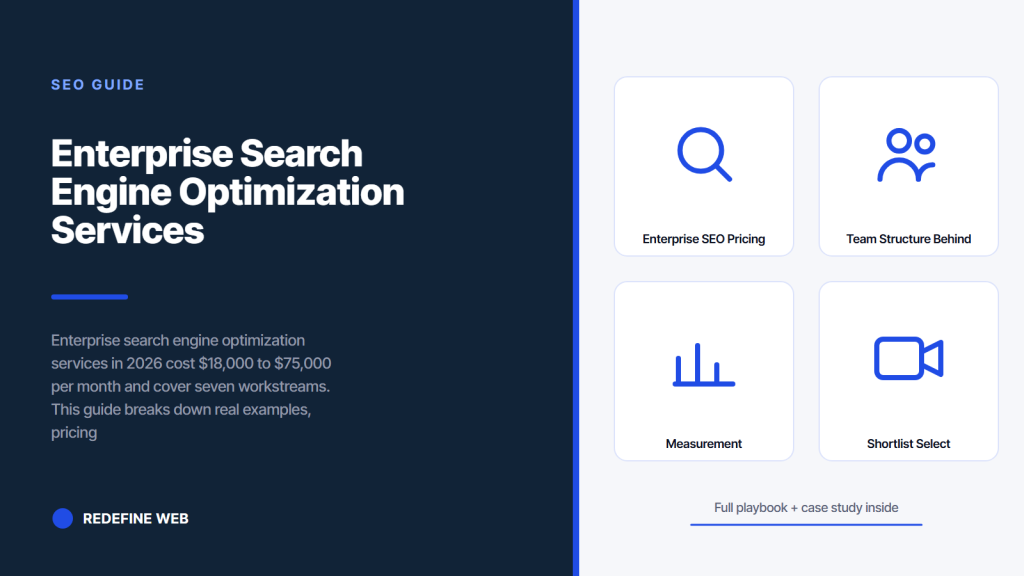
- Enterprise SEO retainers land at $18,000 to $75,000 per month by scope.
- Programs need six agency roles plus three client-side owners.
- Log-file analysis frees crawl budget on 40 percent of enterprise sites.
- QBRs report revenue, not rankings. Anything less is theater.
- Two-year contracts compound. Year one is foundation, year two is defense.
- Enterprise SEO pricing and retainer structures in 2026
- The team structure behind an enterprise SEO program
- Measurement, attribution, and reporting cadence
- How to shortlist and select an enterprise SEO partner
- The technical workstream in a large enterprise SEO program
- Content strategy and editorial production at enterprise scale
- Links, digital PR, and authority-building at enterprise scale
- International and multi-region SEO for global brands
- Analytics, dashboards, and stakeholder reporting
- Working with enterprise search engine optimization services vendors long-term
- Wrapping up enterprise SEO services
Enterprise search engine optimization services are what a 500-employee brand needs when the SEO problem stops being a keyword list and starts being a coordination problem across product, legal, engineering, content, and PR. You are not looking for a scrappy freelancer. You are looking for a partner that speaks fluent Jira, understands staging environments, and can run a technical rollout without breaking site speed on a Black Friday cycle. This guide covers what those services include, what they cost, how they get scoped, and how to tell a real enterprise partner from a boutique repackaging their retainer.
You get the vendor-comparison framework, real pricing bands from live 2026 deals, the seven workstreams that show up on every enterprise SEO scope, and the internal signals that tell you the program is working before the traffic curve confirms it. Read straight through in about eleven minutes. Written for VPs of marketing, heads of growth, and enterprise SEO managers who need to defend the budget line at the next board meeting.
Enterprise SEO pricing and retainer structures in 2026
Enterprise search engine optimization services retainers in 2026 land in three bands. Entry-band $8,000 to $18,000 per month buys a strategist plus part-time technical and content help. Mid-band $18,000 to $35,000 per month buys a full pod: strategist, technical lead, content lead, link acquisition, and analytics analyst. Upper-band $35,000 to $75,000 per month adds international, digital PR at scale, and dedicated product-vertical specialists.
The upper-band fee is not a status flex. It reflects the reality that a $2 billion revenue company with 40,000 product pages and eight regional sites cannot run on four people. The team that runs a program at that scale is 12 to 20 people internally at the agency, with 60 to 80 percent of the fee going to headcount. Vendors quoting under $8,000 per month for a Fortune 1000 site are either underscoping deliberately to win the contract or planning to hand the account to a junior after signing.
| Band | Monthly retainer | Team size | Typical fit |
|---|---|---|---|
| Entry | $8,000 to $18,000 | 3 to 5 people | Mid-market, single product, US-only |
| Mid | $18,000 to $35,000 | 6 to 10 people | Enterprise, multi-product, 2 to 3 markets |
| Upper | $35,000 to $75,000 | 12 to 20 people | Global enterprise, 5+ markets, multi-brand |
| Project add-ons | $50,000 to $450,000 | Variable | Migrations, launches, category expansions |
Scoping fees versus outcome fees
Most enterprise retainers are scope-based. You pay for deliverables, hours, and access. A minority are outcome-based, tied to organic revenue growth or ranking improvements. Outcome-based fees look attractive on paper but usually favor the vendor because the baseline gets negotiated by the party with more data. If you go outcome-based, hire an independent analytics consultant to set the baseline before the contract is signed. Otherwise, stick with scope pricing and hold the vendor accountable on hours and deliverables.
Contract terms that protect the enterprise
Standard enterprise contracts run 12 to 24 months with a 90-day termination clause after month six. Ownership of deliverables, keyword research, content drafts, and reporting dashboards should transfer to the client on termination. Non-solicit clauses on the vendor’s staff should be reciprocal, not one-sided. Any vendor that pushes a 36-month term without a mid-contract break clause is protecting its own risk at your expense. A well-run enterprise SEO engagement earns its second year on results, not on contract lock-in.
The team structure behind an enterprise SEO program
Enterprise search engine optimization services delivery needs six roles on the agency side and three roles on the client side. Missing any one causes the same failure mode: strategy without execution, execution without measurement, or measurement without organizational buy-in.
On the agency side, you need a strategy director, a technical lead, a content lead, a link and PR lead, an analytics analyst, and a project manager. On the client side, you need an SEO owner, an engineering liaison, and a content operations lead. When any of those seats is empty, the program stalls. The most common gap: no engineering liaison on the client side, which means every technical recommendation waits in a Jira backlog for a quarter before shipping. Programs that ship technical fixes inside 30 days always have a named engineering liaison.
Agency-side roles
- Strategy director: owns roadmap, quarterly business reviews, board-level updates
- Technical lead: crawl budgets, rendering, log analysis, structured data
- Content lead: cluster planning, editorial calendar, brand voice compliance
- Link and PR lead: digital PR campaigns, industry surveys, publisher outreach
- Analytics analyst: GA4, Search Console, BigQuery, custom dashboards
- Project manager: sprint planning, stakeholder communications, deliverable QA
Client-side roles
The SEO owner on the client side is usually a senior manager or director inside marketing. They own the roadmap, unblock stakeholder decisions, and defend the budget at leadership review. The engineering liaison is a senior engineer with 20 percent of their time carved out for SEO tickets. That percentage is negotiated with engineering leadership at kickoff, not assumed. The content operations lead owns brand review, legal review, and publishing workflow, and is usually a content marketing manager or editorial director.
Measurement, attribution, and reporting cadence
Enterprise search engine optimization services measurement is not a monthly ranking report. You get a weekly technical health dashboard, a monthly content and links progress report, and a quarterly business review that ties organic to revenue and pipeline. Anything less granular is under-serviced. Anything more granular is theater.
Attribution stays messy in enterprise organic. Last-touch attribution undervalues SEO by 40 to 60 percent because organic sits early in the buyer journey. Multi-touch attribution helps but requires a stitched data pipeline across Google Analytics 4, the CRM, and the marketing automation platform. Guidance in Google Search Central stays foundational, but the deeper measurement work lives in your BigQuery warehouse. Budget $60,000 to $150,000 in year one for the analytics engineering to get attribution right.
Weekly technical health
The weekly technical health dashboard tracks crawl errors, indexation status, Core Web Vitals, log-file anomalies, and any structured data breakage. Anomalies get flagged inside 24 hours with a triage recommendation. The dashboard should be built once and maintained, not rebuilt in a slide deck each week. Enterprise vendors that rebuild a slide deck weekly are running mid-market playbooks on enterprise contracts.
Quarterly business review
The quarterly business review is where the SEO program earns its next quarter of funding. Expect a 90-minute meeting with the CMO or VP of marketing, covering organic revenue trajectory, ranking share of voice against named competitors, technical debt burn-down, content publishing throughput, and pipeline attribution. Any vendor that shows up with a ranking report instead of a revenue report at the QBR is not the enterprise SEO services partner you thought you hired. Data guidance from Search Engine Land’s enterprise SEO coverage holds up on this point.
The bottleneck is rarely the SEO plan. It's legal + brand + eng review time on every change. Ask your would-be vendor what their average ticket cycle time was last engagement.
How to shortlist and select an enterprise SEO partner
Shortlist five to seven vendors, request written proposals, run reference calls on three, and negotiate the final two. The full cycle takes 10 to 14 weeks. Skipping any step usually costs six to nine months of program time when the wrong vendor gets picked and unwound.
The RFP process filters by capability. The reference calls filter by execution. The negotiation filters by cultural fit. Enterprise SEO is a two-year relationship at minimum, and cultural fit matters as much as capability. A brilliant vendor whose team clashes with your internal marketing culture will underperform a merely competent vendor whose team gets along with yours. Pay attention to how the vendor’s team communicates during the sales cycle, because that is exactly how they will communicate at month 14.
The seven RFP questions that filter noise
- Show us three enterprise SEO services examples that ran 24 months or longer, with named metrics
- What percentage of your revenue comes from your top 3 clients
- Who leads day-to-day on our account and what is their availability
- How do you handle a client engineering team that blocks technical recommendations
- Walk us through your attribution model for organic revenue
- What did you get wrong on a client program in the last 24 months and how did you fix it
- Who owns the deliverables if we terminate the contract
Cultural fit signals to trust
Trust the vendor whose sales team includes a technical lead who can go deep on log files without slides. Trust the vendor who pushes back on your RFP scope with a specific counter-proposal instead of nodding along. Trust the vendor whose reference clients say the same thing when asked independently. Do not trust the vendor whose sales team is smoother than their delivery team, or whose junior AE runs the entire pitch without a technical lead in the room. Enterprise SEO delivery runs on senior delivery hands. If those hands are not in the room during the sale, they will not be in the room during delivery either.
The technical workstream in a large enterprise SEO program
Technical SEO at enterprise scale is a systems engineering problem. You are managing crawl budget on 500,000 to 40 million URLs, coordinating rendering behavior across a headless React front-end and a legacy templating system, and running weekly regression tests on structured data. The technical lead spends 60 percent of their time on log-file analysis and rendering QA, not on running Screaming Frog crawls.
Log-file analysis is where the highest-value findings come from. Googlebot’s crawl budget follows internal-linking depth, sitemap freshness, and server response speed. A pattern we see in 40 percent of enterprise sites: 30 to 60 percent of Googlebot’s crawl budget getting spent on paginated category filters that should be blocked in robots.txt. Fix the robots.txt policy and crawl budget frees up for the pages that actually drive revenue. That one fix, on the right site, grows organic revenue 8 to 14 percent inside three months.
JavaScript rendering QA
JavaScript rendering is where enterprise sites break silently. A React or Vue front-end that renders content client-side without server-side rendering hides content from Googlebot’s initial crawl, and the rendered pass runs on a delay of hours to weeks. The fix is server-side rendering or dynamic rendering, implemented consistently across every route. The audit uses the URL Inspection tool in Search Console plus a headless-Chrome rendering pass in Screaming Frog. Weekly regression testing catches breakage before it costs indexation.
Structured data at scale
Structured data on an enterprise site covers product, article, organization, breadcrumb, and often FAQ or how-to. Consistency across templates matters more than exotic schema types. The technical lead runs a monthly schema validation sweep across every template and reports breakage inside 48 hours. Broken schema does not always tank rankings immediately, but it tanks eligibility for structured-data features that compound over time. Systemic schema breakage on 10 percent of URLs is worth $200,000 to $600,000 per year in lost organic revenue on a mid-cap ecommerce site.
Content strategy and editorial production at enterprise scale
Content at enterprise scale is not about writing more blogs. It is about publishing the right pages, in the right cluster shape, with editorial quality that survives brand review. The content lead spends 40 percent of their time on strategy, 30 percent on stakeholder alignment, and 30 percent on editorial QA.
A common failure pattern: the enterprise content team publishes 20 pages per month across scattered topics, each ranking well individually but never compounding into topical authority. The fix: consolidate around three to six pillar topics, publish 40 to 80 pages per topic over 12 to 18 months, and interlink aggressively. The compound effect kicks in around month 14 to 18 as Google recognizes the topical authority signal. Programs that switch to cluster-based publishing typically triple organic revenue per page inside 24 months versus scattered publishing at the same page count.
The pillar and cluster model at scale
A pillar page runs 3,500 to 8,000 words and covers a topic broadly. Cluster pages run 2,000 to 4,000 words each and cover subtopics narrowly. Internal linking flows both directions with descriptive anchors, not “click here.” The keyword universe for one pillar can support 60 to 120 cluster pages when the topic is broad enough. The strategist maps the universe at kickoff and the content lead executes over 12 to 24 months. Do not skip the mapping step. Ad-hoc publishing without a mapped universe produces coverage gaps and cannibalization inside six months.
Editorial standards and brand review
Enterprise editorial standards cover voice, structure, legal disclaimers, product accuracy, and image licensing. Every content lead builds a style guide during the first 60 days that codifies brand voice and gets signed off by marketing leadership. Drafts route through brand review, legal review, and product review in a defined SLA. Pages that fail review get returned with tracked changes, not killed. Vendors that publish content without brand review are creating future legal cleanup for the client’s legal team.
Every enterprise SEO kickoff includes at least one meeting where a senior stakeholder asks whether we should optimize for Bing. We say yes with a straight face, add three hours a quarter to the scope for Bing Webmaster Tools maintenance, and move on. The question comes back exactly once, six months later, when someone in leadership uses Bing at home and gets a bad result. Then it goes quiet for the rest of the contract. Bing exists. Bing traffic on B2B enterprise sites runs 3 to 7 percent of Google. Bing rewards you for not ignoring it. That is the entire Bing conversation.
Links, digital PR, and authority-building at enterprise scale
Enterprise link-building is digital PR, not directory submissions. You run one or two original research reports per year, pitch them through a real PR firm partnership, and earn coverage in Bloomberg, Forbes, TechCrunch, or vertical trade press. Each campaign generates 20 to 60 high-authority backlinks plus brand mentions that grow the domain authority curve for 12 to 24 months.
Original research is expensive. Budget $60,000 to $180,000 per campaign for survey infrastructure, data analysis, report design, and PR distribution. The return is measurable in referral traffic, branded search growth, and organic ranking gains on the researched topic. Programs that skip original research and try to earn links through outreach on generic blog posts hit a ceiling around 8 to 12 links per month, most of them low-authority. The math favors two research reports per year over 60 outreach emails per week.
Working with a PR firm
Digital PR at enterprise scale usually runs through a partnership between the SEO agency and a specialist PR firm. The SEO agency owns the research and the content package. The PR firm owns the media relationships. Splitting responsibilities cleanly avoids the mistake we see when SEO agencies pretend to do PR: emails that never get returned by tier-one journalists and coverage limited to the SEO agency’s own blog. Ask the SEO vendor which PR firms they partner with by name.
Link quality thresholds
The team should target links from publications with Domain Authority 60 or higher, editorial-style pages (not link roundups), and topical relevance to the client’s category. A link from a lifestyle blog on a fintech story is not worth the fee spent earning it. Weekly review of newly earned links catches the low-authority accidents inside a week. Reject any link earned through paid placement, PBN, or reciprocal link exchange. Enterprise SEO does not touch that inventory, and any vendor that does is exposing the client to a Google manual action.
International and multi-region SEO for global brands
Global SEO requires hreflang architecture, country-code top-level domains or subdirectory logic, in-country content, and regional link acquisition. The mistake we see on 60 percent of international rollouts: US-first thinking applied globally. The fix is native content strategy per market with dedicated regional owners.
Hreflang implementation on 5 to 20 markets is a full quarter of technical work. Every URL variant needs a bidirectional hreflang tag pointing to every other language and region version. Errors get flagged inside the International Targeting report in Search Console. The rollout has to coordinate with the CDN configuration so regional traffic hits the right origin. Botch the CDN routing and Googlebot crawls the US version from every geography, which cancels the entire hreflang benefit. Reference material from Ahrefs’ enterprise SEO guide covers the setup patterns.
In-country content strategy
In-country content requires native writers who understand regional search behavior, cultural context, and industry terminology. Machine translation flattens the copy and misses local search intent. Budget $0.18 to $0.32 per word for native writer content in tier-one markets, and 2 to 3 times US content volume during the first 12 months to build regional authority from a zero base. Regional editorial calendars align with regional product launches, promotions, and cultural moments. A single global calendar does not survive contact with local reality.
Regional link acquisition
Links from a US publication do not move rankings in the UK, DACH, or APAC. Each market needs its own link acquisition program with regional PR firms, in-language pitches, and regionally-relevant assets. Digital PR budgets scale roughly linearly with markets: a five-market international program needs $200,000 to $400,000 per year in regional PR spend on top of the US budget. Skipping regional links caps international ranking growth at page 2 and 3 for competitive terms, no matter how good the content is.
Analytics, dashboards, and stakeholder reporting
Analytics at enterprise scale means a stitched pipeline across Search Console, GA4, BigQuery, the CRM, and the marketing automation platform. The analyst spends 60 percent of their time on dashboard maintenance and 40 percent on ad-hoc analysis. Reporting cadence: weekly technical, monthly program, quarterly business review.
The BigQuery layer is where enterprise analytics diverges from mid-market. You ship raw Search Console data to BigQuery daily, join it with GA4 event data, layer in CRM lead status, and produce a stitched dataset that answers questions like “how many closed-won deals came from pages that ranked for competitor terms in Q3.” That question is impossible to answer without the warehouse layer. Budget $60,000 to $150,000 in year one for the analytics engineering. Ongoing maintenance runs 8 to 20 hours per month.
Pipeline attribution for SEO
Pipeline attribution for SEO requires stitching organic session data to the lead, then to the opportunity, then to the closed deal. Marketing automation platforms handle the first stitch. The CRM handles the second and third. First-touch and multi-touch models both undercount SEO on long enterprise sales cycles, so most CFO-level attribution reports use a hybrid model with SEO getting credit on the first touch and a fractional credit on subsequent touches. The math is imperfect. It is still better than assuming SEO drives zero pipeline because the CRM last-touch is always the sales rep.
Dashboard templates and stakeholder views
You need three dashboard views. The technical view goes to the SEO team and engineering liaison, refreshed daily. The program view goes to marketing leadership, refreshed weekly. The executive view goes to the CMO and CFO, refreshed monthly. Each view answers a different question. Do not send the technical dashboard to the CMO. Do not send the executive dashboard to the technical lead. The failure mode of enterprise reporting is one dashboard trying to serve every stakeholder and serving none of them well.
Working with enterprise search engine optimization services vendors long-term
The enterprise SEO relationship works on 24-month cycles. Year one is technical debt and content foundation. Year two is compound growth and market defense. Year three is category expansion or international rollout. Vendors that only serve year one produce a good foundation and leave money on the table. Vendors that stay for years two and three compound the value.
The best enterprise engagements we see share three habits: monthly executive stand-ups with the CMO, quarterly on-site strategy sessions with the full agency team on the client’s floor, and one shared Slack channel with response SLAs. The habits matter more than the workflow tooling. A Slack channel that goes quiet for a week signals a stalled program. An on-site session that runs three hours over is a program that has momentum. Watch the meta-signals as closely as the metrics. For the operating stack, our search engine optimization services retainer covers the core deliverables that map cleanly to enterprise scope.
Scaling scope inside the retainer
Scope typically expands twice inside 24 months. First expansion at month 6 to 9, usually adding content volume or a new topic cluster. Second expansion at month 15 to 18, usually adding international or a category expansion. Both expansions get negotiated as amendments, not new contracts. The billing rate on the amendment matches the original hourly rate. Vendors that push a 15 to 30 percent premium on amendments are chasing margin, not aligned with the program. Push back and walk if needed.
When to switch vendors
Switch vendors when the QBR consistently misses committed metrics for two quarters, when the assigned team lead leaves and the replacement is a junior, or when the vendor’s founding leadership sells the agency to private equity and quality drops. Switching is expensive: 3 to 6 months of onboarding a new vendor, plus 3 to 6 months of ramp before new work compounds. Only switch when the current vendor is actively costing you more than the switching cost. Otherwise, negotiate a new lead and give it two quarters. If you are ready to shortlist providers, our search engine optimization consulting services post covers the diligence path in more depth.
Wrapping up enterprise SEO services
Enterprise search engine optimization services are a two-year commitment to a partner who can coordinate across product, engineering, content, PR, and analytics. The retainer runs $18,000 to $75,000 per month depending on scope. The team runs 6 to 20 people on the agency side plus 3 dedicated seats on the client side. The playbook covers seven workstreams, and any vendor missing two or more is running a mid-market program on an enterprise fee.
If you are running the vendor selection right now, use the seven RFP questions, run three reference calls, and check cultural fit as hard as capability. The best enterprise SEO relationships compound past year two and produce the market defense that no single-quarter tactic ever will. For a broader take on the discipline, our search engine optimization services for small business post covers the compounding logic at the other end of the spectrum, and our local search engine optimization services guide covers the map-pack side. When you’re ready to scope a program, our SEO retainer starts at $599 per month at the small-business band and scales up on a defined ladder.
Frequently asked questions
What do enterprise search engine optimization services actually include?
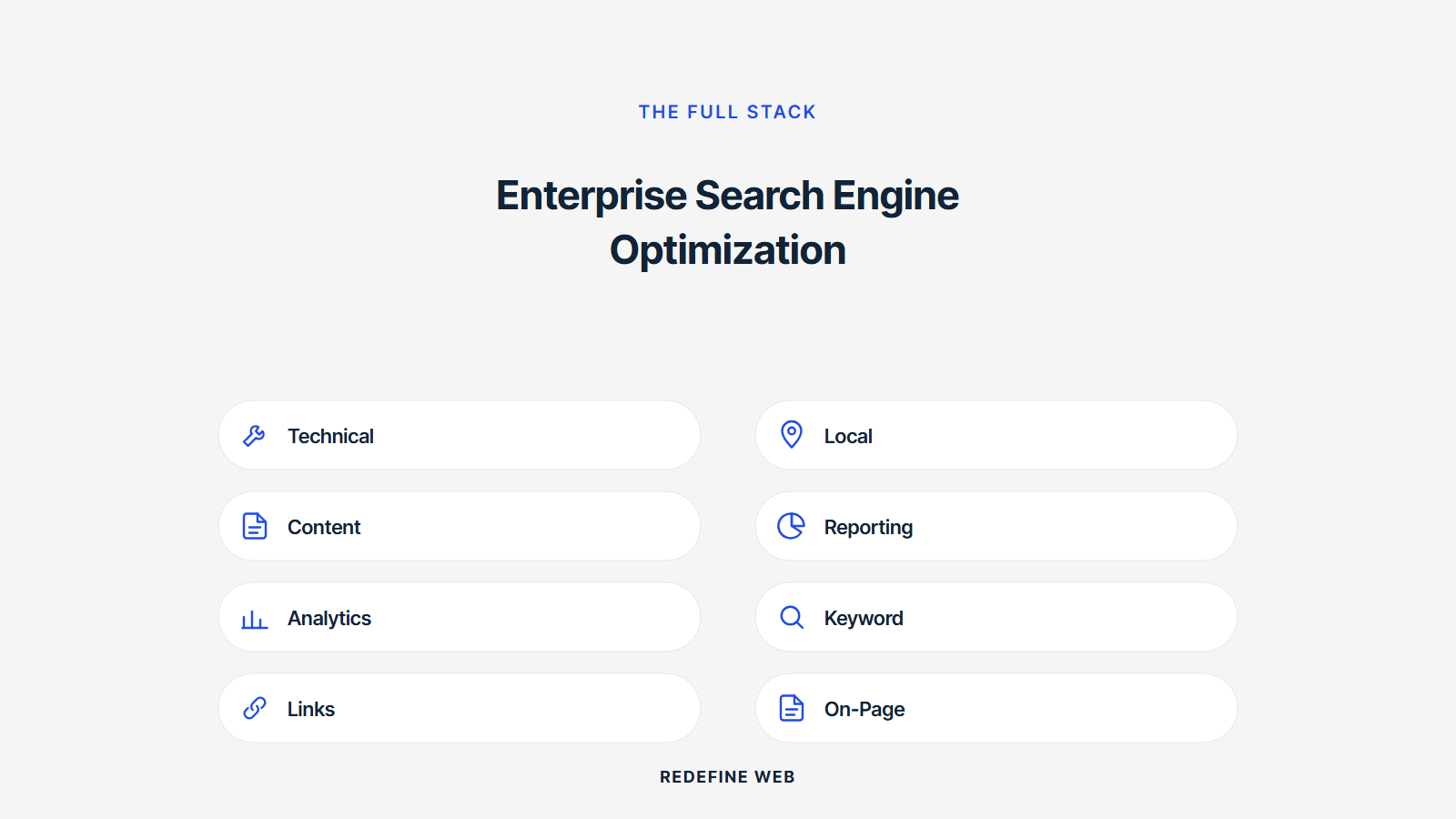
Enterprise search engine optimization services cover seven core workstreams: technical architecture with log-file analysis and rendering QA, content strategy at 300 to 3,000 pages per quarter, editorial production with brand and legal review, digital PR and link acquisition through original research, international and multi-region rollouts with hreflang and CDN work, analytics and attribution with BigQuery pipelines, and cross-team enablement between agency and client stakeholders. Retainers in 2026 run $18,000 to $75,000 per month depending on which of these workstreams are active. Any provider missing two or more of the seven is running a mid-market playbook on an enterprise contract.
How much do enterprise SEO retainers cost in 2026?
Entry-band enterprise SEO retainers run $8,000 to $18,000 per month and staff 3 to 5 people, appropriate for single-product mid-market brands. Mid-band retainers run $18,000 to $35,000 per month and staff 6 to 10 people, appropriate for multi-product enterprises with 2 to 3 markets. Upper-band retainers run $35,000 to $75,000 per month and staff 12 to 20 people, appropriate for global enterprises across 5 or more markets. Project add-ons for platform migrations, category launches, or international rollouts run $50,000 to $450,000 on top of the ongoing retainer, billed as amendments to the master contract.
What are strong enterprise SEO services examples?
Real enterprise SEO services examples fall into four shapes: platform migration, international rollout, category expansion, and market-share defense. A platform migration engagement can run $180,000 to $450,000 for the migration workstream. Forward Networks ran a combined SEO and PPC program with our team that drove 300 percent year-over-year revenue growth, tripled organic traffic in three years, and captured top-3 rankings on high-value network-twin keywords. Automation Anywhere cut cost per lead by 97 percent and scaled customer acquisition 100 times through strategic SEO plus paid audits. Each example runs 24 months or longer to reach compounding organic revenue.
How should I evaluate enterprise SEO services reviews on G2 and Clutch?
Enterprise SEO services reviews on public platforms skew positive because vendors curate the reviewer pool. The pattern is a 4.9 average across 40 to 200 reviews, dominated by recent projects with generous adjectives and short specifics. That is curated, not fabricated. Real signal comes from off-platform reference calls with two current clients and one former client, questions about specific technical wins with named URLs and traffic numbers, and answers to what the vendor got wrong on a client program in the last 24 months. Vendors that give you a former client name and phone number are honest. Vendors that dodge that request are hiding something worth finding.
What team structure do enterprise SEO programs require?
Enterprise SEO programs need six roles on the agency side and three roles on the client side. Agency-side: strategy director, technical lead, content lead, link and PR lead, analytics analyst, and project manager. Client-side: SEO owner in marketing, engineering liaison with 20 percent of their time carved out, and content operations lead for brand and legal review. Missing any seat causes predictable failures. Missing the engineering liaison is the most common gap and causes every technical recommendation to sit in a Jira backlog for a quarter before shipping. Programs that ship technical fixes inside 30 days always have a named engineering liaison at kickoff.
How long before an enterprise SEO program shows business results?
Enterprise SEO programs show technical improvements inside 60 to 90 days, content compounding starting at month 6 to 9, and business-level revenue impact between months 12 and 18. The compound curve steepens through year two as topical authority signals accumulate and the internal-linking graph matures. Programs that expect revenue impact inside 6 months are usually running paid strategies with SEO labeling. Programs that expect nothing before month 18 are usually under-investing in technical work in the first 90 days. The realistic middle ground is a visible ranking curve at month 4, a visible traffic curve at month 8, and a defensible revenue curve at month 14 to 18.
When should we switch enterprise SEO vendors?
Switch enterprise SEO vendors when the quarterly business review misses committed metrics for two consecutive quarters, when your assigned team lead leaves and the replacement is a junior with no comparable enterprise experience, or when the vendor sells to private equity and delivery quality drops noticeably inside two quarters after acquisition. Switching costs 3 to 6 months of onboarding a new vendor plus 3 to 6 months of ramp before new work compounds. Only switch when the current vendor is actively costing more than the switching cost. Otherwise, negotiate a new team lead, give it two quarters, and re-evaluate at the next contract renewal window.
Book your free 30-minute strategy call.
No spam, no sales rep. We use your email to schedule your call with a senior strategist. That is it.
More from the blog
View all articles → SEO
SEO Organic Search Engine Optimization Services That Grow Real Traffic
Read article SEO
SEO SEO for Pet Groomers That Fills the Appointment Book Weekly
Read article SEO
SEO