
B2B Google Ads Strategy That Books Real Sales Meetings
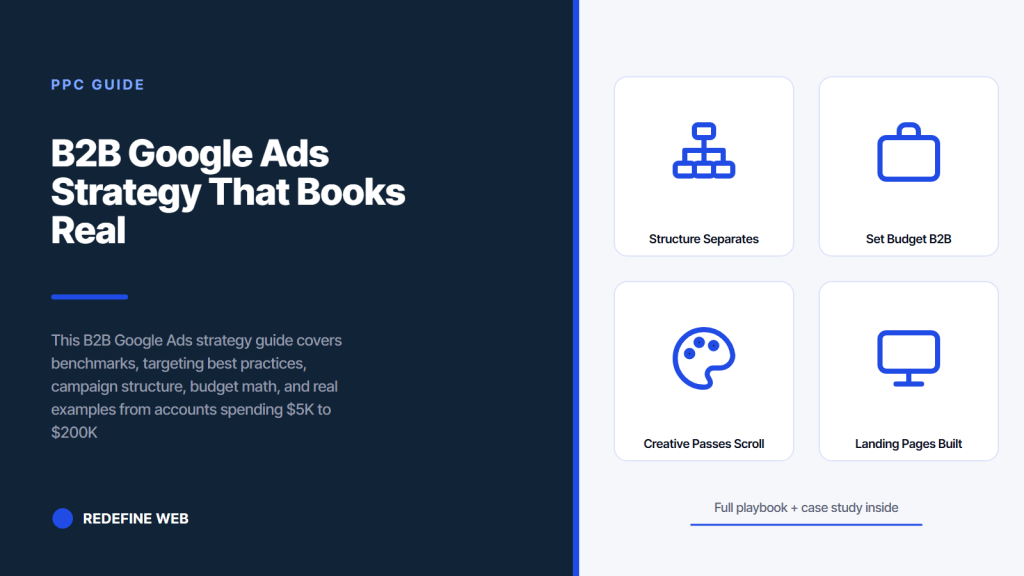
- Benchmarks vary 5x across B2B verticals, so treat them as sanity checks.
- Layer customer match, custom intent, and in-market audiences in observation first.
- Split campaigns by buying, solution, and research intent with matching landing pages.
- Set budget from sales capacity and target cost per qualified lead.
- Report pipeline and revenue monthly, and let smart bidding do the ad copy work.
- B2b google ads campaign structure that separates tiers
- B2b google ads examples from real accounts
- How to set a budget for b2b google ads campaign spend
- A real b2b google ads strategy case study
- B2b google ads tips for creative that passes the scroll
- Landing pages built for a b2b google ads campaign
- B2b google ads expert strategies for mature accounts
- Google ads b2b measurement that survives a CFO conversation
- Wrapping up your b2b google ads strategy
A serious b2b google ads strategy is not a spreadsheet of keywords and a $5K budget. It is a system that ties every campaign, ad group, and landing page to a stage in the buyer’s journey, and offline conversion data feeds it so smart bidding hunts pipeline, not form fills. If your account is set up like a consumer campaign with B2B keywords bolted on, you are lighting money on fire and the CFO already knows.
This post lays out the b2b google ads strategy framework our team runs across accounts from mid-market SaaS to enterprise services. You get b2b google ads benchmarks by industry, an audience-targeting playbook, campaign structure examples, budget math tied to sales capacity, and creative patterns that pass the six-second scroll. Every section maps to a fix we have made on live accounts, not theory. Read straight through if you are auditing an existing account, or skip to the campaign structure section if you are setting one up fresh. Either way, work the checklist against your own account before your next optimization cycle so the changes actually compound.
B2b google ads campaign structure that separates tiers
A b2b google ads campaign built without intent tiers averages out conversion value across buying stages and starves the high-intent traffic that actually books meetings. The fix is simple. Split campaigns by intent stage. Bid differently per stage. Track different conversion actions per stage. Assign different landing pages per stage.
The three-tier structure below is the base pattern. Mature accounts extend it to five or six tiers, but three tiers is enough to see a 20 to 40 percent gain in cost per qualified lead over an unstructured account. If you are running a single campaign with 200 keywords across every intent stage, you are leaving that gain on the table.
Tier 1: buying-intent search
Tier 1 holds your highest-intent keywords. Keywords with modifiers like vendor, provider, agency, platform, software, pricing, quote, and comparison. Bids sit at the top of the range because the searcher is close to a purchase decision. Landing pages match the exact query and route to a demo request form. Conversion action is Demo Request with the highest conversion value. This is where 40 to 60 percent of your budget should live on a mature account.
Tier 2: solution-intent search
Tier 2 holds keywords about the problem the buyer is trying to solve. Reduce customer churn. Automate invoice approval. Improve sales productivity. These queries indicate a real business problem but not yet a purchase decision. Landing pages offer a diagnostic tool, ROI calculator, or benchmark report in exchange for contact info. Conversion action is Diagnostic Request with a mid-tier conversion value. About 25 to 40 percent of budget lives here.
Tier 3: research and remarketing
Tier 3 holds research keywords, brand keywords, and remarketing campaigns. Research keywords define terminology and educate the buyer. Brand keywords defend your name from competitors bidding on it. Remarketing catches buyers who visited but did not convert. Landing pages offer content, videos, or event registrations. Conversion action is Content Download with the lowest conversion value. About 15 to 30 percent of budget lives here.
B2b google ads examples from real accounts
Abstract frameworks are easy to nod at and hard to apply. Here are three b2b google ads examples from real account restructures we ran across different verticals, with the specific changes and the specific outcomes. Same underlying b2b google ads strategy, adapted to the vertical, ad copy, and buyer.
Example 1: mid-market SaaS restructure
A mid-market SaaS account spending $18K a month had 60 keywords in one campaign with $340 cost per demo. We split into three intent tiers, wired offline conversions from HubSpot, built four customer match lists, and rewrote three landing pages. Within 90 days, cost per demo dropped to $190 and demo-to-opportunity rate rose from 8 percent to 21 percent. Spend stayed flat. Pipeline nearly tripled.
Example 2: enterprise services with long sales cycle
An enterprise services firm with a 240-day sales cycle spent $40K a month on a broad match campaign with no offline conversion feed. Reported cost per lead was $180 and everyone assumed the channel was working. Once we added offline conversions with a 270-day attribution window, we found that only 4 percent of leads became opportunities. We shifted 60 percent of the budget to a targeted account-based custom intent campaign focused on 400 named accounts. Cost per lead climbed to $410, but qualified opportunity rate hit 24 percent. Pipeline generated per dollar spent doubled.
Example 3: industrial B2B with a specialty product
An industrial B2B account selling a specialty part had $6K a month and no in-house marketing team. We built one campaign with 40 tightly targeted long-tail keywords, one landing page with a quote request form, and offline conversions tied to closed sales. Cost per quote request settled at $65. Quote-to-close rate ran 32 percent. Revenue per dollar of ad spend hit 8x inside the first 6 months, without a paid rebuild or a marketing hire. Small accounts run just fine on a lean b2b google ads strategy when the structure is right.
How to set a budget for b2b google ads campaign spend
How to set a budget for b2b google ads campaign spend is a function of three variables. Sales team capacity, cost per qualified lead, and target conversion rate through the funnel. Get those three right and the number calculates itself. Copying a competitor’s spend or picking a percentage of revenue does not work.
Work the math backwards from sales capacity. If sales can handle 40 demos a month and your qualified lead rate off Google Ads is 22 percent, you need about 180 form fills. If your target cost per form fill is $80, budget is $14,400 a month. Below that number, you starve smart bidding of conversion data. Above it, you drown sales in leads they cannot service, and the good leads get lost. That single equation is the b2b google ads strategy conversation most agencies skip.
Minimum viable spend for smart bidding
Smart bidding needs 30 to 50 conversions per month per campaign to work well. For a B2B account with a $150 target cost per lead, that means $4,500 to $7,500 per month per campaign as the floor. Accounts under $3K per month usually cannot generate enough conversion data for smart bidding to optimize. If your total budget is under $5K, run one campaign, not four, and consolidate conversions into a single action so bidding has enough signal.
Scaling budget without breaking efficiency
The classic B2B scaling trap is doubling budget in a single month and watching cost per lead spike alongside. Smart bidding needs 2 to 4 weeks to re-learn after any budget change over 20 percent. To scale from $10K to $30K, do it in 15 percent monthly increments across 4 months. Every step lets smart bidding recalibrate. Skip the increments and you waste $15K to $40K on re-training you did not need to spend.
Smart Bidding chases whatever conversion you defined. If it's still form fill, you're paying for MQLs. Wire offline conversions from CRM to bid on real pipeline.
A real b2b google ads strategy case study
Rocket Software, Inc. came to us with a broken activation funnel, a 7 percent activation rate, and paid campaigns disconnected from the drip email system. Google Ads was running with generic ad copy, a single landing page for every campaign, and no offline conversion feed. The account was booking form fills that never became customers because activation was falling apart post-signup.
We restructured the account into three intent tiers, rebuilt the activation drip campaign, added four customer match lists, and wired offline conversions from the subscriber platform back into Google Ads. Activation rate climbed 300 percent in the first month. The subscriber acquisition tool acquired its first 3,000 customers within the first week of the launch. Steady 400-plus daily subscribers followed post-launch. The paid channel and the product funnel finally spoke the same language.
| Metric | Before | After |
|---|---|---|
| Activation rate | 7% | Up 300% |
| Customers (week 1) | Onboarding broken | 3,000 |
| Daily subscribers | Weak | 400+ |
| Drip campaigns | Weak | Full 4-channel |
| Offline conversions | Not connected | Daily import |
Every b2b google ads strategy audit we run includes a question the CFO always asks. Where is the money going? On one account we found $4,200 a month going to search partners nobody had heard of because a checkbox was left ticked from the account creation. Twelve seconds of clicking cleared out 8 percent of monthly spend and cost per qualified lead dropped 11 percent the next week. Sometimes the highest-ROI b2b google ads strategy fix is unchecking a box.
B2b google ads tips for creative that passes the scroll
Ad creative for B2B accounts gets less attention than it deserves. Most B2B ad copy reads like a product feature list translated into 30 characters. That approach loses. Buyers scroll past feature lists. They stop for specific outcomes, named roles, and numbers that match their world.
The b2b google ads tips that consistently work across responsive search ads are three patterns. Name the role. Name a specific outcome with a number. Name the objection your buyer already carries into the search. Every one of those beats generic value-prop copy in every test we have run.
- Headlines that name a role: For CFOs, For RevOps Leads, For CTOs
- Headlines with a number: Cut Demo No-Shows 40%, Book 3x More SQLs
- Headlines that flip an objection: No 6-Month Contract, Integrates in a Week
- Descriptions with proof: 400+ B2B teams shipping in 90 days
- Sitelinks that answer discovery questions: Pricing, Integrations, Case Studies, Demo
Pinning strategy inside responsive search ads
Do not over-pin your responsive search ads. Pinning locks Google out of the machine learning that makes RSAs work. Pin one headline that must appear, usually your brand name or a compliance-required phrase. Leave the rest unpinned so Google can test combinations. Accounts that pin every slot see 20 to 40 percent lower CTR than accounts that pin sparingly. The exception is if legal or compliance requires specific phrasing, in which case pin what you must and accept the trade-off.
Using asset performance ratings
Google rates each headline and description in an RSA as Best, Good, or Low. Pause every Low-rated asset after 30 days. Replace with a variant testing a different angle. Iterate. Over 6 months, that cadence usually adds 25 to 60 percent to CTR and 15 to 30 percent to conversion rate. It is boring work. It compounds harder than any other in-account optimization.
Landing pages built for a b2b google ads campaign
Landing pages are where a decent b2b google ads strategy becomes great or falls apart. Consumer-style landing pages with autoplay video, benefit tiles, and a testimonial slider tank on B2B traffic. B2B buyers want proof, pricing signals, and a low-friction next step. Everything else on the page competes with the CTA.
The skeleton that works across B2B verticals is the same. Specific headline naming the pain and outcome. Subhead with a proof number. Hero form or demo CTA above the fold. Three-column customer logo strip. Short how-it-works section. Case study snapshot with a specific number. Second CTA. FAQ block handling the top objections your sales team already hears every day. That is it. Our B2B PPC Agency service page walks through the full landing-page pattern with examples.
Form field count tied to sales capacity
Long forms filter tire kickers. Short forms maximize volume. Match form length to sales capacity. If sales can absorb 60 demos a month, run a 3-field form and let volume climb. If sales is drowning in low-fit leads, add 4 to 6 qualifying fields. Adding fields cuts form fills 25 to 45 percent and raises qualified lead rate 60 to 120 percent. For B2B where sales time is the constraint, that trade is almost always worth taking.
Proof elements that convert B2B buyers
Real customer logos beat generic testimonials. Specific numbers beat vague claims. Named case studies beat anonymized ones. B2B buyers scan for social validation, and generic proof triggers immediate skepticism. Use logos from customers the buyer will recognize. Use case study excerpts with real numbers, not paraphrased praise. If you cannot get customer approval for named case studies, that is a business problem to fix, not a copywriting problem to work around. For deeper coverage on the SaaS proof pattern, our SaaS PPC Services covers the full playbook.
B2b google ads expert strategies for mature accounts
Once the base b2b google ads strategy is running and converting, the next layer of optimization comes from bidding logic, script automation, and cross-channel measurement. These are the moves that separate accounts stuck at $18K a month cost per demo from accounts hitting $9K a month with better lead quality.
None of these tactics matter until the base is right. If your account still has no offline conversion feed, ignore this section and go fix that first. If your account is running clean, these are the levers that produce the next 20 to 40 percent gain.
Portfolio bidding strategies
Portfolio bid strategies let you group campaigns under a shared target and shared learning. On a B2B account with 6 to 12 campaigns, portfolio Target CPA or Target ROAS usually outperforms per-campaign bidding once each campaign has enough conversion data. Portfolio strategies pool the signal across campaigns and let smart bidding transfer learnings across similar audiences. Use portfolio bidding for tier 1 and tier 2 campaigns. Keep tier 3 on standalone bidding because the intent differs enough that pooling can drag efficiency down.
Scripts and automation layers
Google Ads scripts let you automate account hygiene tasks that would otherwise take 6 to 10 hours a week. Anomaly detection scripts alert when spend, conversions, or cost per conversion moves more than 30 percent overnight. Search terms report auto-negative scripts flag likely spam queries for review. Budget pacing scripts adjust bids to hit monthly targets. The Google Ads scripts documentation lives at the Google Ads Scripts guide, and the community library at Search Engine Land PPC covers proven templates.
Google ads b2b measurement that survives a CFO conversation
A b2b google ads strategy without a measurement layer is a spend hobby. The CFO asks about pipeline. Marketing shows click-through rate. That mismatch defunds Google Ads inside two quarters. The fix is a measurement layer that maps ad spend to pipeline generated, weighted by qualified lead value, tracked across the full sales cycle.
The measurement stack has three layers. Google Ads native conversion tracking with offline import for smart bidding to work. CRM reporting with first-touch and last-touch source captured on every lead. Executive dashboards showing pipeline and revenue by channel and campaign. Every layer feeds the layer above. Every gap breaks the story for leadership. Deeper coverage of paid measurement for SaaS teams lives in our Google Ads Management Services and our B2B SaaS Marketing Agency Tied to Pipeline pages.
Dashboards that leadership actually reads
The monthly leadership dashboard is one page. Spend, form fills, qualified leads, opportunities, pipeline, closed revenue, cost per qualified lead. Trend against prior month and prior quarter. That is it. Under that one page can live 40 pages of detail for anyone who wants the drill down, but the summary page is what gets read. If the summary is 12 pages of platform metrics, leadership stops reading, and budget conversations get harder every quarter.
Picking an attribution model
Data-driven attribution inside Google Ads works well for smart bidding once you have 300 conversions in a 30-day window. For CRM reporting, capture both first-touch and last-touch source and let sales and marketing agree on which one drives budget conversations. Sales-influenced pipeline usually maps to last-touch. Sourced pipeline usually maps to first-touch. Both are valid stories, and both need to be told. What kills reporting is when the two teams use different models and argue about the numbers.
Wrapping up your b2b google ads strategy
A working b2b google ads strategy is not complicated. Intent-tiered campaigns. Offline conversion imports. Layered audience stack. B2B landing pages. Value-weighted conversions. Boring, measurable, compounding work. Get the fundamentals right and Google Ads becomes the most predictable pipeline channel in the B2B stack.
Pick 4 to 6 fixes from this post that match your account’s biggest gaps. Run them for 90 days. Measure qualified leads and pipeline, not clicks. Then pick the next 4 to 6. That cadence is what separates B2B accounts that scale from B2B accounts that plateau.
Frequently asked questions
What b2b google ads benchmarks should I actually target?
Target the middle of the industry-specific benchmark range within 90 days. For B2B SaaS, that means 4 to 7 percent CTR, $8 to $22 CPC, $120 to $340 cost per lead, and 3 to 8 percent conversion rate. Enterprise services accounts run higher on cost per lead because sales cycles are longer and deal sizes are bigger. Industrial B2B runs lower on CPC because the search competition is thinner. Do not compare your account to a generic benchmark averaged across every industry. That comparison misleads more often than it informs. Set your baseline in the first 60 days of the account, then work to improve against your own baseline rather than an external number.
How do google ads b2b audience targeting best practices differ from consumer?
Google Ads for B2B leans heavily on customer match lists, custom intent audiences, and detailed demographics on YouTube and Display. The search network does not offer job title targeting the way LinkedIn does. What it offers is intent through keyword layering plus in-market segments plus first-party CRM data. The stack that works is customer match lists from your closed-won CRM, custom intent audiences built from competitor keywords and URLs, in-market audiences filtered to Business Services or Enterprise Software categories, and detailed demographics on YouTube and Display. Run every layer in observation mode for 30 to 60 days before moving winners to targeting mode with bid adjustments.
What is the right b2b google ads campaign structure?
Intent-tiered campaigns work best. Tier 1 holds buying-intent keywords with modifiers like vendor, provider, pricing, and comparison. Tier 2 holds solution-intent keywords about the problem the buyer is trying to solve. Tier 3 holds research keywords, brand keywords, and remarketing. Each tier has its own landing page, its own conversion action, its own budget allocation, and its own bidding target. On a mature account, tier 1 gets 40 to 60 percent of budget, tier 2 gets 25 to 40 percent, and tier 3 gets 15 to 30 percent. Do not mix tiers inside a single campaign or smart bidding averages out conversion value and starves the tier that actually books meetings.
How to set a budget for b2b google ads campaign spend?
Work the math backwards from sales capacity. If your sales team can handle 40 demos a month and your qualified lead rate off Google Ads is 22 percent, you need about 180 form fills. Multiply that by your target cost per form fill, usually $60 to $150 for B2B, and you get monthly budget. Below the minimum viable spend of about $4,500 to $7,500 per campaign, smart bidding cannot get enough conversion signal to optimize. Above the sales capacity ceiling, you drown sales in leads they cannot service. The right budget matches both constraints. When you need to scale, do it in 15 percent monthly increments to let smart bidding recalibrate.
What b2b google ads examples should I model my account on?
The right model depends on your vertical and sales cycle. For mid-market SaaS with a 60-day cycle, model intent-tiered campaigns with a demo request as the primary conversion. For enterprise services with a 240-day cycle, model account-based custom intent audiences with a diagnostic offer and a 270-day attribution window. For industrial B2B with a specialty product, model a single tight campaign with long-tail keywords and a quote request form. Each of those patterns is a real b2b google ads example we have run to solid returns. What ties them together is intent-first keyword selection, offline conversion imports, and landing pages built for the specific buyer, not consumer-style pages with B2B copy dropped on top.
What b2b google ads expert strategies produce the biggest efficiency gains?
The three biggest efficiency levers on mature B2B accounts are portfolio bidding across intent-matched campaigns, value-weighted conversion imports from CRM, and custom intent audiences built from competitor signals. Portfolio bidding pools smart bidding signal across similar campaigns and typically produces a 15 to 30 percent improvement in cost per qualified lead once each campaign has 30-plus conversions per month. Value-weighted conversions let bidding prioritize high-deal-size leads instead of averaging every form fill. Custom intent audiences on Display and YouTube pull buyers already shopping the category. None of these matter until the base is running with offline conversions active.
What b2b google ads tips help creative pass a busy buyer's scroll?
Three creative patterns work across responsive search ads. Name the buyer's role in the headline. Name a specific outcome with a real number. Flip a common objection in a headline. Generic value-prop headlines like Boost Your Sales rate Low almost every time. Headlines like For CFOs Cutting Report Cycles or Book 3x More SQLs in 60 Days beat those in every test we have run. Pin only what you must for compliance and let Google test combinations across the rest. Pause Low-rated assets every 30 days and replace with new variants targeting the objections your sales team hears on discovery calls. That cadence adds 25 to 60 percent to CTR over 6 months.
Book your free 30-minute strategy call.
No spam, no sales rep. We use your email to schedule your call with a senior strategist. That is it.
More from the blog
View all articles → PPC
PPC Healthcare PPC Advertising Channels Compliance and Targeting
Read article PPC
PPC Dental Facebook Ads Guide for Practices That Book Patients
Read article PPC
PPC