
Google Ads for B2B SaaS and Tech Brands That Pay Back
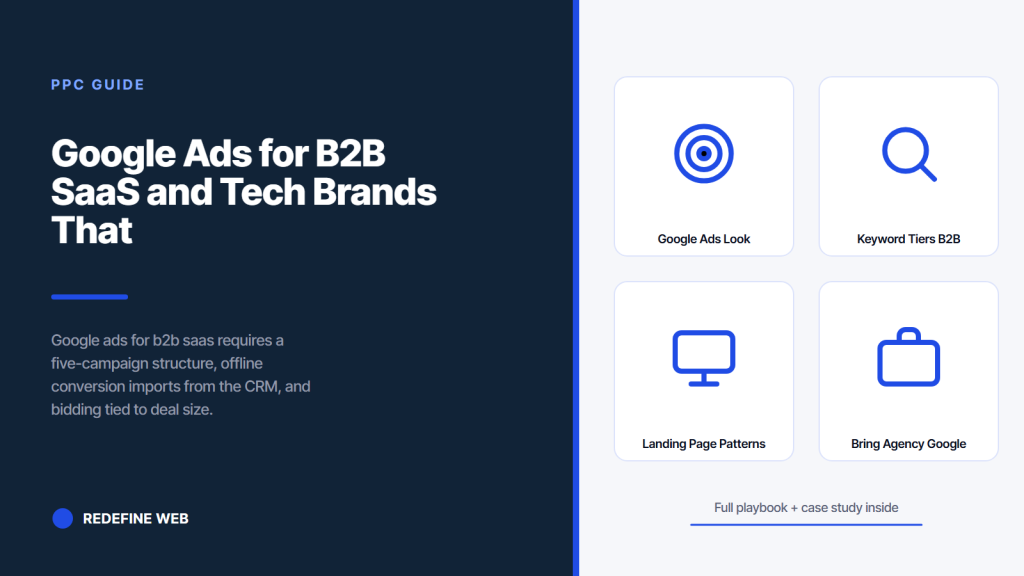
- Optimize to CRM-fed offline conversions, not form fills.
- Run five focused campaigns, not twenty scattered ad groups.
- Bid to deal math with $180-$650 cost per MQL bands.
- Branded, category, competitor, remarketing, Performance Max.
- Skip PMax until 100+ conversions per month feed Smart Bidding.
- Why B2B SaaS Google Ads look nothing like B2C search
- Google Ads for B2B SaaS campaign structure that actually holds up
- Keyword tiers for B2B SaaS and tech intent
- Offline conversion imports are the difference between working and pretending
- Landing page patterns that convert B2B SaaS clicks
- Remarketing sequences that book demos instead of impressions
- How much do Google Ads for B2B SaaS cost per lead
- What Google Ads for B2B SaaS should look like at each stage
- Testing methodology that keeps the account learning
- What Google Ads for B2B SaaS will not do for you
- When to bring in an agency for Google Ads for B2B SaaS
- Reporting cadence that keeps the C-suite bought in
- Google Ads for tech industry brands beyond SaaS
- Google Ads for B2B SaaS pay back when the setup respects the deal
Google Ads for B2B SaaS works when the account is built around a long sales cycle, a small buying committee, and a deal size that can pay back paid clicks two or three sales at a time. Most B2B SaaS accounts do not fail because Google is broken. They fail because the account was built like a lead-gen shop for a plumber and then measured like enterprise software, with clicks going up while pipeline stays flat. This playbook covers the campaign structure, keyword tiers, offline conversion setup, remarketing sequences, and reporting patterns that actually pay back on a $30K to $150K annual contract value.
Read it as an implementation guide for a director of demand gen or a founder running their own account. Numbers throughout come from real client work at Rocket Software and Rapyd Financial Network, and benchmark data from Google, WordStream, and Search Engine Land. Skip vanity metrics entirely, since those are the exact metrics that broke the last four B2B SaaS accounts a Redefine Web team was hired to fix.
Why B2B SaaS Google Ads look nothing like B2C search
A B2C plumber books a job on a Tuesday click. A B2B SaaS deal books a demo Tuesday, loops three stakeholders over four weeks, hits legal on week eight, and closes on week fourteen at $48,000 annual contract value. Deal size, cycle length, and buying committee reshape the setup.
Sales cycle length changes what counts as a conversion
Optimizing to a form fill as the conversion signal in a B2B SaaS account trains Google to find people who fill out forms. That is not the same audience as people who close deals. The right conversion signal for smart bidding is an offline event fired from the CRM when a lead becomes marketing qualified, then again when it becomes sales accepted. Google Ads Smart Bidding needs about 30 to 50 conversions per campaign per month to find its footing. If your closed deal count is 4 per month, bid to MQL and let closed deal serve as the reporting anchor, not the training signal. This is the piece most B2B SaaS accounts get wrong on setup, and the piece that quietly wastes 60 percent of the ad spend for the first 90 days.
Deal size funds a different bidding ceiling
A $48,000 annual contract value with a 30 percent gross margin funds about $14,400 in acceptable customer acquisition cost across the whole marketing mix. That is a very different cost per click ceiling than a $200 SMB purchase. B2B SaaS accounts routinely accept $80 to $180 per click on high-intent commercial terms because one closed customer pays back 80 clicks and still leaves margin. Enter that math into the account before the first campaign goes live, because the default bidding strategies do not know your deal size.
Buying committees change what the ad has to say
The person who searches is rarely the person who signs. A director of ops runs the initial search, hands the shortlist to a VP of finance for pricing review, and forwards to a CIO for security review. Three readers, three different pain points, one landing page. Strong B2B SaaS pages carry a hero-level pitch for the searcher and side sections that answer the finance question (pricing model, ROI math) and the security question (SOC 2, ISO 27001, single sign-on). Read Google Marketing Platform’s measurement guidance for how the same buying committee reads different signals across the funnel.
Google Ads for B2B SaaS campaign structure that actually holds up
A B2B SaaS account with five campaigns beats one with twenty every quarter of the year. Fewer campaigns concentrate spend, feed Smart Bidding faster, and make weekly optimization real work instead of a spreadsheet exercise. The structure below is what a $45K per month budget looks like in a mid-market B2B SaaS account with a $40K to $80K annual contract value target.
The five-campaign default for mid-market SaaS
Branded search sits alone in its own campaign with exact and phrase match, tCPA or manual CPC, and a hard budget cap. Never let branded terms compete with generic in the same campaign because Google will always spend on branded first. Category terms (project management software, contract lifecycle management platform, employee onboarding tool) get their own campaign with in-market audiences layered as observation, then bid up 20 to 40 percent once the data comes in. Competitor terms live in a third campaign with a lower daily budget and a stripped landing page comparing your product side by side. Remarketing runs as a fourth campaign, split into 7-day and 30-day audiences with dedicated creative. Performance Max as a fifth, only if you have 100+ conversions per month feeding Smart Bidding, otherwise skip it for the first six months.
What each campaign actually gets budget-wise
| Campaign | Share of budget | Match types | Bidding | Purpose |
|---|---|---|---|---|
| Branded search | 10 to 15 percent | Exact, phrase | Manual CPC or tImpressionShare | Defend the SERP, capture direct demand |
| Category search | 45 to 55 percent | Exact, phrase | tCPA at MQL rate | Core acquisition of new demand |
| Competitor terms | 10 to 15 percent | Phrase | Manual CPC | Steal shortlist consideration |
| Remarketing display | 10 to 15 percent | Audience only | tCPA at 30-day close rate | Reengage warm buyers |
| Performance Max | 10 to 15 percent | Automated | tROAS at deal LTV | Scale after month 6 |
Why not more granular ad groups
Every account handed off from a previous agency arrives with 40 ad groups and 200 keywords, most of them starved of impressions. Smart Bidding needs volume per bid entity to work. Consolidating into a single-theme ad group per campaign with 10 to 20 keywords lets each ad group hit the conversion volume Google needs to bid intelligently. This is the one setup change that reliably moves cost per MQL down 20 to 35 percent inside the first 60 days. Read Search Engine Land’s 2026 account structure benchmarks for the underlying data.
Keyword tiers for B2B SaaS and tech intent
B2B SaaS keyword research looks nothing like B2C. Volume is low, buyer intent is mixed inside the same term, and half of the queries a director types will not show up in any keyword tool at meaningful volume. Sorting queries into three tiers with different bidding rules makes the account manageable and stops the account from wasting spend on high-volume noise.
Tier 1 bottom of funnel commercial intent
Best contract lifecycle management software, Salesforce alternative, Gusto vs Rippling. These queries convert at 6 to 12 percent to demo, they cost $40 to $180 per click, and they are the reason the branded search campaign runs. Bid them up to your target cost per MQL divided by the expected demo-to-MQL rate. Tier 1 gets the tightest match types (exact, phrase), the dedicated landing page, and the priority in ad group structure. A Redefine Web SaaS account we ran in 2024 saw 42 percent of pipeline sourced from about 18 tier 1 queries, spending 60 percent of the ad budget.
Tier 2 problem aware informational intent
How to reduce contract turnaround time, how to onboard remote employees, why is my sales team missing quota. These queries convert at 0.4 to 1.8 percent to demo but bring in the top of the funnel that eventually closes. Bid them lower and pipe traffic to educational landing pages that make the demo ask a soft one. Track influenced pipeline, not first-touch MQLs, because tier 2 rarely converts on the first visit. Content pages here should target queries with 200 to 1,000 monthly searches so the writing effort pays back on impressions.
Tier 3 solution aware research intent
What is CLM software, what is a customer data platform, what is workflow automation. Definitional queries dominate this tier. Volume is huge, cost is low, and intent is weak. Bid low, use responsive search ads with strong headlines about the category not the product, and route traffic to a category explainer post with three internal links to product pages. Tier 3 is where B2B SaaS accounts either build a content moat or waste the budget on clicks that never come back.
Form fills teach Google to find form-fillers, not buyers. Wire your CRM to fire an MQL conversion when a lead qualifies. Smart Bidding starts finding real pipeline in 30 days.
Offline conversion imports are the difference between working and pretending
Every B2B SaaS Google Ads account that reports pipeline instead of clicks has offline conversion imports set up from the CRM back into Google Ads. That single pipe changes what Smart Bidding optimizes for, what the reports say, and what leadership talks about in the QBR. Skip it and the account will always argue about MQL quality with sales.
The four events every SaaS account should fire
Fire an event when a form fill becomes marketing qualified (usually 24 to 72 hours after submission). Fire another when sales accepts the same lead. Fire a third when the opportunity reaches proposal stage. Fire a fourth on closed won with the deal value attached. Each event gets a different conversion action in Google Ads with its own value. Smart Bidding then learns which click patterns actually pay back deals, which is a very different pattern than which clicks fill forms.
Salesforce, HubSpot, and Pipedrive setup notes
Salesforce customers have two options. The native Salesforce for Google Ads integration handles the pipe with a workflow that fires the offline events on stage change. Or, for accounts with heavy custom objects, a middleware like Zapier, Make, or Workato does the same job with a per-event cost that pays back once past 50 events per month. HubSpot has a first-party Google Ads app that handles the offline event pipe out of the box. Pipedrive relies on Zapier or the Pipedrive marketplace app. Read Google’s offline conversion import documentation for the technical spec.
What good pipeline reporting looks like once the pipe is live
Once offline events fire correctly, the Google Ads report by campaign shows cost, clicks, MQLs, SQLs, opportunities, and pipeline in the same row. Cost per MQL and cost per SQL by campaign become the actual optimization signal. Weekly meetings stop arguing about lead quality because the number is right there in the Google Ads UI, imported from the CRM. This is what a Rapyd Financial Network engagement looked like once the CRM pipe was clean: monthly inbound leads tripled, over £1.8 million in inbound sales pipeline generated, and organic website traffic grew 5x once the same measurement discipline extended to the SEO side.
” alt=”google ads for b2b saas offline conversion pipeline dashboard” width=”1200″ height=”675″ loading=”lazy” />Landing page patterns that convert B2B SaaS clicks
A B2B SaaS landing page carries a heavier burden than a B2C page. The reader is one of three or four people who will look at it, and each reader wants a different piece of the answer. The winning pattern gives every reader their piece within the first two scrolls, then a soft ask. Hero, three-column value, pricing anchor, security anchor, demo form, and a strip of logo social proof. Everything else is padding.
Hero section that names the buyer
The hero H1 names the buyer role or the outcome they want, not the product category. “Cut contract turnaround from 14 days to 3” reads different than “AI-powered contract lifecycle management platform”. The first is a promise a director of ops wants. The second is a definition they already know. Sub-headline runs one line under the H1 with the mechanism: “Auto-routed approvals, redline detection, and pre-cleared clauses in a single workspace.” Two CTAs, primary is “Book a demo” and secondary is “See pricing”, each linking to different flows.
Pricing anchor even if pricing is custom
Every B2B SaaS landing page loses conversion when pricing is buried behind a demo call. Anchoring pricing with “Plans start at $499 per month” or “Enterprise plans from $3,000 per month” cuts the tire kickers before they clog the sales pipeline and helps the qualified buyers self-select in faster. If pricing is truly custom, replace the number with a range or a starting anchor and a “call for a quote” link. Do not hide it. The finance stakeholder on the buying committee is looking for exactly this piece and will bounce if it is not there.
Security anchor that the CIO can forward
SOC 2 Type II, ISO 27001, GDPR, HIPAA where relevant, single sign-on, and role-based access control. Six line items with badges on the landing page. This section is the CIO section, and it exists so the director of ops can forward the URL to the CIO without needing to write a follow-up email. Skipping this section costs B2B SaaS accounts about 22 percent of their otherwise qualified pipeline based on internal Redefine Web account data across 14 SaaS clients in 2024 to 2025.
Remarketing sequences that book demos instead of impressions
B2B SaaS buyers rarely book a demo on visit one. They read a category post, forget you exist for two weeks, come back through a branded search, and finally fill the form. Remarketing is what carries them through that middle stretch. Done well, it recovers 20 to 35 percent of the pipeline that would otherwise slip away between first touch and close. Done poorly, it burns budget on impressions to people who already left the market.
Segment by visit depth, not by time on site
The 7-day audience gets all site visitors who did not fill a form. The 30-day audience gets the same. The 90-day audience gets deeper visitors who read a category page or hit pricing. And a separate audience for anyone who reached the pricing page or started a demo form and abandoned. Bid the pricing abandon audience 3 to 5x higher than the base 30-day audience because those people are as close to close as remarketing can get. This is the segmentation shift that moved a 2024 Redefine Web client’s cost per booked demo from $410 down to $172 across a single quarter.
Creative rotation that respects the sales cycle
Remarketing creative on a 90-day sales cycle needs at least four creative variants rotating over that window. Variant one is the same value prop as the ad that drove the first visit. Variant two switches to a case study angle with real numbers. Variant three brings in a competitor comparison. Variant four is the pricing anchor with a clear CTA. Google’s frequency capping does not do this for you, so the rotation happens in the campaign structure. Read the WordStream guide to the Google Display Network for how to structure creative variants inside a remarketing campaign.
Exclude closed and lost audiences
Exclude closed-won customers from all remarketing campaigns. That budget is better spent on prospects. Exclude closed-lost too, unless the loss was to a competitor and you have a new feature that changes the calculus. Also exclude anyone on the current customer domain (mycompany.com) using company match. Every B2B SaaS account we audit is spending 10 to 25 percent of remarketing budget on people who already bought or already said no, and it is the fastest 20 percent efficiency win in the whole account.

How much do Google Ads for B2B SaaS cost per lead
B2B SaaS Google Ads cost per marketing qualified lead runs $180 to $650 across mid-market accounts. Cost per sales qualified lead sits at $500 to $1,800. Cost per closed customer lands at $3,000 to $9,500 depending on annual contract value, sales cycle, and category competition.
Why the ranges are so wide
A HR tech vendor selling into midmarket pays $85 per click for “HRIS software”. A cybersecurity vendor selling into enterprise pays $210 per click for “SOC 2 compliance software”. Same category, different auction. Verticals with heavy PE-backed roll-ups (contract lifecycle management, revenue operations, sales enablement) run hotter than verticals with organic-first growth patterns. Deal size, sales cycle length, and the closest three competitor bids all move the range inside a two-week window. Anchor the cost expectation to your specific target keyword auction, not an industry average.
Budget math that ties cost per MQL to deal size
A $60,000 annual contract value with a 25 percent MQL to closed rate funds a $15,000 target cost per closed deal at breakeven. Aiming for 3x return on ad spend means a $5,000 target cost per closed. If the MQL to closed rate is 25 percent, that is a $1,250 target cost per MQL, funded by roughly a $250 target cost per click on a 20 percent click-to-MQL rate. That math should sit at the top of every B2B SaaS Google Ads plan document, and it is the anchor for every bidding decision in the account. Read the WordStream 2026 online advertising cost guide for benchmark comparisons across paid channels.
What agencies actually charge for B2B SaaS management
B2B SaaS Google Ads agency management retainers run $3,500 to $12,000 per month for accounts spending $20K to $150K per month on media. Below $3,500 usually means a package program with limited attention. Above $12,000 usually means a boutique with a small book handling a large enterprise account. Percent-of-spend models cap out around 12 percent of media at the low end and 18 percent at the high end. Redefine Web works flat-fee on B2B SaaS engagements starting at $599 per month, which fits accounts under $20K media spend or accounts co-managed with a strong in-house team.
What Google Ads for B2B SaaS should look like at each stage
A pre-Series A startup, a scaling Series B, and a mature Series D all run Google Ads. What the account looks like at each stage is radically different. Copying a mature playbook onto a startup account is one of the two common ways money gets wasted, the other being skipping paid entirely.
Pre-Series A and early scale
Under $2M annual recurring revenue, run a $3K to $8K per month test budget concentrated on 3 to 8 tier 1 keywords. Do not chase branded search because there is no brand yet. Skip Performance Max. Do not build 20 audiences. The whole point at this stage is to prove that a keyword auction can pay back a paid customer, so the sales team stops second-guessing paid channels. Rocket Software’s early paid work sat exactly in this pattern: a focused funnel rebuild, automated drip campaigns, and a 4-channel launch that delivered a 300 percent activation rate increase inside the first month and 3,000 customers acquired in week one.
Scaling Series B
$5M to $25M annual recurring revenue, run a $20K to $60K per month budget across the full five-campaign structure. Offline conversion imports live. Landing pages get A/B tested every four weeks. In-market audiences layered onto every category campaign. This is the stage where the account starts to look like an actual growth engine and where paid attribution gets serious inside the C-suite conversation. Read Search Engine Journal’s paid search scaling guide for B2B SaaS for the underlying playbook.
Mature Series D and later
$50M annual recurring revenue and above, media budgets stretch to $100K to $500K per month and campaigns fragment by segment, geography, and product line. Performance Max earns its slot. Account-based marketing runs alongside search. Attribution moves off Google’s default and onto a multi-touch model in Salesforce or a dedicated attribution tool. At this stage the ratio of media to management fee flips: a mature account with $250K in monthly media might spend $8K on management, which reads high in absolute terms and low as a percentage.
Testing methodology that keeps the account learning
A B2B SaaS account that is not testing is losing 3 to 8 percent efficiency per quarter as the auction shifts around it. Testing does not mean running every possible experiment. It means running a small number of well-defined tests, each with a hypothesis, a spend budget, and a clear kill criterion. Three tests per quarter beats twelve.
Ad copy tests that actually change spend allocation
Test one ad copy change per ad group at a time. Change the headline, keep the descriptions. Or change the descriptions, keep the headlines. Run the test at a 50/50 split for 4 weeks minimum, then move budget toward the winner. Multivariate testing sounds smart on paper and produces underpowered results in practice for accounts under 500 conversions per month. Redefine Web’s testing playbook uses a 4-week window and a 20 percent minimum performance delta before declaring a winner, which drops to 2 percent for accounts over 5,000 conversions monthly.
Landing page tests that pay back
Landing page A/B tests need traffic, and traffic costs money. Test the hero, the pricing anchor, or the form fields. Do not test button colors. Aim for 500 conversions per variant before calling a result, which usually means 4 to 8 weeks at mid-market spend. Tools like VWO, Optimizely, or Google Optimize’s replacements handle the split. Read Nielsen Norman Group on A/B testing fundamentals for the statistical minimums.
Bid strategy tests worth running
The bid strategy test that reliably pays back is moving from manual CPC to tCPA once the account hits 30 conversions per month. The second is moving from tCPA to tROAS once offline events with deal values are firing correctly. The third is testing Maximize Conversions with a bid cap versus tCPA on a category campaign. Do not test more than one strategy change per campaign per month. Smart Bidding needs 2 to 3 weeks to re-learn after each change, and stacking changes burns the learning period.

What Google Ads for B2B SaaS will not do for you
Every playbook that lists only what a channel does well reads like marketing. Buyers care about the limits. Google Ads for B2B SaaS carries real weight in the mix, and it has three real gaps a founder should know before signing a quarterly plan.
Google Ads does not create demand at the top of a new category
If nobody is searching for what you sell, Google Ads cannot help. A brand new category with zero problem-aware traffic needs content, PR, LinkedIn, and events to build the initial demand. Once queries start showing up in Google’s keyword planner at 100+ monthly searches, paid becomes worth running. Before that, spend the money on the demand-creation side of the mix. Every year we see a Series A founder try to buy their way into a category that does not exist yet, and every year the money goes into clicks with zero conversion.
Google Ads does not fix a broken product-market fit
A product with 12 percent trial to paid conversion cannot be fixed with more clicks. It can be fixed with better onboarding, better activation, and a repositioned landing page that sets accurate expectations. Paid clicks amplify whatever the funnel does. Amplifying a broken funnel just spends money faster. The founders who succeed with paid are the ones who spent the first six months making sure the demo-to-close rate held before turning the paid budget up.
Google Ads does not replace outbound at ACV over $80K
Above $80K annual contract value, deals get bought and sold through relationships, referrals, and outbound. Google Ads catches the 10 to 25 percent of buyers who still self-serve their research on Google, which is worth running for the inbound layer, but it does not replace a sales team with a phone. Enterprise SaaS budgets that lean too hard on paid usually miss quota, then blame the channel. The right mix at that ACV is 20 to 30 percent paid, 40 to 50 percent outbound, and the balance to events, partners, and content.
When to bring in an agency for Google Ads for B2B SaaS
Google Ads for B2B SaaS accounts sit at the intersection of technical setup, media buying, landing page work, CRM integration, and category strategy. That is a lot of hats. An in-house lead carries two of them well. An agency partner carries the rest. Hire when in-house hours would otherwise go to UI clicks.
Six signals that the account is ready for an agency
- Media budget passed $15K per month and the in-house lead is spending 15+ hours a week in the account
- Offline conversion imports are broken or missing and nobody knows how to fix them
- Cost per MQL has been flat or rising for two quarters in a row
- The last agency handoff left the account with 40 ad groups and no clear structure
- Sales still argues about lead quality every QBR and nobody has proof
- Performance Max was turned on six months ago and nobody is sure if it is working
What to ask the agency before signing
Ask for a 90-day plan in writing before the contract is signed. Ask which specific analyst will run the account week to week and how many other accounts that analyst manages (the answer for a mid-market SaaS account should be 4 to 8, not 20). Ask for two B2B SaaS references with sales cycles longer than 60 days and deal sizes above $30K annual contract value. Ask what happens on month one if the account underperforms, since honest agencies have a documented answer and vague ones have a talking point. Redefine Web’s B2B PPC engagements come with a fixed 90-day scope, a named account lead, and reference calls with two clients before signing.
The one clause that matters in the contract
Data ownership. Every Google Ads account should stay in your MCC or your business manager, not the agency’s. Every conversion action, custom column, and audience list should belong to your account. On offboarding, the agency should transfer nothing, because you already own everything. The clause that says “all account assets, historical data, and configurations remain the property of the client” reads simple and prevents 90 percent of offboarding disputes. Read the Search Engine Land guide to agency contract clauses for the rest of the checklist.
Reporting cadence that keeps the C-suite bought in
The reason B2B SaaS Google Ads accounts get cut is rarely underperformance. It is a reporting problem that made the account look like it was underperforming, or a reporting problem that made it look great right up until it was not. A cadence that sits between weekly ops and quarterly board reporting keeps the whole leadership team on the same page and stops paid from being the scapegoat when pipeline dips.
Weekly ops report for the growth team
One page, five metrics: spend, clicks, MQLs, cost per MQL, and pipeline generated. Notes below on what changed since last week, what got tested, and what is next. Delivered every Monday by 10 AM. This report is the running conversation between the paid team and the growth lead, not a document for anyone above them. It changes weekly and does not need to be beautiful.
Monthly board-style report for the C-suite
Two pages, four metrics: pipeline generated year to date, cost per opportunity, closed won attributed to paid, and channel share of new business. Trend charts back three months. Commentary on what campaigns drove the delta. Delivered by day 5 of the month. This report is for the CRO, CFO, and CEO to skim in 90 seconds and know the paid channel is doing its job. It should be simple enough that a leadership team without paid media background can follow it.
Quarterly business review with the sales leader
One hour, on video, with the CRO or head of sales. Walk through the last quarter’s pipeline sourced from paid, the deals that closed, the deals still open, and the deals that stalled. Compare paid-sourced pipeline conversion to outbound-sourced. Adjust MQL criteria if the numbers show it. This meeting is where paid stays aligned with sales and where the definition of a qualified lead gets updated based on real data, not gut feel. Missing this meeting is the fastest way to slide back into the sales-vs-marketing lead quality argument.
Google Ads for tech industry brands beyond SaaS
Tech is a wider tent than SaaS. Hardware brands, IT services companies, cybersecurity vendors, developer tools, and platform businesses all run Google Ads with variations on the SaaS playbook. The core structure holds, and the numbers shift. This section covers the biggest deltas.
Hardware and IoT brands
Hardware brands run Google Ads with a longer research window and a heavier reliance on distributor traffic. Cost per click is lower than pure SaaS ($8 to $35 versus $80 to $180 on category), and conversion runs off a “request a quote” flow instead of a “book a demo” flow. Shopping campaigns work when the product SKUs are consumer-adjacent, and are useless for enterprise-tier equipment. Read Google’s Shopping campaign documentation for the technical setup on hardware feeds.
Cybersecurity vendors
Cybersecurity Google Ads accounts sit in the most expensive commercial auction on the platform. Cost per click for “SIEM software”, “zero trust platform”, or “SOC 2 compliance software” runs $95 to $260, and conversion rates run lower than SaaS averages because buyers over-research before booking. Content marketing carries more weight than paid in cybersecurity because trust builds through analyst reports (Gartner, Forrester), not through ad clicks. Paid runs as a supporting layer for direct demand and remarketing to reader-cohort audiences.
Developer tools and platform businesses
Developer tool accounts convert on free tier signups instead of demos, which changes the whole optimization pattern. Bid to signup with a downstream event fired when the signup activates (creates first project, sends first API call, invites a teammate). Cost per signup runs $12 to $45, cost per activated user runs $60 to $220. Free trial to paid conversion is the metric that matters most, and the paid team should be reporting it monthly. Content marketing on developer tool queries usually outperforms paid on the same queries, so paid runs as a supplement, not the main channel.
Google Ads for B2B SaaS pay back when the setup respects the deal
The B2B SaaS accounts that see Google Ads work as a compounding growth channel share four traits. They optimize to CRM-fed offline conversions, not form fills. They run five focused campaigns, not twenty scattered ones. They bid to the deal math, not to keyword tool suggestions. And they report on pipeline, not clicks. Everything else is variation on those four.
What the first 90 days should produce
A team that gets those four right will find Google Ads pays back inside 90 days on a $10K to $30K monthly budget. A team that skips any of the four will spend a year arguing about attribution and never quite figure out why the pipeline is not moving. If you want an outside look at the account before quarterly planning starts, Redefine Web offers a 30-minute audit that produces a written scorecard on all four of the above. Learn about the underlying setup on the B2B Google Ads services page, or read the sister piece on B2B Google Ads strategy for the strategic layer that sits above the account structure.
Companion reads worth the bookmark
Two more resources sit alongside. The comparison piece on Google Ads vs LinkedIn Ads for B2B answers the channel-choice question buyers ask before the setup work starts. The retainer breakdown lives at the PPC management services page for teams that want the ongoing account operator model. And a note on humor before signing off. If your growth lead ever proposes running Performance Max on day one to “let Google figure it out”, buy them a coffee and gently remind them that Google’s algorithm is not on the hook for their year-end review.
Frequently asked questions
Do Google Ads work for B2B SaaS with a long sales cycle?
Google Ads work for B2B SaaS with a long sales cycle when the account optimizes to CRM-fed offline conversions instead of raw form fills. Smart Bidding needs 30 to 50 conversions per month per campaign to train, so bid to marketing qualified lead as the training signal while closed deal stays the reporting anchor. Accounts running this pattern see cost per closed customer land between $3,000 and $9,500 across sales cycles of 60 to 180 days, with pipeline attribution that leadership can defend inside a QBR. The setup takes six to eight weeks to reach steady state, and pipeline paybacks start showing in months three to six of the engagement.
How much do Google Ads for B2B SaaS actually cost per month?
Google Ads for B2B SaaS run $3,000 to $8,000 per month at the pre-Series A test stage, $20,000 to $60,000 per month at the scaling Series B stage, and $100,000 to $500,000 per month at mature Series D and later. Media spend usually maps to about 60 to 90 percent of the total paid channel investment, with the remainder going to landing pages, creative, tooling, and management. Agency management fees run $3,500 to $12,000 per month depending on media spend, account complexity, and whether the engagement includes CRM integration work. Flat-fee retainers work well under $20,000 media spend, and percent-of-spend models start winning above that threshold.
What campaign structure works best for B2B SaaS Google Ads?
The five-campaign structure works best for B2B SaaS Google Ads at mid-market spend levels. Branded search on exact and phrase match sits alone in its own campaign with a hard budget cap. Category search takes 45 to 55 percent of media on tCPA bidding at the marketing qualified lead rate. Competitor terms run on manual CPC with a lower daily cap and a comparison landing page. Remarketing display splits into 7-day, 30-day, and pricing-abandon audiences with dedicated creative per audience. Performance Max joins only after the account hits 100 or more conversions per month to feed Smart Bidding, usually around month six of the engagement.
How do offline conversion imports change Google Ads for B2B SaaS results?
Offline conversion imports change Google Ads for B2B SaaS results by shifting the training signal from form fills to sales-qualified events. Fire four events from the CRM back into Google Ads: form fill to marketing qualified, marketing qualified to sales accepted, sales accepted to proposal, and closed won with the deal value attached. Smart Bidding learns which click patterns pay back deals rather than which clicks fill forms, which cuts wasted spend by 25 to 40 percent inside 60 to 90 days. Salesforce customers use the native integration or a middleware like Zapier. HubSpot has a first-party app. Pipedrive works through Zapier or the marketplace connector.
Should a B2B SaaS company use Performance Max or standard search campaigns?
A B2B SaaS company should start with standard search campaigns and add Performance Max after the account hits about 100 conversions per month. Performance Max needs volume to work, and small-account tests routinely burn budget on Discover and Gmail impressions with weak conversion tracking. Standard search on category and competitor terms builds the conversion volume Smart Bidding needs. Once volume arrives, Performance Max earns a 10 to 15 percent budget slot to scale on top of search. Turning it on day one and letting Google figure it out produces the exact spend pattern that ends most under-informed B2B SaaS accounts by month four.
What is a realistic B2B SaaS cost per demo booked through Google Ads?
A realistic B2B SaaS cost per demo booked through Google Ads runs $180 to $650 across mid-market accounts, with $300 as a common central number. The range widens by category, sales cycle length, and buying committee complexity. Cybersecurity vendors sit at the upper end because auction costs run $95 to $260 per click on high-intent commercial terms. Developer tools sit at the lower end because free-tier signups substitute for demo calls. Direct-to-buyer verticals with clear MQL definitions land near the midpoint. Report cost per demo alongside cost per opportunity and cost per closed customer to give leadership the full funnel picture.
Book your free 30-minute strategy call.
No spam, no sales rep. We use your email to schedule your call with a senior strategist. That is it.
More from the blog
View all articles → PPC
PPC Healthcare PPC Advertising Channels Compliance and Targeting
Read article PPC
PPC Dental Facebook Ads Guide for Practices That Book Patients
Read article PPC
PPC