
How to Evaluate a B2B Google Ads Agency for AI, Audience Targeting and Lead Gen
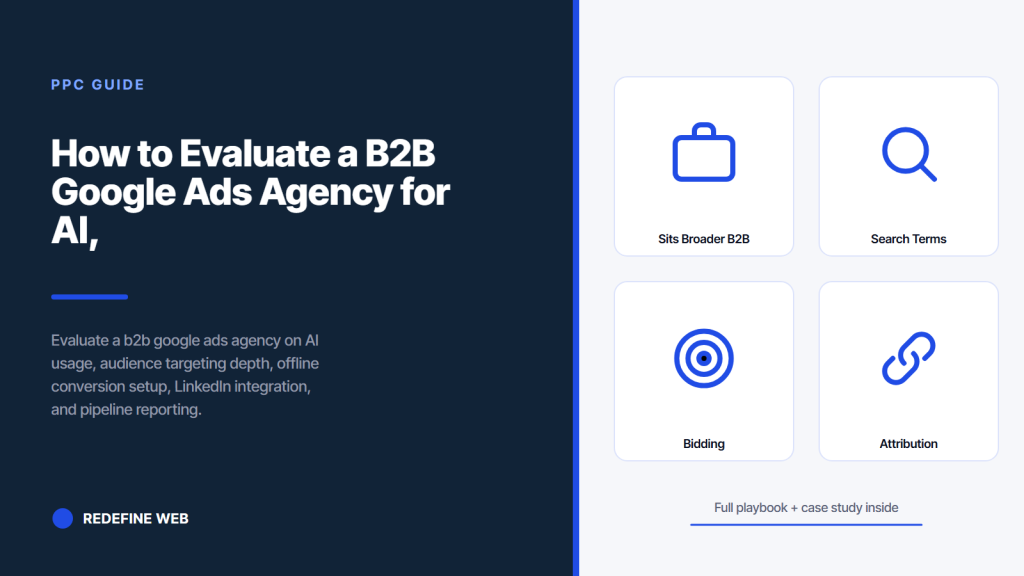
- Score six answers on a 0-to-2 rubric before the second call.
- Audience targeting depth reveals real B2B chops fast.
- LinkedIn plus Google beats Google alone at $30K ACV plus.
- Ask for a paired 90-day plan from two shortlisted vendors.
- The 90-day performance clause protects both sides equally.
You evaluate a b2b google ads agency the same way you would evaluate a new head of demand gen: on the specific work they will actually do, not the logo wall on their homepage. This guide gives you the six-question script, the AI-in-marketing filter, the audience targeting depth check, the LinkedIn cross-platform test, and the contract clauses that separate operators from packagers. Every question comes from actual vendor selections we have watched go sideways, plus the ones that landed correctly.
Read this piece the week before your discovery calls, not after. You want the scorecard filled in as each vendor talks, and you want a pattern to compare answers against before the pitch deck starts moving. When you evaluate a b2b google ads agency, the pitch call is your one clean shot to see how the shop actually thinks about your account before politics and month-four inertia take over. Numbers throughout come from real client work on Camu Digital Campus and Rapyd Financial Network, plus benchmark data from Google Ads, WordStream, and Search Engine Land.
” alt=”paired 90-day plan review field notes for b2b google ads agency selection” width=”1200″ height=”675″ loading=”lazy” />Where Google Ads sits in the broader b2b marketing mix
The b2b google ads agency you pick will own one channel inside a larger digital marketing mix. Understanding how the channel fits into the whole picture helps you pick a vendor who plays well with your other partners. A Google Ads-only shop that ignores content, SEO, and outbound will produce a paid channel that works well in isolation and poorly inside the whole funnel.
Which digital marketing channels feed Google Ads results
SEO builds branded search demand that Google Ads defends. Content marketing produces the landing pages that paid clicks convert against. LinkedIn ads warm audiences that Google catches at commercial intent. Email nurtures leads between visit and close. Every channel feeds the paid results, and the agency should be able to talk about how they coordinate with the other channels your team runs. If they cannot, they will produce paid results in isolation and miss the compounding effects.
When to hire an integrated agency vs a specialist
Hire an integrated digital marketing agency when the account needs multi-channel coordination and you do not want to manage five vendor relationships. Hire a paid specialist when you already have strong in-house SEO, content, and outbound, and you need someone to run paid at depth. The integrated shop trades some depth for coordination. The specialist trades some coordination for depth. Read our B2B PPC agency page for the integrated retainer scope, or our Google Ads management services page for the specialist scope.
The decision framework that ends every vendor evaluation
Every vendor evaluation should end with a written decision, signed off by your VP Marketing and Head of Sales, that names the vendor, the reasons, and the 90-day plan the vendor committed to. This document takes 30 minutes to write and prevents the entire team from second-guessing the pick three months in when a campaign misses its target.
What the decision document should contain
- Vendor name and the two runners-up with brief notes on why the winner beat them.
- Scorecard totals from the six-question script for all vendors evaluated.
- The 90-day plan the winning vendor committed to, with named deliverables and dates.
- Target metrics for months one through three (cost per marketing qualified lead, pipeline sourced, cost per closed customer).
- The 90-day review date and the specific metric that triggers the mutual out if missed.
- Signatures from VP Marketing and Head of Sales.
How to run the 90-day review
Schedule the 90-day review on day one of the engagement. Put it on the calendar as an anchor that the vendor and your team both prepare for. On the review call, walk through the actual outcome versus target for each of the three named metrics, discuss the delta with the vendor’s account lead, and decide whether the engagement extends or the mutual out fires. Half the time the metrics beat target and the engagement extends automatically. A quarter of the time metrics miss for reasons the vendor can articulate and a plan gets built. A quarter of the time the mutual out fires and both sides walk cleanly. All three outcomes are healthy compared to letting a bad engagement drift to month nine.
Companion reads on evaluating a b2b google ads agency
The evaluation guide above works best when you already understand the strategic questions Google Ads answers for B2B. The three companion pieces below round out the picture. Read them the week before your first vendor call so you enter each conversation with the right context.
Strategy and effectiveness reads
Read the B2B Google Ads strategy guide for the underlying campaign structure playbook. Read whether Google Ads work for B2B for the deal-size math and channel disqualifiers. Read the Google Ads vs LinkedIn Ads for B2B comparison for the budget-split logic between platforms. Together the three pieces cover the strategic layer that sits above vendor selection, so you enter the pitch calls speaking the same language as the vendors on the other side of the table.
Where Redefine Web fits in your shortlist
If you want an outside look at your Google Ads account before the vendor selection begins, we run a 30-minute audit that produces a written scorecard on the six areas above. Retainer floor sits at $599 per month with dedicated tiers built for SaaS, fintech, home services, and industrial B2B. See the B2B Google Ads services page for the tier scopes and the retainer math, or read Search Engine Land’s PPC channel coverage for a market pulse read while you shortlist.
Most B2B pitches send a strategist to close and hand you to a junior. In the discovery call, ask for the day-to-day operator's name and last 3 accounts they ran.
Frequently asked questions
What is the fastest way to evaluate a b2b google ads agency?
The fastest way to evaluate a b2b google ads agency is a six-question script scored on a 0-to-2 rubric. Ask about offline conversion setup, time to first sales qualified lead, campaign split logic, reporting cadence, worst account of the last 12 months, and the 90-day performance clause in the contract. Two points for a specific answer with a real example. One point for the right pattern without specifics. Zero for vague answers or pitch pivots. Any vendor scoring under 8 out of 12 drops. Any vendor at 10 or above goes to the paired 90-day plan review. The whole evaluation runs two weeks and takes about four hours of your team's time.
How do you evaluate a b2b google ads agency on AI in marketing?
You evaluate a b2b google ads agency on AI in marketing by asking them to name specifically what AI does inside their process, on which client accounts, and what the measurable delta is. Real answers include Smart Bidding with clean offline conversion imports (20 to 35 percent lower cost per MQL in 60 days), responsive search ads with AI-generated headline variants under weekly human review (8 to 14 percent higher click-through rate), and audience expansion via Similar Audiences seeded off closed-won lists (30 to 60 percent broader qualified reach). Vague AI claims about proprietary platforms usually mean a rebranded dashboard. Ask for a live demo during the pitch call.
How do you check the agency's audience targeting depth?
You check audience targeting depth by asking the agency to walk you through the four audience layers they would build in the first 30 days on your account. The right layers are Customer Match from your CRM (closed-won, active pipeline, lost-to-competitor as separate lists), in-market audiences layered as observation for 30 days then targeting, Similar Audiences off closed-won seed lists, and remarketing segmented by page depth (pricing, features, blog). Anyone who cannot name and explain those four layers on the pitch call has not run enough serious B2B accounts to be trusted with yours.
Should the agency integrate LinkedIn ads and Google Ads for b2b lead generation?
Yes. A serious b2b lead generation program runs LinkedIn ads and Google Ads together, not as separate silos. LinkedIn catches buyers earlier in the funnel at a lower cost per view, Google catches them at commercial intent, and the two channels feed each other via Matched Audiences and Customer Match. LinkedIn video engagement audiences become Google Customer Match seeds. Sponsored content clickers become Google remarketing pools. If the agency cannot describe how they coordinate the two platforms, they are running Google as an island and leaving 15 to 25 percent of qualified pipeline on the table across the whole engagement.
What contract clauses matter most when evaluating a b2b google ads agency?
Five clauses matter most. Term length (6 or 12 months is the market floor). Cancellation notice (30 to 90 days written with a performance kill switch). A 90-day performance review clause naming one specific metric and a mutual out if the metric misses. Transparent pass-through pricing on attribution tools, hosting, and third-party fees so setup surprises do not surface in month three. Account ownership at contract end: your Google Ads MCC, your creative assets, your audience lists, your conversion actions stay yours. Setup fees run $1,500 to $8,000 for fair scope. Reject anything above $10,000 on accounts under $50,000 monthly media spend.
How long should the whole vendor evaluation take?
The whole vendor evaluation should take two weeks. Week one covers three discovery calls with the six-question script and independent scoring by two or three stakeholders. Week two runs the paired 90-day plan review with your top two vendors, a written decision document signed by VP Marketing and Head of Sales, and a scheduled 90-day review date on the calendar for the winning engagement. Total team time invested is about four hours. Skipping the paired plan review or the written decision usually costs the account 60 to 90 days at month four when second-guessing kicks in. The two-week format is faster than most evaluations and produces better decisions.
What outcomes should the evaluated b2b google ads agency deliver?
The evaluated b2b google ads agency should deliver a 3:1 to 8:1 lifetime value to cost of acquisition ratio on closed-won revenue over 6 to 12 months, cost per sales qualified lead 20 to 40 percent below the vertical benchmark, and pipeline sourced representing 15 to 30 percent of total marketing-sourced pipeline. Named examples from live retainers include Camu Digital Campus with qualified leads up 70 percent and cost per acquisition down 28 percent in one quarter, and Rapyd Financial Network with monthly inbound leads tripled and over £1.8 million in inbound sales pipeline generated across the engagement window.
Book your free 30-minute strategy call.
No spam, no sales rep. We use your email to schedule your call with a senior strategist. That is it.
More from the blog
View all articles → PPC
PPC Healthcare PPC Advertising Channels Compliance and Targeting
Read article PPC
PPC Dental Facebook Ads Guide for Practices That Book Patients
Read article PPC
PPC