Picking a B2B PPC agency gets loud fast. Every shop opens with a case study from a client that looks nothing like yours, buries pricing behind a discovery call, and swears the branch office in your metro is the reason to sign. None of that is the reason to sign. The reason to sign is one disciplined account, one media planner, one attribution model, and one dashboard that reads the same whether your buyers sit in Indianapolis, Dallas, London, Atlanta, Boulder, or a California metro. Retainer starts at $2,800 per month plus ad spend. Twelve minutes end to end.
Every metro on this page pulls buyer-intent search traffic. The job is not to pick a metro. The job is to pick an agency that runs the same tight structure inside every metro your sales team covers. This guide names the structure, prices the retainer, walks a real Automation Anywhere build, and closes with the five questions worth asking on the first call.
B2B PPC agency London and Europe accounts run on the same cadence
Cross-Atlantic accounts add three wrinkles worth naming up front. Currency, VAT, and GDPR. The core playbook does not change. Your paid media shop in Europe runs the same tight ad group structure, the same negative keyword sweeps, and the same offline conversion imports as the US book. What changes is target-metro lists for London, Dublin, Amsterdam, Berlin, Munich, Paris, Madrid, and Milan, GBP or EUR spend tracking, consent management on every landing page, and weekly readouts scheduled at 14:00 GMT so your London team joins during business hours instead of over dinner.
Consent management is non-optional for EU traffic
Google Consent Mode v2 has been mandatory for EU traffic since March 2024. If your London or Berlin landing pages fire the Google Ads pixel before consent is granted, the conversion data is unreliable and the account eventually gets flagged. Your paid media team wires Consent Mode v2 during the launch build and validates it with Google Tag Assistant. Cookie banners that block the pixel entirely leave money on the table. Banners that ignore consent break the law. The middle path is Consent Mode v2 with modeled conversions filling the gap for users who decline. Google’s Consent Mode v2 documentation walks through the implementation. The EU data protection law hub covers the regulation itself.
Currency, VAT, and one invoice
Multi-region billing gets messy fast if you let it. The clean setup is one monthly invoice from your paid media partner in your reporting currency (usually USD for the retainer), with a per-region ad-spend breakout at the bottom in GBP and EUR. VAT is applied on the retainer for EU-registered clients, exempt on ad spend passed through to Google. Your finance team sees one line item per month, the account manager sees the region split, and the CFO sees the pipeline attribution per region. Simple. Three-way accounting nobody has to reconcile at month-end.
California and Boulder accounts pull on a different buyer pattern
California accounts pull harder than the rest of the country on SaaS and clean-energy keywords. Boulder is a smaller pool, but it punches above its weight for climate tech, biotech, and outdoor-industry B2B. California campaigns need higher daily budget ceilings so the click volume runs 2 to 4x what you see in the Midwest. Boulder campaigns need lower budgets and tighter geographic circles since the search volume is thin. The account structure is the same in both. The budget curve is not.
Budget ceilings scale with metro volume
A California paid search account for a mid-market SaaS company usually runs a $12,000 to $30,000 monthly ad spend across LA, San Diego, San Francisco, San Jose, and Sacramento. The same company running Boulder B2B PPC scopes for a Front Range presence sees $2,500 to $6,000 monthly ad spend concentrated on Boulder, Denver, and Fort Collins. Boulder pulls dense buyer intent in narrow categories. California spreads across broad categories with heavy competition. The account structure holds. The budget curve does not.
Lookalike plays from LinkedIn to Google
California and Boulder accounts benefit most from a LinkedIn-to-Google warm audience handoff. Your LinkedIn Ads campaign nurtures a target account list for 60 days. Anyone who visits your site from that campaign gets tagged for a Google Ads customer match audience. When they search commercial-intent keywords in the next 90 days, your bid goes up 60%. That is how you catch the buyer at the exact moment they are shopping. This is not a metro-specific tactic, and it works hardest in high-volume metros where you can afford to spend on warm audiences.
How B2B PPC agencies price the work across regions
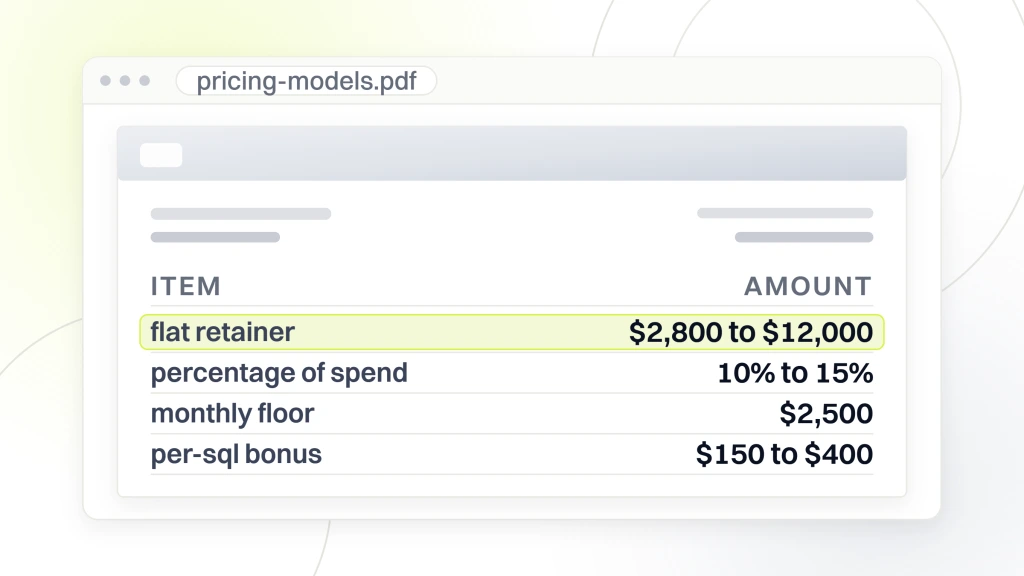
Pricing lands in three shapes. Flat retainer, percentage of spend, and hybrid. Flat retainers run $2,800 to $12,000 per month. Percentage of spend runs 10% to 15% with a $2,500 floor. Hybrid uses a lower flat retainer plus a per-meeting kicker.
For a deeper walkthrough, see our B2B PPC agency pricing breakdown.
| Model | Monthly retainer | Best for | Watch out |
|---|---|---|---|
| Flat retainer | $2,800 to $12,000 | Predictable spend, mature funnel | Retainer creep as scope grows |
| Percentage of spend | 10% to 15%, $2,500 floor | Accounts scaling ad spend fast | Agency incentive misaligned at low spend |
| Hybrid flat + performance | $1,800 flat + $200 per SQL | Mid-stage accounts wanting shared risk | SQL definition drift over 90 days |
| Project-only | $8,000 to $25,000 one-time | Account audits, migrations | No ongoing optimization |
What the retainer really buys you
A $2,800 monthly retainer buys one media planner at 30% of their time, one analyst at 10%, and a weekly 30-minute readout. A $12,000 retainer buys a dedicated media planner at 80% of their week, a full-time analyst, a landing page designer on call, weekly strategy calls, and executive reporting for the CFO. The math is straightforward. Retainer size drives bench depth. Any shop selling you a $2,000 retainer with promises of a dedicated lead is either bait-and-switching or losing money on your account. Neither ends well for you.
Performance clauses land three ways
Performance kickers land three ways. Per-SQL bonuses ($150 to $400 per qualified meeting above a monthly threshold). Percentage-of-pipeline (2% to 5% of attributed pipeline dollars). Retainer step-ups tied to sales-qualified lead cost reduction. The cleanest is per-SQL since the definition is clear on day one. Percentage-of-pipeline sounds sexy and requires agreed-on attribution windows and a shared definition of pipeline stage. Retainer step-ups reward the agency for lowering cost, which is what you want.
A named example. Automation Anywhere across five global metros
Automation Anywhere, a global leader in Robotic Process Automation serving 2,800+ enterprise customers, came in paying $1,936 per lead. Campaigns chased impression share, lead volume, and awareness at the same time. Global campaigns ran English-only and duplicated across regions without market adaptation. Landing pages missed keyword targeting on quality score, and ad copy stacked features whereas competitors offered analyst reports and free trials. A strong product wrapped in unsustainable acquisition economics. A familiar setup for a paid media conversation, and a familiar problem too.
The build
We ran a structured multi-phase rebuild. Audit first, then segment, then offer, then optimize. Campaigns split by goal so awareness, impressions, and lead-gen each had a clean, optimizable KPI. Persona-driven ad copy replaced feature-heavy language with problem-solution messaging that mirrored how IT decision-makers actually frame the pain internally. Bid strategy shifted from rank to conversion efficiency, and quality score improvements compounded the savings. Landing pages got rebuilt per region with locally relevant proof points so what worked in North America was not forced on APAC. A free-trial funnel replaced the plain contact form so the offer could stand next to analyst reports and white papers from larger competitors. High-intent traffic finally hit pages that matched intent.
The numbers, real
Cost per lead dropped from $1,936 to $63, a 97% improvement in acquisition efficiency. Customer acquisition scaled 100x, from 150 per month to nearly 8,000 leads monthly. Ad impressions climbed 300%, solidifying global digital visibility in key markets. Weekly region-segmented reporting stayed at the top so the CFO could read pipeline against spend per region in one view. The HubSpot definition of a sales-qualified lead is the standard we align every client’s SQL bar to on day one. Automation Anywhere’s SQL bar sits at BANT-qualified with a decision-maker introduction booked.
Why LinkedIn Ads carries a bigger load in B2B PPC accounts
Ignoring LinkedIn in B2B PPC leaves pipeline on the floor. Its targeting layer knows job title, seniority level, company size, industry, and years of experience. LinkedIn cost per thousand impressions runs 5 to 8x higher than Meta, and the pipeline coming out the other side is qualified from click one. The math works cleanly once your average contract clears $30,000, and it works even harder above $75,000.
Account lists are the whole game
Your LinkedIn Ads campaign is only as good as the target account list you upload. Bad lists include every company in a category regardless of fit. Good lists filter by revenue band, employee count, funding stage, tech stack, and buying-committee signals from tools like ZoomInfo or Apollo. Your paid media partner should own the list build in month one or partner with a demand gen tool that does. Uploading a spreadsheet of 8,000 random SaaS companies and calling it targeting is not targeting.
Message ads plus sponsored content, not either or
Sponsored content builds awareness inside the account list. Message ads and conversation ads book meetings from warm accounts. You run both, in that order. A cold account list sees sponsored content for 30 days. Anyone who engages (video watch, page visit, form fill) gets tagged into a message ad audience that pushes a demo booking flow. Skipping the awareness layer and going straight to message ads produces low open rates and complaints to LinkedIn support. Skipping the message layer and staying in sponsored content produces impressions and zero meetings.
Reporting cadence that keeps your CFO happy
A working reporting cadence has three tiers. Weekly readouts run 30 minutes. Monthly reviews run 60 minutes. Quarterly business reviews run 90 minutes with the executive team. The weekly stays tactical. What changed, what tests are running, what the account needs from your team. The monthly turns strategic. Pipeline attribution, cost-per-SQL trend, channel mix rebalancing. The quarterly climbs to executive. Full-funnel view, next-quarter forecast, budget reallocation recommendation. Any shop skipping the quarterly is running your account without a plan.
One dashboard, not four
Your paid media partner should hand you one dashboard, not four channel-specific Looker Studio tabs. The dashboard rolls up Google Ads, Bing Ads, LinkedIn Ads, and Meta Ads into a single view keyed to sales-qualified meetings. Drill-downs exist for the analyst. The top-line view exists for you. If your monthly report opens with impressions across four channels stacked in a bar chart, the reporting is built for the agency, not for your CFO. Rebuild the top layer for the CFO first. Push everything else into drill-downs the analyst can open on demand.
What the monthly review actually covers
Six things, in order. Sales-qualified meeting count vs target. Cost per sales-qualified meeting vs baseline. Attributed pipeline dollars. Channel mix (spend and SQL contribution by channel). Top three account wins. Top three tests running next month. If your monthly does not open with SQL count, the shop is reporting on activity, not outcomes. If your monthly runs 40 slides deep, someone is padding the deck. Twelve slides is plenty for a 60-minute review. If the SQL definition slips mid-quarter, tighten it against the B2B sales funnel framework before the next monthly.
Choosing the B2B PPC agency partner
Shortlisting a B2B PPC agency is not about location. It is about track record inside your industry, attribution discipline, and pricing structure. Location is a footnote at best. The full walkthrough on choosing a B2B PPC agency covers the 12-question first-call script. This section is the short version.
Five questions to ask on the first call
- Show me an anonymized account structure from a current B2B client. Not a case study slide. The actual campaign map.
- How do you import offline conversions from a CRM into Google Ads. Walk me through the last time you set that up.
- What is your definition of a sales-qualified lead, and how do you align it to my sales team’s definition.
- What does the weekly readout look like. Send me last week’s from any current client with numbers redacted.
- What is your typical ramp curve for a new account in month one, month three, and month six.
Any shop that answers question one with “we do not share client accounts” is dodging. Every reputable shop in the category has at least two anonymized reference accounts they can screenshare on a discovery call. If they cannot, the account structure is not something they are proud of.
References you really call
Ask for three references. Call two of them. Ask each reference three things. How responsive is the account manager on Slack. What was the biggest surprise in the first 90 days. What would they change about the engagement if they were starting over. The best reference conversations happen when you catch the client on a Wednesday afternoon and get 15 minutes on the phone. Anything scripted through the agency’s account team is theater. If you want more depth on how to filter reviews, see our breakdown on B2B PPC agency reviews.
ROI and payback windows across every metro
Return on B2B PPC spend depends on three inputs. Average contract value, sales cycle length, and gross margin. Rough math from live accounts. A healthy B2B PPC book produces a 3:1 to 5:1 pipeline-to-spend ratio inside 90 days, then tightens to 6:1 to 10:1 by month 12 as the offline conversion model matures. Payback windows land between 4 and 9 months depending on ACV. Under $10,000 ACV, payback has to hit inside 4 months or the unit economics do not clear. Over $100,000 ACV, a 9-month payback is fine.
The three inputs that decide payback
Average contract value, sales cycle length, gross margin. That is the trio. A $60,000 ACV with a 90-day cycle and 70% gross margin can afford $8,000 in customer acquisition cost per closed deal and still pay back inside 6 months. A $12,000 ACV with a 180-day cycle and 50% margin needs CAC under $2,000 per deal. Your paid media partner should model this on the first discovery call, not after they have your credit card on file. If they cannot walk through the math before signing, they are guessing at your unit economics after signing.
A pipeline attribution dashboard the CFO will really read
The dashboard the CFO reads has five numbers on it. Ad spend, sales-qualified meetings, attributed pipeline, closed-won revenue, and pipeline-to-spend ratio. Not fifty. Five. Everything else lives in the drill-down. If your CFO cannot answer “is paid media paying back this quarter” in under 30 seconds of scrolling, the dashboard is failing at its job. For more on tuning this, our writeup on B2B PPC ROI optimization lays out the exact structure we build for every client.
Scoping and onboarding a new paid media partner
Onboarding runs four weeks if the shop is disciplined. Week one is discovery. Sales team interviews, CRM audit, closed-won pull. Week two is build. Account structure, keyword universe, negative lists, landing page inventory. Week three is launch prep. Offline conversion import setup, tracking QA, ad copy sign-off. Week four is go-live and the first weekly readout. If a shop tells you they can launch inside a week, they are skipping discovery. Ask what they are skipping.
Data you hand over on day one
- Last 90 days of closed-won deals with source attribution (CRM export).
- Current keyword lists and negative keyword lists from Google Ads and Bing Ads.
- Landing page URLs for every active buyer-intent theme.
- Sales-qualified lead definition your sales team accepts.
- Access to Google Ads, Bing Ads, LinkedIn Ads, Meta Ads Manager, GA4, and your CRM.
- Current cost-per-SQL baseline (if measurable) or cost-per-form-fill baseline.
Handing this over inside week one saves 10 to 15 hours of back-and-forth. Handing it over inside week three delays the launch by two weeks and puts the shop into scramble mode. The prep discipline sets the tone for the engagement.
Kickoff meeting agenda that moves the ball
Sixty minutes, five people, three outcomes. Attendees. Your CMO or head of demand gen, the account manager from the agency, the media planner, someone from sales operations who owns the CRM, and someone from finance who owns the SQL definition. Outcomes. Signed-off SQL definition, signed-off attribution window (typically 30 to 90 days for B2B), signed-off reporting cadence. If any of the three drift after week one, the account starts wobbling in month two. Lock them at kickoff.
Scaling a B2B PPC account to multi-region operation
You start in one metro. You add a second metro at month three when the first is producing SQLs at a stable cost. You add a third at month six. Adding all five metros on day one is a math error since the offline conversion model needs volume in one region to learn before it can generalize to others. The Google Smart Bidding documentation confirms the model needs 30 to 50 conversions per 30 days per campaign to optimize meaningfully. Split budget across five thin campaigns and you get none of them.
Expansion order across metros
Start where your existing customer base is heaviest. If 60% of your closed-won is in Dallas and Atlanta, launch those two first. Month three, add Indianapolis. Month six, add London and layer Consent Mode v2 during the build. Month nine, add California with heavier budget ceilings. Month twelve, add Boulder if the vertical fit is there. Anyone who launches all seven on day one is running a spreadsheet, not a media strategy.
Shared services versus owned accounts
Some enterprises give each regional sales team its own PPC account. That fragments learning and doubles the retainer. The better setup is one account, one media planner, region-tagged campaigns, region-tagged reporting. Each regional sales lead gets a filtered view of their metros without owning a separate agency relationship. Costs less. Learns faster. Aligns pipeline attribution across regions instead of arguing about it. If you want the deeper strategic comparison across shops that specialize in multi-region B2B, our best B2B PPC agencies shortlist walks through the top 17.
Warning signs the paid media shop you hired is not going to work
You can spot a failing engagement inside the first 45 days. The signs are consistent. The account manager gets swapped in the first 60 days. The weekly readout gets moved to biweekly, then monthly, without explanation. The monthly report still opens with impressions in month three. Offline conversions never made it into Google Ads. The media planner cannot name your top three buyer personas. Any two of these means you are 90 days from wanting out.
The junior media buyer tell
You interviewed an experienced lead during the sales cycle. You are working with a junior buyer 60 days in. That is the bait and switch. Ask on the first call. Who is the media planner assigned to my account, how many years have they run B2B accounts, and how many other accounts are they on right now. If the answer is more than four other accounts, they are stretched. If the answer is less than three years of B2B experience, they are learning on your budget. For SaaS accounts the bar is higher still, and our take on SaaS PPC services that deliver real demos spells out what a seasoned media planner should show you on the first call.
The attribution loop never closed
Offline conversion imports are the single biggest predictor of engagement quality. If day 30 comes and the imports are still not wired, you have a shop that either does not know how to wire them or does not prioritize the work. Neither is fine. This is the one gate to escalate on inside the first month. Send a Slack message to the account manager on day 30 asking for a screenshot of the offline conversions arriving in Google Ads. If the answer is a stall, you have your read.
B2B PPC agency versus in-house media buyer
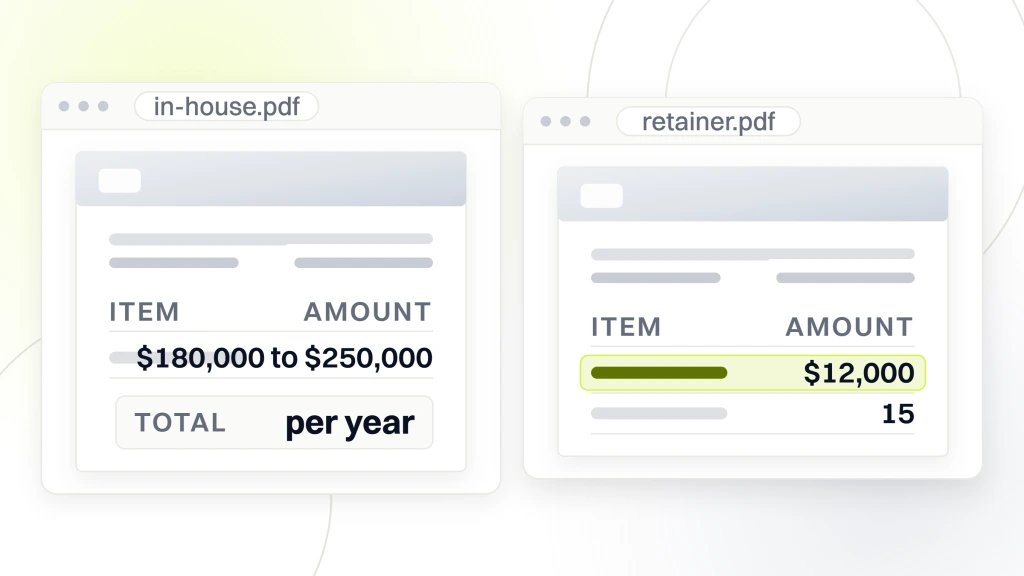
In-house makes sense above $80,000 monthly ad spend when the company has a demand gen team of three or more. Below that, the loaded cost of an in-house media planner (salary plus benefits plus tools plus management overhead) runs $180,000 to $250,000 per year. That covers 15 months of a strong outside retainer at $12,000 per month with more depth on the bench. The math flips at scale. Not before.
The hybrid model is usually the answer
Most mature accounts land on a hybrid. An in-house demand gen lead who owns strategy and internal alignment, plus an outside shop that owns execution and reporting. Your in-house lead runs the SQL definition conversation with sales, owns the offer roadmap, and briefs the agency. Your agency runs the account structure, keyword expansion, landing page tests, and offline conversion pipes. Neither one alone is faster than both together at scale. If you already have a strong internal marketer, our B2B PPC agency service page walks through how we scope the split.
SaaS accounts often stay agency-heavy longer
SaaS companies with fast product roadmaps often stay agency-heavy longer than services businesses since the media strategy needs to move as fast as the product. New feature launches, new pricing tiers, new integration partners. Each one changes the buyer message. An agency team already running 20 SaaS accounts sees the pattern faster than a solo in-house buyer. Our writeup on SaaS PPC services covers the specific structural differences for product-led growth accounts.
Where to start with a B2B PPC agency this quarter
Book three discovery calls. Ask each shop the five questions in the choosing section. Score the answers. Shortlist two. Get anonymized account structures on the second call. Pick the one that feels least like a pitch and most like a working session. Sign a 6-month agreement since the offline conversion model needs a full quarter to learn before you can judge the engagement fairly. A shorter agreement guarantees you are switching agencies before the model matures.
Contract terms that protect both sides
Six-month initial term with a 60-day termination clause after month three. Data ownership. Your Google Ads account, your Bing account, your LinkedIn account, your GA4, your CRM, your dashboards. The agency has admin access, not ownership. On exit, they hand back everything within 10 business days. This is standard. Any shop that pushes back on data ownership is a red flag. You are renting their expertise, not selling them your accounts.
Internal alignment beats agency selection
The best paid media partner will fail if your sales team has not agreed on the SQL definition. Fix internal alignment first. Get sales, marketing, and finance in one room. Agree on what qualifies. Agree on the attribution window. Agree on the reporting cadence. Then hire the agency. The number one reason B2B PPC engagements fall apart in month four is that sales and marketing were arguing about SQL quality from month one, and the agency had no clean signal to optimize against.
Ready to run one disciplined B2B PPC account across every market you sell in. Our B2B PPC agency service page covers the full scope. Retainer starts at $2,800 per month, discovery lands inside 14 days, and the first campaigns go live inside 30 days. One media planner, one dashboard, every metro on your target map, and a weekly readout your CFO will read without asking a follow-up question.