
Benefits of Combining SEO and PPC for Healthcare Practices
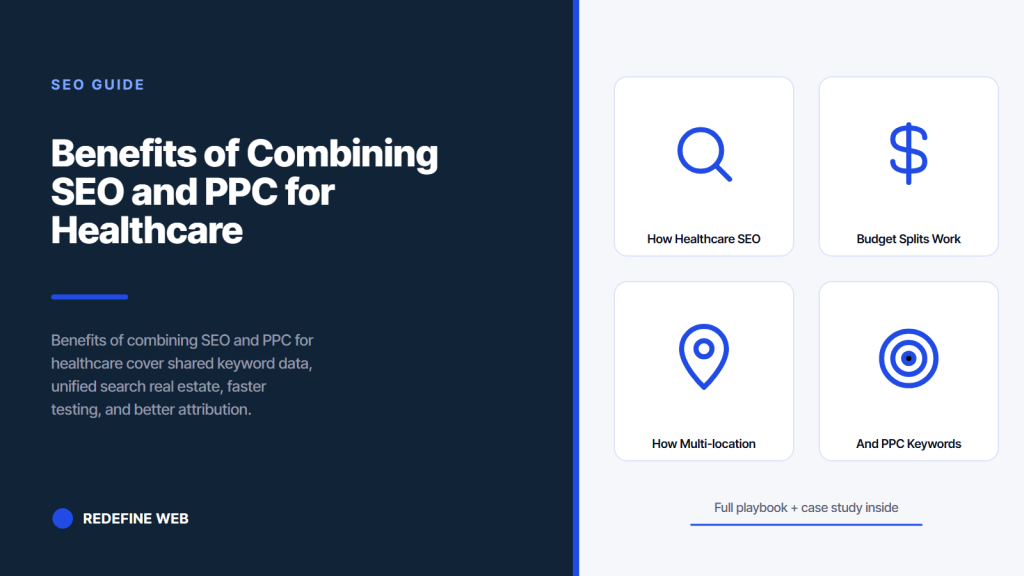
- Benefits of combining SEO and PPC compound quarterly.
- PPC data teaches SEO which intents actually convert.
- SEO content boosts PPC quality score by 3-6 points.
- Budget splits shift as SEO rankings mature.
- One team owning both channels beats two agencies.
- How healthcare SEO improves PPC
- Which patient intents belong on paid vs organic
- Budget splits that work for healthcare practices
- How a multi-location practice used combined SEO and PPC
- Where healthcare SEO keywords and PPC keywords overlap
- Compliance guardrails both channels share
- Reporting that surfaces the benefits of combining SEO and PPC for healthcare
- Where combined healthcare search is heading
Benefits of combining SEO and PPC for healthcare go past the tired “paid feeds organic” argument you read on every agency blog. When you run both channels well, the paid data teaches the SEO team which patient intents actually convert, the SEO content teaches the paid team which landing pages hold attention past 30 seconds, and both share the keyword and audience signals that make each stronger every month. Run either alone and you lose the compound feedback loop that makes the whole search stack pay off.
This guide covers where the benefits of combining SEO and PPC for healthcare actually show up, which patient intents belong on paid, which belong on organic, how healthcare SEO keywords feed PPC keywords for digital marketing to healthcare and vice versa, the compliance guardrails that HIPAA layers on top of both channels, and the reporting structure that surfaces the shared value without double-counting. Everything comes from working client accounts, not vendor sales sheets.
How healthcare SEO improves PPC
The feedback flows both directions. Healthcare SEO gives PPC three things paid cannot buy at any price: deep long-tail keyword coverage, quality score inputs from the landing page side, and remarketing audience volume large enough for paid to actually work.
Quality score inputs from SEO content
Google Ads quality score rewards landing pages that answer the search intent completely. A PPC landing page built without SEO discipline scores in the 4-6 range. A page built with SEO discipline (intent-matched headline, structured content, fast load, clean semantic markup) scores in the 8-10 range. That quality score gap cuts CPC by 30 to 50 percent. Two identical campaigns with different landing page quality can run 40 percent apart on cost per booked patient. SEO discipline on the paid landing page pays for itself inside 60 days.
Remarketing audience volume
Google Ads and Meta remarketing lists need a minimum audience size (1,000 users on Google, 100 on Meta) to run. Practices relying only on paid traffic often struggle to hit those thresholds. Organic traffic feeds the pixel pool with high-intent visitors who researched the practice on Google, then dropped off before booking. Retargeting them with a low-CPC branded ad campaign captures a 10-15 percent recovery rate. Without the organic traffic feeding the pixel, the retargeting math never works. Practices that rely on paid alone typically wait 6 to 9 months to hit list size, while combined practices hit list size in 60 to 90 days.
Which patient intents belong on paid vs organic
The benefits of combining SEO and PPC for healthcare only land when the keyword split is right. Every keyword falls somewhere on a paid-vs-organic priority split. Practices that put every keyword on both channels waste budget. Practices that put every keyword on one channel leave patient volume on the table. The split matters more than the aggregate spend.
- Emergency intent (“emergency dentist near me”). Paid first. Patients booking on emergency queries convert same-day and cannot wait 6 months for organic rankings.
- Cosmetic and elective procedures (“invisalign cost”). Both channels. Long consideration cycle rewards organic content and paid capture during comparison.
- Insurance and Medicare research (“Medicare Advantage cardiology near me”). Organic. Long-tail volume rewards SEO investment; paid CPCs are prohibitive.
- Symptom research (“chest pain when I breathe”). Organic. Google restricts PHI-adjacent PPC targeting on symptom queries.
- Brand queries (“Redefine Cardiology reviews”). Both channels. Own the SERP top two slots to prevent competitor conquest bids.
- New procedure launches (“weight loss surgery Manhattan”). Paid first for 6 months while SEO content matures, then rebalance.
The split changes quarter over quarter as SEO rankings mature. What starts on paid to capture demand this quarter should shift toward organic as content earns the top-3 organic slots. Rebalancing every quarter keeps the aggregate spend efficient. Static splits fossilize and waste budget inside a year. Practices that rebalance quarterly typically see the aggregate cost per booked patient drop 20 percent per year for the first two years of a combined program.
Budget splits that work for healthcare practices
The right SEO-to-PPC budget split depends on practice maturity, competitive intensity, and how patient the practice owner is about payback timelines. The table shows the working splits we see across independent practice, single-location, multi-location, and DSO tiers. Every practice size gets a different mix.
| Practice tier | Monthly SEO spend | Monthly PPC spend | Working ratio | Payback horizon |
|---|---|---|---|---|
| New solo practice (0-2 years) | $1,500 to $3,000 | $4,000 to $10,000 | 1:3 SEO to PPC | 4 months |
| Established solo (2-5 years) | $2,500 to $5,000 | $5,000 to $12,000 | 1:2 SEO to PPC | 6 months |
| Single-location group | $3,500 to $7,000 | $8,000 to $20,000 | 1:2.5 SEO to PPC | 6 to 9 months |
| Multi-location (2-5 sites) | $6,000 to $15,000 | $15,000 to $50,000 | 1:2.5 to 1:3 SEO to PPC | 9 months |
| DSO / health system | $15,000 to $60,000 | $40,000 to $200,000 | 1:3 SEO to PPC | 12 months |
Newer practices lean heavier on PPC because they need bookings this quarter. Established practices with existing SEO equity can shift some of the paid spend into content and technical SEO because organic pays lower cost per booked patient than paid. DSOs and health systems keep the paid weighting high because scale needs paid volume to hit growth targets even when organic performs well.
How to move budget between the two channels
Move budget quarterly based on organic ranking movement. When a paid keyword earns a top-3 organic ranking, redirect 40 to 60 percent of its paid spend to a related keyword still bidding on discovery. When organic rankings slip on a competitive commercial query, increase paid spend on that query while the SEO team investigates the cause. That constant rebalancing keeps the aggregate spend efficient month over month rather than quarter over quarter.
Most agencies run the channels in silos. Ask which keywords booked patients last month in Ads. Those are your next 5 SEO briefs, not the topic wishlist.
How a multi-location practice used combined SEO and PPC
Georgia Behavioral Health Professionals, a LifeStance Health Inc. division across 10+ Georgia clinics, ran combined SEO and PPC on the same account team. The paid side captured demand this quarter. The SEO side compounded the paid data into content that earned rankings for the next quarter. Both channels shared the same landing page infrastructure and the same analytics setup.
The combined program hit $19 cost per lead against a $25 target while tripling patient acquisition volume. Full impression share was captured for niche services like TMS therapy where competition was thin. The paid team fed the SEO team the highest-converting patient intents. The SEO team fed the paid team the long-tail keyword coverage that let paid focus budget on the highest-intent commercial queries.
The shared landing page infrastructure paid off inside the first quarter. A page built for paid traffic that got refined based on PPC conversion data became the organic landing page 90 days later. Content quality on the paid landing pages also boosted Google Ads quality score into the 8-10 range, cutting CPC by 30 to 40 percent versus a comparable practice running paid-only landing pages. That quality score benefit funded a chunk of the SEO investment.
Zero HIPAA compliance incidents during the 12-month engagement. Consent Mode wired correctly across both channels. Analytics validated weekly to confirm no PHI landed in the pixel. The compliance discipline that healthcare SEO and paid share also amortized across both channels rather than being duplicated. Running SEO and PPC together made the compliance overhead cheaper per booked patient than running either channel alone.
Where healthcare SEO keywords and PPC keywords overlap
The overlap between healthcare SEO keywords and PPC keywords for digital marketing to healthcare is roughly 60 to 70 percent on a well-run account. The 30 to 40 percent that diverges is where the strategic split lives. Practices that map the overlap explicitly avoid double-billing themselves and identify the keywords where one channel wildly outperforms the other.
Keywords that show up on both channels
High-intent commercial queries with local modifiers. Brand queries and near-brand variants. Comparison queries against key competitors. Procedure-cost queries. Insurance-and-Medicare queries in high-competition metros. These get budget on both channels because the paid impression captures the demand this month while the organic ranking captures the demand every month after that. The keyword mapping should reflect this dual investment explicitly rather than treating each channel as independent.
Keywords where one channel wins clean
Symptom research queries and educational queries with no commercial intent go organic only. PPC costs run high and conversion rates run low. Emergency-intent queries and same-day booking queries go paid only for the first 12 months while SEO earns the ranking. Ultra-long-tail comparison queries with under 100 monthly searches also go organic only because paid CPCs on low-volume queries make no economic sense. Explicit mapping keeps aggregate spend efficient across both channels. The mapping exercise takes about 4 hours quarterly and typically finds 10 to 20 percent of the current spend sitting on the wrong channel for the query intent.
Compliance guardrails both channels share
The benefits of combining SEO and PPC for healthcare include shared compliance work. HIPAA layers the same compliance rules on top of healthcare SEO and PPC. Any tracking script that fires on either channel needs a signed Business Associate Agreement with the analytics vendor. Consent Mode v2 needs to be wired correctly on both. Landing pages need to comply with WCAG 2.1 AA regardless of whether the traffic came from paid or organic. Running both channels together lets you amortize the compliance work across both rather than duplicating.
- Consent Mode v2 wired across both channels. Google Ads bidding and organic analytics both need consent signals to behave correctly.
- Signed BAAs with analytics and tag manager vendors. Same BAAs cover both channels; no need to negotiate twice.
- PHI-safe URL parameters on landing pages. Both organic and paid landing pages must scrub PHI from URLs and event payloads.
- WCAG 2.1 AA on every landing page. DOJ enforcement covers both traffic sources; ADA compliance applies at the page level.
- Cookie consent gating tracking scripts. Both channel setups need the same gating logic before scripts fire.
- Quarterly HIPAA sweeps on the analytics setup. Same sweep covers both channels; the auditor does not care where the traffic came from.
Every practice has this conversation. The SEO agency says the PPC agency is wasting budget on brand terms the site already ranks for. The PPC agency says the SEO agency is not moving fast enough on the queries that convert this quarter. Both are right. Both are also missing the point. The right answer is one team owning both channels so the fight becomes a productive meeting instead of two separate agencies each defending their own line item in the marketing budget. Somewhere in Manhattan a CMO is scheduling a meeting to “align the search stack” that will accomplish nothing.
That joke lands because it maps to what most practice search programs actually look like. Two agencies, two invoices, two conflicting attribution models, zero shared data. The benefits of combining SEO and PPC for healthcare require the two teams to actually talk. One team owning both channels or two teams sharing a weekly working session both work. Two agencies exchanging emails once a quarter does not.
Reporting that surfaces the benefits of combining SEO and PPC for healthcare
The benefits of combining SEO and PPC for healthcare only show up in reporting when both channels roll into one dashboard the practice owner reads weekly. Siloed reporting under-credits the assist patterns and misattributes conversions to last-click paid ads that organic content actually earned. A working unified report separates the two channels for tactical tuning but combines them for strategic decisions.
What the weekly report shows
Total booked patients by source. Cost per booked patient blended across paid and organic. Organic ranking movement on the top 30 commercial queries. Paid conversion rate by ad group. Assist-conversion patterns where organic and paid both touched the patient before booking. Landing page conversion rate blended across both traffic sources. All of it in one PDF the practice owner can read in 10 minutes on a Monday morning.
What the quarterly review adds
Budget rebalance recommendations based on ranking movement. Content roadmap updates informed by PPC intent data. Ad group restructures informed by SEO ranking movement. Compliance review updates covering both channels. That quarterly review is where the strategic value of combining the two channels shows up most clearly. Weekly reports keep tactics tight. Quarterly reports keep the strategy honest. Practice owners who read the weekly report every Monday and the quarterly review every three months typically make better budget decisions than owners relying on ad-hoc agency calls when something feels off.
Where combined healthcare search is heading
Google AI Overviews and Search Generative Experience change what “organic” means for healthcare. Patients now see AI-generated summaries above the ten blue links on 40 to 60 percent of health queries. Organic content that gets cited inside those summaries wins outsized visibility. Paid ads still show up alongside AI Overviews, so the combined SEO and PPC benefit compounds even harder in the AI-mediated results.
The Google Search Central blog covers the ongoing ranking and AI Overview changes. The Google Ads Consent Mode v2 documentation covers the paid-side compliance updates. The HHS guidance on HIPAA online tracking covers the compliance layer both channels share. All three are essential reading for any practice running combined SEO and PPC through 2026 and beyond.
The practical next step for most practices is a quarterly rebalance. Map current SEO rankings against current PPC keyword spend. Identify the queries where paid is buying rankings organic already earns (redirect that spend). Identify the queries where paid is capturing demand organic has not earned yet (double down on paid until organic ranks). Identify the queries where neither channel is capturing traffic that competitors are (add both channels aggressively).
Ready to run the combined SEO and PPC program. Our Healthcare SEO Services and Healthcare PPC Agency Services engagements run under one team by default. For deeper reading see our Healthcare SEO (Pillar) and PPC for Healthcare (Pillar). For keyword-level detail our Healthcare SEO Keywords and PPC Keywords for Healthcare pieces are the practical playbooks. Landing-page conversion work sits inside our Healthcare Website CRO guide. The healthcare marketing agency hub ties both channels into the broader acquisition strategy.
Frequently asked questions
What are the benefits of combining SEO and PPC for healthcare?
The benefits of combining SEO and PPC for healthcare cluster into four buckets: shared keyword intelligence where paid data teaches organic prioritization, unified search real estate that captures the top two SERP slots on high-intent queries, faster testing cycles for landing page and messaging variants using paid traffic volume, and honest attribution that credits both channels correctly. Practices running both channels typically see 20 to 30 percent higher combined booking volume than practices running either channel alone at the same aggregate spend.
How does PPC data improve healthcare SEO?
PPC gives you same-day data on which patient intents actually convert. That signal takes healthcare SEO 6 to 12 months to collect organically. Use PPC to identify which service pages convert, which price questions patients ask before booking, which comparison queries drive high-value clicks. Feed that data into the SEO content roadmap so you build pages that already match tested demand rather than guessing. Landing page A/B tests also run 8 to 12 weeks faster on paid traffic volume than on organic.
How does healthcare SEO improve PPC performance?
Healthcare SEO gives PPC three things paid cannot buy at any price. Long-tail keyword coverage that would be prohibitively expensive on paid CPC. Landing pages with SEO discipline that score 8-10 on Google Ads quality score, cutting CPC by 30 to 50 percent versus paid-only pages. Remarketing audience volume large enough to actually hit Google Ads and Meta pixel thresholds, which practices relying only on paid struggle to reach. Combined, these three benefits pay for the SEO investment inside 6 months on most practice accounts.
What is the right SEO to PPC budget split for a healthcare practice?
The split depends on practice maturity. New solo practices should run roughly 1:3 SEO to PPC because they need bookings this quarter. Established solo practices with existing SEO equity can run 1:2 as organic pays lower cost per patient than paid. Single-location groups run 1:2.5. Multi-location practices and DSOs run 1:2.5 to 1:3 because scale needs paid volume to hit growth targets. Rebalance quarterly as SEO rankings mature; static splits waste budget inside a year.
Do healthcare SEO keywords and PPC keywords overlap?
Roughly 60 to 70 percent of healthcare SEO keywords overlap with PPC keywords for digital marketing to healthcare on a well-run account. The overlap covers high-intent commercial queries with local modifiers, brand queries, comparison queries, procedure-cost queries, and insurance queries in competitive metros. The 30 to 40 percent that diverges includes symptom research (organic only), emergency booking (paid only for 12 months), and ultra-long-tail comparisons (organic only). Map the overlap explicitly to avoid double-billing on the queries where one channel wins clean.
Should healthcare practices bid on brand terms?
Yes, even when the practice ranks number one organically. Competitors bid on your brand terms to conquest patient searches. A cheap branded PPC campaign at $0.50 to $2 CPC captures the top ad slot above the organic listing and prevents competitor conquest. The math works even at low volume because branded CPC is cheap and conversion rate on brand searches runs 8 to 15 percent. Skipping brand bidding lets competitors buy patient attention that already belongs to your practice at a cost that is trivial to defend.
Can one team run both healthcare SEO and PPC?
Yes and that is the working setup. When two separate agencies run SEO and PPC, the two teams rarely share data effectively. The SEO team accuses PPC of wasting budget on ranked terms. PPC accuses SEO of moving too slowly. Both are right in isolation and wrong in aggregate. One team owning both channels shares landing pages, keyword research, conversion tracking, HIPAA compliance work, and quarterly reporting. That shared infrastructure delivers the benefits of combining SEO and PPC for healthcare that split-agency setups never realize.
Book your free 30-minute strategy call.
No spam, no sales rep. We use your email to schedule your call with a senior strategist. That is it.
More from the blog
View all articles → SEO
SEO Organic Search Engine Optimization Services That Grow Real Traffic
Read article SEO
SEO SEO for Pet Groomers That Fills the Appointment Book Weekly
Read article SEO
SEO