
PPC Keywords for Healthcare to Book More Patient Calls
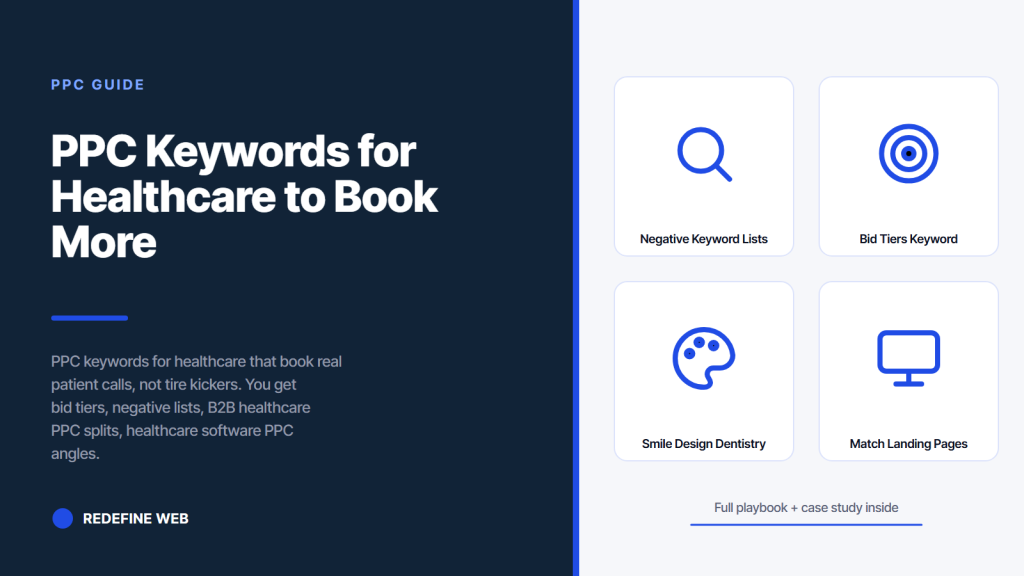
- Four keyword buckets: branded, near-me, service+city, condition+city.
- Negative list cuts 22 to 38 percent wasted spend week one.
- Bid tier per bucket, not per account.
- B2B healthcare PPC and consumer patient PPC never share one account.
- Call tracking captures 76 to 88 percent of true conversions missed by default.
- Four honest buckets of ppc keywords for healthcare
- Negative keyword lists for ppc keywords for healthcare
- Bid tiers by keyword bucket
- B2B healthcare PPC keywords work differently
- Healthcare software PPC and medtech vendors
- Smile Design Dentistry case study on ppc keywords for healthcare
- Long-tail ppc keywords for healthcare companies
- Match landing pages to the keyword bucket
- Tracking and attribution for ppc for healthcare companies
- Where to start on ppc keywords for healthcare
PPC keywords for healthcare split into four honest buckets, and only one of them books real patient calls at a cost you can defend to the practice owner. Most healthcare ppc marketing accounts we audit run one giant campaign with 400 keywords stuffed in, negative lists half-built, and the Book Now form fielding the same tire kickers who called last year. You want the four buckets, the bid tier that fits each one, and the negative list that keeps your $8 clicks off search terms like symptom checkers and job seekers.
You get the four ppc keywords for healthcare buckets, real bid ranges pulled from live accounts, a negative keyword list built for medical and dental intent, the split between B2B healthcare PPC and consumer patient PPC, the healthcare software PPC angle for medtech vendors, and a Smile Design Dentistry example where cost per call dropped 30 percent on a rebuilt keyword list. Read straight through in eight minutes and match the right list to your practice or brand.
Four honest buckets of ppc keywords for healthcare
Every profitable healthcare PPC account we run at Redefine Web sorts its keywords into four buckets. Branded terms, condition-plus-city terms, service-plus-city terms, and near-me terms. The four buckets carry different intent signals, different click prices, and different close rates once the call lands. Treat them as one campaign and your Quality Score sinks. Split them into four ad groups with matched landing pages and your cost per booked call drops 30 to 60 percent inside 60 days.
Branded terms convert at 15 to 25 percent and cost $2 to $6 per click. Condition-plus-city terms convert at 4 to 8 percent and cost $6 to $22. Service-plus-city terms convert at 6 to 12 percent and cost $4 to $18. Near-me terms convert at 8 to 14 percent and cost $5 to $16. Bidding the same amount across all four buckets means you overpay on branded and underbid on service. Sort them and set bids per bucket, not per account. That single change moves conversion economics faster than any landing page tweak you can ship in the same week.
| Bucket | Sample keyword | CPC range | Conversion rate |
|---|---|---|---|
| Branded | smile design dentistry tampa | $2-$6 | 15-25% |
| Condition + city | root canal pain tampa | $6-$22 | 4-8% |
| Service + city | emergency dentist tampa | $4-$18 | 6-12% |
| Near-me | dentist near me | $5-$16 | 8-14% |
Branded bucket rules
Your branded bucket protects the map pack real estate around your practice name. If you skip it, a competitor bids on your name and steals the click from a patient who already knows you. Budget 10 to 15 percent of monthly PPC spend here. Exact match only. Bid to sit in position one on desktop and mobile. Ad copy repeats the practice name and drops a booking phone number. This is the cheapest booked call in your account every single month.
Condition bucket rules
Condition-plus-city keywords carry the highest intent in the healthcare paid stack. Someone typing root canal pain tampa is not researching, they are booking today. But the same keyword pulls symptom checkers, students, and researchers if you run it broad. Force phrase match at minimum. Layer a hard negative list under it. Ad copy names the condition and the fix in the first line and drops a same-day booking offer. Landing page mirrors the ad copy word for word or Quality Score punishes you inside two weeks.
Negative keyword lists for ppc keywords for healthcare
Every ppc keywords for healthcare campaign burns 20 to 40 percent of monthly spend on garbage clicks unless the negative list is built and refreshed weekly. The five worst categories are job seekers, students, insurance shoppers, symptom checkers, and free-service hunters. Each one has its own set of trigger words. Miss any category and your $9 clicks fund search terms like dentist jobs, dental hygienist school, and free dental clinic near me. None of those book a paying appointment.
Build the negative list once at account level, then let each campaign inherit it. Refresh it every Monday with search term data from the last seven days. In an average healthcare PPC account we onboard, the first negative sweep cuts wasted spend 22 to 38 percent inside week one. That saved budget shifts straight to the branded and near-me buckets where conversion is highest. You do not need more clicks, you need cleaner ones.
- Job seekers: jobs, career, careers, hiring, salary, resume, interview, internship, employment
- Students: school, schools, program, degree, certification, course, training, tuition, cheap
- Insurance shoppers: coverage, plan, plans, insurance, premium, deductible, medicare, medicaid (only if you do not accept)
- Symptom checkers: symptom, symptoms, causes, why does, what is, home remedy, diy
- Free-service hunters: free, no cost, no insurance, low income, sliding scale, charity
- Content readers: youtube, video, blog, forum, reddit, quora, wikipedia, pdf, article
- Product shoppers: buy, sale, cheap, coupon, discount, review, reviews, vs, versus
Job seeker negatives
Job-related clicks eat 6 to 12 percent of a healthcare account’s monthly spend before any human notices. Someone searching dental hygienist jobs tampa clicks your emergency dentist ad because Google matched service and city and dropped the noun that mattered. Load the full job seeker list into account-level negatives on day one. Include job, jobs, career, careers, hiring, salary, resume, interview, internship, employment, position, opening, apply. Refresh monthly to catch new variants like remote medical assistant hiring near me.
Symptom checker negatives
Symptom checker traffic looks like intent but converts at 1 percent because the searcher wants an explanation, not an appointment. Someone typing why does my molar hurt when I bite down is researching. Someone typing broken molar tampa is booking. Force the split with symptom negatives: symptom, symptoms, causes, why does, what is, home remedy, diy, natural cure, is it normal, should I worry. The volume of low-intent clicks that disappears in week one is usually 15 to 25 percent of the impressions your ad group was pulling.
Bid tiers by keyword bucket
Bidding one flat maximum CPC across a healthcare account guarantees you overpay on cheap wins and underbid on expensive booked calls. Set four bid tiers, one per bucket, and let Google’s smart bidding scale inside those tiers. Branded runs $2 to $6. Near-me runs $5 to $16. Service-plus-city runs $6 to $22. Condition-plus-city runs $8 to $28. Every tier lines up against the expected conversion rate and average revenue per patient in your practice. Bid to the value of the patient, not the price of the click.
For a general dentistry practice at $340 average revenue per new patient and 22 percent close rate on booked calls, the honest max CPC per booked call lands around $75 (34.4 percent target cost per acquisition). Divide by conversion rate per bucket and you get bid ceilings: $18 on branded, $9 on near-me, $6 on service-plus-city, $5 on condition-plus-city. Set those as ad group max bids and let Enhanced CPC or Target CPA scale under the ceiling. The account never wastes budget on a click that cannot pay for itself.
Mobile bid adjustments
Mobile drives 68 to 82 percent of healthcare PPC clicks in 2026. Desktop still converts 30 percent better on booked-call value but represents 25 percent of impression volume. Set a +15 to +25 percent mobile bid adjustment on service and near-me buckets where mobile searchers dominate. Set a -10 percent mobile adjustment on branded terms where desktop research patterns still hold. Test both adjustments for four weeks before ratcheting. Smart bidding overwrites device modifiers in Target CPA mode, so run manual CPC or Enhanced CPC to keep control here.
Dayparting for booking hours
Healthcare PPC calls that hit outside booking hours go to voicemail and 60 percent never call back. Pull ad schedule data by hour for 90 days and set bid adjustments per hour block. The pattern most healthcare accounts show: -30 percent from midnight to 6 AM, baseline from 6 AM to 8 AM, +15 percent from 8 AM to 6 PM Monday through Friday, baseline evenings and Saturdays, -50 percent on Sundays if closed. Booked-call ratio improves 18 to 24 percent inside 30 days without any keyword or ad changes.
Bidding the same on brand and near-me terms wastes 30% of budget. Open account, pull cost by ad group. If 4 buckets aren't split, that's your Monday task.
B2B healthcare PPC keywords work differently
B2B healthcare PPC targets hospital procurement, health system directors, and clinic administrators rather than patients. The bid math flips because average deal value runs $18,000 to $240,000 instead of $340 per patient. Keywords shift to platform-plus-use-case terms like ehr integration platform, hipaa compliant scheduling software, revenue cycle management vendor. Search volume drops 90 percent versus consumer intent. Click cost rises to $22 to $85 because ten SaaS vendors bid on the same 40 terms. Conversion rate per click sits at 1 to 3 percent because the first click starts a 4 to 9 month sales cycle.
Bid tiers for B2B healthcare PPC change too. Branded runs $12 to $28. Product category runs $28 to $65. Competitor terms run $18 to $48. Solution-plus-persona runs $22 to $58. Landing pages need a demo request form, not a phone number. Attribution windows stretch to 90 days. LinkedIn Ads plus Google Search is the honest split, not Google alone. If you are running B2B healthcare PPC through the same account structure as consumer patient PPC, split them immediately or the smart bidding treats them as one intent set and starves both.
Four B2B buckets
B2B healthcare PPC keywords sort into four buckets of their own. Category terms (revenue cycle management software), competitor terms (epic alternative), solution terms (reduce claim denials by percent), and integration terms (ehr api integration). Budget splits: 30 percent category, 20 percent competitor, 30 percent solution, 20 percent integration. Every bucket needs a matched landing page and a matched form. Ads that hit generic corporate homepages drop conversion to 0.4 percent, which does not clear the $48 click cost on this side of the account.
B2B negatives
B2B healthcare PPC pulls its own weird junk traffic. Add these negatives on day one: patient, symptom, appointment, near me, hours, review, reviews, pricing (for consumer software), consumer, individual, personal, home use, buy online. The overlap between B2B intent and consumer intent inside the same keyword root is the largest single source of wasted spend in a mixed account. Watch search term reports weekly and add new junk into negatives before it drains another $600.
Healthcare software PPC and medtech vendors
Healthcare software PPC is a distinct animal from both consumer patient PPC and generic B2B SaaS PPC. The buyer is a clinical director, an IT director, or a CFO at a hospital system, and each persona clicks a different keyword root. Clinical directors search for symptom-specific tools (sepsis detection platform, medication reconciliation software). IT directors search for infrastructure terms (hipaa compliant cloud storage, healthcare data warehouse). CFOs search for financial terms (revenue cycle management, claim denial software, prior authorization automation). Match ads and landing pages to the persona reading the ad, not the product category alone.
Healthcare software PPC click prices run $28 to $85 with average sales cycle of 6 to 14 months. Consumer patient PPC clicks run $4 to $28 with same-day booking possible. Do not blend the two under one account or the machine learning treats them as one signal and the model collapses. Split into two Google Ads accounts, two conversion pixels, two attribution windows. Run each on its own quarterly optimization calendar and both scale cleanly. Blending is the single most common mistake we see when auditing mixed healthcare accounts.
Persona-matched ad copy
Persona-matched ad copy triples click-through rate on healthcare software PPC. A CFO clicking revenue cycle management vendor wants to see a headline about denial rate reduction and days-in-AR improvement. A clinical director clicking sepsis detection platform wants sensitivity, specificity, and the FDA clearance year in the ad text. Generic corporate positioning kills both. Write three ad variants per persona per campaign and let the auction rotate. Winning variants show up inside three weeks on every account we run this pattern on.
Common medtech mistakes
The most common healthcare software PPC mistake we see is one campaign named Healthcare with 240 keywords in it, pointed at a homepage that opens with a hero video of a smiling doctor waving at a sunset. The CFO who came in from a keyword like claim denial reduction software watches the video for eight seconds, closes the tab, and files the vendor under one-day-maybe. Your $52 click just funded a stock video license. Split the campaign, match the landing page, kill the sunset. Repeat quarterly.
Smile Design Dentistry case study on ppc keywords for healthcare
Smile Design Dentistry, a Tampa general and cosmetic dental practice, came to us running a single Google Ads campaign with 380 keywords stuffed into one ad group, negative list under 40 terms, and cost per booked call sitting at $186 on a $9,400 monthly ad spend. Three different agencies had rotated through the account in two years, each one adding keywords without cleaning the ones that were already burning budget. Search terms report showed 34 percent of monthly spend was firing on symptom checker and jobs queries.
We rebuilt the account into four ad groups on the bucket structure. Loaded a 620-line negative list on day one. Set bid ceilings per bucket at $18, $9, $6, and $5. Wrote three ad variants per bucket. Pointed each bucket at a matched landing page instead of the homepage. Inside 60 days, PPC conversion rate rose 20 percent overall, cost per call dropped 30 percent from $186 to $130, and monthly booked calls climbed from 51 to 72 on the same $9,400 spend. The retainer paid back inside the first cost-per-call improvement month.
The payback numbers
Pre-rebuild monthly booked calls: 51 at $186 cost per call, total spend $9,486. Post-rebuild monthly booked calls: 72 at $130 cost per call, total spend $9,360. Incremental booked calls per month: 21. Average revenue per new patient at Smile Design: $410. Incremental monthly revenue: $8,610. Annual incremental revenue on the same ad spend: $103,320. Retainer cost annualized: $8,388. Net year-one payback: over 12x on the rebuilt keyword list against the same monthly ad budget the practice had been spending for two years.
Lessons on healthcare ppc marketing
Two lessons from Smile Design apply to any healthcare PPC account. First, ad spend size is not the lever, keyword structure is. The account spent the same $9,400 before and after the rebuild. Every dollar of the gain came from cleaner keywords and matched landing pages. Second, negative lists are not one-and-done. The account’s negative list still grows 12 to 30 terms every Monday as new junk queries appear in the search term report. The agencies that skip the weekly refresh watch cost per call creep back up inside two quarters.
Long-tail ppc keywords for healthcare companies
Long-tail healthcare ppc marketing keywords are the cheapest booked patients in your account, and most practices ignore them because search volume looks like 10 to 40 per month. Aggregate 60 long-tail terms and you build a low-volume, high-conversion tail that runs at 2 to 3 times the conversion rate of head terms at 40 percent of the click cost. Bundle them into a single ad group with dynamic keyword insertion so the ad text reflects the exact query. Landing page runs long copy answering the specific question in the search term.
Example long-tail patterns that work in dental, medical, and vision: same day emergency dentist open now, root canal cost without insurance, gentle dentist for anxious patients, best pediatric dentist accepting new patients, walk in urgent care no appointment, saturday orthodontist consultation, invisalign consultation same week, weekend eye exam near me. Every term names a moment of decision, not a moment of research. That moment closes 2 to 3x more often than a head term click at half the cost per click.
Mining the tail from search terms
Pull the search terms report for the past 90 days. Filter for terms with 3 or more conversions and less than 20 clicks. That report is the long tail already earning inside your account. Pull 30 to 60 of those terms into a dedicated long-tail ad group. Match type: phrase. Bid at 60 percent of the head term ceiling. Match to a landing page that names the exact term in the H1. The move typically drops cost per booked call another 8 to 14 percent inside 45 days.
Seasonal tail patterns
Healthcare search intent moves with the calendar. Back to school pulls pediatric dental and vision searches in July and August. Open enrollment pulls insurance-related dental and medical searches in October and November. Flu season pulls urgent care searches December through February. Tax refund season pulls elective procedure searches February through April. Build seasonal long-tail ad groups scheduled to activate for the 8 to 10 week window each pattern peaks. The rest of the year the ad group sits paused and does not eat budget.
Match landing pages to the keyword bucket
Healthcare PPC keywords convert on the landing page, not on the ad. A perfectly bid keyword pointed at the homepage converts at 1 to 3 percent. The same keyword pointed at a landing page that mirrors the ad copy converts at 8 to 18 percent. That is a 5x delta on the same click cost. Build one landing page per bucket at minimum. Better: one landing page per keyword theme inside the bucket. The extra CRO discipline is the cheapest lever in the account.
Landing page match rules: H1 uses the same nouns as the ad headline. The first paragraph names the specific condition or service the keyword targeted. A phone number sits in the top-right corner, hyperlinked as tel:. A three-field booking form sits above the fold. Trust signals (state license number, insurance logos accepted, real doctor photo) sit inline with the form. Nothing else above the fold. Everything else is below the fold. Practices that skip these five rules watch Quality Score drop and CPC creep up every month.
One page per bucket minimum
The four-bucket keyword structure demands four landing pages minimum. Branded lands on a page that names the practice, drops the primary phone number, and lists the top three services. Near-me lands on a locations page with map, directions, and hours. Service-plus-city lands on a service page that names the service in the H1. Condition-plus-city lands on a condition-specific page with symptoms, treatment options, and a same-day booking form. Anything less and the click-to-page match breaks Quality Score inside 30 days.
Testing what moves
Test one element per landing page per month. Above-fold form field count. Headline copy. Phone number visibility. Trust badge placement. Booking button color. Run each test for 4,000 sessions or 2 weeks, whichever comes first. Winning variants move conversion 8 to 25 percent per test on a bad baseline, 3 to 8 percent per test on a strong baseline. Ten tests a year on ten landing pages compound to 40 to 90 percent conversion gain year over year. That gain covers the cost of the retainer many times over inside 12 months.
Tracking and attribution for ppc for healthcare companies
You cannot optimize ppc keywords for healthcare without call tracking on every campaign. 76 to 88 percent of healthcare PPC conversions arrive as inbound phone calls, not form submissions. Google Ads default conversion tracking captures form fills only. That means the account sees roughly 15 percent of true conversions and optimizes against the wrong signal. Install CallRail, WhatConverts, or CallTrackingMetrics with dynamic number insertion on every landing page. Pass the call as a conversion event back into Google Ads inside 24 hours.
Attribution windows matter for ppc for healthcare companies with sales cycles longer than a single click. B2B healthcare and healthcare software attribute back 60 to 90 days. Consumer patient PPC attributes at 7 to 30 days. Set the attribution window in Google Ads to match reality. Data-driven attribution beats last-click by 12 to 18 percent for accounts with 30+ conversions per month. Below that threshold, use position-based to weight the first and last touch and leave the middle to smart bidding.
Call tracking setup
Dynamic number insertion swaps the practice phone number based on the traffic source that dropped the visitor on the page. Google Ads visitors see one number. Organic visitors see another. Direct visitors see the main line. Each number rings the same front desk but the analytics platform knows which source produced the call. Minimum call duration threshold at 60 seconds filters out wrong numbers and hangups. Post the qualified call event back into Google Ads and smart bidding starts optimizing against booked calls instead of form fills alone.
Offline conversion import
The most sophisticated ppc for healthcare companies push offline conversions back into Google Ads. When the front desk marks a booked call as showed and paid inside the practice management system, that event flows back into Google Ads via the offline conversion API within 72 hours. Smart bidding then optimizes for showed-and-paid patients, not booked calls. The economic quality of every dollar of ad spend rises inside 60 days because the model stops rewarding no-shows. Setup takes 6 to 12 hours of dev work and pays back inside 90 days.
Where to start on ppc keywords for healthcare
Start with a search terms audit for the past 90 days. Export every search term that spent over $30 without converting. Group the results into the seven junk categories (jobs, students, insurance, symptoms, free, content, product). Load them into account-level negatives. That single move typically cuts 20 to 35 percent of wasted spend inside week one. Reallocate the saved budget to the branded and near-me buckets where conversion is highest. Do not touch bid modifiers or landing pages until week two.
Once the negative list is clean, split the account into the four buckets. Match landing pages to each bucket. Set bid ceilings per bucket based on the practice’s average revenue per patient and target cost per acquisition. Layer dayparting on top. Install call tracking with dynamic number insertion. Ready to run this across the account. Our Healthcare PPC Agency That Books Patients engagement runs the full rebuild in 4 to 6 weeks. For the retainer at $599 per month that adds SEO on top, our Healthcare Marketing Retainer Plans from $599/mo is the plan. Pair the paid stack with our Healthcare PPC Campaigns deep dive and our PPC Audit checklist. Compare against SEO thinking in our Healthcare SEO Keywords guide and the unified view in our Benefits of Combining SEO + PPC post. For outside references on Google Ads structure and healthcare paid search benchmarks, see Google Ads account structure best practices, the WordStream healthcare marketing benchmarks, and the Search Engine Land healthcare PPC guide.
Frequently asked questions
What are the best ppc keywords for healthcare practices in 2026?
The best ppc keywords for healthcare practices in 2026 sort into four buckets. Branded terms carrying the practice name book calls at $2 to $6 per click and convert at 15 to 25 percent, and they defend against competitors bidding on your name. Condition-plus-city terms like root canal pain tampa cost $6 to $22 and convert at 4 to 8 percent with the highest patient intent. Service-plus-city terms like emergency dentist tampa cost $4 to $18 and convert at 6 to 12 percent. Near-me terms like dentist near me cost $5 to $16 and convert at 8 to 14 percent on mobile. Run all four as separate ad groups with matched landing pages, not one giant campaign. Bid ceilings differ per bucket based on the practice's average revenue per patient and target cost per acquisition.
What negatives should healthcare ppc marketing accounts add?
Healthcare ppc marketing accounts should load seven negative categories on day one. Job seekers (jobs, career, hiring, salary, resume, interview, internship). Students (school, program, degree, certification, course, training, tuition). Insurance shoppers if the practice does not accept certain plans (coverage, plan, insurance, medicare, medicaid). Symptom checkers (symptom, causes, why does, what is, home remedy, diy). Free-service hunters (free, no cost, no insurance, low income, sliding scale, charity). Content readers (youtube, video, blog, forum, reddit, quora, wikipedia). Product shoppers (buy, sale, cheap, coupon, discount, review, vs). Add roughly 200 to 700 terms at account level and refresh weekly with search term data. First-week negative sweep typically cuts wasted spend 22 to 38 percent.
How does B2B healthcare PPC differ from consumer patient PPC?
B2B healthcare PPC targets hospital procurement, health system directors, and clinic administrators, not patients. Average deal value runs $18,000 to $240,000 versus $340 per patient on the consumer side. Keywords shift to platform-plus-use-case terms like ehr integration platform, hipaa compliant scheduling software, revenue cycle management vendor. Click costs run $22 to $85 versus $4 to $28 on consumer. Sales cycles stretch 4 to 9 months. Attribution windows extend to 60 to 90 days. Landing pages need demo request forms instead of phone numbers. Never blend B2B healthcare PPC and consumer patient PPC in the same Google Ads account because smart bidding treats them as one signal and starves both. Split into two accounts, two pixels, two attribution windows.
What bid should I set for ppc for healthcare companies?
Bid tiers for ppc for healthcare companies come from the practice's target cost per acquisition, not from Google's suggested bids. Calculate: average revenue per new patient multiplied by acceptable ad spend percentage divided by target close rate on booked calls. A dental practice at $410 revenue per patient, 22 percent close rate, and 34 percent target CAC lands at $63 max cost per booked call. Divide by the expected conversion rate per bucket and you get bid ceilings: $18 on branded, $9 on near-me, $6 on service+city, $5 on condition+city. Set those as ad group max bids and let Enhanced CPC or Target CPA scale under the ceiling. The account never wastes budget on a click that cannot pay for itself under the target CAC math.
Do I need call tracking for healthcare PPC?
Yes, call tracking is non-negotiable for healthcare PPC. 76 to 88 percent of healthcare PPC conversions arrive as inbound phone calls, not form submissions. Google Ads default conversion tracking captures form fills only, meaning the account sees roughly 15 percent of true conversions and optimizes against the wrong signal. Install CallRail, WhatConverts, or CallTrackingMetrics with dynamic number insertion on every landing page. Set the minimum call duration threshold at 60 seconds to filter wrong numbers. Pass qualified calls as conversion events back into Google Ads within 24 hours. The most sophisticated healthcare accounts push offline conversions from the practice management system into Google Ads so smart bidding optimizes for showed-and-paid patients, not just booked calls. That setup takes 6 to 12 hours of dev work and pays back inside 90 days.
Which long-tail ppc keywords for healthcare book patients cheapest?
Long-tail ppc keywords for healthcare book patients at 2 to 3 times the conversion rate of head terms at 40 percent of the click cost. Look for patterns naming a moment of decision, not a moment of research. Winning examples: same day emergency dentist open now, root canal cost without insurance, gentle dentist for anxious patients, walk in urgent care no appointment, saturday orthodontist consultation, invisalign consultation same week, weekend eye exam near me. Mine your own long tail by pulling the search terms report for terms with 3 or more conversions and less than 20 clicks. Load 30 to 60 of those into a dedicated ad group with phrase match. Bid at 60 percent of the head term ceiling. Match to a landing page that names the exact term in the H1. Cost per booked call typically drops another 8 to 14 percent inside 45 days.
Book your free 30-minute strategy call.
No spam, no sales rep. We use your email to schedule your call with a senior strategist. That is it.
More from the blog
View all articles → PPC
PPC Healthcare PPC Advertising Channels Compliance and Targeting
Read article PPC
PPC Dental Facebook Ads Guide for Practices That Book Patients
Read article PPC
PPC