
A health and beauty marketing agency lives in a hybrid category most agencies fumble. Health and beauty brands sell supplements, cosmeceuticals with active ingredients, wellness devices, and skincare (our marketing agency for beauty brands piece covers the broader DTC scope) that straddle FDA cosmetic and OTC drug regulations depending on the claim on the label. A working partner knows where each SKU sits on that regulatory line, drafts creative that stays compliant, and coordinates paid, SEO, Amazon, retention, and creator work on a single claim substantiation library. The scope is wider than pure beauty and tighter on compliance than pure DTC.
This guide walks the working scope of a health and beauty marketing agency in 2026. Category segmentation across supplements, cosmeceuticals, and wellness devices. FDA claim compliance and DSHEA safe harbor language. Retail channel mix across Amazon, pharmacy, and prestige. Retention flows tuned to replenishment curves. Retainer bands from $1,499 per month to $6,000 per month. Red flags in every proposal. The Beauté Aesthetics New York rebuild that produced 166% qualified lead growth on the same approach. Read it end to end and you have the filter that separates a real category specialist from a mass beauty shop without pharma discipline. See our beauty and skincare marketing agency page for the full retainer stack Redefine Web operates under.
What a health and beauty marketing agency actually owns
A working partner owns 5 stacked functions on one compliance-vetted claim library. Paid social on Meta and TikTok pushes 30 to 80 creative variants per month through claim review, mirroring the workflow in our beauty social media marketing agency guide. SEO on the DTC storefront grows organic sessions on ingredient explainers, regimen guides, and product hub pages (compare against the picks in our best beauty SEO company shortlist). Amazon Sponsored Products captures 30 to 50% of category search demand. Klaviyo and Attentive flows recover 18 to 26% of abandoned carts and hit replenishment timing on subscription SKUs. Creator seeding ships user-generated content that clears DSHEA and FTC disclosure rules on the first pass.
Category segmentation across supplements, cosmeceuticals, and wellness devices
Category segmentation is the first gate. Supplements sit under DSHEA and require structure-function claim disclaimers on every ad and PDP. Cosmeceuticals with active ingredients like retinol, niacinamide, or salicylic acid sit at the FDA cosmetic-drug boundary and require careful claim framing to avoid drug classification. Wellness devices like red light masks and microcurrent tools face FDA Class II clearance rules if the marketing implies a medical benefit. A working agency segments the catalog on day 3 and writes a claim playbook per bucket by end of week 2.
Monthly pricing bands for a health and beauty marketing agency
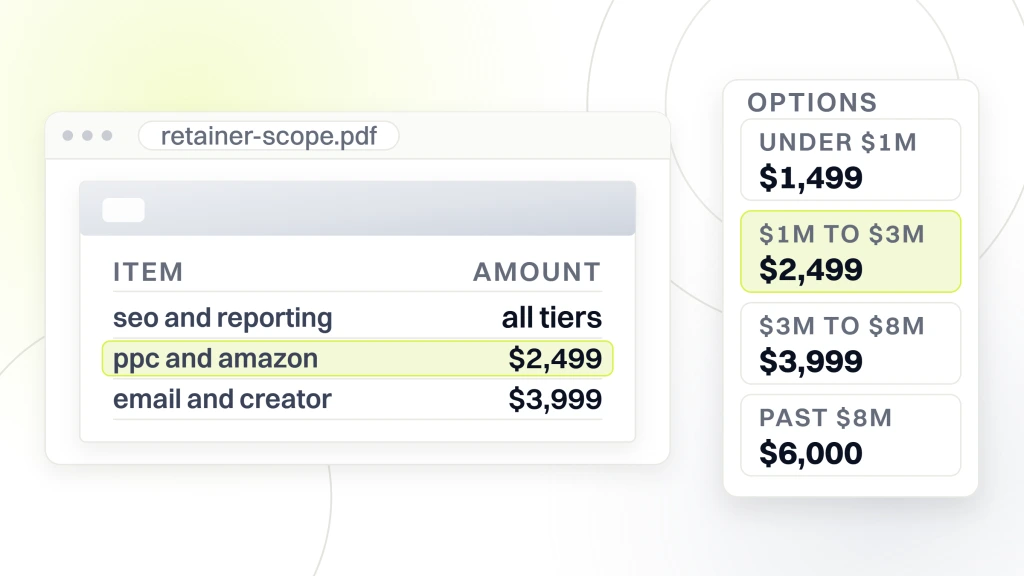
Redefine Web SEO and PPC retainers for health and beauty brands run $1,499, $2,499, $3,999, and from $6,000 per month. The floor at $1,499 fits a small-catalog brand under $1M annual revenue running foundation SEO with monthly reporting. The mid-range at $2,499 to $3,999 fits DTC brands from $1M to $8M annual revenue running SEO plus PPC plus Amazon Sponsored Products plus Klaviyo retention. The upper range at $6,000 and up fits catalog brands past $8M running full-stack with 30 to 80 monthly compliance-vetted creative variants and pharmacy retail media coordination inside the same retainer envelope. Ad spend bills separately across every tier.
Retainer tiers by revenue band
| Annual revenue tier | Monthly retainer | Channels covered | Compliance reviews per month |
|---|---|---|---|
| Under $1M | $1,499 to $2,499 | SEO + monthly reporting | 15 to 30 |
| $1M to $3M | $2,499 to $3,999 | Add PPC + Amazon | 30 to 60 |
| $3M to $8M | $3,999 to $6,000 | Add email + creator | 60 to 120 |
| $8M to $20M | $6,000 and up | Full DTC + pharmacy retail | 120 to 200 |
| $20M and up | Custom | Full-stack + Sephora + Ulta | 200 and up |
Percent-of-media versus flat retainer
Percent-of-media pricing at 10 to 15% of monthly ad spend fits health and beauty brands past $200,000 in monthly ad spend where flat retainer stops covering compliance-heavy labor. Flat retainer pricing fits brands under $200,000 monthly ad spend where percent-of-media would starve the agency of ops budget for substantiation library work. Hybrid pricing (flat retainer plus performance bonus tied to Amazon Buy Box share and retail sell-through targets) fits brands scaling through their first Sephora launch where alignment on category metrics matters more than fixed cost predictability.
Case study from a Manhattan health and beauty clinic
Beauté Aesthetics New York, a luxury beauty and aesthetics clinic in Manhattan, engaged Redefine Web as an integrated partner across web design, SEO, and creator content coordination. The clinic sat at the intersection of clinical treatments and a curated skincare product line with active ingredients. The website undersold the brand. Landing pages read like a clinical brochure. No compliance-vetted content engine fed the top of the funnel.
The 12-month program layered a full website rebuild, treatment-specific landing pages with compliance-vetted claim language, product page copy refresh with structure-function safe harbor language, technical SEO cleanup, schema markup on every treatment and product SKU, and a targeted creator seeding cohort of 40 New York beauty and wellness creators briefed on compliance-safe claim language. Every workstream reported into the same weekly dashboard with cost per booked consultation and website conversion rate as paired headline metrics.
Across 12 months, the program grew qualified leads 166%, new users 88%, and website conversion rate 27%. The integrated stack Redefine Web ran for Beauté Aesthetics New York now sits inside our beauty SEO service at maintenance cadence, with the internal marketing lead operating the ongoing program. The compliance workflow keeps every new campaign inside the safe harbor while the creative team ships content volume at the pace a modern DTC brand requires across every acquisition channel the clinic runs today.
Creative production the agency runs each month
Creative production for health and beauty products is compliance-heavy. Every static ad, every video ad, every PDP hero image, and every email carries claim language that goes through review before publication. A working program ships 30 to 80 new pieces of creative per month across static, video, PDP, and email formats. Each variant tests a compliance-safe hook, ingredient angle, or benefit framing. Producing this volume without a compliance-integrated pipeline usually gets one asset flagged per month, and the ad account freezes for 2 to 4 weeks while paperwork clears.
Static ad workflow with claim review
Static ad workflow with claim review inserts a 20 to 30-minute review gate between designer output and paid publication. Every variant gets tagged with claim type (cosmetic, structure-function, comparative), the substantiation file that grounds the claim, and disclaimer language if applicable. A working agency runs 20 to 40 static variants per month across Meta and TikTok inside a Figma-plus-Airtable pipeline that keeps the review gate under 30 minutes per asset. For rule references on claim framing, review the FDA structure-function claim guidance and align the disclaimer language on every asset.
Video ads with claim substantiation on file
Video ads for health and beauty products carry the highest claim risk because voiceover and creator testimonials can drift into drug claim territory in a single sentence. A working agency runs claim substantiation review on every video script before production and on every finished cut before publication. Winning variants that survive review sit in a substantiated library the paid team reuses across campaigns. Skip this step and a video ad usually gets flagged inside 30 days by platform review, and reinstating an account takes 4 to 8 weeks of paperwork.
Retention marketing on supplements and skincare SKUs
Retention marketing for health and beauty products owns the customer lifecycle after first purchase and the replenishment curve on each supplement or skincare SKU. A working program runs 6 core Klaviyo flows, 3 core Attentive flows, a loyalty program in Yotpo, and a subscription program in Recharge. Flow revenue on replenishable products (supplements, serums, cleansers) hits 30 to 45% of email revenue on a mid-catalog brand once flow architecture stabilizes past month 6 with compliance-vetted copy across every touchpoint.
Replenishment flows for supplement subscribers
Replenishment flows for supplement subscribers need to hit at the point of bottle depletion. A 30-day supply of collagen powder runs 30 to 35 days at daily use. A 60-day supply of vitamin D3 runs 60 to 66 days. A working agency sets Klaviyo timers on each supplement SKU based on average consumption. According to Klaviyo ecommerce email benchmarks, replenishment flows sent at the right timing produce 40 to 80% open rates and 5 to 12% conversion rates versus 15 to 25% open rates on generic campaigns.
Subscription math through Recharge
Recharge subscriptions run 20 to 40% of orders on health and beauty products with replenishable SKUs (supplements especially, at the high end of the range). Subscription customers carry 3 to 5x the lifetime value of one-time buyers and improve LTV to CAC ratios past month 12. A working agency builds subscription-specific flows, adjusts the discount ladder to hold retention past 6 shipments, and monitors churn weekly to catch product-fit issues before they compound across the base. Our beauty PPC service layers paid on top of the retention foundation.
Amazon Sponsored Products for health and beauty brands
Amazon Sponsored Products drive 30 to 50% of search behavior for health and beauty SKUs and belong inside every retainer past $2,499 per month. A working program runs 8 to 20 branded campaigns, 15 to 30 category campaigns, and 5 to 10 competitor conquest campaigns per SKU cluster. Amazon Buy Box share climbs 15 to 30 points on top branded terms inside 90 days when the substantiation library, listing content, and paid coverage all align. Boogie Board, a DTC brand we scaled on this same infrastructure discipline, dropped cost per conversion to $31 at scale with tight budget control and clean creative.
Listing content that clears Amazon medical claim rules
Listing content clears Amazon medical claim rules by keeping every bullet inside cosmetic or structure-function language without crossing into drug territory. Words like “treats,” “cures,” and “prevents” trigger suspension. Words like “supports,” “promotes,” and “helps maintain” stay inside safe harbor with the right disclaimer. A working agency audits every listing quarterly against the current Amazon health and beauty policy and updates language inside 5 business days of a policy change. This audit prevents the 2 to 4-week suspension window that hits brands with stale listings.
Sponsored Brands and video for the branded term
Sponsored Brands campaigns own the top of the Amazon search results page for branded terms and prevent resellers from bidding the brand into a reseller channel. Sponsored Brands video takes 20 to 30% of clicks on category terms and lets the founder brief 15-second product demos that stay inside claim safety. A working agency runs Sponsored Brands and Sponsored Brands video at 8 to 15% of total Amazon budget, holds the branded term at 90%-plus impression share, and grows unbranded category share on category terms across 90 days.
Red flags in a health and beauty marketing proposal
Every health and beauty founder reads 2 proposals a month promising 6x ROAS at $5,000 per month plus full compliance vetting. The red flags below catch most. One agency pitched a proprietary AI compliance engine that turned out to be a Chrome extension flagging the word “cure” and nothing else. A Chrome extension is not a compliance engine.
- Retainer under $1,499 per month with a promise of full compliance vetting plus multi-channel work. That budget covers 8 to 12 hours of specialist time. Real programs need 40 to 180 hours per month.
- No written compliance workflow. Every asset needs a written checklist and a substantiation file. Vague answers here mean the compliance work does not happen.
- Guaranteed structure-function claims without safe harbor disclaimer. Any agency that promises drug-adjacent claims without DSHEA disclaimer is drafting future FDA warning letters.
- No mention of Amazon Sponsored Products as a core channel. Amazon is 30 to 50% of health and beauty search behavior and skipping it loses the branded term to a reseller.
- No named substantiation file library. Real programs maintain substantiation files alongside the marketing calendar. Vague answers signal the files do not exist.
- Case studies with generic industry benchmarks instead of named health and beauty brands with specific compliance-vetted campaign numbers over 6 months.
Green flags in a real pitch
Green flags: a written compliance workflow with a named substantiation file library, category segmentation across supplements versus cosmeceuticals versus wellness devices, a stated Amazon Sponsored Products strategy, at least 2 health and beauty case studies with real brand names and compliance-safe campaign outcomes over 6 months, and a monthly reporting cadence with compliance incident count as a paired metric alongside revenue. Any pitch hitting 5 of these 6 is worth a follow-up call.
Timeline from signed contract to compounding results
Health and beauty founders arrive with wildly different expectations on timeline. Some expect a 5x ROAS spike inside the first 30 days because a competitor caught one last quarter. Others expect nothing for 6 months because prior agencies never delivered compliance-safe work. Real timelines sit in a narrow window shaped by category mix, compliance baseline, and how tightly the substantiation file library gets built in month 1 across the SKUs the brand cares most about.
Month 1 is compliance audit and substantiation library
Month 1 is compliance audit and substantiation library build. Every existing PDP, every existing ad, and every existing email gets audited against the compliance checklist. Every claim gets tagged with its substantiation file or flagged for research. The first batch of 15 to 30 static ads and 8 to 12 video variants ships into paid rotation through claim review. Expect no revenue improvement in month 1 because platform algorithms need clean data plus compliance-vetted creative before Advantage Plus and Smart Performance optimize meaningfully. Per Google Ads Help, learning phase on a new campaign runs 7 to 14 days on stable creative.
Compounding kicks in around month 4
Compounding kicks in around month 4. Paid campaigns exit learning phase on stable creative rotation. Amazon Buy Box share climbs on the top 10 branded terms. Klaviyo flows produce their first full replenishment cycle on hero SKUs. Between month 4 and month 9, most health and beauty brands see blended media efficiency ratio climb 25 to 55%, cost per acquisition drop 20 to 40% versus month 1 baseline, and Amazon Buy Box share climb 15 to 30 points on the top branded terms as reseller pressure eases.
In-house team versus an agency partner
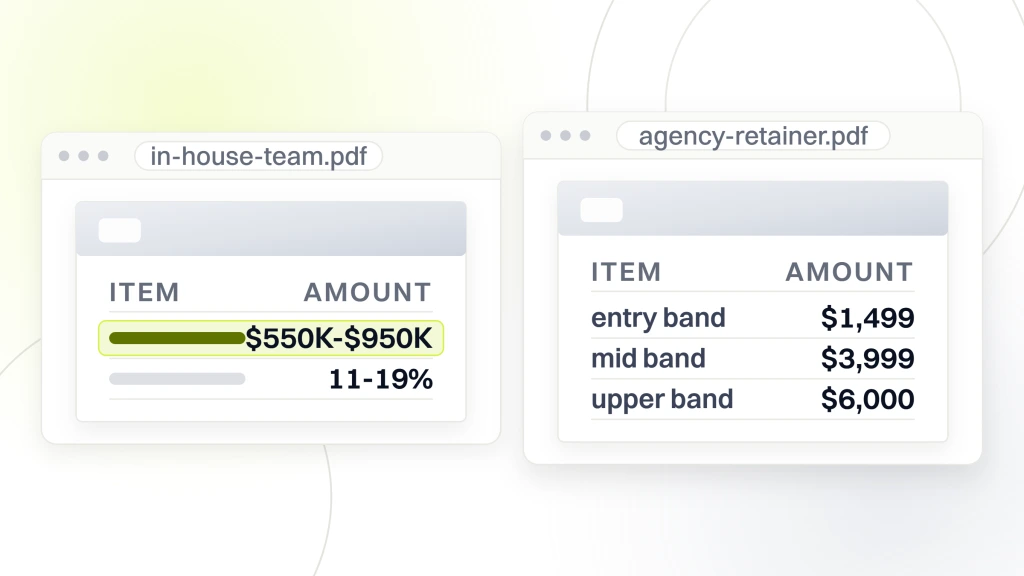
Every founder eventually asks whether to build an in-house health and beauty marketing team or partner with an agency. The honest answer depends on annual revenue, category complexity, and whether the founder wants to manage a compliance-heavy pipeline alongside product, ops, and finance. Below $5M annual revenue, an agency partnership wins on math because the total labor cost of a full-stack in-house health and beauty team runs $550,000 to $950,000 per year fully loaded.
The in-house team salary math
A full-stack in-house health and beauty marketing team runs 8 people minimum. A growth lead, a paid media specialist, an Amazon specialist, an email and SMS specialist, a designer, a motion designer, a copywriter, and a regulatory compliance coordinator (usually a fractional role sourced from a life sciences background). Fully loaded salaries plus benefits plus tool licenses lands the annual cost at $550,000 to $950,000. Below $5M in annual revenue, that labor cost eats 11 to 19% of revenue.
Hybrid model for brands past $8M
Hybrid teams win for brands past $8M in annual revenue. Growth lead, paid media specialist, Amazon specialist, and regulatory coordinator come in-house. Creative production, PDP copy work, and creator partnerships stay with an agency partner. This split gives the founder direct control on the 2 channels closest to strategic decisions (paid media budget and compliance workflow) while keeping labor-intensive production work off the internal payroll. Most brands past $20M eventually pull creative production in-house too. Our beauty marketing retainer plans support both fractional and full-service arrangements.
Content, SEO, and organic growth on the DTC storefront
Content and SEO on the DTC storefront produce compounding organic revenue that lowers blended acquisition cost every quarter. A working agency ships 4 to 12 long-form editorial pieces per month across ingredient explainers, regimen guides, and comparison content. Each piece links into product hub pages and category pages that carry commercial intent. Abigail Ahern, a global home decor brand Redefine Web scaled through the same content-plus-paid stack, hit a 179% revenue increase and a 3,000% paid-social return on ad spend without a single discount banner. The same content-plus-paid pattern applies to health and beauty DTC brands with regimen-driven decision cycles.
Ingredient explainers that rank on informational queries
Ingredient explainers rank on informational queries like “niacinamide benefits for oily skin” and “marine collagen versus bovine collagen.” A working agency writes each piece at 1,800 to 2,600 words, cites 4 to 8 peer-reviewed studies, and links to product hub pages that carry the ingredient. This organic base lowers blended cost per acquisition 15 to 25% inside 9 months once content compounds.
Regimen guides that convert on commercial intent
Regimen guides convert on commercial intent queries like “best skincare routine for combination skin” and “vitamin stack for immune support.” A working agency writes each guide as a decision path from problem statement through product mix. Every product mention links to the PDP with UTM tracking so attribution stays clean. Regimen guides carry 8 to 14% assisted conversion attribution across a 90-day window and typically become the highest-revenue organic pages on the storefront by month 12.
Wrapping up health and beauty marketing agency selection in 2026
Picking the right partner in 2026 comes down to 6 things. A written compliance workflow. Category segmentation across supplements plus cosmeceuticals plus wellness devices. Amazon Sponsored Products discipline. Creative production volume with claim review inside 30 minutes per asset. Retention lifecycle depth tuned to replenishment curves. And named health and beauty case studies with compliance-safe outcome numbers over 6 months. Programs that run all 6 produce compounding revenue, Amazon Buy Box share climbing 15 to 30 points on branded terms, and media efficiency climbing 25 to 55% past month 4.
Real programs like the 12-month Beauté Aesthetics New York engagement produce 166% qualified lead growth by pairing compliance-vetted website rebuild, SEO buildout, and creator content on the same team reporting into the same weekly dashboard. Redefine Web SEO and PPC retainers for health and beauty brands run $1,499, $2,499, $3,999, and from $6,000 per month with ad spend billed separately. If your health and beauty brand is picking a growth partner in the next 60 days, ask 3 agencies for line-item scopes with named compliance workflow, named substantiation library, named Amazon strategy, and case studies with real brand names. Book a call and Redefine Web will walk through the last 3 health and beauty programs we ran end to end.