
Best SEO Companies for Chiropractors (How to Compare Providers)

- Shortlist three chiropractor SEO companies, never six, and run a paid trial.
- Ask for the last twelve months of ranking and lead reports.
- Call tracking on every campaign or the numbers are guesswork.
- Month-six new-patient count is the honest scoreboard.
- Red flags: guaranteed rankings, private blog networks, ninety-day contracts with no data.
- In-house chiropractor SEO expert vs an agency
- Reporting and KPIs the best chiropractor SEO companies track
- A real example: what a chiropractor SEO client engagement looks like
- Questions to ask on the sales call
- Tools the best SEO companies for chiropractors use
- Onboarding checklist for the first 30 days
- Chiropractor SEO specialists vs generalist agencies
- How Redefine Web helps chiropractic practices pick a partner
Best SEO companies for chiropractors are the ones that book new patients on the schedule, not the ones with the prettiest ranking screenshots. You want the phone to ring with someone who has already read the reviews, seen the price, and picked a slot. That happens when the map pack ranks, the service pages match search intent, the Google Business Profile stays active, and the front desk answers a tracked call. This guide is the shortlist framework we use with every practice owner who asks us to compare providers, plus the six criteria that filter time-wasters fast.
You’ll read the deliverables a real chiropractor SEO company delivers every month, the price band that matches serious work, the red flags that end the conversation early, and the questions that separate strategists from salespeople. Read straight through in nine minutes, then shortlist three providers and run a paid trial before signing anything longer than 90 days.
In-house chiropractor SEO expert vs an agency
A full-time SEO hire runs $75K to $110K base salary. Add benefits, tools, and content production capacity and the fully loaded cost lands around $120K to $150K per year. That is $10K to $12.5K per month. For that budget, you can hire a strong chiropractor SEO agency, a paid ads specialist, and a content writer, and still keep budget for tools and reporting. The economics rarely favor in-house until you’re managing five or more locations.
The hybrid model for practice groups
Group practices at five or more locations run a hybrid model. One in-house marketing lead who owns strategy, brand voice, and quarterly reporting. One outside agency that handles technical SEO, content production, and location-page management. The lead spends 30 percent of time on strategy, 30 percent on internal review workflows, 20 percent on paid ads oversight, and 20 percent on managing the agency relationship. That split scales cleanly past ten locations.
When to fire the agency and replace them
Fire the agency when month six passes and new-patient count from organic hasn’t moved. Fire when the monthly report is a copy-paste of last month’s. Fire when the strategist has been replaced twice in nine months. Do not fire because rankings dip in a single month (Google fluctuations are normal). Do not fire because a single competitor opened a new location and outranked you (that’s a market shift, not a vendor failure). The bar for firing is a sustained six-month flatline against a documented scope.
Reporting and KPIs the best chiropractor SEO companies track
The scoreboard for chiropractor SEO is five numbers. Booked new patients from organic. Cost per booked new patient. Map pack rank on top three condition keywords. Total organic sessions. Total form and call conversions. Everything else is diagnostic. A monthly report over 10 pages is padded. Under three pages is thin. The right length is five to seven pages with a single-page executive summary at the top.
Call tracking is mandatory
Call tracking on every marketing channel or the numbers lie. A dynamic number swap tool like CallRail costs $45 to $145 per month for a single-location practice. It shows the source of every inbound call and lets you filter for new-patient calls that turned into booked exams. Without it, you’re guessing which channel produced revenue. Any chiropractor SEO company that says call tracking is optional in 2026 is either lazy or hiding weak results.
The monthly review cadence
A 45-minute call once per month. Report review, wins from last 30 days, next 30 days of work, and one strategic question. That’s the cadence a serious chiropractor SEO agency runs. Not a 90-minute quarterly review that becomes a three-hour finger-pointing session. Not a weekly Zoom that turns into project management. Monthly, tight, and outcome-focused.
KPI targets month over month
Month 1-3: baseline everything, apply technical fixes, launch content cadence. Rankings may dip slightly during content overhaul. Month 4-6: map pack movement on 3-5 condition keywords, first booked exams from organic content. Month 7-9: month-over-month new-patient growth of 8-15 percent. Month 10-12: steady 20-40 new patients per month from organic search on a single-location practice with a healthy service area.
A real example: what a chiropractor SEO client engagement looks like
Our team ran a paid media and web engagement with Canadian Orthodontic Partners across their 65-clinic network. Not the same vertical, but the same principle. Structured deliverables, integrated tracking, and outcome-focused reporting drove booked consults up 97 percent and cost per booked consult down 58 percent over a 12-month partnership. Same math applies to a chiropractic practice at the single-location or multi-location level. The mechanics differ. The discipline is identical.
What worked in the first 90 days
The first 90 days of a strong chiropractor SEO engagement is unglamorous. Fix schema markup. Consolidate duplicate service pages. Clean up citation inconsistencies (name mismatches, wrong phone number formats). Update Google Business Profile categories, services, and hours. Add five patient FAQ articles that answer the top questions from Search Console. None of that moves rankings in week one. All of it compounds by month four.
What worked in months four through nine
Content cadence kicks in. Two blog posts per month. One patient story per month. GBP posts twice per week. Reviews collected from every patient at checkout via the tablet flow. Map pack ranking moves from position 6-8 into the top three on 4 of 5 condition keywords. Organic sessions double. Booked new patients from organic grow from 3 per month to 18 per month. That is a typical month-9 result for a single-location practice in a mid-size metro.
Any chiro SEO firm can rank a homepage. Ask which PMS they wire conversion tracking to. If they cannot name Chirotouch or Genesis, they never touch attribution.
Questions to ask on the sales call
Prepare five questions before every sales call with a chiropractor SEO company. Ask them all when you interview best SEO companies for chiropractors. Watch the answers. Confident agencies answer in specifics with numbers and named clients. Weak ones answer in adjectives and hypotheticals. The questions filter faster than any proposal review.
- Can I speak with two current clients before signing?
- Show me your last three monthly reports for a comparable practice.
- How many chiropractic accounts does my strategist personally manage?
- What’s your average client tenure, and what’s the churn rate at month 6 and month 12?
- Which specific technical fixes will you complete in the first 30 days?
Why the tenure question matters
An agency with an average client tenure of 8 months is churning half its book every year. An agency with 26-month average tenure is producing steady results and clients renew. Ask directly. Confident agencies quote the number. Weak ones dodge with “we don’t share that” or pivot to case studies. Tenure is a proxy for whether the work delivers, and it’s the single hardest question for a bad agency to answer honestly.
Who’s actually doing your work
The person on the sales call is rarely the person doing the work. That is fine if the actual strategist has capacity. It is not fine if the strategist runs 15 accounts and touches yours twice a month. Ask how many accounts your strategist personally manages. Ask for their name and LinkedIn. Ask to meet them before signing. A serious chiropractor SEO expert has an active LinkedIn, a portfolio, and 30 minutes for a discovery call.
Tools the best SEO companies for chiropractors use
The tool stack is not the point when comparing best SEO companies for chiropractors. The output is the point. That said, ask what tools the agency runs and cross-check against the industry standard. Ahrefs or Semrush for keyword and backlink data. Google Search Console and Google Analytics 4 (free, mandatory). CallRail or similar for call tracking. BrightLocal or Whitespark for citation management. Local Falcon for map pack rank tracking. A CMS integration for schema. That’s the base kit.
Proprietary software is usually a wrapper
Every third agency will pitch you their “proprietary SEO platform.” Nine times out of ten it’s a white-labeled version of a $30 per month SaaS product with the logo replaced. That is fine if the reporting is clean and the strategy is sound. It is a warning sign if the platform is pitched as the deliverable. You’re paying for strategy and execution. The platform is the tool the strategist uses to see the data.
Reporting tools that matter
Google Search Console is free and shows real query data. Google Analytics 4 is free and shows real conversion data. CallRail costs $45 per month and shows call source and duration. Local Falcon costs $49 per month and shows map pack rank at the ZIP code level. If the agency has those four tools plugged in and integrated into a dashboard, you have what you need. Anything beyond that is nice-to-have.
Onboarding checklist for the first 30 days
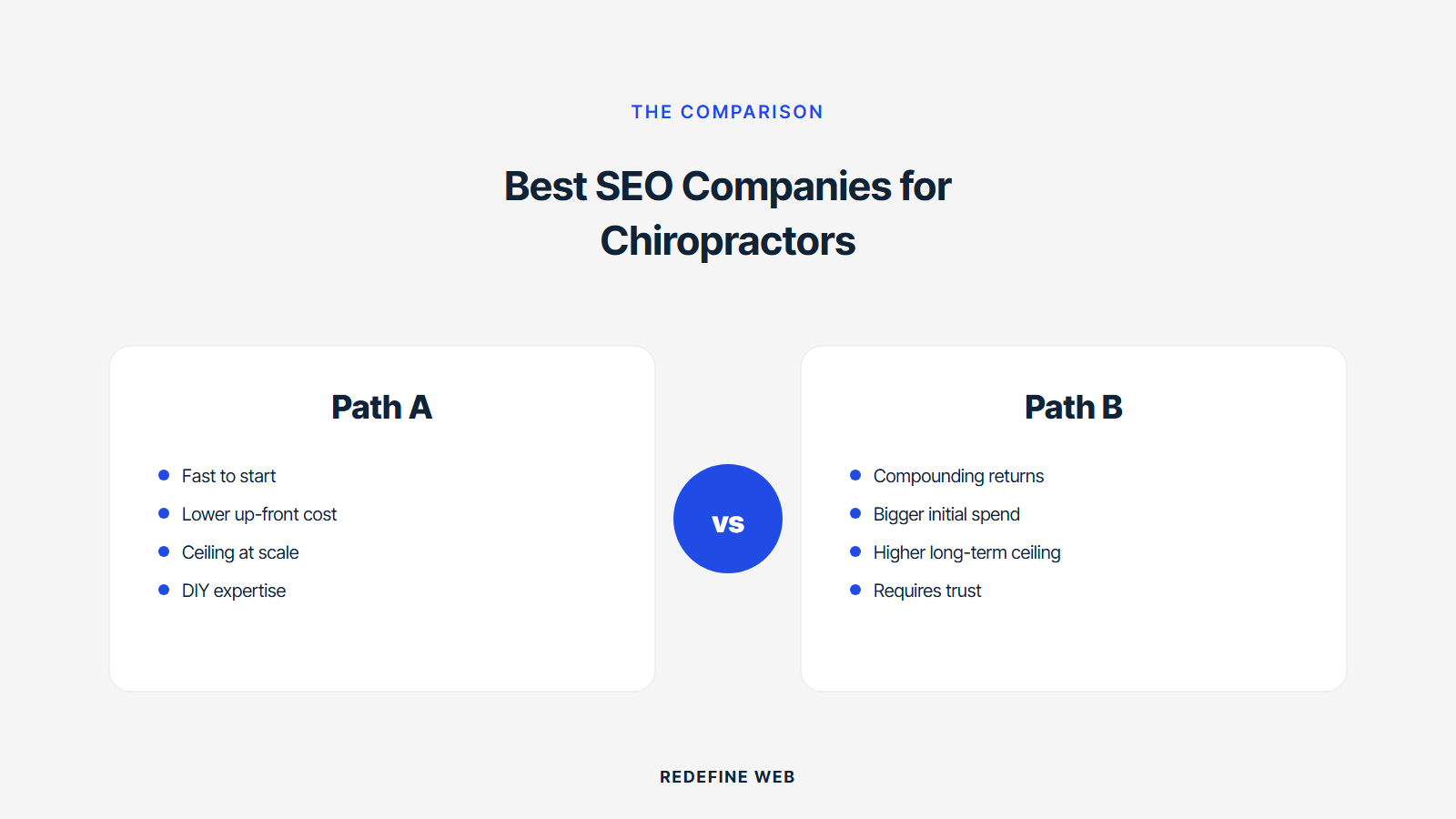
The first 30 days of a chiropractor SEO engagement set the tone for the next 12 months. The agency needs full access to seven systems and clarity on five decisions. If onboarding takes more than 10 business days, the vendor is understaffed. If the vendor asks for less than that list, they’re skipping steps.
- Google Business Profile admin access (not manager, admin)
- Google Search Console and Analytics 4 property access
- WordPress or CMS admin login
- Hosting login (for technical fixes and page speed work)
- Domain registrar access (for DNS records if schema needs verification)
- Existing Google Ads account (read-only is fine if you keep it in-house)
- Existing patient management system for booking data
Five decisions to make on day one
Brand voice document (how the practice talks to patients). Priority service pages (which 5 pages get worked first). Blog cadence (1 or 2 posts per month). Review generation flow (tablet at checkout, SMS after visit, both). Reporting recipient list (owner only or full team). Decide those five on the kickoff call. Every deferred decision adds two weeks of drift.
The 30-day review that catches drift early
At day 30, sit down with the strategist and ask three questions. Did the technical audit deliverables land on time? Did the priority service page updates go live? Is call tracking installed and reporting cleanly? If the answer is no on any of those, the trial is failing. Not “give it more time.” Failing. A 90-day paid trial only works if month one delivers. Weak agencies coast through month one, push a burst of work in month three, and hope you don’t notice the drift.
Chiropractor SEO specialists vs generalist agencies
A generalist agency that runs SEO for plumbers, lawyers, and chiropractors will hit 70 percent of the deliverables well. A chiropractor-specific SEO company will hit 90 percent, faster, because they already know the condition keyword map, the patient education gaps, and the map pack behavior in chiropractic. The specialization tax is real. Expect to pay 15 to 25 percent more for a specialized chiropractor SEO expert. Worth it for practices generating over $40K per month.
When a generalist agency works
A generalist agency works if the strategist has healthcare or local-services experience and the account manager has run at least three chiropractic accounts in the last two years. Not a specialist, but not blank-slate either. Ask directly on the sales call: “Which of your team members has worked on chiropractic accounts, and how many?” The answer will show you whether the generalist can pull off specialist-level execution on your account.
When you need a chiropractor-specific SEO firm
The best SEO companies for chiropractors that specialize get called in when the practice runs multi-provider, multi-technique operations. Decompression tables, cold laser, personal injury, sports rehab, prenatal, pediatric. Every technique has its own patient search behavior. A generalist agency will treat them as one keyword bucket. A specialist splits them into six service pages and six ranking targets. On a multi-provider account, that alone drives 20 to 30 percent more booked exams over 12 months. Compare providers against our Best SEO for chiropractors benchmark before signing.
How Redefine Web helps chiropractic practices pick a partner
We run Chiropractor marketing services for independent practices and multi-location groups across the US and Canada. Our first call is a free 30-minute audit that reviews your Google Business Profile, service pages, and Search Console data live on screen so you leave with a real punch list.
You leave the call with a punch list of the three top-priority fixes to apply in the next 30 days. A punch list you can take to any vendor, ours included.
Our scope and starting price
Our starting retainer for a single-location chiropractic practice is $599 per month for the core SEO scope: Google Business Profile management, on-page work on 3-5 priority pages, one blog post per month, monthly citation maintenance, and monthly reporting. That is the base. Practices that want two posts per month, PPC integration, or multi-location scale move into the $1,600 to $3,500 band. Everything runs on a 6-month starting contract with a straightforward renewal after.
Our reporting and review loop
Monthly report on the second Tuesday. 45-minute review call the same week. Five-KPI executive summary on page one. Rankings, traffic, calls, forms, booked exams. Wins from last 30 days. Next 30 days of work. One strategic question we’re testing. That’s it. If the report bloats past six pages, we cut something. The client owns their time.
Where our related playbooks help
When you’re weighing SEO investment against paid search, read our PPC for chiropractors playbook alongside this one. Practices in launch mode should also review the Marketing plan template. And every SEO partnership discussion is smoother once you’ve read our SEO buyer’s guide, How to choose an SEO company. Between those four resources, you’ll walk into any vendor conversation ahead of the salesperson. Also useful for review flow: Moz’s Local SEO Learning Center and Google’s Google Business Profile guidelines.
One last note before you book vendor calls. If a salesperson answers every question with a slide, and the slide is a stock photo of a smiling receptionist next to a graph pointing up and to the right, close the tab. Real chiropractor SEO strategists answer questions with numbers, tradeoffs, and “we tried it, here’s what happened.” That is the one filter that saves the most time.
Frequently asked questions
How much do the best SEO companies for chiropractors charge?
Independent chiropractor SEO retainers sit in the $1,200 to $3,500 per month range for a single-location practice. Multi-location DSO and PT groups pay $3,500 to $8,000 per month depending on service radius and content volume. Anything under $600 per month is thin content and off-page work that never moves the map pack much. Anything over $10,000 for a single-location practice is enterprise pricing without matching enterprise deliverables. Always ask for the scope sheet before the price quote.
How long until a chiropractor SEO company produces booked exams?
First map pack movement lands between week six and week ten when the Google Business Profile is clean and the citations are consistent. First booked new patient tied to organic search shows up between month three and month five in most cases. Steady month-over-month lead growth takes six months of consistent work. Any company promising booked patients in week two is either running paid ads under the SEO invoice or lying about attribution entirely.
What deliverables should be in a chiropractor SEO contract?
Monthly on-page optimization on three to five priority pages, a content brief for one to two new blog posts, Google Business Profile posts twice per month, citation cleanup and new citations, technical SEO checks (page speed, schema, redirects), and a monthly report with rankings, traffic, and booked exam data. If the contract lists only vague phrases like ongoing optimization or SEO services, ask for the line-item scope sheet before you sign.
How do I verify a chiropractor SEO company's case studies?
Ask for the practice name and the Google Business Profile URL. Look up the profile and check current review volume and star rating. Ask the SEO company for the month-over-month new-patient count from the reported period. Better yet, ask if you can call the practice owner for a five-minute reference chat. A confident company hands you two phone numbers on request. A weak one hands you a screenshot of ranking positions instead.
Should I hire an in-house SEO expert or a chiropractor SEO agency?
For a single-location practice with under $50K in monthly revenue, hire an agency. Full-time SEO salaries start at $75K and require a content writer and a paid ads specialist to be productive. For a group of five or more locations, a hybrid model works best. One in-house marketing lead who owns strategy, brand, and reporting, plus an outside agency that handles technical SEO, content production, and citation management at scale.
What are the red flags when picking a chiropractor SEO company?
Guaranteed first-page rankings on generic terms. No call tracking or refusal to install it. Private blog network mentions (Google penalizes these fast). Contracts under 90 days with no monthly report cadence. Reporting only on ranking positions and no lead data. Agencies that will not name a single active client. A single point of contact who is also the salesperson and the strategist and the writer. Any of those and you keep shopping.
Can I switch chiropractor SEO companies without losing rankings?
Yes, if the new agency gets full access to the Google Business Profile, Search Console, Analytics, hosting, and CMS accounts before the old contract ends. Ask for a 30-day handoff window. Export the last twelve months of Search Console data, Google Ads history, and Google Business Profile insights before you cancel. Change every password on the transition day. Do not let the outgoing agency delete the blog content their team wrote for you.
Book your free 30-minute strategy call.
No spam, no sales rep. We use your email to schedule your call with a senior strategist. That is it.
More from the blog
View all articles → SEO
SEO Organic Search Engine Optimization Services That Grow Real Traffic
Read article SEO
SEO SEO for Pet Groomers That Fills the Appointment Book Weekly
Read article SEO
SEO