
Custom Web Application Development Services for Real Software Builds
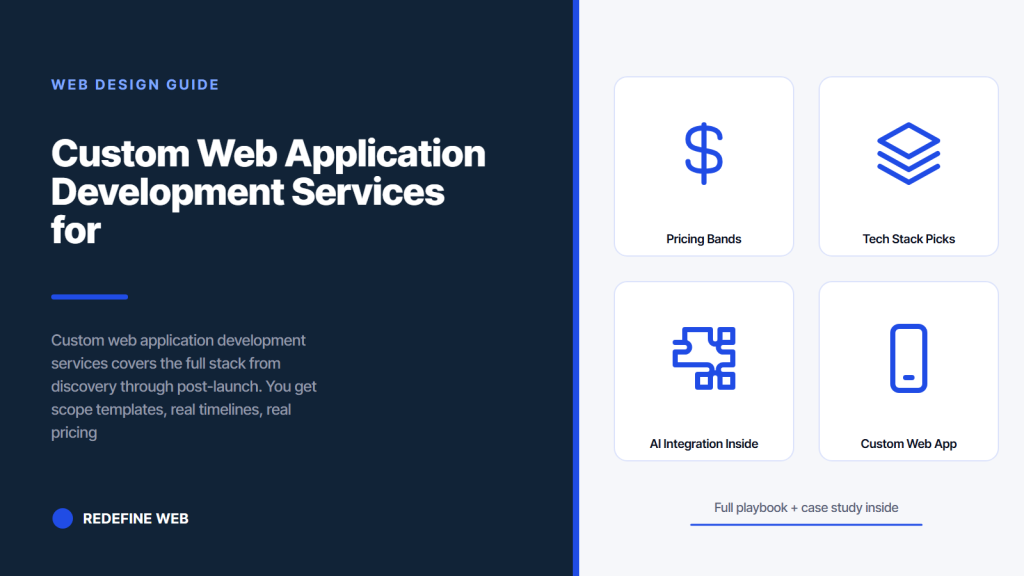
- Nine work streams inside a real scope. Ignore any flat quote.
- Mid-market builds land at $60k to $180k on 12 to 20 weeks.
- Seven scoping questions turn a vague idea into an honest number.
- Hypercare and monthly retainer belong in the scope, not as extras.
- Rocket Software, Inc. drove activation up 300 percent in one month.
- Custom web application development services pricing bands and timelines
- Tech stack picks for a custom web app in 2026
- Industry-specific custom web app patterns
- AI integration inside a custom web app in 2026
- Custom web app modernization for existing systems
- The right team shape for a custom app project
- Post-launch support and the 30-day hypercare window
- A custom web application development services case study on a SaaS onboarding rebuild
- Where to start with your custom web app project
Custom web application development services turn a bottleneck in your business into working software. You already know the problem. Your team is running the workflow in seven spreadsheets. Your customers are typing the same information into three places. Your ops lead is spending four hours a week on manual reconciliation. A custom web app fixes that. This guide walks you through the scope, the pricing bands, the tech stack, and how our team at Redefine Web scopes one on the first call.
You will read what a custom web application development service actually covers, how it differs from a website or an off-the-shelf SaaS, the seven scoping questions we ask on every discovery call, the four pricing bands we see across projects, the AI features worth integrating in 2026, the industry-specific patterns for healthcare, fintech, and supply chain, and a case study on a rebuilt SaaS onboarding flow that drove activation up 300 percent in month one.
Custom web application development services pricing bands and timelines
Custom web application development services in USA run $18,000 to $500,000 depending on scope. Most projects we ship land in the $60,000 to $180,000 band. That range covers a real MVP with 6 to 12 core features, one payment integration, one CRM sync, hosted on managed infrastructure, and a 30-day hypercare window. Below $18,000 you get a website with a login form. Above $500,000 you get platform-level architecture with a dedicated product team.
Affordable custom web application development services do exist. They cost less because they cover less scope, not because a vendor found a magic shortcut. A $22,000 project ships 4 to 6 features on a template design with one integration and no dedicated PM. A $180,000 project ships 15 features on a custom design with 4 integrations, a dedicated PM, and 90 days of post-launch support. Both are honest scopes. The mismatch happens when a client budgets $22,000 and expects the $180,000 deliverable set.
| Band | Scope | Timeline | Best for |
|---|---|---|---|
| $18k to $35k | 4 to 6 features, template UI, 1 integration | 6 to 10 weeks | Solo founder MVP, internal tool prototype |
| $40k to $80k | 7 to 10 features, custom UI, 2 integrations | 10 to 16 weeks | Seed-stage SaaS, mid-market internal tool |
| $85k to $180k | 10 to 15 features, custom UI, 3 to 4 integrations, PM included | 16 to 26 weeks | Series A SaaS, multi-location ops platform |
| $200k to $500k | 15+ features, custom design system, 5+ integrations, dedicated squad | 26 to 52 weeks | Series B+ product platform, enterprise workflow |
Discovery is 10 to 15 percent of every band
Every honest quote allocates 10 to 15 percent of the total to discovery. That covers stakeholder interviews, workflow mapping, data audit, integration inventory, and a written scope document. Clients sometimes push back on paying for discovery. Skipping discovery is how projects blow past budget by 60 percent because the vendor rebuilds the same screen four times in response to feedback that would have surfaced in a 45-minute interview. Discovery pays for itself in every project.
The costs vendors forget to name
Hosting runs $80 to $2,000 per month depending on user count and traffic pattern. Domain and SSL run $20 to $200 per year. Third-party services like Stripe, SendGrid, Twilio, and Auth0 add $50 to $2,000 per month combined. Monitoring and error tracking on Sentry or Datadog runs $30 to $500 per month. A honest custom web application design and development services quote lists every one of these in a monthly-cost appendix. Missing them is how a $60,000 build turns into a $9,000 annual surprise on the operations budget.
Tech stack picks for a custom web app in 2026
Tech stack picks for a custom web app in 2026 are narrower than they were three years ago. The winners on our side are Next.js on the front-end, Node or Python on the back-end, Postgres for the database, and Vercel or AWS for hosting. That stack handles 80 percent of scoped projects at retainer scale. The other 20 percent needs a specialty pick, usually driven by a specific integration or compliance rule.
You do not need to know the stack picks going into a scoping call. Your custom web app development service company should recommend based on your workflow, your team’s existing skills, and your hosting preferences. What you should know is that the tech stack is a downstream decision. A vendor who leads with the stack on the first call is selling the tool, not the outcome. See MDN Web Docs on modern web development for the reference against which every stack pick gets evaluated.
Front-end framework picks
Next.js runs 60 percent of the custom web app builds we ship because the file-based routing and server components map well to how our engineers think about page-level state. React with Vite covers another 25 percent for teams already deep in React. Vue and Nuxt cover the last 15 percent for teams with existing Vue expertise. Every one of these frameworks ships production apps at scale. The pick follows the team’s existing skills, not the framework’s marketing.
Back-end language and database picks
Node with TypeScript on Fastify or Nest runs about half our back-end work because the shared language with the front-end team simplifies the hire pool. Python with FastAPI runs 30 percent because ML integrations sit natively in Python. Laravel and PHP cover 20 percent for WordPress-adjacent teams and existing PHP shops. Postgres runs 90 percent of the database picks because JSONB columns handle semi-structured data well without giving up transactional guarantees. See our custom web development cost breakdown for how the stack pick maps to the pricing band.
Industry-specific custom web app patterns
Custom web application development services company work follows industry-specific patterns. Healthcare needs HIPAA-compliant hosting, audit logging on every data access, and BAA-signed integrations. Fintech needs PCI-DSS scope reduction, transaction reconciliation, and reporting flows. Supply chain needs bulk import handling, inventory reconciliation, and multi-warehouse state. Every industry has its own scoping quirks that show up before the first line of code.
Recognizing the pattern early saves 20 percent of the timeline. A healthcare project that skips the HIPAA hosting question until sprint 3 rebuilds the auth layer and the database configuration. A fintech project that treats Stripe as a simple checkout integration hits a compliance gate at week 10. A supply chain project that ignores the multi-warehouse state model rewrites the inventory tables at week 14. Naming the industry pattern on the first scoping call closes those gaps.
Healthcare and HIPAA-scoped builds
Healthcare custom web app builds ship on HIPAA-compliant hosting from day one. AWS with a signed BAA, Azure with a signed BAA, or a specialist host like Aptible. Every user action gets logged. Every PHI field gets encrypted at rest and in transit. Every integration partner signs a BAA before the first API call. Every dev environment stays free of production PHI. Missing any one of these on a healthcare project turns into a regulatory event within 12 months of launch.
Fintech and PCI-scoped builds
Fintech custom web app builds keep card data out of your servers. Stripe Elements, Braintree Hosted Fields, or Adyen Web Drop-in mean the card number never touches your infrastructure. That single design choice drops PCI scope from Level 1 down to SAQ A. Every fintech project we ship uses one of these tokenization flows. Every one saves the client six figures a year in compliance audit and infrastructure hardening cost. Every custom web development services security compliance fintech proposal we write leads with this pattern.
If under 20 people log in every day, off-the-shelf SaaS beats custom. Airtable plus Zapier runs the workflow for a tenth of a custom build cost.
AI integration inside a custom web app in 2026
AI integration inside a custom web app in 2026 is a scoped feature, not a marketing headline. The winning patterns are semantic search on internal documents, a chat interface to internal data, structured extraction from user uploads, and workflow suggestions based on historical patterns. Every one of these ships as a 2 to 4 week module bolted onto the core app. None of them requires you to rebuild the whole product around AI.
The right question is not whether to add AI. The right question is which workflow inside your app costs your users the most cognitive load, and which AI feature would reduce that. A CRM that offers a smart summary of a customer’s last 12 months of activity saves the account manager 5 minutes per call. A ticketing system that suggests a resolution based on similar past tickets saves the agent 3 minutes per case. Both are scoped AI features that pay back inside a quarter. See our custom web development services with AI integration breakdown for the seven feature patterns worth building in 2026.
Model choice inside a custom app
Model choice inside a custom app follows cost and latency. OpenAI GPT-4o mini and Anthropic Claude Haiku land at $0.15 to $0.25 per million input tokens and respond in under 2 seconds. Those two models cover 80 percent of production workloads. GPT-4o and Claude Sonnet cost 10x more and only justify the extra spend on complex reasoning tasks. Every AI feature we scope names the model on the estimate and explains why we picked it.
Retrieval-augmented generation vs fine-tuning
Retrieval-augmented generation ships in 2 weeks. Fine-tuning ships in 6 weeks and needs 2,000 to 10,000 training examples. Nine out of ten custom app AI features that clients describe as fine-tuning actually work as retrieval-augmented generation. You point the model at your own documents, wrap the response with a system prompt, and get 90 percent of the benefit at 20 percent of the cost. Fine-tuning wins when you need a specific writing style or a domain-specific classification the base model gets wrong. Retrieval wins everywhere else.
Custom web app modernization for existing systems
Custom web app modernization development services rebuild an app that ships but no longer scales. The typical trigger is a business that has outgrown a Wix or a Bubble prototype, an internal tool built in Access or FileMaker, or a legacy PHP app on shared hosting. The modernization scope is smaller than a greenfield build because the workflow is already validated. The scope is trickier because you have to migrate real data without breaking real users.
Every custom health web app redesign development services project starts with a data audit. What tables exist. What columns are actually used. What data quality issues hide in the current dataset. That audit takes 3 to 5 days and saves 3 to 5 weeks of rework at week 12 when a hidden data quality issue surfaces in production. Skipping the audit is the number one reason modernization projects run 40 percent over budget.
Data migration as the core risk
Data migration on a modernization project is where most projects stumble. You write ETL scripts that pull from the old system, transform to the new schema, and load into the new database. You run them against a staging environment. You run them again after every code change. You run them a final time on cutover night with a 30-minute freeze on the old system. Every migration script version gets tagged in git so a rollback is possible. Every one of the last 12 modernization projects we shipped followed this exact pattern.
Cutover planning saves the launch
Cutover night is not the time to fix bugs. Every issue that surfaces after 6 PM on cutover night has to be pre-planned or rolled back. Every leading custom web development services for healthcare enterprises project we run schedules cutover for a Saturday at midnight local time, freezes the source system for 90 minutes, runs the final migration, warms the cache on the new app, and reopens at 3 AM. Users log in Monday morning to a rebuilt app with all their data intact.
The right team shape for a custom app project
The right team shape for a mid-size custom web application development services company build is one product designer, one front-end engineer, one back-end engineer, a shared DevOps or platform engineer, and a project manager who owns the sprint cadence. Five people is enough to ship a $60k to $180k project on a 12 to 20 week timeline. Fewer people means bottlenecks. More people means coordination overhead that slows delivery without adding output.
Client-side, one product owner and one technical liaison is the right split. The product owner makes scope decisions inside the week. The technical liaison answers integration and data questions inside a business day. Projects with a rotating cast of decision-makers on the client side ship 30 to 50 percent slower than projects with a single accountable owner. Every custom web app development services company that has done 30 projects has seen this pattern.
The single biggest signal of a doomed project is a discovery call attended by nine people from the client side, five of whom identify as a stakeholder, three of whom have opinions on the button color of the login screen, and one who asks whether the app can also do payroll. Every custom app agency has taken that call. Every one has quoted anyway. Every one has regretted the quote by week six. The fix is not fewer meetings. The fix is one accountable owner on the client side before signature.
In-house vs agency team
Hiring in-house engineers for a one-time custom app build takes 4 to 6 months on the recruiting side, another 2 months on onboarding, and a full year of salary and benefits before the project ships. An agency delivers the same project in 12 to 20 weeks for less than the fully-loaded cost of one senior engineer. In-house wins when the app becomes a long-term product with continuous development. Agency wins when the app is a project with a defined launch and a modest ongoing maintenance footprint.
Offshore agency tradeoffs
Offshore custom web app development services quote 30 to 60 percent lower than US agencies. That savings comes with tradeoffs. Timezone gaps add 24 to 48 hours to every feedback cycle. Language nuance costs an extra revision on every product design pass. Cultural differences in stakeholder communication cost a scope reset every 4 to 6 weeks. Offshore wins when the scope is fully specified upfront and the client has an internal PM who can front the timezone gap. Offshore loses when the scope is emerging and the client needs synchronous conversations to move forward.
Post-launch support and the 30-day hypercare window
Post-launch support is where most custom app projects fail or succeed. Every project we ship includes a 30-day hypercare window covering priority-one bug fixes, minor feature tweaks, and hosting stabilization. That window costs 5 to 10 percent of the total build and prevents 90 percent of the launch anxiety that ships alongside a new app. Every serious custom applications development services agreement includes hypercare as a line item, not a favor.
Beyond the 30-day hypercare, ongoing support runs on a monthly retainer of $2,000 to $12,000 depending on complexity. That retainer covers minor feature additions, security patches, dependency updates, and one round of design refinement per quarter. Every mid-market custom web app product ends up paying about 15 to 25 percent of the initial build cost per year in ongoing maintenance. Budget for that from day one and the launch does not turn into a crisis in month six.
Monitoring and error tracking
Sentry catches JavaScript errors. Datadog watches server performance. Uptime Robot pings the public endpoints every 5 minutes. Every custom web app we ship configures all three before the first user logs in. That trio catches 95 percent of production issues within 15 minutes of them starting, which lets the on-call engineer fix small problems before they become customer support tickets. See the web.dev Core Web Vitals reference for the metrics that monitoring dashboards track against on the front-end.
Security patch cadence
Dependency vulnerabilities show up in every custom app within 90 days of launch because npm, PyPI, and Composer publish thousands of package updates every week. Every serious ongoing support contract runs weekly dependency scans, monthly patch cycles, and same-day patches for anything rated high or critical. Skipping this cadence is how apps end up in the news for a data breach two years after launch. Include it in the ongoing scope, not as an optional add-on.
A custom web application development services case study on a SaaS onboarding rebuild
Rocket Software, Inc. came to us with a subscriber acquisition tool that was losing 93 percent of trial signups before the second session. The onboarding flow was broken in three places, the drip email campaigns were misfiring, and the activation dashboard had no meaningful signal on which behaviors correlated to retention. The team had 4 weeks until a scheduled marketing push and no time for a full rebuild. We scoped a targeted custom web app modernization on the exact 6 features that mattered.
Inside 30 days we rewrote the onboarding flow with a 3-step wizard, plugged in a real drip sequence hooked to activation events, and pushed a dashboard that scored every user on activation likelihood. Rocket Software, Inc. drove activation rate up 300 percent in the first month, hit 3,000 customers in launch week, and settled into 400-plus new subscribers per day post-launch. Every one of those numbers came from a scoped custom web app development service that targeted the highest-impact six features instead of rebuilding the whole product.
The scoped six features
Three-step onboarding wizard. Activation event tracking wired to Segment. Drip campaign engine triggered on activation gaps. Activation likelihood scoring model. Admin dashboard with cohort filters. Bulk export to CSV for the go-to-market team. Six features. Four weeks. One integrated release. That focus is what a good custom applications development services scope looks like when the calendar is tight and the stakes are real.
The outcome measured 30 days out
Activation rate up 300 percent. Three thousand customers in week one. Four hundred plus new subscribers per day. Those three numbers came from a targeted 4-week custom web app development service that focused on the six features with the highest activation impact instead of a 6-month rebuild that would have missed the marketing window. That is the shape of a good custom web app engagement. Focus on the workflow that pays back inside 30 days. Ship. Measure. Iterate.
Where to start with your custom web app project
Start with the seven scoping questions above. Write your answers down. Send them to two vendors. Compare the proposals. The vendor whose proposal breaks the scope into nine work streams, names monthly hosting and third-party costs, quotes a discovery phase, and asks follow-up questions is the vendor you want to work with. The vendor whose proposal quotes a flat number without breakout is quoting a website, not an application. That gap is the biggest single tell in a custom app hiring process.
Ready to scope a custom web app with a team that ships production software. Our custom web development services covers the full engagement from discovery through post-launch. For the pricing math, see our custom web development cost. For related builds, see our web design and development services and custom web portal development services. For authoritative reference on production web application architecture, see MDN Web Docs on server-side programming.
Frequently asked questions
What do custom web application development services actually include?
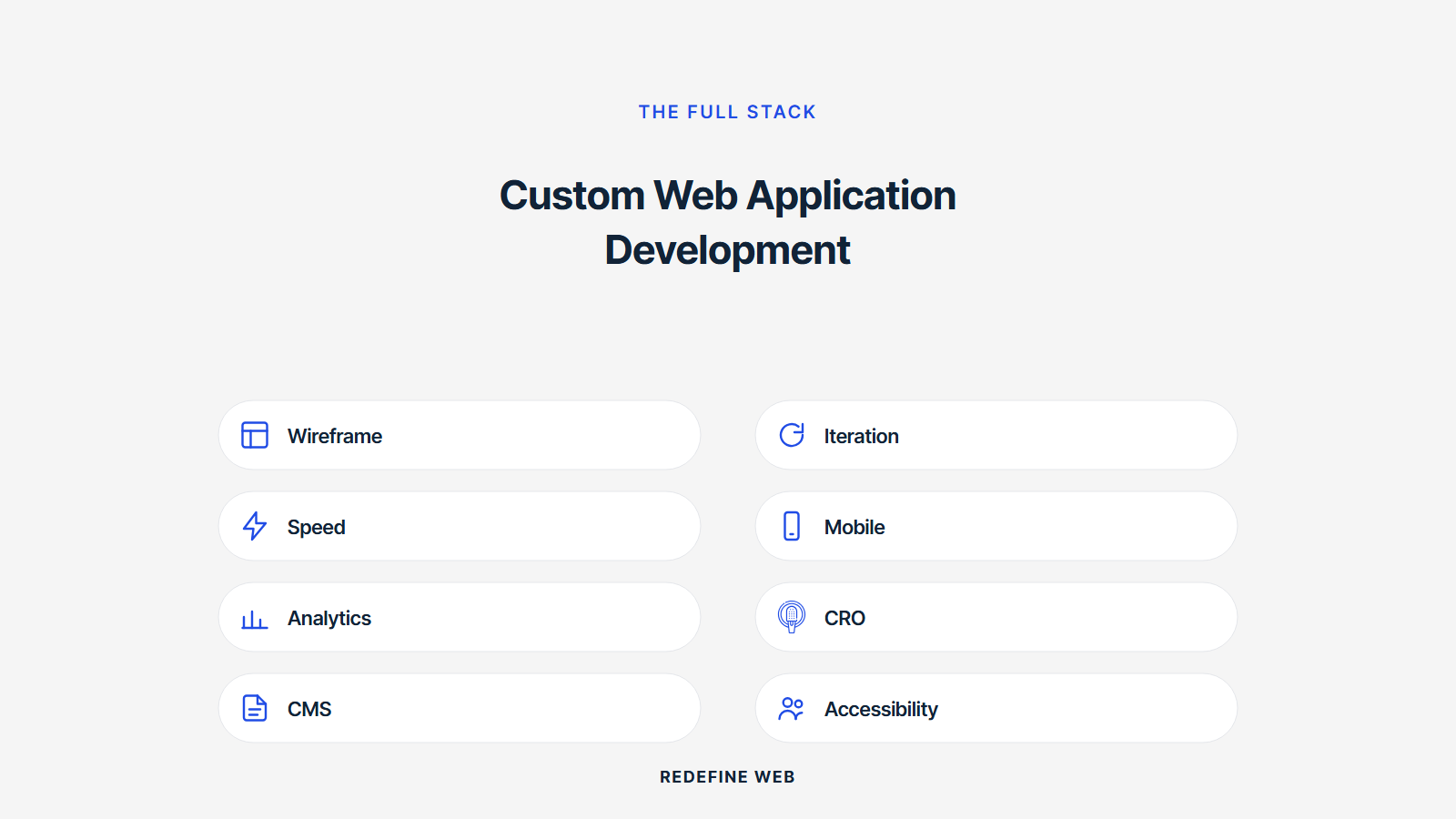
Custom web application development services cover discovery, product design, front-end build, back-end build, database schema, hosting setup, third-party integrations, testing, launch coordination, and a 30-day post-launch hypercare window. That is nine work streams under one contract. Every stream has its own deliverables and its own risk. A vendor who quotes a flat number without breaking out the streams is quoting a website, not an application. The honest quote itemizes every stream so you can compare vendors on the same axes and spot where a low quote is skipping a real work stream.
How much do custom web app development services cost in USA?
Custom web application development services in USA run $18,000 to $500,000 depending on scope. Most projects land in the $60,000 to $180,000 band with a real MVP of 6 to 12 features, one payment integration, one CRM sync, managed infrastructure, and a 30-day hypercare window. Below $18,000 you get a website with a login form. Above $500,000 you get platform-level architecture with a dedicated squad. Affordable custom web application development services exist because they cover a smaller scope, not because a vendor found a magic shortcut. Budget matches deliverable set, not the other way around.
How long does a custom web app development service take?
A scoped MVP with 4 to 6 features ships in 6 to 10 weeks. A 7 to 10 feature build ships in 10 to 16 weeks. A 10 to 15 feature Series A grade product ships in 16 to 26 weeks. A platform build with 15-plus features and multiple integrations ships in 26 to 52 weeks. Timelines assume a five-person team on our side and one accountable product owner on your side. Projects with a rotating cast of client decision-makers ship 30 to 50 percent slower. Budget the calendar for your internal decision cadence, not just our sprint cadence.
What is the difference between a custom web app and off-the-shelf SaaS?
Off-the-shelf SaaS wins when your workflow matches the product manager's default assumption. HubSpot works for CRM if you sell like most B2B teams. Custom web application development services wins when your workflow does not match any product manager's default. Custom software follows your actual process. Off-the-shelf tools force you back to the average. That is why practices, DSOs, and multi-location home services groups commission custom internal tools once revenue clears $5 million and the workflow no longer fits the top-three SaaS options in their category.
Which tech stack is best for a custom web app in 2026?
Next.js on the front-end, Node with TypeScript or Python with FastAPI on the back-end, Postgres for the database, and Vercel or AWS for hosting covers 80 percent of scoped custom web app projects at retainer scale. Vue and Laravel cover the other 20 percent for teams with existing expertise in those stacks. The pick follows the team's existing skills and the integration requirements, not the framework's marketing. A vendor who leads with the stack on the first scoping call is selling the tool, not the outcome you actually want to build.
Do I need in-house engineers or an agency for a custom web app?
Hiring in-house engineers for a one-time custom app build takes 4 to 6 months on the recruiting side, another 2 months on onboarding, and a full year of salary and benefits before the project ships. An agency delivers the same project in 12 to 20 weeks for less than the fully-loaded cost of one senior engineer. In-house wins when the app becomes a long-term product with continuous development. Agency wins when the app is a project with a defined launch and a modest ongoing maintenance footprint of 15 to 25 percent of the build cost per year.
Book your free 30-minute strategy call.
No spam, no sales rep. We use your email to schedule your call with a senior strategist. That is it.
More from the blog
View all articles → Web Design
 Core Web Vitals Healthcare Websites Actually Need to Book Patients
Read article Web Design
 Professional Services Website Design Best Practices for 2026
Read article Web Design