
Custom Web Development Services Pricing How Much It Costs in 2026
- Four pricing bands from $12k to $500k cover 95 percent of buyers.
- Mid-band $35k to $90k lands most seed MVPs.
- First-year all-in cost is 1.5 to 2x the build.
- Ongoing maintenance runs 15 to 25 percent per year.
- Rocket Software, Inc. spent $48k for 300 percent activation.
- Hidden costs vendors forget to name
- How to compare prices of custom web development services
- Offshore vs US custom web development services pricing
- Affordable custom web application development services picks
- Custom web development services pricing case study
- Budget planning framework for buyers
- Contract structure that protects both sides
- Where to start with your custom web development budget
Custom web development services pricing runs $12,000 to $500,000-plus depending on scope, and the difference between a wasted $30,000 and a well-spent $90,000 is not the vendor’s hourly rate. It is the scope conversation on the first call. This guide is what every band actually covers, the hidden costs vendors forget to name, the offshore vs US comparison, the affordable options for nonprofits, and a real case study on a scoped 4-week engagement.
You will read what the four pricing bands cover, why custom full stack web development services pricing sits higher than front-end-only work, how to compare prices of custom web development services across vendors without getting fooled by hourly rates, the hidden monthly costs every honest quote breaks out, when affordable custom web application development services actually deliver production quality, nonprofit-friendly picks, and the numbers from a real Rocket Software, Inc. rebuild that drove activation up 300 percent.
Hidden costs vendors forget to name
Hidden costs are where custom web development services pricing gets tricky. Hosting runs $80 to $2,500 per month. Domain and SSL runs $20 to $200 per year. Third-party services like Stripe, SendGrid, Twilio, and Auth0 add $50 to $2,000 per month combined. Monitoring on Sentry or Datadog runs $30 to $500 per month. Backup and disaster recovery runs $80 to $400 per month. Every one of these appears on the operational bill within 30 days of launch.
A honest quote lists every one of these in a monthly-cost appendix so you know what the operational bill looks like at 3, 6, and 12 months. Missing them is how a $60,000 build turns into a $9,000 annual surprise on the operations budget. Every SOW we write includes the appendix. Every founder who signs an SOW without one gets a first-month invoice surprise 30 days after launch. That surprise is preventable with an hour of upfront math.
- Hosting: $80 to $2,500 per month depending on user count
- Identity provider (Auth0, Clerk): $150 to $2,000 per month
- Transactional email (SendGrid, Postmark): $50 to $600 per month
- Monitoring (Sentry, Datadog): $30 to $500 per month
- Backup and disaster recovery: $80 to $400 per month
- Domain and SSL: $20 to $200 per year
- Compliance audit (annual for regulated industries): $5,000 to $30,000 per year
- Ongoing retainer (optional): $2,500 to $12,000 per month
First-year all-in total
First-year all-in cost lands at 1.5 to 2x the initial build cost. A $60,000 build turns into $8,000 to $18,000 in first-year hosting and third-party services plus $30,000 to $144,000 in optional retainer if you keep the vendor on for feature work. The true first-year cost of a $60,000 seed MVP lands between $110,000 and $220,000 depending on retainer scope. Every founder we advise budgets 1.75x as the base plan and rarely gets surprised at year-end.
Ongoing maintenance percentage
Ongoing maintenance for a custom web app runs 15 to 25 percent of the initial build cost per year. That covers minor feature additions, security patches, dependency updates, and one round of design refinement per quarter. Every mid-market custom web app product ends up paying this rate whether they use an agency retainer or an in-house engineer. Skipping ongoing maintenance is how apps end up in the news for a data breach two years after launch.
How to compare prices of custom web development services
To compare prices of custom web development services across vendors, use total-project cost against a fixed scope. Not hourly rate. Not day rate. Total cost. Ask every vendor to price the same feature list on the same timeline. The quote spread lands in a 30 to 60 percent range.
The bottom of the range is under-scoping. The top of the range is a well-loaded enterprise agency. The middle of the range is where honest scopes land. Every serious buyer compares scopes side-by-side before comparing prices. See MDN Web Docs on modern web development for the reference against which every scope gets evaluated.
Beyond total cost, four questions separate an honest quote from a lowball. Does the quote break scope into work streams? Does the quote name monthly operational costs? Does the quote include discovery and post-launch hypercare? Does the vendor’s portfolio match your phase? A quote that answers no to any of these is either under-scoping or hiding scope. Every serious buyer runs this checklist on every quote.
The hourly rate trap
The hourly rate trap catches every first-time buyer. Vendor A quotes $60/hour. Vendor B quotes $150/hour. Buyer picks A on price. A takes 30 weeks to ship what B would have shipped in 12. Total cost lands the same. Timeline hurts A by 18 weeks. Every buyer we advise looks at total-project cost against fixed scope. That framing catches the hourly trap on the first quote comparison.
Same-scope comparison discipline
Every quote comparison starts with the same written scope. That scope names the features, the integrations, the user roles, and the launch criteria. Every vendor prices that scope. Quotes that arrive with an expanded or shrunk scope get sent back for a rewrite against the original. This discipline takes an hour of your time on the first pass and saves 3 to 4 weeks of scope thrash mid-project. Every serious buyer we work with runs this process.
Offshore vs US custom web development services pricing
Offshore custom web development services pricing runs 30 to 60 percent below US rates. India-based vendors charge $18 to $45 per hour. Eastern European vendors charge $40 to $80. Latin American vendors charge $35 to $75. US-based vendors charge $110 to $250. The savings is real. So are the tradeoffs. Timezone gaps add 24 to 48 hours to every feedback cycle. Language nuance costs an extra revision. Cultural differences in stakeholder communication cost 4 to 6 weeks over a 20-week engagement.
Offshore wins when the scope is fully specified upfront, the client has an internal PM to front the timezone gap, and the workflow is well-understood in the industry. Offshore loses when the scope is emerging, the client needs synchronous conversations, or the workflow is unusual enough that the vendor has to guess. Every founder we advise runs this comparison before signing an offshore SOW.
India-based vendor tradeoffs
India-based custom web development services pricing at $18 to $45 per hour targets the biggest offshore savings. Engineering talent is deep, especially on .NET and Java. English proficiency in tier-1 cities is high. The 10-hour timezone gap with US East Coast is the biggest logistical hurdle. Vendors who run a 4-hour overlap window per day mitigate the gap. Vendors who batch everything to a daily standup do not.
Eastern European vendor tradeoffs
Eastern European vendors (Poland, Ukraine, Romania) charge $40 to $80 per hour and target US and European clients. Timezone overlap with US East Coast is 6 to 7 hours, which is workable for a 2 to 3 hour overlap window. English proficiency is uniformly high. Engineering culture skews strong on React, Node, and Postgres. Political and regional stability matters here as of 2026, and every serious offshore pick considers the current situation before signing a long-term SOW.
Ask any vendor for a fixed scope with a fixed total. Anyone who won't commit to that in writing is planning to bill you for scope creep and call it discovery.
Affordable custom web application development services picks
Affordable custom web application development services exist because they cover a smaller scope, not because a vendor found a magic shortcut. A $22,000 project ships 4 to 6 features on a template design with 1 integration and no dedicated PM. A $180,000 project ships 15 features on a custom design with 4 integrations, a dedicated PM, and 90 days of post-launch support. Both are honest scopes. The mismatch happens when a client budgets $22,000 and expects the $180,000 deliverable set.
The affordable band works for founders who accept the tradeoffs. Template UI. Limited role model. One integration. No custom design system. Six-week timeline. That scope validates a business idea, gets 10 to 20 users on the product, and closes the seed round. Every founder who tries to buy a Series A build in the affordable band ends up rebuilding at seed with a real budget. That rebuild costs 2 to 3x what a right-sized seed MVP would have cost from the start.
Affordable custom web app development services for nonprofits
Affordable custom web app development services for nonprofits sit in the $15,000 to $60,000 band because most nonprofits qualify for donated hosting credits, free tiers on major SaaS tools, and grant-funded engineering hours. TechSoup gives nonprofits access to $50,000-plus in software licenses at a fraction of retail. Every nonprofit build we scope taps these credits before adding paid infrastructure. That discipline turns a $60,000 build into a $35,000 build without cutting scope. Every serious agency working with nonprofits knows this playbook.
Grant-aligned timelines
Nonprofit builds often align with grant timelines. A grant that pays out in Q1 2026 wants a working product by Q3 2026 for the reporting cycle. That timeline drives the scope conversation more than the budget. Every nonprofit engagement we run maps the grant reporting calendar against the sprint calendar in week 1. Missing this alignment costs the nonprofit the next grant cycle when the product does not exist for the reporting deadline. Every nonprofit build we scope names this alignment on the first call.
The most predictable moment in every custom web development pricing conversation is the founder who hears the $90,000 mid-band number, nods thoughtfully, and asks whether the timeline could be a little faster and the price could be a little lower and the scope could actually be a little larger. Every agency has had that call. Every agency has learned to draw the fast-cheap-complete triangle on the whiteboard. Pick two.
Custom web development services pricing case study
Rocket Software, Inc. came to us with a pre-launch subscriber acquisition tool losing 93 percent of trial signups before the second session. Four weeks to a scheduled marketing push. No time for a full rebuild. Total budget of $48,000. We scoped a targeted 4-week engagement at the top of the mid-band on the exact 6 features that mattered. Three-step onboarding wizard, activation event tracking, drip campaign engine, activation-likelihood scoring, admin dashboard, and bulk export.
Inside 30 days we plugged the rebuilt features into the existing product, wired the event pipeline to Segment, and pushed the release. Rocket Software, Inc. drove activation rate up 300 percent in month one, hit 3,000 customers in launch week, and settled into 400-plus new subscribers per day post-launch. Every one of those numbers came from a $48,000 scoped engagement instead of a $180,000 full rebuild that would have missed the marketing window. That is the shape of a good scope in the mid-band.
The cost math
$48,000 total build. $6,200 monthly retainer for the first 6 months post-launch. $2,800 monthly hosting and third-party services. $340 monthly monitoring. Total year-one all-in cost of $114,760. That budget bought a rebuilt product, 6 months of on-call engineering support, and a launch that hit primary metrics on day 30. Every founder we work with runs this math before signing. The $48,000 headline number was 42 percent of the true first-year cost. That is the shape of an honest budget.
The outcome measured 30 days out
Activation rate up 300 percent. Three thousand customers in week one. Four hundred plus new subscribers per day. Those three numbers came from a $48,000 scoped engagement that focused on the moments in the funnel with the highest drop-off. Not a full rebuild. Not a fine-tuned model. A wizard plus event tracking plus a scoring model plus a bulk export. Every feature earned its place in the scope before it earned its way into the budget.
Budget planning framework for buyers
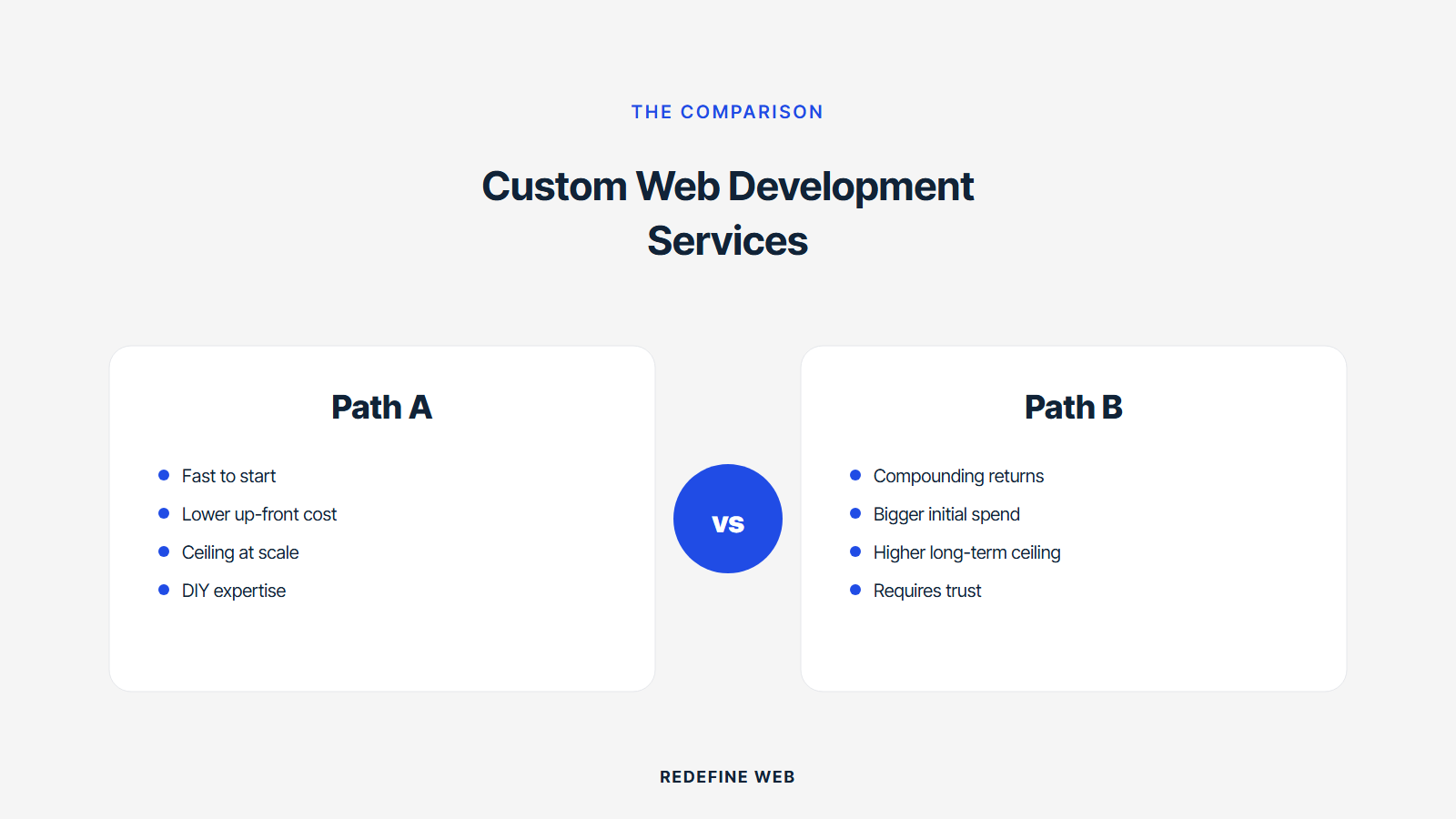
Budget planning for buyers of custom web development services pricing quotes has four buckets. The initial build. The first year of hosting and third-party services. The first hire or retainer post-launch. And the reserve for phase 2 features you have not scoped yet. Every buyer we work with underestimates the third and fourth buckets. Overestimating them is how you avoid a cash crunch 6 months post-launch.
The initial build is the smallest bucket for most SaaS buyers. A $60,000 build turns into $8,000 to $18,000 in first-year hosting and third-party services. Add $30,000 to $144,000 in retainer if you keep the vendor on. Add 25 to 40 percent of the initial build cost as a phase 2 reserve. The true first-year cost of a $60,000 seed MVP lands closer to $110,000 to $220,000 all-in. Budget for the all-in number, not just the build.
Phase 2 reserve math
Every buyer should hold 25 to 40 percent of the initial build cost as a phase 2 reserve. That reserve funds the features that surface in the first 90 days of real users hitting the product. Every launch reveals 3 to 6 features the scope missed because the users had not touched the product yet. Skipping the reserve means these features get pushed to the next fundraise or the next budget cycle. That delay costs the product 3 to 6 months of momentum.
Retainer vs first hire math
Agency retainer at $6,000 to $12,000 per month costs $72,000 to $144,000 per year. A first in-house engineer runs $130,000 to $220,000 fully loaded. The retainer wins for the first 12 months post-launch because the agency team is already familiar with the codebase, the engagement can flex up and down with scope, and the founder does not have to spend 4 months on recruiting. Every founder we advise runs this math before hiring. Most keep the retainer.
Contract structure that protects both sides
Contract structure on a custom web development services pricing engagement matters as much as the number. Fixed-price contracts push scope risk to the vendor. Time-and-materials contracts push scope risk to the buyer. Milestone-based contracts split the risk. Every serious engagement we run uses milestone-based pricing with a fixed scope per milestone and a change order process for anything outside the milestone.
Fixed-price wins for buyers with a locked scope and a vendor with delivery track record. Time-and-materials wins for exploratory prototypes where the scope will change every week. Milestone-based wins for most seed-to-Series-A engagements because it aligns cash flow with delivery. Every founder we advise picks milestone-based unless the scope is unusually stable or unusually emergent. See web.dev Core Web Vitals reference for the launch-quality metrics milestones get evaluated against.
Milestone structure and payment cadence
Typical milestone structure has 4 to 6 milestones on a 12 to 20 week engagement. Kickoff milestone at 15 percent. Design lock milestone at 25 percent. Feature complete milestone at 35 percent. Launch milestone at 20 percent. Post-launch hypercare milestone at 5 percent. Every milestone has a written definition of done and a written scope of work. Every payment triggers on milestone acceptance, not calendar date. That structure keeps both sides accountable.
Change order process
Change orders cover anything outside the original SOW scope. Every serious engagement processes change orders in writing with a scope description, an effort estimate, and a price adjustment. Verbal scope changes create disputes at week 12 that a 20-minute change order conversation in week 4 would have prevented in week 4. Every engagement we run tracks change orders in a shared doc that both sides update. That discipline saves 3 to 5 disputes per project and preserves the relationship long-term.
Where to start with your custom web development budget
Start with the four-band table above. Match your project to a band. Get 2 to 3 quotes from vendors whose portfolios show work at that band. Compare the quotes against total-project cost, not hourly rate. Add the monthly operational cost appendix to the comparison. Add the phase 2 reserve. Sign the SOW with the vendor whose quote breaks scope into work streams, names monthly costs, and quotes discovery as a real phase. That process saves 8 to 12 weeks of misfit on the wrong engagement.
Ready to scope a custom web build with a team that ships production software. Our custom web development services covers scoping, discovery, and production builds end to end. For the base scope math, see our custom web application development services, custom web portal development services, and custom web development services for startups. For AI-specific patterns, see our custom web development services with AI integration. For the wider service context, see our web design and development services. For authoritative reference on production web architecture, see MDN Web Docs on server-side programming.
Frequently asked questions
How much do custom web development services cost in 2026?
Custom web development services pricing runs $12,000 to $500,000-plus depending on scope. Four honest bands. $12k to $30k for a pre-seed prototype or small internal tool. $35k to $90k for a seed MVP or mid-market web app. $95k to $180k for a Series A build or multi-role portal. $200k+ for enterprise platforms and dedicated squads. Every band has a scope shape and a definition of done. Every band has a wrong pick that looks tempting until week 6. Match your project to a band, get 2 to 3 quotes against the same fixed scope, and compare total-project cost rather than hourly rate.
Why does custom full stack web development services pricing sit higher than front-end-only work?
Custom full stack web development services pricing sits 30 to 50 percent higher than front-end-only work because full stack covers the database, API, business logic, integrations, and hosting on top of the interface. Front-end work is faster and cheaper because the vendor does not own state, authentication, or data flow. Every project with logged-in users, saved data, or business logic that runs on user input is full-stack work. Every vendor pitching front-end-only pricing for a full-stack build is quoting the wrong scope. Naming this on the first call prevents 20 percent of the timeline lost to scope resets mid-project.
How do I compare prices of custom web development services across vendors?
To compare prices of custom web development services, use total-project cost against a fixed scope, not hourly rate. Ask every vendor to price the same feature list on the same timeline. The quote spread will land in a 30 to 60 percent range. The bottom is under-scoping. The top is a loaded enterprise agency. The middle is where honest scopes land. Beyond total cost, ask four questions. Does the quote break scope into work streams? Does the quote name monthly operational costs? Does the quote include discovery and post-launch hypercare? Does the vendor's portfolio match your phase?
What hidden costs do vendors forget to name?
Hosting runs $80 to $2,500 per month depending on user count. Identity provider like Auth0 or Clerk runs $150 to $2,000 per month. Transactional email on SendGrid or Postmark runs $50 to $600 per month. Monitoring on Sentry or Datadog runs $30 to $500 per month. Backup and disaster recovery runs $80 to $400 per month. Compliance audits for regulated industries run $5,000 to $30,000 per year. Every one of these appears on the operational bill within 30 days of launch. A honest quote lists every one in a monthly-cost appendix. Missing them turns a $60,000 build into a $9,000 annual surprise.
Do affordable custom web application development services actually deliver production quality?
Affordable custom web application development services exist because they cover a smaller scope, not because a vendor found a magic shortcut. A $22,000 project ships 4 to 6 features on a template design with 1 integration and no dedicated PM. A $180,000 project ships 15 features on a custom design with 4 integrations, a dedicated PM, and 90 days of post-launch support. Both are honest scopes. The affordable band works for founders who accept the tradeoffs of template UI, limited roles, and single integration. Founders who try to buy a Series A build in the affordable band end up rebuilding at seed with a real budget.
Are there affordable custom web app development services for nonprofits?
Affordable custom web app development services for nonprofits sit in the $15,000 to $60,000 band because most nonprofits qualify for donated hosting credits, free tiers on major SaaS tools, and grant-funded engineering hours. TechSoup gives nonprofits access to $50,000-plus in software licenses at a fraction of retail. Every nonprofit build we scope taps these credits before adding paid infrastructure. That discipline turns a $60,000 build into a $35,000 build without cutting scope. Nonprofit builds often align with grant timelines, and mapping the reporting calendar against the sprint calendar in week 1 is the discipline that prevents missing the next grant cycle.
Book your free 30-minute strategy call.
No spam, no sales rep. We use your email to schedule your call with a senior strategist. That is it.
More from the blog
View all articles → Web Design
 Core Web Vitals Healthcare Websites Actually Need to Book Patients
Read article Web Design
 Professional Services Website Design Best Practices for 2026
Read article Web Design