
Why Most Dental Billboard Ads Waste Money and When They Do Not
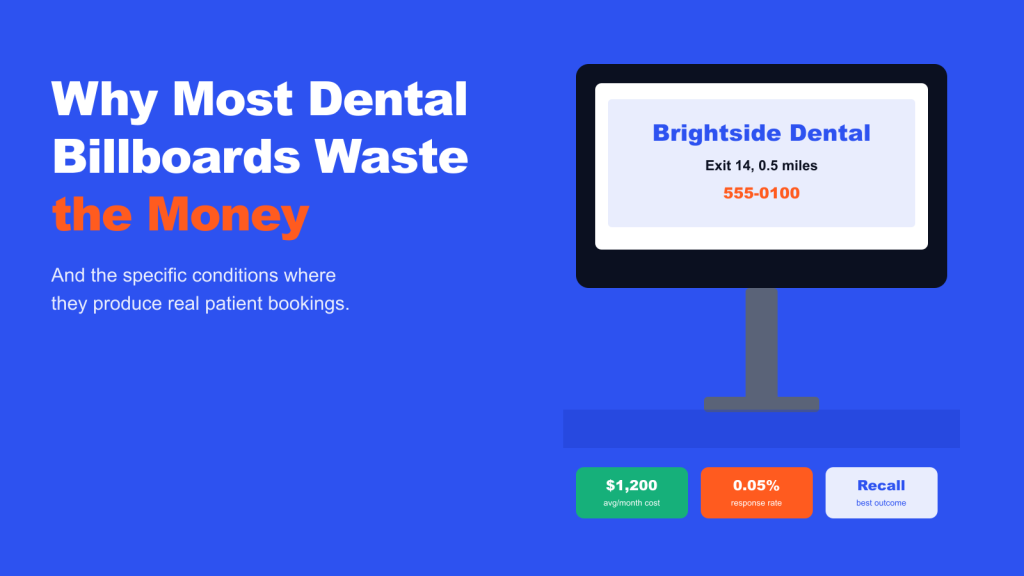
Dental billboards are the most argued-about advertising medium in practice marketing. Some dentists swear by them as brand builders. Others spend thousands on a roadside sign and book zero new patients directly from it. The truth sits between those two experiences, and the difference between a billboard that pays off and one that drains the marketing budget comes down to three specific conditions.
[rdw_takeaways items=”Dental billboard ads almost never produce direct bookings at a competitive cost per patient but can produce measurable brand recall that amplifies digital ad performance.|The three conditions that make a dental billboard cost-effective are high daily traffic volume, a practice within 2 miles, and a message that fits in six words or fewer.|Billboards work best when paired with a Google Ads campaign targeting the same geographic area so patients who see the sign can find you when they search.|Digital dental advertising consistently outperforms billboard ads on cost per booked appointment in all market types except the specific high-traffic urban corridor condition.|Tracking dental billboard ROI requires a unique phone number, a short vanity URL, and before-and-after branded search volume comparison in GA4.”]
[/rdw_takeaways]
What Dental Billboard Ads Actually Produce
Let us start with what a dental billboard realistically does and does not do. A billboard ad produces brand recall. A patient who drives past your billboard three times a week for two months knows your practice name and probably your location. When that patient needs a dentist and searches on Google, they are more likely to click your ad, your Google Business Profile, or your organic listing than a competitor they have never seen before.
What a dental billboard almost never produces is a direct booking from a patient who saw the sign and immediately called to schedule. The response mechanism is broken by design. A patient driving at highway speed cannot safely write down a phone number. A patient stuck in traffic might remember a name. Maybe. The direct response rate from dental billboard dental ads averages between 0.01% and 0.08% of impressions, which translates to perhaps one to three direct patient contacts per month from a well-placed board.
That is not zero. But it is also not close to the return a comparable budget produces in Google search or Meta advertising. The argument for dental billboards is not about direct response. It is about brand amplification for the digital campaigns you are already running.
Three Conditions That Make Dental Billboards Worth the Cost
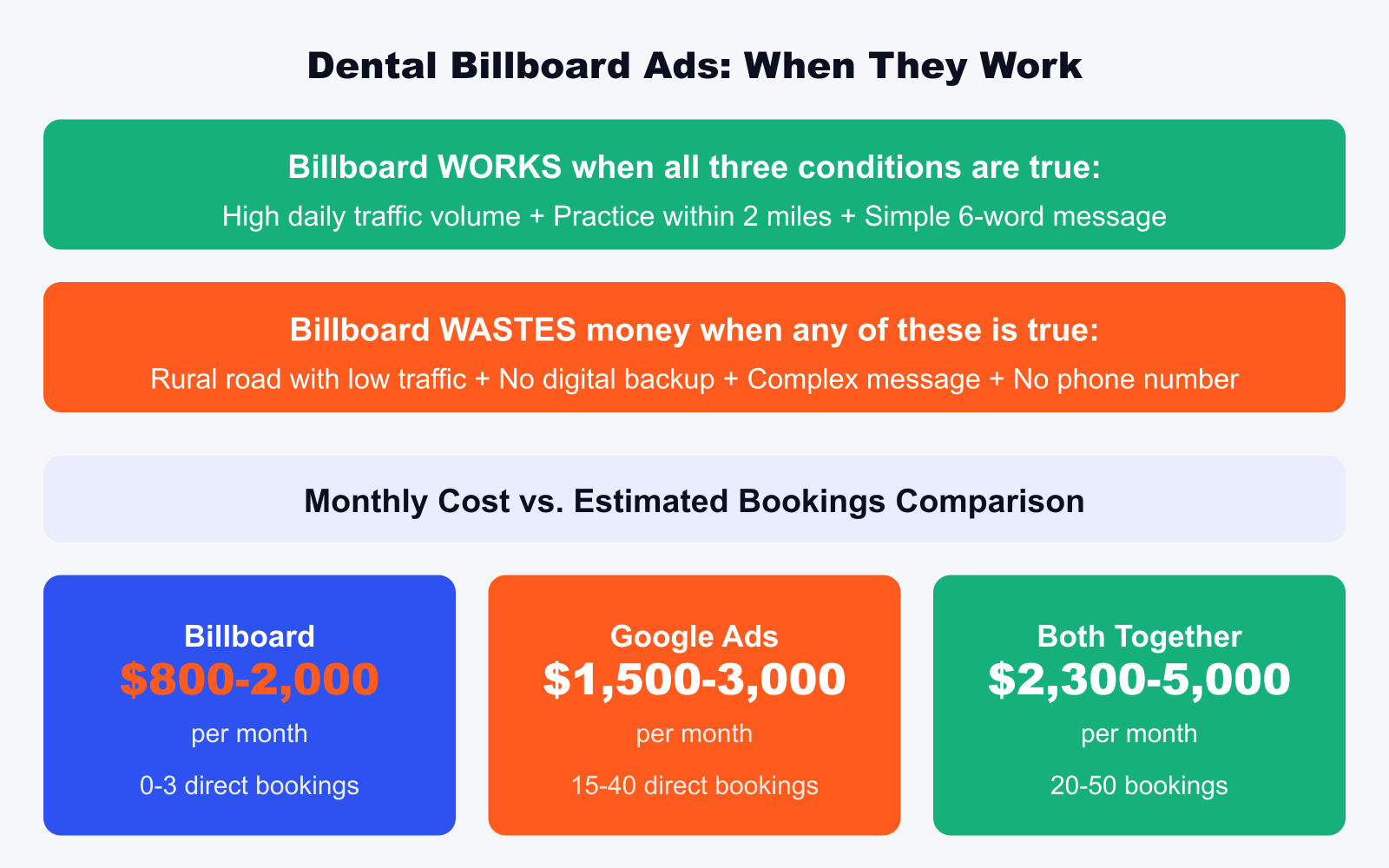
Most dental billboard spending produces poor ROI because the practice buying the board has not verified that the necessary conditions are in place. When all three conditions exist, a dental billboard can contribute measurably to the practice marketing program. When any one of them is missing, the billboard rarely justifies the cost.
Condition one: high daily traffic volume. The billboard needs to generate meaningful impressions. An outdoor advertising board on a suburban arterial road with 8,000 vehicles per day produces brand recall across a population that is too small to justify the $800 to $2,000 monthly cost. A billboard on a primary commuter corridor with 60,000 to 120,000 vehicles per day generates meaningful name recognition across a large local population. Traffic count data is publicly available in most metro markets and should be the first question you ask any outdoor advertising vendor.
Condition two: your practice is within two miles of the board. A billboard advertising your dental practice works best when patients who see it can act on the awareness within a reasonable travel distance. A board three miles from the practice on a road that does not lead naturally toward it produces awareness in people who are unlikely to convert to patients. A board on the exit ramp that leads directly to your practice, with your cross-street visible from the road, makes the recall actionable.
Condition three: your message fits in six words or fewer. A driver moving at 45 miles per hour has approximately three to four seconds to process a billboard. The average adult can read six words in three seconds. Your dental billboard must communicate your practice name and one claim in six words. Smiling Families. Exit 14. Brightside Dental. That is seven words and it works. Three bullet points, your tagline, your credentials, and your phone number do not work on a billboard. They work on a postcard.
Dental Billboard Ad Design That Communicates in Three Seconds
Most dental billboard creative is designed by someone applying print design logic to an outdoor medium. The rules are completely different. A print ad can have seven words on one line and twelve on the next. A billboard can have seven words total, and even that is pushing the readable limit at speed.
Font size. At 500 feet, 10-inch letters are barely readable. At 300 feet, they are comfortable. Billboard vendors typically specify minimum font sizes for their boards. If they do not, use 36-inch-tall letters for the primary text and nothing smaller than 18 inches for secondary elements. Most dental billboards are designed with fonts that are far too small to read at driving speed.
Color contrast. High contrast between text and background is mandatory. White on dark blue, yellow on black, black on white. Low-contrast combinations like dark green text on a slightly lighter green background are invisible at speed. The brand palette rules that apply to your digital dental ads do not all transfer to outdoor. Readability is the primary design constraint.
One element per board. Your practice name. Your phone number. Your location. Pick two of those three. A board that has all three plus a headline, a tagline, a photo, and a social media handle communicates none of them effectively. The best dental billboard creative is the simplest dental billboard creative.
The phone number problem. Phone numbers on billboards are largely decorative. A driver cannot safely dial a number they read from a moving vehicle. The value of the phone number on a dental billboard is not that patients call it. It is that they see it, their brain registers it as a local provider, and they search your name on their phone at the next red light. Include a short, memorable vanity number (1-800-DENTIST-style) if you have one. Otherwise, prioritize the website or a short URL.
| Element | Include | Why |
|---|---|---|
| Practice name | Yes, always | The only lasting impression |
| Short location cue | Yes, if space allows | Makes recall actionable |
| Phone number | Only if memorable | Rarely dialed, adds recognition |
| Short URL | Yes, if under 15 chars | Searchable at the next light |
| Tagline or claim | Only if 4 words or fewer | Dilutes if complex |
| Multiple services | Never | Unreadable at speed |
| Social media handles | Never | Zero recall at speed |
How to Track Dental Billboard Ad ROI
Dental billboards are difficult to track precisely, but they are not untraceable. Several measurement approaches give you enough data to make an informed hold-or-cancel decision when the board contract comes up for renewal.
Unique vanity phone number. If your billboard includes a phone number, use a unique tracked number that routes to your main line. Every call to that number came from someone who remembered it from the billboard or searched it after seeing the board. This is the most direct attribution available for outdoor dental advertising.
Short unique URL. Use a URL like bright-dental.com/local or brightside.dental on the board. Patients who type that exact URL directly accessed it from the billboard. Track these sessions in GA4 as a custom source. The volume will be small but the attribution is clean.
Branded search volume comparison. Before the billboard goes up, note your average weekly branded search volume in Google Search Console (searches for your practice name directly). After the board has been running for 60 days, check branded search volume again. An increase in branded searches that is not explained by other marketing activity is attributable to the billboard awareness effect. This is the most reliable proxy metric for outdoor advertising in dental markets.
Intake asking. How did you hear about us? Train your front desk consistently. Some percentage of billboard-influenced patients will say they saw your sign, even if they actually found you through Google after the sign planted the name in their memory.
Dental Billboards and Digital Ads Running Together
The strongest case for dental billboard advertising is not the billboard in isolation. It is the billboard as a brand amplifier for your digital campaigns. When a patient has seen your practice name three times this week on their commute and then sees your Google search ad, your Meta retargeting ad, or your Google Business Profile, the conversion rate on those digital touchpoints is measurably higher than it would be if the billboard had never run.
This halo effect mirrors what we measured when building multi-channel digital programs for practices running concurrent organic and paid campaigns. When Answer Air Services ran a program combining multiple digital channels, they saw 350% more web traffic and 171% more leads during the campaign window. The cross-channel reinforcement, where one channel validated the practice’s presence established by another, produced results that neither channel could have generated alone. The same dynamic applies when a dental billboard amplifies the digital program’s reach to patients who primarily encounter it through passive exposure before converting through an active search.
The coordination that makes this work: run the billboard on a corridor that overlaps with your Google Ads geographic targeting zone. This means the same patient who sees your billboard is also seeing your Google search ads and Meta awareness ads. The convergence of multiple touchpoints produces a patient who feels familiar with your practice before they ever interact with your digital marketing directly.
The dental remarketing ads channel plays a specific role here. Patients who see the billboard, search your name out of curiosity, visit your site, and then leave without booking are retargeted by your Google and Meta retargeting campaigns. Without the retargeting layer, those billboard-influenced visits produce no bookings. With it, you convert a percentage of the billboard awareness into actual booked appointments.
When Dental Billboard Ads Fail to Produce ROI
Most dental billboard spending fails on one of four predictable mistakes. Knowing them helps you evaluate whether the billboard a local vendor is pitching you is worth the monthly contract.
Low-traffic locations. An outdoor advertising board at 15,000 vehicles per day in a suburban area produces roughly 450,000 monthly impressions. At a 0.05% response rate, that is 225 patient contacts per month, of which perhaps 10% convert to booked appointments. Twenty-two new patient appointments from $1,500 in monthly spend is $68 per booked appointment. That math works. The same board on a 4,000 vehicles per day rural road produces five booked appointments at $300 per acquisition. That math rarely works compared to digital alternatives.
No digital backup campaign. A billboard without a concurrent Google search campaign is a brand awareness spend that cannot be converted. Patients who see the board and want to find you will search your name. If your Google Business Profile is incomplete, your website loads slowly, or your Google Ads are not running for your practice name as a branded keyword, that intent evaporates.
Complex creative. A dental billboard with five messages, multiple fonts, a large photo, and a long URL produces zero recall. The vendor selling the space will call it a premium placement and charge accordingly. The creative will still fail to communicate anything the patient retains.
No tracking mechanism. Running a dental billboard for six months without a unique phone number, a tracked URL, or a branded search volume baseline produces a marketing spend you can never justify or invalidate. You will renew on gut feeling rather than data. The call tracking for dentists setup covers the phone tracking piece in detail.
Dental Billboard Cost Benchmarks by Market Type
Understanding what a dental billboard costs in different markets helps you evaluate whether the spend belongs in your marketing mix at all.
Rural markets: static billboard boards rent for $300 to $700 per month. Traffic volumes are low. Response rates can be competitive with digital in markets where Google Ads search volume is too thin to sustain a profitable campaign. In these markets, billboard advertising is often the most cost-efficient outdoor acquisition channel available.
Suburban markets: static boards on commuter arterials rent for $800 to $2,500 per month. Traffic volumes are moderate to high. Digital competition for dental keywords is present but not extreme. Billboard advertising in these markets can produce a reasonable return when paired with a digital campaign but rarely outperforms digital on a standalone cost-per-patient basis.
Urban and metro markets: digital billboard placements on primary commuter corridors rent for $3,000 to $15,000 per month. Static boards are cheaper but compete for sight lines with digital boards. In these markets, the same budget produces far more booked appointments through Google search and Meta targeting. Billboard advertising in dense urban markets is best reserved for practices with large marketing budgets where brand presence across all channels is the goal rather than pure acquisition efficiency.
Compare these benchmarks against your current cost per booked appointment through digital channels. The dental PPC advertising cost guide covers digital benchmarks across markets so you can make the comparison directly.
Frequently Asked Questions About Dental Billboard Ads
Do dental billboard ads actually book new patients?
Dental billboard ads rarely produce direct bookings at a competitive cost per patient. The average direct response rate is 0.01% to 0.08% of impressions. What billboards do reliably produce is brand recall that amplifies digital campaign performance. Patients who have seen your billboard and then search for a dentist are measurably more likely to click your Google ad or visit your website than patients with no prior exposure. The billboard’s value is brand halo, not direct response.
How much do dental billboard ads cost per month?
Dental billboard costs range from $300 per month for rural static boards to $15,000 or more for digital boards on urban commuter corridors. The typical suburban dental practice billboard on a moderate-traffic arterial road runs $800 to $2,500 per month. Compare this against your cost per booked appointment from digital channels before committing to an outdoor advertising contract.
What should a dental billboard say to be effective?
An effective dental billboard communicates the practice name plus one claim in six words or fewer. Bright smiles. Exit 14. Brightside Dental. Tooth pain? Same-day. Call 555-0100. The message needs to be readable in three seconds at driving speed. Phone numbers should be memorable or omitted. Taglines work only if they fit in four words. Multiple services, bullet points, and elaborate descriptions do not work on billboards.
How can I track whether a dental billboard is producing results?
Assign a unique call tracking number to the billboard. Use a short unique URL that is trackable in GA4. Measure branded search volume in Google Search Console before and after the board launches. Train your front desk to ask every new patient how they heard about the practice. Cross-referencing these four data sources gives you a reasonable estimate of the billboard’s contribution to new patient acquisition.
Is a dental billboard better or worse than Google Ads for patient acquisition?
In virtually all market types, Google Ads produces a lower cost per booked appointment than dental billboard advertising. The exception is rural markets where Google search volume for dental keywords is too low to support a profitable campaign. In suburban and urban markets, the same $1,500 monthly spend produces 10 to 25 booked appointments through Google search versus two to five through a well-placed billboard. Billboards complement digital campaigns by building brand recognition. They do not replace them.
Should a dental practice run billboards and digital ads at the same time?
Yes, if the billboard is in a high-traffic location and the budget allows for both. The combination produces a higher conversion rate on digital touchpoints than digital alone because patients who have seen the billboard already know the practice name. The billboard awareness effect is most measurable when the geographic radius of the billboard overlaps precisely with the geographic targeting zone of the Google and Meta campaigns. See our guide to dental PPC strategy for the full campaign structure that supports multi-channel integration.
Want to build a multi-channel dental advertising strategy where every dollar is tracked to a booked appointment? See what we do for dental practices at our dental marketing hub.
Book your free 30-minute strategy call.
No spam, no sales rep. We use your email to schedule your call with a senior strategist. That is it.
More from the blog
View all articles → PPC
PPC Home Services PPC Marketing: What a Strong Campaign Looks Like
Read article PPC
PPC PPC for Home Service Businesses: How to Lower Cost Per Lead
Read article PPC
PPC