
Google Ads vs Facebook Ads for Dentists
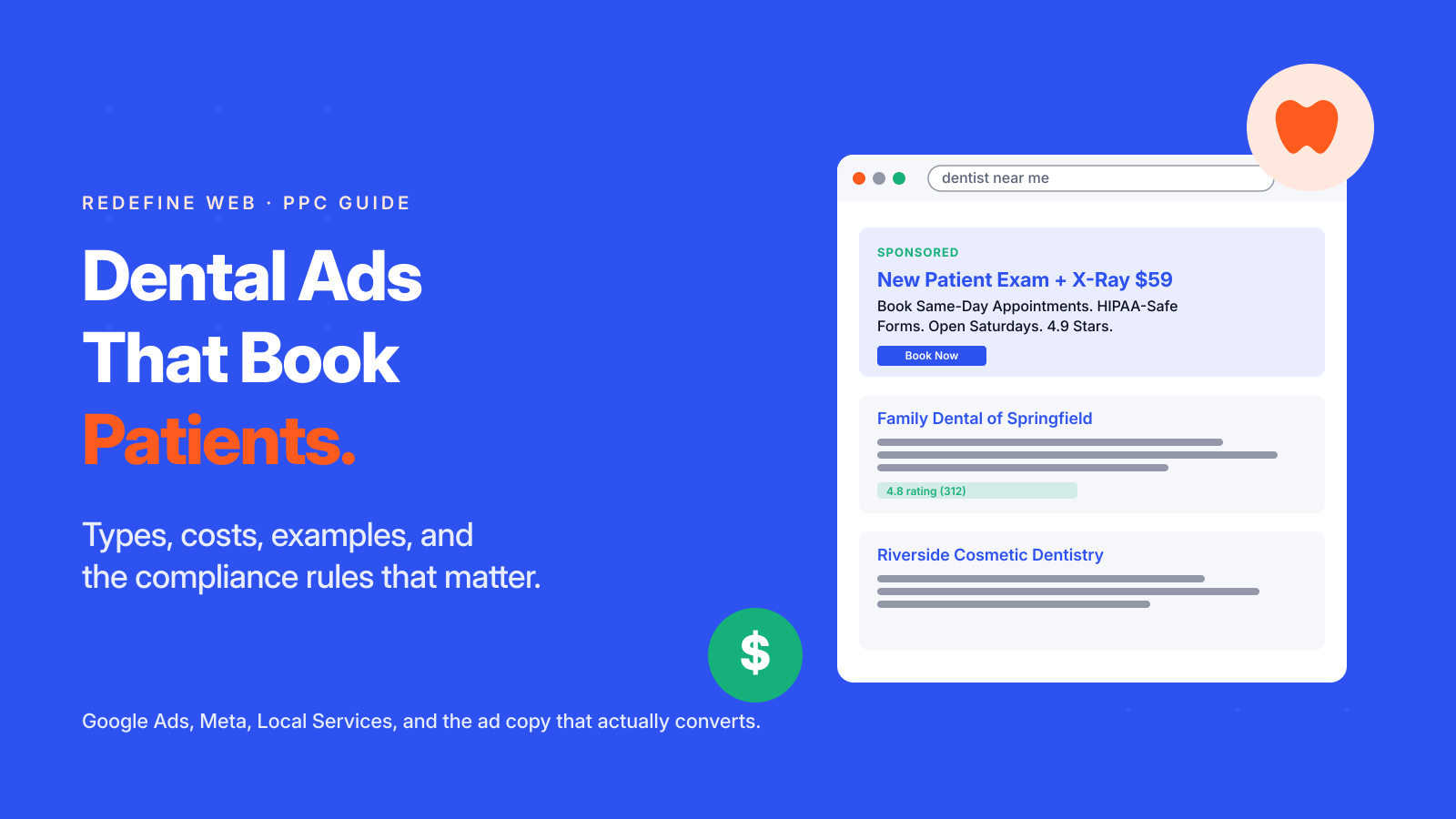
Dental ads are the fastest way to fill a chair, and the fastest way to torch a budget when the setup is wrong. A well-run Google Search campaign brings a new patient in for $75 to $150. A poorly targeted Meta campaign burns $3,000 a month and produces free-cleaning shoppers who never come back. This guide walks through the six ad types that work for dentists in 2026, what each one costs, real examples, and the dental ads compliance rules that keep the account from getting suspended.
The six dental ad types that produce booked patients
Most practices spread budget across the wrong mix. They pour money into a Facebook boost, ignore Local Services Ads, and wonder why the phone stays quiet. The healthy channel split for a single-location practice puts Google Search Ads in the driver’s seat, with three secondary channels feeding it and one trailing channel handling remarketing. The chart below shows what a working mix looks like once tracking is in place.

Google Search Ads catch the highest-intent traffic. Someone typing “dentist near me” or “emergency root canal” is ready to book today. Search ads sit above the map pack and take about 15 to 25 percent of clicks on a competitive dental keyword. Cost per click runs $6 to $18 for general dentistry and $12 to $45 for implants or Invisalign. The full breakdown of what a converting implant funnel looks like sits in our dental implant marketing guide. Well-managed accounts land new patients in the $75 to $150 range once conversion tracking is honest.
Local Services Ads (LSAs) sit above search ads with a Google Screened badge. Dentists pay per lead, not per click, and the lead is a phone call or a booking request that came through the ad. Cost per lead runs $20 to $65 depending on market density. LSAs require background checks, license verification, and a minimum number of Google reviews. Practices with 100+ reviews at 4.7 stars or higher dominate this placement.
Meta ads (Facebook + Instagram) work for cosmetic dentistry marketing, Invisalign, and new-mover campaigns. They do not work as a substitute for Search Ads. Meta demand is lower-intent, so the copy has to sell the appointment, not just describe the service. A properly targeted Invisalign campaign to women 25 to 45 within a five-mile radius pulls consult requests at $40 to $85 each.
YouTube + display remarketing catches visitors who left the site without booking. The full dental remarketing ads playbook covers the audience windows and creative rotation. Ad spend on remarketing is small (5 to 10 percent of the budget) but the return is outsized. The audience already knows the practice. Skippable YouTube ads with a 15-second hook run $0.05 to $0.15 per view.
The last two channels, TikTok and Nextdoor, work for specific plays. TikTok fits pediatric dental marketing and young-adult cosmetic practices. Nextdoor’s neighborhood targeting works for practices in dense suburbs. Skip both if the primary service line is implants, sedation, or emergency dentist marketing.
What dental ads cost in 2026
Total monthly ad spend for a single-location practice starts at $1,500 and scales to $12,000. Below that floor there isn’t enough impression volume to learn what works. Above $12,000 a single location hits diminishing returns and the money is better split into new locations or premium service lines.
The healthy starting split for a $3,500 monthly ad budget looks like this. About $1,800 in Google Search Ads targeting five core service groups. About $700 in Local Services Ads. About $700 in Meta running one cosmetic or Invisalign campaign, which is also where a filtered teeth whitening marketing offer performs best. About $300 in YouTube and display remarketing to close browser abandoners. This mix produces 20 to 40 new-patient inquiries a month for most private practices once the landing pages and tracking are in place.
Below is the 2026 benchmark table we see across dental accounts under active management. Costs vary by market density (a Manhattan dentist pays double a rural Nebraska practice) but the ratios hold.
| Ad type | CPC or CPL | Cost per new patient | Best fit |
|---|---|---|---|
| Google Search Ads (general) | $6 to $18 CPC | $75 to $150 | All practices |
| Google Search Ads (implants) | $12 to $45 CPC | $180 to $420 | Implant, sedation, cosmetic |
| Local Services Ads | $20 to $65 CPL | $45 to $110 | 4.7+ star, 100+ reviews |
| Meta (Facebook + Instagram) | $1.20 to $3.80 CPC | $85 to $220 | Cosmetic, Invisalign, new-mover |
| YouTube skippable | $0.05 to $0.15 CPV | $95 to $180 | Remarketing + brand build |
| Display remarketing | $0.80 to $2.20 CPC | $60 to $140 | Cart-abandon and booking flows |
The full pricing framework is on our dental PPC services page. Every plan there breaks out monthly ad spend from the management fee so nothing hides behind a bundled number.
What a high-performing dental ad looks like
The best dental ads share four traits. A specific offer with a real dollar figure. Proof (star rating, review count, or year established). A booking-friendly call to action. And a location or service qualifier so the click self-selects.
Here’s a working Google Search Ad for a general dentist in a mid-sized market. Notice how the headline stack answers the search, names the offer, and stacks proof in the description lines.
Headline 1: New Patient Exam + X-Ray $59
Headline 2: Book Same-Day Appointments
Headline 3: 4.9 Stars | 812 Google Reviews
Description 1: Open Saturdays. Online booking in 60 seconds.
             HIPAA-safe intake forms. Sedation available.
Description 2: General dentistry, Invisalign, implants.
             Free second opinions on major work.
CTA: Book Now
Sitelink 1: New Patient Special
Sitelink 2: Meet the Dentists
Sitelink 3: Emergency Appointments
Sitelink 4: Financing Options
The same principles apply to dental social media ads, but the visual matters more than the copy. A short vertical video of the office and one dentist introducing the practice outperforms a static graphic by 2 to 3x on cost per lead. Text overlay stays under 20 percent of the frame so Meta’s algorithm doesn’t throttle delivery.
What kills conversion is the opposite of specificity. “Beautiful smiles start here” with a stock-photo blonde and no offer, no rating, no location signal. That ad gets clicks from curious browsers and zero from patients ready to book. If the ad wouldn’t make a patient pick up the phone in a busy waiting room, it won’t perform online either.
Landing pages make or break the ad spend
An ad that sends traffic to the homepage buries the conversion by three clicks and cuts lead volume by 40 to 60 percent versus a purpose-built landing page. Every campaign needs its own landing page, and each landing page needs one job.
The winning dental landing page pattern runs seven blocks. The hero repeats the ad’s offer verbatim so the patient knows they clicked the right thing. The trust bar shows the Google star rating, review count, and years in practice. A short first-person paragraph from the dentist explains what the appointment covers. Photos of the actual office, not stock. A one-screen booking widget (not a “request appointment” form buried behind a scroll). An FAQ that handles insurance, financing, and same-day questions. A sticky call button that stays visible through every scroll.
Speed matters as much as layout. A landing page that takes more than 2.5 seconds to load on a phone loses about 30 percent of clicks before the hero even renders. Compress images, drop unused fonts, and cache aggressively. This is one of the four biggest levers on cost per new patient across every dental account we run, and it’s covered in more depth on our dental website design page.
Real dental ad results across a 50-location DSO
The cleanest way to show what right-sized dental ads produce is a real client. Smile Design Dentistry, a 50+ location DSO, came to us with inflated ad spend, low-quality leads, and tracking that couldn’t tell which office booked which patient. Every location ran ads independently, so a $12 CPC in one market was cross-contaminating a $6 CPC market next door.
The scope covered a full account restructure. We built one Google Ads MCC with per-location sub-accounts. Search campaigns split by service line so implant queries no longer wasted budget on hygiene bidders. Paid social ran as full-funnel prospecting-plus-remarketing, with creative tested weekly. Every location got its own landing page tied to its Google Business Profile so the ad, the map listing, and the site all told the same story.
Six months in, cost per call dropped 30 percent across the network, lead quality moved from a 12 percent booking rate to 38 percent, and the finance team could finally see which offices carried the ad spend and which subsidized it. The full breakdown is on the case study page linked above.
What matters isn’t the 30 percent number. What matters is the shape of the fix. Structural account cleanup plus per-location tracking plus tighter landing pages beats a $40,000 monthly budget spread thin across a badly organized MCC. Multi-location groups looking at the same pattern should read the DSO dental marketing rollout playbook next.
Compliance rules that keep the account alive
Dental is a regulated category. Google, Meta, and the FTC each have rules that suspend accounts when broken, and none of them warn you first. Six rules cover the biggest exposure areas.
HIPAA and pixel data. A booking-request form on a landing page cannot pass patient details to Meta, Google, or any third-party pixel. That means no auto-populated email or phone number in the Meta CAPI event, no PHI in Google Ads offline conversion imports, and no third-party session-replay tool running on booking pages. Use hashed conversion signals only. Sign a Business Associate Agreement with every vendor whose stack touches the form.
Personalized advertising restrictions. Google Ads classifies dentistry under sensitive health categories in most account structures, which blocks remarketing to specific health conditions. Remarketing to “visited implant page” audiences works. Remarketing to “gum disease patients” does not, which is why safe periodontal marketing books those consults from search and content instead of retargeting. Read the exact policy on the Google Ads personalized advertising page before scaling remarketing.
Claims about outcomes. “Straighter teeth in six months” is fine. “Cure your TMJ” is not. Any medical outcome claim needs supporting evidence and a disclaimer, and dental boards in about 20 states have specific rules on before-and-after photos including required patient consent, storage retention, and how the images can be cropped.
State-level advertising rules. Some state dental boards restrict discounts on specific services, superlative claims (“best dentist in…”), or the naming convention for a practice. Check the state board’s advertising rules before launching a new-patient special. The ADA advertising rules summary is a strong starting point.
Meta ad copy on health. Meta rejects ads that promise weight loss, “before and after” transformations without permission, or aggressive claims. Frame ads around the appointment experience and the office, not the physical outcome. Consult-request offers convert better than transformation-promise offers anyway.
Landing page disclosures. Every landing page that captures a phone number needs a TCPA-compliant checkbox for SMS follow-up if the practice sends appointment reminders by text. Miss the checkbox and the practice inherits liability for every unsolicited text.
Tracking that turns ad clicks into booked patients
The single biggest reason dental accounts underperform isn’t the ad copy or the bid strategy. It’s broken tracking. Ninety percent of the dental accounts we audit have at least one of these three problems: form fills counted as conversions when they never turned into appointments, calls tracked without call-source attribution, or ad-platform conversion counts double what the practice management software says.
The tracking stack that solves this runs four layers. Call tracking with dynamic number insertion (CallRail or CallTrackingMetrics) so every phone number on the site rotates by traffic source. A form platform (Formidable, Gravity Forms, or Ninja Forms) that fires a hashed conversion event on submit. Offline conversion imports from the practice management software (Dentrix, Open Dental, Eaglesoft) so Google Ads and Meta learn from actual booked visits, not form submissions. And a lightweight dashboard (Looker Studio, Databox) that shows cost per new patient by channel on one screen.
When those four layers are wired correctly, an ad account gets 20 to 40 percent cheaper within three months. The bids didn’t change. Google’s Smart Bidding is finally optimizing to real patients instead of form guesses. Practices considering vendors should read our full guide to picking a partner in the dental marketing agency guide and our post on what makes a dental Google Ads agency worth hiring.
Common dental ad mistakes that burn budget
Six mistakes show up on 80 percent of the accounts we audit. Any one of them costs $500 to $2,000 a month in wasted spend.
- Running all service lines in one campaign. Implants, hygiene, and emergency should each have their own campaign. Mixed campaigns train Google to bid an implant CPC on a hygiene searcher, blowing 4x the target CAC.
- Sending all clicks to the homepage. The homepage answers ten questions. A landing page answers one. Cost per booked patient drops 30 to 50 percent when every campaign lands somewhere purpose-built.
- Broad-match keywords with no negatives. Broad match on “dentist” bleeds spend to jobs, salaries, veterinary dental, dental school queries, and every other tangent. Start with phrase or exact match and expand only after negatives are stacked.
- No offline conversion import. Ad platforms optimize toward whatever they’re told is a conversion. If the target is a form submission, the algorithm finds people who fill out forms and don’t show up. If the target is a booked visit, the algorithm finds patients.
- Ignoring Local Services Ads with the “we don’t need them” excuse. LSAs sit at the top of the search page and charge per lead, not per click. Skipping them cedes prime real estate to competitors for a channel that often produces the cheapest patients.
- No creative refresh cycle. Meta creative fatigues in 3 to 6 weeks. Google responsive search ads need new headlines every 60 to 90 days. Set-and-forget campaigns lose 20 percent of performance per quarter.
The first fix on any account is stopping the bleed before adding new spend. Bringing on a new campaign with broad-match and homepage-landing still live just funds the waste faster.
When to bring in outside help
Three signals mean it’s time to hand the ads to a specialist. Monthly ad spend over $3,000 with no in-house Google Ads certified staff. Cost per new patient trending up quarter over quarter with no clear reason. Or a plan to launch a new service line (implants, sedation, cosmetic) where the CPCs are 3x general dentistry and mistakes get expensive fast.
A specialist runs the ad account, the tracking stack, and the landing pages under one plan. The office keeps the Google Ads and Meta accounts in its own name, so leaving means changing the manager access, not starting from scratch. Our dental marketing team scopes every engagement so the practice owns every asset from day one.
Frequently asked questions
How much should a dentist spend on ads per month
A single-location dental practice should spend $1,500 to $6,000 per month on dental ads once tracking is in place. Below $1,500 there isn’t enough impression volume for Smart Bidding to learn, and results stay noisy. Above $6,000 a single location hits diminishing returns and money moves better into a second location.
The healthiest split we see for a $3,500 monthly budget runs about 50 percent Google Search Ads, 20 percent Local Services Ads, 20 percent Meta, and 10 percent YouTube or display remarketing. That mix produces 20 to 40 new-patient inquiries a month for private practices in mid-competition markets. Multi-location DSOs scale that per office, with per-location tracking so the finance team can see which addresses carry the network and which lag.
Do dental ads work better on Google or Facebook
Google Search Ads produce cheaper and higher-intent dental leads than Facebook for general dentistry, urgent care, and any procedure where patients search actively. Meta wins for cosmetic services, Invisalign, and new-mover awareness where demand needs to be created rather than captured.
The healthy account runs both. Google Search Ads and Local Services Ads catch the ready-to-book traffic at $75 to $150 per new patient. Meta ads warm up the wider audience so those same patients recognize the practice when they eventually search. Running only one channel leaves 30 to 40 percent of achievable volume on the table. The two audiences barely overlap.
Are dental ads HIPAA compliant by default
No. Standard ad platform pixel setups on booking pages violate HIPAA if the form captures patient identifiers. Every dental practice running ads needs a compliance review of the tracking stack before launching. That review covers the Meta pixel, Google Ads conversion tags, session-replay tools, form platforms, and the Business Associate Agreement chain.
The fix is a HIPAA-safe conversion model. Server-side tracking that hashes patient identifiers before sending events to ad platforms. Signed BAAs with every vendor in the data path. Consent language on any form that captures a phone number for SMS follow-up. Practices that skip this step have paid HIPAA fines starting at $100 per record and climbing into six figures for repeat findings. Review the Meta pixel healthcare policy and the Google Ads sensitive category rules before enabling any pixel on a booking page.
What’s the average cost per lead for dental ads
The average cost per lead for dental ads across all channels ran $85 to $175 in 2026, with well-managed Google Search accounts closer to $75 and cold Meta campaigns closer to $220. Local Services Ads produced the lowest cost per booked patient at $45 to $110 for practices meeting the review and rating thresholds.
Cost per lead varies by market density, service line, and creative quality. A general-dentistry search ad in a mid-sized Ohio market runs $65 CPL. The same campaign in downtown Los Angeles runs $185 CPL where bid prices are triple. Implant campaigns cost 3 to 5 times more per lead than hygiene campaigns but each patient is worth 30 to 80 times more, so the ROI math still favors implants when the sales process holds up.
How long before dental ads start booking patients
Google Search Ads produce their first booked patients in 7 to 14 days once campaigns are live and tracking imports are running. Meta ads need 14 to 21 days to exit the Meta learning phase before cost per lead stabilizes. Local Services Ads produce leads within 48 hours of approval but the approval itself takes 2 to 4 weeks for background checks and license verification.
The full ramp curve for a new dental account looks like this. Week one is setup and tracking. Week two brings the first search-ad bookings. Week four brings the first Meta bookings. Month three is where cost per new patient hits the target range as Smart Bidding finishes learning against real appointments. Any dental ads vendor promising booked patients in the first week is either sitting on an existing account or overpromising the ramp.
Should a small dental practice run Local Services Ads
Yes, if the practice has at least 50 Google reviews at a 4.6-star rating or higher and can pass the Google Screened background check and license verification. Local Services Ads sit above every other ad placement on mobile search and charge per lead, not per click. That combination often produces the cheapest new patient in the account.
Practices below the review threshold should focus on local SEO ranking factors and reputation building for two to three months to hit the LSA eligibility bar, then apply. Once accepted, the practice can dispute low-quality leads directly in the LSA dashboard and get credited back for non-service inquiries. This dispute mechanic is one reason LSAs consistently outperform regular pay-per-click at scale.
See how we run dental ads
Walk through our full framework on the dental marketing page, or read the retainer plans from $599 a month. If the numbers line up, we’re happy to run the tracking audit before the ad accounts touch a dollar of new spend.
Book your free 30-minute strategy call.
No spam, no sales rep. We use your email to schedule your call with a senior strategist. That is it.
More from the blog
View all articles → PPC
PPC Home Services PPC Marketing: What a Strong Campaign Looks Like
Read article PPC
PPC PPC for Home Service Businesses: How to Lower Cost Per Lead
Read article PPC
PPC