
Dental Citations That Move the Map Pack (NAP + Directories)
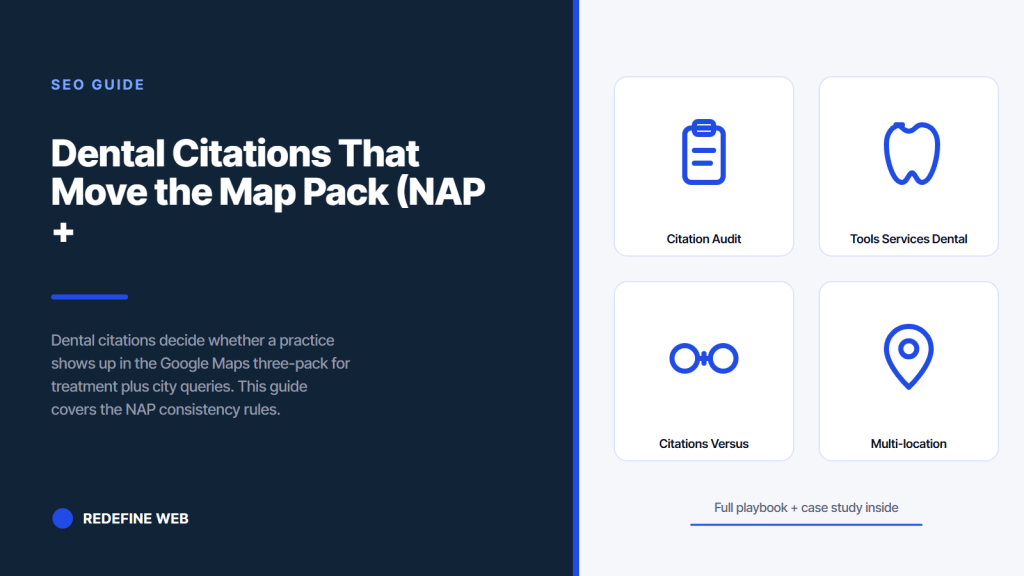
- Dental citations only move rankings when NAP data matches across every directory.
- Google Business Profile plus the top 40 directories carry 90 percent of citation weight.
- Duplicate listings cost rankings faster than missing listings.
- Health-vertical directories outperform generic directories for dental sites.
- Citation audits belong on a quarterly cadence, not a one-time cleanup.
- The directory list that actually carries weight
- The citation audit workflow
- Tools and services for dental citations
- Cost benchmarks for dental citations
- Citations versus reviews versus links
- Health vertical directories that matter most
- Multi-location citation strategy
- Common dental citation mistakes
- Where dental citations fit in 2026
Dental citations decide whether a practice shows up in the Google Maps three-pack for treatment plus city queries, or sits on page two while a competitor with cleaner directory data takes the calls. The map pack drives 60 to 70 percent of new patient calls in most dental markets, and citation consistency remains one of the three biggest levers Google uses to decide who ranks in that map pack. This guide covers the working rules practice managers and SEO agencies use to build citations that actually move rankings, not just inflate a directory count on a monthly report.
The numbers below track what we see across active dental SEO engagements at Redefine Web. A citation cleanup at iSmile Dental Spa, our Carmichael CA client, contributed to page-one rankings on 75 keywords inside six months and helped grow patient volume from 1-2 new patients per month to 12-14 consistently. That is the ranking behavior a working citation program produces. Not screenshots of directory submission dashboards.
The directory list that actually carries weight
The top 40 dental citation directories carry roughly 90 percent of the ranking weight available from citations. Everything past directory 60 is either a scraped copy of a top-40 directory or a low-trust site with no measurable impact on Google’s local algorithm. Practices trying to submit to 300 directories through an automated service usually spend money on listings that will never move a ranking, while missing three or four vertical-specific directories that would have moved several.
Directories split into four tiers by ranking impact. Tier one covers the mapping engines and the largest generalist directories. Tier two covers health-vertical directories that carry patient traffic and trust. Tier three covers local business directories with regional authority. Tier four covers association directories and chamber of commerce listings that produce unstructured citations with high per-link value.
- Tier 1 (mapping and generalist): Google Business Profile, Apple Maps, Bing Places, Yelp, Yellow Pages, Facebook.
- Tier 2 (health vertical): Healthgrades, Vitals, Zocdoc, WebMD, 1-800-Dentist, RateMDs, Wellness.com.
- Tier 3 (local business): BBB, Superpages, MerchantCircle, Manta, Foursquare, Citysearch, Chamber of Commerce.
- Tier 4 (association): State dental association, ADA member directory, local dental society directories.
Practices covering all four tiers with clean NAP data pull the strongest available citation signal. Practices covering only tier one and tier three miss the health vertical layer that Google reads as topic authority, and the ranking curve on treatment plus city queries flattens sooner. For a fuller technical audit of the on-site work that pairs with these listings, our dental seo audit walks the priority ranking of fixes.
The citation audit workflow
A working citation audit runs in five passes. First, extract the current citation profile using a tool that scans the web for practice mentions. BrightLocal, Whitespark, and Moz Local all produce this report. Second, mark every citation as consistent, inconsistent, duplicate, or dead. Third, produce a fix list ordered by directory authority. Fourth, submit corrections or updates through each directory’s owner-verification workflow. Fifth, re-scan six weeks later to catch any drift.
The step that catches most practices is duplicate cleanup. A duplicate listing on Yelp, Bing, or Apple Maps splits ranking signal and confuses Google. Duplicates usually appear after a practice rebrands, moves, changes phone numbers, or transfers ownership. The fix requires claiming both listings, merging them where the directory allows, or requesting removal of the incorrect version. This step alone takes 8 to 15 hours across the top 40 directories on a practice that has been operating for more than five years.
- Extract: run a citation scan on BrightLocal, Whitespark, or Moz Local.
- Categorize: mark each listing consistent, inconsistent, duplicate, or dead.
- Prioritize: order by directory authority, top 40 first.
- Submit: fix or update via each directory’s verification workflow.
- Re-scan: repeat every quarter to catch drift and new listings.
The re-scan is where practices either hold rankings or lose them. Directory data gets scraped and republished across the web weekly. A single old suite number sitting on one directory propagates back into dozens more within a year. The quarterly audit catches this drift while it is still cheap to fix. See our dental seo strategies for how citations fit inside the wider quarterly review.
Tools and services for dental citations
The tool market splits into scanners, builders, and managed services. Scanners produce the audit report showing current citations, inconsistencies, and duplicates. Builders let you submit new citations to directories through a single interface. Managed services combine both and add human verification for the trickier directories that block automated submissions. A working stack usually pairs one scanner with either a builder for hands-on practice managers or a managed service for practices that outsource the entire local layer.
Pricing varies more than the marketing pages suggest. Scanners run $15 to $35 per month for a single location. Builders run $2 to $4 per directory submission plus a subscription base. Managed services run $99 to $299 per month per location, sometimes with a per-directory add-on. Multi-location dental groups negotiate custom rates that scale below the per-location list price. Whitespark, BrightLocal, Yext, Moz Local, and Semrush Local each cover the market at slightly different price points.
- BrightLocal: strong scanner plus builder, $27 to $79 per month, best for solo practices.
- Whitespark: citation builder with human verification, $59 to $199 per month, best for competitive markets.
- Yext: managed sync across 70-plus directories, $199 to $999 per year per location, best for multi-location groups.
- Moz Local: automated distribution to major data aggregators, $99 to $299 per location per year.
- Semrush Local: bundled with Semrush subscription, competitive for practices already using Semrush.
The tool alone does not build the citations. Someone still verifies NAP data before submission, monitors for drift, and manually fixes the directories automation cannot reach. Any dental SEO retainer bundling citations at $150 or below per month usually skips this manual layer, which is where citation coverage drifts back down within six months even after a clean initial build.
Every practice manager has at some point opened a citation audit report and discovered the office phone number listed on Superpages is from a call tracking company that stopped working with the practice in 2019, the Yelp listing shows the old suite number from before the tenant renovation, and Yellow Pages still refers to the practice by the previous owner’s surname. The audit report is 84 pages. The practice manager has 15 minutes between patient meetings. The receptionist has been fielding calls from confused new patients trying to find suite 200 in a building where suite 200 has been a shoe repair shop since the last dentist retired. Citation hygiene sounds boring until it stops being.
Your report says 80 citations built. What matters is if NAP matches across the 20 that count. Search your practice name in quotes. Fix mismatches first.
Cost benchmarks for dental citations
The table below tracks what we see across active dental SEO engagements at Redefine Web. Numbers shift with the number of locations, the age of the practice, and the state of the existing citation profile at kickoff. Newer practices with clean starting data sit at the low end. Older practices with mixed NAP data across 60-plus directories sit at the top.
| Citation program | Upfront cost | Monthly ongoing | Directories covered | Best fit |
|---|---|---|---|---|
| DIY with a scanner | $0 to $100 | $27 to $79 | Top 20 | Solo practices, tight budgets |
| Builder plus manual | $400 to $900 | $79 to $149 | Top 40 | Single-location practices, active manager |
| Managed service | $500 to $1,500 | $199 to $399 | Top 60 | Growing practices, no in-house time |
| Multi-location managed | $1,200 to $3,500 | $400 to $1,200 | Top 80 per location | DSOs, group practices, 3-plus locations |
The middle band produces the best return on effort for most single-location dental practices. Adding a managed service becomes worthwhile once practice manager time gets pulled toward operations and clinical support, or once the practice enters a competitive urban market where directory drift happens faster. Multi-location practices almost always pay off the managed tier through the time savings alone. For a fuller multi-location playbook, our multi location dental seo covers the DSO pattern.
One extra note on pricing sanity. Any dental citations bundle marketed at under $50 per month with a claim of coverage on 300 or 400 directories is submitting to scraper sites and low-trust aggregators that will not move a single ranking position. The cost math on those bundles reveals the model. At 300 directories per month for $50, the service is paying under 17 cents per directory, which does not cover the compute cost of the submission itself. The result is inflated submission counts on directories Google discounts, no NAP verification, and no cleanup workflow when a listing fails or reverts. Practices comparing quotes should weight quality of coverage on the top 40 far above raw listing count in any proposal.
Citations versus reviews versus links
Local SEO for dentists runs on three signal groups. Citations reinforce the identity of the practice. Reviews reinforce trust and recency. Links reinforce authority and relevance. Practices strong in only one of the three see rankings drift when a competitor covers all three. Practices strong in two but weak in the third hold rankings on lower-competition queries but lose the top spot on treatment plus city queries where competition compresses.
Citations and reviews interact directly. A directory with strong review velocity carries more ranking weight than the same directory with stale reviews. Healthgrades and Vitals reviews influence Google’s local ranking indirectly through the trust signal they broadcast. Practices with 25 recent Healthgrades reviews outrank practices with 200 stale reviews from three years ago, even at the same Google review count. The Moz local search ranking factors study tracks the interaction across the top 100 factors.
- Citations: identity signal, weighted heaviest on the top 40 directories.
- Reviews: trust and recency signal, weighted heaviest on Google plus the top 5 vertical directories.
- Links: authority and relevance signal, weighted heaviest on local partnerships and association mentions.
- Balance: strong coverage across all three groups compounds better than depth in any single group.
A citation audit is where most SEO engagements start because it produces the fastest visible ranking movement, but skipping the review layer or the link layer stalls the ranking curve at month six or seven. Working programs run all three in parallel from month one, not sequentially. See our dental seo strategies guide for how to sequence the three across an SEO retainer.
Health vertical directories that matter most
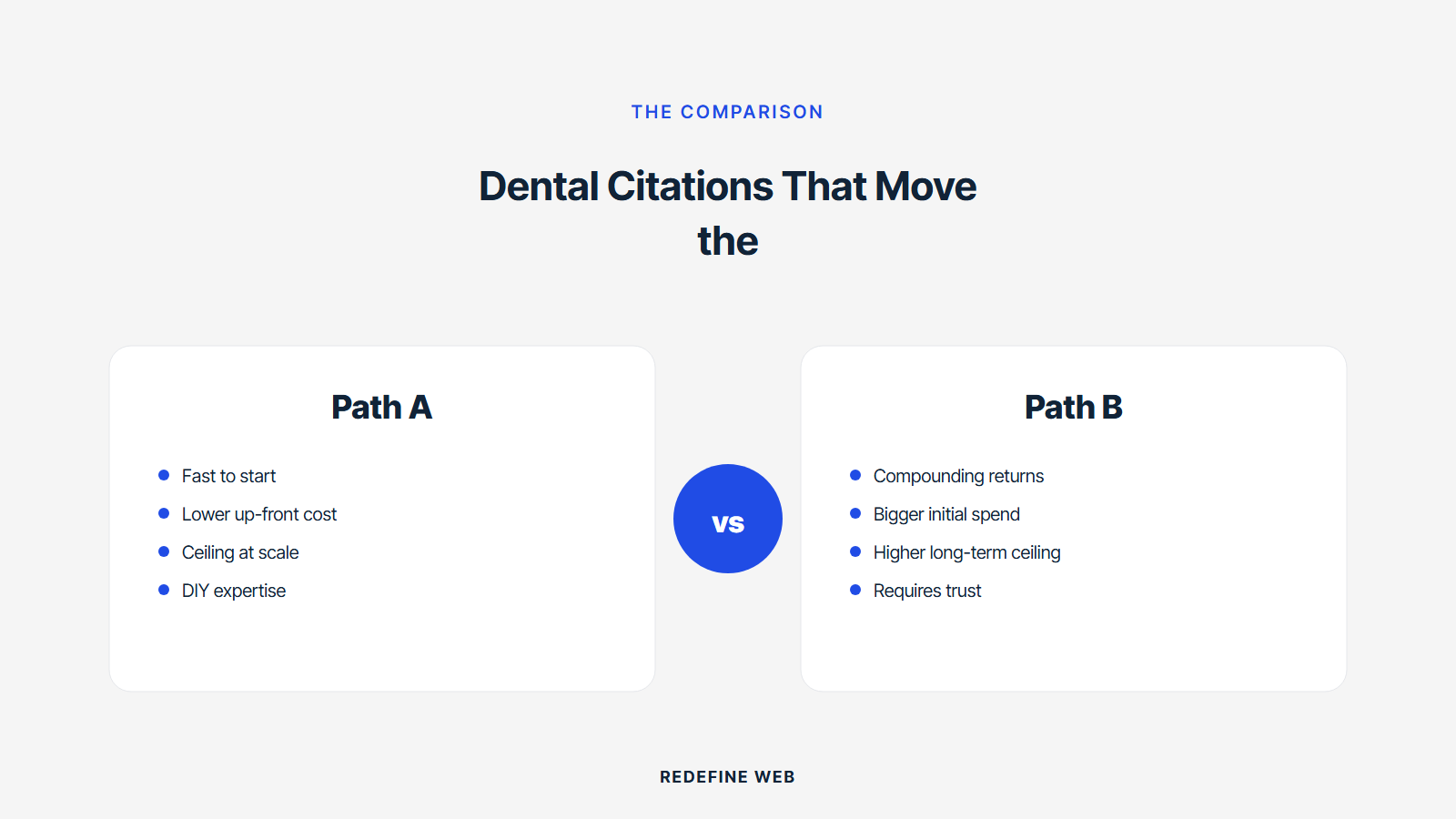
Health-vertical directories carry outsized weight because Google reads them as topic-authoritative sources for dental practice information. Healthgrades and Vitals cover general medical and dental provider listings. Zocdoc adds booking functionality that many patients use directly. WebMD carries traffic through content pages that link to provider directories. 1-800-Dentist runs a paid referral network that still influences rankings through profile mentions. RateMDs adds a review layer. Each carries per-listing weight above a generic business directory.
The health-vertical layer produces two ranking effects at once. The direct citation effect on the Google Maps algorithm, and the indirect referral traffic that generates behavioral signals Google reads back into the local ranking model. A Healthgrades profile with a strong review score and a click-through to the practice website sends a behavior signal that reinforces the local pack ranking on treatment plus city queries. Skipping the health-vertical layer costs both effects at once.
- Healthgrades: complete profile with credentials, treatments, and photos.
- Vitals: profile with insurance accepted and treatments offered.
- Zocdoc: paid but produces direct bookings alongside the ranking effect.
- WebMD Physician Directory: free listing with backlink to practice website.
- 1-800-Dentist: profile through the referral network.
- RateMDs: profile plus review generation.
- State dental association directory: member directory listing.
Practices completing all seven health-vertical citations pull a stronger local ranking signal than practices completing only Google Business Profile plus the tier-one generalist directories. The workload runs 4 to 8 hours per directory on the first pass because each requires provider credential verification, treatment tagging, and photo uploads. Once complete, the maintenance drops to 1 to 2 hours per directory per year.
Multi-location citation strategy
Multi-location dental groups face a different citation problem. Every location needs a dedicated Google Business Profile, a separate citation profile across the top 40 directories, and an independent NAP consistency check. A group with 12 locations manages 480 citation touch points at minimum. Errors compound quickly because a bulk directory sync sometimes writes the wrong location’s phone number to a directory, and the mismatch propagates through the data aggregators before anyone notices.
The working approach uses a location-parent directory structure with strict naming conventions. Each location gets a location-specific practice name suffix (or no suffix, matching the Google Business Profile), an office-line phone number never mixed with call tracking, and a suite-formatted address matching Google’s normalization. Directory submissions run through a managed service like Yext or Semrush Local that supports multi-location sync with location-specific data fields. Skipping the managed service tier at multi-location scale usually costs more in cleanup hours than the annual subscription.
- Naming convention: locked practice name, no per-location suffix unless required by GBP.
- Phone convention: office line per location, never a shared call tracking number.
- Address normalization: matches USPS format for suite and street abbreviations.
- Sync tool: Yext, Semrush Local, or BrightLocal Multi-Location for automated distribution.
- Audit cadence: quarterly per location, monthly during rapid expansion or acquisition.
The Smile Design Dentistry engagement at 50-plus dental offices tracked as a case study on Redefine Web ran citation cleanup on this exact structure and contributed to a 30 percent reduction in cost per call across the PPC campaigns that fed off the same local footprint. Citation hygiene at multi-location scale pays off in both organic map pack visibility and paid campaign performance because the profiles Google reads are consistent across both channels.
Common dental citation mistakes
Most dental citations profiles we audit share the same four mistakes. Old business names sitting on legacy Yelp and Yellow Pages listings. Call tracking phone numbers accidentally submitted to directories during a paid campaign. Duplicate listings on Bing or Apple Maps that split ranking signal. Missing coverage on the health-vertical layer while the tier-three business directory layer is oversaturated with low-trust submissions from an old bulk service.
The next tier of mistakes hides inside the categorization layer. Google Business Profile categories that describe the practice too narrowly (only “Dentist” instead of “Dentist plus Cosmetic Dentist plus Emergency Dental Service”) miss ranking opportunities on treatment plus city queries. Categories that describe the practice too broadly (“Doctor” instead of “Dentist”) water down the primary ranking signal. Category selection deserves the same attention as NAP data because Google uses it directly to decide which queries the profile qualifies for.
- Old business names on legacy Yelp, Yellow Pages, or Superpages listings.
- Call tracking numbers accidentally submitted to directories during paid ad campaigns.
- Duplicate listings on Bing, Apple Maps, or Yelp splitting ranking signal.
- Missing health-vertical coverage while tier-three business directories are oversaturated.
- Wrong Google Business Profile categories: too narrow or too broad.
- Inconsistent hours of operation across directories, which affects local pack visibility during closed hours.
- Broken website URLs pointing to old domains or 404 pages from a redesign.
Each mistake is fixable inside a standard SEO retainer without extra scope. The audit at kickoff should surface which of the seven your practice has, and the fix roadmap should sequence them by expected ranking impact. Any agency skipping this audit and moving straight to monthly deliverables is running a generic playbook, which is where citation coverage decays quietly and rankings slide without anyone noticing until three months later.
Where dental citations fit in 2026
Google Business Profile carries more weight in the local ranking model than five years ago, and the raw citation count matters less than it once did. What has increased in importance is citation quality and health-vertical relevance. A dental practice with a strong Business Profile plus 40 clean citations on authoritative directories outranks a practice with a weak Business Profile plus 200 messy citations across scraper sites. That is the shift practices funding an SEO retainer in 2026 need to understand before signing up for another 300-directory submission service.
AI Overviews now appear on 20 to 35 percent of treatment plus city queries in the dental vertical, per Search Engine Land tracking. Practices cited across the health-vertical directory layer pick up mentions inside AI Overview answers at a higher rate than practices missing that layer. The citation profile feeds into how Google evaluates the practice as a topic-authoritative source, and AI Overviews compound that effect week over week. See Search Engine Land’s local SEO guide for the current pattern shifts.
If organic new patient calls have flattened over the last two quarters, or the practice used to hold the map pack on treatment plus city queries and now sits below the fold, the first move is a citation audit paired with a Business Profile review. Most practices fix 60 to 80 percent of the citation problems inside 30 hours of specialist time, and the ranking recovery starts inside six weeks. See dental seo services or google business profile for dentists for the paired workflow, or dental reputation management for how the review layer ties in.
Frequently asked questions
How many dental citations does a practice actually need to rank?
A working baseline is Google Business Profile plus 40 to 60 authoritative directory listings with consistent NAP data. Beyond 60 the marginal ranking benefit drops sharply, and beyond 100 many practices see zero incremental movement on treatment plus city queries. Practices chasing 200-plus citation counts through automated services usually pay for listings on low-trust directories that carry no ranking weight. Focus the budget on the top 40 by directory authority in the healthcare vertical, and audit them every quarter for NAP drift.
Do dental citations still matter with Google Business Profile carrying more weight?
Yes. Google Business Profile is the single largest local signal, but citations verify the practice name, address, and phone across the wider web, which reinforces the profile. Practices with a strong Business Profile and thin citation coverage see three-pack rankings drift when a competitor with matching Business Profile signal and stronger citation coverage moves into the market. The ranking effect is smaller than five years ago, but it still moves the map pack on competitive treatment queries.
What NAP inconsistencies actually hurt dental rankings?
Suite number formatting differences (Suite 200 vs Ste 200 vs #200), phone number formatting (with or without dashes), abbreviated versus full street names, and old business names on stale listings all count as inconsistencies Google flags. The most damaging pattern is two different phone numbers listed for the same practice across directories, which happens after a call tracking number gets published on one directory and the office number on another. Pick one primary NAP format and enforce it across every listing.
Should a dental practice pay for a citation service or build them manually?
A hybrid approach usually wins. Use a service like BrightLocal, Yext, or Whitespark for the top 40 authoritative directories where automation saves 15 to 25 hours of manual submission time. Then add manual citations on health-vertical directories, local chamber of commerce sites, dental association directories, and local business associations where automation coverage stops. The manual layer covers the directories that carry ranking weight but sit outside the standard automation pack.
How often should dental citations get audited?
Quarterly for active practices, monthly for practices in competitive markets or during an SEO ranking recovery push. The audit checks for NAP drift, duplicate listings, closed directories, and new authoritative directories that have appeared. Skipping the quarterly audit is where citation rankings decay, because directory data gets scraped and republished across the web, and a single old suite number on one directory propagates back into the profile of dozens more within a year.
How much do dental citations cost to build and maintain?
Manual outreach for the top 40 directories costs 15 to 25 hours of specialist time upfront at a $75 to $125 blended rate, so $1,100 to $3,100 for the initial build. Automated services like BrightLocal Citation Builder run $2 to $4 per directory or $99 per month for a managed subscription. Ongoing maintenance runs 3 to 6 hours per quarter at similar blended rates. Practices building through an SEO agency typically bundle citations into the retainer rather than paying for them line-item.
Which dental citation directories carry the most ranking weight?
Google Business Profile sits at the top by a wide margin. Apple Maps, Bing Places, Yelp, and Yellow Pages come next. In the health vertical, Healthgrades, Vitals, Zocdoc, WebMD, and 1-800-Dentist carry outsized weight because they get patient traffic and trust signals Google reads as authoritative. State dental association directories and city-level chamber of commerce listings round out the top 20. Everything past directory 60 is either a scraped copy of one of the top 20 or a low-trust site with no ranking impact.
Book your free 30-minute strategy call.
No spam, no sales rep. We use your email to schedule your call with a senior strategist. That is it.
More from the blog
View all articles → SEO
SEO Organic Search Engine Optimization Services That Grow Real Traffic
Read article SEO
SEO SEO for Pet Groomers That Fills the Appointment Book Weekly
Read article SEO
SEO