
Dental SEO Audit That Actually Prioritizes What Moves Rankings
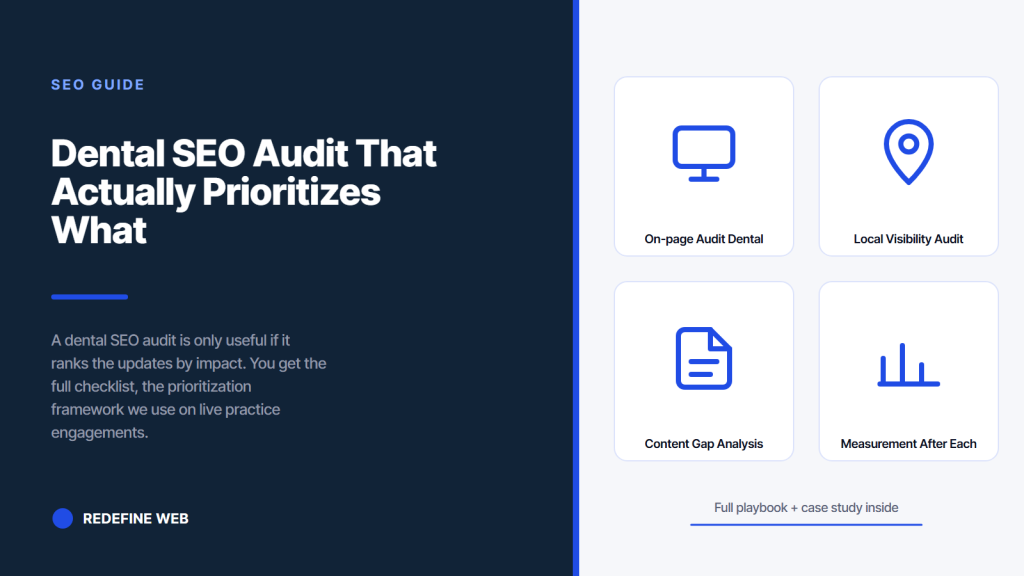
- Audit four layers. Technical, on-page, local, content coverage.
- Prioritize by revenue impact and effort. Top 20 findings only.
- Every audit fix needs one metric attached.
- Weekly standup and monthly report keep the backlog alive.
- Retainer starts at $599 per month for follow-through work.
- On-page audit for dental service pages
- Local visibility audit for the map pack
- Content gap analysis against the top three
- Prioritization framework once the audit is done
- Measurement after each audit finding gets fixed
- Tools that make a dental SEO audit reproducible
- The deliverable a dental SEO audit should produce
- Common pitfalls in a dental website seo audit
A dental SEO audit tells you what is broken and what is costing you patients. You do not need a 400-item PDF. You need three lists ranked by revenue impact, a 90-day sequence to work through them, and a way to measure whether each fix moved the map pack, organic clicks, or booked calls. This guide is the exact framework we run on live dental accounts, from the technical crawl through the content gap analysis, with the prioritization logic that separates the fixes worth doing this month from the ones that can wait.
You will finish this in about ten minutes and know how to run your own dental website seo audit, or how to grade one you already paid for. The dental seo analysis pattern is the same for a solo practice in a suburb and a five-location group in a metro. What changes is scope, not the framework.
On-page audit for dental service pages
Every service page on a dental site has a job. Rank for one main procedure keyword plus the map-pack term for its metro. On-page audit checks whether the page is set up to do that job or whether it is a diluted mix of three topics fighting each other.
Pull each service page’s title tag, H1, meta description, and first 100 words into a spreadsheet. Mark the primary keyword you want it to rank for. Mark whether that keyword appears in the title, H1, meta, first paragraph, and at least two H2s. In a typical dental site audit we find that 40 to 60 percent of service pages either target the wrong primary keyword, share a title tag pattern with three other pages, or have a first paragraph that never mentions the procedure at all. Every one of those is a same-week fix that moves rankings inside 30 days.
Title tags and meta descriptions
Title tags on dental service pages should follow one shape. Procedure + city + practice name. Not procedure + practice name + city. Google reads the first 60 characters. If your city sits after your practice name and your practice name is 25 characters, Google truncates the city. Meta descriptions are for click-through, not rank. Write a benefit-forward sentence that mentions the procedure and the city and ends with a book-friendly action word. Read the WordStream local SEO breakdown if you want a longer take on the same pattern.
Heading hierarchy and topic focus
Every service page needs one H1 that includes the procedure. H2s should cover the questions patients actually ask before booking that procedure. Cost. Recovery. Insurance. Alternatives. What to expect. Pediatric or adult. Pain. Timeline. If your Invisalign page has H2s like About Us, Our Values, and Meet the Doctor, Google does not know it is about Invisalign. Push those to the About page and give the procedure page back its focus.
Local visibility audit for the map pack
The map pack drives more dental new patient calls than the organic ten blue links. If your dental SEO audit does not include a serious local check, half the revenue opportunity gets missed. Local audit covers Google Business Profile, citation consistency, review velocity, and location page setup.
Grade your Google Business Profile against ten checks. Verified. Primary category matches your busiest procedure. All service attributes filled. Booking link resolves. Photos posted inside the last 90 days. Q&A section populated. Products or services section used. Weekly Posts scheduled. Owner responses on 100 percent of reviews inside 48 hours. UTM tagging on the website link. Most solo practices we audit hit 3 to 5 of those ten. Getting to 9 or 10 usually adds 15 to 30 percent to map-pack impressions inside 90 days.
| Local check | Common gap | Rank impact |
|---|---|---|
| GBP primary category | Set to Dentist instead of specialty | High |
| NAP citation match | Suite number varies across 12 directories | Medium |
| Review velocity | Under 4 reviews per month | High |
| GBP photos | No new photo in 6 months | Medium |
| Owner review responses | Below 60 percent response rate | High |
| Booking link | 404 or redirect chain | High |
| Location page schema | Missing LocalBusiness or Dentist type | Medium |
Citations and NAP consistency
Pull citations from BrightLocal or a manual sweep of the top 25 dental directories. Match every listing against a canonical NAP block. The name, address, and phone need to be pixel-identical across every directory. A missing suite number on Yelp, a truncated street name on Healthgrades, and an old phone number on the state dental board profile all cost you rankings. Fix the top 25 first. Ignore the long tail because most of those directories carry no ranking signal anyway.
Review generation workflow
Review velocity beats review count in the 2026 local algorithm. A practice with 60 reviews and 5 fresh ones every month outranks a practice with 300 reviews and none in the last 90 days. Your audit should count reviews per month over the trailing 12 months and score anything under 4 per month as a fix. The workflow that moves it: an SMS request 24 hours after a completed appointment, one automated follow-up if unopened, and a hand-off to the office manager on any hesitation.
Content gap analysis against the top three
Content gap analysis is where cheap audits stop and real dental seo strategies start. Pull the top three ranking sites for your five most valuable procedure keywords. List every H2 they cover, every FAQ they answer, and every schema block they emit. Your gap is anything the winners share that your site does not have. That gap is the content roadmap for the next two quarters.
NC Dental Clinic came to Redefine Web in 2023 holding zero top-10 positions on their key procedure keywords. A structured content gap sweep against their three Vista, CA competitors produced 22 missing subtopics across implants, veneers, and emergency care. Publishing those over six months moved patient volume 900 percent and grew average monthly organic sessions from a few dozen to a few thousand. Same practice, same location, same team, different content coverage.
Blog content versus service pages
Blog posts and service pages do different jobs. Service pages carry money keywords like invisalign and dental implants city name. Blog posts carry the informational cluster around each service, catching people three or four questions before they book. Your audit should show whether your service pages are strong enough to rank without blog support (rare) or whether the blog is doing too much of the work with no service page underneath.
Internal linking patterns
Blog posts should link to the relevant service page. Service pages should link across to sibling services and up to the location page. Location pages should link to every service offered at that location. Most dental sites we audit have 20 to 40 blog posts pointing nowhere and service pages that only receive links from the main menu. The fix is one round of manual internal linking during the audit, then a rule for every future post that requires two contextual links to a service or location.
Any audit longer than 20 prioritized fixes buries the work that moves rank. Ask your auditor for the top 5 by revenue impact. If they can't, the audit is a doc, not a plan.
Prioritization framework once the audit is done
The audit produces a long list of findings. The framework decides which ones get worked in month one, which ones wait for month two, and which ones stay on the shelf. Prioritize on two axes. Revenue impact from one to five. Effort cost from one to five. Do the high-impact low-effort items first. Do the high-impact high-effort items second. Skip the low-impact items unless you have nothing else to do, which you never do.
The prioritization matrix looks obvious on paper and is missed on every audit that lands in the mailbox as a 300-item PDF. If the deliverable does not tell you where to start Monday morning, the audit failed. Insist on the ordered list even if you never look at the appendix. Our dental seo strategies writeup covers how we run this prioritization at the account level.
- Fix crawl errors and redirect chains inside week one
- Rewrite title tags and meta descriptions on top-10 service pages in week two
- Overhaul the Google Business Profile in week three
- Publish two content-gap blog posts per week starting week four
- Launch a review generation SMS flow at week six
- Rebuild internal linking site-wide at week eight
- Ship location pages for every city inside your 15-minute radius by week twelve
Quick wins to work first
Quick wins live at the top of the matrix. Broken internal links. Missing meta descriptions. GBP primary category set incorrectly. Reviews sitting unanswered for weeks. A booking link that redirects three times before loading. Every one of those is a same-day fix that moves rankings or conversions inside 30 days, which is the fastest ROI window in the whole audit. Get them all done before you write a single new blog post.
Structural fixes that need real time
Structural fixes take weeks or months. A site migration. Rebuilding location pages for a five-office group. Redesigning a template that flunks Core Web Vitals. These do not slot into a Monday morning to-do list. Plan them across a quarter, budget accordingly, and pair each one with a metric you can check when the work goes live. Do not stack two structural fixes at once because the attribution gets muddy and you cannot tell which one moved the number.
Measurement after each audit finding gets fixed
Every audit fix needs a metric. The metric proves you moved the ranking, the traffic, or the booked call. Without the metric you have a list of chores and no way to know which chores paid off. Every audit at Redefine Web ships with the metric spelled out alongside the fix.
Track three tiers of metric. Search Console impressions and average position for on-page and content fixes. GBP insights impressions, direction requests, and calls for local fixes. GA4 sessions and calltracker calls for anything above the fold. Cross-reference weekly. If a fix ships and no metric moves inside 30 to 90 days, revisit the assumption behind the fix, not the fix itself. Our dental seo strategies post covers the measurement rhythm month by month.
Reporting cadence for audit follow-through
Report weekly on the audit backlog burn-down and monthly on the metrics that show ranking movement. Weekly reports keep the team accountable for the fix cadence. Monthly reports give the practice owner the ranking, traffic, and booked call picture. Avoid quarterly-only reporting because too many things drift in 90 days without a check-in. Practices with weekly plus monthly cadence keep their audit findings on track more often than practices with any longer rhythm.
The best dental SEO audit we ever ran identified 187 findings. The office manager printed all of them, put the binder on a shelf, and rearranged the waiting room instead. The waiting room looked great. The rankings did not move. Nine months later a new hire found the binder, worked through the top 20 items in a quarter, and organic patient calls doubled. The audit was never the problem. Nobody rearranged the waiting room the second time.
Tools that make a dental SEO audit reproducible
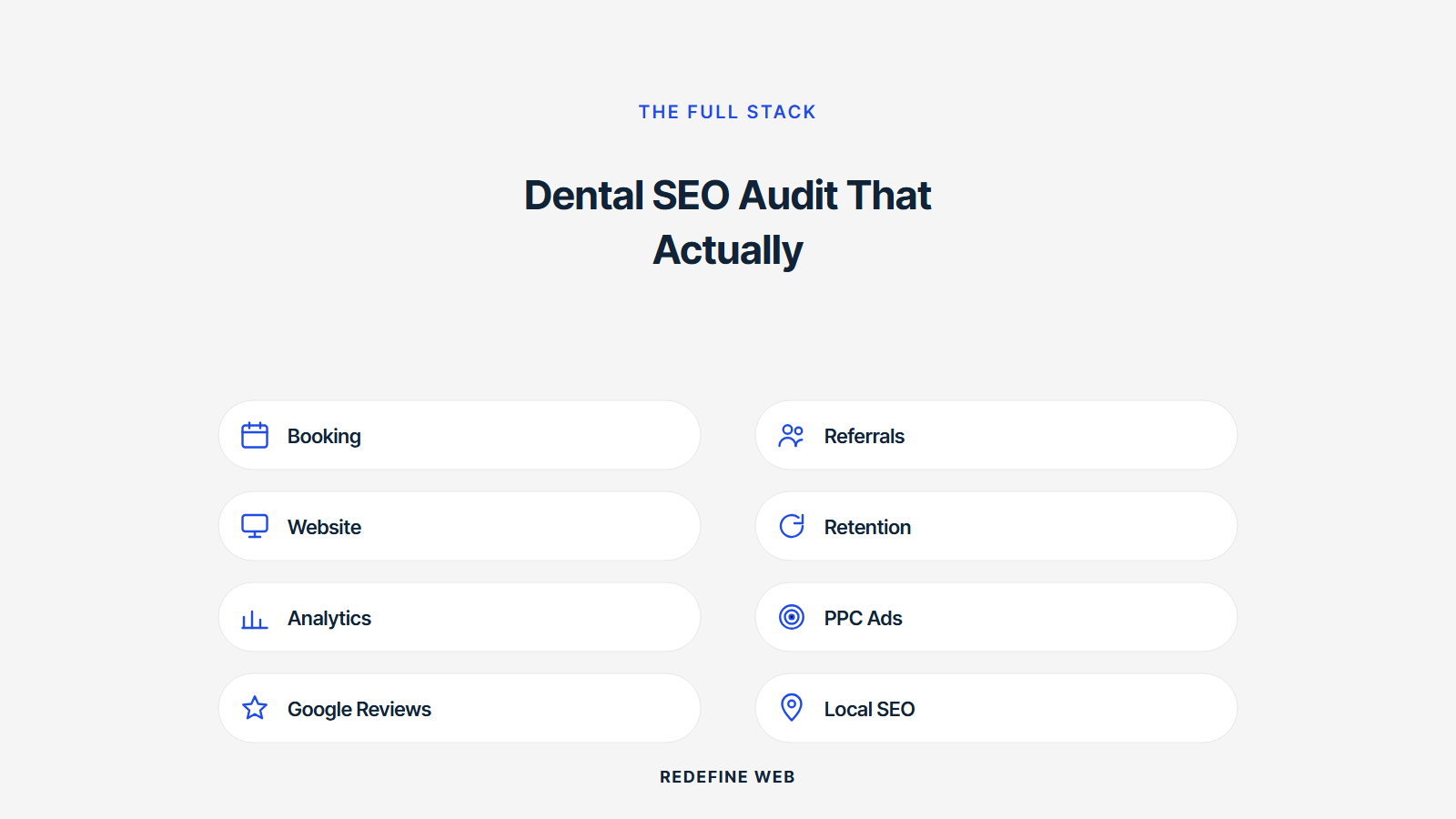
You can run a dental SEO audit in a spreadsheet if you have to. You will run it faster and more accurately with the right stack. The five tools worth paying for cover crawling, keyword data, backlink data, rank tracking, and local grid tracking. Everything else is optional.
Screaming Frog handles the crawl. Ahrefs or Semrush handles keyword and backlink data. AccuRanker or Nightwatch handles rank tracking at scale. Local Falcon or BrightLocal Grid handles the map-pack proximity grid. Google Search Console and GA4 are free and non-negotiable. That stack runs about $250 to $500 per month for a solo practice and roughly $700 to $1,200 per month for a multi-location group. Cheaper stacks work for one-off audits, not for ongoing engagement.
Free versus paid tooling
Free tooling gets you 60 percent of the audit. Search Console for indexing and query data. Google’s PageSpeed Insights for Core Web Vitals. GBP Insights for local. That combination catches the biggest fires. Paid tools add depth on backlink profile, competitor keywords, and rank tracking granularity. If your practice generates six figures of new patient revenue from search per year, the paid stack pays for itself inside the first quarter.
Where AI tooling helps and where it does not
AI tools sort findings and summarize crawl data faster than a person can. They do not replace the judgment call on which finding gets worked first. That judgment sits with the strategist who knows the practice’s revenue mix, patient acquisition cost, and payer mix. Use AI to compress the audit from three days to one. Do not use AI to write the priority list. Search Engine Journal’s local SEO section tracks how AI is reshaping the audit workflow week by week.
For teams that want the local layer done well before touching content, our local SEO for dentists guide is the companion piece to this audit.
The deliverable a dental SEO audit should produce
An audit deliverable that lives on a shelf earned nothing. The one that gets worked has three parts. A one-page summary of top findings ranked by revenue impact. A backlog spreadsheet with every finding, effort estimate, and owner. A 90-day plan that maps the top 20 findings to weeks.
The summary is for the practice owner. The backlog is for the team doing the work. The 90-day plan is the contract between them. If you buy an audit that ships as a 90-page PDF without the summary and the plan, you paid for a report, not a project. Push back and get the plan. Our full dental seo services retainer starts at $599 per month and includes both the audit and the follow-through team.
Who owns the plan after the audit
Ownership decides whether the plan gets worked. Assign one owner per finding. The office manager owns GBP fixes. The webmaster owns technical fixes. The content lead owns page rewrites. The agency owns strategy, prioritization, and reporting. If a finding has no owner named on the backlog, it will not get done. That is the pattern we see on every stalled engagement.
Cadence after the audit ships
Weekly 30-minute standup with the backlog on-screen. Monthly report against the metrics tied to each finding. Quarterly re-audit on the top three layers, not the full sweep. That cadence keeps the audit alive as a working plan instead of a snapshot. Practices that hold the cadence for two full quarters typically see 25 to 60 percent ranking movement on their top procedure keywords, plus meaningful map pack growth in the local grid.
Common pitfalls in a dental website seo audit
Even a well-scoped dental website seo audit runs into predictable pitfalls. The findings list is too long. The prioritization gets ignored. The team owns nothing. The reporting stops after month one. Every one is a process failure, not a data failure. Guard against them going in.
The biggest pitfall is treating the audit as a deliverable instead of a starting point. The audit is the map. The route is the 90-day plan. The destination is a ranked page or a booked patient. Map without route without destination equals a fancy report and no change to the P&L. Every dental seo analysis we ship comes with the route already drawn.
Vanity metrics to ignore
Ignore total keyword count. Ignore domain authority as a headline metric. Ignore average time on page for informational content. Track ranked keywords in positions 1 to 10, GBP calls, and booked patient count from web. Everything else is a scoreboard your audit report can win without your P&L moving. Focus the audit on numbers that pay staff.
Scope creep during execution
New shiny objects show up mid-engagement. A vendor pitches TikTok ads in week five. A competitor launches a rebrand in week seven. The temptation is to pause the audit backlog to chase the new. Do not. Finish the top 20 audit findings first. New tactics slot into the next quarter, after you know what moved the numbers and what did not. Discipline on the plan beats agility on a new tactic every time.
Frequently asked questions
How much does a dental SEO audit cost
A standalone dental SEO audit runs $1,500 to $6,000 depending on site size and how many location pages the auditor has to grade. Solo practices with 8 to 15 pages sit at the low end. Multi-location groups with 40 to 200 pages sit at the high end. Anything under $1,000 usually means a template report with no prioritization or 90-day plan, which is exactly the deliverable that ends up on a shelf. If the audit comes bundled with a monthly SEO retainer, most agencies fold the cost into the first two months of the engagement instead of charging separately.
How long does a dental SEO audit take to complete
A full dental SEO audit takes five to fifteen business days to produce a working deliverable. The technical crawl runs in a day. On-page grading takes two to three days for a mid-sized site. Local visibility grading takes another two days including GBP grading and citation sweep. Content gap analysis against the top three competitors adds three to five days. Add one day for the prioritization matrix and 90-day plan on top of that. Rushing the timeline usually means skipping the content gap layer, which is the one that separates a real audit from a shallow one.
What tools do I need to run my own dental website seo audit
You need five tools to run a credible dental website seo audit. Screaming Frog for the technical crawl. Google Search Console for indexing and query data. Ahrefs or Semrush for keyword and backlink data. Local Falcon or BrightLocal Grid for the map pack proximity grid. Google Business Profile insights for local performance. Screaming Frog runs $259 per year. Ahrefs and Semrush both start around $99 per month. Local Falcon costs $24 per month. Search Console and GBP are free. The full stack runs about $250 to $500 per month for a solo practice.
How often should I run a dental SEO audit
Run a full dental SEO audit once per year, plus a lighter quarterly check on the technical crawl, on-page core, and local layer. Trigger an unplanned audit after a website redesign, a domain migration, a Google core update that hit your traffic, or six months of flat rankings. Monthly SEO work should focus on executing the audit findings, not rerunning the audit. Practices that audit monthly usually spend more time reporting than fixing, and the ranking curve stays flat because nothing gets worked long enough to matter.
What is the difference between a dental SEO audit and a website audit
A general website audit covers site speed, design, hosting, and general UX. A dental SEO audit focuses specifically on organic search performance for dental procedure and local keywords. Both look at technical health, but the SEO audit adds keyword mapping, content gap analysis against the top three ranking sites, local visibility grading against the map pack, and citation consistency across dental directories. If your goal is more new patient calls from search, buy the SEO audit. If your goal is a general site tune-up, a website audit is enough.
Can I skip a dental SEO audit and jump straight to fixes
You can, but you will fix the wrong things first. Every practice has 40 or more findings across four layers, and only 10 or 12 actually move rankings inside the next 90 days. Without the prioritization framework, you spend budget on the visible items, like a homepage rewrite, and miss the invisible ones, like a broken sitemap or a wrong GBP category. The audit exists so the fix order matches the revenue impact order. Skipping it means paying for motion instead of progress.
Book your free 30-minute strategy call.
No spam, no sales rep. We use your email to schedule your call with a senior strategist. That is it.
More from the blog
View all articles → SEO
SEO Organic Search Engine Optimization Services That Grow Real Traffic
Read article SEO
SEO SEO for Pet Groomers That Fills the Appointment Book Weekly
Read article SEO
SEO