
Dental Website Templates vs Custom Design (Real Costs)
- Dental website templates rank about 45 percent as well as custom builds.
- Most templates run $79 to $499 monthly with $500 to $2,500 setup.
- Ranking ceiling hits around month four on treatment queries.
- Switching to custom pays back in 12 months past 40 monthly new patients.
- Duplicate template copy triggers Google's helpful-content down-ranking.
- How to evaluate dental website templates before you buy
- Conversion rate of dental website templates
- How to switch off a template later
- Dental website templates vs website builders like Wix and Squarespace
- Case study: switching off dental website templates to custom
- Alternatives to dental website templates worth considering
- Common mistakes practices make with dental website templates
- Making the final dental website templates decision
You want a professional dental website live in three weeks, and every vendor pitch keeps circling back to dental website templates that promise “$99 setup” and a live URL by Friday. The math looks great on the sales call, and the math looks very different six months in, when the template still doesn’t rank, still doesn’t book, and still charges you $79 a month to sit on a subdomain you never actually own. This guide walks through what dental website templates actually deliver, where they beat a custom build, and where they quietly cost you patients you should have booked on the schedule. We compare the three tier structures every dental vendor sells, the real cost math over 36 months against a custom dental website design, the ranking ceiling that hits around month four, and the four exit clauses your contract should include before you sign. Read it before you commit to a template subscription that locks the practice into a platform you can’t move off later without paying a full rebuild all over again.
How to evaluate dental website templates before you buy
Evaluate dental website templates on six dimensions before signing anything. Mobile page speed on a 4G connection. Contract exit terms after 90 days. Ownership of the domain and content on cancellation. Number of practices running the exact template layout. Copy customization included in the base retainer. Booking integration with your existing practice management software.
- Test mobile page speed on PageSpeed Insights against three demo sites from the vendor. Targets: LCP under 2.5s, CLS under 0.1, INP under 200ms.
- Ask the vendor to name five other practices running the exact template you’re considering. If they refuse, that’s the answer.
- Confirm you keep your domain name on cancellation, and confirm you can export content in a portable format like HTML or Markdown.
- Get the copy edit quota in writing. Two hours monthly is thin. Six hours monthly covers a growing practice.
- Verify booking integration with your specific PMS. Dentrix, Eaglesoft, Open Dental, Curve, and Denticon each have different integration paths.
- Confirm HIPAA-compliant forms come standard, not as a $30 monthly upsell.
- Read the cancellation clause. Some vendors require 90-day written notice and charge a data-export fee.
The demo site test
Every vendor shows a beautiful demo. Look up the same template on Wayback Machine to see what it looked like two years ago. Templates that have been in market for four-plus years without a visual refresh usually mean the vendor is running the same design against 2019 conversion patterns. Newer templates with recent visual updates show a vendor actively investing in the product. That matters more than the initial demo aesthetic.
Conversion rate of dental website templates
Dental website templates convert at 2.1 to 3.4 percent on average, measured as visits that produce a booked appointment or a phone call over five minutes. Custom dental sites convert at 3.8 to 6.2 percent on the same measurement. The gap comes from four places: template forms with too many fields, generic hero images that don’t match the practice, missing trust signals like credentials and case counts, and treatment pages that read as generic instead of specific to the practice’s positioning.
Every vendor sales deck shows a 12 percent conversion rate on a template site. The screenshot always cuts off the traffic source column. Turns out the 12 percent was three visitors, and two of them were the vendor’s QA team.
Fixing conversion on a template site
Template sites can close half the conversion gap with three fixes. Replace stock hero photography with real practice photos, ideally the doctor plus one operatory shot and one team shot. Rewrite the top three service pages (usually cleanings, implants, and cosmetic) in the practice’s actual voice, using real patient scenarios. Reduce the contact form to name, phone, preferred time, and reason for visit. Those three moves push a template site from 2.5 to 3.8 percent conversion in most cases, closing about 55 percent of the gap to a custom build. The remaining gap comes from page speed, checkout-style booking flows, and treatment-specific landing pages the template can’t produce without a full off-template rebuild.
How to switch off a template later
Switching off dental website templates takes six to twelve weeks and $8,000 to $22,000 for the new build, plus the cancellation friction the vendor writes into the contract. The domain moves without drama in most cases. The content usually does not export in a clean format, so service pages get rewritten from scratch.
Plan the switch on a 90-day arc. Sign the new build contract in week one. Notify the template vendor of intent to cancel per the contract terms in week two. Rebuild service pages in weeks three through eight. Set up 301 redirects for every URL that changes in weeks eight and nine. Cut the DNS over in week ten. Monitor rankings and traffic weekly through week twenty. Practices that skip the redirect step lose 30 to 60 percent of organic traffic for two to four months while Google re-crawls, which recovers but hurts the year.
Contract exit clauses to check now
Read the contract exit clause today, not the day you decide to switch. Common clauses include 60 or 90-day written notice, a data export fee of $200 to $500, a domain transfer fee of $150 to $300, and, in a few cases, a 12-month minimum term that carries a cancellation penalty. Practices that sign without reading these terms end up locked in for six to nine months longer than planned, which delays the new build revenue by two quarters.
Template sites fail on duplicate copy across a template family, not on speed. Google flattens rankings around month 4. That's the ceiling, not the design.
Dental website templates vs website builders like Wix and Squarespace
Dental website templates are dental-specific. A dental website builder like Wix, Squarespace, or Weebly is generic. The dental template comes with pre-written service pages, dental-specific booking integrations, and HIPAA-appropriate form templates. The generic builder gives you a blank canvas and lower monthly cost ($16 to $49 monthly) but no dental content and no HIPAA guardrails out of the box.
Generic builders work when the practice has an in-house marketer who can write dental copy, configure HIPAA-compliant forms manually, and maintain the site. That’s rare for a solo practice. Dental-specific templates work when the practice wants dental-adjacent content and integration handled by the vendor. The tradeoff is monthly cost. A Wix dental site runs $200 to $300 monthly all-in with plugins. A dental template runs $200 to $300 monthly for the vendor. The dental template wins on content and compliance. The generic builder wins on design flexibility.
The DIY tradeoff
DIY builders like Wix and Squarespace can produce a functional dental site for a solo practice in 40 to 80 hours of work. That’s the tradeoff. Practices that value the doctor’s clinical time above $75 per hour usually find the DIY path costs more in opportunity cost than a professional template subscription. Practices that have a front-desk lead with design instincts and available bandwidth save real money on the DIY path.
Case study: switching off dental website templates to custom
VP Dental ran a mid-tier dental website template for 34 months. The site converted at 2.7 percent, ranked in the map pack for the practice name and one branded query, and stalled on treatment queries like “porcelain veneers” and “same-day crowns.” New patient bookings sat at 22 monthly, and the practice owner budgeted for growth. The team switched to a custom dental website design over a 14-week engagement. The custom build launched in month four, and by month nine the practice hit 44 monthly new patient bookings, added $8,100 per month in recurring revenue from higher treatment mix, and moved from page 3 to page 1 organic on eight competitive treatment queries.
The switch cost VP Dental $18,000 for the custom build, $1,900 monthly for the paired SEO retainer, and 14 weeks of coordination. Payback happened in month seven based on the incremental revenue. The template was doing its job at practice launch. It stopped being the right tool once the practice grew past 25 monthly new patients and started competing for treatment queries against 40+ practices in the metro.
What the switch actually moved
The custom site did three things the template couldn’t. The service pages went from generic dental copy to VP Dental’s actual patient stories, which pushed time on page from 48 seconds to 2:14. The booking form dropped from nine fields to four, which pushed form completion rate from 41 percent to 68 percent. And the site loaded 2.1 seconds faster on mobile, which helped both conversion and rankings. Three specific changes, not a magic redesign.
Alternatives to dental website templates worth considering
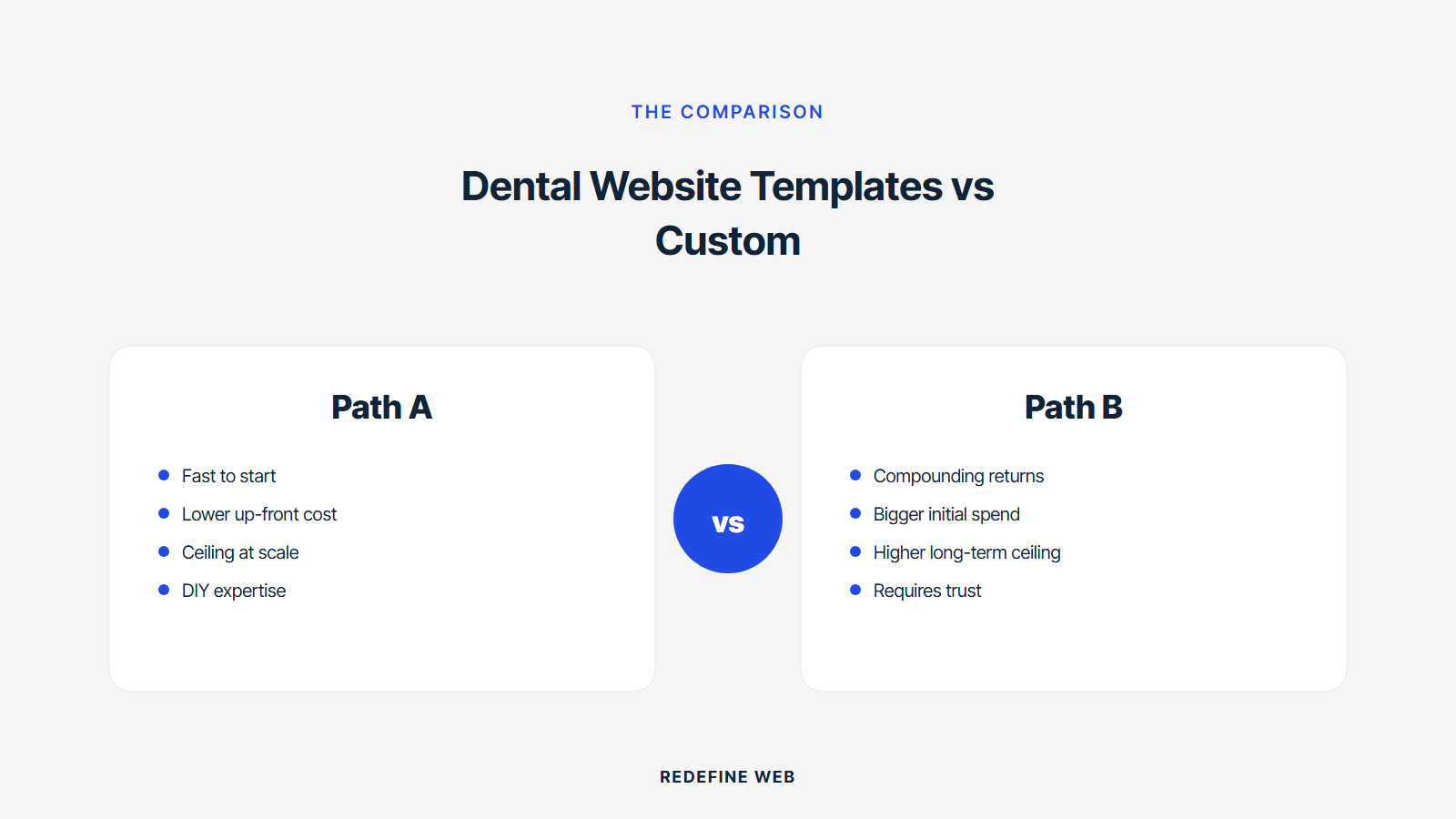
Three alternatives sit between a $79 monthly template and a $22,000 custom build. Semi-custom builds start at $4,500 to $9,000, where a designer customizes a base template with the practice’s photography, copy, and color palette. WordPress with a dental-tailored theme like GoDental or Denta runs $2,500 to $5,000 for setup and $60 to $150 monthly for hosting and maintenance. Headless dental sites with a Next.js frontend cost $12,000 to $28,000 up front but scale to multi-location practices without a redesign.
The semi-custom path is where most growing single-location practices land. It splits the difference on cost and customization. The WordPress path fits practices with an in-house marketing lead who wants control. The headless path fits DSO groups and multi-location practices that need one platform to serve 5 to 40 locations. When you’re ready to move past a template, the semi-custom route is usually the cleanest step up because you get real customization without the full custom build price tag.
Which alternative fits which practice size
Solo practice, 15 to 30 new patients monthly: entry or mid-tier dental template. One to two provider practice, 30 to 60 new patients monthly: mid-tier template or semi-custom build. Three to six provider practice, 60 to 150 new patients monthly: semi-custom or full custom on WordPress. Multi-location practice or DSO, 150+ new patients monthly across locations: full custom or headless on a scalable stack. Each tier maps to a marketing budget where the site quality actually moves patient volume.
Common mistakes practices make with dental website templates
Practices trip on dental website templates in predictable patterns. The most expensive mistake is signing a 24-month contract at the entry tier and hitting the ranking ceiling in month four, then paying 20 months of retainer on a site that no longer moves patient volume. The second most expensive is buying the premium tier and never using the copy customization included in the retainer, leaving the site with the same generic copy the entry tier ships with.
- Signing a long contract before testing the vendor’s response time on a copy edit request.
- Buying the entry tier because it’s cheap, then discovering booking isn’t included.
- Skipping the mobile page speed test before signing. Template quality varies widely on mobile.
- Not asking who owns the domain. A few vendors register the domain in their own account.
- Failing to add real practice photos, keeping the stock library instead.
- Never rewriting the top three service pages to match the practice’s positioning.
- Assuming the template retainer includes SEO. It usually includes SEO edits, not SEO strategy.
- Waiting until year three to switch, after the practice has outgrown the template ceiling by three quarters.
The retainer inclusion trap
Vendors sell “SEO included” on the mid and premium tiers. What’s included is usually meta tag edits, title tag rewrites, and monthly Google Business Profile posts. Strategy work like keyword research, competitor analysis, content planning, and link building is not included and gets charged as a separate retainer at $800 to $2,500 monthly. Practices that read “SEO included” and expect real SEO growth are underserved. The fix is to read the SEO deliverable list carefully before signing, and to budget for a separate SEO retainer if organic growth is a goal.
Making the final dental website templates decision
The dental website templates decision comes down to three questions. First, does the practice need a site live in under four weeks, or is eight to sixteen weeks acceptable? Second, is the marketing budget under $2,500 monthly, or above? Third, is the practice competing in a metro market of 30+ practices, or a low-competition market of under 10? Two “template-friendly” answers out of three, and a template is the right choice. Two or more “custom-friendly” answers, and the template will hit its ceiling within 18 months.
For practices already on a template that stalled, the switch to custom pays back inside 12 months for most single-location practices booking above 40 new patients monthly. If you want a second opinion on whether your current template is holding the practice back, our team runs a free 20-minute audit that pulls organic ranking data, page speed benchmarks, and conversion rate estimates against your current template. You can also read our breakdown of dental website development timelines to gauge what a custom build actually takes end to end.
For a full walkthrough of the vertical, our dental marketing hub covers SEO, PPC, and web design as one integrated stack. Practices ready to invest in a custom build can start with our dental website design services, and practices testing the water can pair a template with a light dental SEO retainer to see what the growth curve looks like. The right answer depends on where the practice is today and where it needs to be in 18 months.
Next steps by practice stage
Brand-new practice under six months in: sign a mid-tier dental website template for the first 12 to 18 months while patient volume builds. Growing practice past 40 monthly new patients: plan the custom build for the next 6 to 9 months so it launches before the template ceiling caps growth. Established practice on a template past 24 months: run a diagnostic on rankings, conversion, and speed against custom benchmarks, and switch if two of the three metrics underperform. Multi-location practice: skip the template entirely and build on a scalable stack from day one.
Frequently asked questions
How much do dental website templates cost per month?
Dental website templates run $79 to $499 monthly depending on tier. Entry templates at $79 to $129 include a fixed layout, stock photos, and a contact form. Mid-tier at $199 to $299 adds booking widgets, review integrations, and small copy edits. Premium at $299 to $499 unlocks light customization, a blog, and monthly SEO edits. Setup fees run $500 to $2,500 on top. Add photography, extra forms, and off-template edits, and the mid-tier subscription usually lands at $200 to $300 monthly all-in for most solo and two-provider practices.
Do dental website templates rank in Google?
Dental website templates rank at about 45 percent of the traffic a comparable custom dental site produces. Local pack rankings stay competitive because Google Business Profile signals drive the pack. Organic rankings on treatment queries like implants, veneers, and Invisalign underperform against custom sites by 30 to 60 percent. The gap comes from duplicate template copy running across hundreds of practice sites, which Google's helpful-content system down-ranks. Rewriting the top service pages in the practice voice closes about half the gap, and a full custom rebuild closes the rest.
How long does it take to launch a dental website template?
Dental website templates launch in two to four weeks in most cases. Week one covers content intake, logo upload, and photo selection from the vendor library or your own shoot. Week two covers copy edits, page structure changes within the template limits, and booking integration setup. Weeks three and four cover final QA, contact form testing, HIPAA form review, and DNS cutover. Practices switching from an existing site add a week for 301 redirect mapping. A custom dental website design, for comparison, takes eight to sixteen weeks from kickoff to launch.
Can I switch off a dental website template to a custom site later?
Yes, and most growing practices do so between month 18 and month 36. The switch takes six to twelve weeks for the new build plus contract exit friction. Domain moves without drama in most cases. Content export rarely delivers a clean file, so service pages usually get rewritten. Read the template contract exit clause today. Common terms include 60 to 90-day written notice, a data export fee of $200 to $500, and, in some contracts, a 12-month minimum term with a cancellation penalty. Planning the exit at signing avoids a six-month delay when you actually want to move.
Are free dental website templates any good?
Free dental website templates work only as a temporary bridge for a brand-new practice testing whether marketing produces bookings. Free templates ship without booking integration, without HIPAA-compliant form templates, without vendor support, and with generic dental copy shared across every practice that downloaded it. The site loads slower, ranks worse, and converts lower than a paid template. Practices past month six should upgrade to a paid template or a semi-custom build. Free is fine as a two-month bridge. It's not fine as a two-year marketing foundation for a real practice.
Should I use a dental website template or a general builder like Wix?
Dental website templates come with pre-written dental copy, dental-specific booking integrations, and HIPAA-appropriate forms. Wix and Squarespace give you a blank canvas at lower monthly cost, $16 to $49, but no dental content and no HIPAA guardrails. Dental templates win when the practice wants dental content and compliance handled by the vendor. Wix wins when the practice has an in-house marketer who can write dental copy and configure compliant forms. All-in monthly cost usually lands within $50 of each other once you add plugins, so pick based on who does the content and compliance work.
Book your free 30-minute strategy call.
No spam, no sales rep. We use your email to schedule your call with a senior strategist. That is it.
More from the blog
View all articles → Web Design
 Core Web Vitals Healthcare Websites Actually Need to Book Patients
Read article Web Design
 Professional Services Website Design Best Practices for 2026
Read article Web Design