
Digital Marketing for Optometrists Every Booked Exam Explained
- Six channels do the work in digital marketing for optometrists.
- Cost per booked exam ranges $3 to $80 by channel.
- Recall automation runs $3 to $9 per booked exam.
- Google Ads books exams inside week one.
- Blended cost per booked exam lands at $18 to $28.
- Why digital marketing for optometrists compounds faster than traditional
- The optometrist digital marketing channel mix
- What cost per booked exam looks like by channel
- Optometrist web marketing and the site that converts
- Internet marketing for optometrist practices at every stage
- How to execute an optometrist internet marketing program in 90 days
- Digital marketing for optometrists channels compared side by side
- What optometrist online marketing looks like in practice
- How to choose a vendor for digital marketing for optometrists
- Working with Redefine Web on optometrist digital marketing
- Which digital marketing for optometrists channel to add next
Digital marketing for optometrists is the six-channel mix that produces booked exams. Not every channel earns a slot in every practice. Not every channel goes live in month one. But every channel below is trackable by cost per booked exam, which is the only number that matters when a practice owner sits down at the end of the month and asks whether the marketing spend earned its keep this quarter or wasted the budget on impressions no patient saw.
This guide covers each channel with real 2026 numbers, the sequencing pattern that produces trackable cost per booked exam by week four, and the mix that fits solo, two-location, and multi-location groups. The numbers come from Vision Express (62 percent booking growth in six months) and Dr Parth Shah (40 percent booking growth on a 120 percent organic gain). Read straight through in nine minutes or skip to the sections that match your practice stage today.
Why digital marketing for optometrists compounds faster than traditional
Digital marketing for optometrists compounds faster than traditional because attribution runs at the channel level. A billboard cannot tell you which exam it booked. A Google Ad tells you the exact keyword, ad copy, and landing page that produced the booking, along with the cost. That transparency lets a practice owner cut waste inside two weeks instead of two quarters.
Traditional marketing (print, radio, billboard, direct mail) still contributes to branded search volume, which Google now weighs as a local ranking signal. Practices with strong offline presence in their community usually see 20 to 40 percent of their organic traffic arrive through branded searches. The problem is not that traditional stops working. The problem is that traditional cannot be optimized weekly because the feedback loop runs on quarters or years.
Digital gives you weekly loops. Google Ads report yesterday’s spend and today’s clicks. Local search dashboards show map-pack position by day. SEO rankings shift weekly. Recall automation reports every send. That cadence lets a practice owner reallocate budget across channels inside days instead of quarters, which is why practices running digital-first typically pass traditional-first competitors inside 18 months on total booked exams.
The other advantage is targeting precision. A billboard reaches everyone on the highway, most of whom will never book an exam. A Google Ad reaches only people searching “eye doctor near me” or “diabetic eye exam.” The search itself confirms the intent. That efficiency lets a practice with a $2,400 monthly ad budget produce more booked exams than a competitor with a $15,000 monthly billboard schedule, and the math has held for six years running.
The optometrist digital marketing channel mix
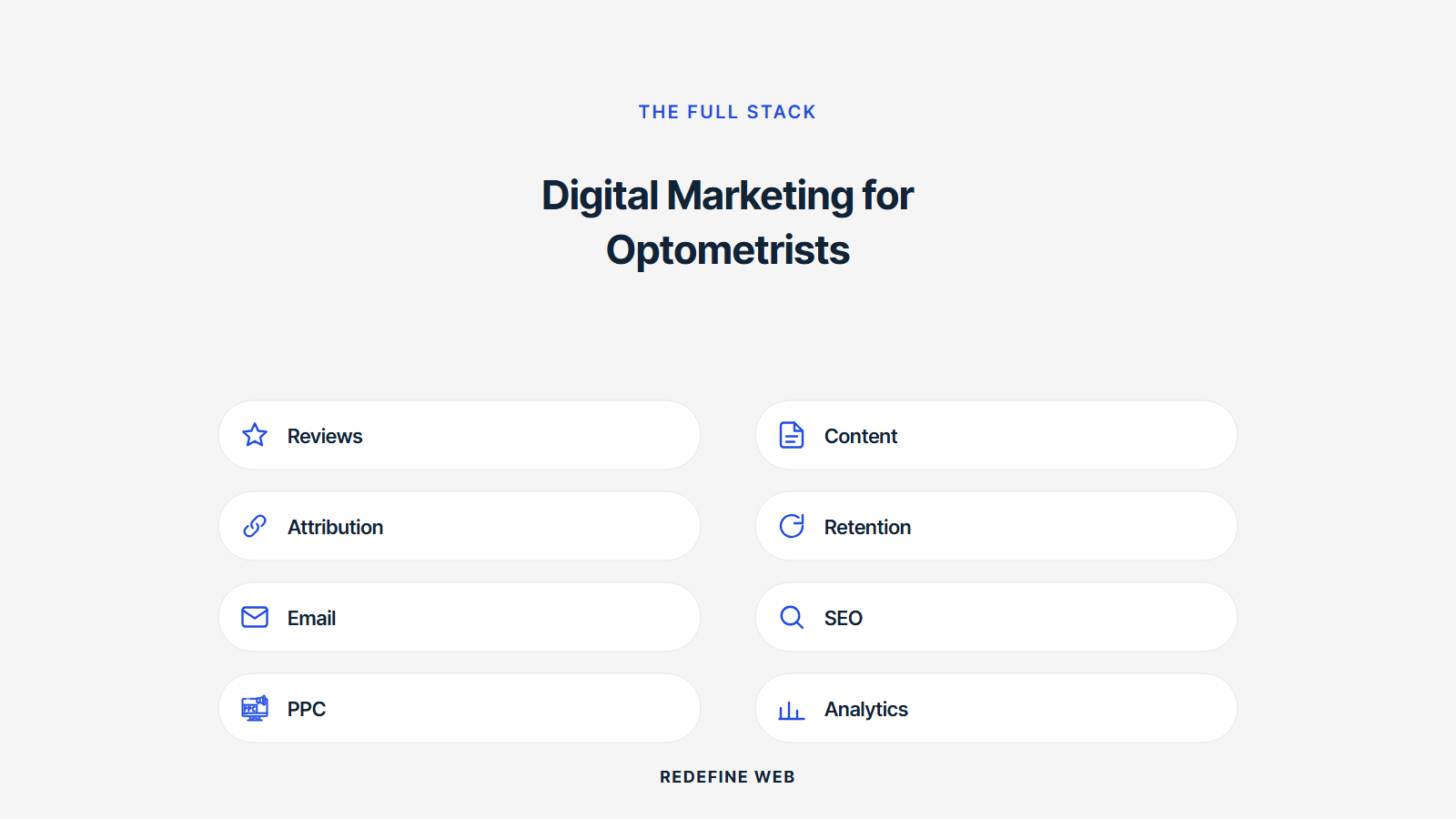
A working optometrist digital marketing mix runs six channels. Website with a booking flow that converts. Google Business Profile with active local search work. Google Ads split into routine, medical, and brand campaigns. Non-brand organic SEO with condition and service pages. Recall automation into the existing patient list. Review outreach tied to the practice-management system. Meta Ads earn a seventh slot for specific service lines like myopia management.
- Website converting routine at 6 to 12 percent and medical at 4 to 8 percent
- Google Business Profile with weekly posts and citation cleanup
- Google Ads on routine, medical, and brand intent (three campaigns)
- SEO with condition pages, service pages, technical hygiene
- Recall flows firing at month 10, month 12, month 16
- Review outreach via SMS 24 hours after every visit
- Meta Ads for specialty service lines beyond routine exams
Each channel plays a specific role. Website converts every visitor. GBP owns the map pack. Google Ads captures active demand at the fastest speed. SEO compounds slowly and delivers the lowest blended cost per booked exam over 18 to 36 months. Recall keeps the existing list productive. Reviews build the trust that closes the click. Meta creates demand for specialty services Google search volume cannot yet support. Overlap between channels is intentional and produces the compounding effect that shows up in month six numbers.
Practice owners who try to run one channel in isolation typically hit a ceiling at $2,000 to $3,500 monthly booked-exam revenue and stall out. The compounding needs all six firing together, and the sequencing decides whether the first 90 days feel productive or scattered. That is why the buying order matters more than the total budget number.
What cost per booked exam looks like by channel
Cost per booked exam by channel breaks down as $3 to $9 for recall automation, $8 to $20 for local search, $12 to $35 for SEO organic, $18 to $55 for Google Ads, and $35 to $80 for Meta Ads on specialty service lines.
Google Ads at $18 to $55 blended across routine and medical intent runs the paid workhorse channel. SEO organic at $12 to $35 kicks in once content has been live for six months. Local search (map pack) at $8 to $20 is the cheapest source of new patients on the mix. Recall automation at $3 to $9 per booked exam is nearly free at scale.
Meta Ads run $35 to $80 blended on specialty service lines because the audience is being educated rather than captured. Reviews as a standalone channel do not produce direct bookings but boost the map-pack ranking, which increases the free-traffic denominator on every other channel. The boost is real but hard to isolate, so most reporting rolls reviews into the local search bucket.
The blended cost per booked exam across all channels usually lands at $18 to $28 for an established practice running the six-channel mix. A new practice in year one runs higher because there is no recall base and no organic ranking yet. A five-year-established practice with strong reviews and content momentum runs lower because the free channels (SEO, local, recall) carry more of the load and paid channels only fill gaps.
Practice owners should track a rolling four-week average of cost per booked exam by channel. Weekly numbers bounce around too much to act on directly. The four-week rolling average smooths noise and surfaces real trend movement. A 15 percent shift in the rolling average is worth investigating. A 30 percent shift is worth an emergency call to the vendor. Reference Google Search Central’s blog for how attribution model choices affect the numbers.
Ignore cost per click and impressions. Pull last month's ad spend, divide by exams booked. If it's above , one channel is bleeding. Find which before adding a new one.
Optometrist web marketing and the site that converts
Optometrist web marketing is everything that happens on the site after the traffic lands. A booking button visible on every page. One landing page per exam type. A page for every accepted vision plan. An insurance page. An about-the-doctor page with a real photo and credentials. A location page with map, hours, phone, and parking notes. Missing any of these sends prospective patients to a competitor who has them.
The booking flow decides conversion. A four-step form loses 25 to 40 percent of clicks compared to a two-step form. Step one asks reason for visit and preferred date range. Step two asks name, phone, email, and insurance. Anything more happens after the practice calls back. Vendors pushing all fields to step one because it “reduces phone calls” quietly reduce booked exams too, which is a math a practice owner should verify against the tracking data quarterly.
Page speed carries real weight. Every second above 3 seconds costs roughly 10 percent of the conversion rate. Optometry sites often carry heavy stock imagery and third-party booking widgets pushing load past 6 seconds on mobile. Fixing this is not glamorous but consistently produces 15 to 30 percent more bookings on the same traffic. Reference web.dev’s Core Web Vitals for the baseline metrics to hit.
Conversion rate is not a single number. Routine intent converts at 6 to 12 percent on a working site. Medical intent converts at 4 to 8 percent. Vision-plan searches convert at 8 to 15 percent because the search itself confirms the intent to use insurance. Report and track them separately. Blending them into a site-wide conversion rate hides which pages need attention. Our optometrist website design guide walks the layout patterns that convert.
Internet marketing for optometrist practices at every stage
Internet marketing for optometrist practices runs different mixes at each stage. A new practice in month one has no organic ranking, no recall base, and no review base. Every channel starts from zero. An established practice at year five has partial organic ranking, a large recall list, and a growing review base. The channel weightings shift accordingly.
New practice mix. Website, GBP setup, Google Ads (routine plus brand), review outreach, basic tracking. Total lands at $2,800 to $4,500 monthly retainer plus $2,500 to $4,500 ad spend for the first six months. Skip SEO retainer until month six because the site needs to stabilize. Skip Meta until specialty service lines exist. Skip recall until 12 months of visits have accumulated in the practice-management system to build a real recall list.
Established solo mix. Full six-channel stack. Retainer runs $2,800 to $4,200 monthly plus $2,000 to $3,500 ad spend. The channel weighting shifts toward SEO and recall as the free traffic carries more of the load. Google Ads budget can taper 20 to 30 percent once the map pack ranking is stable and the organic content is compounding through month twelve.
Multi-location group mix. All six channels concurrent plus consolidated reporting. Location-specific landing pages replace generic service pages. Recall runs per-location tuning based on staff mix and demographics. Total lands at $6,000 to $12,000 monthly retainer plus $4,000 to $10,000 ad spend for a three-location group. See our marketing for optometrists post for the general channel deep-dive.
How to execute an optometrist internet marketing program in 90 days
An optometrist internet marketing program executes in four two-week sprints over 90 days. Sprint one covers tracking and site fixes. Sprint two launches paid. Sprints three and four add organic SEO and recall automation. Meta and specialty layers come after.
Sprint by sprint. Week 1 to 2 covers booking-flow audit, GBP cleanup, tracking install with call tracking and GA4. Week 3 to 4 launches Google Ads with routine and brand campaigns, then adds medical by end of week 4. Week 5 to 6 kicks off SEO content cadence and starts review outreach. Week 7 to 8 goes live with recall automation and the first monthly reporting review.
Sprint one is boring on purpose. No paid spend goes live until tracking is confirmed working end to end. Call tracking with dynamic number insertion, form-fill events firing into GA4, Google Ads conversion actions imported from GA4, Meta CAPI ready if Meta is on the plan. Vendors skipping this get pretty reports in month two and no defensible numbers in month three, which is when the practice owner stops trusting the invoice.
Sprint two puts money into the fastest channel. Google Ads books exams in week one when launched clean. Routine and brand run first because both convert at the highest rate and cost per click is predictable. Medical intent goes live end of sprint two after routine has a two-week baseline. Splitting the two lets the vendor bid appropriately on each. Blending them into one campaign wastes 20 to 40 percent of the spend.
Sprints three and four compound. Content publishing at one deep piece per week. Review outreach adds 8 to 15 new reviews across the first six weeks. Recall automation launches at week eight with three flows (month 10, month 12, month 16). By day 90 the practice has trackable numbers on every channel, a rising review count, a live recall program, and the first month of organic content live and starting to attract traffic.
Digital marketing for optometrists channels compared side by side
The table below compares every channel by cost per booked exam, time to first booking, and month-six blended contribution. Numbers reflect independent optometry practices in 2026. Metro competition pushes cost per booked exam 20 to 40 percent higher. Rural markets sit at or below the low end of each range.
| Channel | Cost per booked exam | Time to first booking | Month-6 share |
|---|---|---|---|
| Google Ads | $18 to $55 | Week 1 | 30 to 40 percent |
| Local search / GBP | $8 to $20 | Week 8 to 16 | 20 to 30 percent |
| SEO organic | $12 to $35 | Month 4 to 6 | 10 to 20 percent |
| Recall automation | $3 to $9 | Week 8 | 15 to 25 percent |
| Meta Ads | $35 to $80 | Week 2 to 4 | 5 to 10 percent |
| Reviews (indirect) | Rolls into local | Compounds | Amplifies local |
Reading the table. Google Ads is fastest to first booking and takes the largest share by month six. Local search is cheapest per booked exam and compounds with time. SEO is slowest but produces the durable, low-cost booking source that carries a practice through the next decade. Recall automation is the near-free channel that most practices ignore. Meta Ads sit last on cost efficiency but earn a slot for specific service lines.
Adding up the month-six shares does not equal 100 percent because the channels overlap. A patient searches on Google, sees a map pack listing, checks reviews, then books through a recall email that arrived at the right moment. Multi-touch attribution credits all four channels partially. Last-click attribution credits only the recall email and undervalues the top-of-funnel work.
What optometrist online marketing looks like in practice
Optometrist online marketing in practice looks like Vision Express, an independent optometry practice specializing in vision therapy and dry eye. The engagement ran the 90-day sequence over six months and produced 62 percent booking growth, 71 percent revenue growth, and a $28 blended cost per booked exam from Google Ads.
Month zero looked like every stalled practice. Booking volume had held flat for three quarters. The site was outdated. Their prior vendor sent monthly reports without a cost per booked exam figure anywhere in them, which is a tell that a general medical marketing agency has taken on an optometry account and does not know what to measure. The map-pack ranking sat at position five. The recall list had 4,200 patients but no automation running against it.
The engagement rebuilt the site in weeks one to four, cleaned up GBP and citations in weeks two to three, launched Google Ads in week four across three campaigns, and installed recall automation at week eight. Content cadence started week six with the first three service pages (vision therapy, dry eye, and pediatric exam). Reviews jumped from 47 to 91 in the first three months on outreach through the practice-management system.
Six months in, booking volume was up 62 percent, revenue was up 71 percent, and cost per booked exam from Google Ads held at $28 blended. Recall reactivation added 32 exams per month by month five. Organic traffic gained 46 percent by month six with the compounding still ramping. The reporting layer let the practice owner see cost per booked exam per channel weekly, which the prior vendor never delivered even monthly.
The prior vendor’s final report before the switch cited “impressions gained” and “keyword coverage expanded.” Neither number pays the rent. Impressions are what happens before a click, and a click is what happens before a booking, and a booking is the only number the practice owner needed to see. Two layers of abstraction always mean the vendor is hiding something.
How to choose a vendor for digital marketing for optometrists
A vendor that fits digital marketing for optometrists has three specific things. Optometry-specific experience with named references. A flat retainer with no ad-spend markup. Weekly reporting on cost per booked exam by channel. Vendors missing any of the three treat optometry accounts like generic small-business marketing and stall out at month six.
Optometry experience means the vendor has run at least five optometry accounts. Ask directly on the first fit call and expect specific practice names, specific results, and specific reference contacts. Vendors that dodge or generalize the answer usually have zero optometry accounts and are pitching from a general medical playbook that will miss the annual cadence, the insurance split, and the 48-hour purchase window.
Flat retainer with no ad-spend markup matters because percent-of-spend vendors have an incentive to raise your budget, not your cost per booked exam. A vendor charging 15 percent of ad spend earns more when your Google Ads budget doubles. That structure creates a conflict of interest that shows up in every budget conversation for the length of the engagement. Flat retainer keeps the incentives aligned on your booked exam number.
Weekly reporting on cost per booked exam by channel is the third check. Ask to see the actual dashboard template on the fit call, not a screenshot deck. Vendors that cannot show a live dashboard from a current account either do not build them or hide them behind sanitized monthly PDFs. Both patterns end badly. See our marketing companies for optometrists post for the fuller vendor selection framework.
Working with Redefine Web on optometrist digital marketing
Redefine Web runs digital marketing for optometrists as an integrated program under one lead per practice. The stack covers site, SEO services, PPC services, local search, recall, reviews, and reporting. Retainers start at $599 monthly for a lean local program and scale to $3,500 monthly for full-stack coverage on a solo practice. Multi-location retainers scale with the operating footprint.
Every engagement follows the 90-day sequence. Tracking and site fixes in weeks one to two. GBP cleanup in weeks two to three. Google Ads live by week four. SEO cadence starting week six. Recall automation live by week eight. Meta Ads and advanced service lines follow after the base produces predictable cost per booked exam numbers by month three.
Contract structure runs six months minimum, flat retainer with no ad-spend markup, 30-day wind-down clause, and practice-owned ad accounts and domain. Reference calls with current independent optometry clients are provided during the first fit call, not held back until the pitch. See our optometrist marketing agency stack for packages and case study links, or read the optometrist marketing playbook for the underlying growth model.
Weekly reporting comes standard. Every dashboard ties directly to cost per booked exam per channel because that is the only metric that matters when the practice owner sits down at the end of the month and asks whether marketing earned its keep. Everything else supports that number or gets cut from the report.
Which digital marketing for optometrists channel to add next
A new practice adds site, local search, and Google Ads first. An established solo practice adds reporting and recall automation before layering more paid. A multi-location group adds consolidated reporting and location-level attribution on top. The order matters more than the total.
Practice owners who trust the sequence save money and see the compounding earlier than those who spread thin from day one. Buying the right two channels and running them well for 90 days produces the tracked baseline that justifies scaling into the rest. Buying every channel at month zero without sequencing produces waste and vendor fatigue.
Read the optometrist marketing cost guide for the pricing math, and the SEO for optometrists guide for the organic channel deep-dive. Vendor selection frameworks from HubSpot, Content Marketing Institute, and Search Engine Land back up the sequencing choices above.
Frequently asked questions
What does digital marketing for optometrists cover?
Digital marketing for optometrists covers the six channels that produce trackable booked exams. A booking-ready website. Google Business Profile with active local search work. Google Ads split into routine, medical, and brand campaigns. Non-brand organic SEO with condition and service pages. Recall and reactivation automation into the existing patient list. Review outreach tied to the practice-management system. Meta Ads earn a seventh slot for specific service lines. Each channel produces measurable cost per booked exam, which is the only metric that matters at the end of each month.
What is the average cost per booked exam in optometrist digital marketing?
The blended cost per booked exam across a full six-channel program lands at $18 to $28 for an established independent practice in 2026. New practices in year one run higher because there is no recall base and no organic ranking yet. Established five-year practices with strong reviews and content momentum run lower because the free channels (SEO, local, recall) carry more of the load. Channel-specific numbers range from $3 to $9 for recall automation up to $35 to $80 for Meta Ads on specialty service lines.
How does optometrist web marketing convert visitors into booked exams?
Optometrist web marketing converts visitors through a two-step booking form, one landing page per exam type, a page for every accepted vision plan, an insurance page, and a location page with map, hours, phone, and parking. Routine intent converts at 6 to 12 percent on a working site. Medical intent converts at 4 to 8 percent. Vision-plan searches convert at 8 to 15 percent because insurance intent is already confirmed. Page speed under 3 seconds and a booking button on every page carry more weight than any other single design choice.
How fast does internet marketing for optometrist practices show results?
Google Ads books exams in week one when the campaigns launch clean, at a cost per booked exam of $18 to $55. Local search moves the map pack in 8 to 16 weeks and produces bookings at $8 to $20 blended. SEO content gains show at month four to six on a well-executed program. Recall automation books exams starting week eight after the flows go live. Meta Ads produce steady conversions inside 30 days on specialty service lines. Any vendor promising 90-day results across all channels together is misrepresenting the timelines.
Do I need Meta Ads in my optometrist digital marketing mix?
Not every practice needs Meta Ads. Meta earns a slot when the practice runs specific service lines like myopia management, dry eye clinics, scleral lens fittings, or aesthetic services where Google search volume cannot yet support the awareness needed. Practices without a specialty focus usually skip Meta and put the budget into Google Ads plus content. Practices with a specialty service line use Meta to educate the market that Google cannot reach yet because the query volume is still low. The right answer depends on the specialty focus and the goal for the next 12 months.
How is optometrist online marketing measured and reported?
Optometrist online marketing is measured on three numbers. Cost per booked exam by channel. Total booked exams by source. Patient lifetime value versus total marketing spend. Cost per booked exam requires call tracking with dynamic number insertion, form-fill events firing into GA4, offline conversion imports from the practice-management system, and a Looker Studio dashboard tying it all together. Reporting cadence runs weekly on the 15-minute quick numbers and monthly on the strategic narrative. Vendors sending only monthly PDFs cannot catch slipping campaigns fast enough to protect the account.
Book your free 30-minute strategy call.
No spam, no sales rep. We use your email to schedule your call with a senior strategist. That is it.
More from the blog
View all articles → Digital Marketing
 Dental Marketing Tips That Compound Into New Patients
Read article Digital Marketing
 Ecommerce Marketing Strategies That Drive Real DTC Revenue
Read article Digital Marketing