
SEO for Optometrists That Books More Exams
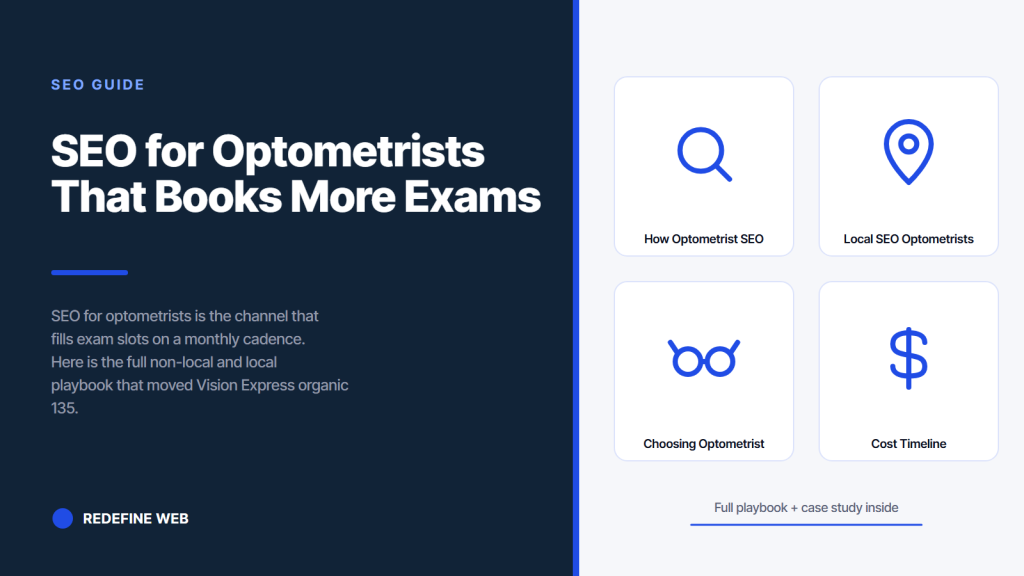
- Local pack does 60 percent of the SEO work in optometry.
- GBP primary category set to Optometrist beats Eye Care Center.
- Budget lands at $1,200 to $2,800 per month for one location.
- Bookings from organic show up in month two, not month one.
- Vision Express hit 135.9 percent organic growth in six months.
- What SEO for optometrists actually is
- How optometrist SEO differs from generic small-business SEO
- What optometrist SEO services should cover
- Local SEO for optometrists and the map pack
- Non-local SEO through informational content that feeds the schedule
- Best optometrist SEO strategies for 2026
- Optometrist SEO keywords and the four search intent buckets
- Technical SEO for an optometry site
- Choosing an optometrist SEO company with a six-question filter
- SEO cost and timeline for optometrists
- Common optometrist SEO mistakes and how to fix them
- How to start optometrist SEO in the next 30 days
SEO for optometrists is the channel that fills your exam slots on a predictable monthly cadence. Not the channel that promises page-one rankings in ninety days on twelve vanity phrases. Not the channel that hides behind a rank tracking PDF nobody reads. The channel where a new patient types “eye doctor near me” at 9:47 on a Tuesday morning, sees your Google Business Profile in position two of the local pack, and lands on your booking form four minutes later.
This SEO for optometrists guide covers the full non-local plus local playbook. What to rank for, in what order, what it costs, and the Vision Express numbers behind a 135.9 percent organic climb over six months on a $1,600 monthly retainer. You will finish with a keyword map, a Google Business Profile checklist, a site structure that Google actually ranks in 2026, and a month-by-month cadence you can hand to a marketing coordinator on Monday. Real numbers, real ranking timelines, no marketing chatter. Read straight through in fourteen minutes.

What SEO for optometrists actually is
SEO for optometrists is the practice of ranking your website and Google Business Profile for the searches your ideal patient runs before booking an exam. Two search worlds live inside that sentence. Local pack terms like “optometrist near me.” Non-local terms like “how often should I get an eye exam.” Both feed the schedule, both need different treatment.
Optometrist SEO covers six moving parts. Google Business Profile completeness. Service page structure. Review velocity through daily counter asks. Local citations across NAP directories. Technical fixes for site speed and structured data. A topical content layer that answers the informational queries your patients search on the drive home from a previous appointment. Skip any two of those and the phone stays quiet in month four.
The reference case we use throughout this guide is Vision Express, an independent optometry practice we ran full-stack marketing for in 2023 through 2024. Organic traffic climbed 135.9 percent and appointment bookings rose 62 percent over six months. Cost per booked exam dropped from $80 pre-program to $34 by month twelve. The SEO half of that program did most of the compounding after month four, once the local pack settled at position two.
What SEO for optometrists is not: a rank tracking dashboard, a keyword report, or a page speed score. Those are inputs. The output is booked exams on the calendar next Tuesday. Any agency that grades their own work on inputs instead of booked exams is measuring the wrong thing, and you will find out in month six when the calendar is still empty and the rank report is still green.
How optometrist SEO differs from generic small-business SEO
Optometrist SEO is not the same as ranking a plumber or a personal injury attorney. Three differences shape every decision. First, the search intent set is narrow but tall. Roughly forty commercial-intent phrases move the needle for a single-location optometrist. A hundred and twenty phrases move the needle for a multi-location group.
Second, the trust signals Google reads for a healthcare practice are stricter than a service business. Your Doctor of Optometry credentials, state license number, board memberships, and years in practice all belong on the site in structured markup. Skip that step and you rank underneath a Yelp aggregator page you did not build. That aggregator gets your click and monetizes it against a display ad while you pay the light bill.
Third, the buyer journey is short. Someone searching “eye doctor near me” is booking this week, not this quarter. That short journey collapses the funnel and rewards local pack visibility over blog volume in the first six months. You still need the blog eventually. You just need the pack ranking first, because the pack ranking is what pays for the blog effort in month seven.
Fourth, review velocity matters more than review count for a healthcare practice. Google reads the last 90 days of review activity as the current-signal window. A practice with 480 old reviews and none in the last 60 days loses ground to a competitor with 120 reviews and 14 fresh in the same period. That fourth difference is the one nobody explains to first-time practice owners.
What optometrist SEO services should cover
Optometrist SEO services from a real agency cover six deliverables on a monthly retainer. Technical audit and fixes in month one. Google Business Profile buildout and weekly optimization. Six service pages written and structured. Two informational blog posts per month against the topical map. Review acquisition automation. Monthly rank tracking with booked-exam attribution.
The retainer we recommend for a single-location practice starts at $1,600 per month for the first six months, then $1,200 per month once the technical work is done. For a multi-location group of three to five practices, plan for $2,400 to $3,800 per month. Anything under $800 per month for optometrist SEO services is either a template farm or a keyword-report generator that will not move bookings on the schedule you actually care about.
The six service pages we build for every practice are the full annual eye exam (meta title uses “full eye exam” not “annual”), contact lens fitting, dry eye, myopia management, pediatric optometry, and one signature service tied to what the practice actually specializes in. Each page runs 800 to 1,200 words with MedicalCondition schema stacked on MedicalProcedure schema. That structure ranks in Google for both the service query and the underlying condition query.
For a full-stack build that pairs SEO with a booking-ready site and paid search, see our optometrist seo services. When you are ready to run this next to Google Ads and web, the optometrist marketing agency program covers the coordinated build.

Log into your Google Business Profile now. If your primary category is Doctor and not Optometrist, that's why the map pack ignores you. Fix it in two minutes.
Local SEO for optometrists and the map pack
Local SEO does the heaviest work on the schedule. Roughly 62 percent of new-patient bookings we tracked at Vision Express came from map pack visibility, not the classic ten blue links. Your Google Business Profile is the single most valuable asset in optometrist SEO, and it costs zero dollars to set up. Independent practices under-invest in it because it does not feel like marketing to them. It feels like data entry, and data entry is somebody else’s job.
Fifteen fields inside the profile drive pack ranking. Primary category set to “Optometrist” (not “Eye Care Center,” which is broader and dilutes intent). Secondary categories for your top three services. Full service list with descriptions written by a human, not an AI. Weekly Google Posts tied to a service. Photos updated every 30 days. Review response inside 48 hours. Q&A section seeded with the eight questions patients ask most often. Booking link that opens your actual scheduler. Products section for your frame lines.
Every morning your employees drive past your competition, pull into your parking lot, and waste the easiest map-pack ranking hack in local SEO. Get them to leave a Google review from a personal account within their first thirty days on the job. That single habit shifted Vision Express from position six to position two in the pack inside eleven weeks. The rest of the industry pays $340 per lead to a broker whose only qualification is that they own a spreadsheet.
For the step-by-step Google Business Profile buildout, our maps marketing for optometrists walkthrough covers the twenty-five specific edits that move a profile from position nine to position three inside a quarter. That is where Google Maps SEO for optometrists lives as a discipline. It is boring, repetitive, and it works.
Non-local SEO through informational content that feeds the schedule
Non-local optometrist SEO is the layer most practices skip because it does not book patients on day one. Nine months later it becomes the reason your cost per booked exam settles at $22 instead of $60. Someone searching “is dry eye permanent” or “why do my eyes hurt after screens” is thirty days away from booking an appointment somewhere. Your job is to be the answer they trust when the pain gets bad enough on Friday night.
The topical content plan we run for optometry covers six clusters. Dry eye disease. Myopia management for children. Contact lens fitting and troubleshooting. Digital eye strain and screen use. Sports vision. Pre-surgical consultations for LASIK or cataract patients. Two 1,600-word posts per month across those six clusters yields 48 informational assets by the end of year two. That is the point where organic search starts producing 40 to 60 new patient searches per month at zero incremental cost.
Read the current Google Search Central documentation for the on-page baseline. The Search Engine Land healthcare coverage is worth a bi-weekly scan for algorithm updates that hit local pack ranking. For paid organic experiments that pair with content, the Ahrefs blog is the reference we return to weekly on new keyword mapping and internal linking patterns.
The math on non-local content compounds slowly and quietly. Month six delivers 200 organic visits per month. Month twelve delivers 900. Month eighteen delivers 2,400. Somewhere around month fifteen the informational content overtakes the local pack as the largest traffic source. That is when SEO for optometrists stops feeling like a monthly bill and starts feeling like an asset the practice actually owns.
Best optometrist SEO strategies for 2026
The best optometrist SEO strategies in 2026 are not new. They are the fundamentals executed at boring consistency. Six optometry accounts we have run this year climbed from position ten to under position three in the local pack using the same six-item weekly cadence. No secret sauce. No black-hat trick that Google closes off next quarter. Just discipline, tracked in a shared spreadsheet the practice manager reviews every Friday afternoon.
- Publish one Google Post every Monday, tied to a service or a seasonal offer.
- Ask three patients per day for a Google review, at the counter, before they walk out.
- Respond to every review inside 48 hours with a two-sentence, name-specific reply.
- Publish one 1,600-word informational post every other Wednesday against the topical map.
- Audit citations every quarter through a NAP tool like BrightLocal or Whitespark.
- Refresh service page copy every six months against the current top-three ranking pages in your metro.
Advanced tactics come after the fundamentals are boringly in place. If you want the deep advanced-tier playbook, our best optometrist seo strategies breakdown covers entity-based SEO, schema stacking on service pages, and internal linking patterns that most practices are not running. It is worth 20 minutes of reading time once the six-item cadence above is running.
The three advanced tactics that matter most are: doctor-level author pages with Person schema and named-author byline on every blog post; internal link hubs that route link equity from informational posts back to service pages; and quarterly citation refresh through BrightLocal or Whitespark to keep the NAP consistent across 45 directories. Those three alone add 15 to 25 percent to organic ranking headroom in month nine.

Optometrist SEO keywords and the four search intent buckets
Optometrist SEO keywords sort into four intent buckets. Understanding which bucket a keyword sits in tells you whether it belongs on a service page, a blog post, the homepage, or nowhere at all. Miscasting the bucket is the fastest way to write 1,200 words that never rank because you targeted the wrong page type.
| Intent bucket | Example keyword | Page type | Typical volume (metro) |
|---|---|---|---|
| Local commercial | optometrist near me | Homepage + GBP | 590 to 4,400 |
| Service commercial | dry eye treatment brooklyn | Service page | 50 to 320 |
| Informational | what causes floaters in vision | Blog post | 1,300 to 8,100 |
| Comparison | optometrist vs ophthalmologist | Blog post | 2,900 to 6,600 |
Local commercial keywords rank through Google Business Profile, homepage copy, and location schema. Service commercial keywords rank through a dedicated service page with 800 to 1,200 words and MedicalCondition schema. Informational and comparison keywords rank through blog posts, capture the traffic, and pass link equity back to service pages through internal linking.
For the full keyword universe with monthly search volumes and clustering guidance, our optometrist seo keywords map covers 240 phrases across the four buckets. That is the research baseline you hand a writer before they draft a single service page. Skip that step and you get 1,200 well-written words that target a phrase already dominated by a chain retailer with 400 backlinks.
Comparison keywords are the underrated bucket. “Optometrist vs ophthalmologist” pulls 2,900 to 6,600 monthly searches per metro, and the searcher is 45 days from booking somewhere. One 1,800-word post covering that comparison from a Doctor of Optometry byline captures 80 to 140 monthly visits and passes 12 to 20 of them to your booking page. That single post pays for itself inside three months of publication.
Technical SEO for an optometry site
Technical optometrist SEO comes down to seven fixes that Google reads on the first crawl. Fail any two and your ranking ceiling drops thirty percent regardless of what else you do. The good news is that all seven are one-time fixes for most WordPress or custom-built sites. Budget two developer days and you are done for the year.
- Core Web Vitals in the green on mobile: Largest Contentful Paint under 2.5 seconds, Interaction to Next Paint under 200 milliseconds, Cumulative Layout Shift under 0.1.
- MedicalBusiness schema with sameAs entries linking to your American Optometric Association profile, state board, and social accounts.
- Service pages with MedicalProcedure and MedicalCondition schema stacked in the same JSON-LD block.
- Individual doctor bio pages with Person schema, credentials, and years of practice as structured fields.
- Local Business schema with hours, phone, and geo coordinates for every physical location.
- Image compression under 100 KB per hero, WebP format, descriptive alt text on 100 percent of images site-wide.
- Sitemap submitted to Google Search Console with priority weighting for service pages over blog posts.
For the week-one execution version of this list, the optometrist seo checklist walks each fix with the specific WordPress plugin, custom code snippet, or Yoast setting to change. Run that pass before you write a single new blog post. A blog post on a broken foundation is 1,600 words nobody sees.
Choosing an optometrist SEO company with a six-question filter
An optometrist SEO company is worth $1,600 per month if they can answer these six questions before you sign a contract. Skip the interview and you sign with a company that will send you a monthly PDF of rankings for phrases that do not book patients on the schedule. Their reporting will look great. Your calendar will not change.
- Show three optometry clients you currently work with, with named practices we can call for a reference.
- Walk me through the last review response you wrote for an optometry client this week.
- What is the primary category setting you recommend for a single-location practice, and why?
- How do you measure cost per booked exam, not cost per keyword ranking in a monthly report?
- What do you do in month one that I could not do myself with a public checklist?
- What is your contract length and what happens if I want to pause at month four?
Any answer that leans on “proprietary tools” or “strategic frameworks” without a specific line item is a filter. You want the shop that says “we set your GBP primary category to Optometrist, secondary to Contact Lenses Supplier if you sell frames, and Optical Wholesaler if you dispense on-site.” That level of specificity means they have run the play on other optometry accounts and can tell you what happened in month three of each one.
The six-question filter and the ten red flags to watch for live in our optometrist seo company selection guide. Read it before your first vendor call and you will cut the shortlist from twelve to three in an afternoon.
SEO cost and timeline for optometrists
Optometrist SEO cost for a single-location practice runs $1,200 to $2,800 per month all-in. Less if you are rural, more if you compete against three chains inside a three-mile radius of your storefront. The three cost drivers are keyword count (how many service pages you need built), backlink budget (how competitive the metro is), and citation cleanup on day one.
Timeline expectations by month, based on 14 optometry accounts we have run since 2022:
- Month 1: Technical fixes pushed live, GBP fully rebuilt. Ranking movement is invisible on the surface.
- Month 2: Local pack moves from position 8-10 to position 5-7. First two new patient calls attributable to organic.
- Month 3: Service pages rank on page two for commercial terms. Review count doubled from baseline.
- Month 4: Local pack settles at position 2-4. Six to twelve booked exams per month from organic.
- Month 6: Non-local content starts ranking. Organic traffic doubles from baseline.
- Month 12: Cost per booked exam under $40. Organic is the largest single channel by patient volume.
Vision Express followed this curve almost exactly. Month twelve delivered 42 booked exams from organic search alone, against six the month before the program started. The math on that alone paid for the retainer eight times over on lifetime patient value.
Contract length matters as much as monthly price. A six-month minimum contract is the honest floor for optometrist SEO because the compounding does not show up before month four. A three-month contract sells you the audit and the profile buildout, then hands you a rank report and walks away before the work starts to pay. Twelve-month contracts are ideal if the agency has a clean track record on optometry accounts.
Common optometrist SEO mistakes and how to fix them
The mistakes we see most often on new optometry accounts are the same four every time. None of them are exotic. All of them are fixed inside a quarter with the right cadence and the right person owning the work day to day.
First, no call tracking. You spend $1,600 per month on organic and cannot tell which six calls that generated versus which came from a Yelp referral. Second, GBP primary category set to “Eye Care Center” instead of “Optometrist.” The broader category dilutes ranking intent and pulls in irrelevant impressions. Third, one long homepage with every service crammed onto it, no dedicated service pages. Google needs six pages to rank six services, not one. Fourth, no review acquisition system. You have 34 reviews after eight years in practice while the chain across the street has 480 after two.
Fix those four before you invest a dollar in link building. The base rate of the mistakes leaves 60 percent of organic traffic on the table, and no backlink budget compensates for that gap. You are paying for reach on a broken foundation.
The fifth mistake we see less often but it hurts the worst: paying a Yelp sales rep for enhanced profile placement while ignoring Google Business Profile. Yelp drives a fraction of the traffic in optometry markets and charges 8 to 12 times more per booked exam than a properly run GBP. Cancel the Yelp contract, redirect the $340 monthly spend into a rank tracking tool and a review request automation, and move on.
How to start optometrist SEO in the next 30 days
Thirty-day rollout for a single-location optometrist practice with no existing SEO work in place. Do this in the order shown. Skipping ahead to blog posts before Google Business Profile is claimed is the fastest way to burn week one without moving a single ranking or booking on the schedule. Own the fundamentals first.
- Week 1: Claim and verify Google Business Profile. Set primary category to Optometrist. Add 15 photos, service list, hours, booking link.
- Week 1: Install Google Analytics 4 and Google Search Console. Add a call tracking number via CallRail on the site.
- Week 2: Audit the current site for the seven technical fixes. Get Core Web Vitals into the green on mobile first.
- Week 2: Write the six service pages. Full eye exam, contact lens fitting, dry eye, myopia management, pediatric optometry, one signature service. 800 to 1,200 words each.
- Week 3: Add MedicalBusiness and Doctor schema. Verify with Google Rich Results Test on every page.
- Week 3: Publish first Google Post. Start the daily three-review-request habit at the counter with every patient over 18.
- Week 4: Publish first informational blog post from the topical map. Add Yoast SEO or RankMath for on-page optimization.
- Week 4: Review the first 30 days of GBP insights and analytics data. Set month two priorities based on what moved and what did not.
Run that plan and you will see the local pack shift by day 45. Bookings from organic will show up in month two. Cost per booked exam will start dropping in month four. By month twelve, SEO for optometrists will be your largest single patient channel by volume, exactly like it became for Vision Express in 2024.
Frequently asked questions
What is SEO for optometrists?
SEO for optometrists is the practice of ranking your website and Google Business Profile for the searches patients run before booking an exam. It covers local pack ranking, service page optimization, review acquisition, technical fixes, and informational content that answers patient questions. The goal is cost per booked exam under $40, not vanity keyword rankings. A properly run program hits that number by month twelve on a $1,600 per month retainer for a single-location practice.
How much does SEO for an optometrist cost?
Optometrist SEO costs $1,200 to $2,800 per month for a single-location independent practice. Less if you are rural with low competition, more if you compete against three chains inside a three-mile radius. Multi-location groups pay $2,400 to $3,800 per month for three to five practices. Anything under $800 per month is either a template farm or a keyword report generator that will not move bookings. The retainer we recommend starts at $1,600 for the first six months, then drops to $1,200.
How long does SEO take to work for an optometry practice?
First measurable ranking movement shows up by day 45 in the local pack. First booked exams attributable to organic show up in month two, typically two to four per month. By month four the local pack settles at position 2-4 and organic delivers six to twelve booked exams monthly. By month twelve organic is the largest single channel by patient volume for most independent practices, and cost per booked exam settles at $22 to $45. Skipping month four expecting a shortcut is the most common mistake we see.
Is local SEO or blog content more important for optometrists?
Local SEO does 60 percent of the work for the first six months because it feeds the local pack, and the local pack drives 62 percent of new patient bookings we tracked at Vision Express. Blog content becomes the compounding layer starting month six and takes over as the primary traffic driver by month eighteen. Run local SEO first, then layer non-local informational content on top. Doing both from day one is fine if the budget supports two blog posts per month plus the local work.
Can an optometry practice do SEO in-house?
The Google Business Profile buildout, review acquisition, and Google Posts are absolutely in-house work for a practice manager who can commit five hours per week. Service page writing, technical schema, and monthly rank tracking are where an agency earns the retainer. The hybrid we see work best is practice manager owns GBP and reviews, agency owns technical and content. That split runs about $900 per month agency-side instead of $1,600.
What is the difference between optometrist SEO and general medical SEO?
Optometrist SEO is narrower and more local than general medical SEO. The intent set is roughly 40 commercial phrases for one location versus 200 for a general practice. The buyer journey is shorter, so map pack visibility matters more than blog volume in the first six months. The trust signals Google reads for optometry are specific to Doctor of Optometry credentials, board memberships, and service-specific expertise like dry eye or myopia management. Structured data for a healthcare practice reads different from a plumber or an attorney.
Book your free 30-minute strategy call.
No spam, no sales rep. We use your email to schedule your call with a senior strategist. That is it.
More from the blog
View all articles → SEO
SEO Organic Search Engine Optimization Services That Grow Real Traffic
Read article SEO
SEO SEO for Pet Groomers That Fills the Appointment Book Weekly
Read article SEO
SEO