
Marketing for optometrists comes down to 5 decisions and one calendar. You pick the channels that book exams. You size the budget to the practice stage. You sequence the work so each channel enables the next. You measure cost per booked exam weekly. You cut the channels that stop earning. Everything else is noise, and this guide walks each decision with real 2026 numbers.
You won’t find generic marketing advice below. You’ll find what independent practices at 800 to 12,000 active patients actually run, what it costs, and what a 90-day launch looks like when the vendor is competent. The numbers come from Vision Express (62% booking growth in 6 months, 135.9% traffic growth) and Dr Parth Shah (120% organic traffic growth in 6 months), and from the framework we teach every new optometry account inside the first fit call. Skip to the sections that fit your stage.
Why marketing for optometrists differs from generic healthcare marketing
Optometry marketing differs from generic healthcare marketing on 3 specific counts. The annual exam cadence, the split between vision and medical insurance, and the 48-hour purchase window. Any vendor missing these 3 treats an optometry account like a specialty surgical practice and stalls out at month 6.
Optometry sits in a specific spot on the healthcare map. The exam is annual for most patients, insurance coverage is split between medical and vision plans, and the purchase decision is usually made inside 48 hours of the search. Generic healthcare marketing plans miss all 3, which is why practices that hire a general medical marketing agency usually feel stuck at month 6 with pretty reports and no booked exams.
The annual visit cadence changes recall math. Dental practices book 6-month cleanings. Optometry books 12-month exams, sometimes 15-month for stable adults. Recall flows need to fire at the right window without hitting the patient monthly. Vendors used to dental cadence over-send and burn the list. Vendors used to primary care under-send and lose the recall. The right cadence for optometry is one first-touch at month 10, one nudge at month 12, and one reactivation at month 16.
The insurance split changes copy. A routine exam covered by a vision plan reads differently than a medical exam covered by health insurance. Landing pages that blur the 2 lose conversion on both. A page that says “we accept VSP and BCBS” tells the reader both routine and medical coverage are available and pulls both intents into the booking flow. A page that only lists vision plans loses the medical exam booking every time.
The 48-hour purchase window changes ad strategy. Optometrists who add a routine ad campaign this Monday can see the first booked exam on Wednesday. Compare that to a specialist surgical practice where the buyer researches for 6 weeks before scheduling a consult. The short window is a gift. It lets a vendor prove cost per booked exam inside 2 weeks instead of 2 quarters. It’s a trap too when the ad copy tries to educate in place of booking.
The 6 channels that book exams for optometrist marketing
Six channels do the work in a modern program. A booking-ready website. Google Business Profile with active local search. Google Ads on routine, medical, and brand intent. Non-brand organic SEO with condition and service pages. Recall and reactivation automation into the existing patient list. Review outreach tied to the practice-management system. A 7th channel, Meta Ads, earns a slot when a practice runs a specific service line like myopia management or dry eye clinics.
- Site that converts. Routine intent at 6 to 12% and medical at 4 to 8%.
- Google Business Profile. Weekly posts and quarterly service edits.
- Google Ads. Split into routine, medical, and brand campaigns.
- Non-brand SEO. Condition and service pages plus technical hygiene.
- Recall flows. Month 10, month 12, month 16.
- Review outreach. SMS 24 hours after the visit.
- Meta Ads. Only for specific service lines beyond routine exams.
You’ll notice print, radio, and billboard don’t appear. Those channels still work in small markets for established practices with brand strength, and they contribute to branded search volume, which Google now weighs as a local ranking signal. They don’t belong in the first 90 days of a fresh program. The attribution is impossible to read clean, and the budget can’t be defended against the digital baseline yet.
Community sponsorships and school partnerships sit in the same follow-on bucket. They add trust and local visibility over years. They don’t move the schedule inside a quarter. Practices that lead with them for the comfort factor often skip the harder digital work and stall out on the same 45 monthly exams for 3 years running. Digital first, community second, and both together after month 12 is the pattern that compounds.
A 90-day plan for marketing for optometrist clinics
The 90-day plan runs in 4 two-week sprints. Week 1 to 2 covers a booking-flow audit, GBP cleanup, and tracking installation with call tracking and GA4. Week 3 to 4 launches Google Ads with routine and brand campaigns, then adds medical intent by end of week 4. Week 5 to 6 kicks off the SEO content cadence and starts the review outreach flow. Week 7 to 8 goes live with recall automation and the first monthly reporting review.
Sprint one is boring on purpose. No paid spend goes live until tracking is confirmed working end to end. That means call tracking with dynamic number insertion, form-fill events firing into GA4, Google Ads conversion actions imported from GA4, and Meta CAPI ready if Meta is on the plan. Vendors that skip this step deliver pretty reports in month 2 and no defensible numbers in month 3, which is when the practice owner stops trusting the invoice.
Sprint 2 puts money into the fastest channel. Google Ads books exams in week one when the campaigns launch clean. Routine and brand run first. Both convert at the highest rate, and the cost per click is predictable. Medical intent goes live end of sprint 2 after the routine campaign has a 2-week baseline. Splitting the two lets the vendor bid appropriately on each. Blending them into one campaign wastes 20 to 40% of the spend. Our optometrist PPC ads post covers the account structure, ad copy, and negative-keyword lists that produce the fastest booked exams.
Sprints 3 and 4 compound. Content publishing kicks off at one deep piece per week. Review outreach adds 8 to 15 new reviews across the first 6 weeks. Recall automation launches at week 8 with the 3 flows (month 10, month 12, month 16) into the existing patient list. By day 90 the practice has trackable numbers on every channel, a rising review count, a live recall program, and the first month of organic content live and starting to attract traffic.
How much does marketing for optometrists cost per month
A working program costs $3,800 to $6,300 monthly for a solo practice in years one to 3, $4,700 to $8,000 for an established solo, and $7,000 to $11,500 for a two-location group. Three-to-5-location groups spend $10,500 to $19,000 monthly. Numbers include retainer plus ad spend and assume flat retainers with no ad-spend markup.
Retainer usually splits into local search plus content, paid media management, and reporting. Ad spend flows directly to Google and Meta. Setup costs are one-time, spread across months one to 3. Bundled programs from a full-stack vendor save 15 to 25% versus a la carte across 3 separate vendors. Coordination overhead sits in one team instead of 3 accounts. Practices already running an in-house social manager can leave that scope out and buy only the rest.
Ad spend deserves its own note. $2,000 monthly on Google Ads at a $28 blended cost per booked exam produces 71 exams. That number isn’t a fantasy. It’s the floor Vision Express hit in month 2 and held through month 6. Cost per booked exam drifts up in metros with 6+ competing practices per zip code and drifts down in rural markets. Either way, the calculation the practice owner should run monthly is exam volume times average patient lifetime value against the total marketing spend.
A practice with a $2,400 average patient lifetime value that books 45 exams from marketing at a total spend of $5,500 monthly is earning back roughly 20x over the patient lifetime. That’s why the mix works. A practice booking 15 exams at the same spend needs to fix the funnel, not add more channels. See our optometrist marketing cost guide for the full cost-per-exam math and payback modeling.
Online marketing for optometrists across search and social
Online reach for an eyecare practice covers 5 surfaces. Search (organic and paid), local search on Google Maps, social (organic and paid on Meta), email and SMS into the existing list, and the site itself. All 5 belong on the map. Not all 5 belong in every practice’s first quarter. The right mix depends on stage, market competition, and whether the practice runs any specialty service lines.
Search wins early. Intent is highest. A person typing “eye doctor near me” or “optometrist accepting new patients” wants an appointment inside 48 hours. Ranking on that query, via paid or organic, produces bookings faster than any other tactic. Google Ads is the fastest path in weeks one to 4. Organic SEO for optometrists takes 8 to 16 weeks to start moving and 4 to 6 months to compound meaningfully.
Local search sits between paid and organic. Google Business Profile plus reviews is technically organic and free to run, yet it takes real work to maintain. The payoff is a map-pack position that captures 60 to 75% of the clicks on any near-me query. Practices that treat GBP as a passive listing miss the biggest free-traffic opportunity in optometry. Practices that treat it as a channel with weekly posts and quarterly service edits pass their competitors in one quarter.
Social plays a different role. Meta Ads earn a slot for specific service lines (myopia management, dry eye clinics, scleral lens fittings) that Google search volume can’t yet support. Organic social builds trust and community, yet rarely books exams directly. Practices with an in-house social manager can run both. Practices without one should skip organic social and put the budget into paid channels that produce trackable exams. Our social media marketing for optometrists guide walks the platforms and content mix that actually books exams.
AI-answer search is a new surface worth watching in 2026. Local queries like “best optometrist in Austin for dry eye” now surface an AI summary above the map pack in many markets. Practices that already run strong condition and service pages tend to get quoted. Practices with thin generic homepages don’t. The fix is the same content investment SEO already asks for. No separate line item required yet.
Web marketing for optometrists and the pages that convert
On-site work is what happens after the traffic arrives. A booking button visible on every page. One landing page per exam type. A page for every accepted vision plan. An insurance page. An about-the-doctor page with a real photo. A location page with map, hours, phone, and parking notes. Missing any of these pages sends prospective patients elsewhere.
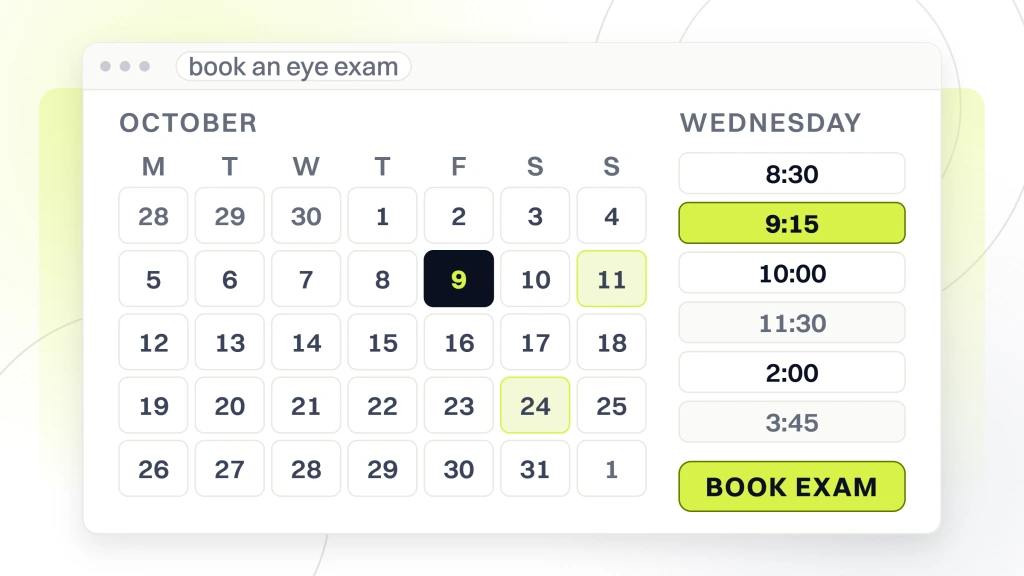
The booking flow matters as much as the pages. A 4-step booking form loses 25 to 40% of the clicks compared to a 2-step form. Two steps means step one asks for the reason for the visit and preferred date range. Step 2 asks for name, phone, email, and insurance. Anything more happens after the practice calls back to confirm. Vendors that push every field onto step one to “reduce phone calls” quietly reduce booked exams too.
Page speed matters. Every second of load time above 3 seconds costs roughly 10% of the conversion rate. Optometry sites often carry heavy stock imagery and third-party booking widgets that push load past 6 seconds on mobile. Fixing this isn’t glamorous, yet it consistently produces 15 to 30% more bookings on the same traffic. See web.dev’s Core Web Vitals guide for the baseline metrics to hit.
Conversion rate isn’t a single number. Routine intent converts at 6 to 12% on a working site. Medical intent converts at 4 to 8%. Vision-plan searches convert at 8 to 15%. The intent to use insurance is already confirmed by the search itself. Report and track them separately. Blending them into a site-wide conversion rate hides which pages need attention. For layout patterns that convert on optometry sites, our optometrist website design guide walks the templates and CRO tests we run.
What a real optometrists marketing engagement looks like
A real engagement follows the 90-day plan above and produces trackable booked exams by month 3, with compounding through month 12. Vision Express hit 62% booking growth and 135.9% traffic growth in 6 months on this pattern, and secured 71% practice growth on top. The stack, sequence, and reporting all matter.
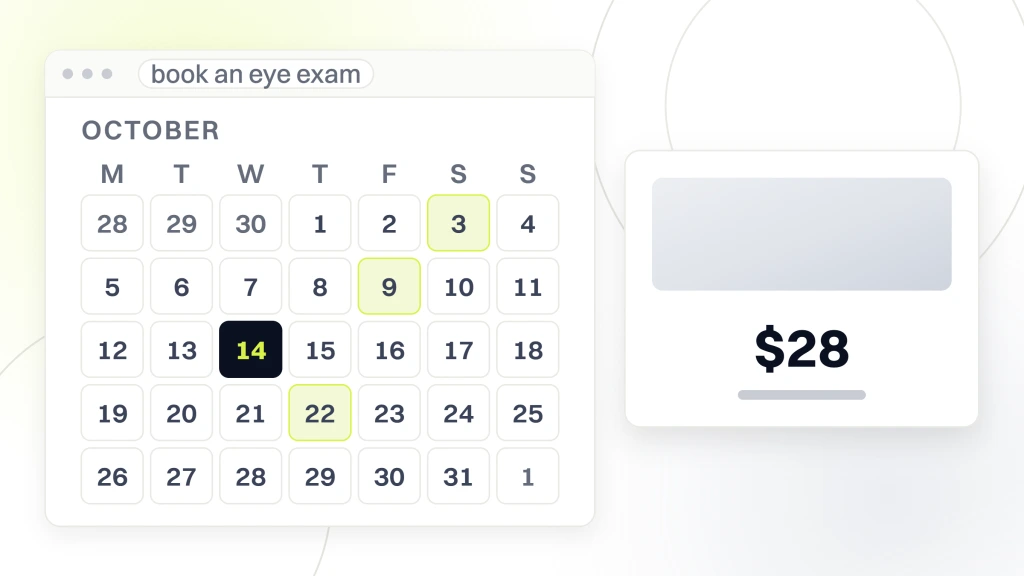
Vision Express, an independent optometry practice with a vision therapy and dry eye focus, came in month zero with a plateau. Booking volume had held flat for 3 quarters. Their prior vendor sent monthly reports without a cost per booked exam figure anywhere in them. That’s the tell that a general medical marketing agency has taken on an optometry account and doesn’t know what to measure.
The engagement ran the standard 90-day sequence. Site rebuild in weeks one to 4 with a fixed booking flow, dedicated vision therapy page, and dedicated dry eye page. GBP overhaul in weeks 2 to 3 with a full citation cleanup across 40 directories. Google Ads launched week 4 with routine, medical, and brand campaigns each on their own landing page. Recall automation went live at week 8. Content cadence started at week 6 with the first 3 service pages.
Six months in, the practice was up 62% on booked exams, 135.9% on traffic, and holding a $28 blended cost per booked exam from Google Ads. Recall reactivation added 32 exams per month to the schedule by month 5. Organic traffic gained 46% by month 6 with compounding still ramping. The weekly reporting layer let the practice owner see cost per booked exam per channel every Monday, which the prior vendor never delivered even monthly. A separate optometry engagement with Dr Parth Shah drove 120% organic traffic growth over the same 6-month window using the same content-and-tracking discipline.
Marketing for solo optometrists versus multi-location groups
The channel mix doesn’t change between solo and multi-location. The weighting does. Solo practices book from a smaller radius, face fewer direct competitors, and can run a lean program. Multi-location groups compete across a wider footprint, need brand consistency across sites, and require reporting that splits by location so the operator sees which practice needs attention.
Solo mix. Website plus updates, GBP plus local search, Google Ads on routine and brand, recall automation, review outreach, reporting. Total lands at $2,800 to $4,200 monthly retainer plus $2,000 to $3,500 ad spend. Skip Meta Ads until a specific service line justifies the awareness. Skip a separate SEO retainer until month 6 when the site is stable and content cadence can begin without diluting other priorities.
Multi-location mix. All 7 channels concurrent. Location-specific landing pages replace generic service pages. Reporting splits by location. Recall runs per-location tuning based on staff mix and patient demographics. Total lands at $6,000 to $12,000 monthly retainer plus $4,000 to $10,000 ad spend for a three-location group. Six-to-8-location groups scale accordingly.
Groups above 8 locations often move to a hybrid model with an in-house marketing coordinator plus a vendor. The coordinator owns brand, event calendar, and clinical content review across sites. The vendor owns paid media, technical SEO, and consolidated reporting. Roles need clean written boundaries. Overlap kills accountability and doubles coordination overhead. See our marketing companies for optometrists post for the vendor selection framework.
Marketing for optometrists budget benchmarks
The table below shows what independent practices spend by size in 2026. Numbers assume flat retainers with no ad-spend markup. Bundle discounts of 15 to 25% apply when a single vendor runs the program instead of 3 separate accounts. Setup is one-time.
| Practice stage | Retainer | Ad spend | Total monthly |
|---|---|---|---|
| Solo, year 1 to 3 | $1,800 to $2,800 | $2,000 to $3,500 | $3,800 to $6,300 |
| Solo, established | $2,200 to $3,500 | $2,500 to $4,500 | $4,700 to $8,000 |
| Two-location group | $3,500 to $5,500 | $3,500 to $6,000 | $7,000 to $11,500 |
| Three to 5 locations | $5,500 to $9,000 | $5,000 to $10,000 | $10,500 to $19,000 |
| Six or more locations | $9,000 to $18,000 | $8,000 to $18,000 | $17,000 to $36,000 |
Ad spend runs on top of the retainer and flows directly to the platform. Vendors rolling ad spend into the retainer and calling it “included” create a conflict of interest on budget decisions. Setup covers booking-flow rebuild, GBP cleanup, tracking installation, and recall flow authoring. A practice signing today pays setup across months one to 3.
Numbers reflect what practices pay. Vendors quoting substantially below the ranges are usually offering a template site, no tracking work, and light monthly Google Business Profile edits. That price point exists and works for a specific segment of new practices with no budget yet. It rarely produces measurable booked exams inside the first 90 days.
Vendors quoting substantially above the ranges usually roll ad spend into the retainer and hide the split. Ask directly for the retainer line and the ad spend line as separate numbers on the proposal. A vendor that can’t break the two apart in writing is a vendor that won’t break them apart in reporting either. That opacity always ends badly at contract renewal.
The 3 numbers a marketing for optometrist program must report weekly
Three numbers matter above all others. Cost per booked exam by channel. Total booked exams by source. Patient lifetime value versus total marketing spend. Every dashboard the vendor sends should surface those 3 inside 15 seconds of loading. If it doesn’t, the reporting is wrong.
Cost per booked exam by channel requires call tracking with dynamic number insertion, form-fill events firing into GA4, offline conversion imports from the practice-management system, and a Looker Studio or similar dashboard tying it all together. Setup runs $1,500 to $4,000 as a one-time project. Practices that skip this step have no idea whether Google Ads or SEO is producing the exams. They end up cutting the wrong channel when budget tightens.
Total booked exams by source is a leading indicator. Track it weekly, not monthly. A 4-week slip in booked exams from any channel is a signal the campaign needs attention. A 12-week slip means the vendor stopped working the account. Practice owners running the weekly view catch problems inside 2 weeks. Those on monthly reports catch them at month 3, which is usually one month too late.
Patient lifetime value versus marketing spend is the ROI number the practice owner presents to the accountant. Target a 10x to 20x lifetime-value-to-spend ratio for an established practice. A practice earning 4x needs to fix the funnel. A practice earning 30x needs to spend more. Underinvestment is leaving growth on the table. Reference Google Search Central’s blog for how attribution shifts across GA4 model choices.
Working with Redefine Web on marketing for optometrists
Redefine Web runs the whole stack as an integrated program under one lead per practice. The stack covers site work, SEO services, PPC services, local search, recall automation, and reporting. Retainers start at $1,499 monthly for a lean local program and scale to $3,999 monthly for full-stack coverage on a solo practice. Multi-location retainers scale with the operating footprint.
Every engagement follows the 90-day plan. Tracking and site fixes in weeks one and 2. GBP cleanup in weeks 2 and 3. Google Ads live by end of week 4. SEO cadence starting week 6. Recall automation live by week 8. Meta Ads and advanced service lines follow after the base program produces predictable cost per booked exam numbers by month 3.
Contract structure runs 6 months minimum, flat retainer with no ad-spend markup, 30-day wind-down clause, and practice-owned ad accounts and domain. Reference calls with current independent optometry clients are provided during the first fit call, not held back until the pitch. If your practice doesn’t fit our current book, we’ll name a peer shop that fits better and part on good terms. See the optometrist marketing agency stack for packages and case study links.
Reporting cadence runs weekly on the quick numbers and monthly on the strategic narrative. Every dashboard ties directly to cost per booked exam per channel. Everything else supports that number or gets cut from the report. Read the full optometrist marketing playbook for the underlying growth model that guides every engagement.
Which marketing for optometrists channel to add next
A new practice adds site, local search, and Google Ads first. An established solo practice adds reporting and recall automation before layering more paid. A multi-location group adds consolidated reporting and location-level attribution on top. The order matters more than the total.
Practice owners who trust the sequence save money and see the compounding earlier than those who spread thin from day one. Buying the right 2 channels and running them well for 90 days produces the tracked baseline that justifies scaling into the rest. Buying every channel at month zero without sequencing produces waste and vendor fatigue every time.
Ready to walk the sequence with a real vendor. Read the optometrist marketing strategy 12-month plan for the roadmap, and the digital marketing for optometrists channel-mix breakdown for how paid and organic interact through the year. Vendor selection frameworks from Search Engine Land and HubSpot back up the sequencing choices above.