
E-commerce SEO Packages Working Tiers, Scope, and Pricing
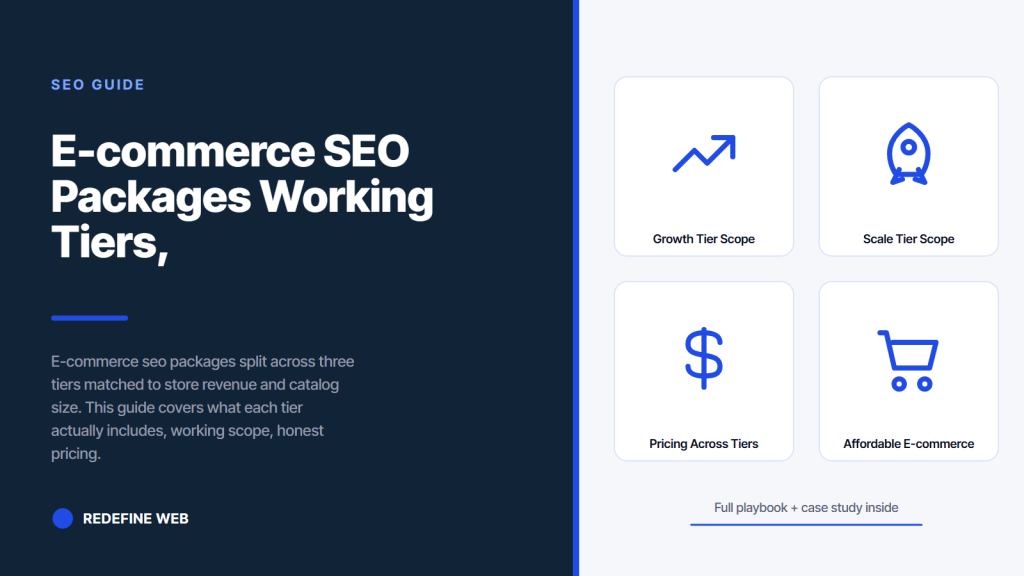
- Three tiers match store revenue and catalog size.
- Starter tier at $599 to $1,200 monthly on 6-month contract.
- Growth tier at $1,800 to $3,600 with backlinks and content.
- Scale tier at $4,800 to $9,600 with enterprise depth.
- Demand a written monthly deliverable log every time.
- Minimum contract length runs 6 to 12 months to compound.
- E-commerce seo packages growth tier scope
- E-commerce seo packages scale tier scope
- E-commerce seo packages pricing across tiers
- What e-commerce seo packages actually include per month
- Affordable e-commerce seo packages options for tight budgets
- How to choose an e-commerce seo packages provider
- Common e-commerce seo packages purchasing mistakes
- E-commerce seo packages monthly cadence expectations
- What to do this week to pick e-commerce seo packages
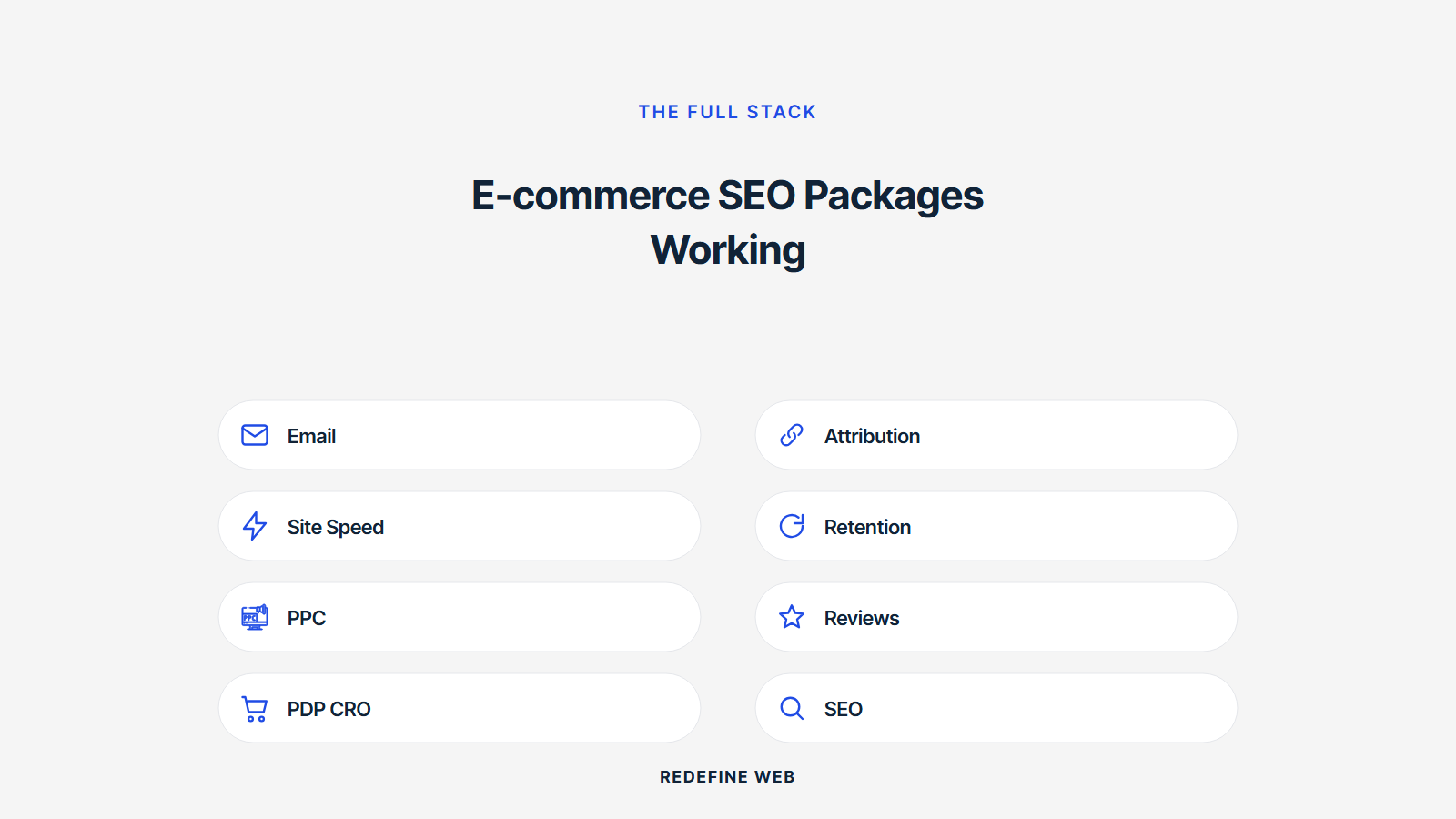
- Where e-commerce seo packages fit the full marketing stack
E-commerce seo packages sit in three working tiers on the honest side of the agency market and roughly seven mystery-box tiers on the dishonest side. The honest side prices packages against store revenue, catalog size, and specific monthly deliverables. The dishonest side prices packages against how much the merchant seems willing to spend, wraps the scope in vague marketing language, and delivers 40 percent of the promised work in the first three months hoping the merchant does not audit the deliverable log. Picking the right package matters because e-commerce seo packages either compound organic revenue every quarter or produce a $2,400 monthly invoice with nothing measurable to show for it.
This guide covers the honest e-commerce seo packages structure the way our team scopes it for growing DTC stores on Shopify, WooCommerce, and BigCommerce through 2025. What each package tier actually includes month by month. Working scope across product page rewrites, category page work, technical health, backlink development, and content marketing. Honest pricing that matches specific deliverables. Plus the five questions every merchant should ask before signing an SEO retainer that separate the working packages from the mystery boxes.
E-commerce seo packages growth tier scope
The growth e-commerce seo packages tier fits stores between $500K and $2M annual revenue with 200 to 500 SKUs. The typical price band runs $1,800 to $3,600 per month on a 6-month contract commitment. The scope adds deeper category work, more product page rewrites per month, backlink development, and dedicated content marketing on top of the starter tier’s foundational work. Growth tier stores have usually completed the starter tier’s foundation and now need volume plus depth to compound organic revenue.
The monthly deliverable log runs eight items on the growth tier. Rewrite 15 product page titles and descriptions per month across the top 100 SKUs. Rewrite 3 category pages per month across the top 20 categories. Publish 2 blog posts per month covering buyer questions or comparison content. Build 3 to 5 backlinks per month through digital PR or partnership outreach. Run a full technical audit every 90 days plus a monthly spot-check. Deliver monthly Search Console reports plus quarterly deep-dive competitor analysis. Fix 2 template-level issues per month. Monitor and respond to schema errors surfaced by Rich Results test.
The growth tier realistic year-one result is 45 to 90 percent organic session growth and 40 to 80 percent organic revenue growth. That range assumes the store had completed foundational SEO work before starting the growth tier. Stores jumping to growth tier without doing foundational work first usually get closer to the low end because half the retainer gets consumed on cleanup rather than compounding growth work. The related deep-dive on which foundational fixes matter most sits inside our e-commerce seo audit services guide.
E-commerce seo packages scale tier scope
The scale e-commerce seo packages tier fits stores between $2M and $10M annual revenue with 500 to 2,000 SKUs. The typical price band runs $4,800 to $9,600 per month on a 12-month contract commitment as the standard operating agreement for stores at this revenue tier. The scope adds enterprise-grade technical depth, dedicated content team output, aggressive backlink development, and international expansion support for stores selling across multiple countries or metro markets.
The monthly deliverable log runs ten items on the scale tier. Rewrite 40 product pages per month across the top 200 SKUs. Rewrite 6 category pages per month across the top 40 categories. Publish 4 to 6 blog posts per month covering buyer questions, comparisons, and buying guides. Build 6 to 10 backlinks per month through digital PR, partnership outreach, and content syndication. Run a full technical audit every 60 days. Deliver weekly Search Console spot-checks plus monthly deep-dive reports. Fix 3 to 5 template-level issues per month. Monitor schema across all product URLs monthly. Handle international hreflang setup where relevant. Coordinate with the merchant’s paid search team to align organic and paid keyword targeting.
The scale tier realistic year-one result is 60 to 120 percent organic session growth and 50 to 100 percent organic revenue growth. Custimy, the SaaS customer data platform for e-commerce, ran an equivalent-scope engagement across content and technical SEO that shifted the paid-organic revenue split 22 percentage points toward organic over 12 months, funded a second round of category expansion, and produced compounding gains through the following year. That case study is the reference standard for what scale tier packages should produce when both sides execute honestly against the deliverable log.
E-commerce seo packages pricing across tiers
The e-commerce seo packages pricing table below shows the working price band per tier plus the realistic year-one outcomes. Every legitimate partner prices on a monthly retainer with a specific deliverable log, not on a per-hour scramble that produces uneven work across the month.
| Tier | Store size | Monthly retainer | Contract length | Year one revenue growth |
|---|---|---|---|---|
| Starter | Under $500K revenue < 200 SKUs | $599 to $1,200 | 6 months | +25 to +50 percent |
| Growth | $500K to $2M revenue | $1,800 to $3,600 | 6 months | +40 to +80 percent |
| Scale | $2M to $10M revenue | $4,800 to $9,600 | 12 months | +50 to +100 percent |
| Enterprise | $10M plus revenue | $9,600 to $24,000 | 12 months | +40 to +85 percent |
| Custom SOW | 5,000 plus SKUs or international | Custom | 12 to 24 months | +35 to +75 percent |
The table above assumes the merchant executes on the recommendations the SEO team surfaces every month. Retainers where the merchant blocks 30 percent of recommendations or slows down implementation by 60+ days consistently produce below-the-band results because the ranking movement depends on both sides executing against the same deliverable log. Stores that treat the retainer as a monthly check-box paid to an outside team without integrating recommendations into the store’s own weekly cadence usually see the low end of the year-one range or below the band entirely for the first two quarters. The best seo tools for e-commerce stores guide covers the tool stack the merchant and the SEO team share to keep the deliverable log and the reporting dashboard aligned week over week. External reference reading on retainer structure sits at the Moz SEO agency pricing article.
A store on an enterprise SEO package spends half its marketing budget on scope it can't execute. Match the tier to catalog size, not what feels ambitious.
What e-commerce seo packages actually include per month
Every honest e-commerce seo packages retainer breaks down monthly deliverables into five workstream categories. Product page work. Category page work. Content marketing. Technical health. Backlink development. Each workstream carries a specific volume commitment per month scaled to the retainer tier the merchant contracted.
Merchants who ask for the deliverable log before signing a contract separate honest agencies from mystery-box agencies quickly because the honest side has the log written down and the mystery-box side deflects with vague marketing language when pressed on specifics.
The five workstreams are not equal weight across tiers. Starter tier retainers spend 40 percent on product page work, 25 percent on category work, 15 percent on content, 15 percent on technical, and 5 percent on backlinks. Growth tier retainers rebalance to 30 percent product, 20 percent category, 20 percent content, 15 percent technical, and 15 percent backlinks. Scale tier retainers spend 25 percent on product, 15 percent on category, 25 percent on content, 15 percent on technical, and 20 percent on backlinks.
The rebalancing reflects the reality that starter tier stores need foundational content and category work first before backlinks and content marketing can compound. Scale tier stores have the foundation completed and now need aggressive backlinks and content to keep growing against larger competitors. Every workstream deliverable log ties directly to a Search Console query the retainer targets and a specific revenue-attribution KPI the merchant and the agency track together in a shared reporting dashboard updated weekly. Read the Search Engine Land e-commerce SEO library for the deeper reference material on each workstream.
Affordable e-commerce seo packages options for tight budgets
Affordable e-commerce seo packages exist for merchants running under $250K annual revenue who cannot fit the $599 starter tier into the monthly marketing budget. The affordable path runs three specific options that produce measurable results without the full agency retainer. Freelance SEO on a per-project basis. Fractional SEO consulting on a 5-hour monthly block. Do-it-yourself SEO using the free tool stack plus published guides. Each option has real tradeoffs.
Freelance SEO on a per-project basis runs $800 to $2,400 for a specific one-time project (technical audit, top-50 product page rewrite, backlink outreach sprint) with no ongoing retainer commitment. That works well for stores needing a specific gap closed but does not produce compounding results because the SEO work stops the day the project delivers. Fractional SEO consulting on a 5-hour monthly block runs $400 to $800 per month and gives the merchant weekly access to an experienced SEO who reviews Search Console data and gives specific recommendations the merchant then executes.
Do-it-yourself SEO using the free tool stack (Search Console, GA4, Screaming Frog free tier, Rank Math free) plus published guides produces roughly 40 to 60 percent of the results a starter tier retainer would deliver, for merchants who can commit 8 to 16 hours per month to executing the work themselves. That path works for founder-led stores where the founder cares about SEO and has the time. It does not work for stores where the founder is too busy with other operations to actually run the recommendations. Match the affordable path to the merchant’s honest available hours.
How to choose an e-commerce seo packages provider
Choosing an e-commerce seo packages provider is where merchants either pick a partner that compounds organic revenue over 12 months or a mystery-box vendor that invoices monthly with nothing measurable to show. The five questions below separate the working providers from the mystery-box vendors in the first 30-minute discovery call.
Every DTC store owner has hired an SEO agency that promised the moon in the discovery call and delivered exactly one page of generic recommendations that could have come from a ChatGPT prompt three months later. The right response the second time around is asking every SEO agency to send three examples of e-commerce stores they took from position 10 to position 3 on a specific transactional query along with the client’s actual Search Console screenshots, real revenue numbers, and permission to call the client directly. Agencies that can produce all three usually earn the retainer. Agencies that deflect with case studies from three years ago on stores they no longer service usually do not.
- What is the monthly deliverable log: honest agencies have it written down; mystery-box agencies deflect
- Which SEO worked on my account: honest agencies name the person; mystery-box agencies say the team
- Show me 3 e-commerce stores you took from position 10 to position 3: honest agencies produce them
- How do you handle mobile-first indexing: answer must be specific to mobile crawl behavior
- What is your minimum contract length: honest answer is 6 to 12 months; anything shorter usually means churn
Common e-commerce seo packages purchasing mistakes
Every store that switches SEO agencies has made at least one of the same purchasing mistakes the previous round. Learning from the mistakes shortens the search for the next partner and separates the working providers from the mystery-box vendors before the retainer signs. The seven mistakes below are the ones we see repeat across DTC store audits every quarter regardless of vertical, revenue tier, or platform. Fixing them before signing a new retainer is the highest-return purchasing move a merchant can make.
- Signing without a written deliverable log: leaves the scope negotiable every month
- Believing a 3-month timeline promise: SEO takes 6 to 12 months minimum to compound
- Paying for a $299 all-in-one SEO tool subscription: buys data without analyst time to run it
- Skipping the technical audit before content work: content sits on a broken foundation
- Cancelling at month 3 because rankings did not move: month 3 is when compounding starts
- Choosing based on lowest price only: cheapest retainer usually produces zero output
- Choosing based on flashy sales deck: sales quality does not correlate with execution quality
The mistakes cluster around two root causes. The merchant either did not do the research work before signing (skipping references, skipping the deliverable log, skipping the technical audit) or did not have the internal discipline to run the monthly cadence together with the agency once the retainer started. Both root causes are fixable before signing the next retainer. The upfront research work takes 8 to 16 hours across two weeks. The internal cadence discipline takes 2 hours per month of the merchant’s time. Together they raise the probability of a successful year-one outcome from roughly 40 percent to roughly 85 percent based on our own client data across the previous three years of ecommerce retainers.
E-commerce seo packages monthly cadence expectations
The e-commerce seo packages monthly cadence expectations set the standard for what the merchant should see every month regardless of tier. Skipping any part of the cadence signals the agency is coasting or overwhelmed and either problem points at the same eventual outcome: the retainer stops compounding revenue.
The monthly cadence runs four cadence items across every tier. A monthly deliverable log update showing exactly what shipped that month against the contracted scope. A monthly Search Console report with query-level performance data plus specific recommendations for the next month. A monthly video summary (5 to 8 minutes) walking through the wins, the misses, and the next 30 days. A monthly billing invoice matched to the deliverable log. Merchants who never see the cadence items are almost always in a mystery-box retainer regardless of what the sales deck promised at signing.
The cadence gets sharper as the tier scales. Growth tier retainers add a quarterly deep-dive competitor analysis on top of the monthly cadence. Scale tier retainers add weekly Search Console spot-checks between monthly reports. Enterprise retainers add real-time Slack channel access for urgent issues that surface between scheduled reports. Every layer of cadence sharpness reflects the reality that higher-tier retainers demand tighter feedback loops because the incremental spend needs to produce incremental measurable output across every rolling 30-day window rather than every 90 or 180 days.
What to do this week to pick e-commerce seo packages
Pick three actions from the list below and finish them by Friday. A merchant who spends one focused afternoon on package research usually surfaces two or three qualified SEO partners plus rules out four or five mystery-box vendors, which shortens the eventual signing timeline by weeks.
The starting state on most stores looks the same. No documented package requirements. No shortlist of qualified providers. No baseline of the store’s current Search Console performance to measure against once the retainer starts. No documented budget ceiling. Every one of these inputs moves from broken to functional inside a week of focused research work by the merchant or a marketing lead using the questions and templates in this guide. The ecommerce seo services for DTC brands playbook covers the sequencing for stores wanting the execution off their plate.
- Document the store’s revenue tier and SKU count to identify the correct package tier
- Baseline current Search Console query performance for the top 30 revenue URLs
- Request written monthly deliverable logs from 3 SEO agencies at your revenue tier
- Ask each agency for 3 e-commerce case study references at your SKU count
- Verify each reference by calling the client and asking what the agency did in month 5
- Compare deliverable logs side by side and rule out anyone that deflects with marketing language
- Confirm minimum contract length is 6 to 12 months and matches the industry standard
Where e-commerce seo packages fit the full marketing stack
E-commerce seo packages sit inside a broader digital marketing stack that includes paid search, email marketing, SMS marketing, and social media. The SEO package produces the organic revenue channel. Paid search fills the top-of-funnel intent the organic side does not yet capture. Email and SMS handle the repeat purchase cycle. Social media builds brand awareness that compounds through direct and organic traffic over time. Every channel either compounds through the SEO work or fights against it.
Stores that budget for paid search without SEO produce revenue that stops the day the paid campaigns pause. Stores that budget for SEO without paid search leave the top-of-funnel intent uncaptured for the first 6 to 12 months while the SEO work compounds. The working stack budgets for both proportionally to the store’s growth stage. Sub-$500K stores spend heavily on paid to prove product-market fit while the SEO foundation builds. $2M+ stores rebalance toward SEO as the organic channel starts compounding. Every year the paid-organic split shifts a few points toward organic on stores that treat SEO as compounding investment rather than monthly expense.
E-commerce seo packages are not one-size-fits-all. Match the tier to the store’s revenue and catalog. Demand a written monthly deliverable log. Ask the five discovery questions. Verify references. Sign for 6 to 12 months minimum. Run the monthly cadence together. That is the whole plan for picking a package that compounds organic revenue instead of producing a monthly invoice with nothing measurable to show. Merchants who follow the plan usually keep the same partner for 3 to 5 years because compounding results produce compounding retention. Next Monday is when the plan starts.
Frequently asked questions
What are e-commerce seo packages and how are they structured?
E-commerce seo packages are monthly retainer bundles that combine product page rewrites, category page work, technical health, content marketing, and backlink development into a single fixed monthly fee. Honest packages come in three tiers matched to store revenue and catalog size. Starter tier at $599 to $1,200 per month fits stores under $500K revenue with fewer than 200 SKUs. Growth tier at $1,800 to $3,600 per month fits stores between $500K and $2M revenue. Scale tier at $4,800 to $9,600 per month fits stores between $2M and $10M revenue. Every honest tier has a specific written monthly deliverable log covering the five workstreams. Mystery-box packages deflect with vague marketing language when merchants ask for the deliverable log.
How much do affordable e-commerce seo packages cost for small stores?
Affordable e-commerce seo packages for merchants under $250K annual revenue run three specific options that produce measurable results without the full agency retainer. Freelance SEO on a per-project basis runs $800 to $2,400 for a specific one-time project like a technical audit or a top-50 product page rewrite. Fractional SEO consulting on a 5-hour monthly block runs $400 to $800 per month and gives the merchant weekly access to an experienced SEO who reviews Search Console data. Do-it-yourself SEO using the free tool stack plus published guides produces 40 to 60 percent of a starter tier retainer's results for merchants who can commit 8 to 16 hours per month to executing the work themselves. Match the path to available hours.
What is included in a Redefine Web e-commerce seo services package?
A Redefine Web e-commerce seo services package covers five workstreams every month scaled to the retainer tier. Product page work covering title tag, meta description, and body description rewrites on the top revenue SKUs. Category page work covering above-grid intro copy, below-grid buyer question sections, and schema installation. Content marketing covering blog posts on buyer questions with real search volume. Technical health covering Screaming Frog crawls, Core Web Vitals monitoring, and schema validation. Backlink development covering digital PR outreach and partnership placements. Every workstream ties to a specific Search Console query the retainer targets and a specific revenue-attribution KPI tracked in a shared weekly dashboard between the merchant and the SEO team.
How do you choose the right e-commerce seo packages provider?
Choose based on five specific discovery questions rather than sales deck quality or lowest price. What is the monthly written deliverable log? Which named SEO will work on my account and can I meet them? Show me 3 e-commerce stores you took from position 10 to position 3 with the client's actual Search Console screenshots and permission to call directly. How do you handle mobile-first indexing specifically? What is your minimum contract length? Honest agencies produce specific written answers within 48 hours of the discovery call. Mystery-box agencies deflect with marketing language, name the team instead of the individual, and produce case studies from three years ago on stores they no longer service.
How long does an e-commerce seo packages contract usually run?
The industry standard is 6 to 12 months minimum depending on tier. Starter tier retainers usually run 6-month contracts. Growth tier retainers usually run 6-month contracts with a 12-month option that drops the monthly rate 10 to 15 percent. Scale tier retainers usually run 12-month contracts as the standard operating agreement because the compounding work needs at least 12 months to produce measurable revenue movement. Enterprise retainers usually run 12 to 24-month contracts. Agencies offering shorter than 6-month contracts usually mean they know their execution quality is inconsistent and want the merchant to churn out before noticing. Compounding SEO results simply do not fit inside a 3-month contract window.
What is the biggest mistake when buying e-commerce seo packages?
Signing without a written monthly deliverable log leaves the scope negotiable every month and lets the agency ship 40 percent of the promised work while blaming the merchant for missing recommendations. The written deliverable log needs to specify exact deliverable counts by workstream. Fifteen product pages rewritten per month means fifteen not eight. Three category pages rewritten per month means three not one. Four backlinks placed per month means four not two. Merchants who accept vague promises like ongoing SEO work or continuous optimization usually get monthly invoices for $2,400 with nothing measurable to show. The single fix is asking every agency to send the written deliverable log before signing anything and matching it against the invoice every month.
Book your free 30-minute strategy call.
No spam, no sales rep. We use your email to schedule your call with a senior strategist. That is it.
More from the blog
View all articles → SEO
SEO Organic Search Engine Optimization Services That Grow Real Traffic
Read article SEO
SEO SEO for Pet Groomers That Fills the Appointment Book Weekly
Read article SEO
SEO