
Ecommerce WordPress Website Maintenance With WooCommerce
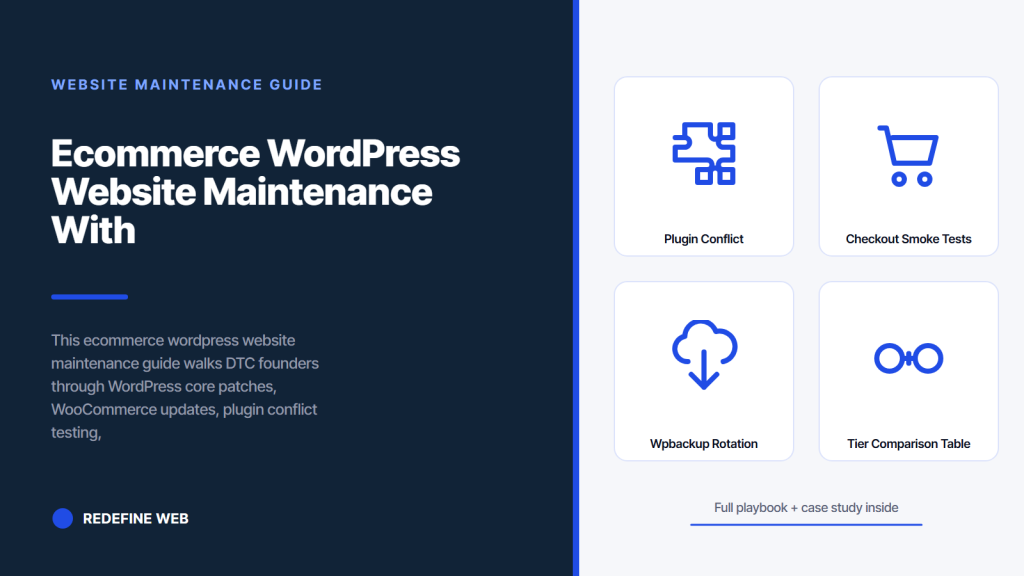
- WordPress core patches sequenced within 72 hours of CVE releases.
- WooCommerce upgrades tested on staging against payment gateway extensions.
- Plugin updates batched three to five at a time, never all at once.
- Checkout smoke tests monthly across five real customer devices.
- WPBackup daily backups with quarterly restore testing on staging.
- Plugin conflict testing workflow on a staging environment
- Checkout smoke tests across desktop and mobile
- Database optimization inside ecommerce wordpress website maintenance
- WPBackup rotation and offsite retention strategy
- Tier comparison table for wordpress ecommerce maintenance retainers
- Security hardening for WooCommerce beyond generic WordPress
- Performance optimization inside a wordpress ecommerce maintenance retainer
- A real WordPress plus WooCommerce maintenance engagement in production
- Who owns wordpress ecommerce maintenance inside a growing DTC brand
- Where wordpress ecommerce maintenance fits the broader DTC stack
A Boogie Board customer running a WooCommerce sub-store for their B2B wholesale line came to our team last February after their Recharge subscription flow silently double-charged 47 customers over a two-week window because a plugin update on the WooCommerce Subscriptions extension conflicted with their custom cart calculation code. Their prior developer had auto-updates turned on across every plugin, no staging environment, and no rollback path. The refund plus reputation cost hit $6,400 in a single fortnight. A real ecommerce wordpress website maintenance retainer with staged plugin update sequencing and a WooCommerce checkout smoke test would have caught the conflict inside the staging pass at zero customer impact. That is the specific failure pattern this guide walks in scope.
This piece is the real monthly workstream for DTC stores running WordPress plus WooCommerce. Core WordPress patch sequencing. WooCommerce version upgrade paths across payment gateways and shipping extensions. Plugin conflict testing on a staging environment before production promotion. Checkout smoke tests across desktop and mobile. Database optimization inside ecommerce wordpress website maintenance. WPBackup rotation and offsite retention. Every recommendation runs on real WooCommerce retainers our team runs at monthly cadence for DTC brands between $500K and $3M annual revenue.
Plugin conflict testing workflow on a staging environment
Plugin conflicts are the single biggest source of unplanned downtime on WooCommerce stores. Two plugins depending on incompatible library versions, two plugins hooking the same WooCommerce filter with conflicting logic, or a plugin loading a script that breaks another plugin’s admin dashboard interface all fall into the conflict pattern. Testing on staging catches conflicts before they reach production.
How the staging environment gets set up honestly
The staging environment sits on the same hosting stack as production, not a shared dev server with different PHP versions or MySQL builds. Kinsta, WP Engine, Cloudways, and SiteGround all ship a one-click staging clone that mirrors the production environment with a database sync. Stores on lower-tier managed hosting or shared hosting usually do not have real staging and need to run staging locally through Local by Flywheel or LocalWP with a manual database export. Staging environments that drift from production produce false-positive test results on the staging side and let real conflicts through to production. Our writeup on best woocommerce seo plugins covers the plugin selection side of the same hygiene problem, and stores running fewer overlapping plugins usually run into fewer staging conflicts because the surface area stays smaller.
The staged plugin update procedure per update batch
Our maintenance team updates plugins in batches of three to five at a time on staging, never all at once, because a batch of 20 concurrent updates makes it impossible to isolate which plugin caused a conflict when the staging environment breaks. Each batch runs through a checkout smoke test on staging before the next batch. Plugins that produce warnings or errors get rolled back individually and either updated separately with a compatibility patch or deferred to the next major release. The batched approach takes 90 minutes to 3 hours per month per store versus the 20-minute click-all-update approach that produces the exact conflict pattern maintenance retainers are supposed to prevent. The 90 minutes per month is the specific cost of preventing a $4,000 emergency invoice pattern our team sees on stores that arrive without a staged plugin sequence in place.
Checkout smoke tests across desktop and mobile
The WooCommerce checkout is the single highest-value page on the store. A broken checkout for 90 minutes on a store doing $80,000 monthly revenue costs approximately $3,700 in lost orders plus reputation damage on customers who bounce and never return. Monthly smoke testing catches breakage patterns before they affect real customers, which is the entire operational reason for the workstream sitting inside every retainer.
The five devices the monthly smoke test covers on our retainers
- Desktop Chrome on Windows 11 or macOS Sonoma, which usually catches 40 percent of the store’s actual traffic.
- Mobile Safari on iOS 17 or newer, which usually catches 30 to 35 percent of DTC traffic and produces the highest checkout abandonment when it breaks.
- Mobile Chrome on Android 13 or newer for the Android customer segment.
- Desktop Safari on macOS Sonoma, which catches the checkout-specific WebKit rendering edge cases that Chromium browsers hide.
- Desktop Firefox for the smaller privacy-focused customer segment that still produces higher-than-average AOV on many DTC brands.
Each device runs through the full add-to-cart, applied discount, guest checkout, and returning-customer checkout paths with a written pass or fail per path. The full monthly smoke test takes 45 to 75 minutes on a store with a single checkout template, and 90 to 150 minutes on stores running B2B wholesale, subscription flows, or split-cart configurations. Stores that skip the mobile Safari path in the smoke test discover it when the founder’s own iPhone-using customers start emailing about a broken checkout on the day of a promotional email. Our writeup on the ecommerce website maintenance checklist covers the smoke test cadence alongside the other monthly, quarterly, and annual line items every real WooCommerce retainer runs.
Database optimization inside ecommerce wordpress website maintenance
WooCommerce stores past 50,000 lifetime orders start showing database bloat that produces slow admin dashboard load times, slow order search, and eventually slow checkout page loads. The wp_options table grows because plugins accumulate transient rows that never expire. The postmeta table grows because every order carries 40 to 80 meta rows. The woocommerce_order_items table grows linearly with order count. Real maintenance retainers include quarterly database health checks against the specific WooCommerce table growth pattern.
The four database health checks every quarterly review runs
The first check is wp_options table size against a 25 MB soft limit. Stores past 25 MB usually have expired transients that never got cleaned up, which slows every admin page load because WordPress loads autoloaded options on every request. The second check is postmeta orphan count where the meta row references a post ID that no longer exists, usually left over from a plugin uninstall or a batch product deletion. The third check is woocommerce_sessions table cleanup because expired guest checkout sessions accumulate and never self-purge on some hosting stacks. The fourth check is the WooCommerce High-Performance Order Storage migration status for stores that have not yet migrated from legacy CPT-based orders to the new HPOS tables. WP Rocket published a good primer on WordPress database cleanup that maintenance teams should read before running the health checks on a client site.
What the optimization delivers on measurable store metrics
Database optimization on a bloated WooCommerce store usually cuts admin dashboard load time by 40 to 65 percent and cuts the site’s Time to First Byte by 15 to 30 percent, which flows into Core Web Vitals scores on category and checkout pages. Stores past $2M annual revenue with three to five years of order history usually recover 200 to 400 milliseconds off the average page load through a proper quarterly database cleanup pass. That kind of gain is measurable in the store’s GA4 numbers within 30 days of the pass and shows up directly in the checkout page load time reports the founder reads in the monthly maintenance report. Regular website maintenance for ecommerce stores that skip database optimization eventually replays the same slow-store pattern until the founder pays for a one-time cleanup at 3 to 5 times the recurring cost.
Every Recharge or Subscriptions plugin update needs staging first. Turn off auto-update on payment plugins today. Even one production surprise costs more than staging setup.
WPBackup rotation and offsite retention strategy
Backups that never get tested are not backups. Every WooCommerce store carries the risk of a database corruption, a botched plugin update, or a hosting incident that requires a full site restore, and the backup strategy is only real if a restore has been tested inside the last 90 days on a staging environment. Retainers that ship monthly backup reports without testing restores produce a false sense of security that becomes obvious when the store actually needs a restore.
The daily plus weekly plus monthly backup rotation
Our maintenance team runs a three-tier WPBackup rotation on every WooCommerce store. Daily automated backups for the last 30 days stored on the primary offsite destination (usually Amazon S3 or Backblaze B2). Weekly backups retained for 12 weeks giving the founder a rolling quarter of recovery points at coarser granularity. Monthly backups retained for 12 months producing a full year of recoverable states for stores that need to review order history or compliance-related data. The three-tier rotation costs $8 to $22 monthly in offsite storage per store depending on database size, and it produces the recovery flexibility the founder actually needs when the request comes in for last-Tuesday-at-3pm data. Cheaper backup plans that only retain 7 to 14 days of history usually miss the specific recovery window the founder needs when an incident goes unnoticed for two weeks.
Quarterly restore testing that proves the backup actually works
Every quarter our team runs a full restore of the current WPBackup snapshot onto a staging environment, times the restore process end to end, and documents the pass or fail against the store’s monthly report. The restore test catches three specific issues most retainers miss. Backup files that got corrupted silently during upload and cannot be extracted. Database exports that reference a MySQL feature the staging environment does not support. Media library files that were never included in the backup because a directory permission changed on production. Stores that skip the quarterly restore test carry a backup archive that looks fine on the report and fails the day it is actually needed, which is the exact scenario every real maintenance retainer is supposed to prevent. WordPress.org published a useful reference on WordPress backups that founders should read before signing any maintenance retainer that claims backup coverage without documented restore testing.
Tier comparison table for wordpress ecommerce maintenance retainers
The table below is the shortest honest version of the three-tier retainer model our team runs for WordPress plus WooCommerce stores. Every column reflects deliverables that ship every month on real client retainers. Prices carry through six-month contracts because platform update cadences and maintenance model validation both need two quarters to prove properly before either side has enough data to renew or renegotiate honestly.
| Deliverable | Starter ($599/mo) | Growth ($999 to $1,899/mo) | Scale ($2,400 to $5,900/mo) |
|---|---|---|---|
| WordPress core patch cadence | Within 72 hours of CVE | Within 24 hours of CVE | Within 4 hours of CVE + zero-day watch |
| WooCommerce upgrade testing | Monthly on staging | Every release on staging | Every release on parallel staging + prod |
| Plugin update batches | Monthly, batches of 5 | Bi-weekly, batches of 3 | Weekly, batches of 3 |
| Checkout smoke tests | Monthly, 3 devices | Weekly, 5 devices | Weekly, 8 devices + API smoke tests |
| Database health checks | Quarterly | Monthly | Weekly + query log review |
| WPBackup rotation | Daily, 30-day retention | Daily, 90-day retention | Hourly snapshot + daily, 12-month |
| Restore testing | Semi-annual | Quarterly | Quarterly + disaster recovery drill |
| Included dev hours | 2 hours (4 carryover) | 6 hours (12 carryover) | 12 to 20 hours (40 carryover) |
| Account structure | Shared queue | Named lead | Named account owner |
The three-tier model prices against store complexity, not just revenue. A $2M revenue store running 12 plugins on a single-checkout template sits inside Growth. A $1.5M revenue store running Recharge subscriptions, WooCommerce Bookings, and a headless React front-end sits inside Scale because the integration surface area demands the tighter coordination. Founders picking a tier by price alone usually replay the tier upgrade conversation inside 90 days when the first incident exceeds the deliverable list for the wrong-tier retainer. Real ecommerce wordpress website maintenance packages price on the integration surface area, which is the honest way to scope a WooCommerce retainer.
Security hardening for WooCommerce beyond generic WordPress
WooCommerce stores carry payment card data flowing through the checkout, customer PII in the orders table, and admin dashboard access to financial workflows. Security hardening on a WooCommerce store goes beyond generic WordPress hygiene into payment-specific and admin-specific controls that most maintenance retainers underspec. Real hardening covers the admin surface, the checkout surface, and the customer account surface separately.
Admin surface hardening at the retainer level
The WooCommerce admin dashboard is the highest-value target for credential-stuffing attacks because it exposes order data, customer PII, and financial reporting. Real hardening includes two-factor authentication on every admin account, admin URL obfuscation past the default /wp-admin path, session expiry tightened to 8 hours, and IP allowlisting for admin access on stores past $1M annual revenue where the attacker cost-benefit shifts. Every retainer should ship a monthly login audit report that lists successful and failed admin logins with IP geolocation, which usually surfaces credential-stuffing attempts the founder had no idea were happening. Stores that skip the login audit discover admin compromise only after the attacker has already exfiltrated customer data or injected malicious code into the checkout template.
Checkout surface hardening against card skimmers and Magecart-style attacks
The WooCommerce checkout page is a Magecart target because a single malicious script injected into the checkout template can capture card data across every transaction until someone notices. Real hardening includes Subresource Integrity hashes on every third-party script loaded on the checkout page, Content Security Policy headers restricting script sources, and weekly integrity monitoring against the checkout template’s file hash. Stores past $3M annual revenue should run PCI DSS-adjacent scanning through a dedicated tool like Sucuri or Wordfence’s premium tier plus manual template audit quarterly. The hardening cost sits between $40 and $180 monthly in tooling depending on tier and produces the specific defense against the checkout-injection attack pattern that periodically hits DTC WooCommerce brands. Founders that skip this workstream discover the compromise only after Stripe or their bank flags unusual transaction patterns, which is the point where the reputational damage is already priced in.
Performance optimization inside a wordpress ecommerce maintenance retainer
Performance work on a WooCommerce store sits inside the maintenance retainer as monthly regression testing, not as a one-time optimization project. The store’s page load time drifts over 90 to 180 days as new products, new promotional images, and new tracking scripts accumulate. Monthly regression testing catches the drift before it hits a threshold where Core Web Vitals scores drop and category page rankings start slipping.
Core Web Vitals regression testing on category and product pages
Our team runs monthly Core Web Vitals regression testing on the top 20 revenue-driving product and category pages using PageSpeed Insights, WebPageTest, and Chrome UX Report data. Any page that regresses more than 200 milliseconds on Largest Contentful Paint or crosses the 100-millisecond threshold on Cumulative Layout Shift gets flagged inside the monthly report with a root cause note (usually a new image without dimensions, a new tracking script, or a plugin that added a render-blocking asset). Stores that fix regressions within 30 days of detection usually hold their Core Web Vitals scores year over year. Stores that let regressions accumulate over three or four months usually drop 8 to 15 percent of organic traffic on the affected page templates. Our writeup on the ecommerce website maintenance cost breakdown covers where the performance line item sits inside the retainer scope alongside the other monthly deliverables.
Image optimization and CDN configuration for growing product catalogs
Every WooCommerce store past 500 products carries an image optimization workstream. Product photos accumulate at whatever quality the founder uploaded them, without consistent WebP conversion or dimension standardization. Monthly retainers should include a batch WebP conversion pass on new product images, a lazy-loading review on category page thumbnails, and a CDN configuration check on the media library. Stores running Cloudflare, BunnyCDN, or KeyCDN benefit from a monthly cache purge and configuration review because CDN configurations drift as new plugins add cacheable asset patterns.
A real WordPress plus WooCommerce maintenance engagement in production
Boogie Board, the reusable writing tablet brand doing $650K annual ad spend against a WooCommerce store selling in 40-plus countries, came to our team in 2023 with a plugin-heavy WordPress installation and a WooCommerce configuration that had not been through a proper maintenance pass in 14 months. The prior developer had auto-updates on every plugin, no staging environment, and no documented rollback path. Two silent plugin conflicts had produced checkout errors during promotional windows over the prior 90 days that the internal team never traced to root cause.
Our team rolled Boogie Board onto a Growth tier ecommerce wordpress website maintenance retainer at $1,499 monthly. The retainer covered WordPress core patching within 24 hours of a CVE release, WooCommerce upgrade testing on a Kinsta staging environment every release, plugin update sequencing in batches of three, weekly checkout smoke tests across five devices, monthly Core Web Vitals regression testing against the top 20 product and category pages, quarterly database health checks, and daily WPBackup snapshots with 90-day offsite retention. The retainer included six hours of monthly development work rolling into the next month, which the team used for seasonal product launch pages and quarterly template tweaks.
Across the following 12 months on the retainer, the store held under 2.1 seconds fully loaded across desktop and mobile, cost per conversion held at $31 across the paid media stack, and the conversion rate climbed 11 percent as measured against the pre-engagement baseline. The maintenance retainer caught two silent plugin conflicts inside quarter two that would have produced checkout errors during promotional windows and one payment gateway compatibility drift inside quarter three that would have dropped Stripe transactions for approximately 4 percent of monthly orders if it had run unnoticed for two weeks. The retainer paid back inside its first quarter on the caught failures alone. That is the pattern real regular website maintenance for ecommerce stores should produce on growing WooCommerce brands past the $1M annual revenue mark.
Who owns wordpress ecommerce maintenance inside a growing DTC brand
Ownership on the client side is the fourth decision after scope, tier, and cadence. Somebody at the brand has to own the maintenance retainer relationship or the vendor’s monthly report goes unread and the workstream drifts back into break-fix mode. The right owner depends on the brand’s stage and the founder’s own bandwidth.
- Solo DTC founder: founder owns the maintenance relationship directly, reads the monthly report, and approves plugin update batches.
- Small team ($500K to $1M): marketing coordinator or operations lead owns the relationship, escalates to founder on incidents.
- Growth stage ($1M to $3M): fractional CTO, technical operations lead, or ecommerce manager owns the relationship and reviews the technical work directly.
- Scale stage (past $3M): in-house developer or VP of engineering owns the relationship with the vendor as a specialized WooCommerce partner.
- All stages: monthly report review happens on a fixed calendar cadence, not when someone remembers.
- Escalation path: named individual and named backup on the brand side with 24-hour response SLA on incidents.
Brands without a named owner produce a relationship where the vendor’s monthly report goes unread and the retainer drifts into break-fix mode after quarter two. Brands with a named owner produce a relationship where the monthly report drives decisions on plugin consolidation, performance work, and quarterly restore testing. Ownership is not a title. Ownership is the person who reads the report, approves the batched updates, and calls the vendor’s named lead when an incident hits. That decision-making authority is what turns a maintenance contract into an operational partnership the store can actually run against every quarter.
Where wordpress ecommerce maintenance fits the broader DTC stack
Ecommerce wordpress website maintenance sits at the operational floor of the DTC marketing stack. Every acquisition dollar spent on paid, organic, email, and creative depends on a store that stays fast, buyable, and safe. Founders that budget for acquisition without funding maintenance eventually run into an incident inside 12 months that undoes a quarter of paid spend, which is when the maintenance conversation gets forced by an outage rather than chosen at planning time.
How maintenance ties into paid, organic, and email retainers
Most DTC brands past $1M annual revenue run three retainers side by side. A maintenance retainer covering the WooCommerce store health. A paid media retainer covering Google Shopping, Meta, and TikTok Shop. An SEO retainer covering category page work, comparison content, and technical hygiene. Email flow work usually sits inside a Klaviyo-specialist retainer or a fractional CRM lead. The four retainers share monthly reporting so the paid manager knows what the maintenance vendor is patching, the SEO team knows what the maintenance vendor is deprioritizing, and the maintenance vendor knows what the paid team is scaling into that might change the store’s traffic mix. Our ecommerce maintenance hub covers the combined scope for brands running all four retainers under coordinated reporting.
What honest scoping looks like at contract signing
Honest scoping at signing includes a written list of monthly deliverables, a named account owner or shared queue depending on tier, a documented escalation path for incidents, and a monthly report format the founder actually reads. Retainers start at $599 monthly on Starter for stores under $500K annual revenue running a straightforward WooCommerce configuration, scale into the mid-four-figures on Growth for stores between $500K and $3M with integration surface area, and reach $2,400 to $5,900 monthly on Scale for stores past $3M with subscription platforms, headless configurations, or B2B alongside DTC. Six-month contracts are standard because platform release cadences and maintenance model validation both need two quarters to run their proper cycle honestly. Founders comparing scopes across vendors before signing should ask for the deliverable list, the escalation path, and a sample monthly report from three referenceable current clients.
Every WooCommerce quarterly review eventually reaches the moment where the founder discovers the maintenance vendor has been quietly catching one silent plugin conflict per quarter for a year, and the finance lead asks why the retainer looks so expensive when nothing ever goes wrong. Somewhere in every store’s monthly report, a maintenance retainer quietly justifies itself by preventing the exact incidents nobody ever remembers to include in the ROI math, and the founder stares at a report full of green checkmarks wondering what they are paying for.
Frequently asked questions
What does ecommerce wordpress website maintenance include for a WooCommerce store?
Ecommerce wordpress website maintenance for a WooCommerce store includes seven recurring workstreams every month. WordPress core patches within 72 hours of a CVE release. WooCommerce version upgrades tested on a staging environment against payment gateway and shipping extension compatibility. Plugin update sequencing in batches of three to five with a rollback path per plugin. Checkout smoke tests across the top five customer devices from GA4. Database health checks against wp_options bloat and postmeta orphans. WPBackup daily backups with 60-day offsite retention and quarterly restore testing. Uptime monitoring at 1-minute intervals with human escalation inside 15 minutes on a failure. Generic WordPress maintenance packages skip the WooCommerce-specific work, which is where most of the operational risk actually sits.
How does wordpress ecommerce maintenance differ from a generic WordPress retainer?
Wordpress ecommerce maintenance differs from a generic WordPress retainer in three ways. The checkout page runs custom Blocks or shortcodes tied to WooCommerce templates that break silently on version upgrades, which needs its own monthly testing pass. Payment gateway extensions like Stripe, Authorize.net, and PayPal update on their own cadences and drift out of compatibility with the WooCommerce core if the update sequence gets wrong. Shipping calculators, tax plugins, and subscription tools sit on the checkout path with their own edge cases. A generic WordPress retainer that treats a WooCommerce store like a brochure site misses the payment-specific and checkout-specific work entirely, which shows up as an emergency invoice the first time a plugin conflict drops the checkout during a promotional window.
How often should WooCommerce plugin updates run inside a maintenance package?
WooCommerce plugin updates should run in batches of three to five plugins at a time on a staging environment, never all at once, because a batch of 20 concurrent updates makes it impossible to isolate which plugin caused a conflict when the staging environment breaks. Starter tier retainers batch monthly. Growth tier batches bi-weekly. Scale tier batches weekly. Each batch runs through a checkout smoke test on staging before the next batch. Plugins producing warnings or errors get rolled back individually and either updated separately with a compatibility patch or deferred to the next major release. The batched approach takes 90 minutes to 3 hours per month per store versus the 20-minute click-all-update approach that produces the exact conflict pattern maintenance retainers are supposed to prevent.
What database work belongs inside regular website maintenance for ecommerce stores on WordPress?
Regular website maintenance for ecommerce stores past 50,000 lifetime orders should include quarterly database health checks against four specific patterns. First, wp_options table size against a 25 MB soft limit where expired transients never got cleaned up. Second, postmeta orphan count where meta rows reference post IDs that no longer exist. Third, woocommerce_sessions table cleanup because expired guest checkout sessions accumulate on some hosting stacks. Fourth, the WooCommerce High-Performance Order Storage migration status for stores that have not yet migrated from legacy CPT-based orders. Database optimization on a bloated WooCommerce store usually cuts admin dashboard load time by 40 to 65 percent and cuts the site's Time to First Byte by 15 to 30 percent.
How much does WordPress plus WooCommerce maintenance cost per month by tier?
WordPress plus WooCommerce maintenance costs $599 monthly on the Starter tier for stores under $500K annual revenue with a straightforward configuration and under 15 plugins. Growth tier runs $999 to $1,899 monthly for stores between $500K and $3M annual revenue with active email programs, monthly launches, and 15 to 25 plugins. Scale tier runs $2,400 to $5,900 monthly for stores past $3M annual revenue with subscription platforms like Recharge, headless React or Next.js front-ends, or B2B wholesale alongside DTC. Six-month contracts are standard because platform update cadences run quarterly and the maintenance model needs two quarters to prove itself against the store's real failure patterns before either side has enough data to renew or renegotiate honestly.
Book your free 30-minute strategy call.
No spam, no sales rep. We use your email to schedule your call with a senior strategist. That is it.
More from the blog
View all articles → Website Maintenance
 WordPress Website Maintenance Packages That Keep the Site Safe and Fast
Read article Website Maintenance
 Pet Website Maintenance Checklist for Ecommerce Pet Brands
Read article Website Maintenance