
Ecommerce Website Maintenance Checklist Monthly to Annual
- Monthly tasks catch small issues before Black Friday breaks them.
- Quarterly audits find the plugin bloat that slows checkout.
- Annual work covers backup restores and platform version upgrades.
- Skipping backups costs more than the entire retainer.
- Cadence beats scope every quarter of the year.
- Strategies for successful ecommerce store maintenance across the year
- Tips for ecommerce store maintenance from day one
- Ecommerce business preventative maintenance checklist for peak season
- A real ecommerce website maintenance program in production
- Where the ecommerce website maintenance checklist fits the growth stack
- Frequently Asked Questions
A DTC skincare brand doing $2.1M annual revenue called us last October because checkout stopped accepting Apple Pay two days into their fall campaign. The fix took 18 minutes once we looked at the site. The plugin conflict that caused it had been sitting inside a WooCommerce update from six weeks earlier that nobody caught because the store had no ecommerce website maintenance checklist. The lost revenue across those 48 hours was $47,000. The retainer that would have caught the conflict inside a routine Tuesday scan was $649 per month. Founders read that math once and start asking for the checklist we run on our own client stores.
This guide covers the ecommerce website maintenance checklist our team runs across DTC Shopify, WooCommerce, and BigCommerce stores. Monthly tasks that catch small issues before peak season. Quarterly audits that find plugin bloat and speed drift. Annual work on backups, platform version upgrades, and dead-link sweeps. Real cadences by platform. Priority order when budget is tight. Every recommendation runs on the ecommerce maintenance hub we operate for retainer clients.
Strategies for successful ecommerce store maintenance across the year
Strategies for successful ecommerce store maintenance are the operating patterns that keep the checklist actually running instead of sitting on a Notion page nobody opens. Ownership. Staging discipline. Documented rollback. Blameless post-incident reviews. The patterns come from watching 100-plus DTC stores keep the same checklist alive across three years while others let theirs decay inside six months.
Named ownership beats every other pattern
Named ownership is the single strongest predictor of maintenance quality on a DTC store. When the checklist lives under a specific person (in-house ops manager, freelance operator, agency lead), it runs on schedule and the store keeps its technical baseline. When the checklist lives under a shared team without named ownership, it drifts inside 90 days because everybody assumes somebody else caught last Tuesday’s plugin update. The named owner does not have to do the work. The named owner has to confirm the work happened. Our writeup on the ecommerce seo audit checklist covers a parallel ownership pattern for the SEO side of the maintenance load.
Staging discipline and documented rollback
Staging discipline means every plugin update, theme change, and platform version upgrade runs on a staging environment first, gets tested against a defined smoke test (checkout, search, category browse, login), and only pushes live once the smoke test passes. Documented rollback means every deployment has a written procedure to revert inside 15 minutes if something breaks. Stores with both patterns push updates weekly without incidents. Stores without them push updates monthly and still cause 2 to 4 outages per year. The pattern investment is one afternoon to write the staging workflow and rollback playbook. The payback is 12 months of stress-free deployments across the maintenance cadence.
Tips for ecommerce store maintenance from day one
Tips for ecommerce store maintenance are the small operational decisions that compound across years into either a clean store or a mess. Log every change. Test the checkout weekly. Monitor page speed continuously. Keep plugin counts under a hard ceiling. Never install a plugin without an owner attached to it.
The change log that saves the founder
Every deployment, plugin update, theme change, and content push gets logged in a shared change log with the date, the person who pushed it, and the reason. When something breaks two weeks later, the change log tells the operator which of the last 40 changes to look at first. Stores without a change log spend 3 to 8 hours diagnosing what broke. Stores with a change log fix issues inside 30 minutes because the culprit change is obvious. The log takes 30 seconds per entry and saves 8 hours per year on average. WP Rocket published a good maintenance overview that covers the operational side of running WordPress at scale.
Plugin count ceiling and the owner rule
WooCommerce stores should hold plugin counts under 25 across the whole install. Shopify stores should hold app counts under 15. Each additional plugin adds 30 to 120 milliseconds of load time and one more update surface that can break during a routine deployment. The owner rule requires every installed plugin to have a named person who decided to install it, wrote down why it exists, and agreed to remove it when the reason disappears. Stores that run the owner rule from launch usually stay under the plugin count ceiling permanently. Stores that skip the rule accumulate 40 to 60 plugins across two years, half of which nobody remembers approving. Our writeup on ecommerce maintenance and support SLA covers the operating workflow behind the retainer.
Ecommerce business preventative maintenance checklist for peak season
An ecommerce business preventative maintenance checklist is the seasonal pass that hardens the store 45 to 60 days before Black Friday, Mother’s Day, back-to-school, or whatever peak the brand runs into. Preventative work catches the issues that would break checkout on the highest-traffic day of the year. Skipping the preventative pass is the single most common cause of Cyber Monday outages.
The preventative pass 45 days before peak
- Load-test the store at 3x expected peak concurrent sessions using Loader.io or a similar service.
- Freeze the plugin and theme stack 30 days before peak (no updates unless a security patch).
- Pre-scale hosting to peak-capacity tier 21 days before peak, not the day of.
- Verify inventory sync between the store, ERP, and warehouse to prevent overselling on out-of-stock SKUs.
- Test payment gateway failover against Stripe, Braintree, PayPal, and Apple Pay under load.
- Pre-warm the CDN cache for landing pages, category pages, and hero product pages.
- Set up a peak-day war room with a defined incident commander, communication channel, and rollback authority.
The preventative pass costs $2,500 to $8,000 for a DTC store doing $3M to $12M annual revenue. Stores that run it never see a peak-day outage. Stores that skip it hit a checkout break on peak day 3 out of 5 years and lose $80,000 to $400,000 in each incident. The math on preventative work is the cleanest math in the entire maintenance category, which is why every retainer that touches peak season includes it by default. Preventative work is also where the operator earns the trust that carries the retainer into year two.
See our companion piece on pet products website maintenance for subscription DTC brands for the subscription DTC angle on the same maintenance framework.
That 47k Apple Pay outage was a Tuesday scan away from being caught. Add a recurring calendar block. Check checkout weekly, not when someone screams.
A real ecommerce website maintenance program in production
RAFZ Cirkulära Interiörer, a Swedish sustainable furniture brand, came to us with a WooCommerce store loading in 15-plus seconds, weekly downtime events, and a plugin count of 47. The site pushed customers away before they reached the cart. Cart abandonment sat near 88 percent. The founder had assumed the slow site was a design problem when it was really an accumulated maintenance debt problem across three years of unmanaged plugin sprawl. Our custom ecommerce platform maintenance costs vs Shopify TCO guide covers the TCO math in more depth.
Our team ran the full ecommerce website maintenance checklist across a 45-day rebuild. Plugin count dropped from 47 to 14 by replacing generic plugins with custom code for the WooCommerce features RAFZ actually used. The theme moved to a lightweight custom build. Database cleanup recovered 340 MB of old revisions and expired transient data. Image compression cut media library size by 62 percent. Backups moved to an offsite daily schedule with monthly restore drills. Change logging started on day one. A custom repaint feature aligned with the sustainability brand, and a place2place API integration handled automatic listings.
Page load dropped to under 2 seconds. Server requests fell 82 percent. Conversion rate rose 28 percent inside the first quarter after the rebuild. Cart abandonment fell 34 points. The maintenance program continues on a monthly checklist cadence with quarterly audits and an annual full pass. Two years later the store still holds its speed baseline because the checklist actually runs every month instead of sitting on a wiki. That is the difference a real ecommerce website maintenance checklist makes over three years compared to the alternative.
Where the ecommerce website maintenance checklist fits the growth stack
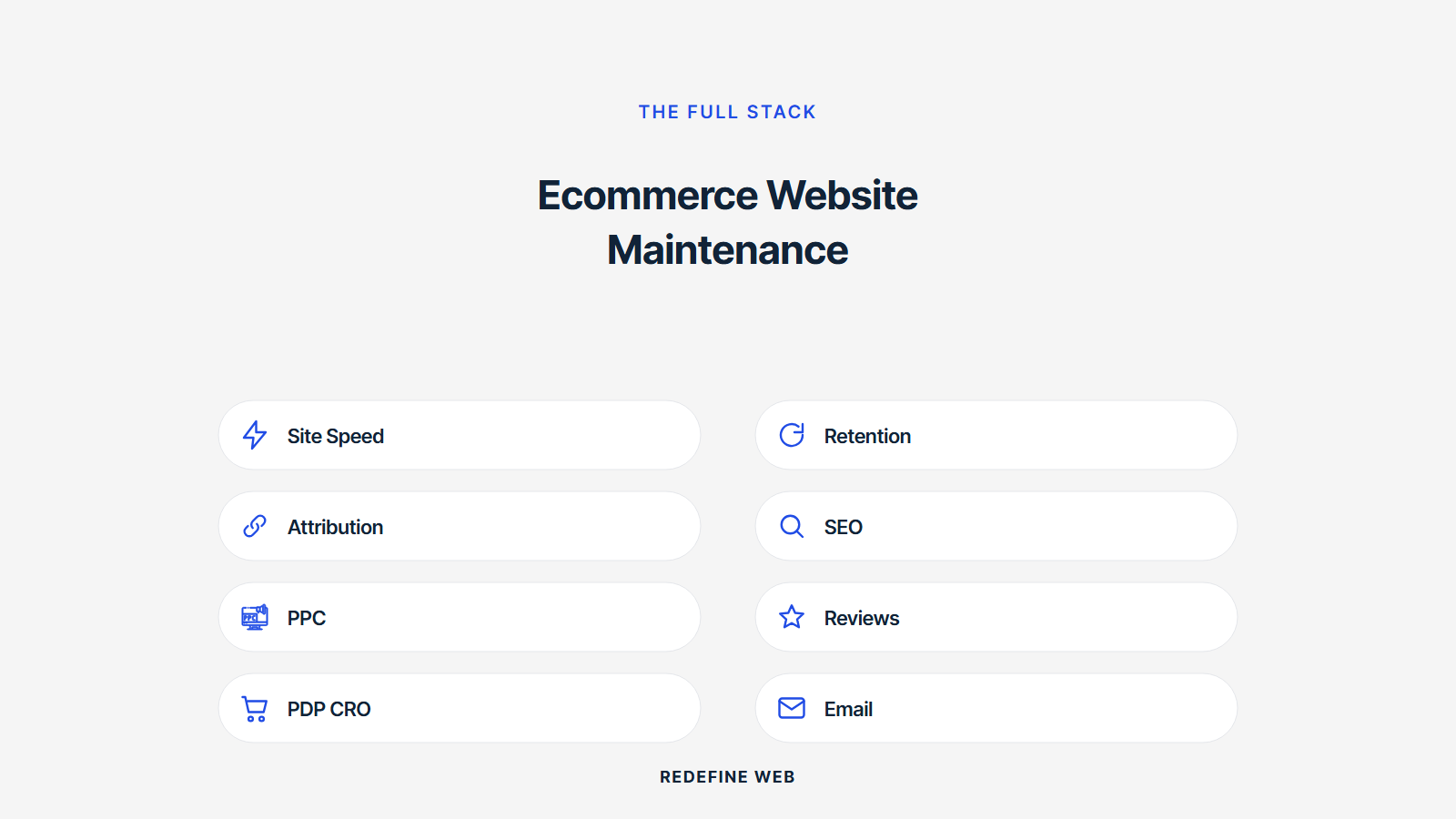
The ecommerce website maintenance checklist sits at the foundation of the growth stack. Every marketing dollar, every paid campaign, every SEO investment either compounds through a stable store or drains into a broken one. Founders that budget for marketing without budgeting for maintenance usually rebuild the store inside 24 months at a cost that eats a full year of the marketing budget.
How the checklist ties into the retainer
Our retainers include the monthly checklist as a fixed scope item, the quarterly audit as a rolling deliverable, and the annual full pass as a distinct yearly line. Six-month contracts start at $599 per month on the Starter tier for stores doing under $2M annual revenue. Growth and Scale tiers add more engineering hours per month, a dedicated staging environment, and priority incident response with a 15-minute response window during peak season. The ecommerce marketing retainer covers the full scope for founders who want the maintenance and the marketing running together under one team.
Every ecommerce retainer eventually reaches the moment where the founder Slacks at 11:47 pm asking why checkout is broken on the biggest ad day of the year. The maintenance report from three months ago listed the WooCommerce version pin. Nobody read it. The plugin conflict was noted in a change log entry from six weeks back. Nobody remembered it. Somewhere in the archive of every DTC store, a Google Doc titled Q3 Maintenance Notes is quietly explaining exactly what broke last Tuesday, while three engineers argue about whose fault it is at midnight.
Frequently Asked Questions
What does an ecommerce website maintenance checklist actually cover for a DTC store?+
An ecommerce website maintenance checklist covers four operational buckets across monthly, quarterly, and annual cadences. Security work handles plugin updates, theme updates (covered in our wordpress ecommerce maintenance writeup), platform core updates, malware scans, and SSL renewals. Performance work runs Core Web Vitals audits, image compression, database cleanup, and cache pruning. Content hygiene sweeps dead links, monitors 404s, regenerates sitemaps, and validates schema. Continuity work runs offsite backups, restore drills, staging syncs, and change logging. Stores running all four buckets on a schedule catch problems in the same week they appear, while stores skipping any single bucket usually discover missed problems during a checkout outage that costs 6 to 40 times what the retainer costs.
How often should a store run each part of the ecommerce website maintenance checklist?+
The monthly cadence covers plugin and theme updates, malware scans, checkout flow tests, backup verification, broken link sweeps, and uptime log reviews, running 4 to 6 hours across a mid-sized DTC store. The quarterly cadence adds Lighthouse audits on top pages, plugin utility reviews, database cleanup, image compression sweeps, and schema validation, running 8 to 14 hours. The annual pass covers platform core upgrades, full backup restore drills, SSL and DNS review, PCI compliance audit, and a 12-month content sweep, running 20 to 60 hours. Preventative work runs 45 to 60 days before peak season with load testing, plugin freeze, hosting pre-scale, and payment gateway failover testing.
What are the biggest ecommerce website maintenance components founders skip?+
Ecommerce website maintenance components most often skipped are offsite backup restore drills, database cleanup, plugin utility reviews, and change logging. Backup restore drills matter because 40 percent of nightly backups fail without any alert, and the failure only surfaces during a real restore attempt. Database cleanup matters because WooCommerce stores accumulate 15 to 30 percent per quarter in old revisions, expired transients, and abandoned cart sessions. Plugin utility reviews matter because stores carry 8 to 15 plugins they no longer use, adding load time and update risk. Change logging matters because it cuts the average incident diagnosis time from 3 to 8 hours down to 30 minutes when something breaks two weeks after a deployment.
What are the smartest strategies for successful ecommerce store maintenance across a full year?+
Strategies for successful ecommerce store maintenance start with named ownership on the checklist, staging discipline on every deployment, and documented rollback procedures under 15 minutes. Named ownership means one person confirms the work happened each month, which prevents the drift that kills unowned checklists inside 90 days. Staging discipline means every plugin update, theme change, and platform upgrade runs on staging with a defined smoke test before going live. Documented rollback means every deployment carries a written revert procedure. Stores running all three patterns push updates weekly without incidents. Stores skipping any of them still cause 2 to 4 preventable outages per year that damage revenue, ranking, and customer trust.
What are the practical tips for ecommerce store maintenance a founder should adopt from day one?+
The practical tips for ecommerce store maintenance from day one are simple to state and hard to skip. Keep a change log with date, person, and reason for every deployment. Test the full checkout weekly on desktop and mobile across every payment method. Monitor page speed continuously with a service like SpeedCurve or Calibre. Cap plugin counts at 25 for WooCommerce and 15 for Shopify. Attach a named owner to every installed plugin so nothing lives without an accountable person. Freeze the stack 30 days before peak season. Run backup restore drills quarterly on a real staging environment. These habits cost minutes per week and save 40 to 200 engineer hours per year in avoided incidents.
Frequently asked questions
What does an ecommerce website maintenance checklist actually cover for a DTC store?
An ecommerce website maintenance checklist covers four operational buckets across monthly, quarterly, and annual cadences. Security work handles plugin updates, theme updates, platform core updates, malware scans, and SSL renewals. Performance work runs Core Web Vitals audits, image compression, database cleanup, and cache pruning. Content hygiene sweeps dead links, monitors 404s, regenerates sitemaps, and validates schema. Continuity work runs offsite backups, restore drills, staging syncs, and change logging. Stores running all four buckets on a schedule catch problems in the same week they appear, while stores skipping any single bucket usually discover missed problems during a checkout outage that costs 6 to 40 times what the retainer costs.
How often should a store run each part of the ecommerce website maintenance checklist?
The monthly cadence covers plugin and theme updates, malware scans, checkout flow tests, backup verification, broken link sweeps, and uptime log reviews, running 4 to 6 hours across a mid-sized DTC store. The quarterly cadence adds Lighthouse audits on top pages, plugin utility reviews, database cleanup, image compression sweeps, and schema validation, running 8 to 14 hours. The annual pass covers platform core upgrades, full backup restore drills, SSL and DNS review, PCI compliance audit, and a 12-month content sweep, running 20 to 60 hours. Preventative work runs 45 to 60 days before peak season with load testing, plugin freeze, hosting pre-scale, and payment gateway failover testing.
What are the biggest ecommerce website maintenance components founders skip?
Ecommerce website maintenance components most often skipped are offsite backup restore drills, database cleanup, plugin utility reviews, and change logging. Backup restore drills matter because 40 percent of nightly backups fail without any alert, and the failure only surfaces during a real restore attempt. Database cleanup matters because WooCommerce stores accumulate 15 to 30 percent per quarter in old revisions, expired transients, and abandoned cart sessions. Plugin utility reviews matter because stores carry 8 to 15 plugins they no longer use, adding load time and update risk. Change logging matters because it cuts the average incident diagnosis time from 3 to 8 hours down to 30 minutes when something breaks two weeks after a deployment.
What are the smartest strategies for successful ecommerce store maintenance across a full year?
Strategies for successful ecommerce store maintenance start with named ownership on the checklist, staging discipline on every deployment, and documented rollback procedures under 15 minutes. Named ownership means one person confirms the work happened each month, which prevents the drift that kills unowned checklists inside 90 days. Staging discipline means every plugin update, theme change, and platform upgrade runs on staging with a defined smoke test before going live. Documented rollback means every deployment carries a written revert procedure. Stores running all three patterns push updates weekly without incidents. Stores skipping any of them still cause 2 to 4 preventable outages per year that damage revenue, ranking, and customer trust.
What are the practical tips for ecommerce store maintenance a founder should adopt from day one?
The practical tips for ecommerce store maintenance from day one are simple to state and hard to skip. Keep a change log with date, person, and reason for every deployment. Test the full checkout weekly on desktop and mobile across every payment method. Monitor page speed continuously with a service like SpeedCurve or Calibre. Cap plugin counts at 25 for WooCommerce and 15 for Shopify. Attach a named owner to every installed plugin so nothing lives without an accountable person. Freeze the stack 30 days before peak season. Run backup restore drills quarterly on a real staging environment. These habits cost minutes per week and save 40 to 200 engineer hours per year in avoided incidents.
Book your free 30-minute strategy call.
No spam, no sales rep. We use your email to schedule your call with a senior strategist. That is it.
More from the blog
View all articles → Website Maintenance
 WordPress Website Maintenance Packages That Keep the Site Safe and Fast
Read article Website Maintenance
 Pet Website Maintenance Checklist for Ecommerce Pet Brands
Read article Website Maintenance