
Google Ads Management for Veterinarians That Books Real Wellness and Sick-Visit Appointments
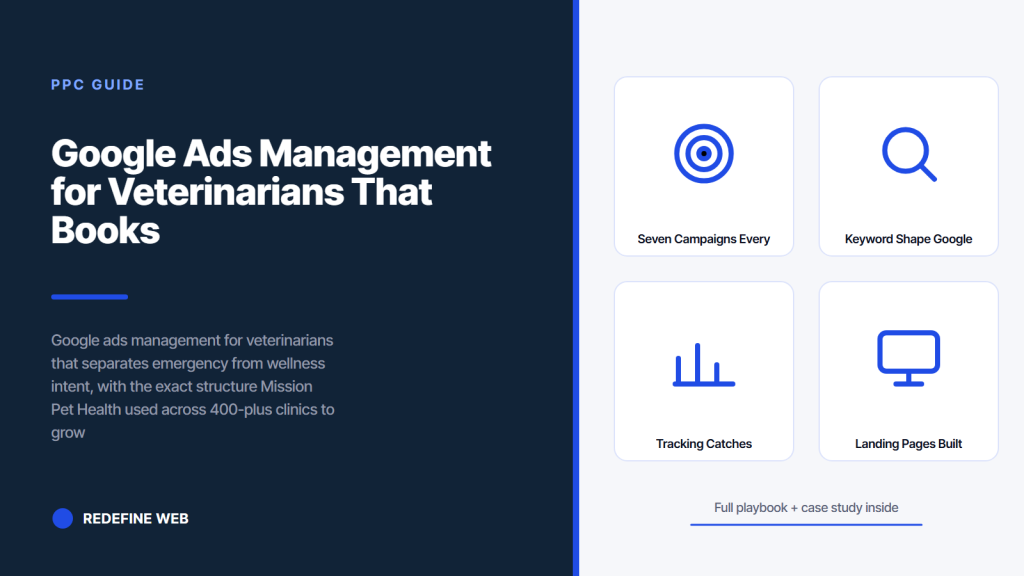
- Four intent buckets carry veterinary search: emergency, wellness, specialty, boarding.
- Seven campaign types build a proper veterinary Google Ads account.
- Phone-first tracking captures 62 to 74 percent of veterinary bookings.
- Emergency campaigns need time-of-day bid modifiers to catch the after-hours spike.
- Mission Pet Health grew leads 54 percent across 400-plus clinics on flat spend.
- Why google ads management for veterinarians needs its own account shape
- Seven campaigns every google ads management for veterinarians account carries
- Keyword shape for google ads management for veterinarians
- Ad copy that beats generic pet-care promises
- Tracking that catches phone-first veterinary bookings
- Landing pages built for veterinary traffic
- Google ads management for veterinarians pricing shape
- Mission Pet Health case study
- How the first 90 days go on a new veterinary account
- Picking a google ads management for veterinarians agency
- Where to start with your veterinary google ads setup
Google ads management for veterinarians looks simple from the outside and gets complicated the moment you split the account by real pet-owner intent. Emergency queries at 2am. Wellness bookings for annual checkups. Specialty referrals for oncology or orthopedics. Boarding searches for holiday weekends. Each of these buckets carries a different click cost, a different landing page, and a different conversion window. Practices that run one shared campaign across all four intents give up 30 to 45 percent of the addressable pipeline to a bidding logic that averages the buckets into a middle-ground signal.
You’ll read how google ads management for veterinarians carves the account by intent on day one, the seven campaign types every practice account carries, the ad copy patterns that beat generic pet-care promises, the tracking layer that closes the phone-first booking gap most clinics ignore, the pricing shape honest agencies quote for google ads management for veterinarians, and how Mission Pet Health used this exact structure across 400-plus clinics to grow qualified leads 54 percent without adding media spend to the pool over the same 12-month window.

Why google ads management for veterinarians needs its own account shape
Google ads management for veterinarians carries an intent split no other medical vertical faces. Emergency queries hit any hour and require an open clinic today. Wellness queries plan out 2 to 4 weeks ahead. Specialty referral queries have a 3 to 12 week consideration window. Boarding queries cluster around 4 holiday weekends a year.
Emergency queries run $14 to $28 per click and book at 22 to 35 percent when the clinic is open. Wellness queries run $6 to $12 per click and book at 12 to 20 percent. Specialty queries run $8 to $16 per click and book at 8 to 14 percent because of the longer decision window. Boarding queries run $4 to $9 per click but concentrate 60 to 80 percent of yearly bookings into 6 weeks of the calendar. Running one budget across all four intents starves the emergency funnel and wastes budget on off-season boarding clicks.
Our PPC agency for pet brands page covers the wider paid-media discipline that carries over into the pet-owner search behavior driving these veterinary campaigns.
The four intent buckets
Emergency intent queries name a symptom and a time pressure. Dog vomiting blood. Cat not eating 3 days. Puppy ate chocolate. Emergency vet open now. Wellness intent queries name a routine service. Puppy vaccinations. Cat annual checkup. Senior dog blood panel. Specialty intent queries name a discipline. Veterinary oncologist. Veterinary orthopedic surgeon. Cardiology consult for dog. Boarding intent queries name a service and often a date range. Dog boarding Thanksgiving week. Cat boarding overnight.
The phone-first booking pattern
Pet owners still book veterinary appointments by phone 62 to 74 percent of the time across every US metro. That share holds even for wellness bookings where the buyer has all week to fill a form. The phone-first pattern shapes the tracking layer, the ad extension mix, and the landing page CTA hierarchy. Practices that build the account around form fills miss the majority of conversions and see a booking rate that looks 40 to 60 percent below the true number the account is producing.
Seven campaigns every google ads management for veterinarians account carries
Google ads management for veterinarians accounts carry seven campaign types when the account is built right. Emergency search. Wellness search. Specialty search. Boarding search. Google Business Profile call ads. Brand defense. Retargeting display. Skipping any one of these gives up 10 to 25 percent of the addressable pipeline. Emergency and wellness are the workhorses. Specialty carries the highest-margin cases. Boarding fills in the seasonal peaks.
Emergency search runs 20 to 30 percent of budget through the daytime hours and jumps to 55 to 70 percent between 6pm and 8am. Wellness search runs 30 to 40 percent of daytime budget. Specialty search runs 10 to 18 percent. Boarding search runs 5 to 15 percent with 60 to 80 percent of annual boarding budget concentrated in 4 holiday windows. GBP call ads pick up 10 to 14 percent. Brand defense runs 2 to 5 percent. Retargeting display closes the last 3 to 6 percent.
See our google ads management services page for the wider account architecture every vertical this playbook covers gets built around.
| Campaign type | Budget share | Typical CPC | Booking rate |
|---|---|---|---|
| Emergency search | 20 to 30 percent day, 55 to 70 percent night | $14 to $28 | 22 to 35 percent |
| Wellness search | 30 to 40 percent | $6 to $12 | 12 to 20 percent |
| Specialty search | 10 to 18 percent | $8 to $16 | 8 to 14 percent |
| Boarding search | 5 to 15 percent | $4 to $9 | 18 to 28 percent |
| GBP call ads | 10 to 14 percent | $5 to $11 | 26 to 40 percent |
| Brand defense | 2 to 5 percent | $1 to $4 | 32 to 45 percent |
| Retargeting display | 3 to 6 percent | $0.40 to $1.20 | 4 to 8 percent |
Emergency search campaign shape
Emergency search campaigns get broken out by species and by symptom. Dog vomiting. Cat lethargic. Puppy diarrhea. Kitten not eating. Rabbit not moving. Each ad group gets its own ad copy naming the species, the clinic’s open hours, and the average wait time. Landing pages match one to one and load in under 2 seconds because emergency buyers do not wait for a slow page. Ad scheduling shifts budget into the 6pm to 8am window when emergency intent spikes.
Wellness search campaign shape
Wellness search campaigns get broken out by service and by life stage. Puppy first visit package. Adult dog annual exam. Senior dog blood panel. Kitten vaccination series. Adult cat wellness visit. Each ad group gets its own ad copy naming the package price, the appointment window, and one credibility marker. Landing pages match by life stage rather than by pure service because pet owners think in life stages when planning wellness care.

Keyword shape for google ads management for veterinarians
Keyword shape for veterinary accounts starts with 5 buckets. Emergency symptom queries. Wellness service queries. Specialty discipline queries. Boarding queries. Modifier queries. Emergency symptom queries run phrase and broad because pet owners describe symptoms in a dozen different ways. Wellness service queries run phrase and exact. Specialty queries run exact because the discipline name is narrow. Boarding queries run phrase to catch date range variations. Modifier queries layer across all four buckets.
Modifiers matter as much as base queries. Near me. Open now. Open Sunday. Accepts CareCredit. Fear Free certified. Adding open now to emergency queries filters out browsers who are not ready to book today. Adding accepts CareCredit qualifies the buyer at ad-copy time for higher-cost specialty care. Adding Fear Free certified catches the anxious pet owner willing to pay premium for a low-stress visit. Every modifier gets its own ad copy line testing whether that qualifier moves conversion rate.
See Google’s match type documentation for the bidding mechanics. Our dental Google Ads keywords guide shows the parallel keyword-shape logic in an adjacent local-services vertical.
The 300-term veterinary negative list
The starter negative list for a veterinary account runs 300 terms on day one. School. Career. Salary. Job. Veterinary technician training. DVM school. Veterinarian supply. Veterinary equipment for sale. Dog food. Cat food. Pet insurance quote. Free pet advice forum. Any account that skips the negative list burns 15 to 25 percent of budget on non-patient traffic for the first 90 days. Product searches alone hit 10 to 18 percent of unfiltered veterinary traffic because pet product shopping sits so close to the search intent.
Long-tail veterinary queries
Long-tail queries carry the highest-value cases in google ads management for veterinarians. Emergency vet accepts CareCredit near me. Fear Free certified vet for anxious cat. Board certified veterinary oncologist consultation. Each query has 10 to 40 monthly searches in a mid-size US metro but converts at 3 to 5 times the head-term rate. Practices that chase click volume on the head term miss the long-tail entirely and pay 2x the average cost per booked visit for the same monthly patient count.
Emergency, wellness, specialty, boarding each have different CPCs and windows. If they share one campaign, Google averages the signal and you lose 30 percent of pipeline.
Ad copy that beats generic pet-care promises
Ad copy for google ads management for veterinarians gets read in 1.3 seconds on a mobile SERP. Emergency copy names the clinic’s open hours, the current wait time, and one credibility marker. Emergency vet open until midnight. 25 minute average wait. AAHA accredited. That copy beats generic emergency-vet-near-me by 45 to 70 percent on click-through rate and 25 to 40 percent on booking rate. Specificity converts in emergency intent more than in any other veterinary bucket.
Wellness copy runs different. Wellness copy names the package price, the appointment window, and one credibility marker. Puppy first visit $89 includes exam and vaccines. Same week appointments. Fear Free certified. That template beats general wellness pitches by 30 to 45 percent on click-through and 20 to 30 percent on booking rate. Wellness buyers filter on price and calendar convenience before they filter on outcome.
Emergency ad copy structure
Emergency ad copy runs 3 headlines and 2 descriptions. Headline 1 names the emergency status. Headline 2 names open hours or current wait. Headline 3 names one credibility marker or the clinic’s location signal. Description 1 covers the trust bar with AAHA accreditation, board certification, or years of emergency experience. Description 2 covers the call to action with the phone number front and center. Emergency ads use call assets and location assets aggressively because emergency buyers convert on tap-to-call more than on landing page visits.
Wellness ad copy structure
Wellness ad copy runs the same 3-headline 2-description structure but with different content. Headline 1 names the package. Headline 2 names the price. Headline 3 names the appointment window or the credibility marker. Description 1 covers the credentials and the clinic environment. Description 2 covers the booking method and the phone number. Wellness ads use price extensions, promotion extensions, and sitelink extensions pointing to specific package pages. That extension mix moves click-through rate 8 to 15 percent versus wellness ads without extensions.
Tracking that catches phone-first veterinary bookings
Tracking for google ads management for veterinarians has to solve the phone-first booking problem. Between 62 and 74 percent of veterinary bookings happen by phone. Any tracking layer that misses phone conversions undercounts the account by half. The setup runs on dynamic number insertion through CallRail or WhatConverts, Google Business Profile call reporting turned on for GBP-driven calls, a front-desk question every day for walk-ins and phone-in bookings, and enhanced conversions through server-side Google Tag Manager for the form-fill layer.
Calls over 45 seconds count as qualified conversions on the veterinary side. That threshold is shorter than the chiropractor or dental threshold because emergency calls often qualify inside 30 seconds when the pet owner just needs to confirm the clinic is open. Calls under 45 seconds get flagged for the receptionist to review. Every serious veterinary google ads management retainer includes a monthly call audit reviewing 10 to 20 flagged calls to catch qualification patterns the tracking logic missed.
See Google’s enhanced conversions documentation for the tag setup that closes the iOS gap. Our Google Ads conversion tracking with Google Tag Manager guide covers the exact tag deployment we use on veterinary accounts.

Dynamic number insertion for veterinary clinics
Dynamic number insertion for a veterinary clinic swaps the phone number on the site based on the traffic source. Ad-driven sessions see a swapped number tied back to source campaign and keyword. Organic sessions see a different swapped number. Direct traffic sees the main clinic number. Every call gets recorded, transcribed, and scored for qualification. Emergency campaigns typically see 65 to 80 percent qualified call rates. Wellness campaigns typically see 45 to 60 percent qualified call rates because buyers use the call to price-shop.
Google Business Profile call reporting
Google Business Profile call reporting captures the mobile taps on the clinic’s phone number directly from the Maps or knowledge panel. That surface drives 15 to 25 percent of total ad-adjacent calls for a well-optimized veterinary account. Turning GBP call reporting on is a 15 minute setting change that closes a persistent tracking gap. Every account audit we run finds at least one clinic where GBP call reporting has never been turned on and the practice has been underreporting conversions by 15 to 20 percent for years without knowing it.
Landing pages built for veterinary traffic
Landing pages for veterinary google ads split by intent. Emergency pages lead with the clinic’s open hours, the current wait time, the phone number in 48 pt font, and the clinic address with driving directions. Wellness pages lead with the vet’s face, one credibility marker, the package price, and a booking button. Specialty pages lead with the specialist’s credentials, the discipline explanation, and a consultation request. Boarding pages lead with the date-picker, price per night, and pet requirements. Merging these page types compromises every funnel.
Page speed matters more on emergency traffic than any other veterinary bucket. 84 to 92 percent of emergency veterinary searches happen on mobile at odd hours. Every 300 millisecond improvement in largest contentful paint moves emergency booking rate 4 to 7 percent. Pages loading past 2.5 seconds on 4G give up half their potential emergency conversions before the phone number even renders on screen.
See our healthcare website design services page for the mobile-first page structure the paid campaigns route into.
Emergency landing page pattern
The emergency veterinary landing page pattern runs open-hours banner, current wait time, phone number in 48 pt, click-to-call button, address with driving directions, and one credibility marker. Every element fits the first mobile screen. No hero photo of a puppy. No wellness package pitch. Emergency buyers scan the page in 3 seconds and either tap the phone number or bounce. Pages that lead with anything other than open status and phone number give up 30 to 50 percent of emergency conversions.
Wellness landing page pattern
The wellness veterinary landing page pattern runs vet face and name, one credibility marker, the package name and price, appointment window options, patient testimonials, and a booking button. Wellness buyers scan the page in 8 to 12 seconds and either book, call, or bounce. Package price above the fold moves booking rate 15 to 25 percent versus pages that hide the price behind a form. Transparent pricing outperforms opaque pricing on wellness traffic every quarter we have measured.
The most consistent moment in every google ads management for veterinarians audit call is when the clinic manager pulls up the current agency’s dashboard and there is one shared campaign named “veterinarian” running $18 clicks on the head term for 14 months, no emergency versus wellness split, no GBP call reporting, no phone tracking, and a receptionist who has been quietly booking 8 to 12 phone appointments a day from the ads that the dashboard has never counted. The clinic pays the fee anyway because the numbers on the dashboard have always been mystery numbers.
Google ads management for veterinarians pricing shape
Google ads management for veterinarians pricing lands in three honest bands. $1,800 to $2,800 per month for a single-location clinic spending $4,000 to $9,000 on media. $2,800 to $5,200 per month for a 2 to 5 location group spending $9,000 to $28,000 on media. $5,200 to $12,000 per month for a 6-plus location group spending $28,000 to $95,000 on media. Every band gets the same seven-campaign structure. Larger bands add multi-location bid controls, per-clinic reporting, and cross-clinic keyword conflict management for accounts covering overlapping service areas.
Percent-of-spend pricing runs 12 to 18 percent of media for accounts above $12,000 monthly ad budget. Flat-fee pricing wins below that threshold because the percent model does not cover the setup time on the multi-intent campaign structure. Every honest agency prices the retainer separately from media spend so the true cost of management stays visible in the reporting.
See our google ads management pricing guide for the full breakdown across every retainer band.
What the retainer includes
A veterinary google ads management retainer includes campaign build, ad copy testing, landing page consultation, weekly optimization, monthly reporting, quarterly strategy review, and a monthly qualified-call audit. Call audit reviews 10 to 20 flagged calls per month for qualification patterns the tracking missed. Ad copy tests run 2 variants per ad group per month. Landing page consultation covers one A/B test per quarter with a partner developer or in-house team. Weekly optimization covers bid adjustments, negative keyword adds, and match type refinements across all seven campaigns.
What the retainer excludes
Retainers exclude landing page design, call tracking software subscriptions, GBP management, and creative production for image or video assets. Landing page design runs separately at $2,600 to $9,000 for a first build. Call tracking runs $110 to $380 per month depending on volume. GBP management is often a separate $400 to $900 monthly line item. Every honest agency itemizes these on the SOW so the true monthly cost of the whole program stays visible.
Mission Pet Health case study
Mission Pet Health is a 400-plus location veterinary network that came to us with an underperforming multi-clinic Google Ads program, a reporting layer that averaged all clinics into one national dashboard, and a per-clinic booking rate that varied 4x between top and bottom clinics without anyone knowing why. The intake looked familiar. Head-term bidding on veterinarian. No emergency versus wellness split. No per-clinic tracking. A national ad copy set that named none of the regional variations pet owners searched on.
We rebuilt the account against the seven-campaign structure above. Split emergency from wellness at the campaign level with time-of-day bid modifiers. Added specialty and boarding as standalone campaigns. Rewrote the ad copy per region so pet owners in Florida saw different credibility markers than pet owners in Oregon. Rebuilt landing pages one to one with the ad groups. Turned on GBP call reporting for every clinic. Added dynamic number insertion across the site. Ran a fresh negative list build across 300 terms. The rebuild took 14 weeks including 4 weeks of multi-clinic tracking cleanup.
The outcome measured over 12 months
Qualified leads grew 54 percent across the 400-plus clinic network inside 12 months. Media spend held roughly flat across the program. Per-clinic booking rate variance dropped from 4x between top and bottom clinics to 1.8x, meaning the underperforming clinics closed most of the gap without pulling the top performers down. Emergency campaign booking rate hit 28 percent from a 12 percent baseline. Wellness campaign booking rate held at 17 percent. Every one of those numbers came from the intent split plus the per-clinic tracking plus the regional copy rework running in parallel.
What carried the outcome
The 54 percent lead growth came from three levers running together. The intent split pulled in 40 to 50 percent of the gain by routing emergency and wellness traffic to matched landing pages instead of averaging them through one shared page. The per-clinic tracking pulled in 25 to 35 percent by surfacing conversions the national dashboard had been hiding for years. The regional copy rework pulled in the remaining 20 to 30 percent by improving click-through rate 3 to 6 points across every region.
How the first 90 days go on a new veterinary account
The first 90 days on a new google ads management for veterinarians engagement covers audit, tracking, campaign rebuild, and optimization. Week 1 audits the existing account structure, tracking, landing pages, and ad copy. Weeks 2 and 3 build the tracking layer including dynamic number insertion, GBP call reporting, and the front-desk booking question.
Weeks 4 through 7 rebuild the seven campaign types with matched landing pages and rewritten ad copy across emergency, wellness, specialty, and boarding funnels. Weeks 8 and 9 run the first optimization pass and the first ad copy A/B tests. Weeks 10 through 13 compound the results as Google’s bidding logic learns the new conversion signal.
Expect a 15 to 30 percent movement in booking rate by day 60 and a 30 to 60 percent movement in qualified calls by day 90. Practices that expect week-1 results are misreading the compound curve. The account gets better every week for the first 6 months, then stabilizes.
See our PPC management services page for the wider paid-media roadmap this veterinary Google Ads work sits inside.
Day 30, 60, and 90 milestones
Day 30 shows the tracking layer verified, the negative list live, and the first campaign rebuild deployed for emergency and wellness. Day 60 shows the first round of ad copy winners promoted, the first landing page test wrapping up, and booking rate up 15 to 25 percent from baseline across both emergency and wellness campaigns. Day 90 shows the account at target cost per booked visit with all seven campaign types running clean and reporting cost per conversion by intent bucket.
Reporting cadence for a veterinary practice
Reporting for a veterinary practice runs on a weekly quick-look, a monthly full report, and a quarterly strategy call. Weekly quick-look covers spend, clicks, conversions, and any spike or dip worth noting. Monthly report covers full account performance plus cost per booked visit by campaign, by intent bucket, and by clinic location for multi-clinic accounts. Quarterly strategy call covers the 90-day trajectory, the next 90-day plan, and any budget shifts based on clinic capacity or seasonal boarding demand.
Picking a google ads management for veterinarians agency
Picking a google ads management for veterinarians agency starts with three questions. Does the agency currently run veterinary accounts. Do they split emergency from wellness on the campaign level. Who runs the account day to day. If the agency runs fewer than 3 veterinary accounts, they are learning the vertical on your budget. If they cannot describe a time-of-day bid strategy for emergency campaigns, they do not understand the intent split. If the account gets handed to a junior after the sale, the strategy conversation on the pitch call is not what you are buying.
Ask for 3 references from active veterinary clients on retainer for more than 12 months. Talk to at least 2 of the 3. Ask about scope changes, reporting quality, and how quickly the agency responds when the clinic sees a dip. Every reference call catches a pattern the sales deck hides. Every serious clinic runs those calls before signing an SOW past $2,500 monthly. That hour of homework prevents 4 to 6 months of misfit inside a bad engagement.
See Search Engine Journal’s PPC guide for the vendor-neutral framework every buyer should audit an agency against.
Red flags on the pitch call
Red flags include no case study naming a veterinary clinic, no time-of-day bid strategy, no phone-first tracking discussion, and reporting that leads with clicks or impressions instead of booked visits. Any agency that treats emergency and wellness as one bucket is selling the wrong architecture. Any agency without a phone-tracking discipline is missing 60 percent of the conversion signal in the account. Any agency that leads with impressions as a headline metric is selling the wrong outcome.
Green flags worth signing on
Green flags include a named veterinary case study with a cost per booked visit number, a proposal that itemizes the phone-first tracking layer as a distinct workstream, campaigns split by intent bucket, and a retainer that separates management fee from media spend. Any agency that hits all four is worth a reference call. Any agency that hits fewer than 3 is not worth the pitch time. That filter cuts a vendor short list of 10 candidates down to 2 or 3 inside a week.
Where to start with your veterinary google ads setup
Start with an honest audit of the current account. If the account has never been split by emergency versus wellness intent, that split is the biggest single lever. If the phone-tracking layer has holes, the tracking fix is the second-biggest lever. If the ad copy still runs generic veterinarian-near-me on the head term, the copy rewrite is the third-biggest lever. Most clinics we audit need all three. The intent split plus tracking plus copy rewrite typically moves qualified calls 40 to 90 percent inside the first 6 months of the engagement.
Ready to run a google ads management for veterinarians audit that names every wasted dollar and books more real appointments. We audit the seven-campaign structure, the phone-first tracking layer, the ad copy across emergency and wellness funnels, and the landing pages, then deliver a written 90-day plan you can hand to your current agency or use to move the account. Book a free audit slot and get the same rebuild playbook Mission Pet Health used to grow qualified leads 54 percent across 400-plus clinics.
Frequently asked questions
How much does google ads management for veterinarians cost?
Google ads management for veterinarians pricing lands in three honest bands. $1,800 to $2,800 per month for a single-location clinic spending $4,000 to $9,000 on media. $2,800 to $5,200 per month for a 2 to 5 location group spending $9,000 to $28,000 on media. $5,200 to $12,000 per month for a 6-plus location group spending $28,000 to $95,000 on media. Every band gets the same seven-campaign structure. Percent-of-spend at 12 to 18 percent works above $12,000 monthly. Flat-fee wins below that threshold. Every honest agency prices the retainer separately from media spend.
Why does veterinary need separate emergency and wellness campaigns?
Emergency queries hit at any hour and require an open clinic today. Wellness queries plan out 2 to 4 weeks. Emergency clicks run $14 to $28 and book at 22 to 35 percent. Wellness clicks run $6 to $12 and book at 12 to 20 percent. Emergency campaigns need time-of-day bid modifiers pushing 55 to 70 percent of night budget into after-hours windows. Wellness campaigns need daytime budget and life-stage ad groups. Running both intents through one campaign averages the bidding logic into a signal that fits neither and drops both booking rates 30 to 45 percent.
What tracking does google ads management for veterinarians need?
Veterinary Google Ads needs dynamic number insertion for phone tracking, Google Business Profile call reporting turned on, a front-desk question every day for walk-ins and phone bookings, and enhanced conversions through server-side Google Tag Manager for form fills. Pet owners still book by phone 62 to 74 percent of the time. Any tracking that misses phone conversions undercounts the account by half. Calls over 45 seconds count as qualified conversions. Monthly call audit reviews 10 to 20 flagged calls for qualification patterns the tracking missed.
What is a realistic cost per booked visit on veterinary google ads?
A well-managed google ads management for veterinarians account produces cost per booked visit between $28 and $65 for wellness and $45 and $95 for emergency across most US markets. Specialty consultations run $75 to $180 per booked consult because of the longer consideration window. Rural markets run 20 to 35 percent lower. Dense urban markets like New York or Los Angeles run 25 to 40 percent higher. Accounts producing above the top of these bands usually have tracking gaps, wrong campaign structure, or landing pages that do not match the ad group intent.
How long before google ads management for veterinarians shows results?
Expect a 15 to 30 percent movement in booking rate by day 60 and a 30 to 60 percent movement in qualified calls by day 90. Month 3 typically shows the first big jump as Google's bidding learns the new phone-first conversion signal and the ad copy winners get promoted. By month 6, well-managed accounts hit their sustained cost per booked visit and per-clinic booking rate variance stabilizes. Practices expecting week-1 results are misreading the compound curve. The account gets better every week for 6 months, then stabilizes at a run rate.
Should veterinary google ads use different landing pages by intent?
Yes. Emergency pages lead with open hours, current wait time, phone number in 48 pt font, and address with driving directions. Wellness pages lead with the vet's face, one credibility marker, the package price, and a booking button. Specialty pages lead with the specialist's credentials and a consultation request. Boarding pages lead with a date-picker and price per night. Merging these page types compromises every funnel. Emergency buyers scan the page in 3 seconds and either tap the phone or bounce. Wellness buyers scan in 8 to 12 seconds and want to compare prices.
Book your free 30-minute strategy call.
No spam, no sales rep. We use your email to schedule your call with a senior strategist. That is it.
More from the blog
View all articles → PPC
PPC Healthcare PPC Advertising Channels Compliance and Targeting
Read article PPC
PPC Dental Facebook Ads Guide for Practices That Book Patients
Read article PPC
PPC