
Google Analytics for Healthcare Websites That Tracks Real Patient Wins
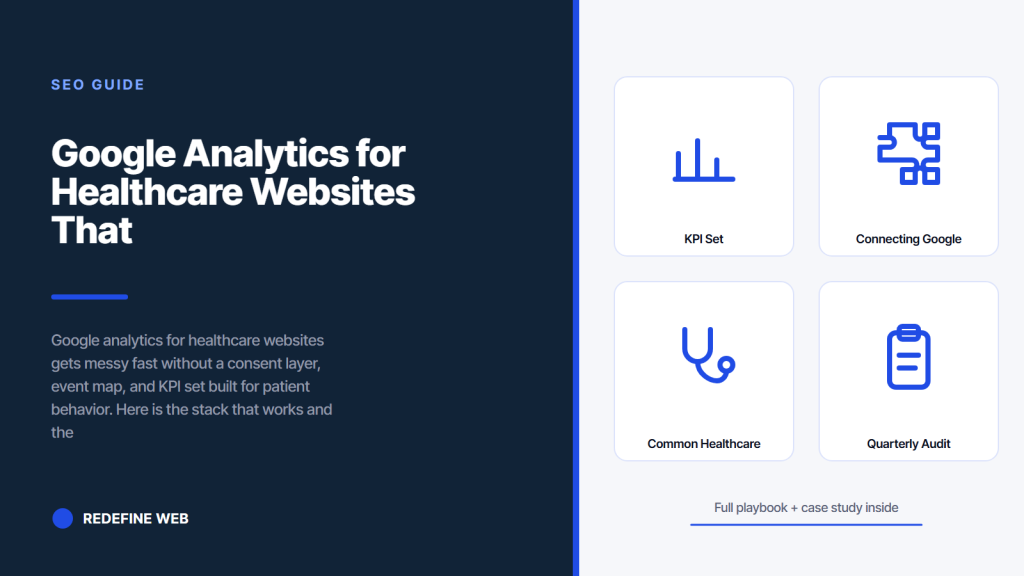
- Track five patient-side events, not vanity page views.
- Wire consent mode v2 with a real gating banner.
- Strip PHI at the tag manager before GA4 sees it.
- Reconcile GA4 to the PMS monthly, gap under 15 percent.
- Build a five-KPI Looker Studio one-pager, drop the rest.
- The Healthcare Web Analytics KPI Set
- Connecting Google Analytics to the Practice Management System
- Real Numbers From a Multi-Location Analytics Cleanup
- Common Healthcare Website Analytics Mistakes
- Healthcare Website Conversion Optimization With GA4 Signals
- Looker Studio Reporting for Healthcare Website Analytics
- Quarterly Audit Checklist for Google Analytics for Healthcare Websites
Google analytics for healthcare websites looks simple on paper. Drop the tag, watch the numbers roll in. Then a compliance officer asks about protected health information in URL parameters, a marketing manager asks why the conversion count is half what the practice management system shows, and the tracking layer turns into a weekend of untangling. This guide walks the setup that keeps google analytics for healthcare websites clean, honest, and compliant, from consent through KPIs.
The short version. Wire GA4 with a consent mode banner, strip PHI at the tag layer, map five patient-side events, and reconcile against the practice management system monthly. Do that and you have healthcare web analytics you can actually make decisions from, plus a clean audit trail when the compliance question shows up. Skip any of it and you get a dashboard that lies to you politely for months while the marketing budget quietly drains against wrong assumptions about which patients came from where.
The Healthcare Web Analytics KPI Set
You need five KPIs at the top of the report and everything else buried in explorations. The five that pay rent are booked appointments, phone calls attributed to organic and paid, contact form submits, direction taps on the location page, and cost per booked patient across paid channels. Track those monthly and the rest of the dashboard becomes optional context.
| KPI | Source | Cadence | Owner |
|---|---|---|---|
| Booked appointments | Practice management system | Weekly | Office manager |
| Attributed phone calls | CallRail or call tracking tool | Weekly | Marketing lead |
| Contact form submits | GA4 event + form plugin | Weekly | Marketing lead |
| Direction taps | GA4 event on map link | Monthly | Marketing lead |
| Cost per booked patient | Ads spend divided by attributed books | Monthly | Practice owner |
Why booked appointments is the anchor
Every other number in the report matters only in relation to booked appointments. A 40 percent traffic spike that produces zero new booked appointments is a signal that the traffic is off-intent. A 5 percent traffic dip that produces the same booked appointments is a signal that intent got sharper. You calibrate everything against the anchor. The practice management system is the source of truth. GA4 is the diagnostic layer.
Cost per booked patient by channel
Split cost per booked patient by acquisition channel monthly. Google Ads runs $80 to $220 per booked patient for a general dental practice depending on market. Local SEO runs $15 to $60 per booked patient once the site is established. Meta Ads runs $120 to $300 per booked patient for cosmetic dentistry, less for pediatric or emergency care. Those numbers are the negotiating floor when you sit down with any agency partner.
The direction taps signal
A direction tap on the location page usually means the patient is about to walk in. That signal correlates strongly with same-day emergency visits and walk-in cleanings, which are hard to attribute otherwise. Track direction taps as a soft conversion. When they rise without a corresponding rise in booked appointments, either the walk-in traffic is undercaptured in the PMS or the location page is being used as a driving reference by patients who never intended to visit. Both are useful signals.
Connecting Google Analytics to the Practice Management System
GA4 lives outside the practice management system. That gap is what makes attribution hard in healthcare. You cannot link a specific GA4 session to a specific booked patient without either passing PHI to Google, which you will not do, or reconciling aggregates monthly between the two systems.
The monthly reconciliation
On the first business day of the month, pull the count of new patient appointments booked in the prior month from the practice management system. Pull the count of booking_complete events from GA4 for the same period. Compare. A gap under 10 percent is normal, because phone calls and walk-ins produce booked appointments GA4 never saw. A gap over 25 percent means either the tag is broken or the PMS is counting phone bookings as web bookings.
Call tracking is the bridge
Call tracking numbers close the loop between GA4 and the practice management system for phone-booked patients. CallRail, WhatConverts, and CallTrackingMetrics all integrate with GA4 through the tag manager. Dynamic number insertion swaps the phone number based on the traffic source, so a call from a Google Ads visit is attributed to Google Ads before the receptionist even picks up. That attribution layer is what makes cost per booked patient calculable per channel.
The reconciliation gap and what causes it
A persistent 15 to 25 percent gap between GA4 and the PMS is usually one of three things. Ad blockers strip GA4 pings for roughly 8 to 14 percent of traffic. Consent denials remove client IDs for another 3 to 8 percent. And the widget iframe sometimes fails to fire the completion event when the confirmation renders inside a third-party iframe. Fix the third one first because it is silent. The other two are structural and get modeled by GA4 automatically.
Real Numbers From a Multi-Location Analytics Cleanup
Smile Design Dentistry, a 50-plus location dental support organization, brought us in when the marketing team could not tell which of the 50 offices was actually driving new patient bookings from the website. GA4 was firing on every page but the events were misconfigured, phone calls were untracked, and the PMS-to-GA4 reconciliation gap was above 40 percent every month.
What we found in the first audit
The booking widget iframe was not sending the completion event upstream because the third-party iframe swallowed the postMessage call. Phone numbers on the location pages were static, so calls were unattributable. And the consent banner was misconfigured, denying analytics_storage silently on roughly 60 percent of first sessions. Three fixes, three separate developer tickets, all shipped inside two weeks.
The reconciliation number after cleanup
After the cleanup the PMS-to-GA4 reconciliation gap dropped from 40 percent to under 12 percent, which is inside the modeling band. Cost per booked patient by channel became calculable for the first time. PPC conversion rate rose 20 percent inside a quarter because we could finally see which campaigns produced booked patients versus which produced clicks that never called. The healthcare web analytics cleanup surfaced the same booking gap across every location once the tag layer was consistent. See our Healthcare Website SEO post for the site-level fixes that pair with the analytics work.
What changed in the reporting cadence
The weekly report went from a 40-metric wall to a 5-KPI dashboard per location, with the monthly one-pager going to the practice owner. Marketing meetings dropped from 90 minutes of interpreting numbers to 20 minutes of deciding on the next campaign. Nobody misses the 40-metric wall. Everyone reads the 5-KPI page.
Pull GA4 conversion count and your PMS new-patient count for last month. If they miss by 15%+, one's lying. Usually the tag fires on the wrong page.
Common Healthcare Website Analytics Mistakes
The plan at the start of the year. Custom dashboards per location, weekly attribution reports, cohort analysis on repeat visits, and a mission-control screen in the office. The plan by March. Whatever pops up in the default GA4 report when the marketing lead opens the tab between calls. If you have run marketing at a practice for more than one quarter, you know exactly how this goes. The good news is the 5-KPI dashboard is enough.
Chasing bounce rate
Bounce rate in GA4 is not what it was in Universal Analytics. Engagement rate replaced it. Chasing bounce rate on a modern GA4 property gets you fiddling with a metric Google itself deprioritized. Look at engaged sessions per page instead, and only for the pages that lead to a conversion event. Everything else is chart wallpaper.
Setting up too many custom dimensions
Every custom dimension you add to GA4 you also need to maintain. Practices spin up 15 custom dimensions in month one and then never look at 12 of them again. Stick to three: traffic source group, service page category, and location. That covers 90 percent of the questions the marketing team actually asks. Everything else is easier to answer with a one-off exploration.
Treating GA4 as the source of truth
GA4 is the diagnostic layer for healthcare website statistics. The practice management system is the source of truth for booked appointments. Treat GA4 like a diagnostic tool, not a ledger. When the two disagree, the PMS wins for booked patient counts, and GA4 wins for traffic source and content path. Neither system is wrong. They measure different things.
Healthcare Website Conversion Optimization With GA4 Signals
Healthcare website conversion optimization is the payoff on a clean analytics layer. Once the events and consent are wired right, GA4 tells you where users drop, which service pages convert, and which traffic sources deserve more spend. The optimization loop moves from guessing to testing.
Funnel exploration for the booking flow
The GA4 funnel exploration on the booking sequence shows the exact step where users drop. Step one is booking widget open. Step two is provider or reason selection. Step three is time slot pick. Step four is contact detail entry. Drop-off between step three and step four is the most common healthcare pattern, and it usually traces to an unexpected insurance field or a hard-to-read time picker on mobile. Fix the fourth step and you often recover 15 to 25 percent of started bookings.
Service page conversion segmentation
Segment the conversion rate by landing page category. Emergency pages usually convert at 8 to 14 percent because intent is sharp. Cleaning pages convert at 3 to 6 percent. Cosmetic pages convert at 2 to 4 percent because the buying window is longer. The point is not that emergency wins. It is that each page needs its own benchmark and its own CTA structure to compete against its own baseline.
Where to run experiments first
Run experiments on the page that gets the most qualified traffic and has the biggest conversion gap versus its category benchmark. That is usually the homepage or a single hero service page. Google Optimize is deprecated so most practices run experiments through PostHog, VWO, or a simple A/B split at the CDN level. See our Healthcare Website CRO post for the test structure that pairs with GA4 tracking.
Looker Studio Reporting for Healthcare Website Analytics
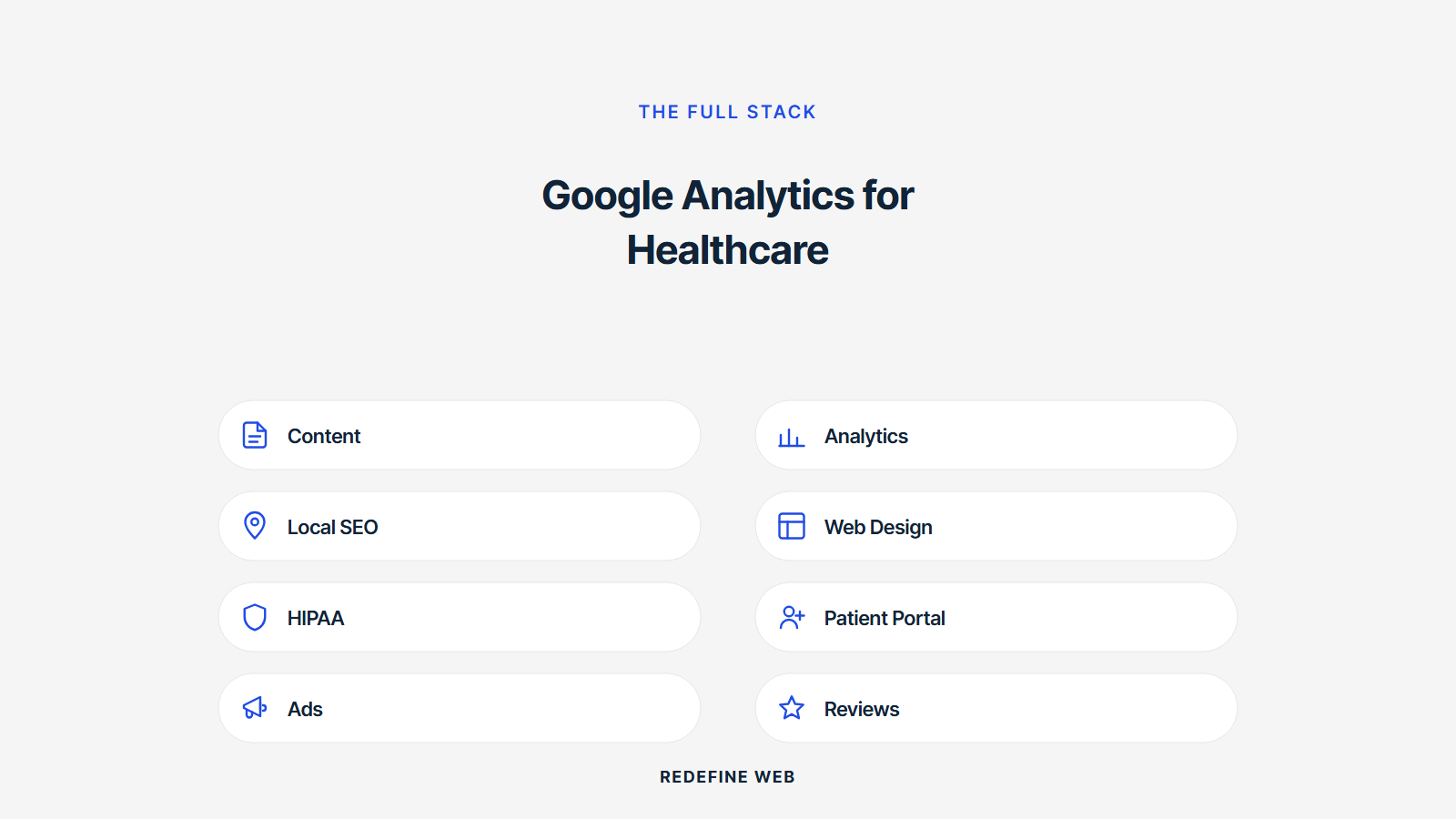
The GA4 native reports are fine for spot checks. For monthly reviews and stakeholder reporting, Looker Studio is the tool. Connect GA4 as a data source, pull in the five KPIs, add a segmentation slice for location if you run multi-location, and you have a one-pager that reads in 30 seconds.
The one-page monthly report
The monthly one-pager needs five sections. KPI scorecard at the top with month-over-month change. Traffic source table with sessions plus conversions per channel. Top ten landing pages by booked appointments. Booking funnel exploration snapshot. Recommended action for next month. That last line is the one everyone reads first, so make it the sharpest sentence on the page.
Blending call tracking data into the report
CallRail and WhatConverts both connect as Looker Studio data sources. Blend the call data with GA4 sessions to show attributed calls per channel alongside sessions per channel. That side-by-side view is where the cost per booked patient math becomes obvious. Practices that skip the blend often overestimate paid channel performance because untracked phone bookings inflate the numerator.
Where the retainer fits
Running google analytics for healthcare websites as part of a broader web marketing program takes 3 to 6 hours a month at a specialist level for a single-location practice. Multi-location groups need 10 to 15 hours. Most practices bundle it inside a monthly healthcare marketing retainer because the analytics work compounds across the SEO, PPC, and CRO tracks. Retainer starts at $599 a month. See our Healthcare SEO Agency page for the specific attribution work we run inside those retainers, and our Healthcare Marketing Agency hub for the full stack.
Quarterly Audit Checklist for Google Analytics for Healthcare Websites
Every quarter, run a four-part audit on the analytics layer. The audit catches silent breakage that happened after a plugin update, a widget swap, or a compliance tool refresh. Twenty minutes of quarterly review beats six months of unnoticed data drift, and it keeps the report defensible when a board member asks about attribution.
Tag firing verification
Open the site in a private window with GA debugger active. Click through the top five landing pages and the booking flow. Every expected event should fire in the debugger console. Anything missing is a broken tag. See Chrome DevTools console documentation for the debugging workflow inside a private window session.
Consent banner spot check
Reload the site with cookies cleared. The consent banner should show before any tag fires. Deny analytics_storage and confirm GA4 still receives a cookieless ping in the debugger. Accept and confirm the client ID appears. Both states need to work or the modeling layer breaks silently and the report reads high or low without you knowing which.
PMS reconciliation review
Pull the last three months of booking_complete counts from GA4 and match them against the PMS new patient count for the same period. A gap that stays under 15 percent means the tag is honest. A gap that widened over the quarter usually means a widget update stopped forwarding the completion postMessage upstream. Fix that first before touching anything else in the tag manager. Google analytics for healthcare websites is only as accurate as the last widget release note nobody read.
Google analytics for healthcare websites earns its keep once the events are right, the consent layer is honest, PHI stays out of the tag, and the KPI set is short. Wire it that way and the report becomes a real decision tool instead of a monthly ceremony that nobody trusts.
Frequently asked questions
Is Google Analytics HIPAA compliant for healthcare websites?
Google Analytics is not a HIPAA business associate and Google does not sign a BAA for standard GA4 accounts. That means you cannot send protected health information into GA4 without creating compliance exposure. The workable pattern is to strip PHI at the Google Tag Manager layer before the ping fires, using regex rewrites on page_location and event parameters to redact any name, email, phone number, appointment ID, or patient identifier. For practices that need session-level attribution to specific patients, move to a HIPAA-friendly analytics platform like Freshpaint or self-hosted Matomo. GA4 with strict tag-layer redaction is the standard setup for most single-location practices.
What events should Google Analytics for healthcare websites track?
The five patient-side events that carry 90 percent of the signal are booking_widget_open, booking_complete, phone_click, contact_submit, and directions_click. Booking widget open catches every session that started the flow. Booking complete confirms the appointment landed on the schedule. Phone click captures tap-to-call intent from mobile. Contact submit picks up form leads. Directions click flags patients about to walk in, which correlates strongly with same-day visits. Everything past those five events is decoration for most healthcare accounts. Track them consistently across the site and the GA4 report becomes a real decision tool instead of a monthly ceremony.
How does consent mode change healthcare web analytics data?
Consent mode v2 changes how GA4 receives pings when the user denies analytics_storage. Instead of dropping the ping entirely, GA4 receives a cookieless ping without a persistent client ID. Google then models the missing sessions into aggregate reports so the trend line stays usable. You will see a modeled segment in explorations and standard reports, typically covering 5 to 15 percent of traffic depending on your audience. Do not turn modeling off. It fills the gap honestly without inventing users. Audit the banner in a private window with GA debugger monthly to confirm the tag actually respects the consent choice.
Why does GA4 disagree with the practice management system?
The gap between GA4 and the practice management system is usually 10 to 25 percent, and three causes explain most of it. Ad blockers strip GA4 pings on roughly 8 to 14 percent of traffic. Consent denials remove client IDs for another 3 to 8 percent. And booking widget iframes sometimes fail to fire the completion event when the confirmation renders inside a third-party iframe. Fix the iframe problem first, since it is silent and traceable. The other two are structural and get modeled by GA4 automatically. Reconcile aggregates monthly rather than trying to match session by session.
What KPIs should a healthcare practice track in Google Analytics?
The five KPIs that pay rent are booked appointments from the PMS, attributed phone calls from call tracking, contact form submits from GA4 events, direction taps on the location page, and cost per booked patient by channel. Booked appointments is the anchor, since every other number matters only in relation to booked patients. Cost per booked patient by channel is the negotiation floor when you sit down with any agency partner. Everything else on the standard GA4 dashboard is context. Build a five-KPI Looker Studio one-pager and let the rest of the GA4 interface serve spot-check questions rather than the monthly review.
How much does Google Analytics for healthcare websites cost to set up?
GA4 itself is free. The full setup cost sits in the tag manager work, the consent banner tool, and the call tracking layer. A single-location practice typically spends $12 to $40 a month on a consent management platform like Complianz or Iubenda, plus $45 to $250 a month on call tracking through CallRail or WhatConverts. The initial GTM configuration, event mapping, PHI redaction, and Looker Studio dashboard build takes 8 to 20 hours from a specialist at $100 to $175 an hour, so budget $1,200 to $3,000 for the setup. Multi-location groups run higher on both setup and monthly cost.
Can Google Analytics track phone calls from a healthcare website?
Yes, in two ways. The lightweight version is a phone_click event that fires when the user taps or clicks the phone number, which GA4 captures cleanly. That tells you intent to call but not whether the call connected or converted. The full attribution version uses call tracking through CallRail, WhatConverts, or CallTrackingMetrics with dynamic number insertion. The tracking tool swaps the phone number displayed on the page based on the traffic source, so a call from a Google Ads visit is attributed to Google Ads before the receptionist picks up. That attribution layer is what makes cost per booked patient calculable per channel.
Book your free 30-minute strategy call.
No spam, no sales rep. We use your email to schedule your call with a senior strategist. That is it.
More from the blog
View all articles → SEO
SEO Organic Search Engine Optimization Services That Grow Real Traffic
Read article SEO
SEO SEO for Pet Groomers That Fills the Appointment Book Weekly
Read article SEO
SEO