
PPC Audit Healthcare Cut Waste and Improve Lead Quality
- Most healthcare PPC accounts waste 20 to 35 percent of spend on drift.
- A structured 22-check audit runs in 90 minutes on tracked accounts.
- Search terms, geo-targeting, and dayparting fixes recover the most budget.
- Conversion tracking accuracy is the highest-leverage single fix.
- Run the audit quarterly to prevent drift from returning.
- Why Run a PPC Audit Healthcare Practices Actually Need
- What a PPC Audit Service for Healthcare Actually Covers
- The 22 Checks That Run in 90 Minutes
- Cost-Effective Tactics for Healthcare PPC Advertising After the Audit
- How to Calculate Healthcare PPC Savings From an Audit
- Healthcare PPC Management After the Audit
- Case Study: LifeStance Health Georgia PPC Audit
- Common Audit Findings That Repeat on Every Healthcare Account
- Compliance Considerations Inside a PPC Audit Healthcare Program
- Who Should Run the PPC Audit Healthcare Practices Trust
You want a ppc audit healthcare accounts can actually act on, not another 60-tab spreadsheet that ends in a $3,000 invoice. This guide is the practical version. You’ll get the 22 checks that identify wasted spend inside an hour, the exact fields where healthcare accounts burn budget without producing patients, the math for calculating real savings, and the tactics that improve lead quality without adding another dollar to the media budget. The short version. Most healthcare PPC accounts waste 20 to 35 percent of spend on match-type sprawl, generic keywords, wrong geographies, and dayparting misses. A structured audit surfaces that waste in 60 to 90 minutes. Fixing it recovers $500 to $8,000 a month depending on account size. Do the audit quarterly and your cost per qualified lead drops 25 to 40 percent inside two quarters. This is the ppc audit healthcare owners can run in-house or send to a specialist without paying agency prices for the review. Use it as a standalone check on any account you inherited, or as the quarterly rhythm inside an existing engagement to keep the numbers honest.
Why Run a PPC Audit Healthcare Practices Actually Need
Healthcare PPC accounts drift faster than any other vertical we work with. Regulatory changes push new keywords into the account. Seasonal search patterns shift attention. New providers get added and old campaigns keep spending. A ppc audit healthcare practices run every quarter catches the drift before it costs six months of budget.
The specific reason healthcare PPC burns more budget than other verticals is the intent gap. Someone searching “chest pain” isn’t the same buyer as someone searching “chest pain treatment near me.” The account structure needs to separate those intents ruthlessly, and most practice accounts don’t. That gap is where 25 percent of the budget disappears every month without producing a single qualified appointment. A structured audit surfaces the pattern and gives you a fixed cost per fix rather than a rolling monthly bleed.
The other reason: healthcare compliance restrictions on retargeting and audience data mean paid programs can’t lean on the same behavioral targeting other industries use to clean up messy accounts. You have to run tighter on Search itself, which means the audit surface has to be more disciplined. A quarterly ppc audit healthcare programs actually complete is what keeps costs sane while the compliance rules tighten each year. Without a regular rhythm the account drifts, and the drift compounds every single quarter you skip the review.
What a PPC Audit Service for Healthcare Actually Covers
A proper ppc audit service for healthcare covers eight sections. Account structure. Keyword health. Match type discipline. Negative keyword coverage. Ad copy compliance. Landing page relevance. Conversion tracking accuracy. Budget allocation across campaigns. Skip any one and the audit misses 15 to 25 percent of the wasted spend hiding in the account.
Account structure review
Every service line should have its own campaign. Every service line campaign should have separate ad groups by intent stage (research, comparison, conversion). Every ad group should have 2 to 3 responsive search ads and 8 to 15 tightly-themed keywords. If your account has one giant “General Search” campaign with 400 keywords, the audit’s first recommendation writes itself.
Keyword health check
Pull the last 90 days of search terms. Sort by spend descending. Any term over $200 spent with zero conversions is a candidate to negative or reassign. Any term with strong conversions on broad match should get promoted to phrase or exact. Any medical term you’re bidding on that doesn’t match your specialty should get killed immediately. This one review usually recovers 10 to 15 percent of monthly spend without touching anything else.
Conversion tracking accuracy
Every phone call over 60 seconds should be a tracked conversion. Every form fill should fire a conversion. Every appointment booked online should fire a conversion. If your account is optimizing against “button clicks” or “page visits” as proxy conversions, the whole bid strategy is fighting the wrong metric. Fixing conversion tracking is usually the single most valuable move in any healthcare PPC audit.

The 22 Checks That Run in 90 Minutes
Structure the audit as a checklist. Every check is either pass, fix now, or investigate. You’ll finish in 90 minutes on a well-tracked account, longer on messy ones. Every account we’ve audited has at least 6 findings on the first pass. Most have 12 to 15. Even accounts run by expensive agencies show up with the same 4 or 5 recurring blind spots you can catch inside the first pass.
- Are conversions tracked for calls over 60 seconds, form fills, and online bookings.
- Are Enhanced Conversions turned on with hashed patient data.
- Are impressions on top target keywords above 40 percent search share.
- Is average CPC on top keywords within 20 percent of industry benchmark.
- Are broad match keywords isolated in their own experiment campaign.
- Is the negative keyword list at least 200 items and refreshed monthly.
- Are competitor brand terms excluded from Search unless intentional.
- Are audiences properly configured under HIPAA restrictions.
- Is retargeting only enabled where compliance allows it.
- Is geo-targeting set to People In Location, not Interest.
- Are location bid adjustments used for high-value ZIPs.
- Are dayparting adjustments set for the practice’s actual open hours.
- Is Ad Rank at least average or better on every campaign.
- Are ad extensions (sitelinks, callouts, callouts, structured snippets) filled in.
- Is the call extension using a call tracker number for source attribution.
- Are landing pages relevant enough for a Quality Score of 7 or higher.
- Do landing pages load in under 2.5 seconds on mobile.
- Are impression-share losses to budget or rank documented.
- Is the account structure ad group themes matching landing page copy.
- Are Performance Max campaigns isolated from Search (or excluded from brand terms).
- Are seasonal patterns reflected in current bid strategies.
- Are budget pacing alerts set at 90 percent of daily budget.
You don't need a audit. Open the account, pull last 90 days search terms, sort by cost. The top 15 wasted queries are the whole audit. Add as negatives Friday.
Cost-Effective Tactics for Healthcare PPC Advertising After the Audit
The audit finds the waste. The follow-up is where the money comes back. Cost-effective tactics for healthcare ppc advertising fall into five families. Each one moves cost per qualified lead 10 to 25 percent when executed disciplined. Stack three of them in one quarter and you can cut waste 40 percent without touching the topline budget.
Tight geo-targeting
People In Location, not People Interested In Location. Radius targeting around each practice location, not broad metro. ZIP-level bid adjustments for the 10 highest-value ZIPs. Exclusion of ZIPs where you consistently see low-quality leads. On multi-location accounts this alone tightens CPA by 15 to 25 percent inside a month.
Match type discipline
Google pushes broad match hard because broad match burns more budget. Resist. Run 80 percent of your keyword budget on phrase match with tight negatives. Use exact match on your top 20 converters. Isolate broad match into a controlled experiment campaign with $50 a day capped. Broad match is not the villain, but unchecked broad match on a healthcare account burns 30 percent of monthly spend.
Dayparting to match the phones
If your front desk closes at 5 PM and doesn’t check voicemail until 9 AM, you should not be paying premium CPC at 8 PM on a Sunday. Pull the conversion-by-hour report. Adjust bids down 40 to 60 percent during closed hours. Adjust up 15 to 25 percent during the 2-hour windows when calls actually get answered. Same budget, better lead quality.
Landing page tightening
Every ad group should have a landing page whose H1 matches the ad copy H1. Every landing page should have one primary CTA above the fold. Every landing page should show a trust signal (provider photo, credential, insurance accepted) in the first viewport. Skip any of these and Quality Score drops, which raises CPC, which burns the budget faster. Fix in an afternoon.
Bid strategy alignment
Max Clicks burns budget on healthcare accounts. Target CPA works once you have 30+ conversions per campaign per month. Manual CPC still wins on small accounts under $2,000 monthly spend. Match the strategy to the account size and stop letting the platform default you into whatever earns Google the most revenue.
How to Calculate Healthcare PPC Savings From an Audit
Every practice owner asks the same question after the audit: how to calculate healthcare ppc savings honestly. The math is four numbers. Total monthly spend. Percentage of spend on non-converting search terms. Percentage of spend on wrong-geo clicks. Percentage of spend during closed hours. Add those three percentages and multiply by monthly spend. That’s your recoverable waste.
The real-account example
Practice spends $8,000 a month on Google Ads. Audit shows 18 percent of spend on search terms with zero conversions in 90 days, 9 percent on clicks outside the 15-mile service radius, and 12 percent on clicks after 8 PM on days when the front desk closes at 5 PM. Total waste 39 percent, or $3,120 a month. Fix the three drivers and the account recovers $2,400 to $2,800 conservatively, or the same lead volume at $5,200 monthly spend.
The lead-quality math
Waste reduction is one number. Lead quality gain is another. Tighter geo-targeting on a healthcare account typically raises the show rate on booked appointments 8 to 15 percent because the leads live closer and are less likely to no-show. Tighter dayparting raises the answer rate on inbound calls 20 to 30 percent because calls hit the phone when the desk actually answers. Both feed the ROI number without touching the invoice.
The 12-month savings model
A $8,000-a-month account with a 30 percent audit-driven waste cut saves $28,800 over 12 months. Add a 15 percent gain on conversion rate from tighter landing pages and you get another 45 to 60 booked appointments a year at your average LTV. On a $2,500 average patient LTV that’s $112,500 to $150,000 in additional annual revenue at zero incremental media cost.
Healthcare PPC Management After the Audit
The audit finds problems. Healthcare ppc management is what stops the problems from returning. Set a monthly rhythm that hits the top 8 audit checks every 30 days and the account never drifts back to the state you started from.
The monthly rhythm
First Monday of the month: pull search terms report, add 40 to 80 new negatives. Second Monday: review conversion trends per campaign, adjust bid strategies. Third Monday: review landing page performance, retest 1 to 2 pages. Fourth Monday: monthly report meeting, decide what changes for next 30 days. Four hours a month keeps a healthy account healthy. Two hours a month keeps a large account from drifting badly.
Quarterly deep audit
Every 90 days, run the full 22-check audit again. Compare findings quarter over quarter. Any check that recurs is a process gap, not a one-time drift. Fix the process. The monthly rhythm handles execution; the quarterly audit handles the structure that drives execution.
Annual strategy review
Once a year, review the campaign portfolio against the practice’s growth stage. New service lines added? New locations? New provider hires that need dedicated pages and campaigns? The audit doesn’t answer strategy questions, only execution. The strategy review is where you decide whether the entire account structure still fits, or whether it needs a rebuild before the next quarter starts.
Case Study: LifeStance Health Georgia PPC Audit
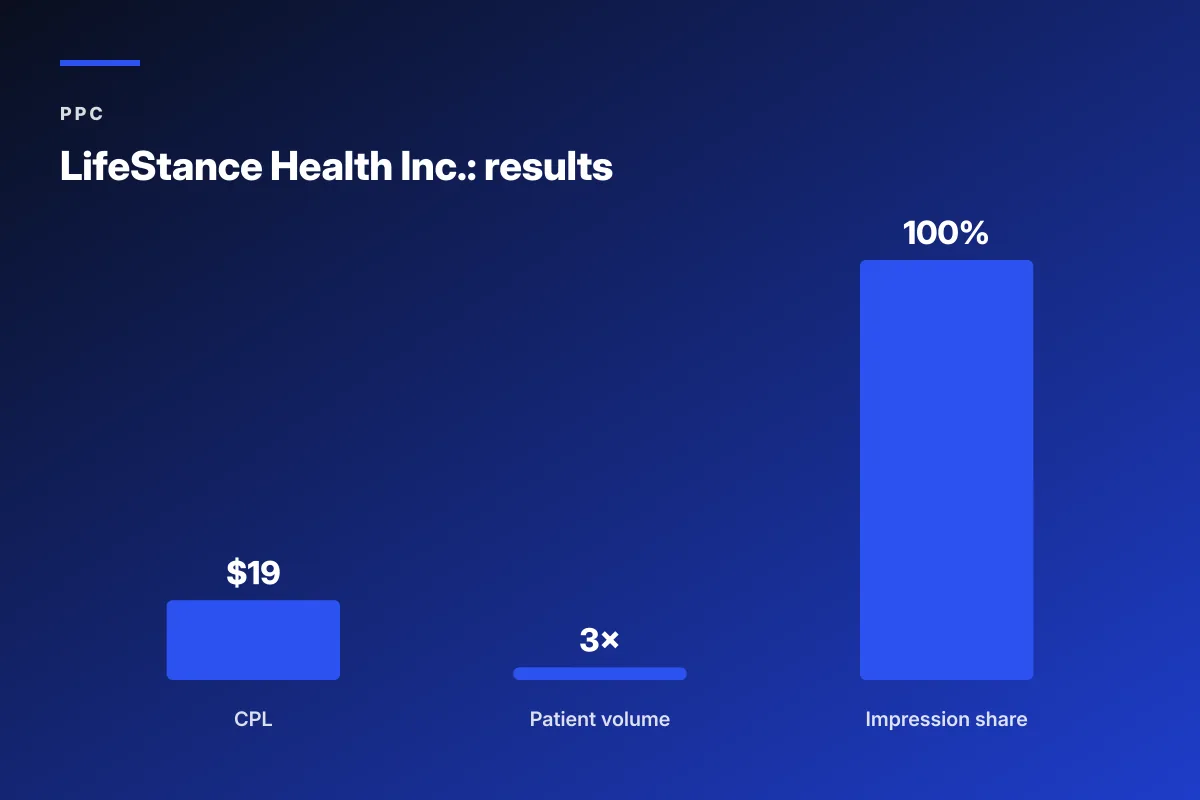
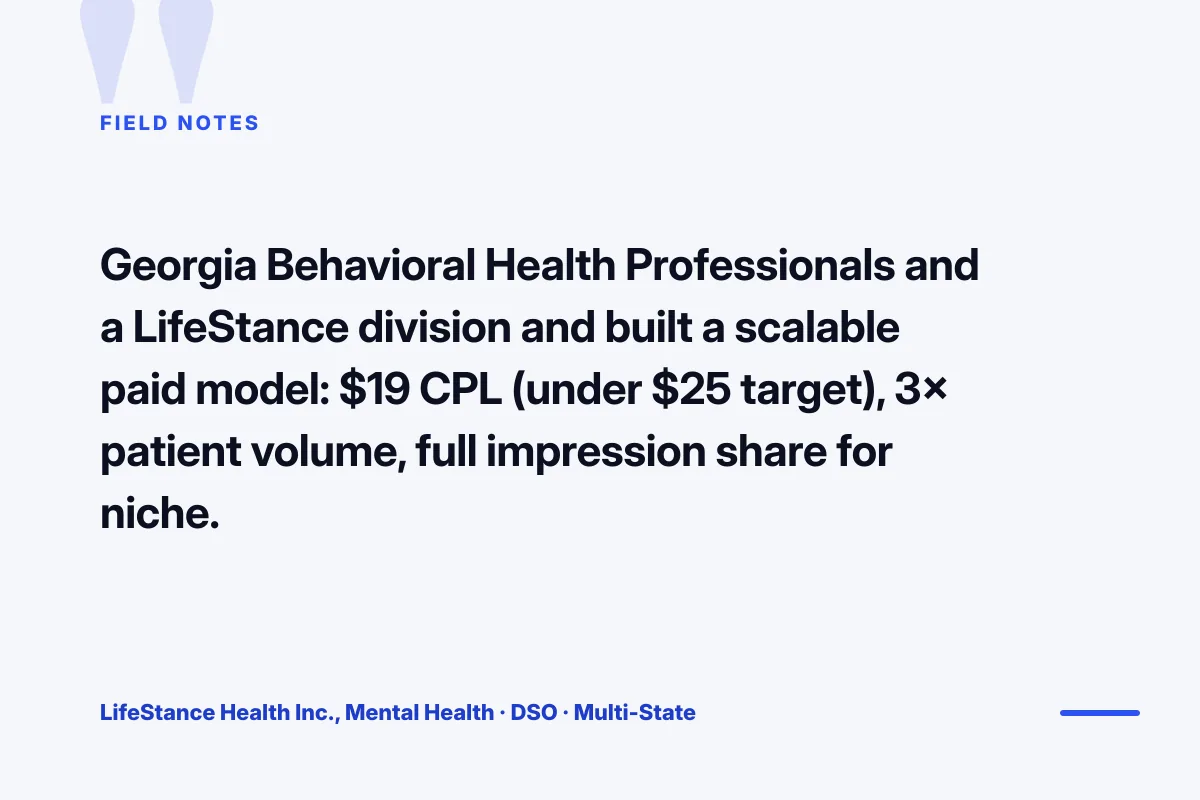
LifeStance Health Inc., a multi-state mental health group with over 10 clinics in Georgia, needed a paid model that could scale across specialties (TMS therapy, general psychiatry, psychology) without CPL spiking above a $25 target. The pre-audit account structure was mixing specialty and geography in the same campaigns, which meant broad targeting was cannibalizing the specialty-specific budgets and CPL trended above target on the niche services.
The rebuild after the audit split every specialty into its own campaign, tightened geo-targeting to People In Location around each clinic, added dedicated landing pages by service, and rebuilt conversion tracking around booked appointments rather than form-fills. Twelve months in, average CPL held at $19 (well under the $25 target), patient acquisition volume tripled across the 10-plus Georgia clinics, and niche services like TMS therapy captured 100 percent impression share. The audit surfaced the structural drift. The follow-through delivered the savings and the volume gain together. That’s the pattern a ppc audit healthcare programs run correctly should produce every quarter: findings translated into structural changes, not one-off tweaks. LifeStance Health Inc. was the size where structure matters most and drift compounds fastest, which made the audit ROI show up inside the first month rather than trickling in over the year. The mid-size multi-location profile is where audits pay back fastest, because the fixes cascade across every clinic simultaneously and the operational overhead of running the changes is low relative to the recovered spend.
| Metric | Pre-audit | Month 12 | Driver |
|---|---|---|---|
| Average CPL | $25 target ceiling | $19 | Specialty campaign split + tight geo |
| Patient volume | Baseline | 3x | Landing pages + conversion tracking rebuild |
| Impression share (TMS) | Fragmented | 100% | Niche campaign isolation |
| Capacity routing | None | Live | Location-specific routing on ads |
Common Audit Findings That Repeat on Every Healthcare Account
Every ppc audit healthcare account we’ve run in the last 24 months surfaces the same 6 findings. Every one is fixable. Every one is dragging your account down as you read this. The pattern is depressingly consistent across specialties, geographies, and account sizes.
The recurring six
- Broad match keywords running unbounded and eating 30 percent of budget on irrelevant queries.
- Negative keyword list under 100 items with obvious misses (job postings, DIY searches, competitor names).
- Conversion tracking counting form starts, not form submits.
- Geo-targeting set to Interest, not People In Location.
- Landing pages using generic homepage copy instead of ad-specific messaging.
- Ad extensions half-filled or missing entirely on lower-priority campaigns.
The one finding that’s funny
Every fifth account has a paused campaign named “OLD DO NOT USE” or “TEST DELETE ME” from 2022 that quietly got reactivated during a UI update and has been spending $40 a day for eight months on keywords like “free dental xray Groupon.” Nobody noticed. The account manager left, the new one inherited the mess, and the campaign named “DELETE” is now the third-largest budget line. Go find it. Then send us a photo. We keep a wall of them.
Why the pattern persists
Healthcare PPC accounts live for 3 to 5 years, changing hands between agencies, in-house managers, and Google reps. Every handoff loses institutional knowledge. Every UI change from Google introduces default settings that override old decisions. The audit is the checkpoint that catches the drift before the drift becomes a rebuild.
Compliance Considerations Inside a PPC Audit Healthcare Program
Healthcare PPC accounts sit under a stricter compliance layer than any other vertical. HIPAA rules limit what patient data can flow into audience lists. Google’s medical policy restricts what ad copy can claim. State-level rules add another compliance layer on top of the federal ones. A ppc audit healthcare owners can trust has to check every one of these boxes or the account is one flagged campaign away from a policy suspension.
Audience restrictions
Customer Match uploads with patient data require careful review. Any first-party data uploaded to Google needs to be either fully hashed or run through a HIPAA-compliant intermediary. Retargeting lists based on health-condition landing pages are restricted. The audit should confirm every audience list documents where the data came from and confirms compliance with the platform’s sensitive-category rules.
Ad copy restrictions
Google’s healthcare and medicines policy limits claims about outcomes, testimonials, and comparative effectiveness. Ad copy that promises specific medical results triggers disapproval faster than any other category. The audit should flag any ad copy using absolute language (“cure,” “guaranteed,” “proven”) and rewrite it into compliance-friendly phrasing before the disapproval lands and the campaign goes dark for review.
Landing page compliance
Every landing page linked from a healthcare ad needs a visible privacy policy, a non-medical disclaimer where appropriate, and no forms collecting protected health information without HIPAA-compliant transmission. The audit is where those checks get logged, because they’re rarely caught at campaign launch and they compound into legal risk over time.
Who Should Run the PPC Audit Healthcare Practices Trust
You can run this audit yourself if you have basic Google Ads familiarity and 90 minutes free. You can hire an external auditor for $500 to $2,500 flat depending on account size. You can add it as a quarterly deliverable inside an agency retainer. The right answer depends on your current management model and how much drift the account has accumulated.
DIY audit
Works if you already manage the account and know the account structure. Use the 22 checks above. Log findings in a spreadsheet. Assign fixes to yourself with due dates. Repeat every 90 days. Total time roughly 3 hours a quarter. If you can maintain that rhythm, DIY audit is the highest-value process a practice owner can run themselves without hiring help.
External auditor
Works when you suspect drift but don’t have time to diagnose it. A flat-fee external audit surfaces problems fast, and it’s cheaper than switching agencies. Ask for a written deliverable with findings, priorities, and dollar savings estimates. Skip auditors who won’t quote a fixed price. Skip auditors whose deliverable is a slide deck instead of a spreadsheet.
Where we run this
If you want the audit as a service, our Healthcare PPC Agency Services covers it. For the broader management playbook, see Healthcare PPC Management. Campaign structure decisions live in Healthcare PPC Campaigns. If you’re picking between agencies, our Choosing a Healthcare PPC Agency guide walks through the criteria. External references worth reading: the Google Ads negative keywords documentation, the Search Engine Land PPC guide, and the WordStream analysis of PPC management best practices.
Frequently asked questions
What does a real ppc audit healthcare account need to cover?
A ppc audit healthcare accounts should treat seriously covers eight sections: account structure, keyword health, match type discipline, negative keyword coverage, ad copy compliance, landing page relevance, conversion tracking accuracy, and budget allocation across campaigns. Skip any one of those and the audit misses 15 to 25 percent of the potential waste hiding in the account. On healthcare specifically, the two areas that catch owners off guard are conversion tracking (form-starts counted instead of form-submits, phone calls under 60 seconds counted as leads) and geo-targeting (Interest instead of People In Location). Fix those two and most accounts recover 15 to 20 percent of monthly spend before touching keywords or ads. Budget the audit at 90 minutes on a tracked account, longer on messy ones.
How does a ppc audit service for healthcare differ from a generic PPC audit?
A ppc audit service for healthcare has three additional considerations a generic audit misses. First, HIPAA-compliant audience configuration and retargeting exclusions on segments where the platform's audience data would create compliance risk. Second, keyword scrutiny for medical terminology that could trigger Google's restricted-content classifications on sensitive conditions. Third, extra weight on call tracking configuration because a much higher percentage of healthcare conversions land as phone calls versus form fills, and untracked calls destroy the ROI math for the whole account. A generic audit will find the same match-type sprawl and negative-keyword misses, but the healthcare-specific layer needs a specialist who has run at least 20 practice accounts to spot correctly.
What are the top cost-effective tactics for healthcare ppc advertising after an audit?
Cost-effective tactics for healthcare ppc advertising fall into five families, each one moving cost per qualified lead by 10 to 25 percent when executed with discipline. Tight geo-targeting on People In Location with radius targeting around each clinic. Match-type discipline running 80 percent of budget on phrase match with heavy negatives. Dayparting bid adjustments matching when the front desk actually answers phones. Landing page tightening so each ad group's page copy mirrors the ad copy H1 and shows trust signals in the first viewport. Bid strategy alignment matching the strategy to account size (Manual CPC under $2,000 monthly spend, Target CPA above). Stack three of the five in one quarter and total waste can drop 40 percent without cutting topline budget.
How to calculate healthcare ppc savings from an audit honestly?
How to calculate healthcare ppc savings honestly comes down to four numbers. Total monthly spend. Percentage of spend on search terms with zero conversions in the last 90 days. Percentage of spend on clicks outside your target service radius. Percentage of spend during hours when the front desk cannot answer calls. Add the three percentages, multiply by monthly spend, and that's your recoverable waste. On a typical $8,000-a-month practice account we see 18 percent non-converting search terms, 9 percent wrong-geo, and 12 percent closed-hours clicks, totaling 39 percent waste or roughly $3,120 a month recoverable. Add the downstream gains from tighter lead quality (higher show rates, higher answer rates) and the 12-month ROI is well above the audit cost.
How often should healthcare ppc management include a full audit?
Healthy healthcare ppc management includes a light monthly review, a quarterly full audit, and an annual strategy review. The light monthly review handles search-terms negatives, conversion trend analysis, landing page performance, and a 30-day forward plan. The quarterly audit runs the full 22-check list and catches drift on any process gap. The annual review looks at whether the campaign portfolio still fits the practice's growth stage: new service lines, new locations, new provider hires. Skipping the quarterly audit and relying only on the monthly review is a common mistake, because the monthly cadence catches drift within the campaigns but not structural drift across the account. Structure drift is where the expensive damage accumulates.
How long does a proper ppc audit healthcare account take to complete?
A proper ppc audit healthcare account takes about 90 minutes on a well-tracked account with clean conversion tracking already in place. Messy accounts (broken conversion tracking, sprawling campaign structure, no negative keyword list) run 3 to 5 hours because the auditor has to rebuild the analytical foundation before running any of the diagnostic checks. Larger multi-location accounts add roughly 30 minutes per additional location or specialty campaign, because each one needs geo, dayparting, and landing page checks run separately. Budget 2 hours per account as a baseline and add time for complexity. External audit services typically quote $500 to $2,500 flat depending on account size, which usually pays back in the first month of implementing the findings.
What is the single highest-leverage fix in most healthcare PPC audits?
The single highest-leverage fix in most healthcare PPC audits is conversion tracking accuracy. Every phone call over 60 seconds should fire a tracked conversion. Every form-submit (not form-start) should fire a conversion. Every appointment booked online through the practice's scheduling tool should fire a conversion. Most accounts we audit are optimizing bid strategies against proxy metrics like button-clicks or page-visits, which means the whole automated bidding system is fighting the wrong target. Fix conversion tracking first and the account starts optimizing toward real appointments within 14 days as the platform's learning phase adjusts. Every other audit finding is downstream of accurate conversion tracking. Skip this fix and the rest of the audit is theater.
Book your free 30-minute strategy call.
No spam, no sales rep. We use your email to schedule your call with a senior strategist. That is it.
More from the blog
View all articles → PPC
PPC Healthcare PPC Advertising Channels Compliance and Targeting
Read article PPC
PPC Dental Facebook Ads Guide for Practices That Book Patients
Read article PPC
PPC