
Healthcare PPC Campaigns Structure Targeting and Budgeting
- Healthcare PPC campaigns win on intent segmentation, not creative talent.
- People In Location targeting saves 10 to 15 percent of spend immediately.
- Dayparting to match phone hours raises answer rates 20 to 30 percent.
- Automated bidding needs 30 plus monthly conversions to outperform manual.
- Backward budget math from LTV beats guessing at a media number.
- Why Healthcare PPC Campaigns Need Tight Structure
- Campaign Shapes by Service Line
- Targeting Rules That Cut Waste Across Healthcare PPC Campaigns
- Budget Math from CPC to Cost per Booked Patient
- Successful Healthcare PPC Campaigns Cost per Sale Reduction Examples
- Successful Healthcare PPC Campaigns Cost per Sale Examples in Context
- Case Study LifeStance Health Inc. Multi-Clinic PPC Rebuild
- Common Campaign Mistakes and the One-Sitting Fixes
- Scaling Healthcare PPC Campaigns Past $10K Monthly Spend
- Where to Take This Next
You want healthcare ppc campaigns that actually book appointments, not another dashboard of vanity clicks. This is the practical guide. You’ll get the campaign shapes that fit each service line, the targeting rules that cut wasted spend in half, the budget math that maps CPC to real cost per booked patient, and the successful patterns we’ve watched work across 30-plus practice accounts in the last 24 months. The short version. Well-structured healthcare ppc campaigns land CPL between $18 and $85 depending on specialty and geography. Poorly-structured campaigns burn double that on the same media budget. The gap is not creative talent or bid genius. It’s discipline on three levers: campaign segmentation by intent, tight geo-targeting on People In Location, and conversion tracking that ties every dollar back to a booked patient. This guide walks each lever in order and shows the math behind the fixes, so you know exactly which change to run first on your next quarter.
Why Healthcare PPC Campaigns Need Tight Structure
Healthcare intent varies more per keyword than any other vertical. Someone typing “chest pain” wants information. Someone typing “chest pain doctor near me” wants an appointment. The bid strategy, ad copy, and landing page for those two queries should be nothing alike. Bundle them into the same campaign and both underperform.
Healthcare ppc campaigns win on intent segmentation. Every service line gets its own campaign. Every intent stage inside that service line gets its own ad group. Every ad group gets 2 to 3 responsive search ads and 8 to 15 tightly-themed keywords. That’s roughly 3 to 5 campaigns and 15 to 25 ad groups on a typical two-provider practice account. Bigger practices get bigger structures, but the segmentation logic doesn’t change. Once the structure is set, the operational rhythm becomes much easier to sustain quarter over quarter.
The other reason healthcare ppc campaigns need tighter structure than other verticals: compliance. Google’s medical policy restricts ad copy claims. HIPAA restricts what data flows into audience lists. State-level rules add another layer. A well-segmented account keeps compliant campaigns isolated from experimental ones, so a policy issue on one campaign doesn’t drag the whole account into review. Structural discipline is the compliance moat as much as the performance moat, and healthcare ppc campaigns without it end up dragging their whole account into policy review at the worst possible times. Every reviewed campaign is a paused campaign, and every paused campaign is a missed patient.
Campaign Shapes by Service Line
Every specialty runs a slightly different campaign shape based on intent volume, average appointment value, and competitive pressure in the metro. Six shapes cover 90 percent of the practice accounts we manage. Match your specialty to the closest shape and you have your starting structure inside 20 minutes.
Solo primary care or urgent care
One campaign for branded searches. One campaign for “urgent care near me” plus condition-specific terms. One campaign for insurance-plan queries (“Blue Cross urgent care in [city]”). Budget split roughly 20 percent brand, 60 percent generic urgent care, 20 percent insurance. Total starting budget $2,000 to $4,000 monthly for solo urgent care in a mid-size metro.
Specialty practice (dermatology, cardiology, orthopedics)
One campaign per major procedure (Mohs surgery, Botox, cardiac stress test, joint replacement). One campaign for symptom-driven searches (“skin cancer screening,” “chest pain evaluation”). One campaign for insurance and referral queries. Budget split roughly 40 percent procedures, 40 percent symptoms, 20 percent insurance and referrals. Starting budget $3,500 to $8,000 monthly.
Multi-location group (DSO, MSO, DSO-style)
Location-specific campaign structure with geo-targeting per clinic radius. Master campaigns at group level for branded terms. Location-tier campaigns for service-line queries with location-appropriate landing pages. Insurance-plan campaigns per clinic. This is the shape where scale creates complexity fast, and where a structured audit rhythm becomes non-negotiable to keep costs sane across every clinic.

Targeting Rules That Cut Waste Across Healthcare PPC Campaigns
Targeting is where healthcare ppc campaigns save 20 to 40 percent of monthly spend without touching bids or keywords. Four rules matter more than the rest. Get these right and the account earns back its structure inside a month.
People In Location, always
Google’s default is Interest, which means someone searching from London for “dentist New York” can trigger your ad. On healthcare accounts serving a local metro, that’s pure waste. Switch every campaign to People In Location. Add a service radius around each practice location. Exclude ZIPs where you consistently see low-quality leads. This one setting change typically saves 10 to 15 percent of spend on multi-location accounts and 5 to 8 percent on single-location ones.
Dayparting matches the phones
If your front desk closes at 5 PM and voicemail isn’t checked until 9 AM, don’t pay premium CPC at 8 PM Sunday. Pull the conversion-by-hour report. Cut bids 40 to 60 percent during closed hours. Raise bids 15 to 25 percent during the 2-hour windows when calls actually get answered. Same budget, better lead quality, higher answer rate on inbound calls. The math holds on every healthcare account we’ve audited.
Device bidding on healthcare
Mobile drives 70 to 80 percent of healthcare local search traffic. Tablet drives almost none. Desktop drives higher-value queries (procedure research, insurance verification). Set mobile bids at baseline, drop tablet bids 30 percent, adjust desktop 10 to 20 percent up on high-value procedure campaigns. This device split matches how patients actually behave on healthcare queries.
Audience layering under compliance
HIPAA restricts what patient data flows into Customer Match lists. Retargeting based on health-condition landing pages is restricted under Google’s sensitive-category rules. Use audience layering carefully: in-market segments for general health queries, custom intent segments for procedure research, no first-party PHI in Customer Match. The audit should confirm every audience passes both HIPAA and platform-policy checks.
Bundling info queries and booking queries halves performance. Open your account. If 'chest pain' and 'chest pain doctor near me' share a campaign, split them now.
Budget Math from CPC to Cost per Booked Patient
Budgeting healthcare ppc campaigns starts with a target cost per booked patient, not a media budget. Work backward from patient LTV, close rate, and show rate to a defensible cost per lead, and from CPL to daily budget.
The backward math
Assume $2,500 average patient LTV. Assume 60 percent lead-to-appointment show rate. Assume 40 percent appointment-to-treatment conversion rate. Assume you want 20 percent of gross margin to cover marketing cost. That gives you a target cost per booked patient of $200 and a target cost per raw lead of $48. On a $2 average CPC and a 5 percent landing page conversion rate, that means $40 per lead, which lands right inside target and leaves 15 percent margin for tightening.
Typical CPL ranges by specialty
Dental general dentistry: $35 to $75 CPL. Dermatology cosmetic: $60 to $130 CPL. Orthopedic surgery: $80 to $180 CPL. Mental health specialty: $18 to $45 CPL. Chiropractic: $28 to $65 CPL. Primary care: $22 to $55 CPL. Urgent care: $15 to $40 CPL. These are 2026 numbers across mid-to-large US metros. Rural markets run 30 to 50 percent lower. Manhattan, LA, and Bay Area run 50 to 100 percent higher.
Daily budget calculation
Target monthly patient volume times cost per booked patient times 1.2 for testing headroom equals monthly budget. Divide by 30 for daily. If you want 25 new patients a month at $200 each and 20 percent testing budget, that’s $6,000 monthly or $200 daily starting budget. Add or subtract 20 percent quarterly based on actual CPL performance.
Successful Healthcare PPC Campaigns Cost per Sale Reduction Examples
Successful healthcare ppc campaigns cost per sale reduction examples show a consistent pattern. Cut CPC through better Quality Score, cut wasted impressions through tight targeting, and improve landing page conversion. Do all three and cost per sale drops 30 to 55 percent inside two quarters. The three examples below come from real practice accounts we’ve managed.
Example 1: Dental practice, single location
Starting position: $75 CPL, 42 leads/month, $3,150 monthly spend. Actions: rebuilt campaign structure by service (general, implants, Invisalign, emergency), added 220 negatives, tightened geo to 8-mile radius, rewrote landing pages by service. Result at month 6: $38 CPL, 68 leads/month, same $3,150 spend. Cost per booked patient dropped from $185 to $92. Practice added a hygienist to handle the volume.
Example 2: Multi-location dermatology group
Starting position: $128 CPL, 55 leads/month across 4 clinics, $7,040 monthly spend. Actions: split campaigns by location and procedure, added dedicated landing pages per clinic per procedure, added dayparting for each clinic’s hours, tightened match types. Result at month 5: $72 CPL, 89 leads/month, $6,400 spend. Cost per treatment increased treatment volume 62 percent while cutting monthly spend 9 percent.
Example 3: Chiropractic solo practice
Starting position: $55 CPL, 28 leads/month, $1,540 monthly spend. Actions: added rigorous negative keyword list, moved from broad to phrase match, added call tracking, rebuilt homepage to a conversion-focused landing page. Result at month 4: $32 CPL, 44 leads/month, same $1,540 spend. New patient volume grew 57 percent without adding budget. Practice raised prices twice in the same year.
Successful Healthcare PPC Campaigns Cost per Sale Examples in Context
The successful healthcare ppc campaigns cost per sale examples above all share three fixes: campaign structure aligned to intent, targeting tightened to reduce waste, and landing pages rebuilt to convert. None of them relied on shiny new tactics or expensive automation. They relied on discipline applied to the same three fixes every time. That consistency is what defines a successful ppc marketing for healthcare business over time.
Why the same three fixes keep winning
Google’s algorithms improve each year, but the platform still rewards accounts that give it clean signals. A tightly-segmented campaign structure gives clean intent data. Tight targeting gives clean audience data. Well-matched landing pages give clean conversion data. Feed the platform three clean streams and its automated bidding actually works. Feed it one messy stream and the automation optimizes toward the wrong outcome.
The role of ppc marketing for healthcare business as a system
Ppc marketing for healthcare business succeeds when it’s treated as a system, not a set of campaigns. The system has inputs (keywords, ads, landing pages, budgets), outputs (leads, appointments, booked treatments), and feedback loops (search terms report, conversion trends, CRM close data). Every practice we’ve watched grow past $10,000 in monthly spend without CPL climbing runs the full system, not just the campaigns.
What the system looks like at scale
At $10,000+ monthly spend, the system includes: weekly negative keyword sweeps, bi-weekly landing page A/B tests, monthly conversion attribution reviews with the CRM data pulled in, quarterly full audits, and annual strategy reviews. That’s roughly 15 hours a month of dedicated PPC management on top of the campaigns themselves. Below that hour count, the account drifts and cost per sale creeps back up inside a quarter.
Case Study LifeStance Health Inc. Multi-Clinic PPC Rebuild
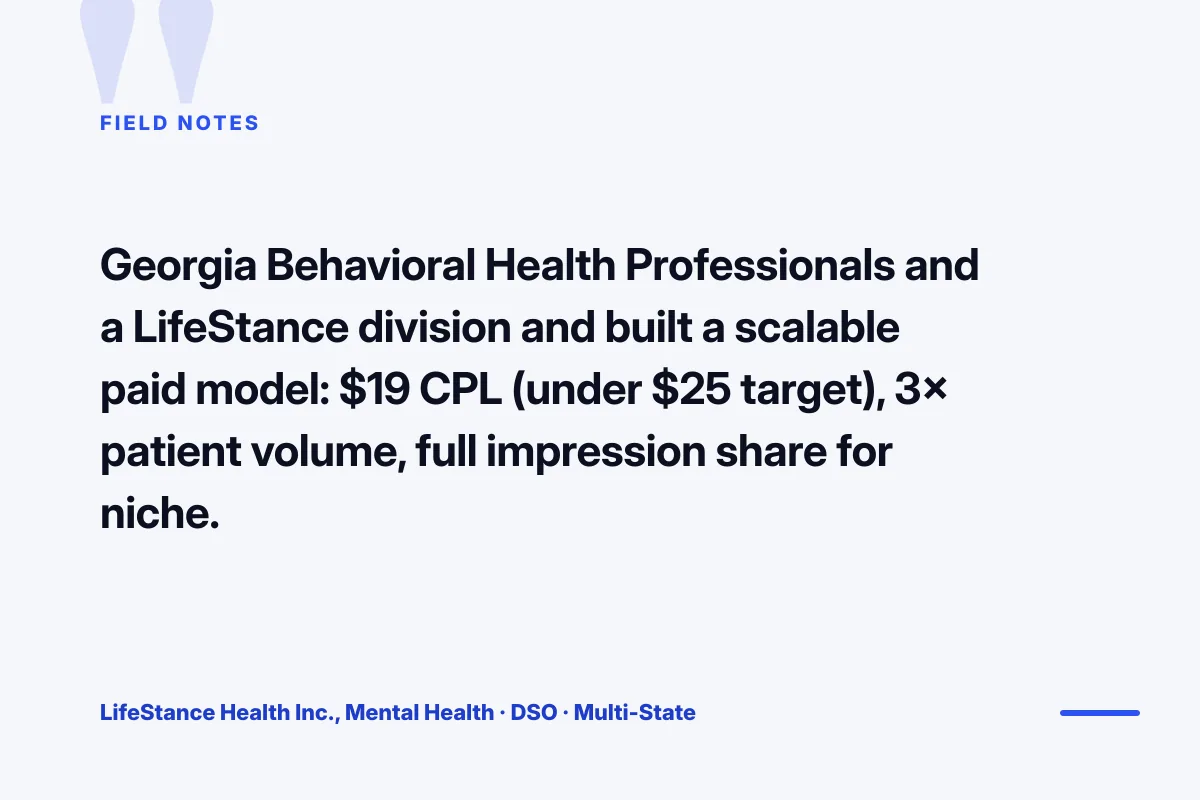
LifeStance Health Inc., a multi-state mental health group with over 10 clinics across Georgia, needed a paid model that could scale across specialties (TMS therapy, general psychiatry, psychology) without CPL spiking above the $25 target. The pre-rebuild account structure mixed specialty and geography in the same campaigns, which meant broad targeting was cannibalizing specialty-specific budgets and CPL trended above target on the niche services in every quarter.
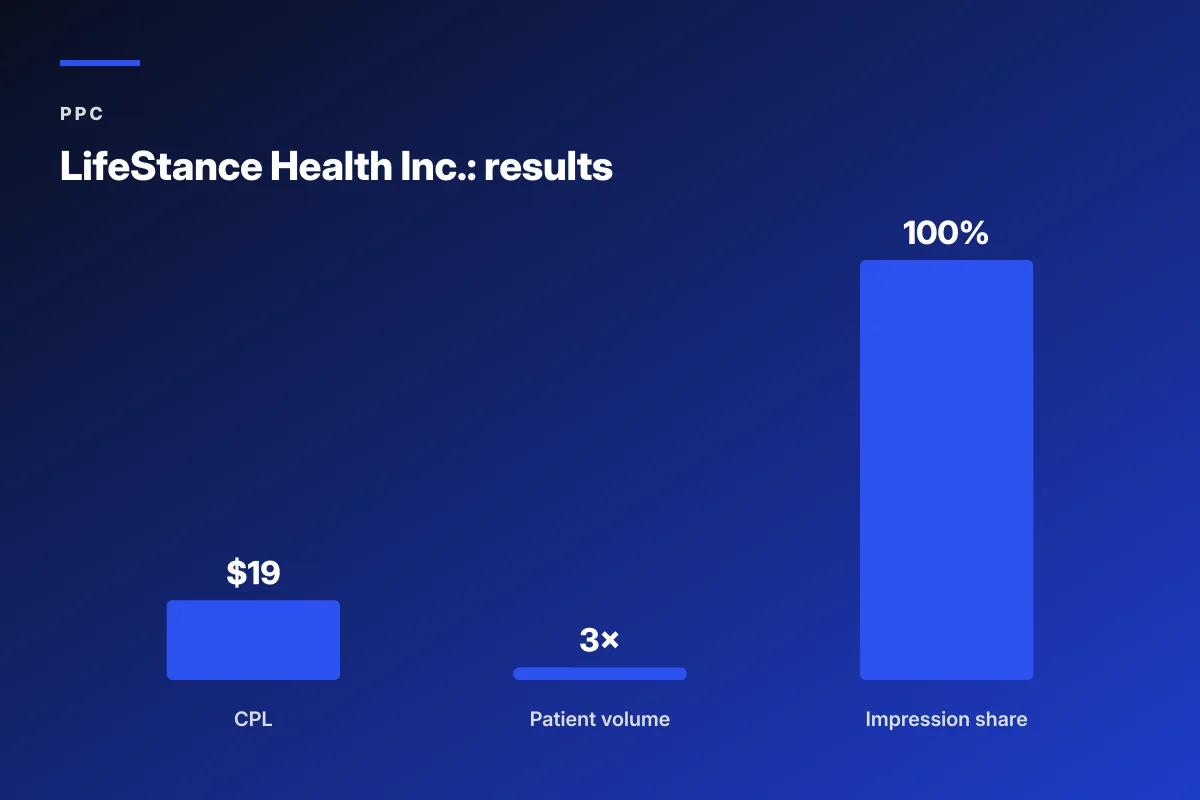
The rebuild split every specialty into its own campaign, tightened geo-targeting to People In Location around each clinic, added dedicated landing pages per service, and rebuilt conversion tracking around booked appointments rather than form-fills. Twelve months in, average CPL held at $19 (well under the $25 target), patient acquisition volume tripled across the 10-plus Georgia clinics, and niche services like TMS therapy captured 100 percent impression share. The structural work paid back inside the first quarter and compounded across the year. The LifeStance Health Inc. rebuild is the clearest illustration we’ve run of what disciplined structure delivers on a mid-size multi-location healthcare account, and the pattern holds on similar accounts we’ve moved through the same process without variation, regardless of specialty mix, geographic footprint, or the level of drift in the account when the rebuild starts. That consistency is what makes the pattern worth building around.
| Metric | Pre-rebuild | Month 12 | Driver |
|---|---|---|---|
| Average CPL | $25 target ceiling | $19 | Specialty campaign split + tight geo |
| Patient volume | Baseline | 3x | Landing pages + tracking rebuild |
| Impression share (TMS) | Fragmented | 100% | Niche campaign isolation |
| Capacity routing | None | Live | Location routing on ads |
Common Campaign Mistakes and the One-Sitting Fixes
Every healthcare account we audit shows the same handful of campaign mistakes. Every one is fixable in a single afternoon. Read this list and you’ll spot at least three problems in your account before you finish your coffee.
The mistake list
- One giant “General Search” campaign with 300+ keywords and no intent segmentation.
- Location targeting set to Interest instead of People In Location.
- Broad match running unbounded and burning 30 percent of the budget on irrelevant queries.
- Ad extensions half-filled or completely missing on lower-priority campaigns.
- Landing page copy that mirrors the homepage instead of the ad message.
- Conversion tracking counting form-starts and page-views as conversions.
- No dayparting on accounts where the front desk closes at 5 PM.
- Automated bidding on campaigns with under 30 conversions per month.
The mistake that’s genuinely funny
Every third account has a campaign paused in 2022 that quietly got reactivated during a UI update and has been spending $30 a day for eleven months on keywords like “free root canal Groupon” or “cheap Lasik near me.” Nobody noticed. The account manager left. The new one inherited a spreadsheet. And Google is happily accepting your money on queries that would horrify your front desk. Go find it. Pause it. Buy yourself a coffee with the recovered $900.
Why the same mistakes repeat
Healthcare PPC accounts live 3 to 5 years, changing hands between agencies, in-house managers, and Google reps. Every handoff loses institutional knowledge. Every Google UI change introduces default settings that override old decisions. Without a documented audit rhythm, the drift compounds and the same fixes keep needing to be re-applied every quarter.
Scaling Healthcare PPC Campaigns Past $10K Monthly Spend
The rules that work at $2,000 monthly spend break at $10,000. Healthcare ppc campaigns above $10K need a different management model, additional platforms, and more sophisticated tracking. If you’re crossing that threshold this year, plan for the operational shift before the campaigns arrive at it on their own.
Automated bidding earns its place
Below 30 conversions per campaign per month, Target CPA and Target ROAS bid strategies underperform Manual CPC. Above 30 conversions, automated bidding starts outperforming humans on volume-and-CPA optimization. Above 100 conversions, automated bidding is the clear default. Scale the bid strategy to the volume you actually have, not the volume you wish you had.
Second-platform expansion
At $10K in Google spend, adding Microsoft Ads captures the roughly 8 to 12 percent of healthcare search that runs on Bing, especially among older-demographic patients. Meta ads for retargeting and awareness at 20 to 30 percent of Google budget. TikTok for younger patient demographics on specific services (cosmetic dentistry, dermatology). Don’t add platforms before Google is stable and profitable.
Attribution beyond last-click
Last-click attribution understates the true value of healthcare PPC by 20 to 40 percent because patients often research on multiple sessions before booking. Data-driven attribution in GA4 or first-party attribution through the CRM captures the assist path. Switching attribution models often raises reported CPL initially, then normalizes as the platform optimizes toward the true conversion path.
Where to Take This Next
Healthcare ppc campaigns reward disciplined execution more than clever tactics. Set the structure, run the rhythm, measure honestly, and the numbers move in your favor inside two quarters. The three highest-value next steps depend on where your account sits today.
If your account is under $2,000 monthly spend
Focus on structure. Split campaigns by service line. Add 200-plus negatives. Switch to People In Location. Fix conversion tracking. Rewrite one landing page per service. That’s the foundation, and it takes roughly 15 hours of one-time work. Come back at $2,500 in monthly spend with clean data.
If your account is $2,000 to $10,000
Focus on rhythm. Weekly negative keyword sweeps. Bi-weekly landing page A/B tests. Monthly attribution reviews. Quarterly full audits. Get the operational hours dialed in and the account will scale to $10,000 without CPL climbing. Skip the rhythm and the account will drift back to where it started within six months.
Where we run this
For the audit playbook that drives every rebuild, see our PPC Audit for Healthcare. For the ongoing management rhythm, see Healthcare PPC Management. For choosing an agency to run this, our Choosing a Healthcare PPC Agency covers the evaluation criteria. For the pillar guide, see PPC for Healthcare. External references worth reading: the Google Ads healthcare policy documentation, the Search Engine Land PPC reference, and the WordStream analysis of PPC management.
Frequently asked questions
How should healthcare ppc campaigns be structured for best results?
Healthcare ppc campaigns should segment ruthlessly by intent. Every service line gets its own campaign. Every intent stage inside that service line (research, comparison, conversion-ready) gets its own ad group. Every ad group runs 2 to 3 responsive search ads and 8 to 15 tightly-themed keywords. That structure lands roughly 3 to 5 campaigns and 15 to 25 ad groups on a typical two-provider practice account. Bigger practices and multi-location groups scale up the number of campaigns, but the segmentation logic never changes. The structure enables three things: clean intent signals for automated bidding, easier compliance isolation when Google flags a specific claim, and better landing page targeting. Skip the segmentation and the account fights the platform's algorithms on every optimization cycle.
What targeting rules cut waste on ppc campaigns for healthcare?
Four rules do most of the work on ppc campaigns for healthcare. First, switch every campaign to People In Location targeting instead of the platform default of Interest, which saves 5 to 15 percent of spend depending on account size. Second, add radius targeting around each practice location and exclude ZIPs where you consistently see low-quality leads. Third, add dayparting bid adjustments that cut bids 40 to 60 percent during closed hours and raise them 15 to 25 percent during the 2-hour windows when the front desk actually answers phones. Fourth, set device bid adjustments matching how patients search healthcare: mobile at baseline, tablet down 30 percent, desktop up 10 to 20 percent on procedure research campaigns. Together these four rules cut wasted spend 20 to 40 percent.
What are successful healthcare ppc campaigns cost per sale reduction examples?
The successful healthcare ppc campaigns cost per sale reduction examples we manage share three fixes every time. Real numbers from three practice accounts: a single-location dental practice dropped CPL from $75 to $38 in six months by rebuilding campaign structure and tightening geo. A multi-location dermatology group cut CPL from $128 to $72 in five months by splitting campaigns by location and procedure. A solo chiropractic practice moved CPL from $55 to $32 in four months by adding negatives, moving to phrase match, and rebuilding the homepage into a conversion-focused landing page. Each case cut cost per booked patient 45 to 55 percent without adding budget. The pattern that repeats is structure plus targeting plus landing page discipline, not clever new tactics.
What do successful healthcare ppc campaigns cost per sale examples share?
Successful healthcare ppc campaigns cost per sale examples all share the same three-part pattern regardless of specialty or account size. First, campaign structure aligned to intent, with every service line in its own campaign and every intent stage in its own ad group. Second, targeting tightened aggressively on People In Location, dayparting to phone hours, device bids that match patient behavior, and audience layering that stays inside HIPAA and platform-policy limits. Third, landing pages rebuilt to convert, with H1 mirroring the ad copy H1, one primary CTA above the fold, and a trust signal (provider photo or credential) visible in the first viewport. None of the successful examples rely on shiny new tactics or expensive automation. They rely on discipline applied to the same three fixes.
How does ppc marketing for healthcare business scale past $10K monthly spend?
Ppc marketing for healthcare business at $10K plus monthly spend needs three operational shifts. First, automated bidding earns its place: Target CPA and Target ROAS bid strategies start outperforming Manual CPC above 30 conversions per campaign per month. Second, second-platform expansion becomes worth it: Microsoft Ads captures 8 to 12 percent of healthcare search on Bing, Meta ads add retargeting and awareness at 20 to 30 percent of Google budget, and TikTok reaches younger patient demographics on cosmetic services. Third, attribution beyond last-click matters more because patients research on multiple sessions before booking, and switching to data-driven attribution in GA4 or first-party attribution through the CRM captures the assist path. Add operational hours to match, roughly 15 hours a month of dedicated management.
What is the honest CPL range for different specialties in 2026?
Honest healthcare ppc campaigns CPL ranges in 2026 across mid-to-large US metros: dental general dentistry $35 to $75, dermatology cosmetic $60 to $130, orthopedic surgery $80 to $180, mental health specialty $18 to $45, chiropractic $28 to $65, primary care $22 to $55, urgent care $15 to $40. Rural markets typically run 30 to 50 percent below these ranges because competitive pressure is lower. Manhattan, Los Angeles, and Bay Area accounts run 50 to 100 percent above these ranges because CPCs are compressed by high competition and lower quality scores from aggressive bidding. Work backward from patient LTV and target margin, then compare to these ranges to see whether your current CPL is where it should be or where it's leaking money.
How much time does managing healthcare ppc campaigns actually take?
Healthcare ppc campaigns under $2,000 monthly spend take about 4 to 6 hours a month of management for someone who knows what they're doing: negative keyword sweeps, conversion trend review, one landing page tweak, monthly report. Between $2,000 and $10,000 monthly spend, plan on 10 to 12 hours a month for weekly negative sweeps, bi-weekly landing page A/B tests, monthly attribution reviews, and quarterly full audits. Above $10,000 monthly spend, plan on 15 hours a month minimum plus additional hours for second-platform work if you've added Microsoft or Meta. Below those hour counts the account drifts and cost per sale creeps back up within a quarter. Above those hour counts you're either overengineering or your account has grown beyond the size the current structure supports.
Book your free 30-minute strategy call.
No spam, no sales rep. We use your email to schedule your call with a senior strategist. That is it.
More from the blog
View all articles → PPC
PPC Healthcare PPC Advertising Channels Compliance and Targeting
Read article PPC
PPC Dental Facebook Ads Guide for Practices That Book Patients
Read article PPC
PPC