
Healthcare SEO Agency Selection and Evaluation Guide
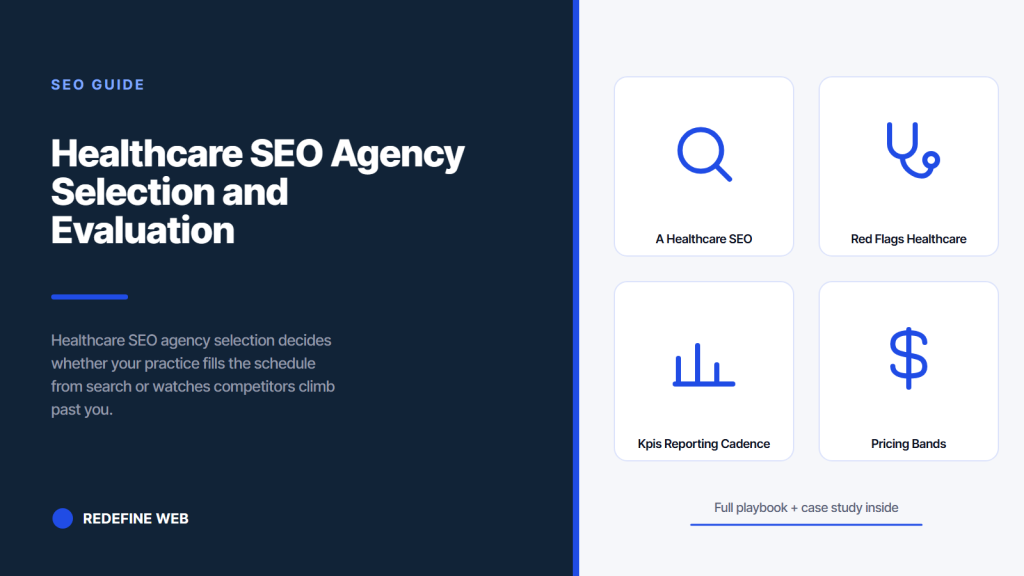
- Healthcare SEO agency selection needs 8 criteria and 12 discovery questions.
- Red flags include ranking guarantees and vague HIPAA answers.
- KPIs run in 3 tiers tied to booked patient volume.
- Retainers run $2,500 to $12,000 monthly by practice size.
- Monthly terms beat 12-month lock-ins with no performance triggers.
- What a healthcare SEO agency actually does day to day
- Evaluation criteria for healthcare SEO agencies that separate real from filler
- Red flags in the healthcare SEO agency pitch you should walk away from
- KPIs and reporting cadence for the healthcare SEO retainer
- Questions to ask on the healthcare SEO agency discovery call
- Pricing bands for healthcare SEO agencies and what falls into each tier
- Contract red lines to negotiate with your healthcare SEO agency
- A real healthcare SEO agency switch that unlocked ranking growth
- Agency versus healthcare SEO consultant versus in-house team
- Where the healthcare SEO agency market is heading in 2026
Healthcare SEO agency selection decides whether your practice fills its schedule from organic search or watches competitors climb past you on every clinical term that matters. Most practices pick the wrong agency the first time, spend $30,000 to $90,000 over a year, and end up back at square one with a folder full of vanity reports and no new patients booked. Getting the selection right saves the practice from the classic 12-month wasted retainer that most independent providers accept as normal when it should not be.
This guide covers healthcare SEO agency evaluation from the practice-owner side. Criteria that matter, red flags in the pitch, KPIs to hold the agency to, questions to ask on the discovery call, pricing bands for real work, and how to structure the contract so the practice keeps control if the seo agency for healthcare underperforms. Everything grounded in patterns we see across practices switching from prior agencies plus healthcare seo consultant engagements that stalled.

What a healthcare SEO agency actually does day to day
A working healthcare SEO agency runs five workstreams in parallel: content, technical, local, measurement, and reporting. Each workstream ties back to booked patient volume rather than vanity metrics like impressions or keyword counts, and the agency has to defend its work in patient-book terms every quarter.
Content workstream covers YMYL-appropriate article writing with named clinical reviewers, primary source citations, and MedicalWebPage schema on every clinical piece. Technical workstream covers Core Web Vitals monitoring, structured data implementation, HIPAA-safe form and tracking review, and quarterly technical audits. Local workstream covers Google Business Profile management, review-request automation, location page maintenance, and citation cleanup across health directories. Measurement covers server-side conversion tracking through GA4 plus rank tracking against the target keyword universe. Reporting covers monthly ops reports plus quarterly strategic reviews with the practice owner.
Any healthcare SEO agency proposing a scope that misses one of the five workstreams either does not understand healthcare specifically or is selling a general SEO package with a healthcare label slapped on. That gap shows up in ranking regressions within six months and in patient-count stagnation within twelve. Practice owners evaluating a healthcare SEO agency should ask each candidate to walk through all five workstreams by name and describe the specific deliverable that lands in each one every month. Vague answers on any workstream mean the agency plans to skip it, which means the retainer costs the practice more than it returns.
Evaluation criteria for healthcare SEO agencies that separate real from filler
Evaluating healthcare SEO agencies comes down to eight criteria that separate real specialists from general shops with healthcare marketing pages. Skipping any criteria increases the odds of a wasted retainer.
- Named healthcare case studies with real metrics. Not “healthcare experience”. Specific practice names, specific ranking gains, specific patient-volume gains, over specific date ranges.
- HIPAA-safe tracking capability. Server-side conversion tracking implementation without shipping PHI to ad platforms.
- YMYL content team with clinical reviewers. Named medical reviewers on the agency staff or on a contracted reviewer network.
- Structured data expertise on MedicalOrganization and Physician schema. Not just BlogPosting schema.
- Local SEO depth for multi-location practices. Location page templates, Google Business Profile management at scale, review-request automation.
- Measurement stack tied to booked patient volume. Not just rankings and sessions.
- Reporting cadence that surfaces problems fast. Monthly ops report plus quarterly strategic review.
- Contract structure with clear exit terms. No 12-month lock-in without performance triggers.
A healthcare SEO agency that clears all eight criteria typically charges a healthcare specialist premium of 20 to 40 percent above a general SEO agency’s pricing. The premium pays back in booked patients within two to three quarters. A general SEO agency at a discount rate that skips half these criteria almost always costs the practice more in the long run through slower ranking gains and higher compliance exposure. The pattern shows up across every specialty we work in and holds through market cycles that vary practice-side demand.
Red flags in the healthcare SEO agency pitch you should walk away from
The healthcare SEO agency pitch process reveals a lot about how the engagement will actually run. Watching for red flags during the sales cycle catches most bad-fit engagements before contract signing rather than three months into a wasted retainer. Six red flags show up in almost every bad-fit pitch we see practices leave behind when they switch to a real specialist.
- Ranking guarantees. No reputable healthcare SEO agency guarantees rankings because Google’s algorithm has too many variables. Guarantees are marketing theater.
- Ranking reports as the primary deliverable. Rankings matter, but a report of only rankings misses the patient-volume tie-back that justifies the retainer.
- Ownership of content or accounts. The practice should own every asset produced under the retainer. Agencies that keep asset ownership as bargaining chips are trapping the practice.
- Undisclosed subcontractors. Some agencies subcontract every workstream to freelancers in different time zones. The practice pays agency rates for freelancer work.
- No named account owner. “Our team” answers to no one. Practices need a named human on the agency side who owns the account.
- Vague answers on HIPAA scope. Any healthcare SEO agency that shrugs off HIPAA questions is planning to skip that layer, which creates compliance risk the practice inherits.
Any three of these six red flags in one pitch is a signal to keep shopping. Any four of the six is disqualifying regardless of pricing. The seo agency for healthcare selection that ends well starts with a rigorous pitch review, and the pitch review that catches these red flags saves the practice from a year of frustration. Practices that skip the pitch review usually discover the red flags around month four of the retainer, which is exactly when the transition friction of switching agencies feels most painful.

A real healthcare SEO agency shares 3 anonymized Search Console screenshots on the first call. If they hide the data behind an NDA, they're hiding weak numbers.
KPIs and reporting cadence for the healthcare SEO retainer
KPIs on a healthcare SEO retainer run on three tiers tied together in every monthly report. Ranking KPIs cover keywords in top 3, top 10, and top 20 across the target keyword universe. Traffic KPIs cover organic sessions by page group and by traffic source. Booked appointment KPIs cover new patient bookings from organic search tied back through server-side attribution. Skipping any tier leaves the retainer defensible only on the vanity metrics that most bad agencies rely on to hide underperformance.
| Tier | KPI | Cadence | Target trend |
|---|---|---|---|
| Ranking | Keywords in top 3 | Monthly | +10-25% quarterly |
| Ranking | Keywords in top 10 | Monthly | +15-30% quarterly |
| Ranking | Local pack appearances | Monthly | +20-40% quarterly |
| Traffic | Organic sessions to service pages | Monthly | +20-50% quarterly |
| Traffic | Organic sessions to location pages | Monthly | +25-60% quarterly |
| Booking | Booked appointments from organic | Monthly | +15-30% quarterly |
| Booking | Cost per booked patient (SEO) | Quarterly | Falling toward $40-$120 |
A monthly ops report to the practice manager covers the ranking and traffic KPIs plus what shipped that month. A quarterly strategic review with the practice owner covers the booking KPIs plus what’s working, what’s not, and the two or three biggest levers to pull in the next quarter. Practices that skip the quarterly review lose sight of the retainer’s contribution to booked patient volume and cut budget the moment a slow month shows up in the ops metrics rather than seeing the pattern in context. That cut-early habit is how good agencies get fired for bad reasons and bad agencies keep getting paid for delivering nothing.
Questions to ask on the healthcare SEO agency discovery call
The discovery call is the practice owner’s chance to test whether the healthcare SEO agency understands the practice’s actual constraints. Twelve questions get to the heart of fit within an hour, and every question below has a right and a wrong answer that a specialist knows and a generalist fumbles.
- Do you sign a BAA with our form provider and hosting vendor. Right answer: yes, and here is the process.
- Do you build server-side conversion tracking. Right answer: yes, and here is the specific implementation.
- Who writes the clinical content. Right answer: named writer, named clinical reviewer, review dates on every piece.
- How do you handle Core Web Vitals audits. Right answer: quarterly technical audit plus continuous monitoring.
- What is your process for MedicalOrganization schema. Right answer: implemented at practice level plus per-provider Physician schema.
- How do you manage Google Business Profile at scale. Right answer: dedicated GBP manager, review-request automation, monthly audit.
- What is your reporting cadence. Right answer: monthly ops plus quarterly strategic.
- How do you tie SEO work to booked patients. Right answer: server-side attribution plus CRM integration.
- What is the SLA on urgent fixes. Right answer: 24 to 48 hours for site-down or compliance issues.
- Who owns the content produced under the retainer. Right answer: the practice, unconditionally.
- What is the contract exit process. Right answer: 30 to 60 days notice, no clawback, all assets handed over.
- Who is my named account owner. Right answer: a specific person with a specific email address.
Any healthcare SEO agency that fumbles half these questions is a poor fit regardless of pricing or brand reputation. The best seo agency for healthcare selection ends with a discovery call where the agency answers all twelve cleanly and demonstrates specialty depth on every one. Practices running the twelve-question test cut their bad-fit rate by roughly half compared to practices relying on pitch decks and sales calls alone, which saves an entire year of retainer waste on the average selection cycle.
Pricing bands for healthcare SEO agencies and what falls into each tier
Healthcare SEO agency retainers run $2,500 to $12,000 monthly depending on practice size, market competitiveness, and scope. Below $2,500 monthly, the retainer covers monitoring and occasional content batches rather than an active program covering YMYL content, technical work, local optimization, measurement, and reporting. Below $1,500 monthly, the retainer usually amounts to directory submissions plus a monthly blog post from a freelance writer, which moves nothing on medical terms.
Solo practice retainers sit in the $2,500 to $4,500 range. Single-location group retainers sit in the $4,500 to $7,500 range. Multi-location group and DSO retainers sit in the $7,500 to $12,000 range. Enterprise health system retainers run higher with custom scope. Above $12,000, the retainer usually includes CRO work, paid search integration, or content production at scale that goes beyond what most independent practices need. Agencies charging above $15,000 for straight SEO on an independent practice site are usually pricing on brand rather than deliverables.
Contract structure matters as much as the retainer number. A 12-month lock-in without performance triggers is a poor structure for the practice. A monthly retainer with a 30-day exit clause is stronger. A 6-month initial term with a 30-day exit clause after the initial term is the pattern that balances agency continuity with practice control. Any healthcare SEO agency insisting on a longer lock-in without performance triggers is signaling that they know the work will not stand up to a quarterly review, which is a red flag on top of every other pitch review criteria worth catching before signing anything.

Contract red lines to negotiate with your healthcare SEO agency
Contract negotiation with a healthcare SEO agency happens once at signing and shapes the entire retainer relationship. Practices that skip the negotiation phase inherit whatever terms the agency’s template imposes. Practices that walk in with a clear list of red lines get a contract that protects them if the retainer stalls. Six red lines matter more than the rest and every one of them ties back to keeping the practice free to leave if the agency underperforms.
First, the practice owns every asset produced under the retainer with no clawback on exit. Content, structured data, Google Business Profile access, GA4 access, Search Console access, and rank tracker access all transfer to the practice at contract end. Second, the exit clause runs 30 to 60 days notice with no early termination penalty. Third, performance triggers written into the contract allow early exit if quarterly KPIs miss targets. Fourth, the named account owner is written into the contract and any change requires practice consent. Fifth, HIPAA responsibilities are spelled out including which vendor holds each BAA. Sixth, subcontractor disclosure requires the agency to name every third party touching the practice’s data.
Any healthcare SEO agency that pushes back on all six red lines is signaling that they want maximum agency-side control over the retainer, which almost always ends poorly for the practice. The Search Engine Land guide on hiring an SEO agency covers the negotiation phase in more detail for practices new to agency contracts. Getting the red lines right at signing costs nothing extra and saves months of frustration if the retainer stalls at month five or six.
A real healthcare SEO agency switch that unlocked ranking growth
Pelvic Rehabilitation Medicine runs 14 locations treating pelvic pain and endometriosis. Before switching agencies, the practice was three years into a retainer with a general SEO agency that delivered monthly ranking reports and quarterly domain-authority updates. Organic sessions were flat. Booked appointments from organic search had not moved in six quarters. The prior agency had never implemented MedicalOrganization schema, had never audited the forms for HIPAA compliance, and had never tied any ranking work back to booked patients.
The new healthcare SEO agency rebuilt the program from the ground up. Content silos got rebuilt around patient journeys with named clinical reviewers on every article. MedicalOrganization and Physician schema went in across the site. Location pages replaced a single locations list with one page per office. Forms migrated to a HIPAA-safe provider with a signed BAA. Server-side conversion tracking replaced client-side pixel firing. Google Business Profile got a full audit with a review-request automation kicked off across every location.
Across the following twelve months, organic keyword growth reached 174 percent and organic traffic climbed 166 percent. The practice launched a patient community platform for pelvic pain and endometriosis support alongside the clinical booking flow. Patients found the site through Google on condition-specific terms and converted into booked visits at rates the prior three-year retainer had never delivered. The healthcare SEO agency switch cost the practice one quarter of transition friction and unlocked a full year of compounding gains, which is the pattern most practices see when they leave a general agency for a specialist.
Agency versus healthcare SEO consultant versus in-house team
The healthcare SEO consultant path fits practices with an existing marketing team that needs specialty depth on specific workstreams. A consultant runs 5 to 15 hours per week at $150 to $300 per hour, covering strategy, technical direction, and quality control while the practice’s in-house team executes the content and local work. The pattern works when the practice already has capable operational staff and needs the specialist layer without a full agency retainer.
The healthcare SEO agency path fits practices without an in-house marketing team or with an in-house team fully occupied by other work. The agency runs all five workstreams end to end. The retainer covers strategy, execution, measurement, and reporting under one roof. The pattern works when the practice wants a hands-off program that ships every month without operational overhead from the practice side.
The in-house team path fits multi-location DSOs and enterprise health systems with the scale to justify a dedicated SEO manager and a small team underneath. A $110,000 SEO manager plus $70,000 content writer plus $65,000 SEO analyst runs $245,000 fully-loaded annually, which pencils out below a large agency retainer for practices spending $15,000 or more monthly on SEO. Below that scale, an agency or consultant almost always outperforms an in-house team because specialty depth costs more to build in-house than to buy from a specialist. The Ahrefs write-up on healthcare SEO covers the operational side in more detail for practices weighing the trade-offs.
Every year a practice manager somewhere signs a $6,000 healthcare SEO retainer with an agency whose slide deck features stock photos of doctors in white coats holding tablets while nodding at each other. The pitch runs 45 minutes and covers zero specifics. Six months later, the ranking report shows impressions up 47 percent, keywords in position 1 to 100 up 22 percent, and booked patients unchanged. Somewhere an SEO agency is billing $6,000 monthly for a slide deck full of stock photos and calling it a healthcare specialty engagement. The practice manager cancels the retainer at month nine. The agency’s next slide deck features a new fictional case study starring the practice they just lost.
The fix is a rigorous pitch process. Real case studies with named practices. Real specifics on YMYL, HIPAA, and schema. Real answers on booked-patient attribution. Real contract terms that let the practice exit if the numbers do not move. All of it takes 4 to 6 weeks of pitch review upfront, and it saves the practice from the classic 12-month wasted retainer that most independent providers accept as normal.
Where the healthcare SEO agency market is heading in 2026
The healthcare SEO agency market in 2026 splits into specialists and generalists more sharply than in prior years. AI Overviews on Google reward sites with strong E-E-A-T signals, which favors agencies that implement named authors, clinical reviewers, and MedicalOrganization schema by default. HIPAA guidance on tracking technologies keeps expanding, which pushes practices toward agencies that build server-side attribution from day one. Core Web Vitals thresholds tighten every year, which favors agencies with dedicated technical staff over freelancer-only shops. The HHS guidance on HIPAA online tracking is essential reading for anyone evaluating agencies against current standards.
Generalist agencies with a healthcare marketing page are losing ground fast to specialist agencies that build every workstream around healthcare from the start. The pricing gap between the two is closing because generalist agencies raise rates to cover the healthcare training their teams never took, while specialist agencies hold rates because their systems already handle the specialty needs. Any healthcare seo consultant engagement that started before 2024 should be re-evaluated against current best practices, and any healthcare SEO agency retainer that has not delivered booked-patient gains in two consecutive quarters should be put on notice or replaced with a specialist that runs the full stack.
If the practice is running an in-flight retainer that has not moved patient numbers in six months, the first move is a two-week audit against the eight evaluation criteria in this guide. The result is a clear picture of where the agency is underdelivering and what would need to change to salvage the engagement. When you want to talk numbers, our Healthcare SEO Services covers the full stack under one retainer. The Healthcare SEO (Pillar) lays out the underlying strategy in detail. The Healthcare SEO Company vs Agency covers the difference between company, consultant, and agency engagements. The DIY Healthcare SEO covers what to run in-house versus outsource. The Healthcare SEO Audit shows the audit checklist we run. The Choosing a Healthcare PPC Agency covers the paid search side. Everything ties back to the Healthcare Marketing Hub for the broader acquisition picture.
For practice owners sizing their first engagement, our healthcare SEO agency hiring guide for practice owners covers evaluation questions, KPI reporting tiers, and the red flags that predict a wasted retainer year.
Frequently asked questions
How do I evaluate a healthcare SEO agency before signing?
Check eight criteria. Named healthcare case studies with real metrics rather than "healthcare experience" claims. HIPAA-safe tracking capability with server-side conversion tracking. YMYL content team with named clinical reviewers. Structured data expertise on MedicalOrganization and Physician schema. Local SEO depth for multi-location practices. Measurement stack tied to booked patient volume. Reporting cadence with monthly ops plus quarterly strategic reviews. Contract structure with clear exit terms. Any healthcare SEO agency that fails half these criteria is a poor fit regardless of pricing or brand reputation.
What are the biggest red flags in a healthcare SEO agency pitch?
Ranking guarantees are a red flag because no reputable agency guarantees rankings under Google's algorithm. Reports full of only rankings without patient-volume tie-back miss what justifies the retainer. Agencies keeping asset ownership as bargaining chips trap the practice. Undisclosed subcontractors mean the practice pays agency rates for freelancer work. No named account owner means nobody at the agency is accountable. Vague answers on HIPAA scope mean the agency plans to skip that layer, which creates compliance risk the practice inherits. Any three of these six in one pitch is disqualifying.
What KPIs should I hold a healthcare SEO agency to?
Three tiers tied together in every monthly report. Ranking KPIs cover keywords in top 3, top 10, and top 20 across the target keyword universe with target trends of 10 to 30 percent quarterly growth. Traffic KPIs cover organic sessions by page group with 20 to 50 percent quarterly growth targets. Booking KPIs cover new patient appointments from organic search tied back through server-side attribution with 15 to 30 percent quarterly growth targets. Cost per booked patient from SEO should trend toward the $40 to $120 range over the first year of the retainer.
How much does a healthcare SEO agency cost?
Retainers run $2,500 to $12,000 monthly depending on practice size, market competitiveness, and scope. Solo practices sit in the $2,500 to $4,500 range. Single-location groups sit in the $4,500 to $7,500 range. Multi-location groups and DSOs sit in the $7,500 to $12,000 range. Enterprise health systems run higher with custom scope. Below $2,500 monthly, the retainer covers monitoring plus occasional content rather than an active program. Above $15,000 for an independent practice site, the pricing is usually brand markup rather than deliverable expansion.
Should I hire a healthcare SEO agency or a healthcare SEO consultant?
The healthcare SEO consultant path fits practices with an existing marketing team that needs specialty depth on specific workstreams. A consultant runs 5 to 15 hours weekly at $150 to $300 per hour, covering strategy while the in-house team executes. The healthcare SEO agency path fits practices without an in-house team or with an in-house team fully occupied by other work. The agency runs all five workstreams end to end. Choose the consultant if operational execution exists in-house. Choose the agency if the practice wants a hands-off program that ships every month.
What contract terms should I look for with a healthcare SEO agency?
A monthly retainer with a 30-day exit clause is the strongest position for the practice. A 6-month initial term followed by 30-day exit is a reasonable middle ground that balances agency continuity with practice control. A 12-month lock-in without performance triggers is a poor structure. The practice should own every asset produced under the retainer without clawback. The agency should surrender all Google Business Profile access, GA4 access, and Search Console access on exit. Any healthcare SEO agency insisting on longer lock-ins without performance triggers is signaling that they know the work will not stand up to a quarterly review.
How long before a healthcare SEO agency shows measurable results?
Local ranking gains show up in 30 to 90 days because Google Business Profile optimization and review-request automation move fast. Medical content ranking gains take 90 to 180 days because YMYL evaluation cycles run longer than general SEO. Traffic gains lag ranking gains by 30 to 60 days as new positions cycle into steady click-through patterns. Booked appointment gains lag traffic gains by another 30 to 60 days. The full compound effect of a healthcare SEO agency retainer shows up around the six-month mark, with clear ranking and local signals visible well before that.
Book your free 30-minute strategy call.
No spam, no sales rep. We use your email to schedule your call with a senior strategist. That is it.
More from the blog
View all articles → SEO
SEO Organic Search Engine Optimization Services That Grow Real Traffic
Read article SEO
SEO SEO for Pet Groomers That Fills the Appointment Book Weekly
Read article SEO
SEO