
Healthcare SEO Company vs Consultant vs Agency Guide
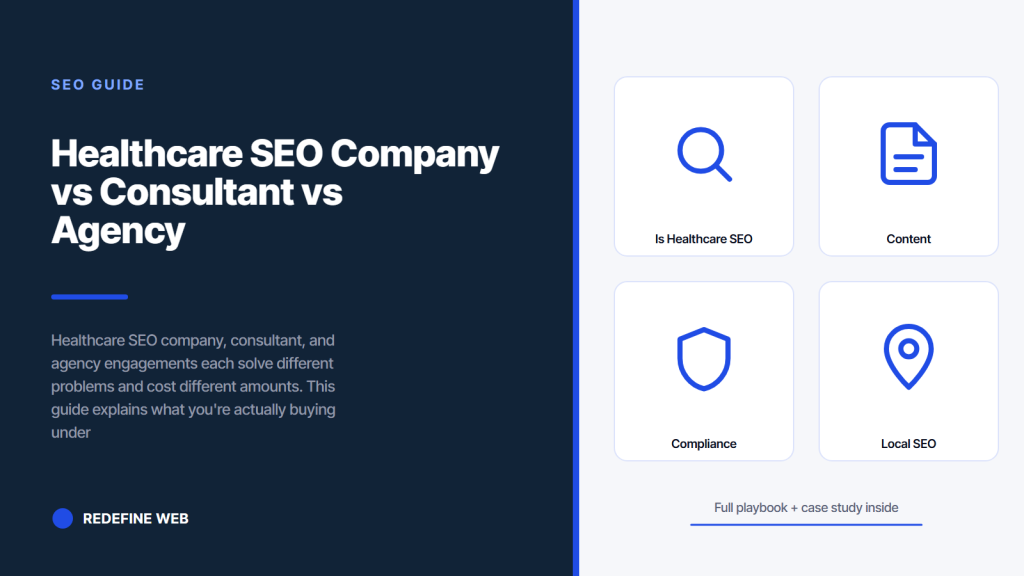
- Healthcare SEO company sells packaged services at $800-$2,500 monthly.
- Healthcare SEO consultant sells specialty hours to in-house teams.
- Healthcare SEO agency runs the full program end to end.
- Solo practices fit company or specialist agency tiers.
- DSOs above 30 locations fit in-house plus consultant.
- What is a healthcare SEO company and what does it sell
- What a healthcare SEO consultant delivers and when to hire one
- What a healthcare SEO agency delivers under the retainer
- The three healthcare SEO company models side by side
- Which model fits solo practices booking under 100 patients monthly
- Which model fits group practices with an in-house marketing team
- Which model fits DSOs and multi-location groups
- A real healthcare SEO model switch that unlocked ranking growth
- How to evaluate recommended seo firms for healthcare regardless of model
- Switching between healthcare SEO models as the practice grows
Healthcare SEO company, healthcare SEO consultant, and healthcare SEO agency are three different service models that get sold under overlapping names. Practice owners often sign a contract without knowing which model they actually bought, which is how retainers stall six months in. A company sells packaged services at scale. A consultant sells specialty hours to your in-house team. An agency runs the full program end to end. The pricing, deliverables, and accountability structure differ across all three, and picking the wrong model for the practice’s stage costs a full year of momentum before anyone notices.
This guide breaks down the three models: what each one actually delivers, what each one costs, which model fits solo practices versus single-location groups versus multi-location DSOs, plus how to switch between models as the practice grows. You’ll finish with a clear picture of which model fits your practice today and a working framework for evaluating recommended seo firms for healthcare against your specific needs. Everything grounded in the pattern we see across dental, primary care, physical therapy, and mental health verticals we work in.

What is a healthcare SEO company and what does it sell
A healthcare SEO company sells packaged, standardized services at scale to a wide roster of practices. Think of it as the volume model for practice-side SEO where the workflow delivers the same deliverables across every client with light customization on top of a shared template.
The typical healthcare SEO company runs 100 to 1,000 practice clients on a shared operational team. Content workflows follow a template. Google Business Profile management runs through a shared queue. Technical audits happen quarterly against a checklist. Reporting comes from an off-the-shelf rank tracker plus a monthly PDF that many companies barely customize per practice. The pricing sits at the low end of the market ($800 to $2,500 monthly) because the shared workflow lets the company operate on scale rather than depth.
Healthcare SEO companies fit solo practices at the low end of the market where the practice cannot justify a specialist retainer and needs baseline SEO coverage. The tradeoff is that healthcare SEO companies rarely handle YMYL content depth, HIPAA-safe tracking, or MedicalOrganization schema at the level a specialist agency does. Rankings improve modestly. Booked patient volume from organic search grows slowly if at all. Practices outgrow the company model within 12 to 24 months of steady practice growth and switch to a consultant or agency at that point. Recommended seo firms for healthcare in the company tier usually differentiate on volume pricing and turnaround time rather than specialty depth.
What a healthcare SEO consultant delivers and when to hire one
A healthcare SEO consultant sells specialty hours to an in-house team that already handles execution. The consultant covers strategy, technical direction, and quality control while the practice’s own staff executes the day-to-day content, local, and measurement work under consultant direction.
A working healthcare SEO consultant engagement runs 5 to 15 hours weekly at $150 to $300 per hour, totaling $3,000 to $18,000 monthly depending on the hour count and rate tier. The consultant sets the strategy, reviews content drafts, audits technical work, and directs the in-house team on priorities. The consultant does not write every article, does not manage the Google Business Profile day-to-day, and does not sit on every internal meeting. The practice’s in-house team handles those pieces under consultant direction.
The healthcare SEO consultant model fits practices at the middle of the market where the in-house team already exists but needs specialty depth. The tradeoff is that the practice bears the cost of the in-house team on top of the consultant fee. A $6,000 monthly consultant plus a $75,000 in-house marketing manager runs $147,000 annually fully-loaded, which is more than a full-service agency retainer for most single-location practices. The model pays off when the in-house team handles other marketing functions too (paid ads, email, social) so the fully-loaded cost gets amortized across more than SEO alone. A healthcare seo expert working as a consultant tends to have narrower depth than an agency team but often deeper depth in one specific vertical (dental only, mental health only) where they’ve spent years building playbooks.
What a healthcare SEO agency delivers under the retainer
A healthcare SEO agency runs the full program end to end without requiring an in-house team on the practice side. The agency handles strategy, content writing, technical work, local optimization, measurement, and reporting. The practice provides the clinical review, service details, and access to the CMS. Everything else lives on the agency side under a named account owner.
A working healthcare SEO agency retainer runs $2,500 to $12,000 monthly depending on practice size, market competitiveness, and scope. Solo practices sit at the low end. Multi-location DSOs sit at the high end. The retainer covers all five workstreams (content, technical, local, measurement, reporting) under one roof. The agency delivers every month on a defined cadence with monthly ops reports plus quarterly strategic reviews.
The healthcare SEO agency model fits practices that want a hands-off program that runs without operational overhead from the practice side. The tradeoff is that the practice depends on the agency for continuity, which makes agency selection a high-stakes decision. Switching agencies mid-program costs a quarter of transition friction while the new agency ramps up. Picking the wrong agency at signing wastes 6 to 12 months before the switch becomes obvious enough to force. Healthcare seo companies at the low end of the agency tier often blur the line between the company model and the agency model, which is where recommended seo firms for healthcare selection gets confusing for practices new to buying SEO services.

Solo doc under /mo needs a company. Multi-location needs an agency. Anyone selling agency pricing for company-tier work is priced wrong for you.
The three healthcare SEO company models side by side
Comparing healthcare SEO companies against consultants against agencies makes the tradeoffs concrete. The table below covers pricing, scope, in-house requirement, KPIs delivered, and best-fit practice size for each model. Practices reading it should focus on the in-house requirement column because that column is the single biggest driver of which model actually fits.
| Model | Monthly cost | Scope | In-house needed | Best-fit practice size |
|---|---|---|---|---|
| Healthcare SEO company | $800-$2,500 | Packaged, templated | None | Solo practices, cash-tight |
| Healthcare SEO consultant | $3,000-$18,000 | Strategy plus direction | Marketing manager + writer | Group practices with in-house team |
| Healthcare SEO agency (specialist) | $2,500-$12,000 | Full program end to end | None | Solo through DSO, no in-house team |
| In-house SEO team | $20,000+ fully loaded | Full program, custom | SEO manager, writer, analyst | Enterprise, DSO 10+ locations |
The three-model split is not rigid. Some healthcare SEO companies scale up scope to overlap with the low end of the agency tier. Some consultants scale up hours to overlap with the agency tier. The distinction that matters is not the label the vendor uses but the actual deliverable pattern: templated versus custom, direction-only versus execution, packaged versus program-based. Getting that right takes a discovery call with each candidate and a clear picture of the practice’s own operational capacity to run the in-house side of the work if the model requires it. Practices that skip the discovery step usually sign with the vendor whose sales page looks best, and the sales page rarely reflects how the workflow actually runs once the retainer starts. Ask the vendor to walk through a day in the life of a client account rather than reading marketing copy back at you.
Which model fits solo practices booking under 100 patients monthly
Solo practices booking under 100 new patients monthly usually fit either the healthcare SEO company tier at the low end or a specialist healthcare SEO agency at the low end. The consultant model rarely fits solo practices because the in-house team required to execute alongside a consultant costs more than the practice can absorb.
At $800 to $2,500 monthly, a healthcare SEO company delivers baseline coverage: Google Business Profile management, quarterly content batches, basic technical monitoring, monthly reports. That gets a solo practice ranking on branded searches plus low-competition local terms. It rarely gets the practice ranking on medium-competition medical terms because the shared workflow does not include YMYL content depth or MedicalOrganization schema at the level Google rewards.
At $2,500 to $4,500 monthly, a specialist healthcare SEO agency delivers the full program tailored to the solo practice. YMYL content with named clinical reviewers. MedicalOrganization schema. HIPAA-safe forms and server-side tracking. Google Business Profile optimization plus review-request automation. Monthly ops reports plus quarterly strategic reviews. The practice ranks on medium-competition medical terms within six months and books measurable additional patients within nine. The extra $1,700 to $2,000 monthly over the company tier pays back 3 to 5 times over in booked patient value within the first year for most solo practices. That math is why the Ahrefs healthcare SEO write-up pushes practices toward specialists rather than the volume tier when budget allows the specialist retainer.
Which model fits group practices with an in-house marketing team
Group practices with an in-house marketing team fit the healthcare SEO consultant model or a specialist healthcare SEO agency depending on the in-house team’s operational bandwidth. The company tier rarely fits because the shared workflow does not scale to multi-provider or multi-location complexity.
When the in-house marketing team handles paid ads, email, social, and website updates already, a healthcare SEO consultant at $6,000 to $10,000 monthly provides the specialty depth without duplicating the operational work. The consultant sets strategy, reviews content drafts, audits technical work, and directs the in-house team on priorities. The in-house team executes. The pattern lets the group practice build long-term SEO capability rather than depending on an outside agency for continuity.
When the in-house marketing team is fully occupied by paid ads and social work, a specialist healthcare SEO agency at $4,500 to $7,500 monthly runs the SEO program end to end without adding to the in-house team’s workload. The agency delivers every month on a defined cadence. The in-house team handles clinical review and CMS access and stays out of the day-to-day SEO execution. The pattern lets the group practice free the in-house team to focus on marketing channels beyond SEO while the SEO program compounds under specialist management. Either model works well for group practices. Choosing between them comes down to the specific bandwidth question about the in-house marketing team.

Which model fits DSOs and multi-location groups
DSOs and multi-location groups usually fit either a specialist healthcare SEO agency at the high end of the retainer tier or an in-house team with a specialist consultant layered on top. The company tier does not scale to the multi-location complexity. The consultant-only model does not scale without an in-house team large enough to execute across every location.
A specialist healthcare SEO agency at $7,500 to $12,000 monthly runs the SEO program across 5 to 30 locations under one retainer. Location page templates roll out at scale. Google Business Profile management runs across every location with a dedicated GBP manager on the agency side. Review-request automation scales across every location. Reporting rolls up by location with drill-down detail. The pattern lets a multi-location DSO get specialty SEO coverage without the overhead of hiring an in-house SEO team.
An in-house SEO team at $245,000 to $450,000 fully-loaded annually fits enterprise DSOs with 30 or more locations where the scale justifies the fixed cost. A $110,000 SEO manager plus $70,000 content writer plus $65,000 SEO analyst covers the baseline. Adding a specialist healthcare SEO consultant on top at $3,000 to $6,000 monthly brings specialty depth for the workstreams the in-house team lacks. The pattern lets a large DSO build capability at scale while still buying specialty depth from outside where it makes sense. Practices considering this path should map the fully-loaded in-house cost against the specialist agency retainer they’re currently paying and only make the switch when the numbers pencil out.
A real healthcare SEO model switch that unlocked ranking growth
Pelvic Rehabilitation Medicine runs 14 locations treating pelvic pain and endometriosis. Before switching models, the practice was three years into a healthcare SEO company retainer at $1,800 monthly that delivered monthly ranking reports and quarterly domain-authority updates. Organic sessions were flat. Booked appointments from organic search had not moved in six quarters. The prior company had never implemented MedicalOrganization schema, had never audited the forms for HIPAA compliance, and had never scaled the SEO program to the practice’s 14-location footprint.
The switch moved the practice to a specialist healthcare SEO agency at $8,500 monthly. The agency ran all five workstreams across every location. Content silos got rebuilt around patient journeys with named clinical reviewers on every article. MedicalOrganization and Physician schema went in across the site. Location pages replaced a single locations list with one page per office. Forms migrated to a HIPAA-safe provider with a signed BAA. Server-side conversion tracking replaced client-side pixel firing. Google Business Profile got a full audit across every location with review-request automation kicked off in parallel.
Across the following twelve months, organic keyword growth reached 174 percent and organic traffic climbed 166 percent. The practice launched a patient community platform for pelvic pain and endometriosis support alongside the clinical booking flow. Patients found the site through Google on condition-specific terms and converted into booked visits at rates the prior three-year company retainer had never delivered. The model switch cost the practice one quarter of transition friction and unlocked a full year of compounding gains, which is the pattern most practices see when they leave the company tier for a specialist.
How to evaluate recommended seo firms for healthcare regardless of model
Evaluating any healthcare SEO firm regardless of model comes down to eight criteria plus twelve discovery-call questions. The criteria filter out volume shops with a healthcare marketing page. The questions filter out specialist claims that do not hold up to technical scrutiny.
The criteria include named healthcare case studies with real metrics, HIPAA-safe tracking capability, YMYL content team with clinical reviewers, structured data expertise on MedicalOrganization and Physician schema, local SEO depth for multi-location practices, measurement stack tied to booked patient volume, reporting cadence that surfaces problems fast, and contract structure with clear exit terms. The discovery-call questions include BAA signing, server-side conversion tracking implementation, content review process, Core Web Vitals audit cadence, schema implementation, Google Business Profile management at scale, reporting cadence, patient attribution, urgent-fix SLA, asset ownership, contract exit process, and named account owner.
Every year a practice manager somewhere signs a $1,200 monthly retainer with a healthcare SEO company whose website features stock photos of doctors holding tablets while nodding at each other. Six months later, the ranking report shows impressions up 47 percent, keywords in position 1 to 100 up 22 percent, and booked patients unchanged. Somewhere a healthcare SEO company is billing $1,200 monthly for a shared workflow that treats every practice the same and calling it a healthcare specialty engagement. The practice manager cancels the retainer at month nine. The company’s next sales page features a new testimonial from a happy client who probably ranks number one for their own name.
The fix is a rigorous discovery process. Ask which model the vendor actually sells. Ask for real case studies with named practices. Ask real specifics on YMYL, HIPAA, and schema. Ask real answers on booked-patient attribution. Match the model to the practice size and in-house capability. All of it takes 4 to 6 weeks of pitch review upfront, and it saves the practice from the classic 12-month wasted retainer that most independent providers accept as normal because they picked the wrong model at signing.
Switching between healthcare SEO models as the practice grows
Switching between healthcare SEO models happens naturally as the practice grows. A solo practice starting at $1,500 monthly with a healthcare SEO company outgrows the model in 12 to 24 months as the practice’s patient volume climbs and the specialty depth gap starts holding back rankings. The switch to a specialist agency at $3,500 monthly is usually the next stop. A group practice at that agency stage may bring on a healthcare SEO consultant at $6,000 monthly once an in-house marketing manager exists, splitting the SEO work between the in-house team and the outside specialist. The Search Engine Land guide on hiring an SEO agency covers the transition patterns in more depth for practices at any stage.
A DSO with 5 to 15 locations sits comfortably in the specialist agency tier at $7,500 to $12,000 monthly for years without needing to move upward. Once the DSO passes 30 locations, the in-house team math starts penciling out and the switch to an in-house SEO team plus specialist consultant becomes the pattern. Enterprise health systems sit in the in-house-plus-consultant model indefinitely because the scale justifies the fixed cost and the specialty depth in one narrow vertical justifies the ongoing consultant fee. The HHS guidance on HIPAA online tracking remains essential reading at every stage because the compliance layer inherits scope regardless of which model the practice runs.
If you’re not sure which healthcare SEO model fits the practice today, our team runs a two-week discovery that maps your practice size, in-house capability, and growth stage against the three models. When you want to talk numbers, our Healthcare SEO Services covers the specialist agency retainer. The Healthcare SEO (Pillar) lays out the underlying strategy in detail. The Healthcare SEO Agency (How to Choose) covers the agency selection process. The Healthcare SEO Strategy lays out the framework. The Healthcare SEO Audit shows the audit checklist we run. The Healthcare SEO Keywords covers the keyword research side. The Website Redesign Benefits covers the design layer that sits under SEO. Everything ties back to the Healthcare Marketing Hub for the broader acquisition picture.
Frequently asked questions
What is the difference between a healthcare SEO company and a healthcare SEO agency?
A healthcare SEO company sells packaged, standardized services at scale to a wide roster of practices at $800 to $2,500 monthly. Content workflows follow a template, Google Business Profile management runs through a shared queue, and technical audits happen quarterly against a checklist. A healthcare SEO agency runs the full program end to end with custom scope tailored to each practice at $2,500 to $12,000 monthly. The agency handles YMYL content depth, HIPAA-safe tracking, MedicalOrganization schema, and dedicated Google Business Profile management. The pricing gap reflects the depth gap.
When should I hire a healthcare SEO consultant instead of an agency?
Hire a healthcare SEO consultant when the practice already has an in-house marketing team that handles execution and needs specialty depth on top. The consultant at $150 to $300 per hour covers strategy, technical direction, and quality control while the in-house team executes the content, local, and measurement work. Hire an agency when the practice does not have an in-house team or when the in-house team is fully occupied by other marketing work. The consultant model requires the in-house team to actually execute. Without that layer, the consultant's strategy work never ships.
How much does a healthcare SEO company cost?
Healthcare SEO companies at the volume tier charge $800 to $2,500 monthly for packaged services covering Google Business Profile management, quarterly content batches, basic technical monitoring, and monthly reports. The pricing sits low because the shared workflow lets the company operate on scale rather than depth. Solo practices at the low end of the market often fit this tier because it delivers baseline coverage at a price the practice can absorb. The tradeoff is limited YMYL content depth and rare MedicalOrganization schema implementation. Practices outgrow the tier within 12 to 24 months of steady practice growth.
Which healthcare SEO model fits a solo practice?
Solo practices booking under 100 new patients monthly fit either the healthcare SEO company tier at $800 to $2,500 monthly or a specialist healthcare SEO agency at $2,500 to $4,500 monthly. The company tier delivers baseline coverage and works for cash-tight practices. The specialist agency delivers YMYL content depth, MedicalOrganization schema, HIPAA-safe forms, and server-side tracking. The extra $1,700 to $2,000 monthly over the company tier usually pays back 3 to 5 times over in booked patient value within the first year. The consultant model rarely fits solo practices because the required in-house team costs more than the practice can absorb.
Can I switch between healthcare SEO models as my practice grows?
Yes, and most practices do. A solo practice at $1,500 monthly with a healthcare SEO company outgrows the model in 12 to 24 months as patient volume climbs and the specialty depth gap starts holding back rankings. The switch to a specialist agency at $3,500 monthly is usually next. A group practice at the agency stage may bring on a healthcare SEO consultant at $6,000 monthly once an in-house marketing manager exists, splitting SEO work between the in-house team and the outside specialist. A DSO with 5 to 15 locations sits in the specialist agency tier for years, then moves to in-house plus consultant once past 30 locations.
What questions should I ask a healthcare SEO expert during discovery?
Twelve questions get to the heart of fit within an hour. Do you sign a BAA with our form provider. Do you build server-side conversion tracking. Who writes clinical content. How do you handle Core Web Vitals audits. What is your process for MedicalOrganization schema. How do you manage Google Business Profile at scale. What is your reporting cadence. How do you tie SEO work to booked patients. What is the SLA on urgent fixes. Who owns content produced under the retainer. What is the contract exit process. Who is my named account owner. Right answers on all twelve indicate specialist depth.
Should I hire an in-house SEO team instead of a healthcare SEO firm?
An in-house SEO team fits enterprise DSOs and large health systems with 30 or more locations where the scale justifies the fixed cost. A $110,000 SEO manager plus $70,000 content writer plus $65,000 SEO analyst runs $245,000 fully-loaded annually. Below that scale, an outside healthcare SEO firm almost always outperforms an in-house team because specialty depth costs more to build in-house than to buy from a specialist. Even at enterprise scale, most in-house teams layer a specialist consultant on top at $3,000 to $6,000 monthly for the workstreams the in-house team lacks depth in.
Book your free 30-minute strategy call.
No spam, no sales rep. We use your email to schedule your call with a senior strategist. That is it.
More from the blog
View all articles → SEO
SEO Organic Search Engine Optimization Services That Grow Real Traffic
Read article SEO
SEO SEO for Pet Groomers That Fills the Appointment Book Weekly
Read article SEO
SEO