Run a Healthcare SEO Audit That Fixes Real Ranking Losses

A healthcare SEO audit is the diagnostic that decides where the next 90 days of work goes. Get the priorities right and the site starts booking patients from organic search inside 6 months. Get the priorities wrong and the practice pays a vendor for reporting that never ties to a filled schedule. The audit itself is not the deliverable. The audit is a triage tool. What comes out the other end is a prioritized fix list scoped to what actually moves rankings and patient volume for medical practices.
This guide walks the healthcare SEO audit checklist we run on every new engagement, from solo cash-pay clinics to 400-clinic networks. Every section maps to a checkable item, a real risk, and a common fix pattern. No 90-page PDF. A working audit you could hand a practice manager and act on before the end of the quarter.
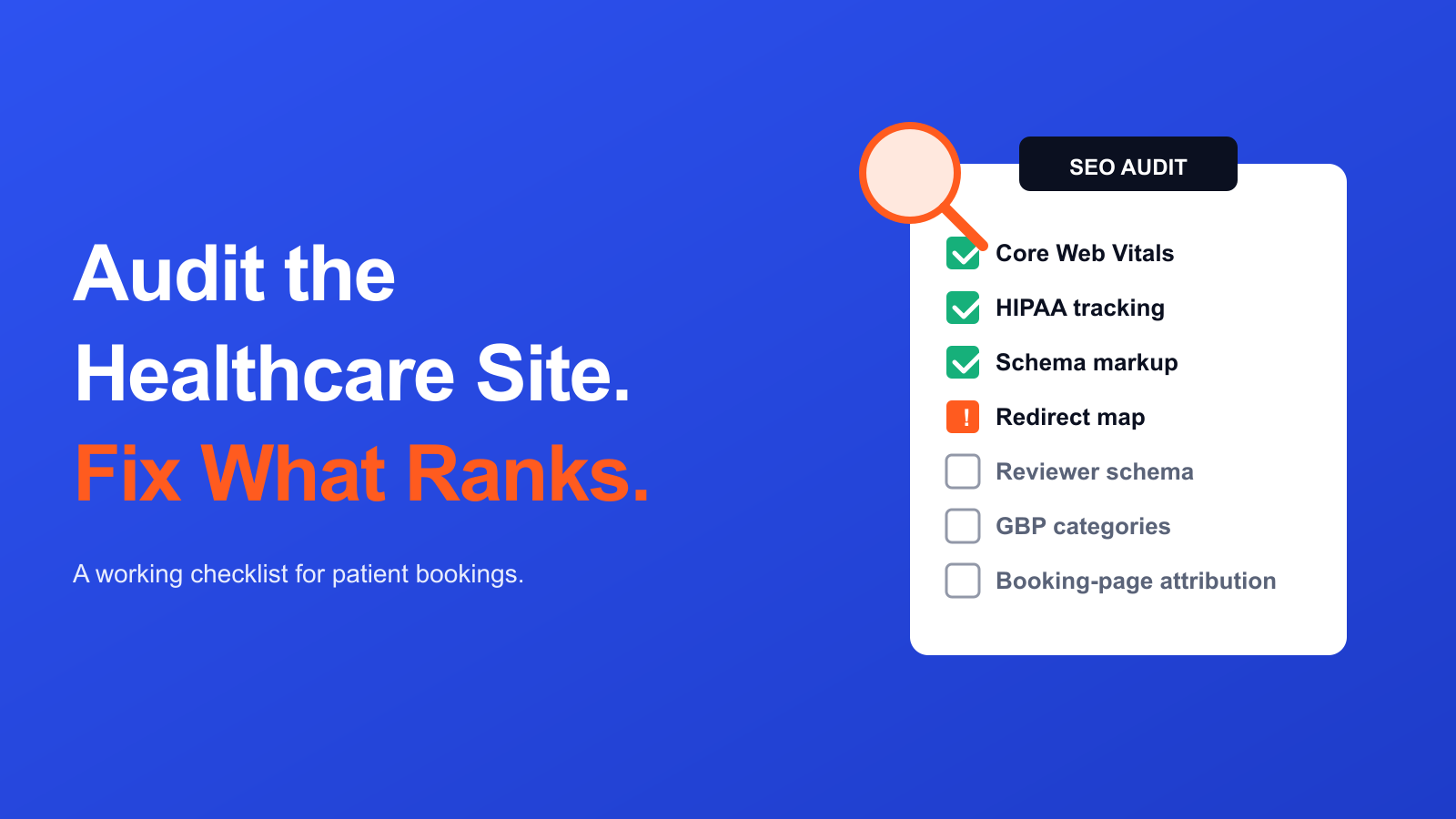
What a healthcare SEO audit actually is
A healthcare SEO audit is a structured review of six work streams: HIPAA-safe tracking, technical foundation, on-page and content, local presence, authority, and measurement. It runs against the current live site, the Google Business Profiles across every location, the analytics stack, and the reporting the practice already receives. The output is a written report that names every issue, ranks issues by patient-booking impact, and hands the practice a scoped 90-day fix plan. Most of the value of the audit is in the ranking. Every practice has a list of 50-plus problems. The audit tells you which 8 to fix first.
The pattern most practices run into on their first healthcare SEO audit: a generalist vendor runs a Screaming Frog crawl, exports a 400-line spreadsheet, calls it a report, and hands it over. That’s a crawl output, not a healthcare SEO audit. A working audit reads the crawl through a healthcare-specific lens. Client-side pixels on a booking-confirmation page get flagged as a compliance risk, not a “tracking config recommendation.” A missing MedicalBusiness schema block gets flagged as an authority gap, not a “structured data suggestion.” The lens is what separates useful audits from expensive ones.
| Audit layer | What we check | Common finding | Fix window |
|---|---|---|---|
| HIPAA + tracking | Booking-page pixels, BAAs, server-side setup, hashed identifiers | Client-side Meta Pixel on thank-you page | Weeks 1-2 |
| Technical foundation | Core Web Vitals, indexation, schema, canonical hygiene, sitemap | LCP 4.2s on booking pages, missing MedicalBusiness schema | Weeks 2-6 |
| On-page and content | YMYL bylines, reviewer chain, service and condition depth, keyword coverage | Every clinical page bylined “Team” with no reviewer | Months 2-6 |
| Local presence | GBP categories, service list, review velocity, NAP citations | Wrong primary category, 3 reviews per location per month | Weeks 3-8 |
| Authority | Publisher signals, reviewer author pages, digital PR footprint | No Person schema tying reviewers to LinkedIn | Months 3-9 |
| Measurement | Booking-attribution dashboard, call tracking, source tagging | Rankings reported, booked patients never tied to organic | Weeks 4-6 |
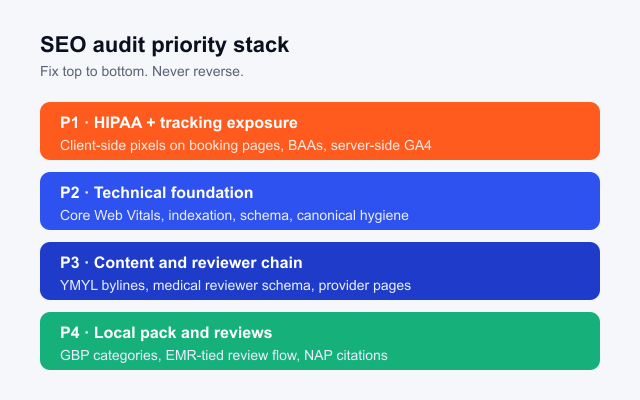
Read the table as a priority stack, not a menu. HIPAA and tracking issues sit at the top because they are the only category where the risk includes an Office for Civil Rights letter. Everything else is ranking work. Nothing else in a healthcare SEO audit outranks the compliance layer. That’s the sequencing rule that keeps the first two weeks of remediation from creating downstream exposure.
Priority one. HIPAA and tracking exposure
Every healthcare SEO audit opens with the tracking stack. The 2022 HHS Office for Civil Rights guidance on tracking technologies, refreshed in 2024, made it explicit: client-side pixels on booking-confirmation pages and any page that ties an identifiable person to a service line count as impermissible PHI disclosure. That guidance covers Meta Pixel, LinkedIn Insight Tag, TikTok Pixel, and any third-party analytics tool that hasn’t signed a BAA. The audit checks the source of every booking, contact, and appointment-request page. If the page loads a pixel from a vendor without a BAA, the finding gets flagged P1 and the fix window is 14 days.
The common fixes cluster into four patterns. Move all tracking behind a server-side tag manager the practice owns. Sign BAAs with every tool that touches identified patient data, including the call tracker, the analytics vendor, and any CRM syncing appointment status. Hash patient identifiers (email, phone, name) client-side before they leave the browser. And build the routing so booking-confirmation events fire the practice’s own conversion event to Google Ads and Meta Ads without ever transmitting the patient’s identity. Practices that skip this step build 12 months of “successful” campaigns and inherit a compliance investigation in month 13.
The audit deliverable for P1 is a fix ticket per exposure, ranked by patient-volume weight. A booking-thanks page loading a client-side Meta Pixel with 2,000 monthly conversions ranks higher than a static “team” page loading LinkedIn Insight with 40 monthly views. Our healthcare website design team scopes the tag-server rebuild as a two-week engagement on most WordPress sites, longer on custom stacks that need a code freeze.
Priority two. Technical foundation issues
Once the compliance layer is safe, the audit turns to the technical foundation. Core Web Vitals sit at the front of the P2 list because Google’s page-experience thresholds treat LCP above 2.5 seconds on mobile as a ranking penalty and a conversion killer. The audit runs a real-device Lighthouse pass on the homepage, one service page, one location page, and the booking flow. If the booking-flow LCP breaches 2.5s, it goes to the top of the technical fix list. A patient who abandons a slow booking form doesn’t come back the next day.
The rest of the technical layer covers indexation hygiene, schema completeness, canonical hygiene, and sitemap health. The audit pulls Search Console coverage data over the last 90 days, notes every server error, soft 404, and duplicate-canonical warning, and matches those to real page templates. Schema completeness runs against Schema.org’s MedicalBusiness and Physician types, plus Article schema on every blog post and MedicalWebPage on every condition or service page. Canonical hygiene checks for cross-domain rel=canonical mistakes (a hospital-system subdomain accidentally canonicalizing to the parent domain is the classic case). Sitemap health checks the XML sitemap against Search Console coverage; if 40% of URLs in the sitemap are unindexed, that’s a submission problem, not a Google problem.
Common technical fixes on healthcare sites follow predictable patterns. Image compression on hero photos usually recovers 800ms to 1.4s of LCP. Deferring third-party scripts (chat widgets, review widgets, analytics fallbacks) recovers 400ms to 900ms of Interaction to Next Paint. Adding MedicalBusiness schema with a full sameAs list ties the practice to its social and directory footprint. Fixing the redirect map on a recent redesign recovers the organic sessions the migration lost. The healthcare SEO pillar guide covers the technical baseline in more depth for practices building their own remediation plan.
Priority three. On-page content and the reviewer chain
The on-page and content audit is where healthcare SEO audits diverge hardest from generalist audits. Google’s Search Quality Rater Guidelines flag medical content under the YMYL (Your Money or Your Life) bar. The raters check for real author expertise, medical review, and organizational credentials on every page that touches clinical information. The audit reads every clinical page against that rubric. Any page bylined “Team,” “Admin,” or the practice name with no named author gets flagged. Any page with a named writer and no named licensed reviewer gets flagged. Any provider bio missing education, residency, board certifications, or a headshot gets flagged.
The audit also checks the content shape against the keyword the page is targeting. A service page targeting “TMS therapy Manhattan” that reads like a brochure (“welcome to our practice”) instead of a service page (what TMS is, who it helps, how the treatment works, insurance coverage, provider credentials, booking) gets flagged for intent mismatch. A condition page targeting “pelvic pain treatment” that offers a 400-word overview and no next-step navigation gets flagged for shallow coverage. The pattern: healthcare content that reads like a marketing brochure ranks worse than healthcare content that reads like a clinician’s patient handout.
Common fixes on the content layer are structural, not stylistic. Add a named writer byline plus a named licensed reviewer to every clinical page. Add Person schema for both, with sameAs pointing to real LinkedIn and licensing directory profiles. Add “Medically reviewed on [date]” language visibly on the page. Expand thin service and condition pages to real depth (1,200-2,400 words with structured subheads). Add citations to primary sources (peer-reviewed journals, CDC, NIH, specialty society guidelines) where a claim reasonably warrants one. Our healthcare SEO strategy framework covers the sequencing of content rebuilds across the first 12 months.
Priority four. Local pack and review workflow
The local layer of a healthcare SEO audit checks the Google Business Profile per location, the review velocity, the NAP consistency across citation sources, and the local landing pages on the site itself. Multi-location groups get audited on a per-location basis. A 14-clinic network with 14 GBPs generates 14 audit findings on average, and the findings rarely repeat cleanly across locations.
The GBP audit checks four things per location. Primary category first (Psychiatrist, not Doctor; Chiropractor, not Health Consultant; Dermatologist, not Skin Care Clinic). Secondary categories filled with every specialty the location supports. Service list populated with real descriptions per service. Photo velocity active (a location that hasn’t posted a photo in 8 months signals dormancy to Google). Review velocity checks against the median for the specialty in the local market; a psychiatrist earning 2 reviews per month in a metro where the median is 12 is quietly losing local pack visibility. NAP consistency runs against the practice’s citation set (Healthgrades, Zocdoc, Vitals, WebMD, insurance directories, association member listings); a phone number that changed in a rebrand two years ago and never got fixed in 40% of citations is a compounding trust hit.
The local landing pages on the site itself get their own read. A location page that says “Serving Manhattan” but never lists the neighborhood, insurance carriers accepted, transit access, parking, provider list, or specific services offered at that location won’t rank against a competitor with real depth. The audit calls out the missing structural elements and hands the practice a rewrite brief per location page.
Measurement and reporting failures the audit catches
The measurement audit is the layer that decides whether the practice’s SEO budget survives the next annual review. A healthcare SEO audit that finds strong rankings and no attribution to booked patients tells the practice it’s paying for reporting, not for a program that moves the schedule. The audit reads the current reporting stack against a fixed rubric: does the practice know how many booked patients came from organic search last month, per service line, per location, per new versus returning patient? If the answer is no on any of those dimensions, the measurement layer gets a rebuild ticket.
The common gaps show up in four places. Server-side GA4 running the healthcare event set is often missing (form submissions, phone calls tracked through a BAA-covered call tracker, chat sessions, appointment-request events). Search Console isn’t pulled into the same reporting layer, so keyword-to-URL performance stays siloed. Call tracking runs without dynamic number insertion by source, so organic calls and paid calls blend into one number attribution. And a monthly attribution dashboard tying organic sessions to booking-page views to booked patients doesn’t exist, or exists only in the vendor’s monthly deck that gets emailed and forgotten.
The audit deliverable for measurement is a scoped stack: which tools already exist and are configured wrong, which tools need to be added, which BAAs need signatures, and what the dashboard looks like at the end. Our healthcare marketing team delivers the measurement build in weeks 4-6 of most engagements because the rest of the SEO work only compounds once the reporting layer exists.
Reading the audit output the right way
A healthcare SEO audit that comes back with 240 findings and no ranking is a list, not a plan. The audit output the practice acts on has three parts: a P1-through-P4 priority stack, a 90-day fix schedule tied to the stack, and a checkable set of leading indicators the practice can watch each month. The priority stack pushes compliance risk to the top regardless of ranking-impact weight. The fix schedule caps the first month at 6-10 issues so the practice’s team doesn’t stall on volume. And the leading indicators (Search Console coverage, Core Web Vitals passing rate, review velocity per location, top-20 rankings for the mapped keyword set) let the practice see the audit working before the booked-patient number moves.
| Reporting item | What good looks like at month 3 | What good looks like at month 6 | What good looks like at month 12 |
|---|---|---|---|
| Search Console coverage | Zero server errors, under 5 soft 404s | Coverage clean, all mapped URLs indexed | Coverage clean, indexation lag under 14 days for new content |
| Core Web Vitals | Homepage + booking pages passing | Every service and location page passing | Site-wide passing, 90-day rolling stability |
| Review velocity | 6-15 per location per month | 10-30 per location per month | 10-30 sustained, 4.5+ average rating |
| Ranking coverage | 15-40% of mapped keywords in top 20 | 40-60% in top 20, 15-25% in top 10 | 60-80% in top 20, 30-45% in top 10 |
| Booked patients from organic | Baseline set, month-over-month tracking live | Non-brand organic bookings up 20-40% | Non-brand organic bookings up 60-140%, CPA falling |
The table is the reporting template we hand every practice at audit closeout. It’s the same template a practice-side team can carry into a follow-up quarter with a different vendor. The audit doesn’t lock the practice into anything. It leaves the practice with a checkable plan.
A real audit story from a New York aesthetics clinic
When Beauté Aesthetics New York, a Manhattan luxury beauty and aesthetics clinic offering advanced treatments and cosmetic procedures, came to us in 2020, they wanted to be the premier destination for medical-grade treatments in the city. The site did not carry the brand. The audit opened with the technical foundation: slow load times, weak metadata, and a WordPress build that hadn’t been optimized for real-device mobile. Content wasn’t the problem the practice thought it was. SEO was. Important keywords weren’t targeted. Landing pages lacked structure. Metadata was incorrect across the treatment set. The audit surfaced every gap in a single priority list.
The 12-month remediation ran through the same P1-P4 stack the audit produced. Foundation went in first: a full rebuild with a gender-neutral luxury visual identity, mobile-optimized templates, and load times pulled under 1 second. On-page came next: treatment-specific landing pages built for the SEO-targeted keyword set, structured schema markup added for stronger indexing, and metadata rewritten across the site. Measurement wrapped the work: analytics and behavior tracking integrated so every strategy call could reference the same numbers. Twelve months later new users were up 88%, inbound leads were up 166%, and the conversion rate was up 27%. None of that came from writing more content. It came from acting on an audit that ranked the fixes correctly and remediating every priority in sequence.
DIY audit versus vendor audit for healthcare practices
Small practices sometimes ask whether a healthcare SEO audit is DIY-able. The answer depends on the layer. The technical foundation layer is partly DIY-able for a technically inclined operator: PageSpeed Insights, Search Console, and Schema.org’s validator cover 60-70% of the P2 findings. The HIPAA and tracking layer is not safely DIY-able without a healthcare-specialist developer or an internal compliance owner in place. The on-page and content layer is partly DIY-able with a clinician plus a marketer working together. The local layer is fully DIY-able for a single-location clinic with 40-60 GBP posts of experience. The authority and digital PR layer is not DIY-able below 5 clinics of scale.
The pattern that works for practices between one and three locations: DIY the technical baseline audit, the local audit, and the on-page audit, then hire a healthcare-specialist consultant for a scoped compliance-and-measurement audit as a one-time project. Practices past three locations move to a full retainer with a boutique agency that owns the audit output and the fix schedule end-to-end. The healthcare SEO agency selection guide covers the vendor-side of that transition, and the healthcare SEO company comparison covers what the tier of vendor changes in scope.
Common healthcare SEO audit mistakes
Every practice we’ve onboarded has seen at least one of these mistakes on a prior audit. Recognizing the pattern is the fastest way to get real value on the next round.
- Treating the crawl output as the audit. A 400-line Screaming Frog export is not a plan. The plan is the ranking of those 400 lines against patient-booking impact and compliance risk. Without the ranking, the practice reads the whole list, gets overwhelmed, and picks the easiest ticket instead of the highest-impact one.
- Skipping the HIPAA layer to move faster. Client-side pixels on booking-confirmation pages are the single most common healthcare SEO audit finding and the single most-often-ignored. The shortcut saves two weeks in month one at the cost of an OCR letter in month twelve.
- Auditing content without an intent read. A 2,000-word service page can still miss its keyword’s intent. The audit reads the SERP for every mapped keyword and flags pages whose format doesn’t match the winners.
- Auditing GBP as a checklist and not a per-location workflow. Multi-location groups have 14 unique audit findings across 14 profiles. A “GBP is optimized” summary line covers up the six locations still on the wrong primary category.
- Auditing rankings without booked-patient attribution. A site that ranks for 200 keywords and books 6 patients from organic search per month has a measurement problem the audit didn’t catch. Ranking is an input. Booked patients are the output.
- Auditing the site without auditing the reporting stack. A vendor’s monthly deck that reports impressions, sessions, and rankings without a single booked-patient tie is a reporting habit the audit needs to name. Practices don’t fix what they don’t see.
- Auditing once and never re-running. A healthcare SEO audit run at month zero decays as the site changes. Quarterly re-audits (or at minimum a fresh audit at each annual renewal) catch drift before it becomes remediation debt.
The tell tying every mistake together: the audit was scoped as a document instead of a workflow. A working healthcare SEO audit is a workflow the practice runs against the current site and current stack every 90 days. The output changes every quarter because the site and stack change every quarter. Practices that treat the audit as a static deliverable stop finding new issues at month four and quietly compound problems for the next 12 months.
Timing an audit inside a broader SEO program
A healthcare SEO audit lands at three natural points in the program lifecycle. Kickoff is the first: every new engagement opens with a full audit before any fix work starts. Quarterly re-audits are the second: at months 3, 6, 9, and 12, a scoped delta audit checks what changed and reprioritizes the next quarter’s fix list. Pre-redesign is the third: any healthcare site heading into a rebuild gets a redirect-map-focused audit two weeks before launch, and a Search Console coverage audit two weeks after. Practices that skip the pre-redesign audit routinely lose 20-40% of organic sessions for 4-6 months as Google re-crawls the new URL set.
The audit cadence integrates with the rest of the SEO program cleanly. Weeks 1-2 of a new engagement run the audit. Weeks 3-6 remediate P1 and open P2. Weeks 7-12 remediate the rest of P2 and open P3 and P4. Months 4-6 hit content and local at scale. Months 7-9 turn on authority. Months 10-12 close out year one and audit again for year two. Our healthcare SEO services team delivers the audit as a paid discovery engagement, and credits the fee back if the practice moves forward on a program retainer inside 60 days.
Frequently asked questions about healthcare SEO audits
What is a healthcare SEO audit?
A healthcare SEO audit is a structured review of a medical practice’s website, Google Business Profiles, analytics stack, and reporting, run against a healthcare-specific rubric that includes HIPAA-safe tracking, YMYL content standards, MedicalBusiness schema, local pack signals, and booked-patient attribution. The output is a prioritized fix list, not a raw crawl export. A working audit ranks issues by patient-booking impact and compliance risk, tops the list with any HIPAA or tracking exposure, and hands the practice a scoped 90-day fix plan. The audit is a triage tool, not a deliverable. The value is in the sequencing.
How much does a healthcare SEO audit cost?
Healthcare SEO audit fees cluster by practice size and scope. A solo cash-pay clinic audit runs $1,800-$3,500 as a one-time engagement. A multi-provider single-location practice runs $3,500-$6,500. A multi-location group (2-10 clinics) runs $6,500-$14,000 because every location needs a per-profile local review. A regional network (10-30 clinics) runs $14,000-$28,000. A hospital system runs $30,000+. The fee scales with the number of GBPs, the number of location pages, and whether the tracking review needs a code-level developer audit or a config-level marketer audit. Anything under $999 is usually an automated tool scan wrapped in a PDF template, which will not surface the healthcare-specific findings that matter.
How long does a healthcare SEO audit take to complete?
A working healthcare SEO audit takes 2-4 weeks to complete on a single-location practice, 4-6 weeks on a multi-location group, and 6-10 weeks on a regional network. The first week runs the technical crawl, GA4 review, and initial HIPAA scan. The middle weeks run the content review, GBP per-location review, and citation set audit. The final week ranks findings, drafts the P1-P4 stack, and delivers the fix schedule. Practices that need a faster turnaround can scope a “compliance-only” audit at 5-7 business days that covers just the P1 layer and defers the rest.
How often should a healthcare practice run an SEO audit?
A healthcare practice should run a full audit at engagement kickoff and a scoped delta audit every 90 days after that. Search Console coverage, Core Web Vitals stability, review velocity, and ranking coverage drift quarter over quarter, and the delta audit catches drift before it becomes remediation debt. A full re-audit runs annually at renewal, plus a targeted redirect-map audit before any redesign or migration and a Search Console coverage audit two weeks after. Practices that audit once at kickoff and never again typically lose 15-30% of organic sessions to compounding issues by month 15.
What tools does a healthcare SEO audit use?
A healthcare SEO audit uses a mix of standard SEO tools and healthcare-specific checks. Screaming Frog or Sitebulb runs the technical crawl. Google Search Console and PageSpeed Insights cover indexation and Core Web Vitals. Schema.org’s validator and Google’s Rich Results Test check schema. GA4 and a BAA-covered call tracker like CallRail Healthcare cover the measurement layer. Ahrefs, Semrush, or Moz cover keyword and ranking data. The healthcare-specific layer runs against HHS OCR tracking guidance, Google’s YMYL rater guidelines, and MedicalBusiness plus Physician schema completeness. A vendor that only names the general-purpose tools and skips the healthcare-specific checks is running a generalist audit on a healthcare site.
Can a healthcare SEO audit find HIPAA compliance issues?
Yes, and it should. A healthcare SEO audit checks every page that touches identified patient data (booking forms, contact forms, appointment-request pages, thank-you pages, patient portal logins) for third-party tracking scripts that would transmit PHI to an external vendor without a signed BAA. Client-side Meta Pixel, LinkedIn Insight Tag, TikTok Pixel, and Google Analytics running client-side without a proper install pattern are the four most common findings. The audit doesn’t replace a formal HIPAA risk assessment done by a compliance officer. It surfaces the technical exposures that a compliance officer would ask the developer to fix. Practices with an internal HIPAA officer should share the audit findings with that officer as the first step in remediation.
Running a healthcare SEO audit for your practice this quarter? Talk to our healthcare SEO services team about a scoped audit engagement with a 90-day fix plan you can act on before your next renewal.
Book your free 30-minute strategy call.
No spam, no sales rep. We use your email to schedule your call with a senior strategist. That is it.