
Healthcare Website Copywriting That Books Patients, Not Just Visitors
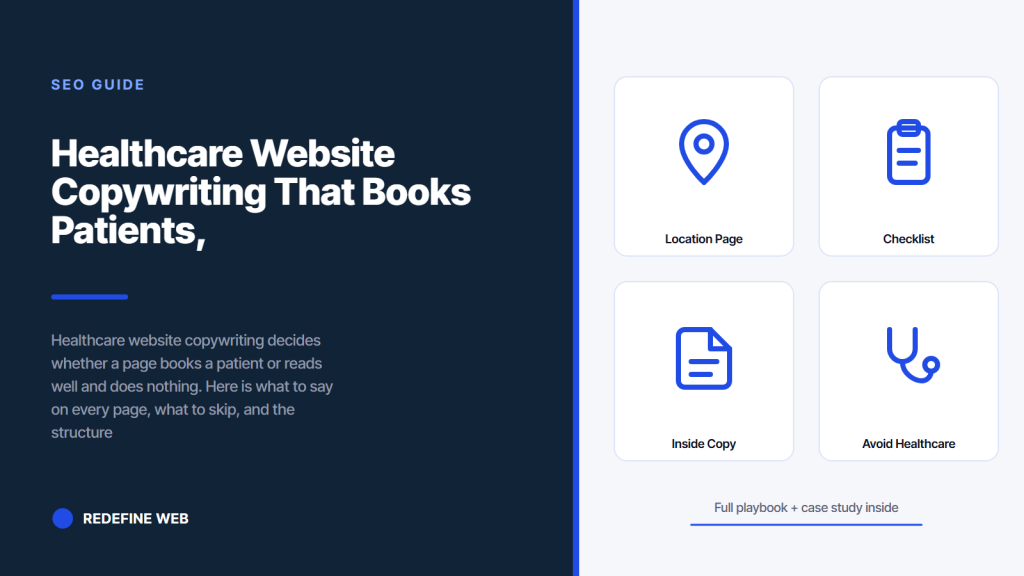
- Answer the visitor's question in the first sentence.
- One CTA per section, repeated at every scroll depth.
- List insurance carriers by name, not generic reassurance.
- Include price bands with a consult confirmation note.
- Move practice history off the homepage and into About.
- Location Page Healthcare Website Copywriting
- The Healthcare Website Content Checklist
- Healthcare SEO Writing Inside the Copy
- What to Avoid in Healthcare Website Copywriting
- Real Numbers From a Healthcare Copy Rebuild
- Hiring Healthcare Website Content Writers
- Measuring Healthcare Website Copywriting Performance
Healthcare website copywriting is the sharpest lever in the whole marketing stack and the one practices touch last. A booking widget will not save copy that reads like a brochure written in 2011. A PPC campaign cannot rescue a homepage that talks about the practice’s history for four paragraphs before mentioning what a new patient actually gets. This guide is the healthcare website copywriting pattern that books patients, plus the copy traps that quietly cost bookings across the site.
The short version. Every page needs an answer-first opening, one primary call to action, proof the reader can verify, and copy short enough to scan in 30 seconds. Skip the practice history on the homepage. Move it to About. Say what the patient gets, price bands where you can, insurance you accept, and the exact next step. Do that and healthcare website copywriting starts pulling weight instead of decorating the design.
Location Page Healthcare Website Copywriting
The location page carries the local SEO for the practice and answers three practical questions. Where are you. When are you open. How do I get there. When you also run more than one location, the location page has to differentiate this office from the others without cannibalizing the parent page’s ranking.
The core information block
Address, phone, hours, and a working map at the top of the page. Not in the footer. Not behind a click. Right there, above the fold. That single block answers the question the patient came with. The rest of the page is context. Practices that bury this block lose direction-taps and calls to competitors whose location page renders the same information above the fold.
Neighborhood context
Two to three paragraphs on the neighborhood, patient service area, and landmarks near the practice. “Located on Main Street between the Chase Bank and the Panera, three blocks from the Vista Village stop.” That copy earns local ranking signals and helps the patient recognize the office when they drive by. Both jobs matter and both need real specifics, not generic language about “serving the community.”
Provider list per location
List the providers who see patients at that specific location, with photos and credentials. Patients booking at a specific office want to know who they will see. Sending them to the About page to guess undermines the trust the location page just built. This is where healthcare website content writers earn their keep by researching each provider once and reusing the block across all pages that reference them.
The Healthcare Website Content Checklist
The website content checklist healthcare teams should apply to every page before publish is a specific 10-item list. Every item is a page-level check. Every page passes all 10 or gets sent back to the writer. That checklist keeps the entire site consistent as the practice grows.
| Check | What passes | What fails |
|---|---|---|
| Answer in first sentence | Named benefit or fact | Practice history |
| One primary CTA | Same button, repeated | Three competing CTAs |
| Price band listed | Range plus consult note | “Call for pricing” |
| Provider photo real | In-office headshot | Stock imagery |
| Credential shown | Named issuing body | Generic title |
| Insurance list | Named carriers | “Most insurance” |
| Scan time under 30 sec | Short paragraphs, headers | Wall of text |
Reading level target
Target an 8th grade reading level for patient-facing pages, tested with the Hemingway app or a similar tool. Healthcare has a well-documented literacy problem, and clinical language on a marketing page pushes patients toward practices whose sites read at a normal conversational level. See NCES adult literacy data for the underlying reader profile.
Word count per page type
Homepage: 400 to 700 words. Service page: 900 to 1,600 words. Location page: 500 to 900 words. About page: 400 to 800 words. Provider bio: 200 to 400 words. Anything under the floor reads thin. Anything over the ceiling reads bloated. Aim for the middle of each band and the page carries its weight without padding.
Insurance and financing copy
List insurance carriers by name. “We accept Delta Dental, Cigna, Aetna, MetLife, and Guardian.” Patients searching for their carrier need to see it. “Most major insurance accepted” fails the specific-search test. Same for financing. Name the provider. “CareCredit and Sunbit financing available.” Real specifics beat generic reassurance every time on healthcare pages that are meant to book patients.
Healthcare SEO Writing Inside the Copy
Healthcare SEO writing sits inside the copy, not on top of it. The keywords go in the headline, subhead, first paragraph, and two or three subheads. Beyond that, the copy is written for the patient. Overloading a page with the same phrase 15 times reads spammy and gets flagged by Google’s helpful content signals.
Cluster keywords over exact-match repetition
Weave the cluster keywords across the page. On an implants page, use “tooth implants,” “dental implants,” “implant consult,” “single-tooth implant,” “full-mouth implants,” “same-day implants.” Google’s algorithm reads variety as depth, and readers scan variety as thorough coverage. Both jobs get done with the same set of naturally chosen phrases.
Question-based subheads
Subheads phrased as questions match the way patients search. “How much do dental implants cost?” “How long does an implant procedure take?” “Am I a candidate for implants?” Each one earns a chance at a People Also Ask feature and reads as a scannable summary. Answer each question in the first 40 to 60 words under the subhead. That answer-first structure is what AI Overviews extract from too.
Internal link the cluster
Link from the implants service page to the consultation page, the sedation options page, and the insurance page. Link back from all three. The internal link graph is what tells Google the implants page is the center of a real cluster, not an orphan. See our Healthcare Website CRO post for the test structure that pairs with the copy work.
If a patient can't answer 'what does this practice do and what does it cost' in one scroll, the copy failed. Time yourself right now on your own site.
What to Avoid in Healthcare Website Copywriting
Some copy patterns actively hurt conversion on healthcare pages. They read fine in a design mockup, then quietly cost bookings once the page is live and real patients start hitting it. This section catalogs the specific patterns we see most often across the healthcare accounts we audit, plus the fixes that consistently reverse the drop in booking rate.
Practice history in the hero
“Founded in 1998 by Dr. Smith, our practice has been serving families for over 25 years.” That sentence has its place. Its place is the About page. In the hero, it costs the practice bookings because the visitor arrived with a question about their tooth pain, not the practice’s origin story. Move history to About and put the answer to the visitor’s question in the hero.
Vague claims without proof
“Compassionate care.” “State-of-the-art technology.” “Committed to excellence.” Every practice claims those things. Nobody differentiates on them. Replace with specifics: “Same-day emergency appointments seven days a week.” “CBCT imaging on-site, no referrals for scans.” “NYU-trained periodontist on staff.” Specific beats generic on every page, every time.
Compliance language that reads as legalese
Some healthcare copy leans on disclaimers, HIPAA notices, and “results may vary” language until the page reads like a warning label. Compliance still applies, but the language belongs in the footer or a dedicated page, not woven through the marketing copy. Split the two audiences: the marketing page speaks to the prospective patient; the compliance page speaks to the auditor. Both get what they need and neither dilutes the other.
Real Numbers From a Healthcare Copy Rebuild
NC Dental Clinic, a 20-year Vista, CA practice, ran a copy rebuild across the homepage and top eight service pages. The pre-rebuild copy was the practice-history-first pattern. The post-rebuild copy used the answer-first structure with price bands, real photos, and one CTA per section.
Booking rate change
Website booking rate rose from 2.1 percent of sessions to 4.7 percent over six months. The gain concentrated on service page traffic, where the price bands and provider photos did most of the work. Homepage bookings rose in step because the hero rebuild focused on same-week appointments and insurance carriers.
Phone volume mix
New patient phone volume dropped 18 percent as more patients used the online booking widget instead. The calls that came in were higher-quality: fewer price-shopping calls, more calls from patients ready to book. The front desk stopped fielding “how much is a cleaning” and started fielding “I would like to book next Tuesday.” That workload change alone saves 3 to 5 hours a week at a single-location practice.
Local search rankings
Local pack rankings improved on eight of the top ten keywords targeted, because the pages now had substantive content instead of thin service pages. Overall organic sessions grew 34 percent in six months post-rebuild. The copy rebuild carried the SEO gains without a separate technical push, because the copy did the work Google’s helpful content signals were asking for. See Google’s helpful content documentation for the underlying signal set.
Hiring Healthcare Website Content Writers
The pitch. Hire a full-time content strategist, a medical writer, a copy editor, and a compliance reviewer. The reality. The office manager and the marketing lead trade Google Docs on Sunday nights. Almost every practice tries the deluxe hire and lands on the Sunday-night Google Docs version. The trick is picking the writer setup that fits the practice’s real cadence, not the org chart of a hospital system.
In-house versus freelance versus agency
In-house writers work for practices with a monthly content plan and 20-plus content pieces a year. Freelance writers work for practices needing 6 to 20 pieces a year with variable timing. Agency writers work for practices bundling copy inside a broader marketing retainer. Match the writer setup to the actual content volume, not the aspirational one. A full-time in-house writer producing 4 pieces a quarter is expensive and slow. A freelance writer at the same cadence is faster and cheaper.
The provider interview cadence
Real healthcare copy comes from provider interviews. A 30-minute recorded interview with the treating provider produces enough raw material for a 1,200-word service page. The writer turns the interview into copy, the provider reviews for clinical accuracy, and the marketing lead reviews for tone and CTA. That three-step loop is what separates real E-E-A-T copy from stock content in the eyes of Google and the eyes of patients. See Google’s guidance on the added Experience signal for what raters look for.
Editorial calendar structure
Publish two new content pieces a month at minimum. One service or location update. One patient-education post that answers a search question your patients ask. That cadence keeps the site earning fresh signals without overloading the review pipeline. See our Healthcare SEO Audit post for the way we prioritize which pages to refresh first inside a copy backlog.
Measuring Healthcare Website Copywriting Performance
Copy performance is measurable. Not on the vanity metrics on the front page of GA4, but on the conversion signal that traces back to individual pages. Three numbers matter. Page-level booking rate. Assisted conversions in the multi-touch attribution model. Time to conversion on a service page.
Page-level booking rate
Compare booking rate per landing page against a category benchmark. Service pages should convert at 3 to 8 percent. Location pages at 5 to 12 percent. Homepage at 2 to 5 percent. Any page well below its benchmark either has a copy problem, a design problem, or a page-speed problem. Copy usually accounts for two of the three when the diagnosis lands.
Assisted conversions
Some pages do not convert directly but assist a later conversion. A blog post on “is a root canal painful” rarely books a patient itself. It builds trust and pushes the reader toward the service page or homepage. Look at the assisted conversion path in GA4 to find those pages. Kill the ones that never appear in a conversion path. Keep the ones that appear regularly. That decision beats page-view counts every time.
Where the retainer fits
Healthcare website copywriting inside a monthly retainer usually covers 2 to 4 pieces per month, refresh work on 1 to 2 existing pages, plus copy for landing pages tied to PPC. Retainer starts at $599 a month. See our Healthcare Marketing Agency hub and Healthcare Website Design service for the full stack that pairs with the copy work.
Healthcare website copywriting is the sharpest lever on the page. Answer first, one CTA per section, real photos, real credentials, real price bands. Do that pattern consistently and the site converts on its own signal, before the ads and the SEO catch up.
Frequently asked questions
What makes healthcare website copywriting different from other verticals?
Healthcare website copywriting has three constraints that ecommerce and B2B copy do not. First, the reader is anxious about a health issue, not shopping for entertainment, so the copy has to answer their question before it does anything else. Second, compliance sits behind every claim, so proof and specificity carry more weight than clever wording. Third, the reader will not click a second time to find price, insurance, or hours, so those specifics have to appear on the first screen. Healthcare copy that ignores those constraints reads well and books nothing. Copy that respects them books patients whether the design is dated or new.
How long should a healthcare website page be?
Homepage 400 to 700 words. Service page 900 to 1,600 words. Location page 500 to 900 words. About page 400 to 800 words. Provider bio 200 to 400 words. These bands come from patterns across the healthcare accounts we run. Under the floor and the page reads thin, which hurts both conversion and organic rankings. Over the ceiling and the page reads bloated, which hurts scan-time and completion. The middle of each band gives the reader enough to trust the practice, enough for Google to rank the page as substantive, and few enough words that the primary CTA still fires at every relevant scroll depth.
Should healthcare websites list prices?
Yes, as ranges with a consult qualifier. "Implants run $2,800 to $4,500 depending on bone health and materials. Financing available. Your consult confirms the specific plan." That structure keeps the range honest, sets the follow-up expectation, and cuts the price-question phone volume. Practices that skip prices worried the patient will hold them to a specific number end up losing the patient to a competitor that lists a range. The competitor is not committing to the low end of the range either. They are giving the reader the confidence to book the consult, which is the whole job of the service page copy.
What is the ideal reading level for healthcare website copy?
Target 8th grade reading level for patient-facing pages, verified with the Hemingway app or a similar readability tool. Healthcare has a documented adult literacy issue, and clinical language on a marketing page pushes patients toward practices whose sites read at a normal conversational level. That does not mean dumbing down the copy. It means using shorter sentences, everyday words where they exist, and clinical terms only when a plain-English alternative would be less accurate. The About page and provider bios can run a grade or two higher because the reader has already committed to the practice. Marketing pages need the lower reading level to capture new patients.
How often should a healthcare practice update website content?
Publish two new pieces a month at minimum. One service or location update. One patient-education post answering a search question your patients actually ask. On a quarterly cadence, refresh the two service pages with the biggest gap between traffic and conversion. On an annual cadence, refresh the homepage hero, insurance list, and provider photos across the site. That publishing rhythm keeps Google's helpful content signals reading the site as active, keeps the copy aligned with what the practice actually offers, and prevents the slow drift that shows up when the marketing lead realizes the site still references a provider who left two years ago.
Do I need a specialized healthcare content writer?
Yes, though not necessarily a former clinician. A healthcare content writer needs three things: comfort with medical terminology, the discipline to run a provider interview and translate the answers to patient-facing language, and the willingness to run every clinical claim past the treating provider before publish. Writers with a healthcare background come with that discipline baked in. Writers without one can learn it in three to six pieces if the provider review loop is set up correctly. Either path works. The pattern that fails is a general content writer producing healthcare pages without a provider review layer, which produces copy that reads fine and violates specific claims the practice legally has to make with care.
How does healthcare website copywriting affect SEO rankings?
Copy is the primary signal Google's helpful content system reads to decide whether a page deserves to rank. Thin service pages with 200 words of vague reassurance get outranked by 1,200-word service pages with real specifics, provider details, and answers to the patient questions that show in People Also Ask. Copy also drives internal link structure, cluster depth, and the semantic entities Google uses to associate the page with a topic. In practical terms, a well-written 1,200-word service page usually ranks 3 to 8 positions higher than the same page at 400 words with the same keywords, and the higher-ranking page converts at a higher rate because the copy also does its conversion job.
Book your free 30-minute strategy call.
No spam, no sales rep. We use your email to schedule your call with a senior strategist. That is it.
More from the blog
View all articles → SEO
SEO Organic Search Engine Optimization Services That Grow Real Traffic
Read article SEO
SEO SEO for Pet Groomers That Fills the Appointment Book Weekly
Read article SEO
SEO