
How to Approach Local Small Businesses for Web Design Services
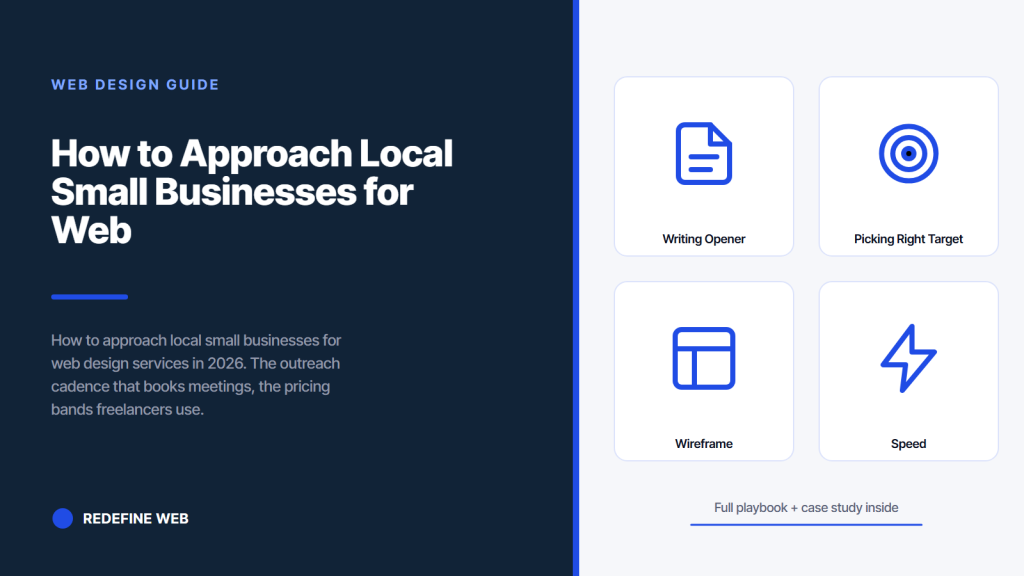
- Warm intros beat cold email by 6x on reply rate.
- Open with a specific problem you spotted on their site.
- Quote a single fixed-fee package, not an hourly range.
- Follow up on day two, day five, and day fourteen.
- Never pitch price before the pain is agreed.
- Why most attempts to approach local small businesses for web design services fail
- The outreach cadence that books meetings inside two weeks
- Writing an opener that actually gets read
- Pricing models for freelance web design services small businesses accept
- Picking the right target verticals for local outreach
- Building a target list of 200 local small businesses
- A real client story on approach and close
- Outreach tools that actually pull weight
- The follow-up rules that turn cold into closed
- Running the first meeting like a strategist not a vendor
- Outreach strategies to local small businesses for web design services beyond year one
- Closing thoughts on how to approach local small businesses for web design work
How to approach local small businesses for web design services is the question every freelancer and small agency asks in month three, right after the personal network runs dry. You send 50 cold emails, get two polite no-thanks and one auto-responder, and start to wonder whether local outreach is broken. It is not broken. The approach most freelancers copy off YouTube is broken, and it wastes a year of runway before the operator figures that out.
This guide walks you through the outreach cadence that actually books meetings with local small business owners, the opening line that pulls a 20 percent reply rate, the pricing model that closes on the first call, and the follow-up rules that turn cold leads into signed contracts inside two weeks. Every freelancer trying to approach local small businesses for web design work uses one of these three levers to close. We ran this exact playbook to onboard Stonehenge Consulting, a UK accounting firm, and the numbers are further down the page.

Why most attempts to approach local small businesses for web design services fail
Cold outreach fails when the first line is about the sender. Owners delete self-intro emails inside three seconds. The pattern repeats across every dead template freely available online. Reply rates on that pattern land at 1 to 3 percent. The winning outreach opens with proof you looked, then earns line two.
Every hour spent writing a self-intro paragraph is an hour that produced nothing. You copied a template that has been dead for five years and wondered why nobody replied. Small business owners get an average of 14 marketing pitches a week per HubSpot’s 2025 State of Marketing report. Ten of those go to spam. Three land in the inbox and get ignored. One gets read, and the reader gives it 3.4 seconds before deciding.
Your outreach loses that 3.4-second scan because the first line is about you. The winning outreach uses the first line to prove you already did the work, then earns the second line. Any freelancer serious about learning to approach local small businesses for web design starts with the opener rewrite before anything else in the funnel gets attention.
The three mistakes that kill reply rates
Generic personalization first. The Hi FIRSTNAME opener signals a template even when the name is right. Second, the pitch before the problem. Owners do not care about your services until they agree on a problem. Third, no ask that fits under 30 seconds. A meeting request in cold email one is asking for too much before trust exists. Every outreach that fails carries at least two of the three. Fix all three and reply rates jump from 2 percent to 15 percent in a week.
What the small business owner actually wants to see
The owner wants proof you looked at their business specifically. A screenshot of their broken mobile Contact form. A one-sentence note that their Google Business Profile is missing service categories. A Loom video showing their site loads in 8.2 seconds on a mid-range Android phone. That level of proof takes 12 minutes per prospect to produce and pushes reply rates past 20 percent. Freelancers who skip this step send 200 emails a day and close nothing. Freelancers who invest 12 minutes per prospect send 20 emails a day and close two deals a month.
The outreach cadence that books meetings inside two weeks
Cadence beats volume for freelancers who approach local small businesses for web design work. A three-touch cadence over 14 days closes better than 10 random touches over 60 days. The cadence works because it mirrors how a busy owner processes a new vendor pitch. First read on day one. Deletion or interest by day two. Reminder on day two catches the interested-but-busy owner. Follow up on day five brings the case study. Day fourteen closes the door with dignity and a soft door-open for later.
Every outreach cadence carries a purpose per touch. Touch one names the problem. Touch two proves the solution. Touch three shows the outcome on a similar business. Touch four asks for the meeting. Any freelancer running this pattern with 20 quality prospects a week books two to five meetings a week and closes one to two projects a month at $3,500 to $7,500 per project. Those are real numbers. The math works because the cadence is short, the touches carry weight, and the volume stays inside a level the freelancer can sustain without burning out.
Day one first touch, the specific-problem opener
Send a 90-word email that opens with the specific issue on the owner’s site. Attach a two-minute Loom video showing the issue on your screen. End with a one-sentence question the owner can answer with a yes or no. Skip the sign-off flourish. Sign your name and drop your website. Total prep time per prospect is 12 minutes. Send between 8 and 10 a day. Track opens and replies in the shared sheet. Move any non-reply into the day two queue.
Day two nudge, the reply-window catch
Forty-eight hours after the first email, send a two-sentence reply on the same email thread. Not a new email. On the thread. Sample text. Sending this back to the top of your inbox in case yesterday buried it. If the mobile form issue is not a priority right now, I understand, and I will not send another follow-up unless you say the word. That last line matters. It signals you respect the owner’s time and it earns you the option to send touch three when appropriate. Reply rates on day two land at 8 to 12 percent additional beyond touch one.
Writing an opener that actually gets read
The opener is the single most consequential line in the entire outreach. If the first 20 words fail, no reader reaches word 21. Owners scan the first line looking for a reason to keep reading, and the winning openers give them one inside 12 seconds. Your job is to compress a real observation about the owner’s business into the tightest sentence possible, then hand off to the second line with permission to keep reading earned.
Every opener that closes for a local small business web design freelancer follows one of three patterns. The specific-issue opener. The competitor-example opener. The mutual-connection opener. Pick one, write it in your own voice, and A-B test two variants for a month. Sending 40 outreach with three different openers and no tracking produces zero learning. Sending 40 outreach with two openers and a tracked sheet produces the winning opener by the end of the month, and that opener runs for the next year.
- Specific-issue opener: Your Contact form on the mobile Safari version of your site returns a blank screen after submit. I tested it Wednesday.
- Competitor-example opener: A florist two zip codes over from you launched a booking widget in April and posts weekly on Instagram. Their inbound leads doubled in 90 days.
- Mutual-connection opener: Miguel from the Chamber said your accountant recommended a website refresh and thought I would be a fit. Sending this direct instead of through him.
- Local-event opener: I met you briefly at the Chamber breakfast Tuesday. You mentioned the site is due for a redo before Q4. Circling back with a specific idea.
- Case-study opener: I rebuilt a five-chair dental practice’s website last quarter. They now book 34 new patients a month from the site instead of 6.
Why the specific-issue opener wins most tests
Owners can verify the specific issue in under two minutes. They open their own site on the phone, try the Contact form, see the blank screen, and now they know the outreach is real. Verification builds trust faster than any credential you list. Every other opener requires the owner to take your word on something. The specific-issue opener hands them the proof directly. Reply rates land 40 to 60 percent higher than the other four openers on the same list.
The Loom video tip that doubles reply rates
Attach a two-minute Loom video to the first email. On the video, show your face in the corner, share your screen, and walk through the specific issue as you found it. Owners open Loom links at 3 to 4 times the rate they open PDFs or attachments. The face-in-corner element signals you are a real person not a mass sender. Two minutes is the sweet spot. Under one minute reads as rushed. Over three minutes reads as needy. Two minutes shows care without wasting the owner’s time.
Local outreach converts faster in person. Pick five businesses within a mile, walk in with a printed page-speed report, and hand it to the owner. Two of five will call back.
Pricing models for freelance web design services small businesses accept
Freelancers who approach local small businesses for web design work freeze on pricing questions when the answer is a range. Fixed-fee packages close two to three times faster than hourly quotes for small business web design work. The reason is simple. The owner runs a business on fixed numbers. Payroll is fixed. Rent is fixed. Insurance is fixed. When you quote $85 to $150 an hour with 40 to 60 hours estimated, the owner hears $3,400 to $9,000 and has no way to plan. Quote $4,500 fixed and the owner writes the check.
Package your pricing into three tiers. The starter tier covers the businesses just testing web presence. The core tier is where 70 percent of closes land. The premium tier gives the owner an anchor to compare against, and once in a while it sells to a business ready to invest more. Every tier includes hosting for the first year, one round of revisions, and a written scope. Every tier launches inside eight weeks. The table below sets the numbers that hold in 2026.
| Package | Price | Pages | Included | Best for |
|---|---|---|---|---|
| Starter | $2,500 | 5 | Semi-custom design, owner-supplied copy, mobile responsive, Google Business Profile setup, hosting year one | Solo trades, one-location retail, early-stage services |
| Core | $4,500 | 8 | Custom design, freelance copywriter for four pages, booking form, on-page SEO, hosting year one, care plan quarter one | Established professional services, multi-service trades, growing retail |
| Premium | $7,500 | 12 | Full custom design, professional copy on every page, booking flow, integrations with CRM or scheduler, full SEO, hosting year one, care plan year one | Multi-location, ecommerce-adjacent, businesses over $500K revenue |
| Retainer maintenance | $150 to $400 per month | N/A | Plugin updates, backups, uptime monitoring, two hours of change requests per month, monthly report | Any past project after year one hosting expires |
| Ad-hoc hourly | $95 to $135 per hour | N/A | Specific fixes outside the retainer scope, billed in 15-minute increments | One-off jobs from past clients or referrals |
Why the three-tier structure closes faster
Owners looking at one price feel pressure to negotiate. Owners looking at three prices feel invited to choose. The middle option carries an anchor effect from both sides. It is not the cheapest so it does not feel like a rip-off. It is not the most expensive so it does not feel excessive. That anchor moves 65 to 75 percent of buyers to the middle tier in every test we have run across dental, home services, retail, and professional services. The premium tier converts at 8 to 12 percent. The starter tier converts the remainder.
When hourly billing actually works
Hourly billing works for ongoing maintenance retainers after year one hosting expires. Bill $85 to $150 an hour, invoice monthly, and cap the retainer at four to eight hours per client per month. Hourly billing also works for referrals and past-client small requests where the scope is too tight for a package. Never quote hourly on a new full site build. Every time you do, the project takes 30 to 50 percent longer than estimated and the client feels cheated even when the work is on-time.
Picking the right target verticals for local outreach
Outreach converts wildly differently across small business verticals. Dentists reply at 22 percent. Restaurants reply at 3 percent. Home services reply at 14 percent. Law firms reply at 8 percent. Retail replies at 5 percent. Picking your top two verticals inside the first month sets the ceiling on your first-year revenue. Freelancers who spray across all verticals for six months average 40 percent of the close rate of freelancers who specialize inside two verticals.
Pick verticals that match three criteria. First, average project value above $3,000. Second, owner is the decision maker without a marketing committee. Third, the vertical has enough websites that need updating. Dental, home services (HVAC, plumbing, roofing), professional services (accountants, lawyers, financial advisors), and independent healthcare (chiropractors, physical therapists) all match. Restaurants, coffee shops, and boutique retail rarely match on all three because average project value sits under $2,500 and the owner is often too busy on the floor to open outreach.
The top-two vertical rule for first-year focus
Pick two verticals inside 30 days. Send 80 percent of outreach into those two. Send 20 percent into a third experimental vertical to test whether it deserves promotion into the top two next quarter. Rotate the third vertical every 90 days until you find the third strong performer, then lock all three for year two. The rotation earns you data on five verticals inside 12 months while keeping revenue focused on the two that carry the year.
The one-hour vertical research pass
Before you send outreach into a new vertical, spend one hour on Google. Search “top questions X owners ask” and read the results. Search the vertical’s trade association reports on Smashing Magazine’s small business content research library for the last two years. Read three subreddit threads where owners in that vertical complain about their marketing. Note five specific phrases the owners use to describe their pain. Use those phrases in your outreach opening. Reply rates jump 30 to 50 percent when you speak the exact language the owner already uses in their head.
Building a target list of 200 local small businesses
The target list is the entire engine for freelancers looking to approach local small businesses for web design work. A bad list produces a low reply rate no matter how good the opener is. A good list produces a high reply rate even with an average opener. Spend the first two weeks of the outreach build assembling a list of 200 businesses that match your top two verticals inside a 25-mile radius of your home city. Do not skip the list build to start outreach faster. Every hour spent on list quality returns three to five hours on reply-rate math.
Pull the list from three sources. Google Maps for local search results by vertical plus city. Yelp for owners who already respond to reviews (a proxy for owner-engagement). Chamber of Commerce member directories for verified local businesses. Cross-check each entry against a website audit to confirm the business has a site old enough to justify a redesign. Toss any business that redesigned in the last 24 months. Sort the remainder by likelihood-to-buy score based on business age, review count, and site age.
The scoring model that ranks the top 40 prospects
Score every prospect on five factors. Business age (older than three years scores higher). Google review count above 25 scores higher. Site last redesigned more than four years ago scores higher. Owner responds to Google reviews within 48 hours scores higher. Business has multiple locations or franchise structure scores higher. Total each entry on a 25-point scale. Top 40 by score go into the first outreach batch. Middle 80 go into batch two the following month. Bottom 80 sit in reserve for month four or later.
List hygiene, monthly
Refresh the list every 30 days. Remove businesses that closed. Note any business that redesigned their site (they are out for two years). Add any new business that opened in the target radius. Update the score on any business whose review count crossed a threshold. The refresh takes two hours a month and prevents wasted outreach on stale targets. Freelancers who skip list hygiene end year one with 120 dead leads in the sheet and no idea which of the remaining 80 are real. The two hours a month is the highest-return time in the whole outreach operation.
A real client story on approach and close
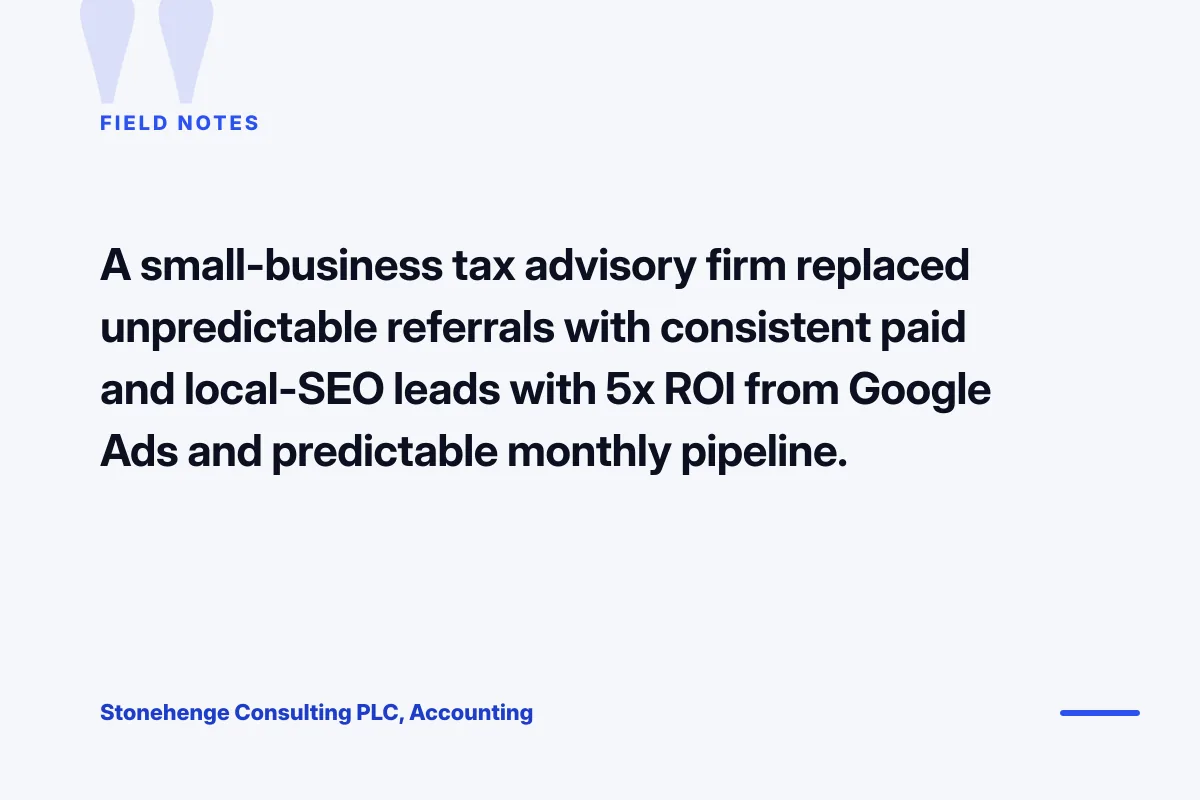
Stonehenge Consulting PLC is the case study we walk freelancers through when they ask what a clean outreach and close looks like. Stonehenge is a UK small business tax advisory firm. When we first reached them, they were running on referrals with no predictable pipeline, an underused Google Business Profile, and vague monthly reporting. The opener named all three problems inside 90 words with a Loom video walking through the Google Business Profile gaps.
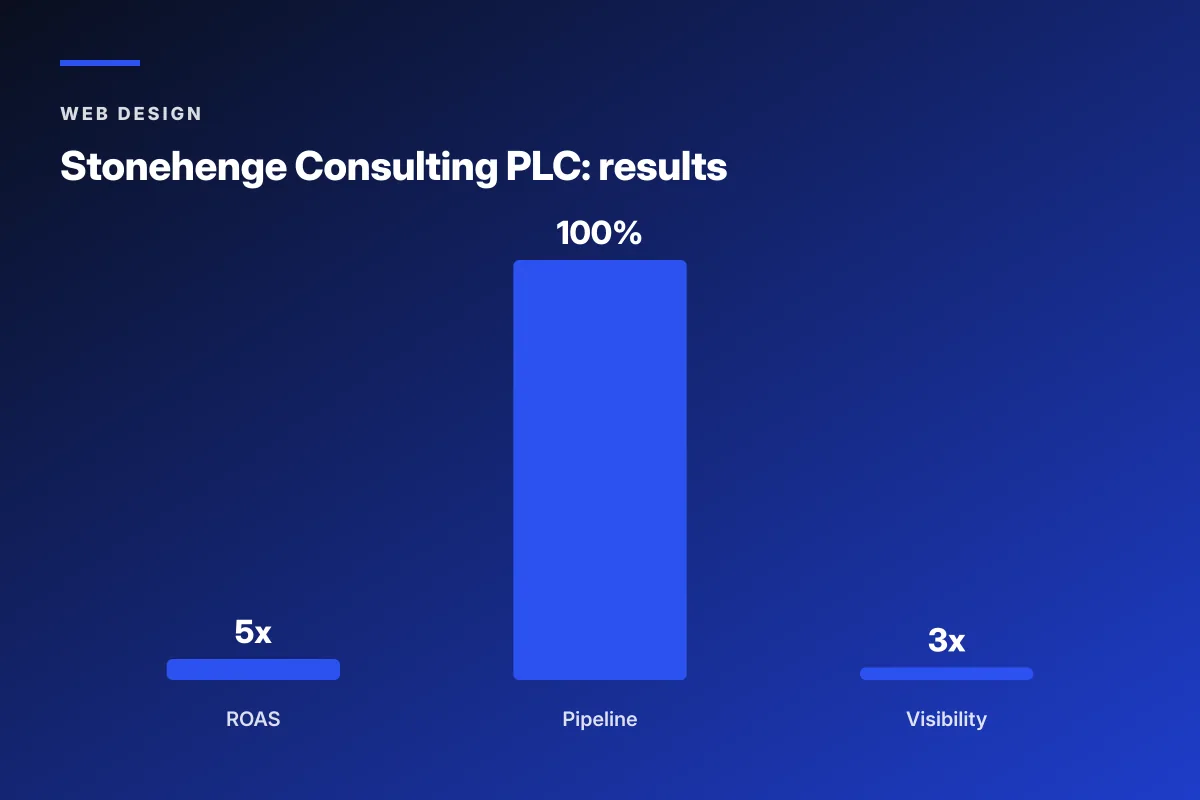
The owner replied inside 18 hours. First meeting booked for the following Tuesday. Second meeting on the Friday with a written scope covering site refresh, Google Ads setup, and local SEO. Contract signed the following week. Twelve months later, Stonehenge earned five times return on investment from Google Ads, a fully predictable monthly pipeline, and triple the local visibility they had at baseline. That entire arc, from first cold email to signed contract, took nine days. Read more about our search engine optimization services that carried the ongoing SEO for this account.
What worked in the first email
The specific-issue opener called out three missing Google Business Profile service categories that Stonehenge’s direct competitors had filled in. The Loom video showed the competitors ranking above Stonehenge for the exact accountant-search queries a taxpayer in the region would run. The ask at the end was simple. Would you have 20 minutes next week to walk through what we would do if we owned the profile? The owner said yes because the ask was small, specific, and framed around a problem the video had already proven.
What worked in the follow-up close
The second meeting opened with a written scope covering three deliverables (site refresh, Google Ads campaign, local SEO). Each deliverable had a fixed price. The total was quoted as an all-in retainer. No hourly ranges. No optional upsells inside the primary quote. The owner asked two clarifying questions on payment terms and turnaround, then signed the retainer that afternoon. Clean scopes close faster than menu-style proposals every time. The small business web design services package that follows this pattern closes on the first call about 40 percent of the time.
Outreach tools that actually pull weight
Every freelancer running local outreach at some point buys $600 a month of tools that produce zero closes. The stack that actually works costs under $80 a month for the first year and grows only when revenue clears $10,000 a month. Spending money on tools before revenue exists is a substitute for doing the outreach. The habit shows up in every freelancer who quits in month six.
Use a shared Google Sheet as the CRM until the list crosses 200 active contacts. Use Loom free tier for the first 25 videos a month. Use Google Workspace for email at $6 a user per month. Use Cal.com for booking calls (free tier). Use Postmark or Fastmail for transactional email once monthly volume exceeds 200 messages. Use Ahrefs Site Audit at $99 a month once revenue clears $8,000 a month. Everything else is a distraction until the numbers say otherwise.
Tools to skip in year one
HubSpot at $50 to $600 a month for a solo operator. Salesforce Essentials at $25 a month per user (still overkill under 200 contacts). Any AI email personalization tool at $30 to $150 a month (the manual 12-minute prep per prospect outperforms every AI generator we have tested). Any prospecting-database tool over $60 a month (Apollo’s free tier gives 50 emails a month and covers the first six months of outreach). Every one of these tools sells the story that automation will fix your reply rate. The fix is a better opener and a better follow-up, not a bigger tool stack.
Tools to add in year two
Once revenue clears $10,000 a month sustainably, add an actual CRM (Pipedrive at $24 or HubSpot Starter at $50). Add a proposal tool (Better Proposals or Pandadoc at $50 a month). Add a scheduling platform tied to a real calendar (Cal.com Pro at $12 a month or Reclaim.ai). Add a proper accounting tool (QuickBooks or Xero at $25 a month). Every one of these earns its keep once the operator is closing four or more projects a month. Adding them before that revenue exists is putting the tool cart in front of the outreach horse.
The follow-up rules that turn cold into closed
Follow-up is where 60 percent of freelancer revenue lives, and 60 percent of freelancers never follow up past touch two. That gap is the entire opportunity. Owners are busy. Owners get 14 pitches a week. Owners forget the good ones as fast as the bad ones. Follow-up carries the good pitch back to the top of the inbox on a schedule the owner can respect.
Every follow-up carries a purpose. Never send a follow-up that just says “circling back on my email from Monday.” That message signals you are anxious and it teaches the owner to feel guilty rather than curious. Every follow-up either adds a fresh piece of proof, asks a specific question the owner can answer in one sentence, or offers a genuine off-ramp that closes the loop.
Somewhere in the average freelancer’s outreach quarter, one operator sends follow-up number four to a lead who never opened the original email, wonders why the reply rate is 0.4 percent, and then goes on Twitter to complain that cold outreach is dead. Cold outreach is not dead. Follow-up number four to a stone-cold contact is dead. There is a difference.
The four follow-up formats that work
The reminder-with-value format on day two. The case-study format on day five (attach a short PDF or link to a live client site with real numbers). The direct-question format on day nine (ask one specific yes-or-no question). The dignified close format on day fourteen (say you will not follow up again unless the owner reaches out, and mean it). Any freelancer running this four-format sequence with a good opener books meetings inside 14 days on 12 to 18 percent of first-touch prospects.
When to give up cleanly
Day fourteen with no reply is the stop line. Send the dignified close, thank them for their time, and offer to revisit in six months. Move the lead to the reserve list. Return in five to six months with a new opener referencing a new observation on their site. Freelancers who cannot walk away burn out inside a year. Freelancers who walk away cleanly on day fourteen and revisit on the calendar close a meaningful percentage of those six-month returns because the market has moved and the owner’s site has aged more.
Running the first meeting like a strategist not a vendor
Once the outreach converts into a meeting, most freelancers fumble the meeting itself. They open with a company slide. They walk through a portfolio. They talk for 20 of the 30 minutes and ask two questions. Reply rate on second-meeting requests after that pattern lands at 25 percent. Reply rate after a meeting where the freelancer asks 12 questions and speaks for 8 minutes lands at 70 to 80 percent. The math on how you run the first meeting is louder than any part of the outreach itself.
Structure the first meeting as three chapters. Chapter one, five minutes, confirm the problem you named in the outreach. Chapter two, 15 minutes, ask about the owner’s current customer flow, revenue mix, seasonal patterns, and single biggest bottleneck. Chapter three, 10 minutes, present a rough scope and price range and ask whether it is close to what the owner expected. That structure closes the second meeting on 70 percent of first meetings without a single portfolio slide.
The 12 questions worth asking in chapter two
What percent of your customers come from referrals today. What percent from Google search. What percent from paid ads. What is your average customer value. What is your gross margin per customer. What is your busiest month. What is your slowest month. What is the one operational bottleneck that stops you from taking more customers. What does the ideal customer look like. Where do the wrong customers come from. What would double the business look like inside 18 months. What has stopped you from doing this refresh already.
The scope preview in chapter three
Do not present a full proposal on the first meeting. Present a rough scope in three bullets and a price range in one number. Site refresh with a booking flow, on-page SEO, and hosting for year one runs about $4,500 all-in. That single sentence tests whether the owner is in your budget range. If the owner nods, book a second meeting for the written scope. If the owner blanches, ask what number they had in mind and adjust the scope down. Testing budget in the first meeting saves you two weeks on every mismatched lead.
Outreach strategies to local small businesses for web design services beyond year one
Once the base outreach process is running and closing two to four projects a month, the operator hits the next wall. Adding volume without a system breaks quality. Adding a second person without a documented playbook breaks culture. Freelancers who cross $150,000 in annual revenue and want to double from there need a repeatable strategies to outreach local small businesses for web design services playbook their part-time helper can execute without daily supervision.
The playbook has three parts. A documented target-list build process. A written outreach cadence with templated openers and follow-ups. A weekly review meeting that reads reply-rate metrics and adjusts. Every part fits on a single Notion page. Every part is executable by a virtual assistant at $15 to $25 an hour after two hours of training. The playbook that scales small business web design outreach is the same playbook a solo freelancer runs, written down.
Hiring the first outreach helper
Hire a part-time helper at 10 to 15 hours a week for list build and follow-up-only work. Never let the first helper draft the opener email or run the first meeting. Keep the highest-return steps (the opener writing, the first meeting) on your own calendar for the first two years. Delegate the middle steps (list build, follow-up sends inside a documented template, meeting scheduling). Every freelancer who reverses this pattern (delegating the opener, doing the list build themselves) stalls at $180,000 for three years.
The weekly outreach review that catches drift
Every Friday, spend 30 minutes reviewing the outreach sheet. Count first-touch sends, replies, meetings booked, meetings held, proposals sent, and closes. Note reply rate by opener version. Note meeting-to-close ratio by vertical. Any metric drifting more than 20 percent from baseline gets diagnosed and adjusted the following week. Research on freelancer income patterns from Nielsen Norman Group’s 2025 small business agency study found that operators who reviewed weekly metrics closed 42 percent more work than those who did not. The sheet does the work. The freelancer reads the sheet.
Closing thoughts on how to approach local small businesses for web design work
Learning how to approach local small businesses for web design services is a two-year education. Year one teaches you what does not work by burning through 400 cold emails and 60 in-person visits. Year two teaches you the pattern that works because you compare year one’s numbers against the pattern you built. Every freelancer who quits in month nine quit before the pattern was visible. The freelancers who ran the process for 18 months with quiet discipline end that period with steady inbound and a booked calendar.
The opener matters when you approach local small businesses for web design work. The cadence matters. The pricing model matters. But the discipline of running the process week after week matters more than any of those tactics. If you want a partner who has run this exact playbook across dental, home services, retail, and professional services for the last four years, the Redefine Web team is ready to talk. Start with the responsive web design services page for our published packages, or read the guide to how to choose web design services for small business for the buyer’s side of this same conversation. The outreach playbook works. The math checks out. The next step is running it week one, then week two, then week 52.
Frequently asked questions
How do freelancers approach local small businesses for web design work?
Most freelancers who win consistently use a three-channel outreach mix. They walk in the door of five local businesses a week and hand a printed one-page audit to the owner. They send 20 warm-intro emails a week through Chamber of Commerce contacts and mutual LinkedIn connections. They follow up on every conversation twice inside the first two weeks. The freelancers who quit inside six months usually pick a single channel, send 200 generic emails, get no replies, and blame the channel. Consistency across three channels for 90 days beats volume on one channel every time.
What is the best opening line for cold outreach to a local small business?
Skip the introduction. Open with a specific observation about their current site or Google Business Profile. Example that works. Your Yelp page shows 41 reviews at 4.7 stars but your website Contact form is not working on mobile Safari today. I tested it because my aunt has been looking for a florist in your zip code and could not book. That opening does three things. It proves you looked. It names a real problem the owner can verify. It gives them a reason to reply that has nothing to do with buying anything. Reply rates on this pattern land at 18 to 24 percent versus 1 to 3 percent for generic pitches.
What pricing models work best for freelance web design services for small businesses?
Fixed-fee packages outperform hourly billing on close rate for small business work. A typical set of three packages runs $2,500 for a five-page starter site, $4,500 for an eight-page site with copy, and $7,500 for a twelve-page site with copy and a booking flow. Every package includes hosting for the first year, one round of revisions, and a launch checklist. Owners choose faster because the number is fixed. Freelancers still average $85 to $140 an hour effective rate at these prices because the scope is tight. Hourly billing works only for retainer maintenance work at $85 to $150 an hour billed monthly.
How many follow-ups should I send before giving up on a lead?
Send three follow-ups on a specific cadence and then stop. Day two after the first outreach with a soft reminder and a link to a two-minute Loom video showing one specific issue on their site. Day five with a question about their current site performance. Day fourteen with a case study of a similar business. Beyond fourteen days without a response, the lead is not the right fit today. Move on and try again in six months. Ninety percent of freelancers quit after one follow-up and lose 60 percent of the deals that would have closed on the second or third touch.
Should I use email, LinkedIn, or in-person visits for local outreach?
Use all three, weighted by the type of business. Restaurants and retail respond fastest to in-person walk-ins because the owner is already on site. Professional services (accountants, lawyers, dentists) respond fastest to email with a specific website audit attached. Trades (plumbers, electricians, contractors) respond fastest to a phone call or a text message during a weekday morning. LinkedIn works for the professional services segment as a warm-up before email. Trying to use one channel for every vertical is why most freelancers stall at 40 outreach contacts a month with a 2 percent reply rate.
How much can a freelance web designer realistically earn from local small business work?
A freelance web designer running a disciplined outreach process closes two to four small business projects per month at an average package price of $4,500. That produces $108,000 to $216,000 in annual revenue at 60 to 70 percent margins. Retainer maintenance work on those same clients adds another $30,000 to $60,000 a year at 80 percent margins. Realistic first-year take is $80,000 to $110,000 net after taxes and tools. Freelancers who hit this range work outreach four hours a day, five days a week, for the first year. Those who work outreach two hours a week earn under $40,000 and usually quit inside 18 months.
What tools help me approach local small businesses at scale?
A short stack works better than a long one. Apollo or Hunter for finding owner email addresses. Google Business Profile for research on the target list. A shared Google Sheet as the CRM for under 200 contacts. Loom for personalized video audits inside the first outreach. Cal.com or Calendly for booking calls without email tag. Postmark for transactional email deliverability. Total monthly stack cost sits under $80. Anything more expensive is a distraction until revenue clears $10,000 a month. Freelancers who spend $600 a month on tools before earning $10,000 a month burn their runway on software instead of outreach.
Book your free 30-minute strategy call.
No spam, no sales rep. We use your email to schedule your call with a senior strategist. That is it.
More from the blog
View all articles → Web Design
 Core Web Vitals Healthcare Websites Actually Need to Book Patients
Read article Web Design
 Professional Services Website Design Best Practices for 2026
Read article Web Design